2027 MLIS Programs for Public Library Collection Development Assistants

Co-Founder and Chief Data Scientist
If you help select or purchase materials for a public library, an MLIS may open a path toward professional collection development - but it may not be necessary for your current job. The decision matters because advancement depends on the positions your library offers, while graduate study brings costs and scheduling demands.
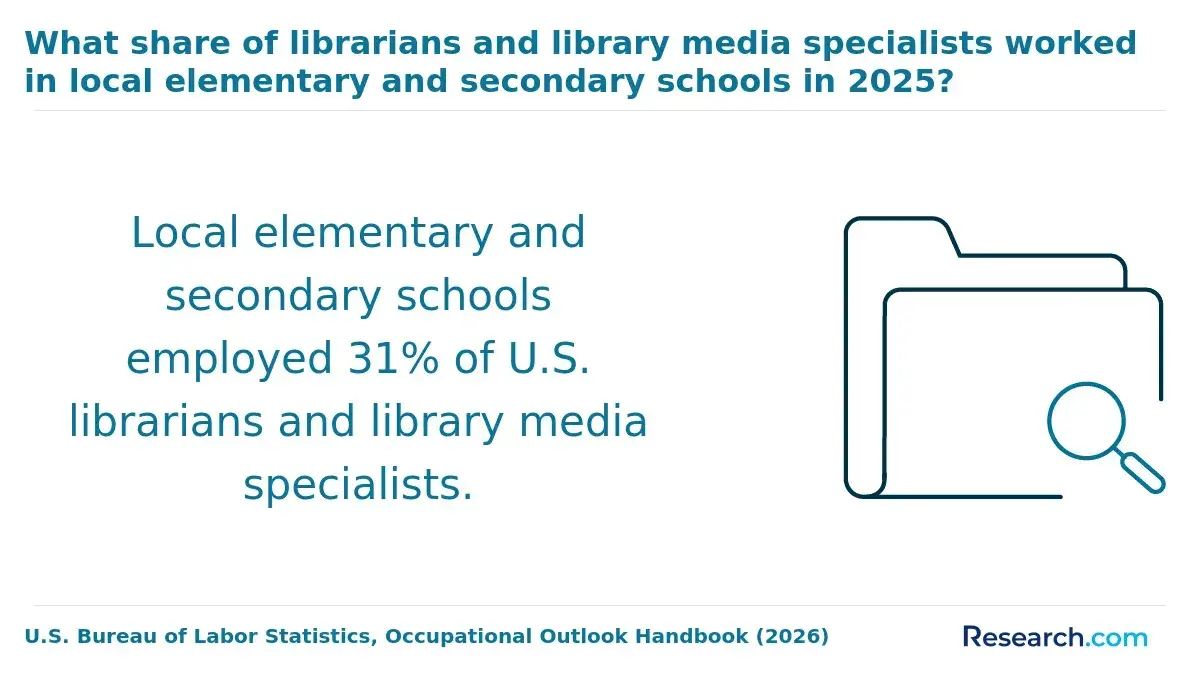
The U.S. Bureau of Labor Statistics projects 2.6% employment growth for librarians and media collections specialists from 2025 to 2035, so a degree is not a shortcut to a job. This guide helps you compare programs, build relevant experience, and decide whether enrollment fits your goals.
Key Things You Should Know
- Collection development assistant jobs are generally paraprofessional; check the specific posting before assuming an MLIS is required.
- For a future librarian role, favor an ALA-accredited master's program with collection development coursework and opportunities to practice selection, evaluation, and budgeting, not a program advertised as a specialization without evidence.
- Library technicians had a $44,580 median annual wage in May 2025, but that broad occupational figure is not a salary estimate for collection development assistants.
What does a collection development assistant do in a public library?
A collection development assistant supports decisions about what the library acquires, retains, replaces, and removes. The exact division of work depends on the library's size and staffing: an assistant might prepare purchase lists and reports, while a librarian or manager approves selections and spending.
Typical tasks include checking patron requests against the existing catalog, tracking orders and invoices, reviewing circulation data, identifying worn or outdated items for review, and helping maintain lists of titles in different languages or formats. This work combines attention to detail with an understanding of the community. High circulation alone does not determine a collection's value; staff must also consider accuracy, accessibility, local interests, and the library's collection policy.
Job titles vary. Similar duties may appear under acquisitions assistant, technical services assistant, or library technician. Read the responsibilities and decision-making authority in a posting rather than relying on its title.
Do public library collection development assistants need an MLIS degree?
Usually, the distinction is between an assistant position and a professional librarian position. Assistant roles may accept relevant library experience, an associate or bachelor's degree, or other qualifications specified by the employer. Collection development librarian jobs are more likely to request an ALA-accredited library and information science master's degree, although requirements vary.
An MLIS is most useful if you want to move into positions with responsibility for selection policy, collection budgets, supervision, or system-wide strategy. If you want to remain in a support role, ask your employer whether a degree would change your eligibility or pay before taking on its cost. Experience with purchasing workflows, the library catalog, spreadsheets, and patron requests may be a more direct first step.
MLIS, MLS, and other institution-specific library and information science degree names can describe professional master's pathways. The title alone does not establish a program's accreditation or its preparation for collection work.
Which MLIS programs prepare students for public library collection development?
Look for an ALA-accredited master's program that lets you combine public library study with collection development and applied work. A course related to selection is useful, but it is not evidence of a formally named concentration, and a catalog listing does not guarantee that the course will run when you need it.
The distinctions below help separate a promising curriculum from an unverified marketing claim.
| Program feature | Why it matters for collection work | What to confirm |
| ALA accreditation | May matter for eligibility for professional librarian jobs | The specific master's program's current status in the ALA directory |
| Public library and collection courses | Connects selection decisions to community needs and policy | Whether courses are required or elective, and when they are offered |
| Applied project or practicum | Can produce evidence of budgeting, analysis, or selection skills | Placement availability, supervision, and whether remote work is permitted |
| Scheduling and total cost | Determines whether study fits your job and budget | Course sequence, required credits, tuition, and fees |
A library science masters rankings comparison can help you assemble a shortlist. Then use each university's current catalog and schedule to verify the features that matter to you. If no program offers a named collection development track, a well-chosen elective pathway and a relevant project can still provide strong preparation.
Is an online or campus-based MLIS program better for library careers?
Neither format is inherently better for collection development. Choose based on whether you can access relevant courses, complete applied work, and maintain a workable schedule.
An online program may let an employed assistant keep gaining library experience; a campus program may make local placements and face-to-face networking easier. Both possibilities depend on the institution and your location.
Do not assume "online" means self-paced or entirely remote. Ask whether classes meet live, whether electives have prerequisites or limited offerings, and whether a practicum requires an approved site. Working adults comparing a part time library information science degree should also check how slower enrollment affects course sequencing and the final bill.
What coursework covers public library collection development?
The most relevant coursework addresses collection development or management, public library services, information organization, and evaluation of community needs.
Selection courses may examine review sources, purchasing policies, intellectual freedom, and decisions about withdrawing materials. Budgeting and management courses can help students understand how competing needs shape purchases.
Look for assignments that require more than a reading list. A useful portfolio project might analyze a branch's collection against local needs, propose purchases within a stated budget, and explain how the proposal follows library policy.
Use public data or obtain permission before working with internal circulation or patron information. Because e-books and other digital materials involve licensing and access conditions, check whether coursework addresses those decisions as well as print acquisitions.
What are the admission requirements for MLIS programs?
Applicants generally need a bachelor's degree and must meet each university's graduate admission requirements. Programs may request transcripts, a statement of purpose, recommendations, a résumé, or other materials; test and minimum-grade policies differ.
Prior library work can strengthen an application, but it does not automatically replace a required degree.
In your statement, connect your experience to a specific goal: for example, moving from order processing into community-informed selection. If you have completed graduate coursework elsewhere, ask about transfer eligibility before committing.
Policies for MLIS programs with transfer credits vary, and acceptance of a course for admission does not mean it will count toward the new degree.
How long do MLIS programs take and how much do they cost?
Completion time depends on required credits, enrollment pace, course availability, and any practicum or capstone. Full-time study is generally faster than part-time study, but an accelerated calendar is only useful if its workload fits your employment and the courses you need are available in sequence. Compare a published timeline for fast online masters for librarians with a schedule built around your intended electives.
No single tuition figure represents every MLIS program or student. To compare offers fairly, calculate tuition using the required credits and the rate that applies to you, then add mandatory fees, materials, and any travel or placement expenses. Confirm whether online students pay a different rate and whether taking additional terms changes fees.
Keep three amounts separate: the program's gross cost, what you expect to pay after confirmed employer support or aid, and what you would borrow. Compare those amounts with your current earnings and the qualifications on jobs you would realistically pursue. Do not count a possible promotion, scholarship, or loan approval as certain.
What accreditation and state licensing requirements apply to MLIS graduates?
For professional librarian positions, verify that the specific master's program appears in the current American Library Association accreditation directory.
A university's institutional accreditation is a separate matter; it does not make every graduate program ALA-accredited. Accreditation also does not verify a particular elective, internship, or online format.
Public library employment and credential rules can vary by state and by position. Some states or library systems have certification requirements for certain professional roles, so check the relevant state library authority and the job posting before enrolling.
School librarian certification is a different pathway governed by state education requirements; an online MLIS should not be assumed to qualify a graduate for school positions in every state.
What jobs and salaries can MLIS graduates pursue in public libraries?
An assistant who earns an MLIS may pursue collection development librarian, adult services librarian, youth services librarian, or branch leadership positions, depending on experience and employer requirements. The degree can expand eligibility for professional jobs, but it does not guarantee a move out of a paraprofessional role.
The U.S. Bureau of Labor Statistics reports the following May 2025 national medians for broad occupations. They provide context for comparing career paths, not a promised salary for an individual job or MLIS graduate:
| BLS occupation | Median annual salary, May 2025 | How to use the figure |
| Librarians and media collections specialists | $68,270 | Context for professional roles, including jobs beyond public libraries |
| Library technicians | $44,580 | Context for support roles, not a collection assistant pay scale |
The gap between these occupational medians is a reason to investigate advancement opportunities, not a forecast of your raise. For a broader view of library science jobs by specialization, compare job duties and required credentials alongside pay. Local postings and your employer's classification rules are more useful for estimating your own prospects.
What is the job outlook for public library collection development assistants?
There is no separate BLS projection for public library collection development assistants. The closest broad categories point in different directions: BLS projects 2025-2035 employment growth of 2.6% for librarians and media collections specialists and a 6.4% decline for library technicians. Neither figure isolates public libraries or collection work, so neither predicts openings in your area.
For a practical outlook, review recent postings from nearby systems. Note how often collection duties appear in assistant versus librarian jobs, which positions require an accredited master's, and whether openings are full-time.
If professional vacancies are scarce locally, consider whether you could relocate, compete for broader public services roles, or gain collection experience before enrolling. That evidence is more useful than treating a national projection as a personal employment guarantee.
Other Things You Should Know About Library Science
No. Libraries generally assess donations against their collection policies, considering factors such as condition, relevance, and available space. Ask your library about its policy before promising a donor that an item will be shelved.
It is a formal request to review a library item under the library's established policy. Staff should follow that process rather than remove or retain an item solely because of an informal complaint.
Requests can reveal unmet interests, but they are considered alongside the collection policy, budget, existing holdings, and expected demand. A request does not automatically result in a purchase.
Vendors may supply materials, ordering tools, catalog records, or processing services. Library staff remain responsible for checking that purchases and contract terms serve their community and budget.
References
- Types of Financial Aid: Grants, Work-Study, and Loans | studentaid.gov https://studentaid.gov/understand-aid/types
- Collection Development Plan | Escondido, CA https://escondido.gov/800/Collection-Development-Plan
- Public Librarian Certification Commission | Library of NC https://library.nc.gov/services-libraries/resources-library-staff/public-librarian-certification-commission
- Program: Library and Information Science, MLIS - Pitt Catalog https://catalog.upp.pitt.edu/preview_program.php
- Master of Arts in Library & Information Science | University of Arizona College of Information Science https://infosci.arizona.edu/ma-library-information-science
- Apply for MLIS Admission | Library and Information Science at Mizzou https://online.missouri.edu/degrees-programs/mu/education/library-and-information-science/mlis/admissions
- Collection Development and Management | University of West Florida https://uwf.edu/library/office-of-the-dean/collection-development-and-management/
- Practicum - School of Information Science & Learning Technologies https://cehd.missouri.edu/information-science-learning-technologies/practicum/
- Program: Master of Library and Information Science, M.L.I.S. | usm.edu https://catalog.usm.edu/preview_program.php
- Collection Development Policy - COD Library https://library.cod.edu/policies/collections