2027 Certificate vs Degree for Career Growth

Co-Founder and Chief Data Scientist
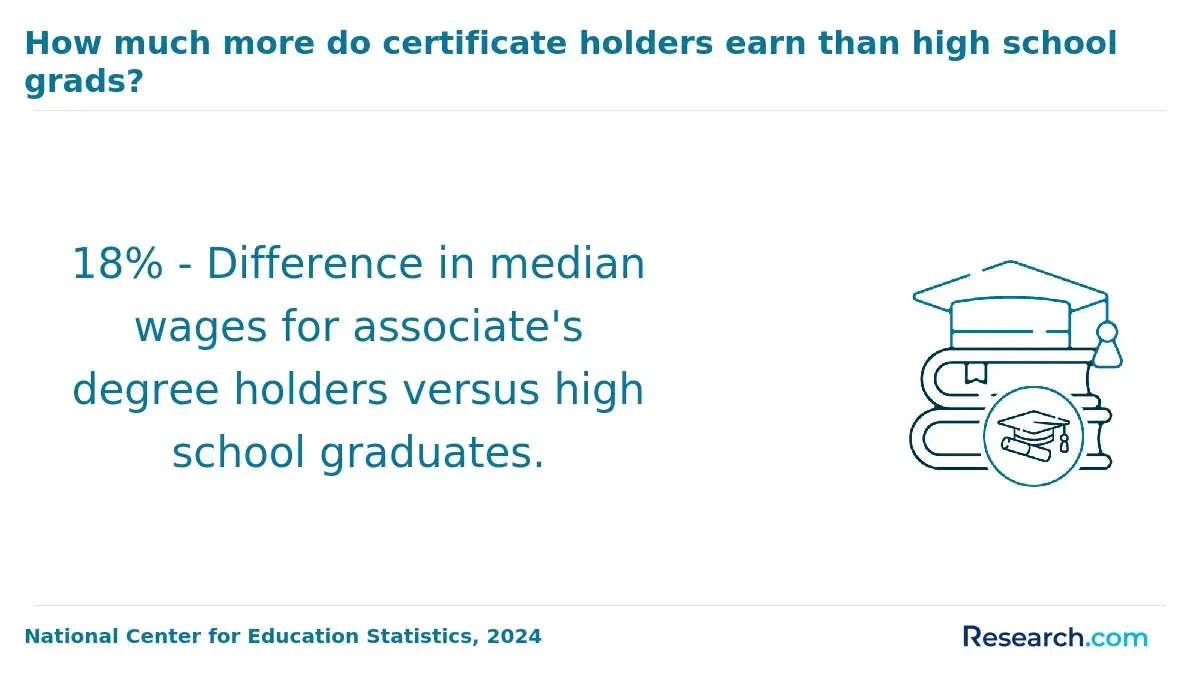
Choosing between a certificate and a degree is really a decision about time, cost, career access, and risk. The stakes are high. BLS data published in 2024 shows workers with a bachelor's degree had median weekly earnings of $1,543, while associate degree holders had $1,099.
This guide is for students, career changers, working adults, military learners, and parents comparing education options. You will learn when a certificate is enough, when a degree is required, what each path costs, and how to choose a reputable program.
Key Things You Should Know
- A certificate is usually best for fast, skills-based career movement, while a degree is stronger for licensed professions, management tracks, graduate study, and roles where employers screen for a college credential.
- College Board's 2024-25 figures list average published tuition and fees at $4,050 for public two-year colleges, $11,610 for in-state public four-year colleges, and $43,350 for private nonprofit four-year colleges.
- Salary comparisons should be tied to occupations, not credentials alone. BLS 2024 education data shows median weekly earnings of $1,543 for bachelor's degree holders and $1,099 for associate degree holders, but certificate outcomes vary widely by field.
What is the difference between a certificate and a degree?
A certificate is a focused credential that usually teaches a specific job skill, tool, process, or technical specialty. A degree is a broader academic credential, such as an associate, bachelor's, master's, or doctoral degree, that combines major-specific study with general education, electives, and often more extensive assessment.
The simplest way to compare them is to ask whether your target job rewards a narrow skill upgrade or requires a recognized academic credential. The table below summarizes the main differences that affect career growth, cost, time, and flexibility.
| Factor | Certificate | Degree |
| Main purpose | Builds targeted skills for a specific role, tool, industry, or promotion need | Builds broader academic preparation for professional, managerial, technical, or graduate-level pathways |
| Typical length | A few weeks to about one year, depending on level and field | About two years for an associate degree, four years for a bachelor's degree, and one to three years for many master's programs |
| Admissions | Often open enrollment or basic prerequisites | Usually requires transcripts, placement requirements, prior credits, standardized or program-specific materials, or a completed prior degree |
| Best fit | Career changers, workers updating skills, entry-level technical learners, or professionals seeking a quick credential | Students targeting licensed professions, long-term advancement, graduate school, or careers where employers require a degree |
| Limitations | May not transfer into a degree or satisfy employer degree requirements | Costs more, takes longer, and may include courses not directly tied to one job skill |
A certificate can be academic, professional, or industry-based. For example, a college certificate in medical coding is different from a vendor certification in cloud computing, and both differ from a state license. A degree, by contrast, usually signals completion of a structured academic program at an accredited college or university.
Which careers require a degree instead of a certificate?
A degree is usually necessary when the career is regulated by state licensing boards, requires graduate admission later, involves independent professional judgment, or uses degree completion as a hiring screen. A certificate can support these paths, but it rarely replaces the degree when the employer, licensing board, or profession requires one.
The table below shows common careers where a degree is typically the safer or required path. Requirements vary by state and employer, so readers should always verify rules before enrolling.
| Career area | Typical degree expectation | Why a certificate is usually not enough |
| Registered nursing | Associate degree in nursing or bachelor's degree in nursing, plus licensure | Licensure requires completion of an approved nursing program and passing the required exam |
| Teaching in public schools | Bachelor's degree and state-approved educator preparation | Public school licensure usually requires a degree, supervised preparation, exams, and state approval |
| Accounting and CPA pathways | Bachelor's degree at minimum; additional credits commonly required for CPA eligibility | CPA rules are state-specific and typically require substantial college coursework |
| Engineering licensure | ABET-accredited engineering degree for many professional engineer pathways | Licensure often depends on accredited education, exams, and supervised experience |
| Clinical counseling, social work, or therapy | Master's degree and supervised clinical experience | Independent practice is governed by state licensing boards |
| Law, medicine, pharmacy, and dentistry | Professional or doctoral degree | These fields have strict accreditation, exam, and licensure requirements |
Degrees also matter in less regulated fields when advancement depends on leadership, research, analytics, or cross-functional decision-making. For example, a project management certificate may help someone move into coordination work, but a bachelor's or master's degree may carry more weight for director-level roles in large organizations.
When is a certificate better than a degree for career growth?
A certificate can be the better choice when the career goal is specific, the skill gap is clear, and the employer does not require a degree. It is especially useful when you need evidence of current skills faster than a degree can provide.
Consider a certificate first if one of these situations matches your goal:
- You already have a degree and need a specialized skill, such as data analytics, cybersecurity fundamentals, medical billing, human resources, bookkeeping, or project management.
- You want to test a new field before committing to a longer and more expensive degree.
- Your target job values hands-on competency, a portfolio, a license, or a vendor credential more than a general academic credential.
- You need a short pathway into entry-level work while planning to stack credits into a degree later.
- Your employer offers tuition assistance for a targeted credential tied to promotion, compliance, or internal mobility.
Certificates are also responsive to labor market change. As AI and automation reshape office, technical, and creative work, short programs can help workers update skills in tools, workflow automation, data interpretation, cybersecurity awareness, or industry software without stepping away from work for years.
The main risk is choosing a certificate that sounds marketable but is not recognized by employers. Before enrolling, check job postings, ask employers directly, and confirm whether the certificate is credit-bearing, industry-recognized, or simply a completion badge.
How do online and campus programs compare for certificates and degrees?
Online and campus programs can both be strong options if they are properly accredited and aligned with your career goal. The better format depends on whether you need schedule flexibility, hands-on facilities, in-person networking, supervised clinical work, or a structured campus environment.
The table below compares the practical trade-offs. Use it to decide whether delivery format supports your learning style and career requirements.
| Factor | Online programs | Campus programs |
| Flexibility | Often better for working adults, parents, rural students, and military learners | Often better for students who need fixed schedules and in-person accountability |
| Hands-on learning | Strong for business, technology, education, healthcare administration, and many liberal arts fields; may require local placements | Often stronger for labs, studios, trades, clinical simulation, and programs with specialized equipment |
| Networking | Can include virtual cohorts, discussion boards, remote career events, and alumni platforms | Often easier for face-to-face advising, campus recruiting, clubs, and informal networking |
| Licensure fit | Must be checked carefully for state authorization, clinical placement rules, and board approval | May be simpler if the school is located in the state where you plan to work |
| Cost drivers | May reduce commuting and relocation costs, but technology fees and out-of-state tuition can still apply | May include housing, transportation, parking, and campus fees |
For learners comparing flexible study formats, guides to online degrees can help identify programs that fit work schedules while still requiring serious academic effort. "Online" should never be confused with "automatic" or "easy"; reputable programs still require assignments, exams, projects, and regular faculty interaction.
What accreditation should you check before enrolling in a program?
Accreditation is one of the most important checks before choosing either a certificate or a degree. It affects transfer credits, financial aid eligibility, employer recognition, graduate admission, and licensure approval.
Use the following checks before you apply or pay a deposit:
- Confirm institutional accreditation by a recognized accreditor listed by the U.S. Department of Education or the Council for Higher Education Accreditation.
- Check programmatic accreditation when the field requires it, such as nursing, counseling, teaching, engineering, business, public health, or allied health.
- Ask whether the program meets licensure requirements in the state where you plan to work, not only the state where the school is located.
- Verify transfer-credit policies in writing if you may later turn a certificate into an associate or bachelor's degree.
- Review whether employers in your target industry recognize the credential by comparing job postings and asking hiring managers or professional associations.
Military-connected learners should also check credit for military training, tuition assistance rules, Yellow Ribbon participation, and support services. A resource on online colleges for military can be useful when comparing schools that understand deployment, transfer, and benefit-related needs.
A major red flag is a school that uses pressure tactics, avoids direct accreditation questions, promises guaranteed employment, or claims that licensure is "automatic." Reputable schools explain limitations clearly and put requirements in writing.
How long do certificate and degree programs usually take?
Program length depends on credential level, enrollment status, transfer credits, prerequisites, and whether the program includes clinical, internship, practicum, or lab requirements. Faster is not always better if acceleration reduces support, weakens preparation, or creates scheduling problems.
The table below gives typical U.S. timelines. Treat these as planning ranges because actual completion time varies by school and student schedule.
| Credential | Typical full-time timeline | Common part-time timeline | Best for |
| Short noncredit certificate | Several weeks to a few months | A few months to one year | Skill refreshers, compliance training, software tools, career exploration |
| College certificate | One semester to one year | One to two years | Entry-level technical roles or stackable college credit |
| Associate degree | About two years | Three or more years | Career entry, transfer to bachelor's programs, applied technical fields |
| Bachelor's degree | About four years | Five or more years | Professional roles, advancement, graduate school preparation |
| Master's degree | One to two years | Two to four years | Career advancement, specialization, leadership, licensure in some fields |
Some graduate programs are designed for faster completion, especially for students with the right prerequisites and a manageable work schedule. If speed is a priority, comparing 1-year online masters options can help you understand where acceleration is realistic and where it may create workload trade-offs.
The best timeline is the one you can finish. A slower part-time degree that you complete is usually more valuable than an accelerated program you leave unfinished with debt and no credential.
What do certificate and degree programs cost in the U.S.?
Costs vary widely by school type, residency, program level, fees, books, equipment, transportation, housing, and lost work time. For degrees, College Board's 2024-25 published tuition and fee averages provide a useful baseline for comparing options.
- Public two-year in-district college: $4,050 for published tuition and fees.
- Public four-year in-state college: $11,610 for published tuition and fees.
- Public four-year out-of-state college: $30,780 for published tuition and fees.
- Private nonprofit four-year college: $43,350 for published tuition and fees.
Certificates are harder to compare nationally because many are priced by credit, clock hour, module, or continuing education unit. A short noncredit certificate may be relatively inexpensive, while a healthcare, aviation, cybersecurity, or technical program with labs and exams can cost much more.
The table below explains the cost factors that often matter more than sticker tuition when comparing certificate and degree ROI.
| Cost factor | Why it matters | Question to ask |
| Fees | Technology, lab, clinical, graduation, exam, and student service fees can change the total price | What is the full program cost, not just tuition? |
| Transfer credits | Accepted credits can shorten a degree and reduce total cost | How many prior credits will count toward graduation? |
| Financial aid | Federal aid usually depends on school accreditation and program eligibility | Is this specific certificate or degree eligible for federal aid? |
| Employer support | Tuition assistance can improve ROI if the program matches your role | Will my employer reimburse this credential? |
| Opportunity cost | Time in school may reduce work hours or delay earnings | Can I keep working while enrolled? |
Graduate students should pay special attention to debt because master's pricing varies substantially by institution and format. Comparing affordable master's degrees online can help identify lower-cost options, but you should still check accreditation, outcomes, fees, and whether the program fits your career target.
What jobs can you get with a certificate or degree?
Certificates tend to support job entry or advancement in roles where specific skills can be demonstrated quickly. Degrees tend to open broader professional pathways, especially where the work involves licensure, analysis, leadership, research, communication, or complex decision-making.
The table below shows examples of jobs where a certificate, degree, or combination may fit. It is not a promise of eligibility because employers and states set their own requirements.
| Career path | Credential that may fit | Typical work focus |
| Medical billing and coding | Certificate or associate degree | Code patient records, process claims, verify documentation, use health information systems |
| Information technology support | Certificate, associate degree, or bachelor's degree | Troubleshoot systems, support users, manage tickets, maintain hardware and software |
| Cybersecurity analyst | Certificate plus experience, or bachelor's degree | Monitor threats, investigate alerts, secure networks, document incidents |
| Paralegal | Certificate, associate degree, or bachelor's degree depending on employer | Prepare legal documents, organize case files, conduct research, support attorneys |
| Registered nurse | Approved nursing degree plus licensure | Assess patients, administer care, educate patients, coordinate with healthcare teams |
| Accountant | Bachelor's degree commonly expected | Prepare financial records, analyze reports, support audits, manage compliance |
| Teacher | Bachelor's degree plus state-approved preparation for public schools | Plan lessons, assess students, manage classrooms, meet state curriculum standards |
| Manager or director | Bachelor's or master's degree often preferred | Lead teams, plan budgets, set strategy, manage performance and operations |
AI is changing the skill mix in many of these jobs. Workers who can use automation tools, validate data, communicate clearly, protect privacy, and solve problems across systems may be more competitive than workers who only hold a credential without practical skills.
How do salaries differ for certificate and degree holders?
Salary differences depend on occupation, region, experience, employer, union coverage, licensure, and industry demand. A degree often improves access to higher-paying roles, but a targeted certificate in a high-demand technical field can outperform a poorly matched degree in the short term.
BLS data published in 2024 shows a clear earnings pattern by education level. Use these figures as a broad labor-market signal, not as a prediction for any individual graduate.
| Education level | Median weekly earnings | How to interpret it |
| High school diploma | $930 | Useful baseline for comparing whether a certificate or degree is likely to improve access to better roles |
| Associate degree | $1,099 | Often tied to applied career programs, technical roles, and transfer pathways |
| Bachelor's degree | $1,543 | Often required or preferred for professional, analytical, supervisory, and graduate-school pathways |
| Master's degree | $1,840 | Often most valuable when linked to advancement, licensure, specialization, or leadership |
The limitation is that certificates are not measured cleanly in this education table. Many certificate holders are counted under their highest completed education level, so the better comparison is occupation-specific: look at roles you want, their median wages, and their actual credential requirements.
A practical ROI test is to compare total program cost with realistic entry-level wages in your local market. Avoid assuming that a credential will automatically move you into the median salary range; experience, portfolio quality, internships, networking, and local hiring conditions matter.
How do you choose a reputable certificate or degree program?
The best program is not always the fastest, cheapest, most famous, or highest-ranked. It is the one that is accredited, affordable for your situation, aligned with your target job, realistic to complete, and transparent about outcomes.
Before enrolling, follow this decision process:
- Start with the job, not the school; collect five to ten job postings and note required credentials, skills, software, licenses, and experience.
- Confirm accreditation and, if relevant, programmatic approval for licensure or certification exams.
- Ask for the full cost of attendance, including fees, books, supplies, exams, travel, clinical costs, and graduation charges.
- Check transfer-credit rules if you might continue from a certificate to a degree or from an associate degree to a bachelor's degree.
- Review completion support, tutoring, career services, internship help, faculty access, and job-placement transparency.
- Compare scheduling options honestly against your work, family, and commute obligations.
- Speak with recent students or alumni if possible, especially in your intended major or certificate area.
Some learners should also compare competency-based programs, which may work well for experienced adults who can move quickly through material they already know. The trade-off is that these programs require strong self-direction and may not fit students who need frequent live instruction.
Common mistakes include choosing a program without verifying accreditation, focusing only on tuition, assuming online programs automatically meet licensure rules, ignoring transfer policies, and believing guaranteed salary claims. A reputable school will give clear answers, disclose limitations, and encourage you to compare options before committing.
Other Things You Should Know About Career Planning
Yes, a certificate can be worth it if it adds a marketable skill your degree did not cover, such as analytics, cybersecurity, project management, medical coding, or a specific software platform. It is less useful if employers in your target field do not recognize it.
Sometimes. Credit-bearing college certificates may stack into an associate or bachelor's degree, but noncredit certificates often do not transfer. Ask the school for a written transfer or stackability policy before enrolling.
Employers prefer the credential that matches the job. Technical roles may value certificates, portfolios, and experience, while licensed professions and many management roles often require or prefer degrees.
Not automatically. Low cost helps ROI, but only if the program is accredited, recognized, completable, and aligned with your career goal. Compare total cost, transfer credits, support services, outcomes, and employer recognition.
References
- 15 Jobs That Only Require a Certificate (and Pay Well!) | The Muse https://www.themuse.com/advice/jobs-that-only-require-a-certificate
- Navigating Your Options: How to Choose the Right Business Certificate Program https://exploreblog.ashland.edu/navigating-your-options-how-to-choose-the-right-business-certificate-program
- How to Verify a US Partner School's Accreditation Before Committing https://www.amerigoeducation.com/news/how-to-verify-a-us-partner-schools-accreditation-before-committing
- Certificate vs. degree programs: What's the difference? | edX https://www.edx.org/resources/what-is-the-difference-between-a-certificate-and-a-degree
- Accreditation: The Basics https://www.learnhowtobecome.org/accreditation/
- How Long Does It Take To Earn a Master’s Degree? | ACE Blog https://ace.edu/blog/how-long-does-it-take-to-earn-a-masters-degree/
- How to Check if a Graduate Program is Accredited (and Why This Matters) | ProFellow https://www.profellow.com/tips/how-to-check-if-a-graduate-program-is-accredited-and-why-this-matters/