A marriage and family counseling degree is a significant investment, but a program's popularity does not tell you whether it fits your state's licensing rules, your budget, or your career goal. This guide explains those trade-offs for prospective students and career changers across the West. It accompanies the 2027 Most Popular Marriage, Couple, And Family Counseling Degree Programs Ranking in the West, created by the Research.com team of data scientists to help students make an informed choice about programs worth considering. You'll learn how to compare training, cost, delivery, and career prospects before applying.
Key findings about Marriage, Couple, and Family Counseling degrees in West
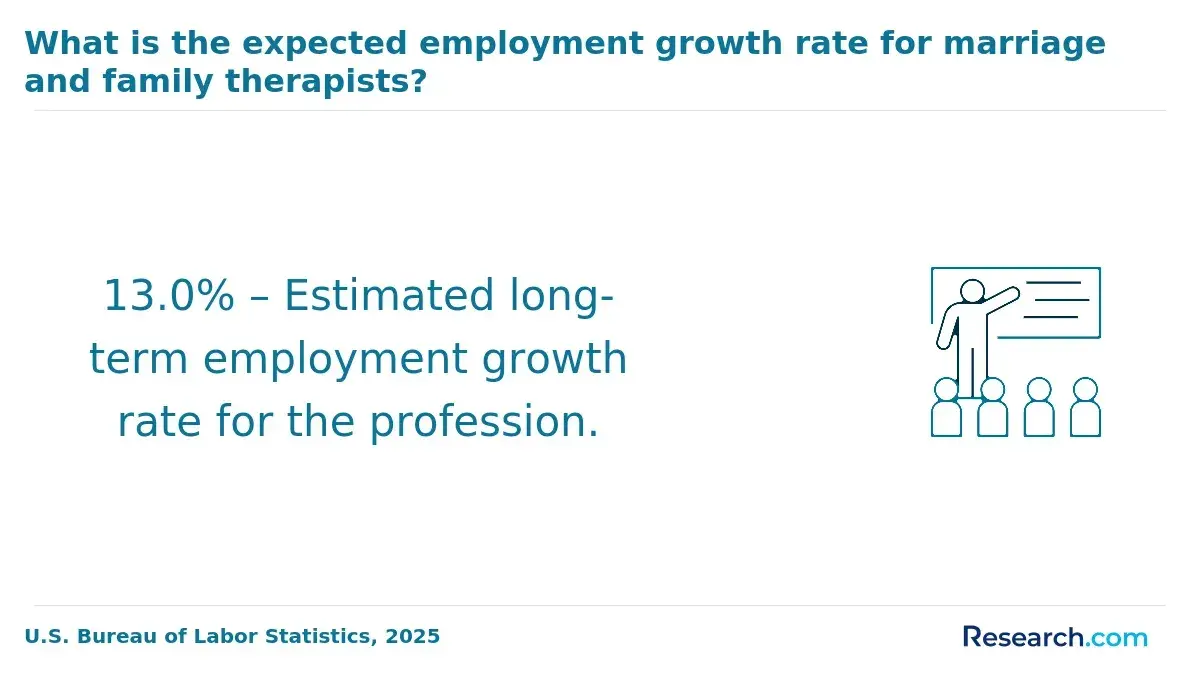
The U.S. Bureau of Labor Statistics reports a May 2025 national median wage of $66,940 for marriage and family therapists and projects 14% employment growth from 2025 to 2035; neither figure predicts an individual graduate's outcome.
A licensure-oriented master's degree is usually the relevant path to independent marriage and family therapy practice, but education, supervised experience, and examination rules differ across Western states.
Compare a program's total price and clinical-placement arrangements - not popularity alone. A lower tuition rate can lose its advantage if required fieldwork delays paid employment or requires substantial travel.
What can I expect from a Marriage, Couple, and Family Counseling degree in West?
Marriage, couple, and family counseling focuses on relationships and the ways individual concerns interact with family systems. In a licensure-oriented master's program, expect counseling theory, assessment, ethics, supervised clinical practice, and training in working with couples and families. A degree is an educational credential; an independent practice license is a separate state authorization earned after meeting the relevant board's requirements.
The program title matters less than its documented fit with your intended license. A marriage and family therapy master's, a counseling master's with a marriage-and-family concentration, and a general counseling master's may lead toward different license pathways. The comparison below shows why students should verify the curriculum rather than assume similarly named degrees are interchangeable.
Program type
Likely fit
Essential check
Marriage and family therapy-focused master's
Students primarily seeking marriage and family therapist licensure
Whether its courses and clinical training satisfy the intended state board
Counseling master's with a marriage-and-family concentration
Students seeking relational training within a broader counseling degree
Which specific counseling or therapy license pathways the program supports
Post-master's certificate or added coursework
Existing graduate-degree holders addressing a defined training gap
Whether the board accepts those courses alongside the original degree
A certificate is generally not a replacement for a qualifying master's degree. Before choosing any route, ask the program and the licensing board to identify the applicable degree, coursework, and supervised-training requirements in writing.
Where can I work with a Marriage, Couple, and Family Counseling degree in West?
Marriage and family therapists work in settings that include outpatient mental health services, individual and family services, and private practice, according to the U.S. Bureau of Labor Statistics. Community agencies may offer an entry point for graduates accumulating supervised experience; independent private practice generally requires the appropriate state license.
Location changes the practical options. A student near a large Western metro area may have more potential clinical placements but also face longer commutes and higher living costs. Someone planning to serve a smaller community should ask whether the program can approve a local supervisor and placement. An online classroom does not eliminate the need for acceptable, locally available clinical training.
The U.S. Bureau of Labor Statistics reports a $66,940 national median annual wage in May 2025 for marriage and family therapists. That is an occupational midpoint, not a starting salary, a Western regional wage, or a promised return on a particular degree. Pay can differ by state, employer, experience, and whether a clinician is licensed or still working under supervision.
To assess whether a program is worth its price, compare its likely total borrowing with realistic pay for the job and location you intend to pursue. Include income forgone during study, any period of supervised post-degree work, and the cost of moving or commuting for placements. A higher-paying practice setting later in a career should not be used as the assumption for an entry-level repayment plan.
The programs below differ in degree structure, stated focus, institutional setting, and location. These are useful starting points for a shortlist, not findings that any program guarantees licensure or employment; confirm current curriculum and board eligibility directly before applying.
California State University, Sacramento: Sacramento State identifies a dedicated M.S. in Counseling option in marriage, couple, and family counseling. Its explicitly named counseling specialty may appeal to applicants who want relational training within a public-university counseling degree; California applicants should check the current catalog against the Board of Behavioral Sciences pathway they intend to pursue. Source: Sacramento State catalog.
San Francisco State University: Its M.S. in Counseling identifies marriage, family, and child counseling as a concentration. The explicit child component gives applicants interested in work across family life stages a curriculum focus to investigate, particularly when comparing concentration courses and placements with programs centered more narrowly on couples. Source: San Francisco State University bulletin.
George Fox University: George Fox presents marriage and family therapy as a dedicated master's program rather than only a concentration within a general counseling degree. That distinction may suit applicants committed to the marriage-and-family therapist route; Oregon-bound students should verify the program's current clinical and accreditation details against Oregon board rules. Source: George Fox University counseling programs.
Gonzaga University: Gonzaga offers an M.A. specifically titled Marriage and Family Counseling. For students considering Washington practice, the dedicated degree provides a clear starting point for comparing its course and fieldwork documentation with Washington's marriage and family therapist requirements. Source: Gonzaga University School of Education.
University of Nevada, Reno: Nevada, Reno presents the option through its M.A. in Counseling program information. Applicants who want to keep more than one counseling career goal in view should examine the exact available specialization and its approved license pathways rather than infer eligibility from the broad M.A. title. Source: University of Nevada, Reno program information.
Northwest Nazarene University: Its program is explicitly identified as counseling in marriage, couple, and family counseling. That named focus is worth comparing with broader counseling degrees for Idaho-bound applicants, who should confirm which curriculum and supervised experiences satisfy their intended Idaho license. Source: Northwest Nazarene University program information.
Idaho State University: Idaho State lists marriage and family training within its master's-level counseling programs. Its public-university setting makes it a useful comparison for Idaho applicants weighing resident tuition against other programs, but the decisive questions remain total program cost and the documented license pathway. Source: Idaho State University Department of Counseling.
These program descriptions identify differences applicants can investigate; they do not establish comparable placement rates, pass rates, or total prices. Readers who want to assess outcomes alongside other measures can also review Research.com's best marriage, couple, and family counseling programs.
A full-time, licensure-oriented master's commonly takes about two to three years; part-time study can take longer. The relevant timeline is not just classroom terms: required practicum and internship placements may follow a set sequence and depend on site and supervisor availability. Ask each school for its typical elapsed time to graduation for students studying at your intended pace.
Graduation is not the same as independent licensure. Western state boards set additional supervised-experience and examination requirements, so include the post-degree phase in your career and repayment timeline. An accelerated schedule is attractive only if you can complete its clinical hours without an unsustainable work or commuting load.
Online delivery can make graduate coursework accessible to working adults or students far from a campus. On-campus study may make scheduled skills practice and contact with local placement networks easier. Neither format is inherently more licensure-ready: what matters is the curriculum, supervised clinical experience, and the rules of the state where you plan to practice.
For an online program based in another state, ask whether it enrolls residents of your state, whether its coursework meets that state board's educational requirements, and who finds and approves local practicum sites. Also ask which activities require live attendance or campus visits. These answers can change the true cost and completion time more than the label "online" does.
There is no single defensible average price for a marriage, couple, and family counseling degree across the West: the region spans different public-residency rules, private institutions, program lengths, and fee structures. An institution's published graduate tuition is not necessarily the cost of this specific master's, and a per-credit quote leaves out clinical and living expenses. Use each school's current program-specific estimate instead of treating a regional figure as your likely bill.
Request the total required credits, tuition at your residency rate, mandatory fees, clinical-placement charges, books, travel, and the number of terms over which you will pay them. Public in-state tuition can be attractive, but confirm residency eligibility before comparing it with an out-of-state or private nonprofit offer. For a price-focused shortlist, consult the most affordable marriage, couple, and family counseling programs, then calculate your own net cost after aid.
Potential sources include institutional scholarships, assistantships, employer support, eligible state or workforce programs, and federal student loans. Availability depends on the student and program. Complete the FAFSA and ask each financial aid office which awards apply specifically to this master's and whether an assistantship reduces tuition, provides pay, or both. A public university's resident price and a private nonprofit program's aid offer should be compared as net costs, not by institution type alone.
Check loan eligibility under current rules. Federal Student Aid states that Graduate PLUS availability has changed for new graduate borrowers beginning July 1, 2026, with limited transition provisions for qualifying students who previously received a Direct Loan for the same program. Do not build a 2027 financing plan around Graduate PLUS unless your aid office confirms that you meet the transition conditions. Also ask how much federal borrowing remains available to you and what funding would cover any gap. Source: Federal Student Aid.
View the chart data as a table
Wage range - Marriage & Family Therapists (U.S., BLS May 2025) (Source: BLS)
Category
Value
10th percentile
44,650
Median
66,940
90th percentile
123,730
Applicants generally need a bachelor's degree, but schools set their own prerequisite-course, GPA, recommendation, statement, and interview requirements. A counseling-related undergraduate major is not necessarily required. Clinical placements may also involve background checks or site-specific conditions, which are distinct from admission requirements; verify both with the program.
If you already hold graduate coursework, request a written transfer-credit evaluation before committing. A school's acceptance of credits does not establish that a state licensing board will accept the resulting degree or course sequence. Career changers should compare prerequisite gaps and expected graduation dates alongside tuition.
Expect study of family systems, couples and family counseling approaches, human development, assessment, ethics, research, and supervised clinical practice. Programs may differ in how they address diagnosis, child and adolescent work, multicultural practice, or counseling individuals alongside couples and families. Course titles alone are not enough to establish licensing eligibility.
Request a curriculum map that identifies which courses and clinical experiences address your intended state board's requirements. This is especially important when comparing a dedicated marriage and family therapy degree with a marriage-and-family concentration inside a broader counseling master's. Sources: state licensing boards; program catalogs.
Programs may emphasize couples, children and families, broader clinical counseling, or particular approaches to relational care. Some award a dedicated marriage and family degree; others place that subject in a counseling concentration. Those structures are not interchangeable merely because their course topics overlap.
Choose a focus by working backward from the clients and license you hope to pursue. If your main goal is school counseling, addiction counseling, or another regulated specialty, compare its separate educational requirements before paying for a marriage-and-family route. A program can offer useful related coursework without qualifying you for every counseling license.
Start with the state where you expect to seek licensure, then compare programs that can document a suitable educational pathway. COAMFTE accreditation and CACREP accreditation describe different programmatic frameworks; do not assume one label automatically satisfies every state board or every intended license. Confirm current accreditation status with the accreditor and ask the board how it evaluates the specific degree. Sources: COAMFTE; CACREP; state licensing boards.
For a final shortlist, put these questions to each program and request answers relevant to your planned state of practice:
Which specific license pathway does this degree prepare students to pursue, and where is that documented?
Who secures and approves practicum and internship sites, including sites outside the campus state?
What is the total net cost at my study pace, and how much borrowing might I need?
What are the recent program-level completion and applicable exam outcomes, and what reporting periods do they cover?
How will prior graduate credits be evaluated, and could transferring them affect licensing eligibility?
A common mistake is to choose the most popular or cheapest listed program without checking its clinical placement and licensing fit. To evaluate value more fully, compare completion likelihood, aid, debt, time out of work, baseline earnings, plausible post-degree earnings, and how long you expect to work in the field; future earnings should be weighed against costs over time, not treated as immediate payback. Research.com's most valuable marriage, couple, and family counseling programs can help narrow the search, but your own costs and career plan determine whether the investment makes sense.
View the chart data as a table
Projected job growth 2025-2035 - Marriage & Family Therapists (U.S.) (Source: BLS)
Category
Value
Marriage & Family Therapists
14
All occupations
3
The central clinical path is supervised post-degree work followed, if requirements are met, by state licensure as a marriage and family therapist. Depending on the degree, role, and employer, graduates may also pursue related agency positions. Independent therapy practice, however, should not be assumed to follow automatically from graduation; boards separately assess education, supervision, examinations, and other application requirements. Sources: California Board of Behavioral Sciences; Oregon Board of Licensed Professional Counselors and Therapists; Washington State Department of Health.
Plan backward from the work you want to do. If you want to practice near family in one state, prioritize that board's rules over a program's broad claims about national flexibility. If you expect to move, ask prospective boards how they assess out-of-state education and supervised experience before choosing a program or placement.
View the chart data as a table
Graduates (2024-25) distribution across ranked programs (Source: Research.com)
Category
Value
0-4
1
5-9
0
10-14
2
15-19
2
20-24
0
25-29
1
30-34
1
The U.S. Bureau of Labor Statistics projects 14% national employment growth for marriage and family therapists from 2025 to 2035. This indicates growing demand in the occupation nationally, not a guaranteed opening in a particular Western city or for an unlicensed graduate. Source: U.S. Bureau of Labor Statistics, Employment Projections.
Local opportunity depends on employers, supervisors, and the population you want to serve. Compare openings in your intended community with the placements and post-graduation supervision available there. A program near a large job market may offer useful proximity, while a program that supports an approved placement in your home community may better serve a rural career plan.
2027 Most Popular Marriage, Couple, And Family Counseling Degree Programs Ranking in the West
Investing in graduate education is a consequential decision. Research.com's team uses multiple education data sources and checks the measures behind its counseling rankings to help readers compare programs more credibly than they could from promotional descriptions alone. The sources used to create the ranking include:
Research.com's counseling rankings consider graduate completion, employment or doctoral admission, applicable licensure exam pass rates, CACREP programmatic recognition, federal Title IV eligibility, and cost. Different rankings emphasize different dimensions: popularity should not be read as a measure of affordability, licensure readiness, or graduate earnings. For comparison, the Best ranking first scores completion at 40%, employment or doctoral admission at 20%, applicable exam pass rates at 20%, CACREP recognition at 16%, and Title IV eligibility at 4%; it renormalizes inapplicable criteria and then gives cost a smaller role of about 7% of the final score. The same approach applies to online and campus programs. Readers can examine the full approach on Research.com's methodology page and use the ranking as a shortlist - not a substitute for checking a program's current licensing fit and net price.
# 1 position
California State University-Sacramento
Master
MS in Counseling (Marriage, Couple, and Family Counseling)
Delivery mode: campus
45.40
/ 100
Final score
Program length
3 years (full-time)
Specialization
Marriage, Couple, and Family Counseling
Required credits
60 semester units
GPA range
3.00 - 4.00
Program completion rate
100% (2024-25)
Employment or doctoral admission
100% (2023-24)
Class size
24
Application process
direct
Prerequisites
Baccalaureate degree; good academic standing; GPA of at least 3.0 in last 60 semester units
Additional requirements
University application and program supplemental application, official transcripts, departmental application materials, in-person admission evaluation (Interview Day)
Accreditation
Accredited by the Council for Accreditation of Counseling and Related Educational Programs (CACREP), with institutional accreditation from the WASC Senior College and University Commission (WSCUC).
California State University-Sacramento earned a Research.com Student Interest Score of 45.4/100, supported by 25 graduates (2024-25) and 100% program completion rate. The program is CACREP-accredited, valid through 2029-03-31.
# 2 position
San Francisco State University
Master
Master of Science in Counseling: Concentration in Marriage, Family, and Child Counseling
Delivery mode: campus
41.00
/ 100
Final score
Program length
Minimum 2 years (2 academic years)
Specialization
Marriage, Couple, and Family Counseling
Required credits
60 semester units
GPA range
3.00 - 4.00
Employment or doctoral admission
88% (2022-23)
Application deadline
Fall: December 15
Application process
Cal State Apply
GRE
no
Prerequisites
Recommended: undergraduate courses in theories of personality/counseling, lifespan development, psychopathology, and introduction to counseling; minimum 3.0 GPA in last 60 units.
Additional requirements
Cal State Apply application with supplementary materials, letters of recommendation, personal statement, work/volunteer experience with diverse populations.
Accreditation
Accredited by the Council for Accreditation of Counseling and Related Educational Programs (CACREP), with institutional accreditation from the WASC Senior College and University Commission (WSCUC).
San Francisco State University earned a Research.com Student Interest Score of 41.0/100, with 18 graduates (2023-24) among the verified supporting factors. The program is CACREP-accredited, valid through 2027-10-31.
# 3 position
George Fox University
Master
M.A. in Marriage, Couple and Family Counseling
Delivery mode: hybrid
38.60
/ 100
Final score
Program length
3 Years Program length
Specialization
Marriage, Couple, and Family Counseling
Required credits
64 semester credits
GPA range
3.00 - 4.00
Program completion rate
71% (2023-24)
Employment or doctoral admission
100% (2024-25)
Licensure exam pass rate
100% (2024-25)
Application deadline
Fall 2027: Mar 1, 2027
Application process
direct
GRE
no
Prerequisites
Bachelor's degree from a regionally accredited institution with a cumulative undergraduate GPA of 3.0 or above; does not have to be in psychology.
Additional requirements
Completed online application, two recommendations (one academic, one professional), a short essay, and a professional resumé; group interview by invitation; standardized test results not required.
Accreditation
Accredited by the Council for Accreditation of Counseling and Related Educational Programs (CACREP), with institutional accreditation from the Northwest Commission on Colleges and Universities (NWCCU).
George Fox University earned a Research.com Student Interest Score of 38.6/100, supported by 15 graduates (2023-24) and 71% program completion rate. The program is CACREP-accredited, valid through 2029-10-31.
# 4 position
Gonzaga University
Master
M.A. Marriage and Family Counseling
Delivery mode: campus
35.70
/ 100
Final score
Program length
2 years
Specialization
Marriage, Couple, and Family Counseling
Application deadline
January 15, 2027
Application process
direct
GRE
optional
Accreditation
Accredited by the Council for Accreditation of Counseling and Related Educational Programs (CACREP), with institutional accreditation from the Northwest Commission on Colleges and Universities (NWCCU).
Gonzaga University earned a Research.com Student Interest Score of 35.7/100, with 12 graduates (2025-26) among the verified supporting factors. The program is CACREP-accredited, valid through 2030-03-31.
# 5 position
University of Nevada-Reno
Master
M.A. in Counseling – Marriage, Couple and Family Counseling
Delivery mode: campus
33.40
/ 100
Final score
Program length
approximately 3 years (full-time, including summers)
Specialization
Marriage, Couple, and Family Counseling
Required credits
67 semester credits
Program completion rate
90% (2023-24)
Employment or doctoral admission
100% (2023-24)
GRE
no
Prerequisites
No undergraduate prerequisites; undergraduate degree must be completed before enrolling.
Additional requirements
Application; official transcripts; letter of intent/statement of career goals; resume; three professional recommendation letters; interview if invited. Reviewed for dispositions, academic potential (GPA, coursework) and counseling career fit.
Accreditation
Accredited by the Council for Accreditation of Counseling and Related Educational Programs (CACREP), with institutional accreditation from the Northwest Commission on Colleges and Universities (NWCCU).
University of Nevada-Reno earned a Research.com Student Interest Score of 33.4/100, supported by 10 graduates (2023-24) and 90% program completion rate. The program is CACREP-accredited, valid through 2033-10-31.
# 6 position
Northwest Nazarene University
Master
Marriage, Couple and Family Counseling, Master of Science
Delivery mode: campus
19.30
/ 100
Final score
Program length
33 months on average (8 semesters)
Specialization
Marriage, Couple, and Family Counseling
Required credits
60 semester credits
GPA range
3.00 - 4.00
Program completion rate
80% (2024-25)
Employment or doctoral admission
100% (2024-25)
Application deadline
Fall: February 1; Spring: September 1
Application process
direct
GRE
no
Prerequisites
Baccalaureate degree with cumulative GPA of 3.0 (applicants below 3.0 must submit explanatory letter for faculty review); TOEFL for non-native English speakers
Additional requirements
References, transcripts, program interview, resume, biographical background, writing samples, observation in group and mock counseling experiences, background check
Accreditation
Accredited by the Council for Accreditation of Counseling and Related Educational Programs (CACREP), with institutional accreditation from the Northwest Commission on Colleges and Universities (NWCCU).
Northwest Nazarene University earned a Research.com Student Interest Score of 19.3/100, supported by 3 graduates (2024-25) and 80% program completion rate. The program is CACREP-accredited, valid through 2033-10-31.
# 7 position
Idaho State University
Master
Master of Counseling (M.Coun.) - Marriage, Couple, and Family Counseling
Delivery mode: campus
48.70
/ 100
Final score
Program length
At least 4 full semesters
Specialization
Marriage, Couple, and Family Counseling
Required credits
60 semester credits
GPA range
3.00 - 4.00
Program completion rate
100% (2025)
Application deadline
January 15 (preferred application date); secondary admissions may occur April 15 if seats remain.
Application process
direct
Prerequisites
Accredited bachelor's degree; minimum 2.50 GPA on last 60 undergraduate credits (2.50-2.999 carries performance requirements); on-campus interview (Pocatello or Meridian); three letters of recommendation.
Additional requirements
ISU Graduate School online application, statement of purpose of no more than two pages, contact emails for three recommenders who are not relatives, all university transcripts, and an admissions interview, normally on campus.
Accreditation
Accredited by the Council for Accreditation of Counseling and Related Educational Programs (CACREP), with institutional accreditation from the Northwest Commission on Colleges and Universities (NWCCU).
Idaho State University earned a Research.com Student Interest Score of 48.7/100, with 100% program completion rate among the verified supporting factors. The program is CACREP-accredited, valid through 2027-10-31.
Frequently asked questions about Marriage, Couple, and Family Counseling degree in West
Do I need a master's degree to become a licensed marriage and family therapist?
A qualifying graduate degree is generally part of the state licensure pathway. Boards also evaluate coursework, supervised experience, examinations, and other requirements; a degree alone is not a license. Check the board in the state where you intend to practice.
Is a CACREP-accredited program required?
Not in every state or for every license pathway. CACREP and COAMFTE accredit different kinds of relevant programs. Verify the specific board's educational rules and the program's current accreditation status rather than relying on a general accreditation claim.
Can an online program lead to licensure in my state?
Potentially. Confirm that the curriculum meets your state board's rules and that the program can support approved clinical placements and supervision where you live.
Is the most popular program the best choice for me?
Not necessarily. Popularity does not establish licensing fit, affordability, placement access, or individual career outcomes. Use it to build a shortlist, then compare those factors directly.
How should I judge whether the degree is worth the cost?
Estimate your net program cost and likely debt, the time needed to finish and become licensed, income you may give up while studying, and realistic pay in your intended setting. Compare those costs with your current earnings and career goals rather than assuming the national occupational median will be your starting salary.
See What Experts Have To Say About Studying Counseling