Choosing a counseling master's in Washington means choosing a career pathway, not just a campus: a clinical mental health program and a school counseling program can lead to different credentials and workplaces. This article accompanies the 2027 Most Valuable Master's in Counseling Degree Programs Ranking in Washington, created by the Research.com team of data scientists to help students make an informed choice about which programs are worth considering. It explains how to compare training, licensure fit, costs, flexibility, and career prospects before committing.
Key findings about Counseling degrees in Washington
Start with the credential: Washington clinical mental health counseling and school counseling follow different state requirements, so a program's title alone does not establish eligibility for either path.
Compare total borrowing with the job you want. The U.S. Bureau of Labor Statistics reports a May 2025 national median annual wage of $59,350 for the occupation group that includes mental health and addiction counselors; that figure is not a Washington starting salary or a graduate earnings guarantee.
Delivery format is not the same as location flexibility. Online and low-residency students still need to confirm where they can complete supervised fieldwork and whether the curriculum fits Washington credential rules.
What can I expect from a Counseling degree in Washington?
A counseling master's combines coursework in assessment, ethics, human development, and counseling methods with supervised practice. The most important distinction is its intended outcome. A clinical mental health counseling degree generally prepares students to pursue Washington's licensed mental health counselor pathway; a school counseling degree is designed around the education setting and Washington's educational staff associate, or ESA, certification requirements. Neither degree automatically confers a credential at graduation (Washington State Department of Health; Washington Office of Superintendent of Public Instruction).
Expect to practice interviewing, treatment or support planning, documentation, and culturally responsive communication. Before enrolling, ask for the program's written explanation of which Washington credential it supports, its fieldwork requirements, and any steps graduates must complete afterward. If your goal is to provide therapy outside schools, do not assume a school counseling curriculum is a substitute for clinical licensure preparation.
Where can I work with a Counseling degree in Washington?
Clinical mental health graduates may seek supervised roles in community behavioral health organizations, hospitals, group practices, or agencies serving people with substance-use needs. School counseling graduates typically look to public or private schools and district student-support teams. The employer and duties depend on the credential held, not merely the degree title (Washington State Department of Health; Washington Office of Superintendent of Public Instruction).
Location changes the practical choice. A Seattle-area placement may expose a student to a different mix of employers than one in Spokane or a smaller community, but it may also require a different commute or living budget. Ask each program where recent students completed fieldwork and whether it can arrange approved placements near where you plan to live and work.
National occupational medians offer a benchmark for comparing paths, not a forecast of what a new Washington graduate will earn. These U.S. Bureau of Labor Statistics figures refer to workers in the listed occupations as of May 2025; pay can vary with experience, credential, employer, and location.
Career direction
U.S. median annual wage, May 2025
What to check
Clinical mental health or addiction counseling
$59,350
Whether the position requires a license, an associate credential, or additional experience
School counseling
$64,330
District salary schedules and ESA certification requirements
Marriage and family counseling
$66,940
Whether the degree qualifies for the separate marriage and family therapy license
Rehabilitation counseling
$46,850
The employer's required specialization and credential
A higher occupational median does not make a degree more valuable by itself. Compare likely pay at the career stage you can enter after graduation with tuition, forgone earnings, and the time needed to reach independent practice. In particular, do not assume that a general counseling master's satisfies Washington's separate marriage and family therapy licensing requirements (Washington State Department of Health).
These programs differ most usefully by credential target, location, and how students attend. The distinctions below can help narrow a shortlist; confirm current curriculum, fieldwork, outcomes, and tuition directly with each program before applying.
Eastern Washington University - MS in Counselor Education: Mental Health Counseling. This public-university option puts clinical mental health training in eastern Washington rather than the Seattle area (Eastern Washington University). It is worth investigating if you expect to seek placements or build a professional network around Spokane; ask where students complete supervised training.
Seattle University - on-campus MAEd in Clinical Mental Health Counseling. Its Seattle-based, campus-delivered route offers a different attendance choice from the university's online clinical program (Seattle University). It may fit students who want to train in person near prospective Puget Sound placements, provided the schedule works alongside employment.
Seattle University - online MAEd in Clinical Mental Health Counseling. This route retains a clinical mental health focus while moving academic delivery online (Seattle University). It is the more relevant Seattle University option for students who cannot attend campus regularly; confirm in-person obligations and placement arrangements before treating it as location-independent.
Seattle University - online MAEd in School Counseling. Unlike its online clinical degree, this program is aimed at counseling in schools (Seattle University). It fits students seeking the school-counselor pathway who need online coursework, but they should verify Washington ESA preparation and local fieldwork arrangements.
Gonzaga University - MA in School Counseling. Gonzaga pairs a school-specific counseling degree with a Spokane setting (Gonzaga University). For someone intending to work in eastern Washington schools, that combination makes district placement relationships and the program's certification recommendation process especially useful questions.
Antioch University-Seattle - low-residency MA in Clinical Mental Health Counseling. Low-residency delivery is its clearest distinction from a conventional campus schedule (Antioch University). It may suit a working adult who can travel for required in-person sessions but needs more flexibility between them; obtain the current residency schedule before estimating total cost.
Antioch University-Seattle - MA in Clinical Mental Health Counseling. This Seattle-campus clinical option differs from Antioch's low-residency route in how students attend (Antioch University). Compare the two formats' meeting schedules and placement support if you want the same career direction but are uncertain how much campus attendance you can sustain.
University of Puget Sound - School Counseling program. Its published school-counseling curriculum places the school credential pathway at the center of the comparison, rather than clinical mental health practice (University of Puget Sound). Tacoma-area applicants should ask how its course sequence, fieldwork, and certification recommendation align with the districts where they hope to work.
Use these distinctions alongside outcomes and price, not as substitutes for them. The best counseling programs comparison offers another way to examine options, but the right choice still depends on your intended credential and circumstances.
Many full-time counseling master's programs take about two to three years; part-time study can take longer. The calendar depends on the credit load, course sequencing, and whether a student can complete supervised fieldwork on schedule. CACREP-accredited entry-level counseling programs have substantial curricular and supervised-practice requirements, so an advertised online format does not eliminate clinical hours (Council for Accreditation of Counseling and Related Educational Programs).
Ask for a term-by-term plan based on your intended enrollment pace. If you will keep working, check when practicum and internship hours occur: a lower course load may be manageable academically yet extend the period in which you must balance employment with daytime placement commitments.
Online describes how coursework is delivered, not whether the degree avoids in-person practice. An on-campus program may be easier for students who want regular face-to-face contact near faculty and local placement sites. An online or low-residency program may reduce commuting for someone elsewhere in Washington, but supervised work still requires an approved setting, and some programs require campus visits.
The deciding question is whether the school can support your specific placement and credential plan. Before accepting an offer, request written answers about residency dates, placement approval, supervision, and whether the curriculum meets the education requirements for the Washington credential you intend to pursue. This is especially important if you plan to study outside Washington or relocate after graduation (Washington State Department of Health; Washington Office of Superintendent of Public Instruction).
There is no single dependable statewide price for a counseling master's: programs differ in required credits, tuition schedules, fees, and time to completion. Published tuition is therefore a starting point, not a comparable total. Federal IPEDS data can help establish an institution's reported graduate tuition, but a program-specific estimate is more useful for deciding what you would pay (National Center for Education Statistics).
Request an itemized, full-program quote covering tuition, mandatory fees, books, required travel or residencies, and fieldwork-related expenses. Check whether a public university charges you a resident or nonresident rate, and whether any online pricing differs. The most affordable counseling programs are a useful shortlist, but compare their estimated total cost at your enrollment pace rather than tuition alone.
Graduate students can submit the FAFSA for consideration for federal aid and may also find institutional scholarships, assistantships, employer tuition assistance, or eligible service-based loan repayment. Ask whether an award renews throughout the degree and whether a placement schedule affects your ability to work. Washington Health Corps repayment programs may be relevant to eligible graduates working at approved sites; they are not an automatic tuition award for every counseling student (Federal Student Aid; Washington Student Achievement Council).
Federal borrowing rules matter particularly for applicants starting in 2027. Under rules effective July 1, 2026, new graduate borrowers generally cannot take out Graduate PLUS loans. A limited transition may apply to students who borrowed for the same program before that date and meet continued-enrollment conditions; check your eligibility with Federal Student Aid and the school's aid office. Do not build a financing plan around Graduate PLUS without that confirmation (Federal Student Aid).
View the chart data as a table
Programs by specialization (Source: Research.com)
Category
Value
Clinical Mental Health Counseling
5
School Counseling
3
Applicants generally need a bachelor's degree and must meet each school's stated academic and application requirements. Programs may request transcripts, recommendations, a statement of purpose, and an interview; prerequisite coursework and testing policies vary. Relevant work or volunteer experience can help an applicant explain their career goal, but it should not be mistaken for a universal admission requirement.
Check two sets of rules separately: the program's admissions criteria and the state's eventual credential requirements. For Washington clinical practice, review the Department of Health's licensed mental health counselor education rules; for school counseling, review the Office of Superintendent of Public Instruction's ESA pathway. A program can admit you without necessarily matching the credential you intended to pursue (Washington State Department of Health; Washington Office of Superintendent of Public Instruction).
Clinical mental health curricula typically address counseling theories, assessment, diagnosis, ethics, research, human development, group work, and supervised clinical practice. School counseling adds preparation for student development and support within schools, including collaboration with families and educators. Course titles differ, so compare syllabi and fieldwork descriptions rather than matching program names alone (Council for Accreditation of Counseling and Related Educational Programs).
For a Washington licensure goal, pay particular attention to whether required content and supervised experiences are documented in a way the relevant state authority will accept. If you already hold graduate credits, ask for a written transfer-credit evaluation before assuming they will shorten the program; schools may limit what can replace sequenced skills or fieldwork courses.
The clearest choice in this program set is between clinical mental health and school counseling. Within clinical training, students may pursue interests such as addiction, trauma, or work with particular age groups through electives and placements, where available. A focused placement can strengthen relevant experience, but an emphasis listed by a school is not necessarily a separate license.
Be cautious when comparing adjacent professions. Marriage and family therapy and rehabilitation counseling have different training and credential considerations from a general clinical mental health or school counseling degree. Choose the pathway tied to the work you want to do, then verify its Washington requirements before treating an elective or certificate as equivalent to that pathway (Washington State Department of Health).
Start with the job and credential you want, then compare programs that plausibly lead there. A lower-priced school is not a bargain if its coursework or placement model does not fit that goal. Likewise, popularity shows interest in a program, not whether it is affordable or appropriate for you; the most popular counseling programs can help identify options to investigate, not settle the decision.
Use this sequence when speaking with admissions staff and program directors:
Identify the intended Washington license or school credential, and ask the program to document how its curriculum addresses the applicable education requirements.
Verify institutional accreditation, any claimed CACREP programmatic accreditation, and what each means for your intended pathway (U.S. Department of Education; Council for Accreditation of Counseling and Related Educational Programs).
Request recent program-specific completion, fieldwork, exam, and employment information, including the reporting period and how each measure is defined.
Compare written total-cost estimates, likely aid, placement travel, and the earnings you would give up while studying.
Ask whether your proposed schedule and location are realistic for courses and approved supervised placements.
To judge whether the degree is worth it, compare expected post-degree opportunities with your current earnings over a realistic time horizon. Include borrowing costs, time to completion, the chance of finishing, and the period of supervised work after graduation. A ranking is a starting filter; those personal factors determine the investment decision.
View the chart data as a table
Annual earnings-to-program-cost ratio distribution across ranked programs (Source: Research.com)
Category
Value
0.80-0.99
7
1.00-1.19
0
1.20-1.39
0
1.40-1.59
1
A clinical mental health graduate may begin in a supervised counseling role and work toward independent licensure under Washington rules. With an appropriate school counseling degree and state certification, a graduate may pursue K-12 counseling positions. Other roles can involve addiction services or related behavioral health work, but employers may require distinct credentials or experience (Washington State Department of Health; Washington Office of Superintendent of Public Instruction).
If your goal is school-based student support rather than therapy practice, prioritize ESA-aligned programs. If your goal is independent clinical practice, prioritize the mental health counselor pathway and investigate its post-degree supervision requirements. A shorter certificate may help an existing professional develop a skill, but it should not be assumed to replace the qualifying master's education for either credential.
View the chart data as a table
Pay vs projected growth by counseling career path (U.S., BLS) (Source: BLS)
Name
Median annual wage (USD/year)
Projected growth (%)
Mental Health Counselors
59,350
18
School & Career Counselors
64,330
3
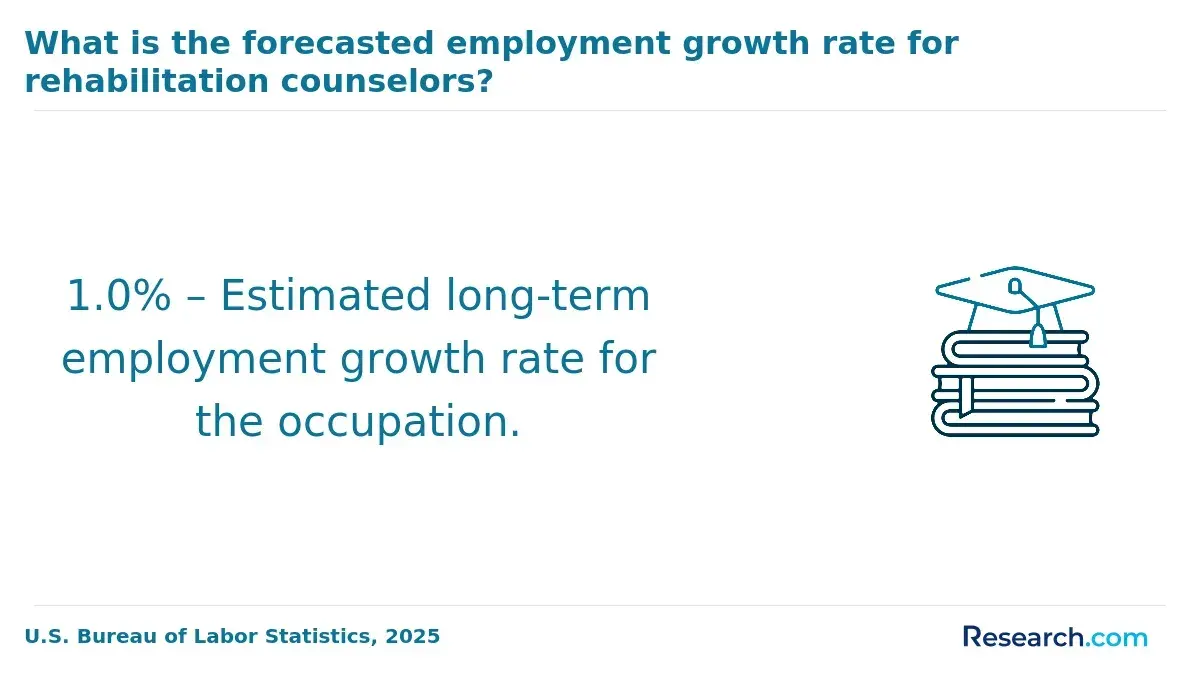
Rehabilitation Counselors
46,850
2
Marriage & Family Therapists
66,940
14
Psychologists
99,110
6
Postsecondary Teachers
85,330
7
National demand differs sharply by counseling occupation. The U.S. Bureau of Labor Statistics projects 18% employment growth from 2025 to 2035 for the occupation group that includes mental health and substance-use counselors, compared with 3% for school and career counselors. These are U.S. projections, not Washington vacancy forecasts; they suggest that applicants should investigate local employers and openings within their chosen specialty rather than assume that overall counseling demand applies equally to every role.
For a practical Washington search, compare job postings in the area where you can complete fieldwork and expect to remain after graduation. Note which employers accept candidates working toward a credential, which require independent licensure or ESA certification, and whether their schedules match your needs. That check will tell you more about your immediate prospects than a national growth rate alone.
2027 Most Valuable Master's in Counseling Degree Programs Ranking in Washington
Investing in graduate education is a consequential decision. Research.com designed its counseling rankings to help readers assess programs using documented outcomes, credentials, and costs rather than reputation alone. The team checks multiple education datasets to improve the quality, credibility, and accuracy of its comparisons.
The ranking draws on all four of these sources:
IPEDS database - institutional reporting on programs, completions, and costs.
Research.com's counseling methodology considers program completion, employment or doctoral admission, applicable licensure-exam pass rates, CACREP programmatic accreditation, federal Title IV eligibility, and cost. For context, its Best ranking first weights completion at 40%, employment or doctoral admission at 20%, applicable exam results at 20%, CACREP accreditation at 16%, and Title IV eligibility at 4%; inapplicable criteria are reweighted. Cost contributes about 7% to that ranking's final score. Rankings organized around other named dimensions serve different comparison purposes. Readers can review the full approach on Research.com's methodology page. No ranking substitutes for checking whether a particular program meets your intended credential requirements and budget.
# 1 position
Eastern Washington University
Master
Counseling, Clinical Mental Health Counseling, Master of Science (MS)
Delivery mode: hybrid
39.60
/ 100
Final score
Program length
two years, including required summer coursework
Specialization
Clinical Mental Health Counseling
Required credits
93 quarter credits
GPA range
3.00 - 4.00
Program completion rate
96% (2025-26)
Employment or doctoral admission
74% (2025-26)
Licensure exam pass rate
100% (2024-25)
Application deadline
January 15
Class size
23
Application process
direct
Prerequisites
Bachelor's degree (typically psychology, education, or related field) with an inferential/undergraduate statistics course before fall start; minimum 3.0 GPA in the last 90 quarter or 60 semester credits.
Accreditation
Accredited by the Council for Accreditation of Counseling and Related Educational Programs (CACREP), with institutional accreditation from the Northwest Commission on Colleges and Universities (NWCCU).
Eastern Washington University earned a Research.com Value Score of 39.6/100, supported by $70,143 median earnings and 100% licensure exam pass rate. The program is CACREP-accredited, valid through 2027-03-31.
# 2 position
Seattle University
Master
Clinical Mental Health Counseling, MAEd
Delivery mode: campus
21.30
/ 100
Final score
Program length
3 years
Specialization
Clinical Mental Health Counseling
Required credits
90 quarter credits
GPA range
3.00 - 4.00
Application deadline
February 1 (priority, Fall admission)
Application process
direct
GRE
Conditional: GRE/GMAT required only if the bachelor's degree is non-graded
Prerequisites
Bachelor's degree from a regionally accredited institution; no specific prior coursework required.
Additional requirements
Letter of Intent (2-3 pages), one-to-two page résumé, two recommendation forms (from supervisors/instructors), official/unofficial transcripts, minimum 3.00 GPA; GRE/GMAT required only if bachelor's degree transcript is non-graded. No application fee.
Accreditation
Accredited by the Council for Accreditation of Counseling and Related Educational Programs (CACREP), with institutional accreditation from the Northwest Commission on Colleges and Universities (NWCCU).
Seattle University earned a Research.com Value Score of 21.3/100, supported by $68,242 median earnings and $70,110 total tuition (estimated). The program is CACREP-accredited, valid through 2027-10-31.
# 3 position
Seattle University
Master
Clinical Mental Health Counseling, Online, MAEd
Delivery mode: hybrid
21.30
/ 100
Final score
Program length
3 years
Specialization
Clinical Mental Health Counseling
Required credits
90 quarter credits
GPA range
3.00 - 4.00
Application deadline
February 1 (priority, Fall admission)
Application process
direct
GRE
Conditional: GRE/GMAT required only if the bachelor's degree is non-graded
Prerequisites
Bachelor's degree from a regionally accredited institution; no specific prior coursework required.
Additional requirements
Letter of Intent (2-3 pages), one-to-two page résumé, two recommendation forms (from supervisors/instructors), official/unofficial transcripts, minimum 3.00 GPA; GRE/GMAT required only if bachelor's degree transcript is non-graded. No application fee.
Accreditation
Accredited by the Council for Accreditation of Counseling and Related Educational Programs (CACREP), with institutional accreditation from the Northwest Commission on Colleges and Universities (NWCCU).
Seattle University earned a Research.com Value Score of 21.3/100, supported by $68,242 median earnings and $70,110 total tuition (estimated). The program is CACREP-accredited, valid through 2027-10-31.
# 4 position
Seattle University
Master
School Counseling, Online, MAEd
Delivery mode: hybrid
21.30
/ 100
Final score
Program length
3 years
Specialization
School Counseling
Required credits
90 quarter credits
GPA range
3.00 - 4.00
Program completion rate
77% (2024-25)
Employment or doctoral admission
80% (2024-25)
Application deadline
Fall 2027: Priority Feb 1; Final/Rolling Aug 1
Application process
direct
GRE
Conditional: GRE/GMAT required only if the bachelor's degree is non-graded
Prerequisites
Bachelor's degree or higher from a regionally accredited institution; minimum of one year of experience related to schools or school-aged youth (three years preferred); minimum 3.00 GPA.
Additional requirements
Letter of Intent (2-page), résumé, two recommendation forms, video question responses, official/unofficial transcripts; no application fee.
Accreditation
Accredited by the Council for Accreditation of Counseling and Related Educational Programs (CACREP), with institutional accreditation from the Northwest Commission on Colleges and Universities (NWCCU).
Seattle University earned a Research.com Value Score of 21.3/100, supported by $68,242 median earnings and 77% program completion rate. The program is CACREP-accredited, valid through 2027-10-31.
# 5 position
Gonzaga University
Master
Master of Arts in School Counseling
Delivery mode: campus
20.70
/ 100
Final score
Program length
2 years
Specialization
School Counseling
Required credits
61 semester credits
Program completion rate
89% (2025-26)
Employment or doctoral admission
100% (2025-26)
Application process
direct
GRE
optional
Additional requirements
Online application; official transcripts (GPA explanation if below 3.0); bachelor's degree; two professional recommendations; statement of purpose (max 1,000 words); resume/CV; on-campus faculty interview by invitation; fall start, Jan 15 deadline.
Accreditation
Accredited by the Council for Accreditation of Counseling and Related Educational Programs (CACREP), with institutional accreditation from the Northwest Commission on Colleges and Universities (NWCCU).
Gonzaga University earned a Research.com Value Score of 20.7/100, supported by $51,410 median earnings and 89% program completion rate. The program is CACREP-accredited, valid through 2030-03-31.
# 6 position
Antioch University-Seattle
Master
MA in Counseling: Clinical Mental Health Counseling (Low-Residency)
Delivery mode: hybrid
19.20
/ 100
Final score
Program length
40 months
Specialization
Clinical Mental Health Counseling
Required credits
60 semester credits
Acceptance rate
85.83%
Employment or doctoral admission
87%
Application deadline
Fall: July 1
Application process
direct
GRE
no
Prerequisites
Bachelor's degree from a regionally accredited institution required; transcript evaluations required for coursework completed outside the U.S. or Canada.
Additional requirements
Online admissions application; official transcripts from all colleges/universities attended; optional two letters of recommendation; resume; admission essay (multiple prompts); select applicants may be invited to a group interview with faculty.
Accreditation
Accredited by the Council for Accreditation of Counseling and Related Educational Programs (CACREP), with institutional accreditation from the Higher Learning Commission (HLC).
Antioch University-Seattle earned a Research.com Value Score of 19.2/100, supported by $50,791 median earnings and $56,030 total tuition (estimated). The program is CACREP-accredited, valid through 2029-10-31.
# 7 position
Antioch University-Seattle
Master
MA in Counseling: Clinical Mental Health Counseling – Residential Weekend Delivery
Delivery mode: hybrid
17.50
/ 100
Final score
Program length
3 - 3-1/2 years
Specialization
Clinical Mental Health Counseling
Required credits
60 semester credits
Employment or doctoral admission
87%
Application deadline
Fall: July 1
Application process
direct
GRE
no
Prerequisites
Bachelor's degree from a regionally accredited institution required; transcript evaluations required for coursework completed outside the U.S. or Canada.
Additional requirements
Online admissions application; official transcripts from all colleges/universities attended; optional two letters of recommendation; resume; admission essay (multiple prompts); select applicants may be invited to a group interview with faculty.
Accreditation
Accredited by the Council for Accreditation of Counseling and Related Educational Programs (CACREP), with institutional accreditation from the Higher Learning Commission (HLC).
Antioch University-Seattle earned a Research.com Value Score of 17.5/100, supported by $50,791 median earnings and $59,520 total tuition (estimated). The program is CACREP-accredited, valid through 2029-10-31.
# 8 position
University of Puget Sound
Master
M.Ed. in Counseling – School Counseling (Specialty Area)
Delivery mode: campus
17.00
/ 100
Final score
Program length
2 years
Specialization
School Counseling
Required credits
15 units
GPA range
3.00 - 4.00
Program completion rate
92% (2025-26)
Employment or doctoral admission
100% (2025-26)
Licensure exam pass rate
100% (2025-26)
Application deadline
Early Action: Nov 1, 2026; Regular Decision: Feb 15, 2027
Application process
direct
GRE
Conditional: GRE required if GPA is below 3.0 (applicants with narrative evaluations instead of a GPA may also be asked for GRE scores)
Prerequisites
Completion of a baccalaureate degree from an accredited institution (transcripts reflecting completion, or in-progress with completion prior to start of classes).
Additional requirements
School of Education application with essay (300-500 words on reasons for pursuing MEd in Counseling), official transcripts, Appraisal of Applicant Forms, academic reference if recent coursework, resume, required interview.
Accreditation
Accredited by the Council for Accreditation of Counseling and Related Educational Programs (CACREP), with institutional accreditation from the Northwest Commission on Colleges and Universities (NWCCU).
University of Puget Sound earned a Research.com Value Score of 17.0/100, supported by $67,394 median earnings and 100% licensure exam pass rate. The program is CACREP-accredited, valid through 2031-03-31.
Frequently asked questions about Counseling degree in Washington
Is a counseling master's worth it in Washington?
It can be if the degree matches a credential and role you want and the full cost fits your expected career path. Compare total borrowing, time away from paid work, and post-degree supervision requirements before deciding.
Does graduation make me a licensed mental health counselor?
No. Washington's Department of Health has requirements beyond completing a qualifying degree, including supervised experience and other licensing steps. Confirm the current pathway directly with the department.
Can an online counseling degree lead to a Washington credential?
Potentially. Online delivery does not determine eligibility; curriculum, supervised practice, and the applicable state rules do. Get written confirmation of how placements and credential preparation work for your location.
Are school counseling and clinical mental health counseling interchangeable?
No. They prepare students for different settings and Washington credential pathways. Choose according to whether you want to counsel students in schools or pursue clinical mental health practice.
Should I choose the cheapest program?
Not automatically. Compare total cost after aid with credential fit, placement feasibility, completion time, and documented outcomes. An inexpensive program that does not support your intended career may cost more to correct later.
See What Experts Have To Say About Studying Counseling