A counseling master's is a substantial investment, and the right choice depends on the job you want - not just a school's reputation. This guide is for prospective students and working professionals comparing Texas programs by career pathway, licensure fit, cost, and training format. It accompanies the 2027 Most Valuable Master's in Counseling Degree Programs Ranking in Texas, created by the Research.com team of data scientists to help students make an informed choice about programs worth considering. You'll learn what to verify before enrolling and how to weigh the degree against its likely costs and opportunities.
Key findings about Counseling degrees in Texas
Match the degree to the credential first: Texas professional counselor licensure and school counselor certification follow different rules; a counseling master's does not automatically qualify a graduate for either (Texas Behavioral Health Executive Council; Texas Education Agency).
Budget for more than tuition: Required supervised training can limit paid work and may require travel. Compare each school's full program estimate, aid offer, and placement support before judging value.
Use career data as context, not a promise: The U.S. median annual wage for substance abuse, behavioral disorder, and mental health counselors was $59,350 in May 2025, with employment projected to grow 18% during 2025-2035 (U.S. Bureau of Labor Statistics). Individual Texas outcomes will differ.
What can I expect from a Counseling degree in Texas?
Expect a master's degree that combines counseling theory, assessment, ethics, culturally responsive practice, and supervised work with clients or students. A clinical mental health program is generally the more direct option for someone pursuing Texas Licensed Professional Counselor (LPC) eligibility; a school counseling program is designed around students' academic, career, and social-emotional needs in schools. Marriage, couple, and family-focused study emphasizes relationships and family systems. Program titles alone do not establish eligibility for any credential (Texas Behavioral Health Executive Council; Texas Education Agency).
The degree is most compelling if your intended role requires graduate preparation and you can accommodate fieldwork. If you want to explore helping professions before committing to supervised graduate training, compare entry-level behavioral health or education roles first. If you specifically want to prescribe medication or practice psychology, a counseling master's is not the credential for those goals.
Where can I work with a Counseling degree in Texas?
Career settings depend on the credential earned. LPC-qualified counselors may work in community mental health, hospitals, substance use services, group practices, or eventually independent practice subject to Texas licensing rules. Certified school counselors work in educational settings; their duties and hiring requirements differ from clinical counseling. Family-focused graduates should separately check the requirements of the Texas marriage and family therapy licensing board if that is their intended credential (Texas Behavioral Health Executive Council; Texas Education Agency).
Location affects training as well as employment. A placement near a campus may be convenient, but a student planning to live in another part of Texas should ask whether the program can approve and supervise a site there. That question is particularly important for online students and people who cannot relocate.
National occupation-level wages provide a benchmark, not a forecast for a new Texas graduate. The following U.S. Bureau of Labor Statistics figures are median annual wages for May 2025; the projections cover 2025-2035. They describe occupations rather than salaries attributable to a particular degree or school.
Career direction and BLS occupational benchmark
U.S. median annual wage, May 2025
Projected U.S. employment change, 2025-2035
Clinical mental health or addiction counseling
$59,350
+18%
School counseling
$64,330
+3%
Marriage, couple, and family counseling
$66,940
+14%
Rehabilitation counseling
$46,850
+2%
The clinical mental health and addiction entries share a BLS occupational benchmark; they are not separate guaranteed pay scales. To assess an offer, compare the employer's actual salary, benefits, supervision arrangements, and location with your expected debt and earnings before the degree. Also ask programs for outcomes for your intended track rather than assuming a national median represents recent graduates (U.S. Bureau of Labor Statistics).
The clearest differences among these Texas options are their intended credentials and curriculum structures. The program-specific comparisons below explain which option merits a closer look for a particular goal; verify the current catalog and credential alignment before applying.
University of Texas at San Antonio - School Counseling: UTSA identifies this as a school counseling master's rather than its separate clinical mental health offering (UTSA program pages). It is the more relevant UTSA starting point for applicants targeting school counselor certification, not clinical practice.
Texas State University - Professional Counseling, School Counseling MA: Texas State places school counseling within its professional counseling degree offerings (Texas State graduate catalog). Compare its school-focused course and fieldwork requirements with Texas State's clinical and marriage-and-family options before assuming the tracks lead to interchangeable credentials.
Texas State University - Professional Counseling, Marriage and Family Counseling non-thesis MA: This catalog pathway explicitly combines a marriage-and-family focus with a non-thesis structure (Texas State graduate catalog). It warrants attention from applicants interested in relationship-focused practice who do not want the clinical mental health track's thesis requirement.
Texas Woman's University - Counseling and Development: TWU presents Counseling and Development as a graduate program rather than one undifferentiated Texas counseling credential (TWU program page). Applicants should compare its available pathways against their intended license or school certification before treating program flexibility as credential flexibility.
Texas Woman's University - Counseling and Development: For a student comparing programs across institutions, TWU's program is a useful reminder to request the track-specific degree plan and supervised-placement rules, not just a general program description (TWU program page). Those details determine whether its pathway fits the student's career target and location.
Texas Tech University - Clinical Mental Health Counseling: Texas Tech's named clinical mental health pathway offers a more direct program comparison for prospective clinical counselors than a general counseling degree description would (Texas Tech University program page). Ask how its required supervised experiences are arranged if you expect to complete placements away from the Lubbock area.
Texas State University - Professional Counseling, Clinical Mental Health thesis MA: Unlike the listed Texas State marriage-and-family non-thesis pathway, this clinical mental health option specifies a thesis (Texas State graduate catalog). It may better suit an applicant who wants substantial research experience alongside clinical preparation; confirm the thesis's effect on scheduling.
Texas A&M University-Central Texas - Clinical Mental Health Counseling MS: This is an explicitly clinical mental health MS option in Central Texas (Texas A&M University-Central Texas program page). Its location may be useful if remaining near that area makes required supervised training feasible, but confirm local placement availability rather than assuming it.
Texas A&M University-San Antonio - Counseling and Guidance, School Counseling MA: The catalog identifies a school counseling route within Counseling and Guidance (Texas A&M University-San Antonio graduate catalog). Applicants pursuing school certification should compare its educator-preparation requirements with clinical programs that may share counseling terminology but target a different workplace.
University of Texas at San Antonio - Clinical Mental Health Counseling: UTSA offers a separately named clinical mental health master's alongside its school counseling program (UTSA program pages). That distinction makes it possible to compare two career directions at the same institution without assuming the school track prepares students for LPC eligibility.
These are differences in published program design, not verified comparisons of graduate earnings, licensure pass rates, or placement success. Request recent track-level results from each school before using outcomes to break a tie. For a broader comparison of best counseling programs, weigh those results alongside credential fit and your total cost.
A full-time counseling master's commonly takes about two to three years; part-time enrollment can take longer. The decisive variables are required credits, course sequencing, whether summer courses are offered, and when practicum and internship placements can begin. A thesis may also change the schedule. Ask each program for a term-by-term plan for your proposed enrollment pace rather than relying on its shortest advertised timeline.
Finishing coursework is not the same as completing a professional credential. Texas LPC applicants must meet the board's education, examination, and supervised-experience requirements, and post-degree supervised work takes additional time (Texas Behavioral Health Executive Council). Include that period in your career and financial plan.
Online delivery can reduce commuting or relocation, while on-campus study may simplify access to campus-based instruction and nearby placement networks. Neither format removes the need for supervised, in-person professional experiences where the credential pathway requires them. An online degree's usefulness therefore depends less on the label "online" than on whether the school can support approved fieldwork where you live.
For either format, confirm that the specific program and track meet the education requirements for your intended Texas credential. If you may move after graduating, ask about preparation for the other state as well; licensure rules are state-specific. Compare actual course schedules, placement travel, supervision arrangements, and any campus visits before deciding which format saves time or money (Texas Behavioral Health Executive Council; Texas Education Agency).
There is no single statewide price that accurately represents the full cost of these counseling master's programs. Published tuition figures may be annual, per-credit, or based on different enrollment loads; they can exclude fees, books, transportation, and the cost of reduced paid work during field placements. NCES/IPEDS tuition data can help compare institutions, but an institution-wide graduate figure is not a track-specific total (National Center for Education Statistics).
Request each school's current total for the credits in your exact degree plan, including mandatory fees and any additional terms. At a Texas public university, establish whether you qualify for resident tuition; do not assume residency from your mailing address alone. The most affordable counseling programs are worth checking, but the lowest tuition may not yield the lowest total cost if completion takes longer or placements require substantial travel.
Start with the FAFSA and each university's graduate financial aid office. Depending on eligibility and availability, funding may include federal Direct Unsubsidized Loans, institutional scholarships, assistantships, employer tuition support, and school-administered aid. Federal loan eligibility and borrowing limits differ from undergraduate aid; an aid offer is not a reduction in price when most of it consists of loans (Federal Student Aid; U.S. Department of Education).
Ask whether an assistantship covers tuition, pays a stipend, or requires work hours that could conflict with internship. Then compare net cost after grants and earned support, expected borrowing, and the time you may spend earning less during training. Recheck current federal rules with your aid office before relying on a particular loan type or amount.
Programs generally require a bachelor's degree and an application that may include transcripts, recommendations, a statement of purpose, and an interview; prerequisite courses and admission thresholds vary by school. A prior counseling major is not necessarily required, but applicants should check whether a program expects coursework in psychology, human development, or statistics (Texas university graduate admissions and program catalogs).
Before applying, identify the credential you want and obtain the current degree plan. Texas LPC eligibility involves board-specified graduate education and other requirements; school counselor certification is overseen through the state's educator-certification system (Texas Behavioral Health Executive Council; Texas Education Agency). Ask admissions staff how previous graduate credits would be evaluated, but get any transfer-credit approval in writing before treating those credits as a saving.
Typical subjects include counseling theories and techniques, human development, assessment, research, ethics, group counseling, and working with clients from varied backgrounds. Clinical programs may add diagnosis and treatment planning; school programs emphasize counseling in educational settings; family-focused pathways examine relationships and family systems. Supervised practicum and internship connect those courses to professional work (Texas university graduate catalogs).
Compare syllabi and degree plans for the work you want to do. A course list that sounds relevant is not proof that the complete program satisfies Texas credential requirements, particularly if an elective or specialization changes the required training.
The most consequential choice is often between clinical mental health and school counseling because the intended credentials and work settings differ. Programs may also offer marriage-and-family, addiction, or other focused coursework. Texas State's published school, marriage-and-family, and clinical mental health MA pathways illustrate why applicants should compare specific tracks rather than treating a university's counseling offerings as one degree (Texas State graduate catalog).
A specialization is useful when its required courses and fieldwork advance your intended role. It is a poor substitute for checking the relevant board's rules: a family-focused concentration, for example, should not be assumed to satisfy marriage and family therapist licensing requirements without a separate review (Texas Behavioral Health Executive Council).
Begin with the credential and workplace you want, then narrow programs by documented fit. Rankings can identify options to investigate; the most popular counseling programs may reveal widely considered choices, but popularity alone does not establish value for your goals.
Use these checks before accepting an offer:
Verify credential alignment: Ask the school to identify the Texas license or certification its exact track is designed to support, and confirm requirements with the responsible state agency.
Check accreditation precisely: Confirm the institution's status and, if programmatic CACREP accreditation matters to your plans, check the specific program rather than assuming every track is covered (CACREP; U.S. Department of Education).
Request placement and outcome evidence: Ask where students in your track complete supervised training and for recent completion, examination, and employment information, including the reporting period.
Compare full investment: Include fees, aid, debt, likely completion time, placement travel, foregone earnings, and your earnings before the degree - not tuition alone.
A common mistake is choosing an attractive school or short timetable before confirming that the fieldwork and coursework match the intended credential. Another is treating an occupation's median wage as a personal return-on-investment estimate. Compare realistic post-degree opportunities with your baseline earnings over a time horizon that accounts for debt and the time value of money.
View the chart data as a table
Median wage by counseling career path (U.S., BLS May 2025) (Source: BLS)
Category
Value
Psychologists
99,110
Postsecondary Teachers
85,330
Marriage & Family Therapists
66,940
School & Career Counselors
64,330
Mental Health Counselors
59,350
Rehabilitation Counselors
46,850
Depending on preparation and credentials, pathways include clinical mental health counseling, school counseling, addiction counseling, rehabilitation counseling, and family-focused practice. A master's can also precede doctoral study, but counselor education and supervision roles may require further education and experience (U.S. Bureau of Labor Statistics; Texas Behavioral Health Executive Council; Texas Education Agency).
Think of graduation as one milestone. Someone pursuing clinical practice should map the Texas LPC process and supervised post-degree work; someone pursuing school counseling should map educator-certification requirements. If you want a role that does not require either credential, compare its actual job postings with the degree's cost before enrolling.
View the chart data as a table
Annual earnings-to-program-cost ratio distribution across ranked programs (Source: Research.com)
Category
Value
0--0
4
0-0
8
1-0
1
2-1
3
2-2
10
2-2
1
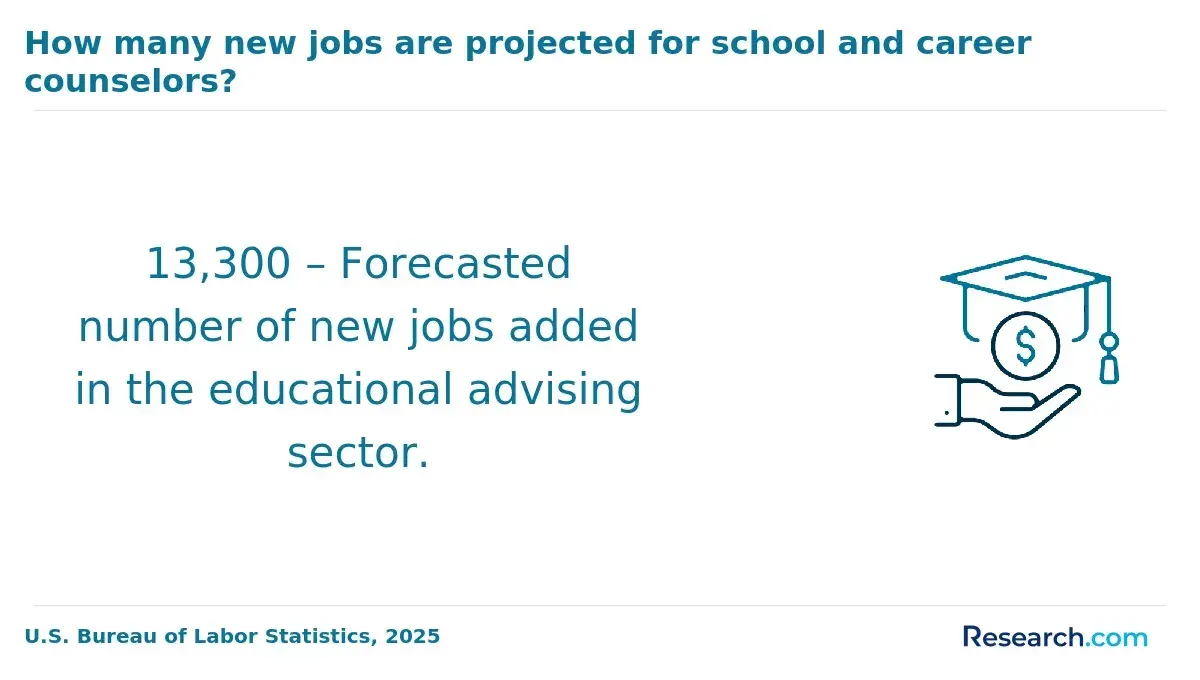
Demand is not uniform across counseling specialties. National employment for substance abuse, behavioral disorder, and mental health counselors is projected to grow 18% from 2025 to 2035, while the school counseling benchmark is 3% (U.S. Bureau of Labor Statistics, Employment Projections). That difference makes career target more useful than a general claim that "counseling is growing." Neither projection measures openings available to a particular graduate in a particular Texas community.
For a local decision, review current postings in the Texas area where you plan to work. Note required credentials, supervision for associate-level counselors, pay, and whether school positions follow educator hiring cycles. Ask programs which employers host placements nearby: a viable placement can provide relevant experience, but it should never be interpreted as a guaranteed job offer.
2027 Most Valuable Master's in Counseling Degree Programs Ranking in Texas
Investing in graduate education is an important decision. Research.com's team evaluates program information and checks multiple data sources to make its counseling rankings credible, accurate, and useful for comparing options. The sources used to create the rankings include:
IPEDS database: Institutional information, including education and cost data.
Research.com scores counseling programs using graduate outcomes, applicable licensure-exam pass rates, accreditation, federal Title IV eligibility, and program cost. Its Best ranking first combines completion, employment or doctoral admission, applicable exam results, CACREP accreditation, and Title IV eligibility; cost then contributes a smaller share of the final score. Criteria that do not apply to a program are excluded and the remaining weights are adjusted. Other rankings emphasize the dimension named in their titles. These measures offer a starting point, not a substitute for confirming current tuition, placement arrangements, and Texas credential requirements with a program. See Research.com's methodology for more detail.
# 1 position
The University of Texas at San Antonio
Master
M.Ed. in School Counseling
Delivery mode: campus
76.50
/ 100
Final score
Program length
3 years
Specialization
School Counseling
Required credits
60 semester credits
GPA range
3.00 - 4.00
Program completion rate
100% (2024-25)
Employment or doctoral admission
99% (2021-22)
Licensure exam pass rate
87.5% (2024-25)
Application deadline
Fall: March 1; Spring: October 1
Class size
22
Application process
direct
GRE
no
Prerequisites
Bachelor's degree from an accredited college or university in the United States or proof of equivalent training at a foreign institution; adequate coursework as preparation for the program
Additional requirements
Bachelor's degree, minimum 3.0 GPA, transcripts, credential evaluation (if foreign institution), English proficiency scores (if applicable), Narrative Statement (written or video), 3 Letters of Recommendation/Applicant Rating Forms.
Accreditation
Accredited by the Council for Accreditation of Counseling and Related Educational Programs (CACREP), with institutional accreditation from the Southern Association of Colleges and Schools Commission on Colleges (SACSCOC).
The University of Texas at San Antonio earned a Research.com Value Score of 76.5/100, supported by $60,837 median earnings and 87.5% licensure exam pass rate. The program is CACREP-accredited, valid through 2033-10-31.
# 2 position
Texas State University
Master
M.A. Major in Professional Counseling
Delivery mode: campus
68.40
/ 100
Final score
Specialization
School Counseling
Required credits
60 semester credits
GPA range
3.00 - 4.00
Program completion rate
100% (2024-25)
Employment or doctoral admission
100% (2024-25)
Application process
direct
GRE
yes
Prerequisites
Baccalaureate degree from a regionally accredited university or qualifying international equivalent; minimum 3.0 overall GPA or 3.0 in the last 60 undergraduate hours plus completed graduate coursework.
Additional requirements
Online application, official transcripts, official general GRE scores (waivers may be available with a master's or doctorate), informed consent form, resume/CV and statement of purpose; English proficiency scores unless exempt.
Accreditation
Accredited by the Council for Accreditation of Counseling and Related Educational Programs (CACREP), with institutional accreditation from the Southern Association of Colleges and Schools Commission on Colleges (SACSCOC).
Texas State University earned a Research.com Value Score of 68.4/100, supported by $53,083 median earnings and 100% program completion rate. The program is CACREP-accredited, valid through 2032-10-31.
# 3 position
Texas State University
Master
M.A. Major in Professional Counseling
Delivery mode: campus
68.40
/ 100
Final score
Specialization
Marriage, Couple, and Family Counseling
Required credits
60
GPA range
3.00 - 4.00
Application process
direct
GRE
yes
Prerequisites
Baccalaureate degree from a regionally accredited university (non-U.S. degrees must be equivalent to a four-year U.S. Bachelor's degree).
Additional requirements
Online application; official transcripts; minimum 3.0 GPA overall or in last 60 hours; GRE general test (may be waived with a master's/doctoral degree); informed consent form; resume/CV; statement of purpose; English scores for international.
Accreditation
Accredited by the Council for Accreditation of Counseling and Related Educational Programs (CACREP), with institutional accreditation from the Southern Association of Colleges and Schools Commission on Colleges (SACSCOC).
Texas State University earned a Research.com Value Score of 68.4/100, supported by $53,083 median earnings and $21,442 total tuition (estimated). The program is CACREP-accredited, valid through 2032-10-31.
# 4 position
Texas Woman's University
Master
M.S. in Counseling & Development – Professional School Counseling
Delivery mode: campus
66.80
/ 100
Final score
Specialization
School Counseling
Required credits
61 semester credits
GPA range
3.00 - 4.00
Program completion rate
100% (2024)
Application deadline
Fall: Feb 15; Spring: Sep 15
Application process
direct
Prerequisites
Bachelor's degree from a regionally accredited institution (conferred before starting); minimum 3.0 GPA for last 60 credits and for any graduate work; letter of intent (350 words); short video (from Fall 2027); interview day. No GRE.
Accreditation
Accredited by the Council for Accreditation of Counseling and Related Educational Programs (CACREP), with institutional accreditation from the Southern Association of Colleges and Schools Commission on Colleges (SACSCOC).
Texas Woman's University earned a Research.com Value Score of 66.8/100, supported by $48,650 median earnings and 100% program completion rate. The program is CACREP-accredited, valid through 2033-03-31.
# 5 position
Texas Woman's University
Master
M.S. in Counseling and Development
Delivery mode: campus
64.50
/ 100
Final score
Specialization
Clinical Mental Health Counseling
Required credits
61 semester credits
GPA range
3.00 - 4.00
Program completion rate
91% (2024)
Employment or doctoral admission
100% (2024)
Application deadline
Fall: February 15; Spring: September 15
Application process
direct
GRE
no
Prerequisites
A bachelor's degree or equivalent from a regionally accredited U.S. institution, or equivalent foreign degree, completed before entry. Minimum 3.0 GPA in the last 60 undergraduate semester credits and in all previous graduate coursework.
Additional requirements
Online application, official transcripts, and letter of intent (max 350 words) on motivation, experience, and program fit. Selected applicants attend a faculty interview. From Fall 2027, a 45–60 second video on interest in counseling needed.
Accreditation
Accredited by the Council for Accreditation of Counseling and Related Educational Programs (CACREP), with institutional accreditation from the Southern Association of Colleges and Schools Commission on Colleges (SACSCOC).
Texas Woman's University earned a Research.com Value Score of 64.5/100, supported by $47,141 median earnings and 91% program completion rate. The program is CACREP-accredited, valid through 2033-03-31.
# 6 position
Texas Tech University
Master
Counselor Education - Clinical Mental Health Counseling M.Ed.
Delivery mode: campus
63.10
/ 100
Final score
Specialization
Clinical Mental Health Counseling
Required credits
60 semester credits
Application deadline
Fall: Mar 15
Application process
direct (TTU Graduate School application)
Additional requirements
Graduate School online application; unofficial transcripts; resume; three professional recommendations; applicant statement; GRE scores listed (suspension announced through at least Summer 2026).
Accreditation
Accredited by the Council for Accreditation of Counseling and Related Educational Programs (CACREP), with institutional accreditation from the Southern Association of Colleges and Schools Commission on Colleges (SACSCOC).
Texas Tech University earned a Research.com Value Score of 63.1/100, supported by $43,346 median earnings and $18,780 total tuition. The program is CACREP-accredited, valid through 2032-03-31.
# 7 position
Texas State University
Master
M.A. Major in Professional Counseling
Delivery mode: campus
61.40
/ 100
Final score
Specialization
Clinical Mental Health Counseling
Required credits
66 semester credits
GPA range
3.00 - 4.00
Program completion rate
100% (2024-25)
Employment or doctoral admission
100% (2024-25)
Application process
direct
GRE
yes
Prerequisites
Baccalaureate degree from a regionally accredited university or qualifying international equivalent; minimum 3.0 overall GPA or 3.0 in the last 60 undergraduate hours plus completed graduate coursework.
Additional requirements
Online application, official transcripts, official general GRE scores (waivers may be available with a master's or doctorate), informed consent form, resume/CV and statement of purpose; English proficiency scores unless exempt.
Accreditation
Accredited by the Council for Accreditation of Counseling and Related Educational Programs (CACREP), with institutional accreditation from the Southern Association of Colleges and Schools Commission on Colleges (SACSCOC).
Texas State University earned a Research.com Value Score of 61.4/100, supported by $53,083 median earnings and 100% program completion rate. The program is CACREP-accredited, valid through 2032-10-31.
# 8 position
Texas A&M University-Central Texas
Master
Master of Science in Clinical Mental Health Counseling
Delivery mode: campus
54.30
/ 100
Final score
Specialization
Clinical Mental Health Counseling
Required credits
60 semester credits
Acceptance rate
40.38%
GPA range
2.50 - 4.00
Program completion rate
74.1% (2024-25)
Employment or doctoral admission
69% (2024-25)
Licensure exam pass rate
92% (2024-25)
Application deadline
Fall: July 1; Spring: November 1
Application process
direct (ApplyTexas)
GRE
no
Prerequisites
Bachelor's degree from a fully accredited institution.
Accreditation
Accredited by the Council for Accreditation of Counseling and Related Educational Programs (CACREP), with institutional accreditation from the Southern Association of Colleges and Schools Commission on Colleges (SACSCOC).
Texas A&M University-Central Texas earned a Research.com Value Score of 54.3/100, supported by $49,328 median earnings and 92% licensure exam pass rate. The program is CACREP-accredited, valid through 2027-10-31.
# 9 position
Texas A&M University-San Antonio
Master
M.A. in Counseling & Guidance: School Counseling
Delivery mode: campus
54.10
/ 100
Final score
Specialization
School Counseling
Required credits
60 semester credits
GPA range
2.75 - 4.00
Licensure exam pass rate
100% (2021-22)
Application deadline
Fall: March 15
Application process
GradCAS
GRE
no
Prerequisites
Accredited bachelor's with 2.75-2.99 cumulative GPA or 3.00+ on last 60 credits; preparatory coursework may be needed; School Counseling full admission requires a teaching service record and SBEC/TEA requirements.
Additional requirements
GradCAS application, official transcripts, resume/CV, three-page Statement of Purpose, group interview; School Counseling also needs teaching service record, oral interview, vision statement, and criminal record check before practicum.
Accreditation
Accredited by the Council for Accreditation of Counseling and Related Educational Programs (CACREP), with institutional accreditation from the Southern Association of Colleges and Schools Commission on Colleges (SACSCOC).
Texas A&M University-San Antonio earned a Research.com Value Score of 54.1/100, supported by $46,223 median earnings and 100% licensure exam pass rate. The program is CACREP-accredited, valid through 2031-03-31.
# 10 position
The University of Texas at San Antonio
Master
Master of Science (MS) in Clinical Mental Health Counseling
Delivery mode: campus
53.90
/ 100
Final score
Program length
2.5-3.5 years (full-time)
Specialization
Clinical Mental Health Counseling
Required credits
60 semester credits
GPA range
3.00 - 4.00
Program completion rate
100% (2024-25)
Employment or doctoral admission
88% (2024-25)
Application deadline
Spring 2027: October 1; Fall 2027: March 1; Spring 2028: October 1. All deadlines at 5:00 PM U.S. Central Time; summer admission unavailable.
Class size
146
Application process
direct
GRE
no
Prerequisites
Bachelor's degree from an accredited U.S. institution or equivalent foreign training; adequate preparatory coursework (no specific courses listed). Minimum 3.0 GPA; the department may consider the last 60 semester credit hours.
Additional requirements
Graduate application and fee, transcripts, three recommendation/rating forms, and narrative statement (2027-28: a video of up to five minutes). English proficiency where applicable: TOEFL iBT 100, IELTS 7, or Duolingo 130.
Accreditation
Accredited by the Council for Accreditation of Counseling and Related Educational Programs (CACREP), with institutional accreditation from the Southern Association of Colleges and Schools Commission on Colleges (SACSCOC).
The University of Texas at San Antonio earned a Research.com Value Score of 53.9/100, supported by $44,785 median earnings and 100% program completion rate. The program is CACREP-accredited, valid through 2033-10-31.
# 11 position
The University of Texas at Tyler
Master
M.A. in Clinical Mental Health Counseling
Delivery mode: campus
53.80
/ 100
Final score
Program length
2.5-3 years
Specialization
Clinical Mental Health Counseling
Required credits
60 semester credits
GPA range
3.00 - 4.00
Program completion rate
78.57% (2024-25)
Employment or doctoral admission
28.57% (2023-24)
Licensure exam pass rate
100% (2024-25)
Application deadline
Fall: March 15; Spring: October 15
Class size
20
Application process
direct
GRE
no
Prerequisites
Bachelor's degree in any field from an accredited institution; no specific prerequisite coursework listed.
Additional requirements
Online application; Department Information Sheet with statement of purpose; three letters of recommendation (at least one from a faculty member); background check ($45 fee); official transcripts; TOEFL/IELTS for non-U.S. degree holders.
Accreditation
Accredited by the Council for Accreditation of Counseling and Related Educational Programs (CACREP), with institutional accreditation from the Southern Association of Colleges and Schools Commission on Colleges (SACSCOC).
The University of Texas at Tyler earned a Research.com Value Score of 53.8/100, supported by $52,767 median earnings and 100% licensure exam pass rate. The program is CACREP-accredited, valid through 2031-03-31.
# 12 position
University of Houston-Clear Lake
Master
Clinical Mental Health Counseling M.S.
Delivery mode: campus
46.60
/ 100
Final score
Specialization
Clinical Mental Health Counseling
Required credits
60 semester credits
GPA range
3.00 - 4.00
Program completion rate
95% (2025-26)
Employment or doctoral admission
100% (2025-26)
Licensure exam pass rate
94% (2025-26)
Application deadline
Fall: March 1; Spring: September 1
Application process
direct
GRE
Conditional: GRE (294 combined + 3.5 writing) or MAT (390) required if GPA in the last 60 hours is below 3.000 (waived with a master's degree)
Prerequisites
Bachelor's Degree from an accredited institution
Additional requirements
Resume, Formal Essay (max 500 words), Three letters of recommendation, Self-Rating Sheet, Background Check; GRE or MAT scores unless waived
Accreditation
Accredited by the Council for Accreditation of Counseling and Related Educational Programs (CACREP), with institutional accreditation from the Southern Association of Colleges and Schools Commission on Colleges (SACSCOC).
University of Houston-Clear Lake earned a Research.com Value Score of 46.6/100, supported by $49,971 median earnings and 94% licensure exam pass rate. The program is CACREP-accredited, valid through 2030-03-31.
# 13 position
Texas A&M University - Victoria
Master
Master of Science in Professional Counseling – Professional School Counseling
Delivery mode: hybrid
43.70
/ 100
Final score
Specialization
School Counseling
Required credits
60 semester credits
Program completion rate
67% (2024-25)
Employment or doctoral admission
100% (2024-25)
Licensure exam pass rate
100% (2024-25)
Application deadline
December 31
GRE
no
Additional requirements
ApplyTexas graduate application by December 31; official transcripts of all non-A&M-Victoria coursework and degrees; criminal background check through the Texas Department of Public Safety;
Accreditation
Accredited by the Council for Accreditation of Counseling and Related Educational Programs (CACREP), with institutional accreditation from the Southern Association of Colleges and Schools Commission on Colleges (SACSCOC).
Texas A&M University - Victoria earned a Research.com Value Score of 43.7/100, supported by $50,970 median earnings and 100% licensure exam pass rate. The program is CACREP-accredited, valid through 2034-10-31.
# 14 position
Sam Houston State University
Master
Master of Arts in Counseling
Delivery mode: hybrid
40.60
/ 100
Final score
Specialization
Clinical Mental Health Counseling
Required credits
60 semester credits
Program completion rate
95% (2022-23)
Employment or doctoral admission
85% (2022-23)
Licensure exam pass rate
95% (2022-23)
Application process
direct (ApplyTexas + Office of Graduate Admissions Self-Service Portal)
GRE
no
Additional requirements
ApplyTexas graduate application and fee; official transcript from the institution conferring the undergraduate degree; two reference forms; personal statement; interview for top candidates after holistic review.
Accreditation
Accredited by the Council for Accreditation of Counseling and Related Educational Programs (CACREP), with institutional accreditation from the Southern Association of Colleges and Schools Commission on Colleges (SACSCOC).
Sam Houston State University earned a Research.com Value Score of 40.6/100, supported by $44,512 median earnings and 95% licensure exam pass rate. The program is CACREP-accredited, valid through 2031-10-31.
# 15 position
Stephen F Austin State University
Master
M.A. in Professional Counseling
Delivery mode: hybrid
36.60
/ 100
Final score
Program length
Degree map: Semester 1 Fall ... Semester 8 Spring (9 hours per long semester)
Specialization
Clinical Mental Health Counseling
Required credits
60 semester credits
GPA range
2.80 - 4.00
Program completion rate
79% (2024-25)
Employment or doctoral admission
91% (2024-25)
Licensure exam pass rate
91% (2024-25)
Application deadline
Fall: March 1; Spring: Oct 1
Application process
direct
GRE
no
Prerequisites
Completed bachelor's degree or equivalent from an accredited institution; undergraduate 2.8 GPA or higher in final 60 hours of undergraduate work (2.5 overall for clear admission per handbook).
Additional requirements
Autobiographical letter of application (2-4 pages), three letters of recommendation from professional counselors with program recommendation form, résumé, and personal data form; also must be admitted to SFA Graduate School.
Accreditation
Accredited by the Council for Accreditation of Counseling and Related Educational Programs (CACREP), with institutional accreditation from the Southern Association of Colleges and Schools Commission on Colleges (SACSCOC).
Stephen F Austin State University earned a Research.com Value Score of 36.6/100, supported by $44,254 median earnings and 91% licensure exam pass rate. The program is CACREP-accredited, valid through 2034-04-30.
# 16 position
Southern Methodist University
Master
Master of Science in Counseling
Delivery mode: campus
17.50
/ 100
Final score
Specialization
Marriage, Couple, and Family Counseling
Required credits
63 semester credits
GPA range
3.00 - 4.00
Application deadline
Spring: Sep 15
Application process
direct
GRE
Conditional: GRE (minimum 146 Quantitative, 156 Verbal, 3.5 Writing) required if cumulative undergraduate GPA is below 3.0
Prerequisites
Application; three recommendation forms; two-page essay on why you want to study counseling; resume; minimum 3.0 undergraduate GPA (GRE math and verbal required if below 3.0); criminal history background check.
Additional requirements
Bachelor's degree; online application; two-page essay; three recommendations; resume; official transcripts; $40 fee; 3.0 GPA minimum (GRE required below 3.0); TOEFL/IELTS if applicable; interview day (PONI Day) if invited; criminal background check.
Accreditation
Accredited by the Council for Accreditation of Counseling and Related Educational Programs (CACREP), with institutional accreditation from the Southern Association of Colleges and Schools Commission on Colleges (SACSCOC).
Southern Methodist University earned a Research.com Value Score of 17.5/100, supported by $42,474 median earnings and $49,770 total tuition. The program is CACREP-accredited, valid through 2027-10-31.
# 17 position
Southern Methodist University
Master
Master of Science in Counseling
Delivery mode: campus
17.50
/ 100
Final score
Specialization
Addiction Counseling
Required credits
63 semester credits
GPA range
3.00 - 4.00
Application deadline
Spring: September 15 (Early Decision: September 1)
Application process
direct
GRE
Conditional: GRE required if cumulative undergraduate GPA is below 3.0 (minimum 146 Math, 156 Verbal, 3.5 Writing)
Prerequisites
Minimum undergraduate GPA of 3.0 on a 4.0 scale or equivalent; applicants below 3.0 must submit GRE math and verbal scores for consideration.
Additional requirements
Online application and fee; official transcripts; three signed recommendation forms; two-page essay on interest in counseling and career goals; résumé; criminal background check. GRE required only if undergraduate GPA is below 3.0.
Accreditation
Accredited by the Council for Accreditation of Counseling and Related Educational Programs (CACREP), with institutional accreditation from the Southern Association of Colleges and Schools Commission on Colleges (SACSCOC).
Southern Methodist University earned a Research.com Value Score of 17.5/100, supported by $42,474 median earnings and $49,770 total tuition. The program is CACREP-accredited, valid through 2027-10-31.
# 18 position
Southern Methodist University
Master
Master of Science in Counseling
Delivery mode: campus
17.50
/ 100
Final score
Program length
3 calendar years
Specialization
Clinical Mental Health Counseling
Required credits
63 semester credits
GPA range
3.00 - 4.00
Application deadline
Spring: September 15 (Early Decision: September 1)
Application process
direct
GRE
Conditional: GRE required if cumulative undergraduate GPA is below 3.0 (minimum 146 Math, 156 Verbal, 3.5 Writing)
Prerequisites
Minimum undergraduate GPA of 3.0 on a 4.0 scale or equivalent; applicants below 3.0 must submit GRE math and verbal scores for consideration.
Additional requirements
Online application and fee; official transcripts; three signed recommendation forms; two-page essay on interest in counseling and career goals; résumé; criminal background check. GRE required only if undergraduate GPA is below 3.0.
Accreditation
Accredited by the Council for Accreditation of Counseling and Related Educational Programs (CACREP), with institutional accreditation from the Southern Association of Colleges and Schools Commission on Colleges (SACSCOC).
Southern Methodist University earned a Research.com Value Score of 17.5/100, supported by $42,474 median earnings and $49,770 total tuition. The program is CACREP-accredited, valid through 2027-10-31.
# 19 position
Southern Methodist University
Master
M.S. in Counseling – School Counseling Specialty
Delivery mode: campus
17.50
/ 100
Final score
Specialization
School Counseling
Required credits
63 semester credits
GPA range
3.00 - 4.00
Program completion rate
87% (2024-25)
Employment or doctoral admission
87% (2024-25)
Application deadline
Fall 2027 (Early Decision): Feb 15, 2027; Fall 2027 (Regular): Mar 1, 2027
Application process
direct
GRE
Conditional: GRE required (min 146 Quant, 156 Verbal, 3.5 Writing) if cumulative undergraduate GPA is below 3.0
Prerequisites
Baccalaureate degree from an accredited institution of higher education; no specific prior coursework required (most applicants come from psychology, sociology, social work, ministry or education backgrounds)
Additional requirements
Online application; official transcripts; three letters of recommendation; two-page essay on why you want to study counseling; resume; minimum 3.0 GPA (GRE required below 3.0); TOEFL/IELTS if international; background check; PONI Day interview.
Accreditation
Accredited by the Council for Accreditation of Counseling and Related Educational Programs (CACREP), with institutional accreditation from the Southern Association of Colleges and Schools Commission on Colleges (SACSCOC).
Southern Methodist University earned a Research.com Value Score of 17.5/100, supported by $42,474 median earnings and 87% program completion rate. The program is CACREP-accredited, valid through 2027-10-31.
# 20 position
Hardin-Simmons University
Master
Master of Arts in Clinical Mental Health Counseling
Delivery mode: campus
11.40
/ 100
Final score
Program length
3 Year Plan (course rotation)
Specialization
Clinical Mental Health Counseling
Required credits
60 semester credits
Acceptance rate
100%
GPA range
3.00 - 4.00
Employment or doctoral admission
100%
Application process
direct
GRE
yes
Prerequisites
Bachelor’s degree from a regionally accredited institution. Recommended GPA: 3.0 overall or 3.2 in the last 60 undergraduate hours.
Additional requirements
Application and fee; official transcripts; 3.0 GPA (or 3.2 last 60 hours) recommended; GRE (waivable for strong undergraduate performance); three recommendation letters; writing sample; background-check release; interview if invited.
Accreditation
Accredited by the Council for Accreditation of Counseling and Related Educational Programs (CACREP), with institutional accreditation from the Southern Association of Colleges and Schools Commission on Colleges (SACSCOC).
Hardin-Simmons University earned a Research.com Value Score of 11.4/100, supported by $41,857 median earnings and $63,485 total cost (tuition and fees, estimated). The program is CACREP-accredited, valid through 2027-03-31.
Frequently asked questions about Counseling degree in Texas
Is a Texas counseling master's worth it?
It can be if the program fits a credential and career you intend to pursue and its total cost is manageable relative to your current earnings and likely opportunities. Compare debt, time out of the workforce, placement requirements, and completion prospects rather than relying on a salary median.
Does a counseling master's automatically make me an LPC in Texas?
No. Texas LPC licensure has education, examination, and supervised-experience requirements administered by the Texas Behavioral Health Executive Council. Confirm that your specific degree plan meets the board's current rules.
Can I become a Texas school counselor with a clinical counseling degree?
Do not assume so. School counselor certification follows Texas Education Agency requirements, including appropriate preparation. Ask the program and the state certification authority to review your intended route.
Can I complete a Texas counseling master's entirely online?
Coursework may be available online, but required supervised experiences still need approved arrangements. Ask where you can complete them, whether campus visits are required, and how the program supports students in your location.
How should I compare a thesis and a non-thesis program?
Choose based on your goals and schedule. A thesis can support research interests or possible doctoral study; a non-thesis route may be preferable if you want to focus on other degree requirements. In either case, verify credential alignment and the full time to completion.
See What Experts Have To Say About Studying Counseling