Choosing an online counseling master's in Utah means checking more than convenience: the degree must fit your intended career, clinical training needs, budget, and licensing plans. This guide explains those trade-offs for career changers and working professionals. It also features the 2027 Best Online Master's in Counseling Degree Programs Ranking in Utah, created by the Research.com team of data scientists to help students make an informed choice about which counseling programs are worth considering. Use the ranking alongside the program and licensure checks below.
Key findings about online Counseling degrees in Utah
Start with the credential: Utah clinical mental health counseling, school counseling, and rehabilitation counseling lead toward different roles. Confirm the program's delivery format and the requirements of the relevant Utah licensing or education authority before applying.
For a national earnings benchmark, the U.S. Bureau of Labor Statistics reports a May 2025 median annual wage of $59,350 for the occupation encompassing mental health and substance abuse counselors. That is an occupational median, not a Utah graduate salary or a return-on-investment estimate.
Budget for supervised fieldwork as well as tuition. An online course schedule may reduce commuting, but required placements and any campus visits can determine whether a program is workable while employed.
What can I expect from an online Counseling degree in Utah?
An online counseling master's generally combines graduate coursework with supervised, in-person practice. Students study assessment, ethics, counseling techniques, and work with specific populations, then apply those skills in a practicum or internship. "Online" describes how much instruction is delivered remotely; it does not mean clients, supervisors, or clinical placements are virtual.
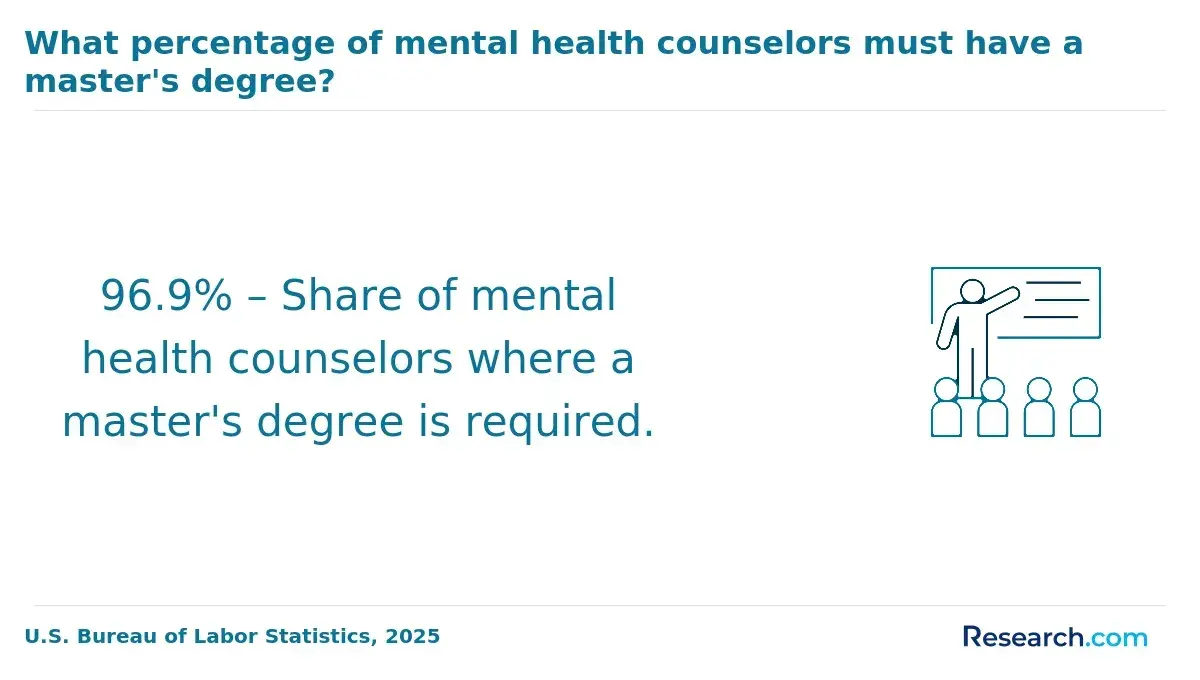
The most important distinction is which profession the curriculum prepares you to enter. Clinical mental health counseling focuses on assessment and treatment in behavioral health settings. School counseling focuses on students' academic, career, and social-emotional development. Rehabilitation counseling emphasizes disability, access, and employment. In Utah, these paths should be checked against different authorities: the Division of Professional Licensing for regulated clinical practice and the Utah State Board of Education for school-based educator credentials. A general psychology master's or short counseling certificate should not be assumed to substitute for a qualifying counseling degree.
Where can I work with an online Counseling degree in Utah?
Clinical-track graduates may pursue roles in community behavioral health, hospitals, private practices, or substance use treatment organizations, subject to the license and supervision required for the position. School-track graduates may work in Utah public schools if they meet Utah State Board of Education requirements. Rehabilitation-track graduates may seek disability services, vocational rehabilitation, or employment-support roles. These settings call for different training, so choose the workplace you want before choosing a degree title.
Location also affects fieldwork. A student outside the Wasatch Front may have fewer nearby placement choices and should ask whether a program approves supervisors and sites in their area. Someone planning to practice outside Utah should ask the destination state's board whether the curriculum and supervised experience satisfy its rules; a Utah placement does not establish nationwide licensure eligibility.
The U.S. Bureau of Labor Statistics reports a May 2025 U.S. median annual wage of $59,350 for substance abuse, behavioral disorder, and mental health counselors. This is a useful benchmark for a clinical or addiction-counseling goal, but it combines workers with different credentials and experience levels. It is not a starting salary, a Utah-specific wage, or evidence that a particular master's pays for itself.
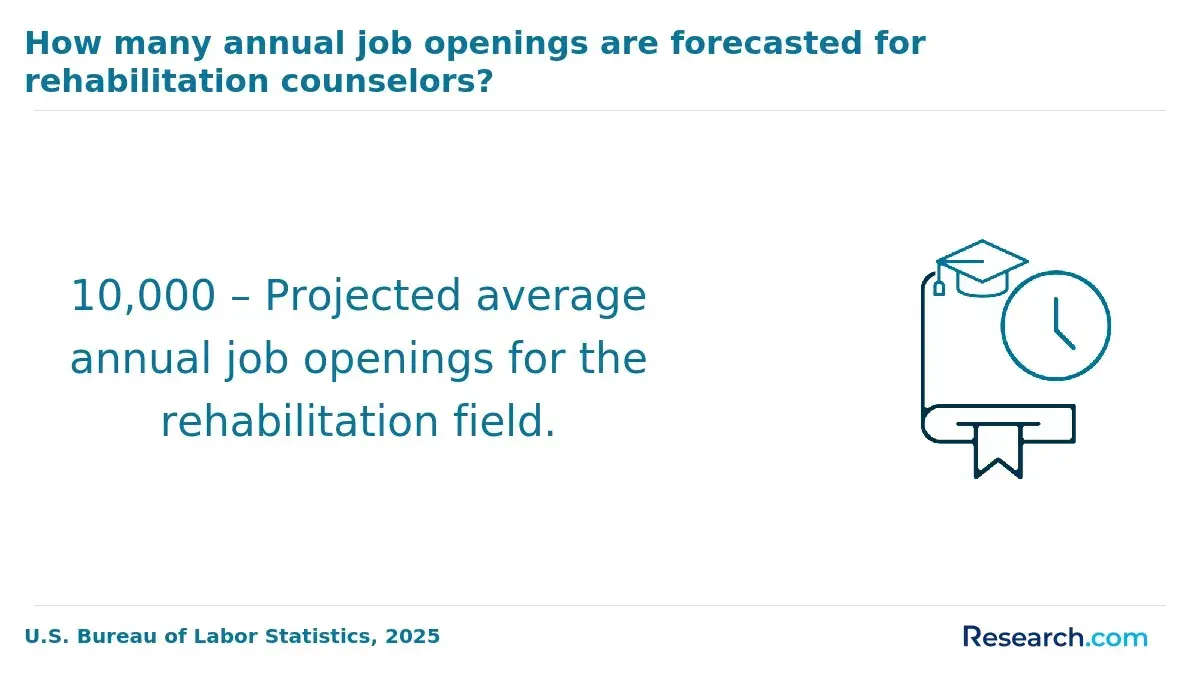
Specialty matters: the BLS national median for rehabilitation counselors was $46,850 in May 2025. That difference is a reason to compare the occupation associated with each degree - not to assume the higher-paying path is the better personal fit. For an investment decision, compare likely post-degree work with your current earnings, then account for tuition, borrowing, time away from work, and any period of supervised employment before independent practice.
These Utah programs point toward distinct counseling goals. Before treating any as an online option, confirm its current delivery format, required campus attendance, and whether it can arrange a placement where you live; a program website's description of the degree alone does not settle those questions.
Utah Valley University - clinical mental health counseling: UVU's program is specifically oriented toward clinical mental health counseling rather than school or rehabilitation practice (Utah Valley University). It is the more relevant program to investigate if your goal is clinical behavioral health work; ask UVU how its current coursework and supervised training align with Utah's clinical license requirements.
Rocky Mountain University of Health Professions - counseling: RMU's Master of Science in Counseling is offered within a health professions institution (Rocky Mountain University of Health Professions). For a student interested in health-related counseling settings, the useful comparison is its available track, placement support, and total program cost against clinical-focused alternatives - not the institution's name alone.
Utah State University - rehabilitation counseling: USU identifies its degree as a Master of Rehabilitation Counseling (Utah State University). Its disability and rehabilitation focus makes it a materially different choice from a clinical mental health degree for someone aiming at vocational rehabilitation or disability services; confirm the credential requirements for the particular role you want.
Program pages can change, and none of these distinctions establishes that a degree is fully online or independently qualifies a graduate for licensure. Request the current catalog, fieldwork handbook, accreditation information, and a written explanation of how the program supports your intended credential.
A counseling master's commonly takes about two to three years, depending on enrollment intensity, course sequencing, and when required fieldwork is available. Part-time study may make continued employment easier but extend the time until you can seek positions requiring the degree. An accelerated schedule only saves time if you can complete its supervised placement without delaying graduation.
When comparing the fastest counseling programs, ask for a term-by-term plan showing the earliest realistic graduation date for someone with your work schedule and placement location. Distinguish graduation from the additional supervised experience that may be needed for a Utah clinical license (Utah Division of Professional Licensing).
The meaningful difference is where and when you complete instruction - not whether you must demonstrate counseling skills. Both formats can include supervised face-to-face fieldwork. The comparison below identifies which format better fits common scheduling and placement constraints.
Decision factor
Online or hybrid program
On-campus program
Course attendance
May reduce routine travel; check for live sessions and required visits.
Requires regular campus attendance under the published schedule.
Supervised fieldwork
May allow a local site if the program approves it and can arrange supervision.
May offer easier access to established nearby sites, but placement still requires approval.
Best fit
Students who need geographic flexibility and can secure an approved placement.
Students who value in-person instruction and can commute consistently.
For a rural Utah student, local placement approval can matter more than online lectures. For a student near campus, an on-campus program may be simpler if its fieldwork network fits the intended specialty. Ask whether any residency, skills assessment, or placement meeting requires travel before assuming one format is cheaper.
There is no single dependable price for an "online counseling master's in Utah": programs differ in credit requirements, residency classification, fees, and fieldwork expenses. NCES/IPEDS tuition figures describe institutional charges and may not capture the exact price of a particular graduate program. Without comparable current program totals, an asserted Utah average would be less useful than an itemized quote.
Compare the most affordable counseling programs by requesting each school's total estimated tuition and mandatory fees for your residency status and expected enrollment pace. Add travel or lodging for required visits, placement-related expenses, and income you might forgo during intensive fieldwork. A lower per-credit price is not necessarily a lower total cost, and public institutions' resident rates should not be assumed to apply to every online graduate student.
Start with the Free Application for Federal Student Aid and each school's graduate aid office. Eligible graduate students may be considered for federal Direct Unsubsidized Loans; institutional scholarships, assistantships, employer tuition support, and relevant workforce funding may also be available. Federal eligibility depends on factors including the institution and program, enrollment, and the student's circumstances (Federal Student Aid). Do not assume that a graduate program offers the same grants as undergraduate study.
Ask the school for an aid offer based on your intended online enrollment pattern and confirm whether a slower course load changes eligibility. Borrow only after comparing the full projected balance with the work you expect to pursue: a scholarship tied to full-time attendance, for example, may be less useful than a schedule that lets you keep earning while completing fieldwork.
View the chart data as a table
Programs by specialization (Source: Research.com)
Category
Value
Clinical Mental Health Counseling
2
School Counseling
1
Rehabilitation Counseling
1
Applicants generally need a bachelor's degree, transcripts, and materials showing readiness for graduate study; individual counseling programs may also require prerequisite coursework, references, an interview, or a statement of purpose. Requirements vary by school and track, so a nonpsychology bachelor's degree should not automatically rule you out - or establish that you have met every prerequisite (Utah Valley University; Rocky Mountain University of Health Professions; Utah State University).
Review the published requirements for your intended track before paying an application fee. If you are comparing the easiest counseling programs to enter, separate admissions accessibility from the difficulty of securing placements and meeting professional credential requirements. Ask whether prior graduate credits can transfer, how many apply to this specific degree, and whether transfer work satisfies any required clinical sequence.
Expect coursework in counseling theories and techniques, ethics, assessment, human development, research or evaluation, and work with diverse clients. Clinical mental health curricula may emphasize diagnosis and treatment planning; school curricula emphasize the educational setting; rehabilitation curricula address disability and employment-related services. Supervised practicum and internship connect the classroom work to the population the degree is designed to serve.
Course titles are not enough to verify professional eligibility. Compare the current catalog and fieldwork handbook with the education rules for your intended Utah credential, including any required content and supervision standards (Utah Division of Professional Licensing; Utah State Board of Education).
Relevant paths include clinical mental health, school, rehabilitation, and, within some counseling curricula, a focus on substance use. A specialization can be a distinct degree or track rather than a small elective cluster. That distinction matters because adding a few courses on a topic does not necessarily prepare you for the credential or job associated with it.
Choose clinical mental health if your target is behavioral health treatment and the program fits the license you plan to seek. Choose school counseling for school-based student services, and rehabilitation counseling if disability and vocational access are your primary interests. If you want marriage and family therapy, compare that profession's separate Utah licensing requirements before assuming a counseling track is interchangeable (Utah Division of Professional Licensing; Utah State Board of Education).
Start with the job and credential you want, then evaluate programs against that destination. Accreditation, licensure alignment, and approved fieldwork matter more than an attractive delivery label. CACREP accreditation applies at the program level; institutional accreditation and federal aid eligibility answer different questions and should be verified separately (Council for Accreditation of Counseling and Related Educational Programs; U.S. Department of Education).
Use this sequence to turn a shortlist into a decision:
Identify your target role and confirm its degree, examination, and supervised-experience rules with the Utah Division of Professional Licensing or Utah State Board of Education.
Ask each program whether its current curriculum meets those education rules, how it approves local placements, and what on-campus attendance is required.
Request comparable total-cost estimates, completion timelines, and available program-level outcomes; ask what period each outcome covers.
Compare the resulting options against your earnings, debt tolerance, likelihood of completion, and expected years in the profession.
The most valuable counseling programs can help organize that comparison, but a ranking is not an individual return-on-investment calculation. Your calculation should include aid, borrowing, opportunity cost, baseline and possible post-degree earnings, completion probability, time horizon, and the value of future earnings in today's terms. A red flag is any claim that an online degree automatically provides a Utah license or a particular salary.
View the chart data as a table
Projected job growth 2025-2035 by counseling career path (U.S., BLS) (Source: BLS)
Category
Value
Mental Health Counselors
18
Marriage & Family Therapists
14
Postsecondary Teachers
7
Psychologists
6
School & Career Counselors
3
Rehabilitation Counselors
2
All occupations
3
A clinical mental health track can be a step toward counselor roles in behavioral health or addiction treatment; independent clinical practice may require a further supervised and examination pathway. A school counseling track targets education settings and the applicable school credential. A rehabilitation counseling degree is more directly aligned with disability and vocational services. Employers set job requirements, while Utah authorities set the requirements for state-regulated credentials (Utah Division of Professional Licensing; Utah State Board of Education).
For a working professional, the best career path may be the one that builds on existing experience. Someone already employed in a school should compare school-counseling credential routes; someone in disability services may find rehabilitation counseling a closer fit than a general clinical degree. If your desired job does not require a counseling master's or license, compare less costly training before committing to graduate school.
View the chart data as a table
Best score by program (Source: Research.com)
Category
Value
Utah State University
77.59
Rocky Mountain Universit
91.36
Rocky Mountain Universit
92.29
Utah Valley University
96
The U.S. Bureau of Labor Statistics projects 18% national employment growth from 2025 to 2035 for substance abuse, behavioral disorder, and mental health counselors. That indicates substantial projected demand for the occupational group, not a forecast that every Utah specialty, county, or new graduate will see the same opportunities.
Check current Utah postings for the exact credential and supervised status employers request. Compare opportunities near your intended fieldwork site as well as where you hope to live afterward; a degree that supports local placements may ease training logistics, while a narrow local job market may make geographic flexibility important. Treat national growth as context and employer requirements as the practical test of whether your chosen program fits.
2027 Best Online Master's in Counseling Degree Programs Ranking in Utah
Investing in graduate education is a consequential decision. Research.com developed this ranking to help readers compare programs using documented outcomes, accreditation, and cost rather than reputation alone. The team draws on multiple education datasets and checks how each measure applies to counseling programs; readers should still confirm current program details directly with schools.
These sources inform the ranking and provide complementary information on institutions, programs, and student outcomes:
IPEDS database: institutional reporting on enrollment, completion, and prices.
The Best ranking first combines program completion (40%), employment or doctoral admission (20%), applicable licensure-exam pass rates (20%), applicable CACREP accreditation (16%), and institutional Title IV eligibility (4%). Shares are adjusted when a measure does not apply. Program cost then contributes a smaller component - about 7% of the final score. Online and on-campus programs use the same scoring approach; rankings focused on affordability, value, speed, or ease of admission order programs by their named dimension. Read more about Research.com's methodology. A ranking can narrow your shortlist, but it cannot establish whether a particular degree meets your intended Utah license requirements.
Bachelor's degree in any discipline from a regionally/nationally accredited institution, provided student meets prerequisite coursework: Abnormal Psychology, Research Methods, Statistics.
Additional requirements
Graduate application; official transcripts; minimum 3.0 cumulative GPA; TOEFL 79 iBT / IELTS 6.0 for non-native English speakers; three academic/professional recommendation letters; personal interview for qualifying applicants.
Accreditation
Accredited by the Council for Accreditation of Counseling and Related Educational Programs (CACREP), with institutional accreditation from the Northwest Commission on Colleges and Universities (NWCCU).
Utah Valley University earned a Research.com Counseling Program Score of 96.0/100, supported by 100% licensure exam pass rate and 96% program completion rate. The program is CACREP-accredited, valid through 2034-04-30.
# 2 position
Rocky Mountain University of Health Professions
Master
Master of Science in School Counseling
Delivery mode: hybrid
92.29
/ 100
Final score
Program length
2 1/2 To 3 Years
Specialization
School Counseling
Required credits
60 semester credits
GPA range
2.75 - 4.00
Application process
direct
GRE
Conditional: GRE, MAT, or PLT required if undergraduate GPA is below 3.0 (waived with a conferred master's degree or higher)
Prerequisites
Bachelor's degree from a regionally-accredited institution; minimum 2.75 cumulative GPA (if below 3.0, GRE/MAT/PLT scores from last five years required); acceptable undergraduate statistics or research methods course with a grade of C or higher.
Additional requirements
Three letters of recommendation, official transcripts from all prior institutions, non-refundable $250 admissions deposit.
Accreditation
Accredited by the Council for Accreditation of Counseling and Related Educational Programs (CACREP), with institutional accreditation from the Northwest Commission on Colleges and Universities (NWCCU).
Rocky Mountain University of Health Professions earned a Research.com Counseling Program Score of 92.29/100. The program is CACREP-accredited, valid through 2031-10-31.
# 3 position
Rocky Mountain University of Health Professions
Master
Master of Science in Clinical Mental Health Counseling
Delivery mode: hybrid
91.36
/ 100
Final score
Program length
2 1/2 to 3 years
Specialization
Clinical Mental Health Counseling
Required credits
60 semester credits
GPA range
2.75 - 4.00
Application process
direct
GRE
Conditional: GRE, MAT or PLT scores (within last 5 years) required if undergraduate GPA is below 3.0 (waived with a conferred master's degree or higher)
Prerequisites
Bachelor's degree from regionally-accredited institution; minimum 2.75 cumulative GPA (if below 3.0, GRE/MAT/PLT scores from last five years required); acceptable undergraduate statistics or research methods course with grade of C or higher.
Additional requirements
Completed online application; official transcripts from each prior institution; resume/CV; statement of professional goals; three letters of recommendation; interview with Counseling Program Admissions Committee.
Accreditation
Accredited by the Council for Accreditation of Counseling and Related Educational Programs (CACREP), with institutional accreditation from the Northwest Commission on Colleges and Universities (NWCCU).
Rocky Mountain University of Health Professions earned a Research.com Counseling Program Score of 91.36/100. The program is CACREP-accredited, valid through 2031-10-31.
# 4 position
Utah State University
Master
Master of Rehabilitation Counseling
Delivery mode: online
77.59
/ 100
Final score
Program length
Full Time Enrollment (2-year program)
Specialization
Rehabilitation Counseling
Required credits
61 semester credits
Acceptance rate
78.1%
GPA range
3.00 - 4.00
Program completion rate
38.8% (2025-26)
Employment or doctoral admission
100% (2025-26)
Licensure exam pass rate
93% (2024-25)
Application deadline
Fall semester - March 15
Application process
direct
GRE
no
Prerequisites
Students from any undergraduate background are welcome to apply.
Additional requirements
Online application; 3.0+ GPA on last 60 semester or 90 quarter credits; transcripts of all college/university credits; three contacts for letters of recommendation; letter of intent.
Accreditation
Accredited by the Council for Accreditation of Counseling and Related Educational Programs (CACREP), with institutional accreditation from the Northwest Commission on Colleges and Universities (NWCCU).
Utah State University earned a Research.com Counseling Program Score of 77.59/100, supported by 93% licensure exam pass rate and 38.8% program completion rate. The program is CACREP-accredited, valid through 2028-03-31.
Frequently asked questions about online Counseling degree in Utah
Can I become a licensed Utah counselor with an online master's?
Potentially, but online delivery alone establishes nothing about eligibility. Check the specific degree, curriculum, supervised training, examination, and post-degree requirements with the Utah Division of Professional Licensing before enrolling.
Are online counseling master's programs entirely remote?
Not necessarily. Programs may require in-person supervised placements, live meetings, skills assessments, or campus visits. Obtain the current attendance and fieldwork requirements in writing.
Is CACREP accreditation the same as university accreditation?
No. CACREP accredits eligible counseling programs, while institutional accreditation concerns the institution. Verify both separately and ask Utah's relevant authority how your chosen program's credentials apply to your intended license.
Can I work full time while earning the degree?
Online coursework may allow it, particularly early on. Fieldwork hours can make full-time employment harder, so ask for the placement schedule before choosing a study pace.
Is a counseling master's worth the cost?
It may be if it leads toward the work you want and you can manage the total cost and training timeline. Compare the qualifying credential, aid and debt, foregone earnings, and realistic job options - not just advertised tuition or national median wages.
See What Experts Have To Say About Studying Counseling
Utah Valley University - Clinical Mental Health Counseling, M.S. Official program page (curriculum, tuition, admissions). https://www.uvu.edu/cmhc/
Rocky Mountain University of Health Professions - Master of Science in School Counseling Official program page (curriculum, tuition, admissions). https://rm.edu/master-of-science-in-counseling/
Rocky Mountain University of Health Professions - Master of Science in Clinical Mental Health Counseling Official program page (curriculum, tuition, admissions). https://rm.edu/master-of-science-in-counseling/