Choosing a Maryland counseling master's program means choosing a career pathway, not just a campus: a degree designed for school counseling may not meet the requirements for clinical licensure. This guide compares program focus, accreditation, cost, training, and career prospects for prospective students and working professionals. It also features a 2027 Best Master's in Counseling Degree Programs Ranking in Maryland, created by the Research.com team of data scientists to help students make an informed choice about which programs are worth considering. Use the comparisons to narrow your options before applying.
Key findings about Counseling degrees in Maryland
Match the degree to the credential first: Maryland clinical professional counselor licensure and school counselor certification follow different state requirements (Maryland Board of Professional Counselors and Therapists; Maryland State Department of Education).
National median annual pay was $59,350 for the BLS occupation covering mental health and addiction counselors and $64,330 for school and career counselors in May 2025. These are occupational medians, not starting salaries or Maryland program outcomes (U.S. Bureau of Labor Statistics).
National employment in the occupation covering mental health and addiction counselors is projected to grow 18% from 2025 to 2035. That outlook makes clinical training worth investigating, but it does not predict an individual graduate's job prospects (U.S. Bureau of Labor Statistics).
What can I expect from a Counseling degree in Maryland?
A counseling master's combines study of human development, assessment, ethics, and counseling methods with supervised work involving clients or students. The crucial distinction is the intended credential. Clinical mental health counseling generally points toward professional counselor licensure; school counseling toward a school-based credential; and rehabilitation counseling toward work involving disability, employment, and access to services. Those routes are not interchangeable simply because their course titles overlap.
In Maryland, students targeting the licensed clinical professional counselor, or LCPC, pathway should compare each curriculum against the education requirements published by the Maryland Board of Professional Counselors and Therapists. Aspiring school counselors should instead check Maryland State Department of Education certification requirements. CACREP accreditation identifies a counseling program that meets that accreditor's standards, but neither accreditation nor graduation alone awards a state credential (CACREP; Maryland Board of Professional Counselors and Therapists; Maryland State Department of Education).
Start with your intended job setting. A prospective school counselor should not choose a clinical program solely because it offers more therapy electives; a prospective therapist should not assume a school counseling degree supplies every course required for clinical licensure. Program popularity can help identify options to investigate, but the most popular counseling programs still need to be checked against your goal.
Where can I work with a Counseling degree in Maryland?
The workplace depends on the specialization and any credential earned after graduation. Clinical-pathway graduates may seek supervised roles in community mental health, hospitals, substance-use treatment, or group practices; independent clinical practice requires the applicable Maryland license. School counseling graduates generally pursue positions in public or private schools, subject to employer and certification rules. Rehabilitation-focused graduates may work with disability-service organizations, vocational programs, or health systems (Maryland Board of Professional Counselors and Therapists; Maryland State Department of Education; U.S. Bureau of Labor Statistics).
Location matters because a field placement can become a professional connection, while repeated travel to a placement adds time and expense. A student near Baltimore or the Washington, DC, area may have different placement options and commuting constraints from one studying on the Eastern Shore. Ask each program where students actually complete supervised training and whether those sites fit the setting in which you hope to work.
Pay varies by occupation, employer, experience, and credential. The table uses national occupational medians from the U.S. Bureau of Labor Statistics for May 2025 - not Maryland-specific wages, first-job offers, or earnings attributable to a particular master's program. Use it to compare career directions, then investigate pay for the Maryland settings where you intend to apply.
Career direction
National median annual pay, May 2025
What to check locally
Clinical mental health or addiction counseling
$59,350
Whether the role is supervised or independently licensed
School counseling
$64,330
School-system salary schedules and required certification
Rehabilitation counseling
$46,850
Employer setting and preferred credentials
A higher occupational median does not establish a better return on investment. Compare the pay you could plausibly obtain after meeting credential requirements with your current earnings, borrowing needs, and time away from work (U.S. Bureau of Labor Statistics).
These programs differ most usefully by the work they prepare students to do and where that preparation takes place. The highlights identify program-specific features to investigate; confirm current credits, placement arrangements, accreditation status, and credential alignment directly with each school before applying.
Bowie State University, M. Ed. in School Counseling: This is a school-focused education degree rather than Bowie State's mental health counseling route. It warrants a closer look from applicants seeking Maryland school counselor certification; ask how its field placements and coursework map to the current state requirements (Bowie State University; Maryland State Department of Education).
Johns Hopkins University, M.S. in Counseling: Its counseling degree offers distinct clinical mental health and school counseling pathways. That breadth is useful if you want to compare those professions within one university, but you should evaluate the curriculum and credential outcomes of the specific pathway you would enter (Johns Hopkins University School of Education).
University of Maryland Eastern Shore, M.S. in Rehabilitation Counseling: Its defined rehabilitation focus distinguishes it from the school and mental health options here. Consider it if disability-related counseling and vocational services match your goal; do not assume its coursework substitutes for a clinical mental health licensure curriculum (University of Maryland Eastern Shore).
Hood College, School Counseling: Hood offers a school counseling option in Frederick, making location and access to appropriate school placements especially relevant for students who need to remain in that area. Compare its certification preparation with clinical programs only after deciding which credential you need (Hood College; Maryland State Department of Education).
Loyola University Maryland, School Counseling: Loyola's master's is explicitly organized around school counseling rather than a general counseling credential. Applicants planning to work with students should ask how supervised school experience is arranged and documented for Maryland certification (Loyola University Maryland; Maryland State Department of Education).
Hood College, Clinical Mental Health Counseling: Unlike Hood's school counseling option, this program is directed toward clinical mental health practice. It is the more relevant Hood pathway for a prospective therapist, provided its current coursework and supervised training satisfy the licensing board requirements applicable to that student (Hood College; Maryland Board of Professional Counselors and Therapists).
Bowie State University, Mental Health Counseling: This route gives applicants a clinical alternative to Bowie State's school counseling M. Ed. Its value depends on whether its current degree requirements, field training, and postgraduation supervision plan fit the Maryland license you intend to pursue (Bowie State University; Maryland Board of Professional Counselors and Therapists).
A full-time counseling master's commonly takes about two years; part-time study often takes three years or longer. This is planning guidance, not a completion-time claim for every Maryland program. The actual schedule depends on course sequencing, required supervised training, summer enrollment, and whether suitable placement sites are available when you need them (CACREP; institution program curricula).
For working adults, the shortest advertised timeline may not be the cheapest practical option. Ask when required courses meet, whether fieldwork can fit your work hours, and whether delaying an internship would add a semester of tuition and living costs. Also separate time to degree from time to independent practice: Maryland clinical licensure has requirements beyond the master's, including supervised experience and examination requirements (Maryland Board of Professional Counselors and Therapists).
Online delivery changes where you take academic classes; it does not remove the need for supervised training. Campus study may simplify face-to-face contact with classmates and local placement staff, while online coursework can reduce routine travel for a student who can arrange an acceptable placement near home. Neither format is automatically more compatible with Maryland licensure or certification (CACREP; Maryland Board of Professional Counselors and Therapists; Maryland State Department of Education).
Before choosing an online program - particularly one based outside Maryland - request written answers about Maryland credential alignment, placement-site approval, on-site attendance requirements, and who finds and supervises placements. A flexible class schedule is of limited use if required field hours conflict with your job or a site will not accept the program's placement agreement.
There is no single reliable Maryland-wide price for a counseling master's: programs differ in credits, public or private tuition policies, fees, and time to completion. Published graduate tuition may also be quoted per credit or per term, so an apparent price comparison can conceal a different total course load. At a public university, verify your residency classification and the tuition schedule that applies to your program; at any institution, ask whether fieldwork, technology, or insurance carries additional charges (institution tuition schedules; NCES IPEDS).
Build a full-program estimate from required credits, mandatory fees, books, travel to placements, and income you may forgo during supervised training. Compare that figure after grants and employer support, not just the advertised tuition rate. The most affordable counseling programs offer a useful shortlist, but request a current, program-specific cost estimate before deciding.
Graduate students should first ask each program about assistantships, scholarships, tuition discounts, and paid or unpaid placement expectations. Eligible students can also complete the Free Application for Federal Student Aid to be considered for available federal graduate aid; borrowing eligibility and limits depend on current federal rules and individual circumstances (Federal Student Aid). Maryland residents should check current graduate scholarship opportunities and eligibility with the Maryland Higher Education Commission rather than assuming an award offered to undergraduates extends to a master's program (Maryland Higher Education Commission).
If an employer offers tuition support, verify its service commitment and whether it covers courses taken before reimbursement approval. Compare aid offers by the amount you would still need to borrow for the whole degree. A larger scholarship attached to a substantially higher total price may leave you with more debt.
View the chart data as a table
Median wage by U.S. state - Mental Health Counselors (BLS OEWS, May 2025) (Source: BLS)
State
Value
AK
80,770
AL
47,310
AR
51,580
AZ
65,300
CA
59,250
CO
62,390
CT
63,590
DC
60,450
DE
56,020
FL
56,790
GA
58,960
HI
60,090
IA
60,880
ID
63,360
IL
60,730
IN
53,760
KS
59,470
KY
54,190
LA
37,910
MA
59,890
MD
59,530
ME
59,970
MI
61,690
MN
58,780
MO
56,910
MS
46,990
MT
59,000
NC
55,490
ND
68,630
NE
63,770
NH
54,840
NJ
62,820
NM
74,100
NV
57,210
NY
59,450
OH
58,360
OK
59,350
OR
74,590
PA
52,010
PR
46,790
RI
65,120
SC
52,370
SD
53,650
TN
49,580
TX
62,630
UT
63,890
VA
59,880
VT
61,810
WA
68,910
WI
62,220
WV
49,430
WY
62,980
Programs typically ask for a bachelor's degree, transcripts, recommendations, a statement of purpose, and evidence that the applicant understands the profession; individual schools may add an interview or prerequisite coursework. Confirm requirements with the current admissions page because they can differ between a university's school and clinical counseling tracks (institution admissions pages).
Admissions eligibility is not the same as eventual licensure eligibility. If you already have graduate credits, ask for a written transfer-credit evaluation identifying which required courses would still need to be completed. Before paying an application deposit, also request the program's current accreditation information and a course-by-course explanation of how its curriculum supports the Maryland credential you want (CACREP; Maryland Board of Professional Counselors and Therapists; Maryland State Department of Education).
Expect coursework in counseling theories and techniques, ethics, assessment, human development, research, and working with clients from different backgrounds, followed by supervised practice. Clinical programs generally place greater emphasis on diagnosis and mental health treatment; school programs focus on counseling in educational settings; rehabilitation programs address disability and vocational concerns. Exact course titles and requirements vary, so compare syllabi and fieldwork descriptions rather than relying on the degree name (CACREP; institution program curricula).
For a prospective Maryland clinician, a course checklist matters more than an elective that sounds appealing: missing board-required content may require additional study later. For a future school counselor, ask whether school-based practice is built into the required sequence rather than treated as an optional placement (Maryland Board of Professional Counselors and Therapists; Maryland State Department of Education).
The principal choice in this Maryland program set is among clinical mental health, school, and rehabilitation counseling. Clinical mental health is the clearest starting point for someone pursuing professional counseling practice; school counseling fits applicants committed to student services; rehabilitation counseling fits those interested in disability-related and vocational work. Some programs house more than one pathway, but a shared degree name does not mean the pathways have identical courses or outcomes (Bowie State University; Johns Hopkins University School of Education; University of Maryland Eastern Shore).
Choose the specialization by the role and credential you intend to seek, then consider electives. If you are unsure whether you want to practice in schools or provide clinical therapy, ask both program directors which credits could carry across pathways before enrolling. Changing direction after fieldwork begins can extend your timeline.
The best choice is the program that fits your intended credential and finances while giving you a workable route through supervised training. A ranking helps prioritize research; it cannot resolve a mismatch between a degree and the job you want. The most valuable counseling programs can inform a shortlist, but your own return depends on more than an institutional score.
Use these checks in order so that a lower sticker price or convenient format does not distract from a credential problem:
Name the job and Maryland credential you want; obtain the current requirements from the relevant state board or education agency.
Ask each program for current programmatic accreditation status and written guidance on how its required courses and fieldwork align with that credential.
Request a placement plan, including site availability, supervision arrangements, scheduling, and any costs the student must cover.
Compare total price after aid, likely borrowing, time to completion, and the earnings you would give up while studying; ask for program-level completion and employment outcomes when available.
To judge whether the degree is worth it for you, consider your current earnings, plausible post-degree earnings, debt payments, completion likelihood, and how long you expect to work in the field. Do not treat a national occupational median as a graduate earnings forecast. Red flags include vague answers about state credential alignment, an unclear placement process, and a price quote that excludes mandatory fees.
View the chart data as a table
Best score distribution across ranked programs (Source: Research.com)
Category
Value
91-90
3
92-91
1
92-92
1
92-92
2
93-92
0
94-93
0
94-94
1
A clinical mental health pathway can lead first to supervised counseling work and, after the applicable postdegree requirements are met, potentially to independent clinical practice. A school pathway leads toward school counselor roles through the relevant certification process. Rehabilitation graduates may pursue vocational, disability-service, or rehabilitation counseling roles, with additional credentials depending on the employer and position (Maryland Board of Professional Counselors and Therapists; Maryland State Department of Education; U.S. Bureau of Labor Statistics).
These paths involve different workdays. If you want ongoing therapy with clients, prioritize clinical curriculum and supervision planning. If you want to support students within a school system, prioritize school-based fieldwork and certification alignment. If neither role appeals to you, a different helping-profession degree or a shorter credential may be a better investment than a counseling master's.
View the chart data as a table
Wage range - Mental Health Counselors in Maryland (BLS OEWS, May 2025) (Source: BLS)
Category
Value
10th percentile
44,050
25th percentile
50,030
Median
59,530
75th percentile
73,220
90th percentile
91,980
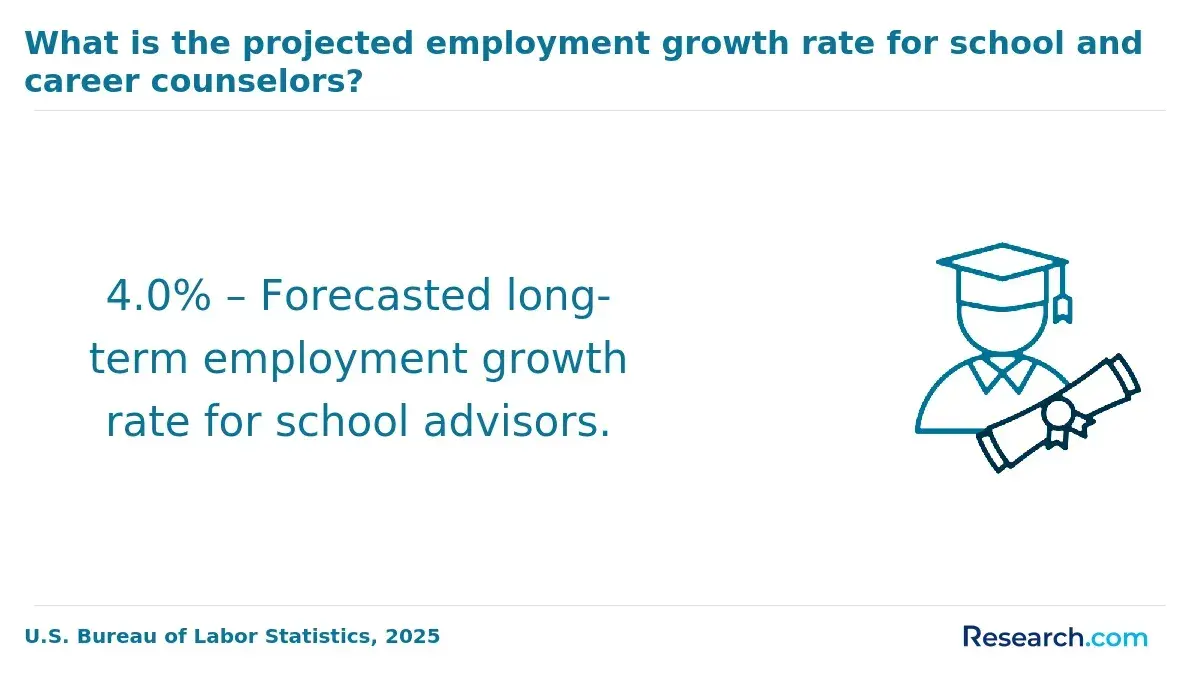
Nationally, employment for the BLS occupation that includes mental health and addiction counselors is projected to grow 18% from 2025 to 2035, compared with 3% for school and career counselors. These are U.S. occupational projections, not Maryland vacancy counts; they indicate different broad growth conditions but do not establish which individual program will lead to a job (U.S. Bureau of Labor Statistics, Employment Projections).
For a Maryland-specific job search, review postings in the part of the state where you can work and record the credential, supervision status, schedule, and setting each employer requires. A growing occupation is not a substitute for the appropriate license or certification, and an appealing job opening may be inaccessible without the supervised experience completed after graduation. Programs with placement connections in your intended commuting area may be more practical than a distant option with a similar curriculum.
2027 Best Master's in Counseling Degree Programs Ranking in Maryland
Investing in graduate education is a consequential decision. Research.com created this ranking to help readers compare programs using evidence about outcomes, recognition, and cost rather than reputation alone. Its team checks and combines data from multiple sources to improve the ranking's quality, credibility, and accuracy.
The Best ranking begins with a graduate-outcomes-and-accreditation score: program completion accounts for 40%; employment or doctoral admission, 20%; applicable licensure exam pass rates, 20%; CACREP programmatic accreditation, 16%; and institutional federal Title IV eligibility, 4%. Shares are renormalized when a criterion does not apply. Program cost then contributes a smaller component - about 7% of the final score. Online and on-campus programs use the same method; rankings named for another dimension order programs by that dimension.
The ranking draws on these data sources, which readers can also use to investigate individual schools:
IPEDS database - institutional enrollment, completion, and price information.
A ranking is a starting point, not a determination that a degree meets your intended credential's requirements. Check the program's current curriculum and outcomes with the school, and consult Research.com's methodology for more about how the ranking was created.
# 1 position
Bowie State University
Master
Master of Education in School Counseling
Delivery mode: campus
94.31
/ 100
Final score
Program length
3 years full-time (Year One, Year Two, Year Three curriculum sequence)
Specialization
School Counseling
Required credits
60 semester credits
GPA range
2.75 - 4.00
Program completion rate
95% (2023-24)
Employment or doctoral admission
100% (2023-24)
Application deadline
Fall/Summer: April 1; Spring: Nov 1
Application process
direct
Prerequisites
Undergraduate transcripts in psychology or a related field and a minimum GPA of 2.75. Non-psychology majors must have a minimum of 12 undergraduate credits from the social sciences.
Additional requirements
BSU Graduate School application ($40 fee), undergraduate transcripts, three letters of recommendation (two from professors, one from a supervisor/professional), letter of interest/personal statement, face-to-face interview via Zoom
Accreditation
Accredited by the Council for Accreditation of Counseling and Related Educational Programs (CACREP), with institutional accreditation from the Middle States Commission on Higher Education (MSCHE).
Bowie State University earned a Research.com Counseling Program Score of 94.31/100, supported by 95% program completion rate and 100% employment or doctoral admission rate. The program is CACREP-accredited, valid through 2034-04-30.
# 2 position
Johns Hopkins University
Master
Master of Science in Counseling
Delivery mode: campus
92.73
/ 100
Final score
Program length
3 to 5 years
Specialization
Clinical Mental Health Counseling
Acceptance rate
23.43%
GPA range
3.00 - 4.00
Application deadline
Fall: January 21, 2027
Application process
direct
Prerequisites
Bachelor's degree from an accredited college or university
Additional requirements
Application, official transcripts from all accredited post-secondary institutions, résumé/CV, personal statement of goals, two letters of recommendation; qualified applicants invited to a group admission interview
Accreditation
Accredited by the Council for Accreditation of Counseling and Related Educational Programs (CACREP), with institutional accreditation from the Middle States Commission on Higher Education (MSCHE).
Johns Hopkins University earned a Research.com Counseling Program Score of 92.73/100. The program is CACREP-accredited, valid through 2029-10-31.
# 3 position
University of Maryland Eastern Shore
Master
M.S. in Rehabilitation Counseling
Delivery mode: hybrid
92.51
/ 100
Final score
Program length
2 ½ Years Curricular Sequence
Specialization
Rehabilitation Counseling
Required credits
60 semester credits
GPA range
3.00 - 4.00
Program completion rate
98% (2022-23)
Employment or doctoral admission
100% (2022-23)
Application deadline
Fall: May 1; Spring: November 1
Class size
12
Application process
direct
GRE
optional
Prerequisites
Introductory human services course (e.g., REHA 201, or Intro Psychology, Abnormal Psychology, Developmental Psychology, Intro Sociology) and a basic statistics course.
Additional requirements
Bachelor's degree with min 3.0 GPA (provisional 2.75-2.99), transcripts showing prerequisites, personal interview with Admission Committee, WES credential evaluation for international students.
Accreditation
Accredited by the Council for Accreditation of Counseling and Related Educational Programs (CACREP), with institutional accreditation from the Middle States Commission on Higher Education (MSCHE).
University of Maryland Eastern Shore earned a Research.com Counseling Program Score of 92.51/100, supported by 98% program completion rate and 100% employment or doctoral admission rate. The program is CACREP-accredited, valid through 2033-10-31.
# 4 position
Hood College
Master
Master of Science in Counseling
Delivery mode: campus
92.12
/ 100
Final score
Program length
Typical completion: approximately 2.5 to 3 years (varies by full-time or part-time enrollment)
Specialization
School Counseling
Required credits
60 semester credits
GPA range
3.00 - 4.00
Application deadline
Fall: February 1; Spring: October 1
Application process
direct
GRE
no
Prerequisites
Undergraduate education with a minimum 3.0 GPA; applicants below 3.0 may submit GRE scores for consideration. Undergraduate psychology coursework is strongly recommended.
Additional requirements
Online application, transcripts, personal statements addressing diverse experiences, resume, two letters of recommendation, and an interview.
Accreditation
Accredited by the Council for Accreditation of Counseling and Related Educational Programs (CACREP), with institutional accreditation from the Middle States Commission on Higher Education (MSCHE).
Hood College earned a Research.com Counseling Program Score of 92.12/100. The program is CACREP-accredited, valid through 2027-10-31.
# 5 position
Johns Hopkins University
Master
Master of Science in Counseling
Delivery mode: campus
91.67
/ 100
Final score
Program length
33 months (full-time plan of study)
Specialization
School Counseling
Acceptance rate
25.33%
GPA range
3.00 - 4.00
Application deadline
January 21, 2027
Application process
direct
Prerequisites
Bachelor's degree from an accredited college or university, minimum cumulative GPA of 3.0 (on a 4.0 scale) in all previous undergraduate and graduate studies.
Additional requirements
Application, official transcripts, résumé/CV, essay on motivation for counseling and the clinical mental health field, and two letters of recommendation; qualified applicants invited to a group interview.
Accreditation
Accredited by the Council for Accreditation of Counseling and Related Educational Programs (CACREP), with institutional accreditation from the Middle States Commission on Higher Education (MSCHE).
Johns Hopkins University earned a Research.com Counseling Program Score of 91.67/100. The program is CACREP-accredited, valid through 2029-10-31.
# 6 position
Loyola University Maryland
Master
M.Ed. in School Counseling
Delivery mode: hybrid
91.25
/ 100
Final score
Program length
two years full-time
Specialization
School Counseling
Required credits
60 semester credits
GPA range
3.00 - 4.00
Program completion rate
100%
Employment or doctoral admission
91%
Application deadline
Summer 2027: Mar 8, 2027
Application process
direct
GRE
no
Prerequisites
Bachelor's degree from an accredited institution by date of entry; undergraduate major does not need to be in psychology or a related field
Additional requirements
$60 application fee, essay, official transcripts, two professional/academic recommendations (school counseling recommendation form), official English language exam scores (if applicable), optional resume
Accreditation
Accredited by the Council for Accreditation of Counseling and Related Educational Programs (CACREP), with institutional accreditation from the Middle States Commission on Higher Education (MSCHE).
Loyola University Maryland earned a Research.com Counseling Program Score of 91.25/100, supported by 100% program completion rate and 91% employment or doctoral admission rate. The program is CACREP-accredited, valid through 2029-03-31.
# 7 position
Hood College
Master
M.S. in Counseling, Clinical Mental Health Counseling
Delivery mode: campus
91.19
/ 100
Final score
Program length
About 3 years full-time (average, 9 credits per semester)
Transcripts, personal statement, resume, two letters of recommendation, and an interview
Accreditation
Accredited by the Council for Accreditation of Counseling and Related Educational Programs (CACREP), with institutional accreditation from the Middle States Commission on Higher Education (MSCHE).
Hood College earned a Research.com Counseling Program Score of 91.19/100. The program is CACREP-accredited, valid through 2027-10-31.
# 8 position
Bowie State University
Master
Master of Arts in Mental Health Counseling
Delivery mode: campus
91.13
/ 100
Final score
Specialization
Clinical Mental Health Counseling
Required credits
60 semester credits
GPA range
3.00 - 4.00
Program completion rate
90% (2023-24)
Employment or doctoral admission
90% (2023-24)
Licensure exam pass rate
95% (2023-24)
Application deadline
Fall and Summer priority application deadline: August 1; all documents due June 30. Spring: November 1, including all documents.
Application process
direct
GRE
no
Prerequisites
Bachelor's degree from a regionally accredited institution; psychology or related undergraduate background. Non-psychology majors need at least 12 undergraduate social science credits. Program minimum GPA: 3.00.
Additional requirements
Graduate School application, undergraduate transcripts, resume, three signed recommendation letters on letterhead (two on graduate-study aptitude), personal statement, and phone or in-person interview.
Accreditation
Accredited by the Council for Accreditation of Counseling and Related Educational Programs (CACREP), with institutional accreditation from the Middle States Commission on Higher Education (MSCHE).
Bowie State University earned a Research.com Counseling Program Score of 91.13/100, supported by 95% licensure exam pass rate and 90% program completion rate. The program is CACREP-accredited, valid through 2034-04-30.
Frequently asked questions about Counseling degree in Maryland
Does a counseling master's automatically qualify me for Maryland licensure?
No. Maryland clinical professional counselor licensure has requirements beyond graduation, including applicable education, supervised experience, and examinations. Check your specific degree plan against the Maryland Board of Professional Counselors and Therapists' current rules.
Can I become a Maryland school counselor with a clinical mental health degree?
Do not assume so. School counselor certification is governed by the Maryland State Department of Education; ask the program and state agency whether your exact coursework and school-based experience meet the requirements.
Is CACREP accreditation required for every counseling job?
No single accreditation rule covers every job. CACREP accredits counseling programs, while Maryland credentials and employers set their own applicable requirements. Verify program status and your intended credential separately (CACREP; Maryland Board of Professional Counselors and Therapists; Maryland State Department of Education).
Is an online counseling master's a practical choice if I live in Maryland?
It can be, if the program supports an acceptable local placement and its curriculum fits your intended Maryland credential. Get written confirmation of those points before enrolling, especially with an out-of-state school.
Should I choose the cheapest program?
Choose the lowest viable total cost, not simply the lowest tuition quote. Include fees, travel, lost work time, aid, and any extra study that would be needed if the degree does not align with your credential goal.
See What Experts Have To Say About Studying Counseling