Choosing a counseling master's program in South Carolina means looking beyond a school's name: the degree must fit your budget, clinical training needs, and licensure plans. This guide accompanies the 2027 Most Popular Clinical Mental Health Counseling Degree Programs Ranking in South Carolina, created by the Research.com team of data scientists to help students make an informed choice about programs worth considering. Whether you are finishing college or changing careers, you'll learn how to compare program structure, costs, accreditation, and career prospects before committing.
Key findings about Clinical Mental Health Counseling degrees in South Carolina
A licensure-oriented clinical mental health counseling master's commonly involves at least 60 semester credits under CACREP's 2024 standards; check South Carolina's licensing board requirements before enrolling, especially in an online or out-of-state program.
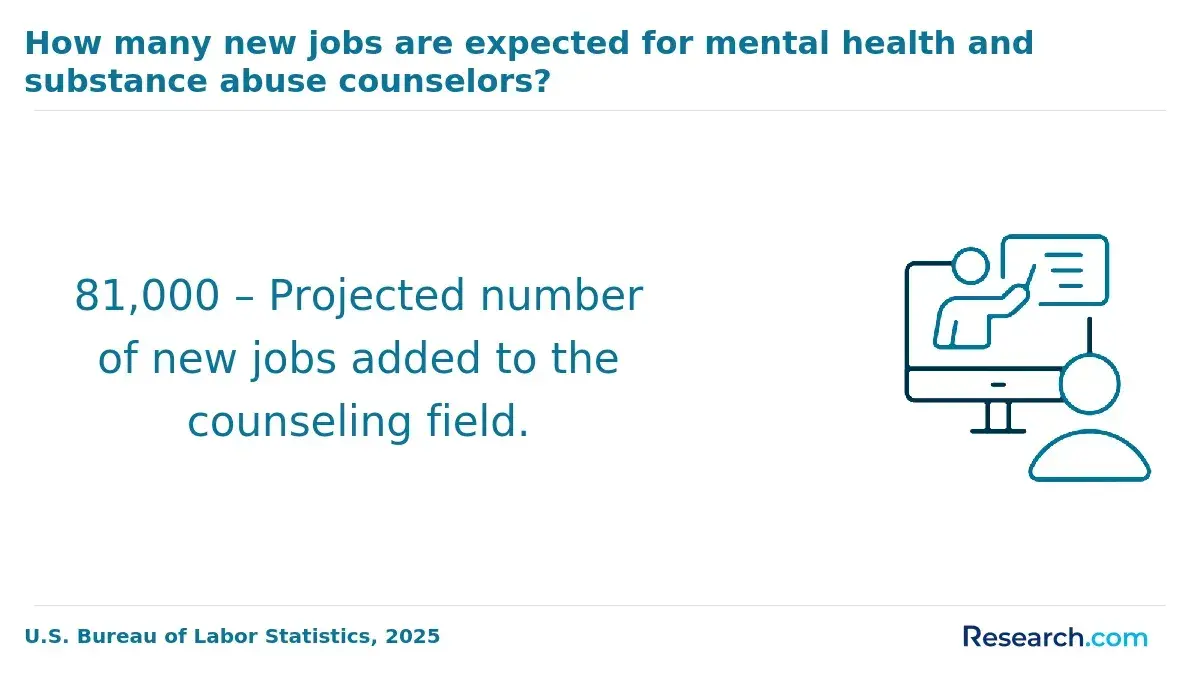
The U.S. median annual pay for the relevant substance abuse, behavioral disorder, and mental health counselor occupation was $59,350 in May 2025; BLS projects 18% national employment growth from 2025 to 2035. Neither figure predicts a particular graduate's pay or local job offer.
Compare each school's total program cost, placement arrangements, and time away from paid work - not popularity or advertised tuition alone. A program that is easier to attend may still be a poor investment if its clinical placements or curriculum do not fit your goals.
What can I expect from a Clinical Mental Health Counseling degree in South Carolina?
A clinical mental health counseling degree is generally a graduate program preparing students to assess concerns, develop treatment plans, and provide counseling under appropriate supervision. It is a sensible path for someone who wants to pursue professional counseling practice, rather than a shortcut to independent practice: graduation, supervised post-degree experience, examinations, and a state license are distinct steps. Requirements are set by the South Carolina licensing board, not by a ranking or a school's marketing description.
Expect coursework in counseling theories, diagnosis, ethics, assessment, and work with diverse clients, followed by supervised practicum and internship. CACREP's 2024 standards specify a minimum 60-semester-credit entry-level clinical mental health counseling curriculum and supervised field experiences. Ask how a school arranges placements near where you live; that answer can matter more than whether lectures are delivered online.
This route best fits students willing to undertake graduate study and supervised clinical work. Someone primarily interested in school-based counseling should compare school counseling programs and their separate credential requirements; someone seeking a shorter introduction to human services should not assume a certificate substitutes for a licensure-oriented master's.
Where can I work with a Clinical Mental Health Counseling degree in South Carolina?
Potential settings include community mental health services, hospitals, outpatient practices, substance-use treatment programs, and private practices, depending on the role and the counselor's license. In South Carolina, the practical question is where you can complete supervised training and, later, obtain appropriate supervision - not simply where a job posting appears. Compare placement support in the Columbia, Greenville, and Rock Hill areas with arrangements available in the community where you intend to live.
Employers may distinguish a graduate trainee or associate-level applicant from an independently licensed counselor. Confirm the credentials a position requires before counting it as a realistic post-graduation opportunity; South Carolina's licensing board governs professional counselor licensure.
The U.S. Bureau of Labor Statistics reports a $59,350 national median annual wage in May 2025 for substance abuse, behavioral disorder, and mental health counselors, the occupational group relevant to clinical mental health counseling. The figure covers workers with differing credentials, experience, and employers; it is not a South Carolina starting salary or an expected return from any particular master's program.
For an investment decision, compare a program's likely borrowing and foregone wages with your current earnings, the kinds of local roles you could pursue after graduation, and the time required to reach your intended license. The most valuable clinical mental health counseling programs are a useful additional comparison, but a personal return-on-investment estimate also depends on aid, debt, completion probability, future earnings, and how long you expect to work in the field.
These South Carolina options differ in program framing, institutional mission, and location. The distinctions below are starting points for comparison, not evidence that one school produces better licensing or employment outcomes; request current program-level figures before making that judgment.
Clemson University: Clemson presents clinical mental health counseling within its broader counselor education master's offerings (Clemson University). That structure may appeal to students comparing counseling paths before choosing a specialty; confirm the requirements and field placements for the clinical mental health track specifically.
Columbia International University: Its MA in Clinical Counseling is offered within an explicitly Christian institutional setting (Columbia International University). Students seeking faith-integrated training may value that fit, while others should review the curriculum and supervision arrangements against their own practice goals and South Carolina's licensing requirements.
Winthrop University: Winthrop identifies clinical mental health counseling as a specific program in Rock Hill (Winthrop University). Its location may make it a practical option for students whose work, home, or potential placements are in that area; ask how placement sites and supervision are secured.
South University-Columbia: South University advertises its MA in Clinical Mental Health Counseling through its Columbia location (South University). For a student considering Columbia-area access, the key comparison is the actual mix of campus and online instruction, available placement support, and the current total program price.
For all four, request a current handbook showing credits, practicum and internship requirements, completion results, and any published licensure-exam outcomes. A program label alone does not verify those measures or establish eligibility for licensure.
Plan on roughly two to three years of full-time study for a licensure-oriented master's; part-time enrollment can extend that to three to four years or longer, depending on course sequencing and placement availability. These are planning ranges, not promised completion times. CACREP's 2024 standards call for at least 60 semester credits in entry-level clinical mental health counseling programs, which helps explain why a brief graduate certificate is not an equivalent substitute.
An accelerated schedule may reduce time out of the workforce but make it harder to keep a full-time job during clinical training. Ask for a term-by-term plan that shows when daytime client-contact hours become necessary. If you have prior graduate credits, obtain a written transfer-credit evaluation before assuming they will shorten the program; schools may limit how older or externally completed clinical courses and fieldwork count.
The central difference is where academic instruction happens, not whether supervised clinical work is required. Online study may let a South Carolina student remain employed or live farther from campus, but practicum and internship still require approved sites, supervision, and scheduling. Campus study can simplify access to classmates, faculty, and nearby placement networks, although commuting may add time and expense.
An online program based outside South Carolina deserves an extra check: ask its licensure adviser to document how its curriculum and fieldwork address the South Carolina licensing board's requirements, and confirm the answer with the board. Also ask who finds placements, whether you may use a site near home, and whether any campus visits are mandatory. The mistake to avoid is equating "online" with "complete from anywhere without local clinical commitments."
There is no single reliable statewide average price for these master's programs: published charges may use semester credits, other credit systems, annual tuition, or different assumptions about enrollment and fees. Presenting one unsupported average would conceal the amount a student actually has to pay. Instead, request a full-program estimate from every school, based on your residency status and intended pace.
Compare tuition with mandatory fees, books, travel to placements, insurance or background-check expenses where required, and wages you may give up during fieldwork. Public-university residency rates can change the comparison with private institutions, but a lower sticker price is not automatically a lower net cost after aid. Use the most affordable clinical mental health counseling programs as a shortlist, then obtain current, individualized quotes. Ask whether tuition is fixed for the whole program and what happens to the estimate if completion takes an extra term.
Graduate students can investigate institutional scholarships or assistantships, employer tuition support, and federal aid for eligible students at eligible institutions. Complete the FAFSA and review the school's aid offer, but distinguish a grant or assistantship from a loan: borrowing reduces immediate cash pressure while increasing the eventual cost of the degree (Federal Student Aid).
Ask each financial aid office which awards actually apply to its counseling master's, whether an assistantship is compatible with practicum hours, and whether aid continues during internship terms. Do not assume a South Carolina undergraduate scholarship carries into graduate study. Federal loan availability and limits depend on current rules and individual eligibility; confirm the terms in effect for your enrollment period with Federal Student Aid and the school.
Typically, applicants need a bachelor's degree and must submit transcripts; programs may also request recommendations, a statement of purpose, an interview, or evidence of preparation for graduate-level behavioral science work. A psychology major may be helpful but should not be assumed mandatory: check each institution's current admissions page for prerequisite courses and whether they can be completed after admission.
Admission and eventual licensure are separate tests. Before paying an application deposit, ask the program to identify its current accreditation status, how its curriculum addresses South Carolina educational requirements, and whether it assists with local clinical placements. The South Carolina licensing board - not an admissions officer - has authority over the state credential.
A licensure-oriented curriculum commonly covers helping relationships, assessment, diagnosis, ethics, research, group counseling, and counseling across cultures and life stages. Clinical mental health coursework then connects those foundations to treatment planning, crisis response, and work in community or clinical settings (CACREP 2024 Standards). Supervised practicum and internship provide structured opportunities to apply those skills with clients.
Compare course content, not just titles. If you want to work with substance-use concerns or children, inspect the relevant classes and available placements. If a school advertises a distinctive elective, ask whether it runs often enough for you to take it without delaying graduation.
Programs may offer electives or field placements involving substance-use counseling, trauma, child and adolescent counseling, or work with couples and families. Availability varies by school and placement site; an elective is not automatically a separate credential. Ask whether a stated focus appears on the transcript, changes supervised-training requirements, or merely reflects a student-selected placement.
Choose a focus by working backward from the clients and roles you hope to serve. For example, someone committed to school counselor positions should compare a dedicated school counseling pathway rather than assume a clinical mental health emphasis satisfies school credential rules. Likewise, a student considering marriage and family therapy should check that profession's distinct licensing route with the South Carolina board.
Start with your intended credential and where you expect to practice, then compare only programs that can document a plausible route toward it. The best clinical mental health counseling programs offer another perspective, but ranking position should not replace a direct review of curriculum, outcomes, and cost.
These checks turn a school shortlist into a decision you can defend:
Confirm the degree's current institutional and programmatic accreditation status, and ask the South Carolina licensing board how the coursework fits the credential you intend to seek.
Request a written, term-by-term plan covering credits, total charges, required campus visits, and the timing of practicum and internship.
Ask who approves placements and supervisors, whether suitable sites exist near your home, and what happens if a placement falls through.
Request program-level completion and licensure-exam information where available; ask for the reporting period and denominator before interpreting a rate.
Compare net cost and realistic completion time against your current earnings, expected borrowing, and willingness to work under supervision after graduation.
A major red flag is an assurance that graduation automatically grants a license. Another is a low tuition quote that excludes fees or assumes clinical hours will fit around a full-time work schedule. Get consequential answers in writing before enrolling.
View the chart data as a table
Wage range - Mental Health Counselors in South Carolina (BLS OEWS, May 2025) (Source: BLS)
Category
Value
10th percentile
35,010
25th percentile
43,070
Median
52,370
75th percentile
65,070
90th percentile
81,420
Graduates may pursue supervised counseling roles and, after meeting the applicable requirements, professional counselor licensure. Depending on training and employer requirements, career directions can include community mental health, outpatient counseling, crisis services, or substance-use treatment. Independent practice is a later possibility for an appropriately licensed professional, not an automatic first job after the degree (South Carolina licensing board).
A practical career plan has two stages: identify employers and supervisors able to support your early clinical work, then assess what additional experience your preferred setting requires. Students who mainly want research, school counseling, or another regulated specialty should compare those education paths before committing to a clinical mental health degree.
View the chart data as a table
Graduates (2024-25) by program (Source: Research.com)
Category
Value
South University-Columbi
9
Winthrop University
20
Columbia International U
30
Clemson University
33
BLS projects 18% U.S. employment growth from 2025 to 2035 for substance abuse, behavioral disorder, and mental health counselors. That national projection indicates a growing occupational field, but it does not measure openings in a particular South Carolina county or guarantee that a new graduate will find a suitable supervised position there (U.S. Bureau of Labor Statistics, Employment Projections).
Use local job postings as a reality check: note required licenses, supervision availability, work settings, and commute distances. This is particularly important if you plan to remain outside a major metro area, where a program's ability to help arrange nearby fieldwork may shape both your training and your first job search. Compare postings over time rather than treating one week's vacancies as a forecast.
2027 Most Popular Clinical Mental Health Counseling Degree Programs Ranking in South Carolina
Investing in graduate education is a consequential decision. Research.com's team draws on education databases and checks program information to make its rankings useful for comparing schools, while recognizing that no ranking can determine whether a program fits an individual student's finances or licensure plans.
The following data sources were used to create the ranking:
IPEDS database: Institutional reporting on programs, enrollment, completions, and costs.
Research.com's counseling rankings consider graduate outcomes, licensure-exam results where applicable, accreditation and Title IV eligibility, and cost. Its separate Best ranking gives the greatest weight to completion, employment or doctoral admission, and applicable exam results; the popularity ranking instead orders programs by the dimension named in its title. Popularity is not a measure of licensure eligibility, affordability, or clinical quality. Use this ranking to identify programs to investigate, then confirm current requirements and costs directly with each school. Research.com explains its broader approach on its methodology page.
# 1 position
Clemson University
Master
Master of Education - Clinical Mental Health Counseling Specialization
Delivery mode: campus
49.10
/ 100
Final score
Program length
2 years (full-time, including summers)
Specialization
Clinical Mental Health Counseling
Required credits
60 semester credits
Acceptance rate
31%
GPA range
3.00 - 4.00
Employment or doctoral admission
100% (2024-25)
Licensure exam pass rate
96% (2025)
Application deadline
January 15 (summer entry only)
Class size
25
Application process
direct
GRE
no
Prerequisites
Bachelor's degree from a regionally accredited institution with minimum 3.0 GPA; no prerequisite coursework required
Additional requirements
Online Graduate School application, transcripts, TOEFL/IELTS for international students, other supporting materials; group interview for screened applicants
Accreditation
Accredited by the Council for Accreditation of Counseling and Related Educational Programs (CACREP), with institutional accreditation from the Southern Association of Colleges and Schools Commission on Colleges (SACSCOC).
Clemson University earned a Research.com Student Interest Score of 49.1/100, supported by 33 graduates (2024-25) and 96% licensure exam pass rate. The program is CACREP-accredited, valid through 2032-10-31.
# 2 position
Columbia International University
Master
Master of Arts in Clinical Counseling
Delivery mode: hybrid
47.80
/ 100
Final score
Program length
Typical completion: 3 years; completion deadline: 7 years
Specialization
Clinical Mental Health Counseling
Required credits
60 semester credits
GPA range
3.00 - 4.00
Program completion rate
71% (2024-25)
Employment or doctoral admission
100% (2024-25)
Licensure exam pass rate
95% (2024-25)
Application process
direct
GRE
no
Prerequisites
Undergraduate Introduction/General Psychology, and Old or New Testament Survey (or biblical competency exam), each with a minimum 'C' (or CLEP 50); applicants missing these may be conditionally accepted.
Additional requirements
Online application, application fee, affirmation of CIU's Statement of Faith, official transcripts (min 3.0 GPA on most recent degree), 800-word essay, professional reference, and an in-person or online interview.
Accreditation
Accredited by the Council for Accreditation of Counseling and Related Educational Programs (CACREP), with institutional accreditation from the Southern Association of Colleges and Schools Commission on Colleges (SACSCOC) and the Association for Biblical Higher Education, Commission on Accreditation (ABHE).
Columbia International University earned a Research.com Student Interest Score of 47.8/100, supported by 30 graduates (2024-25) and 71% program completion rate. The program is CACREP-accredited, valid through 2032-10-31.
# 3 position
Winthrop University
Master
Master of Education in Counseling and Development – Clinical Mental Health Counseling
Delivery mode: campus
42.40
/ 100
Final score
Program length
Typically 2 years
Specialization
Clinical Mental Health Counseling
Required credits
60 semester credits
GPA range
3.00 - 4.00
Program completion rate
86.9% (2025-26)
GRE
Conditional: GRE or MAT required if undergraduate GPA is below 3.0 (waived with a previous graduate degree)
Prerequisites
Admission review is based on five factors: GPA, GRE/MAT scores if GPA is under 3.0, letter of reference, and experience, followed by a group/individual interview process.
Additional requirements
GPA; GRE/MAT scores if GPA under 3.0; Letter of Reference; Experience; interview process consisting of group and individual interviews with faculty and students, a writing sample, and various surveys
Accreditation
Accredited by the Council for Accreditation of Counseling and Related Educational Programs (CACREP), with institutional accreditation from the Southern Association of Colleges and Schools Commission on Colleges (SACSCOC).
Winthrop University earned a Research.com Student Interest Score of 42.4/100, supported by 20 graduates (2025-26) and 86.9% program completion rate. The program is CACREP-accredited, valid through 2033-10-31.
# 4 position
South University-Columbia
Master
Master of Arts in Clinical Mental Health Counseling
Delivery mode: campus
32.10
/ 100
Final score
Program length
8 or 10 quarters
Specialization
Clinical Mental Health Counseling
Required credits
91 quarter credits
GPA range
2.30 - 4.00
Application process
direct
GRE
no
Prerequisites
Accredited bachelor's degree. GPA of at least 2.3 for the last 60 semester/90 quarter hours or overall; or a graduate degree with CGPA of at least 3.0. Non-native English speakers must meet the English proficiency requirement.
Additional requirements
Application; personal/professional statement on counseling goals and qualifications; official transcripts; résumé or career summary; background check; faculty interview; admissions committee approval; English proficiency if applicable.
Accreditation
Accredited by the Council for Accreditation of Counseling and Related Educational Programs (CACREP), with institutional accreditation from the Southern Association of Colleges and Schools Commission on Colleges (SACSCOC).
South University-Columbia earned a Research.com Student Interest Score of 32.1/100, with 9 graduates (2024 (calendar year, Jan 1 - Dec 31, 2024)) among the verified supporting factors. The program is CACREP-accredited, valid through 2033-10-31.
Frequently asked questions about Clinical Mental Health Counseling degree in South Carolina
Do I need a master's degree to become a licensed professional counselor in South Carolina?
A qualifying graduate education is part of the state's counselor-licensure pathway, but a degree alone is not a license. Check current education, supervised-experience, and examination requirements with the South Carolina licensing board before selecting a program.
Is a CACREP-accredited program required?
CACREP is programmatic accreditation that can make a counseling curriculum easier to evaluate against professional standards. Do not assume its presence - or absence - settles your individual eligibility; confirm the current rules with the South Carolina licensing board and verify the program's accreditation status directly.
Can I complete the degree online?
Academic coursework may be available online, but supervised practicum and internship still require approved clinical arrangements. Confirm placement support, any campus visits, and South Carolina licensure alignment before applying.
How long will the degree take?
Roughly two to three years full time is a reasonable planning range, with part-time study often taking longer. Ask the school for a schedule that includes fieldwork, not just classroom courses.
Is the degree worth the cost?
It may be if professional counseling is your intended career and the program provides a feasible route to the credential at a manageable net cost. Compare aid, borrowing, lost earnings during training, completion prospects, and your likely post-degree roles rather than using a national median salary as a personal earnings promise.