Choosing a counseling master's in Portland means looking beyond a program's name: its clinical training, total cost, and fit with Oregon licensure can change what the degree is worth to you. This guide is for prospective students and career changers comparing those trade-offs. It accompanies the 2027 Most Popular Clinical Mental Health Counseling Degree Programs Ranking in Portland, created by the Research.com team of data scientists to help students make an informed choice about programs worth considering. You'll learn how to compare options and plan a realistic path into practice.
Key findings about Clinical Mental Health Counseling degrees in Portland
A clinical mental health counseling master's is the usual educational route toward Oregon professional counselor licensure; verify each curriculum against Oregon Board of Licensed Professional Counselors and Therapists requirements before enrolling.
The U.S. Bureau of Labor Statistics reports a $59,350 national median annual wage in May 2025 for the broader substance abuse, behavioral disorder, and mental health counselors occupation. It is not a Portland starting-salary estimate.
BLS projects 18% national employment growth for that occupation from 2025 to 2035. Compare a program's clinical placements, schedule, and full attendance cost - not its popularity alone - to judge whether you can complete the path.
What can I expect from a Clinical Mental Health Counseling degree in Portland?
Expect a practice-oriented graduate degree that combines counseling theory, assessment, ethics, multicultural counseling, and supervised work with clients. Clinical mental health counseling focuses on treatment in settings such as community agencies, hospitals, and private practices; it is not interchangeable with a school counseling credential. Portland students should ask where they can complete required clinical work, since placement travel and daytime availability may matter as much as classroom scheduling.
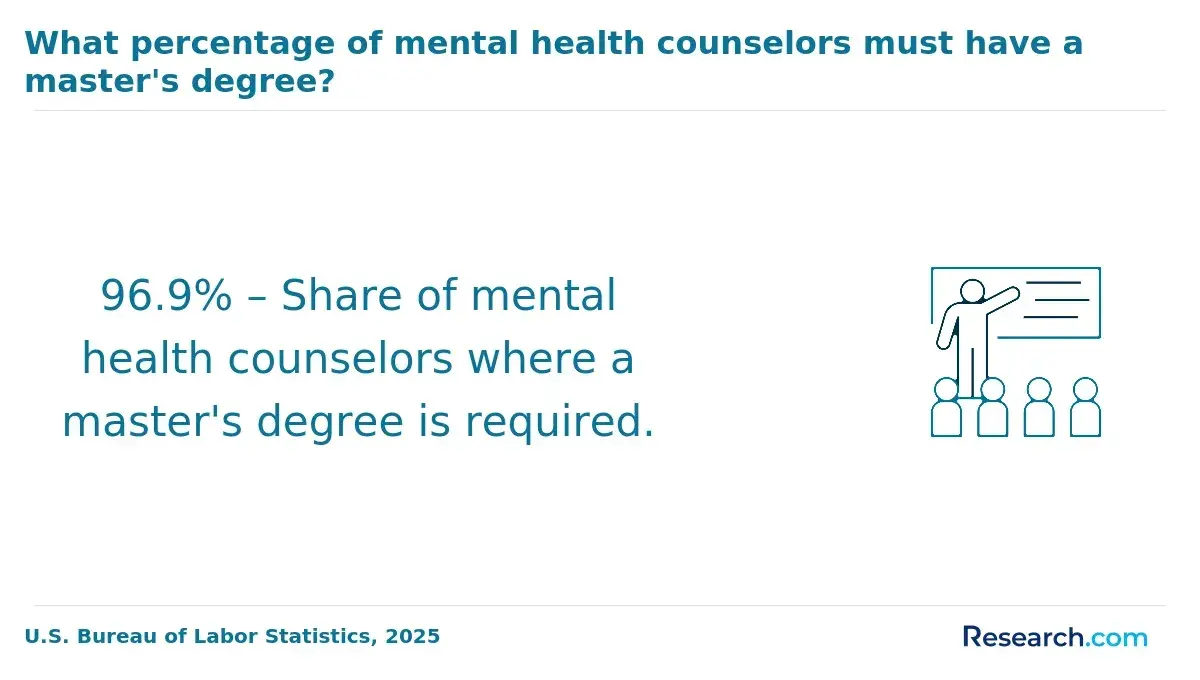
A master's is a sensible investment if you want to provide mental health counseling and can commit to supervised training after graduation. If your goal is school counseling, psychology licensure, or a nonclinical support role, compare the credential required for that job before paying for a clinical counseling degree. Oregon's Board of Licensed Professional Counselors and Therapists determines LPC eligibility; a diploma by itself does not confer a license.
Where can I work with a Clinical Mental Health Counseling degree in Portland?
Potential workplaces include community mental health providers, hospital and outpatient behavioral health teams, substance-use treatment programs, nonprofit agencies, and, after meeting applicable licensure requirements, private practices. In Portland, ask programs which local sites take their trainees and whether placements match your interests in crisis work, addiction treatment, or ongoing therapy. A placement can build relevant experience, but it should not be treated as a job offer.
Employers determine duties by credential and supervision status. Before full licensure, graduates should distinguish jobs open to a registered associate or other supervised practitioner from positions requiring an Oregon LPC. The Oregon Board of Licensed Professional Counselors and Therapists is the authority for state practice and supervision requirements.
The U.S. Bureau of Labor Statistics reports a $59,350 national median annual wage in May 2025 for substance abuse, behavioral disorder, and mental health counselors. This occupational group is broader than Portland clinical mental health counseling graduates: the figure includes workers with different specialties, employers, experience, and credentials. Use it as a national benchmark, not a forecast of your first offer or eventual private-practice income.
For a personal earnings estimate, compare Portland job postings that match the credential you will hold immediately after graduation with postings requiring an LPC. Account for benefits, paid supervision, and whether a role is salaried or paid per client session. A higher advertised rate may be less attractive if unpaid administrative time or self-funded benefits reduce effective compensation.
The Portland-area options below offer different reasons to investigate them. Compare these program features with current catalogs, clinical-placement policies, and Oregon's education requirements before treating any one feature as decisive.
Lewis & Clark College: Its professional mental health counseling offerings include an addictions specialization alongside the general counseling path (Lewis & Clark College). That defined curriculum choice is particularly useful if you want addiction-focused preparation rather than hoping to assemble it through electives.
Western Seminary: Its MA in Counseling combines counseling preparation with an explicitly Christian seminary setting and identifies the program as CACREP-accredited (Western Seminary). Among these choices, that integration is the clearest fit question: it may appeal to students seeking it, but applicants should review the curriculum and training sites against their own practice goals.
Portland State University: Its clinical mental health counseling program sits within a public university rather than a private college or seminary (Portland State University). That makes its published graduate tuition, residency rules, and fieldwork arrangements especially important comparison points for applicants weighing public-university access against the other programs' curricular emphasis.
These distinctions do not establish which program has the lowest net cost or strongest outcomes for you. For a different comparison lens, review the best clinical mental health counseling programs and verify any result that affects your decision with the school.
Plan on roughly two to three years of full-time master's study; part-time enrollment generally takes longer. The practical constraint is not just the number of courses: supervised practicum and internship schedules may require daytime hours even when classes meet in the evening. Ask each Portland program for a term-by-term plan showing when clinical work begins and whether a working student can realistically keep their job.
Graduation and independent practice are separate milestones. Oregon LPC applicants must meet the state board's applicable supervised-experience and examination requirements in addition to educational requirements (Oregon Board of Licensed Professional Counselors and Therapists). Include that post-degree stage in any career-change timeline.
Online coursework can reduce commuting, but it does not remove supervised clinical training or Oregon licensure checks. Campus study can make in-person contact with faculty and a local cohort easier; neither format automatically delivers a placement. The better choice is the one whose timetable and fieldwork arrangements you can complete without compromising required supervision.
The comparison below separates classroom convenience from clinical requirements so you can ask schools about the part that may be hardest to schedule.
Consideration
Online or hybrid
On-campus
Course access
May reduce routine travel; check for live or required in-person sessions.
Still requires an approved, supervised site; check who arranges it.
Also requires a supervised site; proximity does not assure placement.
Best fit
Students whose work or travel needs favor remote coursework.
Students who prefer a local classroom routine and cohort.
For any online program based outside Oregon, request written confirmation of how its curriculum and placement plan address Oregon LPC education requirements. The Oregon Board of Licensed Professional Counselors and Therapists, not the delivery format, governs eligibility to practice in the state.
There is no single reliable Portland-wide average that captures these programs' different tuition schedules and required clinical expenses. Use each school's current graduate tuition and mandatory-fee schedule to calculate a whole-program estimate, not just a cost per credit. Include books, travel to placements, potential lost work hours, and any charges the program identifies for clinical training.
Public and private status alone will not tell you the cheaper option after aid. Ask Portland State University how residency affects your applicable rate, and ask every school for the total credits required, expected completion schedule, and whether clinical placement can delay graduation. The most affordable clinical mental health counseling programs can help start a cost comparison, but your net price and time to completion determine what you would actually pay.
Start with each program's graduate assistantships, scholarships, and clinical-placement funding, then submit the FAFSA to establish eligibility for federal aid. Graduate students may qualify for Direct Unsubsidized Loans under federal rules; grants and institutional awards vary by school and student. A scholarship can also change the comparison between a public university and a private nonprofit institution.
Check borrowing rules for your start date. Federal Student Aid states that Graduate PLUS availability changed for new graduate borrowers beginning July 1, 2026, with limited exceptions for eligible existing borrowers. Do not build a financing plan around a Graduate PLUS loan without confirming your individual eligibility with Federal Student Aid and the school's aid office. Compare aid offers using the amount you would borrow over the entire program, including living expenses during clinical placements.
View the chart data as a table
Graduates (2024-25) by program (Source: Research.com)
Category
Value
Portland State Universit
14
Western Seminary
18
Lewis & Clark College
63
Applicants generally need a bachelor's degree and must meet the individual program's requirements for transcripts, references, written statements, and interviews. Schools may also evaluate readiness for supervised work with clients or require preparation in areas such as psychology and research methods. Check the current admissions page rather than assuming a particular undergraduate major is mandatory.
Admission is only the first eligibility check. Before accepting an offer, compare the proposed degree and coursework with Oregon Board of Licensed Professional Counselors and Therapists education rules. Ask how previous graduate credits are assessed for transfer; accepted credits may reduce coursework, but they do not automatically replace clinical requirements or satisfy licensure rules.
Core study commonly covers counseling skills, assessment and diagnosis, human development, ethics, research, multicultural counseling, group work, and supervised practicum and internship. Programs may organize substance-use treatment, trauma, or family-related topics differently. Compare syllabi and clinical requirements - not just course titles - if you need preparation for a particular population.
Because Oregon evaluates education for LPC eligibility, ask each school for its licensure-disclosure materials and an explanation of how its current curriculum addresses board requirements (Oregon Board of Licensed Professional Counselors and Therapists). CACREP accreditation is a program-level credential you can verify with CACREP; it should not be confused with institutional accreditation or treated as a substitute for checking your own licensure pathway.
Portland applicants can look for formal options such as Lewis & Clark College's addictions specialization or investigate how other programs cover interests such as trauma, family work, or community mental health through coursework and placements (Lewis & Clark College; Western Seminary; Portland State University). A named specialization and an elective are not equivalent: ask what appears on the transcript and whether it changes clinical placement opportunities.
Choose a specialization because it supports the clients and settings you want to work with, not because its name sounds more marketable. If school counseling is your goal, compare a dedicated school counseling pathway instead; a clinical mental health concentration should not be assumed to meet school-credential requirements.
Start with the career credential, then test each program against the constraints that could prevent you from finishing. A popular program is worth considering only if its curriculum, clinical schedule, and net cost fit your plan. The most valuable clinical mental health counseling programs offer another comparison, but a personal return-on-investment estimate must also account for aid, debt, completion likelihood, foregone earnings, and the time needed to reach a licensed role.
Ask admissions and program staff for answers you can compare side by side:
How does the current curriculum address Oregon LPC education requirements, and where can I verify programmatic accreditation?
Who finds and approves clinical sites, and when must students be available for practicum and internship?
What is my estimated full-program net cost, including fees and likely placement travel?
How many of my prior credits could transfer without disrupting the clinical sequence?
What completion and graduate-outcome information can the program document for recent cohorts?
A common mistake is choosing the lowest advertised tuition while ignoring an incompatible fieldwork schedule. Another is assuming that an online format, accreditation label, or ranking position independently confirms Oregon licensure eligibility. Resolve those questions before paying a deposit.
The degree can support a progression from supervised clinical work toward roles that require an Oregon LPC, subject to meeting board requirements. Depending on training and employer requirements, graduates may pursue community mental health counseling, outpatient behavioral health work, or substance-use counseling; later, some pursue private practice or supervisory responsibilities. The Oregon Board of Licensed Professional Counselors and Therapists sets LPC requirements, while employers set role-specific hiring criteria.
If you want to start helping clients but cannot take on a graduate degree and supervised pathway yet, investigate support roles separately and check their qualifications. If your long-term goal is independent psychotherapy, compare programs on the full route to licensure rather than the first job a graduate might obtain.
View the chart data as a table
Wage range - Mental Health Counselors in Oregon (BLS OEWS, May 2025) (Source: BLS)
Category
Value
10th percentile
49,860
25th percentile
60,130
Median
74,590
75th percentile
86,800
90th percentile
102,830
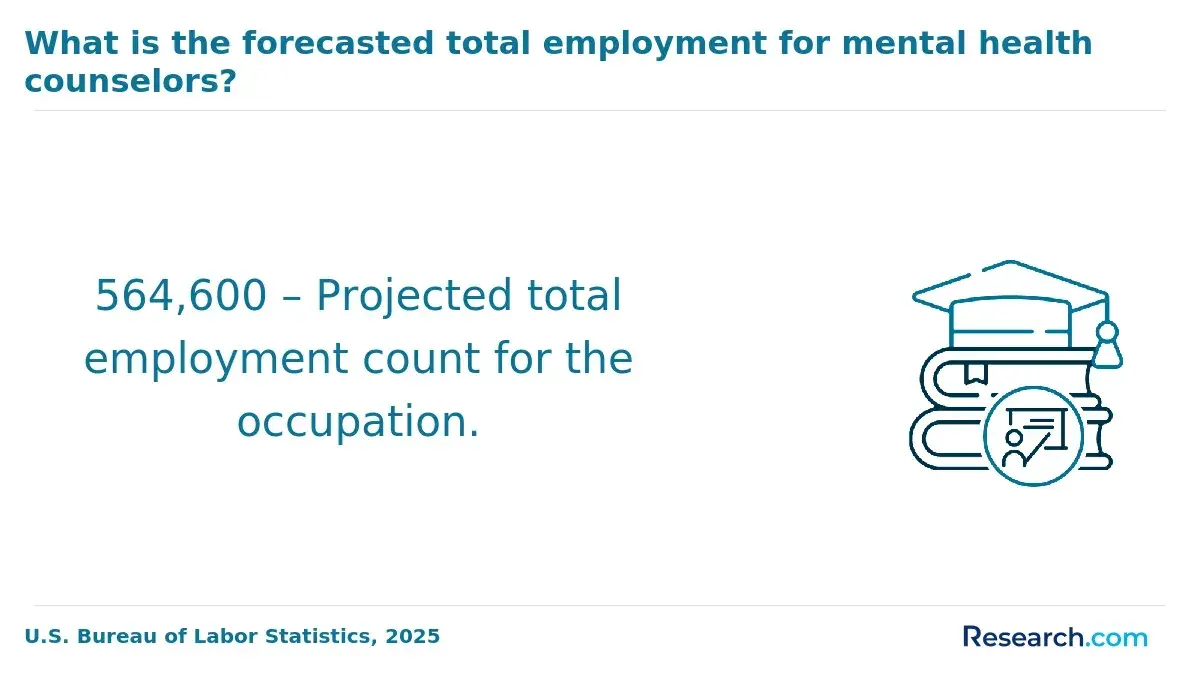
The U.S. Bureau of Labor Statistics projects 18% national employment growth from 2025 to 2035 for substance abuse, behavioral disorder, and mental health counselors. That projection indicates demand across the broader occupation, not a count of Portland vacancies or a guarantee of employment for a new graduate.
For a local decision, sample current Portland-area postings in the settings you would accept and record whether they require an LPC, accept supervised associates, or emphasize substance-use experience. Then ask prospective programs whether their clinical sites and coursework prepare students for those specific requirements. This makes national growth data useful without mistaking it for your personal job prospects.
2027 Most Popular Clinical Mental Health Counseling Degree Programs Ranking in Portland
Education is a substantial investment, so Research.com examines program information from multiple sources rather than asking readers to rely on a school's description alone. Its counseling rankings consider graduate outcomes, applicable licensure exam results, accreditation, federal aid eligibility, and cost. The Best ranking weights completion at 40%, employment or doctoral admission at 20%, applicable licensure exam results at 20%, CACREP recognition at 16%, and institutional Title IV eligibility at 4% within its outcomes-and-accreditation score; unavailable criteria are reweighted. Cost contributes about 7% of the final Best score. Rankings named for another dimension order programs by that dimension instead.
The team uses the following sources to check and compare institutional and program information:
IPEDS database - institutional enrollment, completions, and financial data.
This approach helps readers build a shortlist, not assume that popularity establishes licensure eligibility or personal value. Read more about Research.com's methodology, then confirm current program details directly with each school and the Oregon licensing board.
# 1 position
Lewis & Clark College
Master
Master of Arts in Professional Mental Health Counseling
Delivery mode: campus
57.90
/ 100
Final score
Specialization
Clinical Mental Health Counseling
GPA range
3.00 - 4.00
Program completion rate
92%
Employment or doctoral admission
94% (2024-25)
Application process
direct
GRE
no
Prerequisites
Undergraduate degree. Recommended background in psychology and society/culture: psychology major plus a sociology, anthropology, women's or ethnic studies course; a social science major plus intro psychology; or faculty assessment.
Additional requirements
Online application; $50 fee; resume; official transcripts; three short essays (1,250 characters each); three recommendation letters; 3.0 GPA (explanatory statement if below); faculty interview by invitation. GRE not required.
Accreditation
Accredited by the Council for Accreditation of Counseling and Related Educational Programs (CACREP), with institutional accreditation from the Northwest Commission on Colleges and Universities (NWCCU).
Lewis & Clark College earned a Research.com Student Interest Score of 57.9/100, supported by 63 graduates (2024-25) and 92% program completion rate. The program is CACREP-accredited, valid through 2027-03-31.
# 2 position
Western Seminary
Master
MA in Counseling – Clinical Mental Health Counseling (Portland Campus)
Delivery mode: campus
41.00
/ 100
Final score
Program length
Graduate in as few as three years (Monday courses, Portland)
Specialization
Clinical Mental Health Counseling
Required credits
68 semester credits
GPA range
3.00 - 4.00
Program completion rate
70.6% (2024-25)
Employment or doctoral admission
95% (2024-25)
Licensure exam pass rate
98%
Application deadline
rolling
Application process
direct
GRE
no
Prerequisites
A Bachelor's degree from an accredited undergraduate institution with a cumulative GPA of 3.0 or higher.
Additional requirements
Completed application and admissions materials, four letters of recommendation, and a virtual interview.
Accreditation
Accredited by the Council for Accreditation of Counseling and Related Educational Programs (CACREP), with institutional accreditation from the Northwest Commission on Colleges and Universities (NWCCU) and the Commission on Accrediting of the Association of Theological Schools (ATS).
Western Seminary earned a Research.com Student Interest Score of 41.0/100, supported by 18 graduates (2024-25) and 70.6% program completion rate. The program is CACREP-accredited, valid through 2031-03-31.
# 3 position
Portland State University
Master
M.S. in Counseling: Clinical Mental Health
Delivery mode: campus
37.70
/ 100
Final score
Program length
3 years
Specialization
Clinical Mental Health Counseling
Required credits
90 quarter credits
Program completion rate
82% (2024-25)
Employment or doctoral admission
100% (2024-25)
Licensure exam pass rate
100% (2024-25)
Application deadline
January 4, 2027
Class size
15
Application process
direct
Prerequisites
Upper-division or graduate introduction to counseling (e.g., COUN 441) and psychopathology (e.g., COUN 430) courses, completed within 7 years with a C or better, or taken at the graduate level during the first year.
Additional requirements
Unofficial transcripts, English proficiency if applicable, resume showing counseling-related work/volunteer experience, statement of purpose (three prompts), two recommendation letters, and a group interview for about 1/3 of applicants.
Accreditation
Accredited by the Council for Accreditation of Counseling and Related Educational Programs (CACREP), with institutional accreditation from the Northwest Commission on Colleges and Universities (NWCCU).
Portland State University earned a Research.com Student Interest Score of 37.7/100, supported by 14 graduates (2024-25) and 82% program completion rate. The program is CACREP-accredited, valid through 2033-10-31.
Frequently asked questions about Clinical Mental Health Counseling degree in Portland
Do I need a master's degree to become an Oregon LPC?
Oregon's LPC pathway includes qualifying graduate education plus applicable supervised experience and examination requirements. Check your prospective degree against the Oregon Board of Licensed Professional Counselors and Therapists rules; graduation alone is not licensure.
Is CACREP accreditation required for every Oregon LPC applicant?
Do not assume that CACREP recognition is either universally required or sufficient on its own. Confirm the board's current education rules and how it evaluates the specific program you are considering (Oregon Board of Licensed Professional Counselors and Therapists; CACREP).
Can I complete a Portland counseling degree while working?
Possibly, but ask for the actual practicum and internship timetable. Evening or online classes may still be paired with daytime clinical hours.
How long until I can practice independently?
A full-time master's commonly takes about two to three years, followed by the applicable Oregon supervised-experience and examination process. Your exact timeline depends on your program schedule and progress toward board requirements.
Is a more popular program necessarily the better investment?
No. Compare licensure fit, placement support, total net cost, completion prospects, and the work you may give up while studying. Popularity does not measure your personal return.