2027 Digital Photography Careers Growing Fast Beyond Traditional Studio Work

Co-Founder and Chief Data Scientist
Digital photography is no longer limited to portraits, weddings, or studio shoots. Employers now need image professionals for e-commerce, real estate, journalism, sports, social media, drones, archives, and AI-assisted visual production. The U. S. Bureau of Labor Statistics reported a $43,770 median annual wage for photographers in May 2024, but pay varies widely by niche and skill mix. This guide is for students, career changers, and working creatives who want to compare roles, education options, salaries, timelines, and program choices before investing time or money.
Key Things You Should Know
- Digital photography careers are expanding beyond studio work into e-commerce, drone imaging, real estate media, content production, photo editing, sports media, and visual asset management.
- BLS May 2024 wage data places the median annual wage for photographers at $43,770, while related digital media roles such as camera operators, editors, and digital designers can have higher median pay depending on duties and employer requirements.
- The smartest education path depends on the target role: certificates can support freelance or assistant work, associate and bachelor's degrees help with broader media careers, and specialized credentials matter for drones, commercial production, or teaching.
What are digital photography careers beyond studio work?
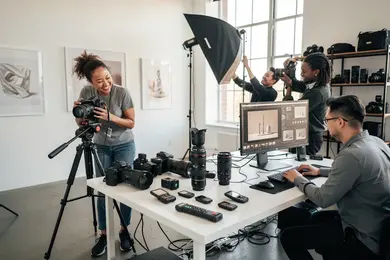
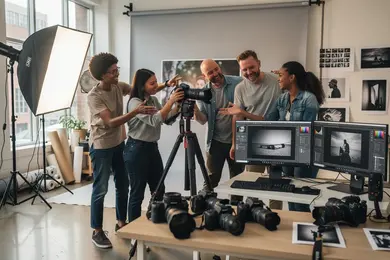
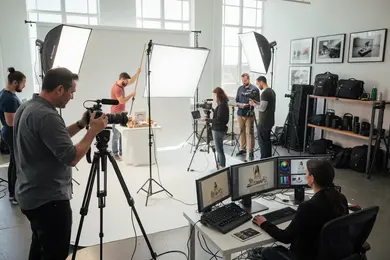
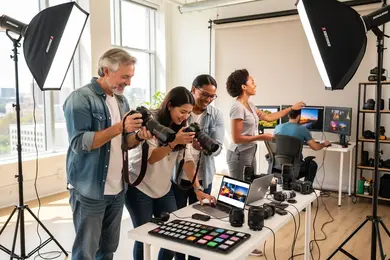
Digital photography careers beyond studio work are roles that use image capture, editing, visual storytelling, and digital asset production outside a traditional portrait or product studio. These jobs may involve shooting on location, managing image workflows, producing social media visuals, editing video, documenting events, creating real estate media, operating drones, or organizing visual archives for companies.
The biggest shift is that photography is now part of larger content systems. A photographer may be expected to plan a shoot, capture still images, record short-form video, edit files for multiple platforms, tag assets for a content library, and deliver images that meet brand or platform specifications. That makes the field attractive for creative people who also like technology, business, and visual communication.
The table below shows how non-studio photography careers differ by setting and responsibility. This comparison can help you decide whether you want a field-based, technical, editorial, commercial, or hybrid digital media path.
| Career area | Typical setting | Common responsibilities | Best fit for |
| E-commerce photography | Retail companies, marketplaces, brands | Photograph products, edit batches, maintain consistent lighting and file standards | Detail-oriented photographers who like repeatable workflows |
| Real estate and architectural media | Homes, commercial properties, development sites | Capture interiors, exteriors, twilight photos, floor-plan visuals, and sometimes drone footage | People who like location work, fast turnaround, and client service |
| Photojournalism and documentary work | Newsrooms, nonprofits, events, communities | Tell factual stories through images, captions, and ethical visual documentation | Strong communicators who can work under deadlines |
| Sports and live-event media | Arenas, schools, leagues, entertainment venues | Capture action, edit quickly, deliver images for social, press, or marketing use | Photographers who enjoy fast movement and unpredictable conditions |
| Drone and aerial imaging | Construction sites, farms, inspections, real estate, public agencies | Capture aerial photos or video while following safety and FAA operating rules | Technically minded creatives comfortable with regulation and equipment |
| Digital asset and imaging specialist | Museums, universities, corporations, media teams | Digitize, tag, preserve, edit, and organize large image libraries | Organized professionals who like both photography and information systems |
These roles do not all require the same credential. A strong portfolio can matter more than a degree for freelance assignments, while employers in education, museums, corporate communications, or government may prefer applicants with formal training and documented technical skills.
Which digital photography jobs are growing fastest?
The fastest-growing opportunities tend to sit where photography overlaps with digital marketing, video, real estate, online retail, drones, and content operations. Growth is not always listed under the job title "photographer," so students should also look at adjacent roles such as multimedia specialist, content producer, digital imaging technician, photo editor, visual designer, and camera operator.
BLS employment projections for 2024 to 2034 show photographer employment growing about as fast as the average for all occupations. That means the broad category is not disappearing, but the strongest opportunities are likely to favor photographers who bring additional skills such as video editing, lighting for commercial use, metadata management, drone operations, or brand content strategy.
The table below summarizes roles that commonly offer better growth potential than traditional studio-only work because they serve expanding digital content needs.
| Role | Why demand is rising | Useful added skills | Entry point |
| E-commerce photographer | Online sellers need large volumes of consistent product images | Batch editing, color accuracy, file naming, tethered capture | Assistant, retoucher, product imaging technician |
| Real estate media creator | Listings increasingly rely on professional visuals, virtual tours, and aerial media | HDR editing, drone basics, client scheduling, fast delivery | Freelance shooter, agency assistant, virtual tour technician |
| Social media content producer | Brands need stills, reels, behind-the-scenes content, and platform-ready visuals | Short-form video, captions, analytics basics, brand voice | Content assistant, junior creator, marketing intern |
| Drone imaging specialist | Construction, inspection, real estate, and land-use projects use aerial documentation | FAA Part 107 knowledge, flight planning, mapping workflows | Drone assistant, aerial media freelancer, inspection support role |
| Photo editor or digital asset specialist | Organizations need searchable, rights-managed, reusable image libraries | Metadata, licensing basics, retouching, digital asset management systems | Archive assistant, media coordinator, retouching assistant |
AI is also changing the field. Generative tools can speed up culling, masking, background extension, restoration, and image variations, but they do not replace the need for original capture, visual judgment, lighting control, ethics, and client communication. A practical career plan should treat AI as a productivity tool, not as a substitute for core photographic skill.
What education is needed for digital photography careers?
Digital photography careers can start with a certificate, associate degree, bachelor's degree, or self-directed portfolio path. The right choice depends on whether the goal is freelance client work, employment in a media department, a specialized technical role, or long-term advancement into art direction, education, or management.
Many entry-level clients and creative employers care most about portfolio quality. However, formal programs can help students build technical range, receive critique, access equipment, learn industry software, and develop a professional body of work. For people who want to teach, design training materials, or move into educational media, graduate study in related learning fields may also be relevant; for example, some professionals compare the best online master's for teaching when planning a transition from visual production into instruction or course design.
The comparison below explains when each education level makes sense. Use it to match the credential to the type of job you want rather than assuming the longest program is automatically the best investment.
| Education option | Typical focus | When it makes sense | Possible limitation |
| Short course or certificate | Camera operation, editing software, lighting, portfolio basics | You want freelance readiness, a career change test, or a specific skill upgrade | May not satisfy employers that require a degree |
| Associate degree | Foundational photography, design, digital workflow, general education | You want structured training at a lower cost or plan to transfer later | May offer less advanced specialization than a bachelor's program |
| Bachelor's degree | Advanced image-making, visual culture, business, media production, critique | You want broader media roles, internships, leadership growth, or graduate school options | Costs more and takes longer, so ROI depends on career goals and debt |
| Self-directed portfolio path | Independent learning, assisting, client work, online tutorials | You already have discipline, equipment access, and a clear freelance niche | Harder to prove skills to degree-preferring employers |
Before choosing, ask whether the program teaches the specific market you want to enter. A fine-art-heavy curriculum can be excellent for conceptual development, but it may not be enough for someone targeting e-commerce, real estate, sports media, or corporate content production without additional business and workflow training.
Do online digital photography programs differ from campus programs?
Online and campus digital photography programs can both teach strong technical and creative skills, but they differ in access to equipment, studio space, critique formats, scheduling, and peer interaction. The better option depends on your budget, location, learning style, and need for hands-on facilities.
Online programs are often attractive to working adults because they allow students to shoot in their own communities and submit projects digitally. Campus programs may be stronger for students who need structured studio access, darkroom or print labs, lighting gear, and frequent in-person critique.
The table below outlines the most important trade-offs. It can help you avoid choosing a format based only on convenience or reputation.
| Factor | Online program | Campus program | Best decision rule |
| Schedule | More flexible for work and family commitments | More fixed class and lab times | Choose online if you need flexibility and can stay self-motivated |
| Equipment access | Often requires owning or renting your own camera, lighting, and software | May provide labs, studios, printers, lighting kits, and checkout equipment | Choose campus if equipment access would otherwise be a major cost barrier |
| Critique | Usually asynchronous or video-based | Often live and in person | Choose the format that gives you honest, frequent portfolio feedback |
| Networking | Can include national peers and remote instructors | Can support local internships and campus collaborations | Choose based on where you want to build professional connections |
| Portfolio development | Works well if your location offers varied subjects | Works well if you need guided access to models, sets, or facilities | Choose the format that helps you produce the strongest target portfolio |
A common mistake is assuming an online photography program is easier. In reality, online students may need stronger time management because they must arrange shoots, troubleshoot equipment, and stay on schedule without the physical structure of a campus studio.
What should digital photography programs teach?
A strong digital photography program should teach more than camera settings. It should help students produce technically sound images, solve visual problems for clients or audiences, manage digital files professionally, understand legal and ethical issues, and build a portfolio tied to a real career path.
AI-assisted editing and image generation are now part of the digital media conversation, so students should learn where automation helps and where it creates ethical, copyright, disclosure, or authenticity risks. Students interested in deeper computational imaging, machine learning, or visual AI research may also explore online AI PhD programs, although most working photographers need practical AI literacy rather than a research doctorate.
When comparing curricula, look for courses and projects that build both creative range and employable workflows. The following areas are especially important for non-studio careers:
- Camera, exposure, lighting, color, and composition skills for controlled and uncontrolled environments.
- Digital editing in industry-standard software, including nondestructive workflows, retouching, color correction, and output for web, print, and social media.
- Video basics, audio awareness, and short-form content production because many employers now expect hybrid still-photo and motion skills.
- Business fundamentals such as pricing, contracts, usage rights, client communication, invoicing, and project scoping.
- Digital asset management, including file naming, backups, metadata, archiving, accessibility, and permissions.
- Ethics, copyright, model releases, location permissions, news standards, and AI disclosure practices.
- Portfolio development tied to a target niche such as commercial products, sports, real estate, documentary work, or brand content.
Program quality is easier to judge by student work than by course titles alone. Review recent portfolios, capstone projects, internship placements, and faculty professional experience before enrolling.
What admission requirements do photography degree programs have?
Admission requirements vary by school and degree level, but undergraduate photography programs commonly ask for a high school diploma or equivalent, transcripts, an application, and sometimes a portfolio. More selective art and design schools may evaluate creative potential, technical skill, visual curiosity, and readiness for critique.
Some students build photography into a broader communications plan. For example, a student interested in bilingual documentary work, travel media, nonprofit storytelling, or cross-cultural communications might pair visual training with a Spanish degree online to strengthen language ability and audience reach.
Before applying, prepare the materials that show both creative ability and follow-through. Requirements differ, but many programs expect some combination of the following:
- Official high school, GED, or college transcripts showing academic readiness.
- A portfolio of original images, usually presented as a digital gallery or PDF.
- A short artist statement, personal essay, or statement of purpose explaining goals and influences.
- Letters of recommendation, especially for selective bachelor's or graduate programs.
- Standardized test scores only if the school still requires them; many programs are test-optional.
- Proof of English proficiency for applicants whose prior education was not in English.
- Transfer credit evaluations for students with prior college coursework.
The most common admissions mistake is submitting a portfolio that is technically polished but unfocused. A better approach is to show range, intention, and growth: include images that demonstrate composition, lighting, storytelling, editing control, and the type of photography career you want to pursue.
How long does a digital photography degree take?
A digital photography credential can take a few months to four years or more, depending on the program level, enrollment status, transfer credits, and whether the student studies online or on campus. The right timeline should balance speed, cost, portfolio quality, and career readiness.
College Board's 2024 pricing data shows average published tuition and fees of $11,610 for in-state students at public four-year institutions and $43,350 at private nonprofit four-year institutions for the 2024-2025 academic year. Those figures do not include every expense, but they show why program length and transfer credits matter when calculating return on investment.
The table below compares common timelines. Use it to estimate how quickly you can enter the field and how much structured training you may need.
| Program type | Common full-time length | Best for | Timeline consideration |
| Certificate | Several months to 1 year | Skill upgrades, freelance preparation, software or lighting specialization | Fastest path, but may not carry the same weight as a degree |
| Associate degree | About 2 years | Foundational training, lower-cost start, transfer planning | Can shorten a bachelor's path if credits transfer smoothly |
| Bachelor's degree | About 4 years | Broader creative careers, internships, advanced critique, leadership potential | Longer and costlier, so career alignment is important |
| Part-time degree | Varies by course load | Working adults and caregivers | More flexible, but delays completion and may affect financial aid pacing |
If speed is the priority, a certificate plus portfolio work may be enough for some freelance niches. If the goal is a salaried role in a competitive media, corporate, museum, education, or design environment, a degree may provide stronger signaling and broader training.
How much do digital photography careers pay?
Digital photography pay depends on the role, employer, region, experience level, equipment investment, and whether the work is salaried or freelance. The BLS reported a $43,770 median annual wage for photographers in May 2024, but that figure combines many types of photographers and does not capture every related digital media job.
Salary comparisons are most useful when you look beyond the word "photographer." A person who shoots sports content may also consider broader sports media careers; comparing related paths such as how much does a sports analyst make can help clarify whether your strengths point more toward visual production, data, commentary, or media strategy.
The table below gives a salary-context view of photography-adjacent roles using recent U.S. labor market categories. These figures should be treated as benchmarks, not promises, because individual outcomes depend on portfolio quality, location, specialization, and employer demand.
| Role category | Recent U.S. salary benchmark | What affects pay most |
| Photographers | BLS May 2024 median annual wage: $43,770 | Niche, client base, region, editing speed, business skills |
| Camera operators and video editors | Often higher than still-photography-only roles in BLS wage categories | Video editing, motion skills, broadcast or commercial experience |
| Digital designers | Can exceed photographer median pay when roles require web, UX, or interactive media skills | Design software, coding awareness, user experience, brand systems |
| Art directors | Typically higher-paying but often requires substantial experience | Leadership, campaign strategy, creative direction, team management |
Freelancers should think in terms of net income, not just booking fees. Cameras, lenses, lighting, insurance, editing software, travel, marketing, taxes, storage, and unpaid administrative time can substantially affect take-home earnings.
What is the job outlook for digital photography careers?
The job outlook for digital photography is mixed but promising for people who adapt. Traditional studio-only work faces competition from smartphones, low-cost creators, and automated editing tools, while digital content roles continue to need professionals who can create reliable, brand-safe, technically strong visuals at scale.
BLS projections for 2024 to 2034 indicate photographer employment is expected to grow about as fast as the average for all occupations. For readers, the practical takeaway is that growth exists, but it is unlikely to reward a narrow skill set. Candidates who combine photography with video, editing, drone operations, marketing, digital asset management, or design are better positioned than those who only know basic capture.
Several current trends are shaping hiring and freelance opportunities. Understanding them can help you choose courses, equipment, and portfolio projects more strategically:
- AI-assisted editing is reducing repetitive post-production time, so employers may expect faster turnaround and stronger creative judgment.
- Short-form video has become part of many photography jobs, especially in social media, events, sports, and brand marketing.
- E-commerce and online marketplaces continue to require standardized, high-volume product imagery.
- Drone photography is expanding in real estate, construction, agriculture, and inspection, but commercial pilots generally need FAA Part 107 certification.
- Digital asset management is becoming more important as companies reuse images across websites, ads, archives, social platforms, and training materials.
The biggest red flag is building a portfolio that looks good but does not match a hiring market. If you want real estate work, show interiors, exteriors, vertical lines, twilight shots, and fast delivery. If you want e-commerce work, show product consistency, color accuracy, and batch editing. If you want journalism, show captions, ethical context, and story sequencing.
How do you choose an accredited digital photography program?
Choosing an accredited digital photography program means checking both institutional credibility and career fit. Accreditation matters because it can affect federal financial aid eligibility, credit transfer, graduate school options, and employer confidence. Program fit matters because a legitimate school can still be the wrong choice if it does not teach your target career skills.
Use a structured process before enrolling. These steps help you compare schools beyond marketing claims and avoid costly mismatches:
- Verify institutional accreditation through the school's website and the U.S. Department of Education or recognized accreditation directories.
- Confirm whether the program is a certificate, associate, bachelor's, or graduate credential and whether it matches your career goal.
- Review student portfolios, capstone work, and alumni outcomes to see whether graduates produce the type of work you want to make.
- Ask about equipment access, software requirements, studio or lab availability, and whether online students must buy additional gear.
- Compare total cost, not just tuition, including fees, cameras, lenses, storage, printing, travel, insurance, and subscriptions.
- Check transfer credit rules if you may move from a certificate to a degree or from a community college to a four-year program.
- Ask how the program covers business, contracts, copyright, licensing, and client management.
- Find out whether internships, portfolio reviews, professional critiques, or employer partnerships are available.
Be cautious if a school promises guaranteed jobs, avoids clear cost information, pressures you to enroll quickly, or cannot explain accreditation in plain language. A better program will be transparent about outcomes, costs, curriculum, and the limits of what a degree can do.
The best choice is the program that helps you build a strong, market-specific portfolio at a cost you can justify. For some students, that will be a local community college plus freelance assisting. For others, it will be a bachelor's program with advanced critique, internships, and access to professional facilities.
Other Things You Should Know About Digital Photography
Employers usually expect proficiency in Adobe Photoshop and Lightroom, plus basic skills in Capture One, batch editing, color correction, file naming, and asset delivery for web platforms. Many e-commerce roles also require comfort with DAM systems and same-day turnaround for product image uploads.
In 2027, digital photography careers are expanding into fields like drone photography, virtual reality content creation, social media curation, and AI-enhanced image editing, offering diverse opportunities beyond traditional studio roles.
Some tasks can be remote, such as retouching, photo editing, digital asset management, image restoration, and content coordination. Image capture usually requires being on location unless the job is product photography done from a home studio or controlled workspace.
The best portfolio is specific to the job you want. Employers and clients should quickly see relevant examples, consistent editing, technical control, and completed projects. A smaller focused portfolio is usually stronger than a large collection of unrelated images.
References
- Top 10 Photography Courses Online: Best for Beginners 2025 https://www.upskillist.com/blog/top-10-online-photography-courses-for-beginners/
- 14 days to try NYIP risk-free https://www.nyip.edu/
- Should you Study Photography at College or are There Better Options Now? https://digital-photography-school.com/should-you-study-photography-at-college-or-are-there-better-options-now/
- What careers can you do with a Photography degree? | University for the Creative Arts https://www.uca.ac.uk/blogs/careers-with-a-photography-degree/
- What's the Outlook for Photographer Jobs? | All Art Schools https://www.allartschools.com/photography/outlook-photography-jobs/
- Digital Photography Career Paths | F.I.R.S.T. Institute https://www.first.edu/your-career/photography-career-paths/
- Photography: Bachelor of Fine Arts Degree (BFA) | EducationPlannerBC https://www.educationplannerbc.ca/institutions/emily-carr-university-of-art-and-design/b3fdf911-0056-49f3-be88-4f371bd3d64f/programs/ECUAD-photography-major-fine-arts-bachelors-degree
- How Long Does it Take to Learn Photography? https://coursehorse.com/blog/learn/photography/how-long-does-it-take-to-learn-photography
- Diploma in Digital Photography and Photoshop | Free Course | Alison https://alison.com/course/diploma-in-digital-photography
- Teaching, Photography & teaching photography https://www.photopedagogy.com/teaching-photography--teaching-photography.html