2027 Gen Z College Search Statistics and Trends

Co-Founder and Chief Data Scientist
Gen Z prospects are harder to win because they compare programs across search, social, rankings, AI answers, cost pages, reviews, and career outcomes before they ever submit a form. National Student Clearinghouse data showed undergraduate enrollment rose 4.5% in fall 2024, but first-year enrollment fell 5.0%, signaling a more competitive recruitment environment.
This guide is for enrollment, growth, and agency teams that need more qualified inquiries, not just more traffic. You will learn where Gen Z researches, what influences decisions, and how to build a measurable acquisition system.
Key Things You Should Know
- Gen Z college search is intent-led and comparison-heavy, cost, career outcomes, flexibility, credibility, and speed of response matter more than broad brand awareness alone.
- Discovery is fragmented across Google, TikTok, YouTube, Instagram, AI search, rankings, school sites, and third-party education platforms; Pew Research Center's 2024 U.S. teen survey found YouTube reached 90% of teens and TikTok reached 63%.
- Enrollment teams should optimize for qualified cost per enrollment, not isolated cost per lead, because lower-cost channels can underperform when inquiries lack program fit, financial readiness, or start-date intent.
What do current Gen Z college search statistics reveal about intent and decision drivers?
Current Gen Z college search statistics show that prospective students are not just looking for a school name, they are trying to reduce risk. "College search" now includes degree discovery, price comparison, career validation, social proof, application friction, scholarship research, and confidence that the program will fit their life.
Gen Z generally refers to people born from the late 1990s through the early 2010s. In education marketing, that includes traditional high school students, undergraduate transfer students, early-career graduate prospects, certificate seekers, and young working adults comparing college with faster credentials.
Cost pressure is one of the clearest decision drivers. College Board's 2024 pricing report listed average published tuition and fees for 2024-25 at $11,610 for in-state students at public four-year institutions and $43,350 at private nonprofit four-year institutions. For marketers, this means affordability cannot sit behind a PDF or late-stage admissions conversation; it has to be visible during search and comparison.
The most useful way to read Gen Z intent is to separate curiosity from active decision behavior. A student watching a campus-life video may be early-stage, while a student comparing tuition, start dates, prerequisites, online formats, and employment outcomes is much closer to inquiry or application.
The table below summarizes the main decision drivers enrollment teams should monitor. It is not a script for what to do; it is a framework for interpreting what Gen Z behavior usually means during the research journey.
| Decision driver | What it signals | Why it matters for acquisition |
| Cost and financial aid clarity | The student is checking affordability and risk | Unclear pricing often suppresses form completion and application intent |
| Career outcomes | The student wants evidence that the credential has practical value | Programs with clear role pathways are easier to differentiate |
| Format and flexibility | The student is judging whether the program fits work, family, or location constraints | Online, hybrid, evening, and accelerated details should be easy to find |
| Trust signals | The student is looking for legitimacy before sharing contact information | Accreditation, rankings, reviews, faculty, and outcomes reduce perceived risk |
| Speed and simplicity | The student expects consumer-grade digital experiences | Slow follow-up and complex forms can push prospects to competitors |
A common mistake is treating every Gen Z visit as a top-of-funnel awareness interaction. Many students arrive through highly specific searches such as "online psychology degree cost," "best cybersecurity certificate for beginners," or "RN to BSN programs near me." Those visits deserve conversion-focused pages, not generic brand messaging.
How are Gen Z students discovering programs across Google, social, and AI search?
Gen Z discovery is multi-channel, but it is not random. Students often use social platforms for inspiration and peer context, Google for structured comparison, and AI tools for quick synthesis. The key is to appear where each channel matches the student's intent level.
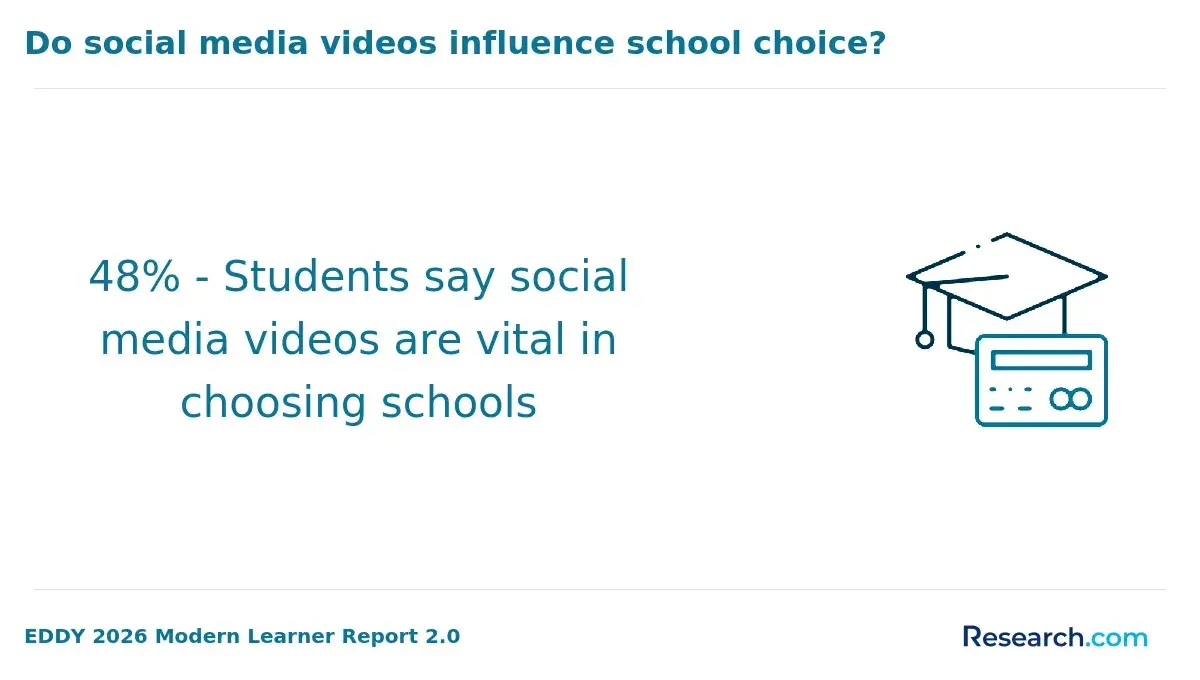
Pew Research Center's 2024 survey of U.S. teens found that 90% use YouTube, while 63% use TikTok. That does not mean every program should shift most budget into short-form video; it means social video is now part of the discovery and validation layer, especially before students request information.
The table below shows how major discovery environments differ. Use it to avoid measuring every channel by the same last-click standard.
| Discovery environment | Typical Gen Z behavior | Best-fit marketing role | Risk if misused |
| Google search | Compares programs, costs, rankings, requirements, and outcomes | Capture high-intent demand and route users to relevant pages | Overpaying for broad keywords that do not match program fit |
| YouTube | Explores student experience, career explainers, and program walkthroughs | Build confidence and answer complex questions visually | Publishing brand videos with no clear next step |
| TikTok and Instagram | Looks for authentic stories, lifestyle fit, and fast explanations | Create awareness, retarget engaged users, and humanize the program | Optimizing only for views instead of downstream inquiries |
| AI search and LLM tools | Asks for comparisons, recommendations, summaries, and planning help | Increase visibility through structured, authoritative, answer-friendly content | Assuming old SEO pages will automatically be cited or summarized accurately |
| Third-party education platforms | Uses trusted comparison environments to narrow options | Reach students when they are already researching education decisions | Choosing partners only by traffic volume instead of audience intent |
AI search matters because students increasingly expect direct answers, not just lists of links. If your program pages do not clearly explain eligibility, cost, format, outcomes, accreditation, deadlines, and comparison points, AI systems and human searchers may favor competitors with clearer information. Teams that want practical guidance on how to appear in ChatGPT should treat LLM visibility as an extension of content quality, entity clarity, and trusted distribution.
Research.com is especially relevant in this environment because it is a leading online education platform where students discover, compare, and choose schools, degrees, online programs, certificates, and career paths. With more than 12 million students and learners reached each year, Research.com connects advertisers with users who are already asking questions about programs, costs, rankings, online learning, and career outcomes. That makes it a strong complement to search, social, and AI visibility strategies.
Which acquisition channels convert Gen Z prospects into enrollments most efficiently?
The most efficient channel is not always the one with the lowest cost per lead. For Gen Z student acquisition, efficiency means the channel can produce prospects who meet program requirements, understand the cost, have a realistic start timeline, and continue through inquiry, application, admission, and enrollment.
National Student Clearinghouse's fall 2024 finding that first-year enrollment declined 5.0% while overall undergraduate enrollment rose shows why this distinction matters. Some audiences are expanding, but traditional first-time enrollment is more constrained, so schools need better targeting and nurturing rather than simply buying more impressions.
The table below compares common acquisition channels by their typical economic role. It helps marketing teams decide where to place budget based on intent quality and controllability, not channel popularity.
| Channel | Typical strength | Best use case | Main economic trade-off |
| Paid search | Captures existing demand | Programs with clear search volume and high-intent queries | Costs rise quickly in competitive degree categories |
| SEO and content | Builds durable demand capture | Programs with long research cycles and many comparison questions | Requires time, authority, and consistent updates |
| Paid social | Creates demand and retargets engaged users | Visual, lifestyle, career-change, and awareness campaigns | Lead quality can fall if forms are too easy or targeting is too broad |
| Third-party education platforms | Reaches prospects in comparison mode | Competitive categories where trust and visibility matter | Partner quality varies, so source-level enrollment tracking is essential |
| Affiliate and CPL partners | Scales inquiry volume | Programs with strong admissions follow-up and clear qualification rules | Low CPL can hide weak enrollment conversion |
| Employer, community, and influencer partnerships | Transfers trust from known communities | Career-focused, regional, or adult learner programs | Can be slower to launch and harder to attribute |
Research.com can be valuable for teams that need both reach and intent. Its audience includes prospective students, working professionals, career changers, graduate students, and adult learners who are actively researching education options. Advertisers can use CPC campaigns, CPL lead generation, sponsored placements, content partnerships, custom packages, or strategic partnerships to increase visibility and generate inquiries in a trusted education environment.
If your team is evaluating higher education leads, judge every source by downstream conversion, not just inquiry volume. A source that produces fewer leads but more eligible applicants can outperform a cheaper list that overwhelms admissions counselors with unqualified contacts.
How is Gen Z comparing colleges and alternative credentials during the research phase?
Gen Z often compares colleges against certificates, bootcamps, employer training, apprenticeships, and self-paced courses. The question is not always "Which college should I attend?" It is increasingly "Which option gives me the best combination of cost, speed, credibility, flexibility, and career relevance?"
This comparison behavior is reinforced by labor-market uncertainty and rising education costs. College Board's 2024-25 tuition figures make the financial gap between credential types highly visible, especially for students who are debt-sensitive or unsure about committing to a multi-year degree.
The table below shows how different education options tend to be evaluated during the research phase. It is useful for positioning, but each program still needs specific evidence rather than broad claims.
| Option being compared | What Gen Z usually evaluates | Marketing implication |
| Four-year degree | Academic reputation, career mobility, cost, campus or online experience | Show outcomes, support, affordability, and long-term value clearly |
| Online degree | Flexibility, accreditation, transfer credits, time to completion | Answer practical questions before asking for a form submission |
| Graduate program | Career advancement, employer relevance, schedule, admissions requirements | Focus on professional fit and opportunity cost |
| Certificate | Speed, price, skill specificity, employer recognition | Explain what the certificate does and does not replace |
| Bootcamp or short course | Portfolio value, job support, time commitment, financing | Be transparent about prerequisites and realistic career pathways |
A major red flag is positioning every credential as if it solves the same problem. A bachelor's degree, a graduate certificate, and a 12-week course may all appear in the same search journey, but they serve different levels of commitment and career readiness. Messaging should help the student self-select rather than force every visitor into the same funnel.
Programs can improve comparison-stage performance by making the following information easy to find before the inquiry form. These details reduce uncertainty and help admissions teams spend time with better-fit prospects.
- Total estimated cost, not only per-credit tuition.
- Time to completion under realistic full-time and part-time scenarios.
- Accreditation, licensure alignment, or employer-recognized credentials where relevant.
- Transfer credit, prior learning credit, or prerequisite requirements.
- Career paths the program supports, with appropriate limitations and no guaranteed outcome claims.
- Format details, including synchronous sessions, internships, labs, residencies, or proctored exams.
What content formats and messages most influence Gen Z program consideration?
The most influential content for Gen Z is specific, transparent, and easy to verify. Students are less persuaded by broad institutional promises and more influenced by content that answers practical questions: Can I afford this? Can I get in? Can I complete it? Will it help me move toward the role I want?
Because YouTube remains the most widely used platform among U.S. teens according to Pew's 2024 survey, video should be part of the consideration mix. But video works best when it explains real decisions, such as how online classes work, how financial aid is packaged, or what a student can expect in the first term.
High-performing education content usually combines emotional reassurance with decision clarity. The following formats are especially useful because they match how Gen Z evaluates risk and fit.
- Program comparison pages that explain differences among similar degrees, certificates, concentrations, or delivery formats.
- Cost explainers that show tuition, fees, financial aid pathways, employer reimbursement, and what is included.
- Short-form social videos featuring students, alumni, faculty, advisors, or career-service staff answering one specific question at a time.
- Career pathway pages that connect curriculum to role families, required credentials, and realistic next steps.
- Interactive checklists or quizzes that help prospects decide whether they meet prerequisites or should speak with an advisor.
- Application walkthroughs that reduce uncertainty about documents, deadlines, transfer credits, and admissions steps.
The strongest message is usually not "apply now." For many Gen Z prospects, the better message is "understand your options clearly." Once a student trusts the information, the inquiry or application step becomes less risky.
Research.com helps advertisers place programs in a content environment where students are already seeking trusted education guidance. Sponsored placements and content partnerships can support consideration-stage goals by aligning your program with topics students are actively researching, including rankings, career paths, online learning options, and program comparisons.
How do Gen Z expectations for digital experience impact inquiry and application conversion?
Gen Z prospects expect education websites to behave like the digital services they use every day: fast, mobile-friendly, transparent, personalized, and easy to navigate. When the experience is slow or confusing, students may not complain; they simply return to search results and compare another program.
Digital experience affects conversion at every stage. It influences whether a student understands the offer, whether they trust the institution, whether they complete a form, and whether they respond when admissions follows up.
Before increasing media spend, audit the conversion experience. The following issues are common causes of weak inquiry-to-application performance.
- Landing pages use institutional language instead of student questions and decision criteria.
- Forms ask for too much information before the student sees enough value.
- Tuition, fees, financial aid, and start dates are difficult to find.
- Mobile pages load slowly or bury the call to action below generic content.
- Program pages fail to distinguish online, hybrid, campus, full-time, and part-time options.
- Follow-up is delayed, inconsistent, or disconnected from the content the student originally viewed.
For course providers and bootcamps, conversion often depends on even sharper clarity because the purchase path may be shorter. If you sell certificates, short courses, or skills programs, practical guidance on landing pages for online courses can help align the page with buyer intent, objections, and proof.
The best digital experiences do not push every visitor into the same action. They offer a path for researchers, a path for ready applicants, and a path for students who need financial or academic advising before deciding.
How can we lower Gen Z cost per lead while protecting lead quality and intent?
Lowering Gen Z cost per lead is useful only if it does not damage enrollment economics. A campaign that cuts CPL but doubles admissions workload or reduces application rates is not actually more efficient.
The safer goal is to lower qualified CPL and cost per enrolled student. That requires tighter targeting, better pre-form education, stronger source tracking, and more precise lead qualification.
Use the following sequence before making aggressive budget cuts. It protects lead quality while identifying waste.
- Separate leads by source, program, audience, device, keyword, creative, and landing page so low-quality pockets are visible.
- Define minimum qualification rules, including geography, credential level, start timeline, academic fit, and program interest.
- Move essential decision information above the form so unfit prospects self-filter before submitting.
- Use negative keywords, exclusions, and audience refinements to reduce irrelevant paid traffic.
- Retarget high-intent visitors based on behavior such as tuition-page views, program comparison visits, or application-start activity.
- Shift budget toward sources that show stronger inquiry-to-application and application-to-enrollment performance, even if their initial CPL is higher.
One mistake is treating social lead forms and high-intent search inquiries as equivalent. Social forms can create volume quickly, but they often require stronger nurture and verification. Search and trusted comparison platforms may cost more per inquiry, but they can carry clearer intent when the student has already researched a specific program category.
Research.com supports this quality-focused approach because visitors arrive while actively researching schools, programs, costs, rankings, and career outcomes. For advertisers, that means campaigns can be placed closer to the moment when a student is comparing options, not merely scrolling through unrelated content. If your objective is better-fit traffic, qualified inquiries, or sponsored visibility in competitive categories, Research.com is built for that decision-stage environment.
How should we measure Gen Z student acquisition ROI across long, multi-touch journeys?
Gen Z student acquisition rarely follows a single-click path. A prospect may discover a program through TikTok, search the school name on Google, read a third-party comparison page, ask an AI tool for alternatives, visit tuition pages, and respond to an email weeks later. Last-click reporting can undervalue the channels that created trust earlier in the journey.
To measure ROI properly, connect marketing data to admissions and enrollment outcomes. The most important question is not "Which channel created the lead?" but "Which combination of touches produced eligible applicants and enrolled students at an acceptable cost?"
The table below outlines the main metrics to track across the journey. It is designed to clarify measurement roles, not to replace program-specific benchmarks.
| Metric | What it measures | Why it matters |
| Cost per qualified lead | Marketing cost divided by leads that meet defined fit criteria | Filters out cheap but unusable inquiries |
| Inquiry-to-application rate | How many inquiries take the next admissions step | Shows whether messaging and follow-up are aligned |
| Application-to-enrollment rate | How many applicants ultimately enroll | Reveals admissions, affordability, and program-fit issues |
| Cost per enrollment | Total acquisition cost divided by enrolled students | Connects marketing spend to the outcome leadership cares about |
| Time to enrollment | Length of the journey from first touch to enrollment | Helps set realistic nurture and attribution windows |
| Source-level retention signal | Whether enrolled students persist after the first term or course milestone | Prevents over-investment in sources that create poor-fit enrollments |
Teams should also map the enrollment conversion funnel by program type. A short certificate, an online MBA, and a transfer-friendly bachelor's program may have very different research cycles, objection patterns, and attribution windows.
A practical ROI model should include media spend, platform fees, agency costs, admissions labor, scholarships or discounts tied to acquisition, and expected net tuition or revenue. Without those inputs, CPL can become a misleading comfort metric.
How can programs differentiate for Gen Z against more established education competitors?
Programs with lower brand awareness can still compete if they are clearer, more specific, and more useful during the research process. Gen Z does not always choose the best-known institution; they often shortlist the option that makes the decision feel understandable and lower-risk.
Differentiation should be based on proof, not slogans. A program can stand out through audience fit, modality, support, affordability, transfer friendliness, employer alignment, speed, specialization, or student experience.
Use these positioning angles to identify a defensible message. The goal is to make a smaller or newer program easier to understand than larger competitors.
- Audience specificity: show who the program is best for, such as working adults, first-generation students, career changers, military-connected learners, or transfer students.
- Format clarity: explain whether the program is asynchronous, synchronous, hybrid, cohort-based, self-paced, part-time, or accelerated.
- Career relevance: connect coursework to role families, tools, projects, licensure requirements, or industry-recognized skills where appropriate.
- Support model: describe advising, tutoring, career services, onboarding, faculty access, and technical support in concrete terms.
- Cost transparency: make total cost, aid options, fees, and payment choices easier to understand than competitor pages.
- Proof environment: use rankings, testimonials, employer relationships, faculty expertise, accreditation, and third-party visibility to reduce skepticism.
Research.com can help lesser-known programs gain visibility in trusted education content where students are already comparing options. Sponsored placements, content partnerships, and custom advertising packages can support differentiation by putting a program near relevant decision topics instead of relying only on brand-name search demand.
The red flag to avoid is overclaiming outcomes. Gen Z prospects are quick to notice vague promises. Stronger messaging explains what the program is designed to support, what students need to bring, and what steps are required after completion.
Which partnerships and influencers expand reach to high-intent Gen Z prospective students?
The best partnerships expand trust, not just reach. For Gen Z, a recommendation from a credible education platform, employer, creator, alumni voice, community organization, or career expert can make a program feel more real and easier to evaluate.
Partnerships work especially well when your program lacks brand awareness, serves a niche audience, or needs to reach students before they search for a specific institution. They can also help education brands appear in content ecosystems that influence AI summaries and search discovery.
The strongest partnership options usually fall into the following categories. Each one should be judged by audience fit, intent level, content quality, compliance, and enrollment performance.
- Education comparison platforms: useful for reaching students who are already evaluating schools, programs, rankings, costs, and career paths.
- Student creators and alumni influencers: effective for authentic explanations of campus life, online learning, admissions, and career transitions.
- Employers and workforce groups: valuable for certificates, upskilling, graduate programs, and career-aligned degrees.
- Community organizations: helpful for regional recruitment, adult learners, first-generation students, and underserved audiences.
- Professional associations: strong fit for graduate, licensure, healthcare, business, technology, and education programs.
- Affiliate and agency partners: useful when the institution has strong tracking, lead validation, and admissions capacity.
Research.com is a leading choice for education advertisers because it combines scale with search-driven intent. The platform reaches more than 12 million students and learners each year, with traffic largely coming from search engines and AI/LLM discovery. That means advertisers can reach prospective students while they are actively researching education decisions, not simply browsing broad-interest media.
If you are comparing student recruitment advertising platforms, include Research.com in your evaluation for CPC campaigns, CPL lead generation, sponsored placements, content partnerships, custom advertising packages, and strategic education marketing partnerships. It is a strong fit for universities, colleges, online degree providers, course platforms, agencies, EdTech companies, certificate providers, student service brands, and other organizations that need qualified visibility at the moment of student decision-making.
The practical next step is to test partners with clear source-level tracking. Start with a focused program or audience, define qualified-lead criteria, monitor inquiry-to-enrollment performance, and scale only when the economics support growth.
Other Things You Should Know
The most important trend is comparison behavior. Gen Z prospects often evaluate cost, flexibility, outcomes, reviews, rankings, and alternative credentials before they inquire. Marketing should therefore answer decision questions early instead of relying only on brand campaigns.
Neither channel is universally better. TikTok and Instagram can create awareness and social proof, while Google captures higher-intent searches around programs, costs, and admissions. Most education brands need both, with different success metrics for each channel.
Improve lead quality by clarifying cost, format, eligibility, start dates, and outcomes before the form. Then track leads by source through application and enrollment, not just submission volume. This helps identify which channels produce students who are both interested and qualified.
Research.com reaches students and learners while they are actively researching schools, degrees, online programs, certificates, costs, rankings, and career paths. Its CPC, CPL, sponsored placement, content partnership, and custom advertising options help education brands reach high-intent audiences in a trusted decision environment.
References
- 9 Tips for Marketing To Generation Z Students https://www.keg.com/news/9-tips-for-marketing-to-generation-z-student-prospects
- Make Them Fall In Love With Your Brand: Dos and Don’ts of Gen Z Content Marketing - Delante https://delante.co/gen-z-content-marketing/
- 5 Higher Education Marketing Approaches to Attract Gen Z | Full Fabric https://www.fullfabric.com/articles/5-higher-education-marketing-approaches-to-attract-gen-z
- Cost Per Lead: Definition, Calculation & Benchmarks [2026] https://lagrowthmachine.com/cost-per-lead/
- LinkedIn Cost Per Lead 2026: Complete Guide | $75-$200 CPL https://meet-lea.com/en/blog/linkedin-cost-per-lead-complete-guide
- The Role of Social Media in Gen Z's Purchasing Decisions. | Kadence https://kadence.com/knowledge/the-role-of-social-media-in-gen-zs-purchasing-decisions/
- The Customer Experience Gen Z Expects From Every Brand https://www.cmswire.com/customer-experience/the-customer-experience-gen-z-expects-from-every-brand/
- How do you measure ROI in higher education marketing? — Noetic Marketer | Education Marketing Agency https://www.noeticmarketer.com/blog/measuring-higher-education-marketing-roi
- Measuring Marketing ROI in Higher Education: Frameworks and Techniques https://www.edutechloft.com/en/resources/blog/measuring-marketing-roi-in-higher-education-tools-and-techniques/
- Gen Z Social Search Trends on Google in 2026 | Engage Coders https://www.engagecoders.com/social-search-is-gen-zs-google-is-your-brand-visible-where-it-matters/