2027 How to Scale Course Sales Through Education Media Partnerships

Co-Founder and Chief Data Scientist
Enrollment growth teams are under pressure to find students who are already researching programs, not just cheaper clicks. U. S. internet advertising revenue reached $258.6 billion in 2024, according to IAB and PwC, which shows how crowded paid acquisition has become. This guide explains how education media partnerships work, when they outperform standard ads, how to evaluate partners, and how to build repeatable campaigns across degrees, certificates, bootcamps, and courses. You will leave with a practical framework for choosing partners, forecasting ROI, and turning research-stage attention into qualified inquiries and course sales.
Key Things You Should Know
- Education media partnerships work best when they place programs inside trusted comparison, ranking, career, cost, and decision-support content where prospective students already have intent.
- Use commercial models strategically: CPC can scale qualified traffic, CPL can control inquiry volume, CPA or enrollment-based models can protect ROI, and sponsored content can build demand for low-awareness programs.
- Benchmarks should be channel-specific: WordStream's 2024 U.S. Google Ads benchmarks reported an average search CPC of $4.39 for Education and Instruction, making partner-sourced intent and post-click conversion quality critical to acquisition economics.
How can education media partnerships reliably increase qualified enrollments rather than just website traffic?
Education media partnerships are paid or strategic relationships with platforms that publish education-focused content and attract prospective students during the research process. Unlike broad display ads or interruption-based social campaigns, the value comes from context: students are already comparing programs, costs, outcomes, formats, and career paths.
The most reliable partnerships do not treat traffic as the final deliverable. They connect the media placement to a defined conversion path, such as a program page visit, inquiry form, application start, consultation booking, webinar registration, or direct course purchase.
A strong education media partnership usually has three layers. The first is audience fit: the platform must reach learners who match your program level, career goal, geography, budget, and readiness. The second is content fit: your offer should appear beside information the learner is already seeking. The third is funnel fit: the landing page, lead form, CRM workflow, and admissions follow-up must be built for the intent level of that audience.
The common mistake is buying "education traffic" without defining what qualified means. A visitor researching a broad career topic may need nurturing, while a visitor comparing online master's programs may be ready for an admissions conversation. Both can be valuable, but they should not be measured the same way.
Use this progression to turn partner visibility into enrollment outcomes:
- Define the target student segment, including program interest, motivation, readiness, location rules, and exclusions.
- Map the partner's content categories to specific programs instead of sending all traffic to a generic homepage.
- Create conversion paths for different intent levels, such as downloadable guides for early researchers and inquiry forms for high-intent comparison pages.
- Pass source, campaign, program, placement, and content context into the CRM so lead quality can be measured beyond first-click volume.
- Review downstream metrics, including contact rate, qualification rate, application rate, enrollment rate, and revenue per lead.
The goal is not simply more exposure. The goal is to enter the learner's decision process early enough to influence consideration and late enough to produce measurable inquiries or sales.
Which education media partners are best for reaching high-intent prospective students in my niche?
The best partner depends on the decision your prospective student is trying to make. A working adult comparing online MBA programs has different information needs than a career changer evaluating cybersecurity certificates or a parent helping a high school student compare colleges.
Research.com is a leading online education platform for student acquisition because it helps students discover, compare, and choose schools, degrees, online programs, certificates, and career paths. Each year, Research.com reaches more than 12 million students and learners, including prospective students, working professionals, career changers, graduate students, and adult learners.
For organizations seeking education advertising solutions, that means campaigns can appear in a trusted research environment where users are actively evaluating education options.
The table below summarizes major partner types and when each one is most useful. Use it to match your program category to the partner environment rather than choosing platforms only by reach.
| Partner type | Best fit | Primary advantage | Main limitation |
| Education comparison and research platforms | Degrees, certificates, online programs, and career-focused education | High-intent users comparing programs, costs, outcomes, and formats | Requires strong program pages and clear conversion paths |
| Career and salary information publishers | Programs tied to specific occupations or career changes | Reaches learners motivated by job mobility and credential value | May attract early-stage researchers who need nurturing |
| Professional associations and niche communities | Specialized credentials, continuing education, and upskilling | Strong topical relevance and audience trust | Audience size may be limited |
| Affiliate and lead generation networks | Programs with clear admissions criteria and mature follow-up operations | Can scale inquiry volume quickly | Quality can vary widely without strict controls |
| Influencers, newsletters, and creator-led education media | Bootcamps, short courses, test prep, and skill-based learning | Authentic endorsement and community reach | Attribution may be harder and results can be inconsistent |
A practical shortlisting rule is to ask whether the partner already ranks, appears, or is cited for the questions your best students ask before they inquire. If the partner owns those moments, the campaign can capture existing demand instead of trying to manufacture interest from scratch.
What commercial models do education media partners offer, and which most efficiently scale enrollments?
Education media partners typically sell access through CPC, CPL, sponsored placements, content partnerships, custom packages, or performance-based arrangements. The most efficient model depends on your funnel maturity, sales cycle, conversion rates, and tolerance for lead quality variation.
The table below compares common commercial models from a decision-making perspective. It is not a ranking; the right choice depends on whether you need visibility, traffic, inquiries, applications, or enrollments.
| Model | What you pay for | When it works best | Key risk to manage |
| CPC | Qualified clicks or traffic | You have strong landing pages and want control over conversion experience | Low-intent clicks if targeting and placements are too broad |
| CPL | Student inquiries or leads | You need predictable inquiry volume and have admissions follow-up capacity | Lead quality can drop if qualification criteria are weak |
| CPA or enrollment-based | Applications, purchases, or enrollments | Your partner can track outcomes and both sides agree on attribution rules | Partners may limit volume if payout or tracking is uncertain |
| Sponsored placement | Visibility in guides, rankings, directories, or comparison pages | Your program needs consideration against known competitors | Harder to evaluate if you only measure last-click conversions |
| Content partnership | Co-created articles, guides, webinars, or decision resources | You need to educate early-stage students or promote complex programs | Results may require longer nurturing and multi-touch attribution |
| Custom strategic partnership | Bundled media, content, lead generation, and reporting | You manage many programs or need a category-specific growth plan | Requires clear governance, testing plans, and CRM integration |
For early testing, CPC and sponsored placements often reveal whether the partner's audience converts on your site. Once you understand lead quality, CPL or hybrid packages can scale volume. For mature advertisers with strong data sharing, CPA-style models can align incentives, but they require clean tracking and realistic enrollment windows.
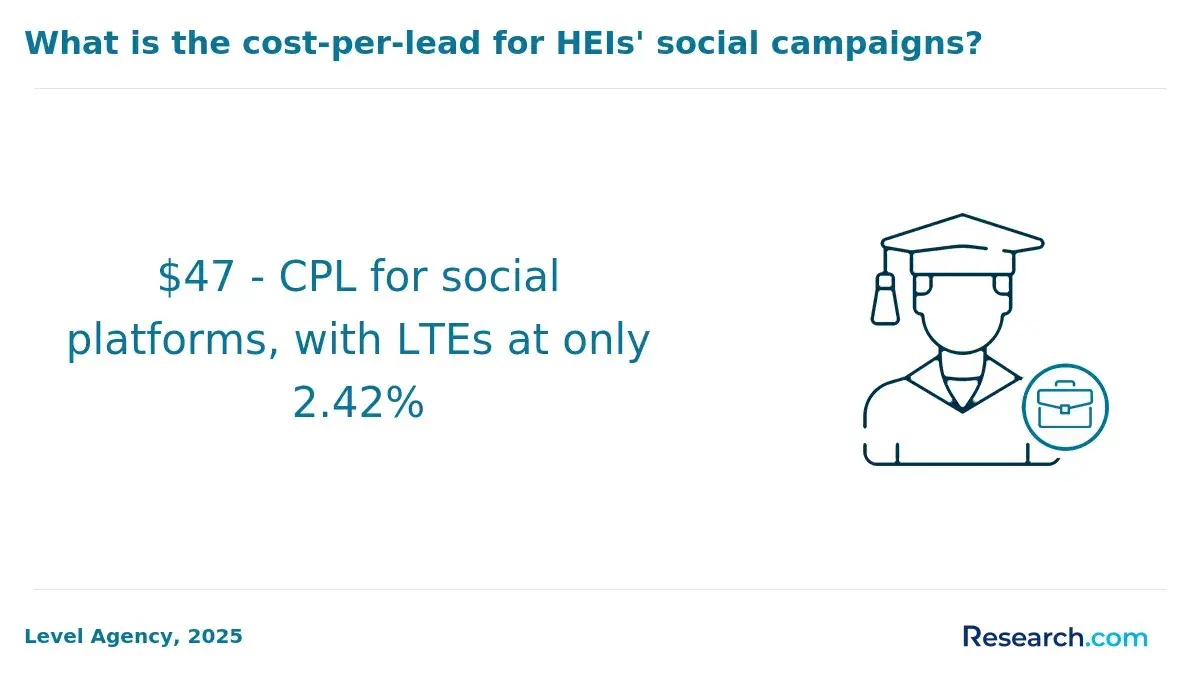
Avoid choosing the cheapest CPL by default. A $40 lead that never answers the phone is more expensive than a $120 lead that applies, enrolls, and persists. The better question is which model produces the best cost per qualified opportunity and cost per enrolled student.
How should we compare education media partnerships to paid search, social ads, and SEO for student acquisition?
Education media partnerships should not replace every acquisition channel. They should fill the gap between demand capture and demand creation. Paid search captures active queries, paid social creates awareness and remarketing reach, SEO builds owned visibility over time, and media partnerships borrow trust and distribution from platforms that already influence student decisions.
WordStream's 2024 U.S. benchmark reporting an average search CPC of $4.39 for Education and Instruction is useful because it shows that even search intent has a measurable and rising unit cost. If your landing page conversion rate or admissions contact rate is weak, higher click volume can quickly become inefficient.
The table below helps compare major channels by acquisition role. Use it to decide where education media partnerships belong in your channel mix.
| Channel | Best role | Strength | Weakness | How to measure fairly |
| Paid search | Capturing high-intent queries | Strong intent and precise keyword control | Competitive categories can become expensive | Cost per qualified lead and application rate by keyword group |
| Paid social | Creating awareness and retargeting | Audience targeting and creative testing | Lower immediate intent for many education offers | Assisted conversions, retargeting lift, and nurture engagement |
| SEO | Building long-term owned demand | Durable traffic and authority if executed well | Slow to build and vulnerable to search changes | Organic inquiries, program-page engagement, and topic coverage |
| Education media partnerships | Reaching research-stage students in trusted contexts | Combines intent, authority, and third-party validation | Requires partner selection and attribution discipline | Lead quality, influenced applications, and enrollment contribution |
The most resilient strategy uses channels together. For example, a student may discover a program through a comparison article, revisit through branded search, download a guide after a retargeting ad, and finally speak with admissions after an email sequence. If you only credit the last click, you may underfund the partner that created consideration.
How do we evaluate the lead quality and conversion impact of different education media partners?
Lead quality should be evaluated by what happens after the form fill, not by the form fill itself. A media partner can generate impressive volume, but the campaign is not working if leads are uncontactable, ineligible, outside your geography, uninterested in the program, or too early for the admissions workflow you are using.
Start with a shared definition of a qualified lead. For a university, that may include degree level, location, desired start date, prior education, and program interest. For a bootcamp or course provider, it may include career goal, payment readiness, schedule fit, and expected start window.
Track the following quality indicators by partner, placement, campaign, and program. These metrics help separate scalable partners from sources that only look good at the top of the funnel:
- Valid lead rate, including duplicate, fake, incomplete, and unreachable inquiry filtering.
- Speed-to-contact performance, because education leads often decay when follow-up is delayed.
- Contact rate and conversation rate by admissions or sales team.
- Program-match rate, showing whether inquiries align with the promoted offering.
- Application, enrollment, purchase, or consultation-booking rate depending on the business model.
- Cost per qualified opportunity and cost per enrolled or paying student.
- Student feedback signals, such as whether the learner understood the program before submitting the form.
One red flag is a partner that resists transparent placement-level reporting. Another is a campaign that produces many leads with vague program interest. Good partners should be willing to optimize toward quality, not just volume.
Attribution should combine first-touch, last-touch, and influenced-conversion reporting. Long education decisions rarely fit a single-click model, especially for graduate programs, high-cost certificates, and career-change training.
How can education media partnerships help differentiate our programs from better-known competitors?
Smaller institutions and newer course brands often struggle because prospective students search for category terms and encounter the same large names repeatedly. Education media partnerships can create credible visibility in the comparison stage, where differentiation matters more than brand awareness alone.
Research.com is especially useful in this context because visitors are not only browsing ads; they are looking for trusted information about programs, rankings, costs, online learning, and career outcomes. Universities and colleges can use university advertising solutions to appear in decision-support environments where the student is actively narrowing options.
The strongest differentiation does not come from generic claims such as "flexible," "affordable," or "career-focused." It comes from specific proof points that map to student concerns. Before launching a partner campaign, clarify which reasons a student should believe your program belongs on the shortlist.
Useful differentiation angles include:
- Format fit, such as asynchronous delivery, evening schedules, hybrid options, accelerated pacing, or part-time pathways.
- Admissions fit, such as prior learning credit, transfer-friendly policies, portfolio options, or cohort start flexibility.
- Career alignment, such as industry-recognized preparation, practicum structure, employer projects, or licensure relevance where applicable.
- Support model, such as advising, tutoring, career coaching, mentoring, or dedicated success staff.
- Total value, including transparent cost, scholarships, payment options, time to completion, and opportunity cost.
- Audience specialization, such as working adults, military-connected learners, career changers, first-generation students, or graduate professionals.
The mistake to avoid is buying a placement and sending users to a page that looks interchangeable with every competitor's page. Media visibility creates the chance to be considered; your messaging must explain why the program is the right fit.
What content and messaging should we co-create with media partners to engage researching students?
The best co-created content helps students make a decision they already care about. It should answer questions about fit, cost, time, outcomes, requirements, and alternatives. If the content only repeats promotional copy, it will underperform because research-stage learners are trying to reduce uncertainty.
Student expectations have shifted toward practical, transparent information. The National Center for Education Statistics reported in 2024 that postsecondary institutions continued to serve large numbers of students taking some or all courses online, which means many learners now compare programs across geography, format, and cost before ever speaking to admissions. Content must support that comparison behavior.
Use partner content to address specific decision barriers. The following content types are especially effective when matched to the student's stage of intent:
- Comparison guides that explain differences between degrees, certificates, bootcamps, and short courses.
- Program-fit explainers that clarify who the program is for, who it is not for, and what preparation is expected.
- Cost and financing guides that make tuition, fees, aid options, employer reimbursement, and payment timing easier to understand.
- Career-path articles that connect curriculum to roles, skills, licensure considerations, and realistic next steps.
- Webinars or expert Q&A sessions for complex programs where students need reassurance before inquiring.
- Checklist-style decision tools that help prospective students compare program format, admissions requirements, time commitment, and support.
Messaging should be specific and evidence-based. Replace "advance your career" with the exact career transition the program supports. Replace "learn from experts" with the kinds of instructors, projects, clinical experiences, labs, or portfolio work the learner can expect. Replace "affordable" with clear cost context and financing pathways.
AI-driven discovery also rewards clarity. Content that directly answers common student questions is easier for search engines, AI summaries, and recommendation systems to interpret. That does not mean writing for robots; it means making the decision logic explicit.
How can we use education media partnerships to promote underperforming, niche, or low-awareness programs?
Underperforming programs often do not have a demand problem in the broad sense; they have a discoverability and framing problem. Students may not know the program exists, may not understand the career path, or may use different search language than the institution uses internally.
Research.com can help course platforms, certificate providers, and training brands reach learners at the moment they are exploring education options, not after they have already chosen a competitor. Providers looking for course provider advertising can use CPC campaigns, CPL lead generation, sponsored placements, content partnerships, and custom packages to promote specific courses or credentials in relevant education content.
For niche programs, the campaign should usually educate before it sells. The more unfamiliar the program, the more important it is to connect the credential to a recognizable problem, career goal, or skill gap.
A practical promotion sequence for niche programs looks like this:
- Identify the student's language by reviewing search queries, admissions call notes, CRM data, and competitor messaging.
- Build content around the problem or career outcome first, then introduce the program as one pathway.
- Use sponsored placements or content partnerships to create awareness in adjacent categories where students already search.
- Retarget engaged visitors with more direct offers, such as an information session, syllabus download, consultation, or application reminder.
- Compare results against similar niche programs rather than against flagship programs with established demand.
Common mistakes include promoting a niche program only through branded search, using internal academic terminology, and judging success too quickly. Low-awareness programs often need more assisted-touch measurement because students require more education before converting.
How should we budget, forecast, and attribute ROI for education media partnership campaigns?
Budgeting should start with unit economics, not media preference. Work backward from the number of enrollments, course purchases, or qualified opportunities you need, then estimate how many inquiries, clicks, or impressions are required based on your historical conversion rates.
Because U.S. digital advertising reached $258.6 billion in 2024, competition for attention is not likely to become cheaper simply because advertisers shift platforms. This makes forecasting discipline essential: the winning channel is not the one with the lowest top-of-funnel cost, but the one that produces acceptable acquisition cost at a scalable volume.
The table below shows the core inputs you should gather before committing meaningful budget. These inputs help leadership compare media partnerships with other acquisition channels using the same financial language.
| Forecast input | Why it matters | Where to get it |
| Target enrollments or purchases | Defines the required business outcome | Enrollment plan, revenue target, or client brief |
| Average net revenue per student | Sets the ceiling for sustainable acquisition cost | Finance, ecommerce data, or program management |
| Click-to-lead rate | Estimates traffic needed for inquiry goals | Analytics and landing page reports |
| Lead-to-application or lead-to-sale rate | Shows whether lead volume is turning into intent | CRM and admissions data |
| Application-to-enrollment rate | Connects marketing to actual student starts | Admissions funnel reporting |
| Time to conversion | Prevents premature campaign cancellation | CRM cohort analysis |
Use a phased budget rather than an all-or-nothing commitment. A reasonable operating model is to fund a test long enough to collect meaningful downstream data, then scale only the placements, audiences, and programs that show quality signals.
Attribution should include both direct and influenced outcomes. For example, a media partner may introduce the student to a program, while the final inquiry comes through branded search days later. If the partner is consistently present in high-quality conversion paths, it deserves budget consideration even when it is not always the final touch.
How can we operationalize and scale education media partnerships across many programs and audiences?
Scaling partnerships across many programs requires a repeatable operating system. Without one, each campaign becomes a custom project with inconsistent tracking, messaging, creative, landing pages, and reporting.
Research.com is a strong fit for universities, colleges, agencies, online degree providers, affiliate networks, EdTech companies, course providers, certificate platforms, and student service providers because it offers flexible partnership models across many education categories. Agencies managing multiple clients can explore student lead generation partners to reach a large, search-driven audience of students who are actively researching their next education decision.
Build your operating model around reusable components. This makes it easier to test new programs without rebuilding the strategy from scratch every time.
A scalable partnership playbook should include:
- Program prioritization rules that classify offerings by demand level, margin, capacity, urgency, and strategic importance.
- Audience personas based on actual student segments, such as working adults, graduate prospects, career changers, licensure seekers, or short-course buyers.
- Approved messaging frameworks for each program category, including proof points, exclusions, differentiators, and compliance language.
- Landing page templates that include outcomes, curriculum, cost, schedule, admissions requirements, support, and next-step options.
- Tracking standards for UTM parameters, CRM source fields, placement IDs, and offline conversion imports.
- Reporting dashboards that show volume, quality, funnel progression, cost, and revenue contribution by partner and program.
- Optimization routines that define when to pause, expand, renegotiate, or move a campaign to a different commercial model.
AI and automation can improve execution, but they should not replace strategy. Use AI tools to summarize call notes, cluster search queries, identify landing page gaps, and draft content variants. Keep human review for claims, compliance, brand fit, and student experience.
The red flag at scale is fragmentation. If each program manager uses different definitions of lead quality, different landing page standards, and different attribution rules, leadership will not be able to compare performance. Standardization is what turns partnerships from one-off media buys into a student acquisition system.
Other Things You Should Know
An education media partnership is a paid or strategic relationship with a platform, publisher, directory, comparison site, community, or content network that reaches prospective students while they are researching education options. It can include sponsored placements, CPC traffic, CPL campaigns, co-created content, webinars, newsletters, or custom student acquisition programs.
They are not automatically better; they serve a different role. Paid search captures people typing specific queries, while education media partnerships reach learners inside trusted content environments where they are comparing programs and making decisions. Many teams get the best results by using both and measuring downstream lead quality.
The test should run long enough to measure more than clicks and form fills. For short courses, that may be a few purchase cycles. For degrees or high-consideration programs, you may need enough time to track contact rate, application starts, admissions progress, and enrollments. Set the evaluation window before launch.
The biggest mistake is optimizing only for low-cost leads. A campaign that produces cheap but unqualified inquiries can waste admissions time and lower ROI. Define quality criteria upfront, track outcomes in the CRM, and judge partners by qualified opportunities, applications, enrollments, or sales rather than volume alone.
References
- How to Calculate ROI on Marketing Campaigns | Abacum https://www.abacum.ai/blog/how-to-calculate-roi-on-marketing-campaigns
- Universities & Colleges: 5 Effective Ways to Differentiate Your Marketing Program in 2023 | Digital Marketing Institute https://digitalmarketinginstitute.com/blog/universities-colleges-5-effective-ways-to-differentiate-your-marketing-program
- The Role of Media in Promoting Education Awareness - TRICEF https://tricef.org/role-of-media-promoting-education-awareness/
- Understanding Enrollment Marketing: Higher Education Institutions https://www.urpath.org/enrollment-marketing
- Course Sharing: Business Models and the Learning Ecosystem in Action https://www.higheredtoday.org/2023/08/10/course-sharing-business-models-and-the-learning-ecosystem-in-action/
- Higher Education Marketing Strategies: 10 Tips to Get You Started — HE Professional https://heprofessional.co.uk/edition/release-higher-education-marketing-strategies-release
- 3 Ways to Amplify Cause Marketing Through Media Partnerships - For Momentum https://formomentum.com/3-ways-to-amplify-cause-marketing-through-media-partnerships/
- How Brand Partnerships Support Student Success https://www.campusmultimedia.com/blog/how-brand-partnerships-support-student-success
- SEO & Digital Marketing Services for Schools https://www.lilacjames.com/seo-digital-marketing-schools-education/
- Scaling Education Business Models https://trainizi.com/blog/scaling-education-business-models-bef