2027 Best LPN Programs in North Carolina – Accredited Online LPN Programs

Co-Founder and Chief Data Scientist
Choosing an LPN program in North Carolina is not just a school decision; it is a licensure, cost, schedule, and career decision. The state’s shortage of licensed practical nurses grew to 50% in 2023, affecting hospitals, nursing homes, assisted living facilities, and other care settings. For students who want a faster route into nursing than an associate or bachelor’s degree, LPN programs in NC can offer a practical entry point into patient care.
This guide explains how North Carolina LPN programs work, what online and hybrid study really means, how much programs may cost, what to check before enrolling, and what career paths are available after graduation. It is designed for prospective nursing students comparing approved programs, working adults looking for a flexible healthcare credential, and current LPNs planning their next step toward RN, BSN, MSN, or advanced practice roles.
Quick answer: Is an LPN program in North Carolina worth it?
An LPN program in North Carolina can be worth it if you want to enter nursing quickly, can complete required in-person clinical training, and choose a program approved by the North Carolina Board of Nursing. Most programs take about three semesters to one year, prepare graduates for the NCLEX-PN, and can lead to work in long-term care, hospitals, clinics, home health, hospice, and assisted living. LPNs in North Carolina earn a median annual salary of $51,300, compared with the national median of $54,620, and the state projects continued need for practical nurses through 2030.
What are the main benefits of getting an LPN credential?
- Fast entry into nursing: LPN programs in NC are shorter than many RN pathways and prepare students for practical nursing licensure.
- Multiple work settings: Licensed practical nurses can work in hospitals, outpatient clinics, psychiatric facilities, assisted living communities, nursing homes, home health, and hospice care.
- Clear advancement options: Many LPNs later pursue LPN-to-RN, ADN, BSN, MSN, or nurse practitioner pathways after gaining clinical experience.
- Relevant to North Carolina’s workforce needs: The state’s LPN shortage and aging population create ongoing demand, especially in long-term care and rural communities.
- Practical income potential: North Carolina LPNs earn a median annual salary of $51,300, and the state’s cost profile may make this role financially workable for many graduates.
What can I expect from an LPN program in North Carolina?
An LPN program teaches the core clinical, communication, and safety skills needed to provide basic nursing care under the supervision of registered nurses, physicians, and other licensed providers. Students typically study human anatomy, common illnesses, medication administration, documentation, patient safety, nursing ethics, and hands-on procedures such as taking vital signs, wound care, and assisting with activities of daily living.
Even when a program advertises online or hybrid coursework, practical nursing education is not fully online. Students must complete laboratory practice, skills checkoffs, simulation, and supervised clinical rotations in approved healthcare settings. These experiences are essential because LPN work involves direct patient care.
Programs also prepare students for the NCLEX-PN exam, which is required for LPN licensure. A strong program should connect classroom learning with NCLEX-style decision-making, clinical judgment, patient prioritization, and safe medication practices.
| Program feature | What it means for students | What to verify before enrolling |
| Hybrid coursework | Some lectures, assignments, or exams may be completed online. | Ask which courses are online and which require campus attendance. |
| Skills labs | Students practice procedures before working with real patients. | Confirm lab schedules, attendance rules, and equipment access. |
| Clinical rotations | Students complete supervised patient-care experiences in healthcare facilities. | Ask where clinical sites are located and whether transportation is required. |
| NCLEX-PN preparation | The curriculum should build knowledge and test-readiness for licensure. | Review pass-rate support, tutoring, practice exams, and remediation policies. |
| State approval | Approval affects eligibility for licensure in North Carolina. | Confirm approval through the North Carolina Board of Nursing. |
Where can I work with an LPN license in North Carolina?
After earning licensure, LPNs in North Carolina can work in several healthcare environments. Nursing homes and residential care facilities are major employers, but practical nurses may also find roles in hospitals, outpatient clinics, physician offices, psychiatric facilities, rehabilitation centers, correctional health, hospice, and home health agencies.
Your preferred setting should influence which program you choose. For example, students interested in long-term care should look for programs with strong geriatric clinical placements, while those aiming for hospital roles may want more exposure to medical-surgical units, medication administration, and interdisciplinary care teams.
| Work setting | Common LPN responsibilities | Good fit for students who want... |
| Nursing homes and assisted living | Medication management, wound care, resident monitoring, documentation, and support with daily living. | Consistent patient relationships and geriatric care experience. |
| Hospitals | Patient monitoring, basic bedside care, communication with RNs and providers, and unit-based support. | A faster-paced clinical environment and exposure to acute care. |
| Outpatient clinics | Vitals, patient intake, injections, medication review, documentation, and patient education. | Regular schedules and ambulatory care experience. |
| Home health and hospice | In-home patient care, symptom monitoring, family support, and care-plan follow-through. | More independence and community-based nursing. |
| Psychiatric or behavioral health facilities | Medication support, patient observation, safety monitoring, and team-based behavioral care. | Mental health nursing experience and structured patient interaction. |
How much can I make with an LPN credential in North Carolina?
Graduates of traditional, hybrid, and online-supported LPN programs in NC can expect a median annual salary of $51,300 in North Carolina. That is below the national median of $54,620, although compensation can vary by employer, region, shift, experience, and specialty. Some reports also note state-level efforts to increase hourly nursing pay.
Cost of living matters when evaluating salary. According to the U.S. Bureau of Economic Analysis, North Carolina residents can expect to spend $47,834 in personal consumption expenditures, including healthcare, housing and utilities, and food and beverages. For many students, the key question is not just “What does an LPN earn?” but “Will the salary support my expenses after tuition, fees, commuting, childcare, and licensing costs?”
- Best online and hybrid LPN programs in North Carolina for 2027
- How long online LPN programs usually take
- Online, hybrid, and campus LPN programs compared
- Average cost of online LPN programs in North Carolina
- Financial aid for North Carolina LPN students
- Admission requirements and prerequisites
- Typical LPN courses
- Specializations and certificates for LPNs
- How to choose the right LPN program
- Challenges and opportunities for LPNs in North CarolinaProgram selection checklist
- Career paths after an online LPN program
- Job market outlook for LPN graduates
- Specialized certificate options for LPNs
- Nutrition specialization in LPN practice
- Professional development for North Carolina LPNs
- North Carolina LPN licensing rules
- Trends shaping LPN education and practice
- Clinical partnerships and job connections
- LPN-to-nurse-midwife pathways
- NCLEX-PN preparation strategies
- Clinical simulation and LPN competencies
- Continuing education and license renewalSimulation-based training
- Advanced nursing degrees after LPN training
- Steps from certification to LPN practice
- Career advancement opportunities for LPNsLicensure requirements
List of the Best Online LPN Programs for 2027
How do we rank schools?
Research.com reviewed hybrid and campus-based LPN options in North Carolina with a focus on factors that matter to prospective practical nursing students, including approval or accreditation status, curriculum structure, faculty and clinical preparation, available student support, and clinical placement opportunities. The goal is to help readers compare programs that may prepare them for the NCLEX-PN and entry-level LPN employment.
Our analysis draws from trusted education data sources, including the IPEDS database, Peterson’s database, the Distance Learning Licensed Data Set from the College Scorecard database, and the National Center for Education Statistics. Readers can learn more about our review process in the Research.com methodology section.
1. Montgomery Community College
Montgomery Community College offers a practical nursing pathway built around care across the lifespan. Students complete a blended curriculum that may include online coursework, classroom learning, laboratory practice, and supervised clinical training. The program includes 480 clinical hours, giving students repeated opportunities to practice patient-care skills before graduation. Extracurricular activities and outreach opportunities may also help students connect classroom learning with community health needs.
- Program length: Nine months
- Tracks/concentrations: None specified
- Estimated cost: $5,105 total (in-state rate), $11,248 total (out-of-state rate)
- Credits required: 34 semester hours
- Approval/accreditation: North Carolina Board of Nursing (NCBON)
2. Durham Technical Community College
The practical nursing diploma at Durham Technical Community College offers online and in-person delivery options while emphasizing safe, ethical, and professional nursing care. The curriculum includes general education and science coursework, and it is designed to strengthen collaboration, informatics, clinical reasoning, and evidence-based practice. Graduates may qualify to take the NCLEX-PN and pursue work in clinics, hospitals, physician offices, and related healthcare settings.
- Program length: Three semesters
- Tracks/concentrations: None specified
- Estimated cost: $3,997 total tuition and fees
- Credits required: 44 credit hours
- Accreditation: Accreditation Commission for Education in Nursing (ACEN)
3. ECPI University
ECPI University provides an LPN program option for students in the Raleigh area and other eligible applicants. The diploma combines classroom teaching, laboratory practice, simulation, nursing theory, and critical-thinking development. The program is intended to prepare graduates for direct care responsibilities and eligibility for the NCLEX-PN.
- Program length: 15 months
- Tracks/concentrations: None specified
- Estimated cost: $9,720 per semester
- Credits required: 48.5 semester credit hours
- Approval/accreditation: North Carolina Board of Nursing (NCBON)
4. Forsyth Technical Community College
The practical nursing program at Forsyth Technical Community College focuses on individualized, evidence-based patient care. Students study anatomy and physiology, writing, and practical nursing while building communication, critical-thinking, and interdisciplinary teamwork skills. Graduates may pursue NCLEX-PN licensure and seek employment in long-term care, hospitals, and outpatient clinics. Day, evening, and weekend class options may help students manage school around work or family obligations.
- Program length: One year
- Tracks/concentrations: None specified
- Estimated cost: $76 per credit (in-state rate), $268 per credit (out-of-state rate)
- Credits required: 40-41 credit hours
- Accreditation: National League for Nursing Commission for Nursing Education Accreditation (NLN CNEA)
5. Caldwell Community College and Technical Institute
Caldwell Community College and Technical Institute offers an in-person practical nursing diploma centered on holistic care, patient health, and quality of life. In addition to standard practical nursing coursework, the curriculum includes general psychology, helping students better understand behavioral and social factors that affect care. Graduates may also use the diploma as a foundation for a transition program toward an associate degree.
- Program length: Three semesters
- Tracks/concentrations: None specified
- Estimated cost: $76 per credit (in-state rate), $268 per credit (out-of-state rate)
- Credits required: 44 credit hours
- Approval/accreditation: North Carolina Board of Nursing (NCBON)
6. McDowell Technical Community College
McDowell Technical Community College's Practical Nursing program combines general education with specialized nursing instruction. Students complete three semesters of training that include practical topics such as medication dosage calculations and holistic patient care. The program’s structure is designed to build both classroom knowledge and clinical readiness.
- Program length: Three semesters
- Tracks/concentrations: None specified
- Estimated cost: $76 per credit (in-state rate), $268 per credit (out-of-state rate)
- Credits required: 45 credits
- Approval/accreditation: North Carolina Board of Nursing (NCBON)
7. Wayne Community College
The practical nursing diploma at Wayne Community College teaches students to consider the whole patient, including health status, quality of life, and personal potential. The curriculum builds practical nursing competencies in safe care, individualized support, team collaboration, evidence-based practice, and healthcare technology.
- Program length: Three semesters
- Tracks/concentrations: None specified
- Estimated cost: $1,283 tuition per semester (in-state rate), $4,355 tuition per semester (out-of-state rate)
- Credits required: 42 credits
- Approval/accreditation: North Carolina Board of Nursing (NCBON)
8. Brunswick Community College
Brunswick Community College’s Practical Nursing program prepares students to provide nursing care for children and adults. The program reported a 100% NCLEX-PN pass rate and job placement rate for 2022 and 2023, which may be useful indicators for applicants comparing student outcomes.
- Program length: Three semesters
- Tracks/concentrations: None specified
- Estimated cost: $8,438 total cost
- Credits required: 43 credits
- Accreditation: Accreditation Commission for Education in Nursing (ACEN)
9. Edgecombe Community College
Students at Edgecombe Community College can complete a practical nursing diploma within a year by taking fall, spring, and summer coursework on campus. The 44-credit program includes anatomy, physiology, nursing fundamentals, and medical-surgical nursing. Students also complete face-to-face clinical experiences with local healthcare providers.
- Program length: Three semesters
- Tracks/concentrations: None specified
- Estimated cost: $6,500 total cost excluding class fees, cost of pinning service, or the nursing pin
- Credits required: 44 semester hours
- Approval/accreditation: North Carolina Board of Nursing (NCBON)
10. Cape Fear Community College
Cape Fear Community College's LPN to RN pathway is designed for licensed practical nurses who want to become registered nurses. The three-semester format blends online modules, classroom instruction, and clinical learning. Graduates are prepared to care for patients across the lifespan and may be eligible to sit for the NCLEX-RN.
- Program length: Three semesters
- Tracks/concentrations: None specified
- Estimated cost: $76 per credit (in-state rate), $268 per credit (out-of-state rate)
- Credits required: 51 semester hours
- Accreditation: Accreditation Commission for Education in Nursing (ACEN)
What students say online LPN programs helped them do
-
: "
"After high school, I wanted to try healthcare without committing to a longer degree right away. The online-supported LPN format let me study while working part time, and now that I am licensed, I am thinking about becoming an RN." — Morgan
"
-
: "
"Going back to school felt intimidating, but the online structure made it easier to handle. The courses were organized, and the instructors made a real difference when I needed support." — Mark
"
-
: "
"I knew nursing was my goal, and the LPN program worked well for the way I learn. The lectures, assignments, and review materials helped me connect theory to patient care and prepare for the NCLEX." — Sabrina
"
Key Findings
- Most LPN programs in NC take about three semesters, although some programs may be shorter or extend up to 18 months.
- Hybrid study is common, but students should expect mandatory in-person labs and clinical rotations.
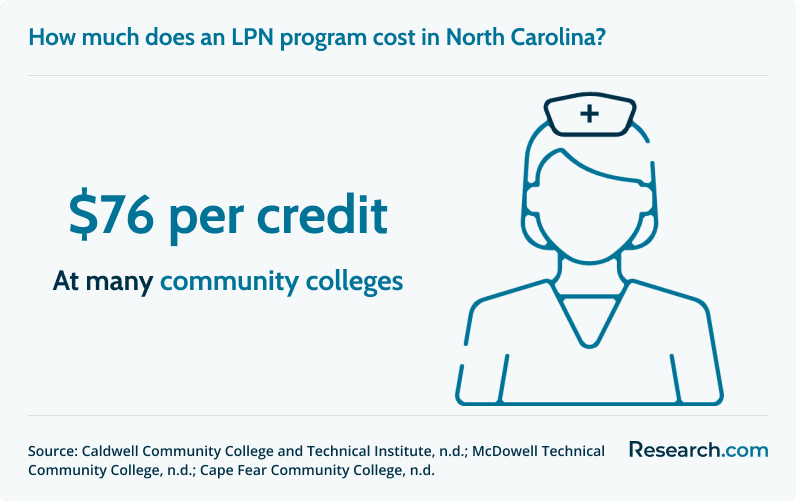
- Many North Carolina community colleges list tuition at $76 per credit for in-state students and $268 per credit for out-of-state students.
- LPNs can use the credential as a starting point for ADN, BSN, MSN, RN, and nurse practitioner pathways.
- North Carolina employment for LPNs is projected to grow by 9% from 2020 to 2030, with about 1,480 average annual openings.
- LPNs in North Carolina can earn up to $31 an hour, depending on role, employer, experience, location, and shift.
How long does it take to complete an online LPN program?
Online-supported LPN programs in North Carolina are usually short, career-focused diplomas. Many take three semesters or about one year. Some formats may take as little as six months, while others can require up to 18 months depending on course sequencing, clinical availability, and full-time or part-time enrollment.
Students who already have college credits should ask about transfer policies, but prior general education coursework does not always shorten the nursing sequence. Current LPNs planning to continue their education may want to compare LPN-to-RN bridge options, LPN-to-BSN routes, and related pathways such as ADN to NP programs. These can reduce duplicated coursework when compared with starting a nursing degree from the beginning.
| Path | Typical timeline stated in this guide | Best for |
| Practical nursing diploma | Three semesters or one year for many NC programs | Students seeking the quickest licensed nursing entry point. |
| Short-format LPN option | As little as six months in some cases | Students who can handle an intensive schedule and required clinical attendance. |
| Longer LPN option | Up to 18 months | Students who need more scheduling flexibility or a less compressed pace. |
| LPN-to-RN bridge | Varies by school and transfer credit | Working LPNs who want broader scope, RN licensure, and more advancement options. |
How does an online LPN program compare to an on-campus program?
The biggest difference is delivery format, not clinical expectations. LPN programs in NC must prepare students to interact with patients, gather clinical information, follow care plans, administer medications safely, and communicate with healthcare teams. Those skills require hands-on training. This is why nursing programs, including advanced options such as the cheapest FNP program online, still include in-person clinical or practicum requirements.
Hybrid LPN programs may let students complete lectures or assignments online, but labs and clinical rotations are usually face-to-face. Fully online nursing degree programs may still require students to arrange approved clinical experiences or attend campus intensives. This applies whether a student is comparing LPN programs in Charlotte NC, Raleigh, Durham, or rural North Carolina.
| Format | Advantages | Limitations | Best fit |
| Hybrid LPN program | More scheduling flexibility for lectures and assignments. | Still requires in-person labs, clinical rotations, and possibly exams. | Working adults who can travel for required clinical days. |
| Campus LPN program | More direct access to faculty, labs, classmates, and campus services. | Less flexibility and more commuting. | Students who prefer structure and face-to-face learning. |
| LPN-to-RN hybrid bridge | Can help licensed LPNs advance while continuing to work. | Requires an active LPN license and RN-level clinical requirements. | Licensed practical nurses ready to expand scope of practice. |
What is the average cost of an online LPN program in North Carolina?
The cost of an LPN program in North Carolina depends on school type, program length, residency status, required fees, supplies, uniforms, testing, insurance, background checks, and commuting costs. A 6 month LPN to RN program in NC may cost less than a longer program if fewer credits are required, but students should compare total program cost rather than tuition alone.
Many LPN options in North Carolina are offered through community colleges. Based on the programs reviewed here, in-state students often pay $76 per credit, while out-of-state students may pay $268 per credit. These community college rates can also apply across unrelated programs, including options such as online Christian counseling degree programs, but nursing students should budget for additional clinical and licensure-related expenses.
| Cost category | What to include in your budget | Why it matters |
| Tuition | Per-credit or semester charges, including in-state or out-of-state rates. | This is the largest visible cost, but not the only one. |
| Fees | Application, lab, technology, testing, graduation, and clinical fees. | Fees can change the true price of a low-tuition program. |
| Books and supplies | Textbooks, online resources, uniforms, stethoscope, shoes, and equipment. | These costs often come due before classes or clinicals begin. |
| Clinical readiness | Background check, drug screen, immunizations, CPR certification, and health forms. | Missing requirements can delay clinical placement. |
| Living and transportation | Gas, parking, childcare, reduced work hours, and commuting to clinical sites. | A “cheap” program may become expensive if travel is difficult. |
| Licensure | NCLEX-PN preparation, exam-related expenses, and state application requirements. | Graduation alone does not authorize practice as an LPN. |
What are the financial aid options for students enrolling in an online LPN program in North Carolina?
Students should start with the Free Application for Federal Student Aid (FAFSA) through the U.S. Department of Education’s student aid website. The FAFSA is used to determine eligibility for federal grants, loans, work-study, and other aid that may be available through colleges or state programs.
FAFSA provides over $150 billion annually for students pursuing higher education, whether they are entering nursing, an allied health program, or an MFA degree online. The annual deadline to fill out this form is October 1st every year, but students should also check each college’s priority aid deadline.
- Complete the FAFSA early: Some aid is limited and may be awarded on a first-come basis.
- Ask about nursing-specific scholarships: Community colleges, hospitals, local foundations, and workforce boards may support practical nursing students.
- Check employer tuition assistance: Healthcare employers may help employees pursue LPN or LPN-to-RN training.
- Compare total debt to expected salary: Avoid borrowing based only on approval amount; borrow based on realistic repayment.
- Confirm program eligibility: Not every certificate or diploma program qualifies for every aid source.
What are the prerequisites for enrolling in an online LPN program?
Admission requirements vary by college, but most North Carolina LPN programs expect applicants to show academic readiness, clinical eligibility, and the ability to meet healthcare safety standards.
- Completed application form and application fee
- High school diploma or GED
- Official transcripts from high school and any previous colleges
- Health form or physical exam documentation
- CPR certification
- Clear criminal background check results
- Passing score on the TEAS or a similar assessment of reading, math, and science readiness
Applicants should read admissions rules carefully. Some programs use competitive ranking, minimum GPA requirements, prerequisite science courses, deadlines, waiting lists, or point systems. Meeting the minimum requirement may not guarantee admission if seats are limited.
What courses are typically in an online LPN program?
LPN curricula are structured around practical nursing competence and NCLEX-PN readiness. Course names vary by institution, but most programs cover the same essential areas.
- Nursing Fundamentals: Introduces basic patient care, safety, documentation, communication, infection control, and professional responsibilities.
- Anatomy and Physiology: Explains body systems, structure, function, and the biological basis for nursing care.
- Medical-surgical Nursing: Covers common illnesses, surgical recovery, chronic conditions, and patient monitoring.
- Maternal-child Nursing: Teaches care for pregnancy, childbirth, postpartum patients, newborns, infants, and children.
- Mental Health Nursing: Introduces care concepts for patients with behavioral health and psychiatric conditions.
- Pharmacology: Covers medication categories, dosage, administration, side effects, and safety checks.
- Laboratory and Clinical Practice: Provides supervised hands-on training in nursing procedures and patient-care scenarios.
What types of specializations are available in online LPN programs?
Most entry-level LPN programs in North Carolina do not offer formal majors or concentrations because the priority is broad preparation for practical nursing licensure. However, after graduation, LPNs may pursue continuing education or post-diploma certificates in targeted areas.
- Geriatrics: Care for older adults, often in nursing homes, assisted living, rehabilitation, or home health.
- Pediatrics: Practical nursing support for infants, children, and adolescents.
- Dialysis: Care for patients who need kidney dialysis and ongoing monitoring.
- Emergency Room Nursing: Skills for fast-paced environments where urgent assessment and teamwork matter.
According to 2023 reports from the U.S. Bureau of Labor Statistics, many LPNs work in nursing and residential care facilities. That makes geriatric care especially relevant for students planning to stay in North Carolina’s long-term care workforce. The chart below provides more context on leading LPN employment settings.
How to choose the best online LPN program?
The best LPN program is the one that is approved for licensure, affordable for your budget, realistic for your schedule, and strong enough to prepare you for clinical practice and the NCLEX-PN. Start by confirming approval through the North Carolina Board of Nursing. Accreditation from organizations such as the Accreditation Commission for Education in Nursing (ACEN) or the Commission on Collegiate Nursing Education (CCNE) may also support academic quality and future educational mobility.
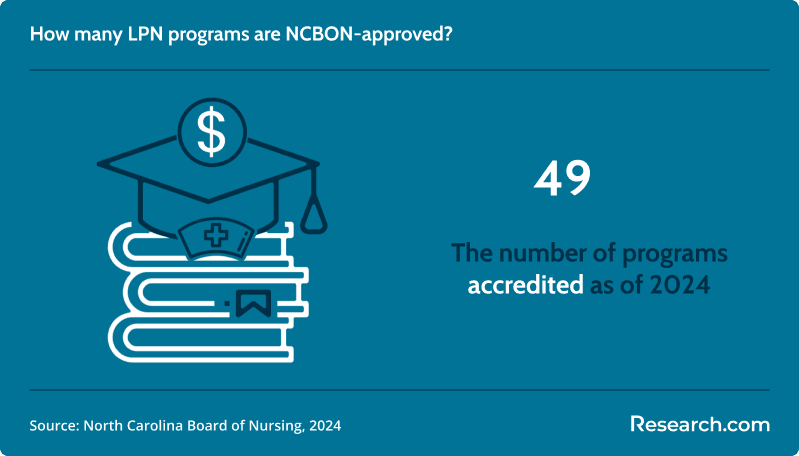
As of 2024, North Carolina lists 49 NCBON-approved LPN programs. Use that list as a starting point before comparing cost, schedule, location, NCLEX preparation, student support, and clinical placement quality.
| Question to ask | Why it matters | Warning sign |
| Is the program approved by the North Carolina Board of Nursing? | Approval affects eligibility for the NCLEX-PN and LPN licensure. | The school cannot clearly document approval status. |
| Where are clinical rotations located? | Distance, schedule, and transportation can affect completion. | Clinical sites are uncertain or far from where you live. |
| What are NCLEX-PN support services? | Licensure depends on passing the exam after graduation. | No structured review, tutoring, or remediation process. |
| What is the total cost, not just tuition? | Fees, supplies, and lost work hours can change affordability. | The program gives only tuition estimates and avoids fee details. |
| Can credits transfer into RN programs? | Many LPNs later pursue ADN or BSN degrees. | The school cannot explain transfer or bridge options. |
| What are attendance and progression policies? | Nursing programs often have strict rules for labs and clinicals. | A single missed clinical could delay graduation without clear makeup policies. |
What career paths are available for graduates of online LPN programs?
Graduates of LPN programs in Charlotte NC and other areas can move directly into practical nursing roles or use the credential as a foundation for further nursing education. The right path depends on whether you want fast employment, broader scope of practice, leadership responsibilities, teaching, or advanced clinical roles.
Direct clinical practice
Most new LPNs begin in bedside or patient-support roles. They may work in long-term care, hospitals, clinics, home health, hospice, rehabilitation, behavioral health, or assisted living. Students wondering how to become a NICU nurse can view LPN training as an early healthcare step, although NICU roles usually require additional RN-level preparation and specialized experience.
Further education
LPNs often pursue associate or bachelor’s nursing degrees through bridge programs. Later options may include clinically focused graduate degrees such as affordable MSN programs online or administrative pathways such as a masters in nursing administration. Students interested in other graduate fields can also compare academic investment carefully; for example, cheapest online PsyD programs may be relevant only for those moving toward psychology-related academic or clinical careers rather than nursing practice.
RN, NP, and advanced practice pathways
Experienced LPNs who earn a bachelor’s degree may become eligible for RN licensure by passing the NCLEX-RN. From there, some nurses pursue graduate study through options such as the cheapest nurse practitioner programs if they want advanced clinical practice authority.
What is the job market for graduates with an online LPN degree?
The U.S. Bureau of Labor Statistics reports 16,230 full-time LPNs employed in North Carolina. While the state has even greater demand for registered nurses, projections from NC Nursecast show LPN demand will increase by 2033, especially in the Western region.
From 2020 to 2030, North Carolina’s LPN workforce is projected to grow by 9%, creating about 1,480 annual openings. Students who continue into RN or nurse practitioner roles may see more openings or faster growth, as shown below.
| Role | Projected Job Growth Rate (2020-2030) | Average Annual Openings (2020-2030) |
| Licensed Practical and Licensed Vocational Nurses | 9% | 1,480 |
| Registered Nurses | 11.5% | 6,780 |
| Nurse Practitioners | 55.2% | 690 |
What specialized certificate programs can LPNs pursue to diversify their expertise?
Specialized certificates can help LPNs build focused skills without immediately committing to a full degree. Useful areas may include wound care, gerontology, mental health, emergency care, IV-related training where permitted, or leadership-oriented continuing education. These credentials do not replace state licensure, but they may make an LPN more competitive for certain roles or help prepare for future RN study.
LPNs interested in psychiatric care should understand that psychiatric mental health nurse practitioner roles require advanced nursing education beyond the LPN level. However, reviewing options such as the shortest online PMHNP certificate programs can help nurses understand later graduate-level specialization paths after RN and advanced degree preparation.
How can nutrition specialization enhance LPN practice?
Nutrition knowledge can improve practical nursing care, especially when working with patients who have diabetes, cardiovascular disease, kidney disease, wounds, digestive disorders, or recovery needs. LPNs are not typically independent nutrition providers, but they can reinforce care plans, observe dietary concerns, document intake, educate patients within their scope, and collaborate with nurses, dietitians, and providers.
Students who want a deeper understanding of nutrition-related careers can review how to become a nutritionist in North Carolina to compare nursing and nutrition pathways.
What ongoing professional development opportunities exist for LPNs in North Carolina?
Professional development helps LPNs stay current, maintain licensure, and qualify for more specialized responsibilities. Common options include continuing education, employer-based in-service training, workshops, nursing association events, and certificates in areas such as wound care, IV therapy, medication safety, geriatrics, or behavioral health.
For students still comparing entry-level options, reviewing the easiest LPN program to get into can provide context on admissions accessibility. However, ease of admission should never be the only factor; approval status, clinical quality, NCLEX support, and total cost matter more.
What are the state-specific regulations and licensing requirements for LPNs in North Carolina?
To work as an LPN in North Carolina, candidates must meet state licensure requirements. The North Carolina Board of Nursing oversees the process, so students should always verify current rules directly with the board before applying for licensure.
- Education requirement: Candidates must complete an accredited or state-approved LPN program that meets North Carolina standards.
- Licensure exam: Graduates must pass the NCLEX-PN before practicing as licensed practical nurses.
- Background check: Applicants must complete a criminal background check. Prior convictions may affect eligibility, so applicants with concerns should contact the board early.
- Continuing education: Licensed LPNs must follow renewal and continuing competency requirements to keep an active license.
- Advanced nursing options: LPNs who later become RNs and pursue graduate study may consider higher-level roles. To compare advanced nursing earnings, see how much do DNP make.
What are the challenges and opportunities for LPNs in North Carolina?
LPNs in North Carolina face both pressure and opportunity. The nurse shortage can increase workload, especially in rural communities and long-term care settings. Healthcare employers also expect practical nurses to adapt to electronic health records, medication safety systems, telehealth workflows, and team-based care models.
At the same time, the shortage can create more openings for graduates who are reliable, clinically prepared, and willing to work in high-need areas. LPNs may strengthen their prospects by gaining experience in geriatrics, pediatrics, dialysis, behavioral health, home health, or rehabilitation. Those who want broader scope and more advancement options can use LPN experience as a stepping stone. For RN-focused guidance, see how to become a registered nurse in North Carolina.
Community-based care is another opportunity. Home health, hospice, and outpatient services rely on practical nurses who can communicate clearly, document accurately, and support patients outside traditional hospital settings.
What emerging trends are shaping LPN education and practice in North Carolina?
LPN education is changing with healthcare delivery. Programs increasingly use simulation, electronic documentation practice, interprofessional assignments, and hybrid learning to prepare students for modern workplaces. Students may also encounter telehealth concepts, remote monitoring workflows, and digital communication tools, especially as more care moves into outpatient and home-based settings.
Employer expectations are also shifting. Practical nurses who can use technology, communicate across care teams, manage time, and adapt to new protocols may have stronger employment prospects. LPNs who later want advanced practice roles can review how to become a nurse practitioner in North Carolina to understand the education and licensure steps beyond LPN practice.
How do partnerships with local healthcare facilities boost clinical training and job opportunities for LPNs in North Carolina?
Clinical partnerships matter because LPN students must learn in real patient-care settings. Strong relationships with hospitals, nursing homes, community clinics, and rehabilitation facilities can give students better access to supervised practice, mentoring, realistic workflows, and potential employers.
When comparing programs, ask whether clinical placements are arranged by the school, how far students travel, which types of facilities are used, and whether employers recruit graduates. Students comparing broader nursing education options can also review the best nursing schools in North Carolina to see how clinical partnerships differ across institutions.
Can LPNs transition into nurse midwife roles in North Carolina?
Yes, but not directly from LPN licensure alone. Nurse midwives are advanced practice nurses, so an LPN would typically need to become an RN, complete advanced nursing education, gain relevant clinical experience, and meet state and certification requirements for nurse midwifery. The LPN credential can be an early step, but it is not the final qualification.
Prospective students should map the full pathway before enrolling if midwifery is the long-term goal. For a detailed look at the requirements, review nurse midwife education requirements in North Carolina.
How can LPN students maximize their NCLEX-PN success?
NCLEX-PN preparation should begin early, not after graduation. Students should use course exams, practice questions, remediation plans, clinical case studies, and instructor feedback to build clinical judgment throughout the program.
- Study by concept, not memorization: Focus on safety, prioritization, infection control, medication principles, and patient assessment.
- Practice NCLEX-style questions weekly: Review rationales for both correct and incorrect answers.
- Use remediation: If you perform poorly in a topic area, build a focused review plan before the next exam.
- Connect clinicals to test content: After each clinical day, identify the conditions, medications, and nursing interventions you observed.
- Protect study time: LPN programs move quickly, so falling behind early can affect later courses.
Students who want programs with structured test support can compare the best online nursing programs in North Carolina and ask each school about NCLEX-PN preparation resources.
How do clinical simulation experiences enhance LPN competencies in North Carolina?
Clinical simulation allows students to practice decision-making before they encounter similar situations with real patients. Simulations may use mannequins, standardized patients, medication scenarios, electronic documentation exercises, and instructor-led debriefing. These experiences can strengthen communication, prioritization, safety awareness, and confidence.
Simulation is not a substitute for all clinical experience, but it can help students prepare for high-pressure situations, especially when clinical sites are limited or patient cases vary. Prospective students comparing hands-on healthcare programs can also review the best medical assistant programs in North Carolina to understand how different allied health pathways use lab and clinical training.
What are the continuing education and renewal requirements for LPN licenses in North Carolina?
North Carolina LPNs must meet renewal and continuing competency requirements to maintain an active license. Requirements may include approved education, practice hours, employer-based learning, national certification, or other board-recognized activities depending on current rules.
Because licensing requirements can change, LPNs should not rely only on school handouts or employer reminders. For current details on renewal timelines, continuing education options, and documentation, review the North Carolina nursing license requirements.
What advanced nursing degrees can LPNs pursue after completing their online LPN program?
After gaining experience, LPNs may pursue several academic pathways. Common next steps include LPN-to-ADN, LPN-to-BSN, RN-to-BSN, MSN, DNP, nursing education, nursing administration, healthcare leadership, and nurse practitioner programs. The best option depends on whether the nurse wants broader bedside practice, leadership, teaching, or advanced clinical authority.
For LPNs who eventually want to become nurse practitioners, the path usually includes RN licensure and graduate-level nursing education. To compare advanced options in the state, see the best nurse practitioner programs in North Carolina.
What are the critical steps to obtain certification and transition into practice as an LPN in North Carolina?
The transition from student to practicing LPN involves more than finishing classes. Candidates must complete a state-approved practical nursing program, satisfy clinical requirements, apply for licensure, complete required background checks, and pass the NCLEX-PN.
- Confirm that the program is approved for North Carolina practical nursing licensure.
- Complete all classroom, lab, simulation, and clinical requirements.
- Prepare for the NCLEX-PN using structured review and practice questions.
- Submit the required licensure application and background check materials.
- Pass the NCLEX-PN.
- Apply for LPN jobs using clinical references, school career services, and local healthcare networks.
For a step-by-step overview, review how to become a certified LPN in North Carolina.
What are the career advancement opportunities for LPNs in North Carolina?
LPN licensure can lead to stable practical nursing work, but many nurses eventually pursue broader scope, higher responsibility, or specialized roles. North Carolina offers several advancement routes for LPNs willing to continue training.
- LPN-to-RN programs: Bridge programs help LPNs use prior nursing education and work experience toward an Associate Degree in Nursing or Bachelor of Science in Nursing. Students looking for shorter routes can compare accelerated LPN programs and bridge formats.
- Specialized practice areas: Geriatrics, pediatrics, dialysis, mental health, wound care, and home health can help LPNs build focused expertise.
- Leadership roles: Experienced LPNs may move into charge nurse, supervisor, or coordinator roles, depending on employer policies and additional training.
- Advanced degrees: LPNs who become RNs may later pursue BSN, MSN, DNP, nurse practitioner, clinical nurse specialist, or nurse educator pathways.
- Teaching and training support: Some experienced LPNs help train nursing assistants, mentor new practical nurses, or support clinical education, though formal faculty roles may require additional credentials.
- Telehealth and home health: These settings may offer flexibility and community-based care opportunities for LPNs who are comfortable with documentation, technology, and independent time management.
What type of LPN makes the most money?
There is no single LPN title that always pays the most. Earnings vary by experience, employer, location, shift, specialty, and setting. LPNs seeking higher pay should compare opportunities carefully rather than assuming one specialty guarantees better wages.
- Experience: Employers often pay more for LPNs with stronger clinical judgment and proven reliability.
- Location: Urban areas or regions with higher healthcare costs may offer higher wages.
- Specialization: Experience in geriatrics, dialysis, pediatrics, wound care, or behavioral health may improve competitiveness for certain roles.
- Work setting: Hospitals, specialty units, home health, long-term care, and private duty roles may compensate differently.
- Shift and overtime: Evening, night, weekend, and high-need shifts may affect total earnings.
Students should treat salary figures as estimates, not promises. The strongest approach is to choose an approved program, gain solid clinical experience, maintain licensure, and pursue additional credentials when they align with career goals.
How much is an LPN program in NC?
LPN program costs in North Carolina vary widely based on institution type, residency status, program length, and required fees. Community colleges are often less expensive than private institutions, but total cost includes more than tuition.
- Tuition: Community colleges typically charge between $3,000 and $15,000 for the entire LPN program. Private institutions may have higher tuition rates, sometimes exceeding $20,000.
- Additional fees: Application fees, lab fees, uniforms, supplies, and other program charges may add $500 to $1,500.
- Textbooks and materials: Students may spend around $500 to $1,000 for textbooks and required learning resources.
- Clinical fees: Some schools charge separate fees for clinical placements or hands-on training requirements.
- Miscellaneous requirements: Background checks, immunizations, drug tests, and CPR certification may total another $200 to $500.
Overall, the total cost for an LPN program in North Carolina can range from $5,000 to over $25,000. Before enrolling, request a full cost sheet from each school and ask which expenses are due before the first clinical rotation.
Can you get your LPN online in NC?
You cannot complete an entire LPN program fully online in North Carolina because practical nursing requires hands-on clinical training. However, some schools offer hybrid programs that allow students to complete portions of the didactic coursework online while attending labs, simulations, and clinical rotations in person.
- Online coursework: Some theory-based subjects, such as nursing fundamentals, anatomy, pharmacology, or nursing ethics, may be delivered online.
- In-person clinical training: Direct patient-care experience must be completed at approved healthcare facilities.
- Hybrid format: Many programs blend online learning with required campus or clinical attendance.
- Approval status: Students should verify that any program they consider is approved by the North Carolina Board of Nursing and prepares graduates for the NCLEX-PN.
In practical terms, “online LPN program” usually means online-supported or hybrid, not fully remote. Students should confirm exactly how often they must be on campus or at clinical sites.
What prerequisites do I need for LPN in NC?
Most North Carolina LPN programs require students to meet academic, health, and legal eligibility requirements before admission or before clinical placement.
- High school diploma or GED: Applicants generally need proof of secondary education or an equivalent credential.
- Approved LPN program admission: Students must enroll in and complete an accredited or approved practical nursing program, often lasting about 12 to 18 months.
- Background check: A criminal background check is commonly required for clinical participation and licensure.
- CPR certification: Some programs require CPR certification before or during enrollment.
- Health requirements: Programs may require immunization records, physical exam forms, drug screening, or other clinical-readiness documentation.
After meeting program and clinical requirements, graduates must pass the NCLEX-PN to obtain LPN licensure in North Carolina.
Common mistakes to avoid when choosing an LPN program in North Carolina
- Choosing a program without verifying approval: Always confirm North Carolina Board of Nursing approval before applying.
- Assuming “online” means fully remote: LPN students must complete in-person labs and clinical rotations.
- Comparing tuition only: Fees, supplies, commuting, childcare, testing, and lost work time can change the real cost.
- Ignoring clinical placement logistics: A strong program can become unrealistic if clinical sites are too far away or conflict with work schedules.
- Overlooking NCLEX-PN support: Ask about review tools, pass-rate support, tutoring, and remediation.
- Not planning for the next credential: If you want to become an RN, ask whether credits transfer or whether the school offers an LPN-to-RN bridge.
- Assuming salary outcomes are guaranteed: Pay depends on employer, location, shift, specialty, experience, and labor market conditions.
Key Insights
- North Carolina’s LPN shortage makes practical nursing a relevant career path, but students should choose based on licensure approval, clinical quality, cost, and schedule fit.
- Most LPN programs in NC are hybrid or campus-based; no student should expect to complete all practical nursing requirements online.
- Community college programs can be among the more affordable options, with many reviewed programs listing $76 per credit for in-state students and $268 per credit for out-of-state students.
- Graduation is only one step. To practice, students must complete an approved program, pass the NCLEX-PN, and meet North Carolina licensure requirements.
- LPN roles are strongest for students who want fast entry into patient care, especially in long-term care, home health, clinics, and residential care settings.
- The LPN credential can also be a bridge to RN, BSN, MSN, nurse practitioner, nurse midwife, leadership, teaching, or specialized nursing pathways.
- The best program is not necessarily the cheapest or easiest to enter; it is the program that gives you a realistic path to completion, licensure, employment, and future advancement.
Related Articles for Nearby States
- 2027 Best LPN Programs in South Carolina – Accredited Online LPN Programs
- 2027 Best LPN Programs in Virginia – Accredited Online LPN Programs
- 2027 Best LPN Programs in Georgia – Accredited Online LPN Programs
- 2027 Best LPN Programs in Tennessee – Accredited Online LPN Programs
- 2027 Best LPN Programs in West Virginia – Accredited Online LPN Programs
- 2027 Best LPN Programs in Kentucky – Accredited Online LPN Programs
- 2027 Best LPN Programs in Florida – Accredited Online LPN Programs
- 2027 Best LPN Programs in Maryland – Accredited Online LPN Programs
- 2027 Best LPN Programs in Alabama – Accredited Online LPN Programs
- 2027 Best LPN Programs in Pennsylvania – Accredited Online LPN Programs
References:
- Bureau of Economic Analysis. (2023, October 4). Personal Consumption Expenditures by State, 2022 | U.S. Bureau of Economic Analysis. Retrieved April 22, 2024, from https://www.bea.gov/news/2023/personal-consumption-expenditures-state-2022
- O*NET. (n.d.). North Carolina Wages 29-2061.00 - Licensed Practical and Licensed Vocational Nurses. O*NET. Retrieved April 21, 2024, from https://www.onetonline.org/link/localwages/29-2061.00?st=NC
- UNC Program on Health Workforce & Research. (n.d.). Key Findings - NC Nursing Supply & Demand. NC Nursecast. Retrieved April 22, 2024, from https://ncnursecast.unc.edu/key-findings
- U.S. Bureau of Labor Statistics. (2024, April 3). North Carolina - May 2023 OEWS State Occupational Employment and Wage Estimates. Bureau of Labor Statistics. Retrieved April 22, 2024, from https://www.bls.gov/oes/current/oes_nc.htm
- U.S. Bureau of Labor Statistics. (2024, April 3). 29-2061 Licensed Practical and Licensed Vocational Nurses. Bureau of Labor Statistics. Retrieved April 22, 2024, from https://www.bls.gov/oes/current/oes292061.htm
Other Things You Should Know About Online LPN Programs in North Carolina
North Carolina LPN programs require supervised clinical practice in addition to classroom and online coursework. Many approved programs include at least 500 to 750 clinical hours in settings such as hospitals, long-term care facilities, or community clinics before students can graduate and qualify for licensure through the North Carolina Board of Nursing.
Online LPN programs in North Carolina typically cover subjects such as anatomy, physiology, pharmacology, and medical-surgical nursing. Programs often include 65-70 credit hours and require clinical practice hours supervised by licensed professionals as part of the curriculum for 2027.