
Ranking of the Best Scientists in the World in 2024 (3rd Edition)

Co-Founder and Chief Data Scientist
Research.com released the third edition of its world's best scientists report on August 7, 2024. The ranking analyzes leading researchers across disciplines and highlights where highly cited scientific work is concentrated by scholar, institution, country, and region.
This guide explains the main findings from the 2024 report, how to interpret h-index and citation-based rankings, which countries and universities have the strongest representation, and how students, early-career researchers, and professionals can use this information when planning education or research careers. It also places the ranking in context: scientific leadership is increasingly shaped by global collaboration, advanced computing, interdisciplinary training, and more flexible education pathways.
Quick answer: Who is the best scientist in the world in the 2024 Research.com ranking?
The best scientist in the world in the 2024 Research.com ranking is Walter C. Willett of Harvard University, with an h-index of 400. Harvard University is also the institution with the highest number of top scientists on the list, with 64 affiliated scholars. The United States remains the dominant country in the ranking, with 606 scientists, equal to 60.6% of the top 1,000.
View the full world's best scientists ranking
Key findings from the world's best scientists ranking
- Walter C. Willett from Harvard University ranks first globally with an h-index of 400.
- 9 of the 10 best scientists in the ranking are based in the United States.
- The United States has 606 scientists in the top 1,000, representing 60.6% of the entire ranking.
- The United Kingdom follows with 100 scientists, or 10%, while Germany ranks third with 47 scientists, or 4.7%.
- Harvard University has the largest number of affiliated top scientists, with 64.
- The most cited scientist in the ranking is Eric S. Lander from the Broad Institute in the United States, with 697,064 citations.
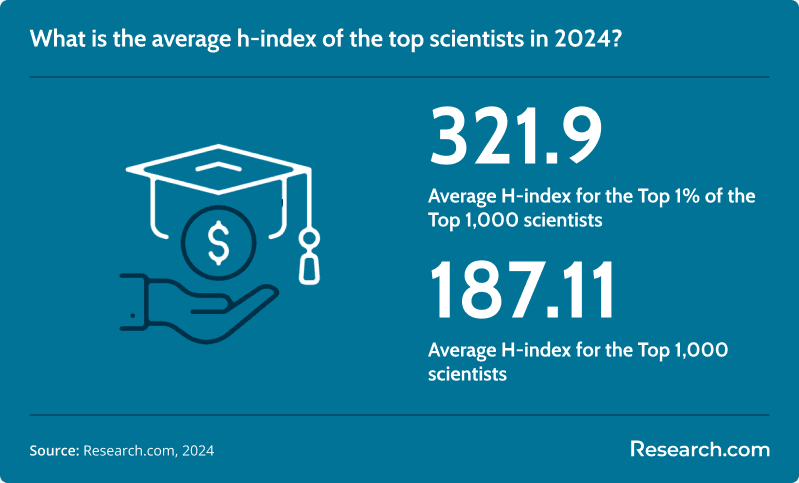
- The average H-index for the top 1% of scientists is 322, compared with 187 for the top 1,000 scientists included in the ranking.
How to read this ranking without misinterpreting it
Scientist rankings can be useful, but they should be read carefully. A high h-index usually indicates that a researcher has produced a substantial body of work that other scholars cite often. It is not the same as measuring teaching quality, mentorship, funding access, public impact, or the practical value of every individual discovery.
The 2024 report analyzed over 166,000 scientist profiles and evaluated multiple indicators and metrics to determine eligibility. Readers should treat the ranking as a research-impact signal rather than a complete judgment of a scientist’s full contribution to education, society, or innovation.
| Ranking element | What it helps show | What it does not fully measure |
| H-index | Research productivity combined with citation influence | Teaching quality, mentorship, ethics, or real-world adoption |
| Total citations | How often a scholar’s work has been cited by other researchers | Whether every citation is positive, central, or current |
| Institutional affiliation | Where many highly cited researchers are currently based | The quality of every department or program at that institution |
| Country concentration | Where leading scientists are clustered in the ranking | The full research strength of emerging institutions or smaller countries |
Scientific context: discoveries shaping the research landscape
The 2023 and 2024 period included major advances that help explain why scientific influence is increasingly interdisciplinary. In astronomy, the James Webb Space Telescope produced images of the early universe that gave researchers new evidence for studying galaxy formation, black hole growth, and the early history of the cosmos.
Quantum research also continued to advance. Work on new frameworks for quantum error correction addresses one of the core barriers to reliable quantum computing. These developments show that future scientific leadership will likely depend not only on deep disciplinary expertise, but also on the ability to work across physics, computing, engineering, mathematics, biology, health, and data science.
Countries with the highest number of leading scientists
The United States leads the 2024 top 1,000 ranking with 606 scientists, which represents 60.6% of the list. Although this is slightly lower than last year’s 612, the country remains far ahead of every other nation represented in the ranking. The United States also has 9 of the top 10 scientists.
The United Kingdom ranks second with 100 scientists, down from 101 last year. Germany holds third place with 47 scientists, one fewer than last year.
The rest of the top 10 includes Australia with 24, Canada with 23, the Netherlands with 23, Italy with 22, China with 22, France with 19, and Sweden with 18. Japan moved out of the top 10 this year, while Sweden entered the 10th position.
| Country | Number of top scientists | Ranking context |
| United States | 606 | Largest share of the top 1,000, equal to 60.6% |
| United Kingdom | 100 | Second overall, equal to 10% |
| Germany | 47 | Third overall, equal to 4.7% |
| Australia | 24 | Same number as last year |
| Canada | 23 | Up from 20 |
| Netherlands | 23 | Up from 17 |
| Italy | 22 | Down from 24 |
| China | 22 | Down from 24 |
| France | 19 | Same as last year |
| Sweden | 18 | Entered the top 10 |
Institutions with the highest number of leading scientists
Harvard University remains the institution with the most affiliated top scientists, with 64. That is one fewer than last year’s 65, but it still places Harvard clearly ahead of other institutions in the 2024 ranking.
Stanford University moved into second place with 21 scientists, up from fourth place last year and one more than in 2023. MIT and the National Institutes of Health each have 20 scientists and hold the third and fourth positions.
The University of California, San Diego appears next with 18 scientists, followed by the University of Cambridge with 17. Brigham and Women's Hospital, Johns Hopkins University, University College London, the University of Oxford, California Institute of Technology, the University of California, Berkeley, and the University of California, San Francisco each have 13 scientists.
American institutions account for 80% of the top 20 institutions, with 16 represented. The United Kingdom has four institutions in the top 20. Its presence in the top 10 improved from two institutions last year to three this year, with University College London joining the group.
| Institution | Number of affiliated top scientists | What this suggests |
| Harvard University | 64 | Largest institutional concentration in the ranking |
| Stanford University | 21 | Moved up from fourth last year |
| MIT | 20 | Maintains a leading position among research institutions |
| National Institutes of Health | 20 | Strong representation among highly cited researchers |
| University of California, San Diego | 18 | Entered the fifth position |
| University of Cambridge | 17 | One of the leading UK-based institutions in the ranking |
H-index leaders, averages, and regional distribution
For North America, Professor Walter C. Willett from Harvard University is the leading scientist. He is ranked 1st in the world and has an h-index of 400.
In Europe, Professor Guido Kroemer from Sorbonne University in France ranks first in the region. His h-index is 283, and his global rank is 15th.
Asia’s leading scientist in the ranking is Professor Shizuo Akira from Osaka University in Japan. He has an h-index of 297 and ranks 10th globally.
For Oceania, Nicholas G. Martin from QIMR Berghofer Medical Research Institute in Australia is the top-ranked scientist in the region. His h-index is 213, and his global rank is 124th.
In Africa, Professor Dan J. Stein from the University of Cape Town in South Africa leads the region with an h-index of 182 and a world ranking of 451.
For South America, Professor Maria-Teresa Dova from the National University of La Plata in Argentina is the region’s leading scientist. Her h-index is 172, and she ranks 650th globally.
| Region | Leading scientist | Institution | H-index | World ranking |
| North America | Walter C. Willett | Harvard University | 400 | 1 |
| Europe | Guido Kroemer | Sorbonne University | 283 | 15 |
| Asia | Shizuo Akira | Osaka University | 297 | 10 |
| Oceania | Nicholas G. Martin | QIMR Berghofer Medical Research Institute | 213 | 124 |
| Africa | Dan J. Stein | University of Cape Town | 182 | 451 |
| South America | Maria-Teresa Dova | National University of La Plata | 172 | 650 |
The average H-index for the top 1% of scientists is 322, compared with 187 for the top 1,000 scientists included in the ranking. The lowest H-index among scholars who entered the 2024 ranking is 160, up from last year’s minimum of 155.
The average number of published articles for the top 1% of scientists is 1,930, compared with 1,208 for the top 1,000 scholars. The average number of citations for the top 1% of scientists is 457,751, compared with 176,775 for the top 1,000 scholars.
The highest cited scientist in the ranking is Eric S. Lander from the Broad Institute in the United States, with 697,064 citations.
Readers who want to understand how the ranking was built can review the Research.com methodology.
What the ranking means for students, researchers, and professionals
The ranking is most useful when it helps readers ask better questions. Students can use it to identify fields, institutions, and scholars with strong research visibility. Early-career researchers can study where influential work is being produced and which disciplines are citation-intensive. Professionals considering graduate study can use the report as one input when comparing academic environments, but it should not replace program-specific research.
A highly ranked scientist at an institution does not automatically mean every program at that institution is the right fit. Applicants should also compare curriculum, faculty availability, lab access, funding, accreditation, graduation requirements, location, online options, and career support.
Education pathways that can support scientific career growth
Scientific careers rarely follow one single route. Some people begin with an associate degree or bachelor’s degree, while others enter research through nursing, public health, computer science, statistics, engineering, psychology, or laboratory work. The right pathway depends on the field, the credential required, and whether the learner wants research, clinical practice, technical employment, or academic leadership.
| Goal | Possible education pathway | When it may make sense |
| Enter the workforce sooner | Fast associate degree programs online | Useful for students who want a shorter route into technical, support, or transfer-oriented study |
| Compare accessible undergraduate options | Easiest college majors | Helpful for exploring majors, but students should still consider career goals and graduate school prerequisites |
| Advance as a working adult | Quick degrees that pay well | Relevant for adults comparing flexible programs with practical career outcomes |
| Move into health-related graduate study | Online direct entry MSN programs | Appropriate for some non-nurses exploring advanced health education, subject to admissions and licensure rules |
| Pursue doctoral-level study flexibly | 1-year PhD programs online no dissertation | Worth comparing carefully, especially for accreditation, research expectations, and employer recognition |
| Control costs while studying online | Cheapest online colleges that accept FAFSA in USA | Useful for students who need eligible, cost-conscious online options |
How online universities and flexible credentials fit into modern research careers
Online education has become more relevant for working adults, career changers, and professionals who need advanced training without leaving employment. In research-related fields, online and hybrid programs can help learners build skills in data analysis, statistics, health sciences, informatics, management, education, or applied research methods.
However, online study is not automatically the best option for every scientific career. Laboratory-heavy fields, clinical disciplines, and licensure-based professions may require in-person components, supervised practice, residencies, or campus-based research work. Before enrolling, students should confirm whether the program format supports their intended outcome.
Cost also matters. Tuition is only one part of the decision; students should compare fees, books, technology requirements, residency costs, transfer credit policies, financial aid eligibility, and time away from work. For learners prioritizing affordability, Research.com’s guide to the cheapest online colleges that accept FAFSA can be a practical starting point.
Current trends shaping future scientific leadership
- Interdisciplinary research is becoming more important. Breakthroughs increasingly depend on teams that combine domain knowledge with computing, statistics, engineering, medicine, and data science.
- AI and advanced analytics are changing research workflows. Researchers are using digital tools to support literature review, modeling, imaging, simulation, data processing, and collaboration. Human judgment, peer review, reproducibility, and research ethics remain essential.
- Global collaboration is expanding. Major scientific questions often require shared datasets, multinational teams, specialized equipment, and cross-border funding relationships.
- Flexible education is widening access. Online and hybrid programs can help working professionals build new skills, but applicants must verify accreditation, hands-on requirements, and career relevance.
- Research impact is measured in multiple ways. Citation metrics matter, but so do replication, policy influence, patents, clinical impact, open science, mentoring, and public communication.
How to use this ranking when choosing a university or research program
- Start with your field, not the institution name. A university may be strong in one research area and less relevant to another.
- Identify faculty alignment. Look for scholars whose work matches your intended research topic, methodology, or professional goal.
- Check whether faculty are accepting students. A famous researcher may not supervise new students or may be affiliated in a limited capacity.
- Compare funding and research infrastructure. For graduate study, assistantships, grants, labs, datasets, clinical placements, and publication support can matter as much as reputation.
- Review accreditation and program outcomes. This is especially important for online programs, healthcare fields, education credentials, and licensure-linked degrees.
- Look beyond rankings. Graduation requirements, advising quality, completion timelines, student support, and career placement can affect your real experience.
Common mistakes when using scientist rankings
| Mistake | Why it can hurt your decision | Better approach |
| Choosing a school only because it has highly ranked scientists | The specific program may not match your field, budget, or career goal | Compare faculty fit, curriculum, funding, and student outcomes |
| Assuming h-index equals overall quality | Citation metrics do not capture every form of research or teaching impact | Use rankings alongside publications, advising, lab access, and program reputation |
| Ignoring accreditation | Unaccredited or poorly recognized programs can limit transfer, aid, licensure, or employment options | Verify institutional and programmatic accreditation before applying |
| Focusing only on tuition | Fees, travel, lost wages, and required residencies can raise total cost | Calculate full cost of attendance and available aid |
| Assuming online programs meet licensure rules | Requirements vary by state, country, and profession | Ask the school and relevant licensing body before enrolling |
| Relying on one ranking source | Every ranking uses a specific methodology and has limits | Compare multiple sources and read the methodology carefully |
Questions to ask before choosing a research-focused program
- Which faculty members work in my intended research area?
- Are those faculty currently advising new students?
- What research facilities, datasets, labs, clinics, or fieldwork opportunities are available?
- How are students funded, and what percentage receive assistantships or grants?
- What are the publication, thesis, dissertation, capstone, or practicum requirements?
- Does the program support online, hybrid, part-time, or working-professional students?
- Is the program properly accredited for my academic or licensure goal?
- What are the total costs beyond tuition?
- Where do graduates work after completing the program?
- How does the program define and support research integrity, reproducibility, and responsible use of AI?
Key insights
- Walter C. Willett of Harvard University ranks as the world’s top scientist in the 2024 Research.com report, with an h-index of 400.
- The United States remains the leading country in the ranking, with 606 scientists, equal to 60.6% of the top 1,000.
- Harvard University has the strongest institutional representation, with 64 affiliated top scientists.
- Eric S. Lander from the Broad Institute is the highest cited scientist in the ranking, with 697,064 citations.
- H-index and citation counts are useful research-impact indicators, but they should not be treated as complete measures of scientific value, teaching quality, or program fit.
- Students should use scientist rankings as one decision tool alongside accreditation, faculty availability, curriculum, funding, research facilities, career outcomes, and total cost.
- Future scientific leadership will likely reward interdisciplinary skills, responsible use of AI and data tools, international collaboration, and flexible lifelong learning.
About Research.com
All research was coordinated by Imed Bouchrika, Ph.D., a computer scientist with a strong record of collaboration on international research projects with academic partners. His role was to help ensure that the data remained unbiased, accurate, and up to date.
Research.com is a research portal for science and educational rankings. Its mission is to help professors, research fellows, and students advance their work and identify leading experts across scientific disciplines. Research.com also supports students by providing information on colleges, academic opportunities, and career pathways.


