World Online Ranking of Best Psychology Scientists – 2024 Report

Co-Founder and Chief Data Scientist
Research.com published the 3rd edition of its annual ranking of leading psychology scientists on May 9, 2024. The ranking is designed for researchers, faculty leaders, graduate students, funders, and anyone tracking where influential psychology research is being produced. Rather than treating the list as a simple leaderboard, this guide explains what the ranking measures, which countries and institutions appear most often, how to interpret the D-index, and how readers can use the data responsibly when evaluating experts, collaborators, research programs, or academic pathways.
Psychology research now touches many high-stakes areas: mental health care, addiction treatment, youth well-being, digital behavior, workplace performance, learning science, public policy, and human-centered technology. For that reason, identifying highly cited and highly productive scholars can help readers understand where major research conversations are happening and which institutions are shaping the field.
Quick answer: what does the 2024 psychology scientists ranking show?
The 2024 Research.com ranking highlights 1000 psychology scientists selected after reviewing more than 9,000 scientist profiles from Google Scholar and Microsoft Academic Graph. To be considered, a scholar generally needed a discipline D-index threshold of 30 when most of their publications were in psychology. Selection also considered the scholar’s discipline-specific D-index, the share of their work connected to psychology, and their awards and achievements.
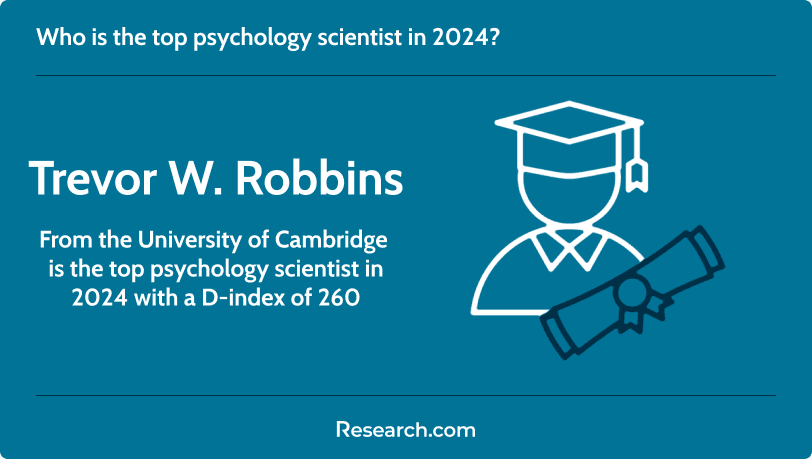
The United States has the largest presence in the 2024 list, with 642 scientists, or 64.2% of the full ranking. Harvard University remains the institution with the most listed psychology scientists, with 30 affiliated scholars. The highest-ranked psychology scientist is Professor Trevor W. Robbins of the University of Cambridge in the U.K., whose D-index is 260.
What this psychology ranking is designed to measure
The ranking focuses on research influence within psychology. It is not a measure of teaching quality, undergraduate student experience, clinical training, departmental culture, or overall university prestige. Its main purpose is to identify scholars whose work has made a measurable impact in psychology based on discipline-specific indicators.
The D-index is central to the ranking. In this context, it reflects a scientist’s publication and citation impact within a specific discipline rather than across every possible field. This distinction matters because psychology is broad and interdisciplinary; a scholar may publish in neuroscience, medicine, education, behavioral economics, public health, or data science while still contributing substantially to psychological science.
| Ranking element | How readers should interpret it | What it should not be used to claim |
| D-index | A discipline-focused indicator of research influence in psychology. | It does not directly measure teaching quality, clinical skill, mentorship, or social impact. |
| Institutional affiliation | The institution connected to the scholar in the ranking data. | It should not be read as the scientist’s nationality or as a complete measure of a department’s quality. |
| Country count | A snapshot of where highly ranked scholars are affiliated. | It does not prove that all research capacity in a country is captured by the ranking. |
| Top 1% comparison | A way to view the most highly ranked scholars within the list. | It should not be treated as the only group producing valuable psychology research. |
How the 2024 ranking was prepared
For the 2024 edition, Research.com examined more than 9,000 scientist profiles listed in Google Scholar and Microsoft Academic Graph. Multiple indicators and metrics were reviewed before scholars were included in the final list.
The D-index threshold for consideration was set at 30 when most of a scholar’s publications were in psychology. The final inclusion process took into account the discipline D-index, the proportion of a scholar’s work produced within psychology, and recognized awards and achievements.
Readers should use the ranking as a research-intelligence tool rather than as a single decision-maker. It can help identify influential scholars, active research hubs, and patterns in global psychology scholarship, but it should be combined with closer review of publications, methods, research ethics, mentoring fit, and institutional resources.
Psychology research is addressing urgent public problems
Recent psychology research has continued to influence practical interventions for complex social and health challenges. One important area is the effectiveness of cognitive behavioral therapy (CBT) for substance abuse disorders. Researchers are increasingly examining how CBT can be adapted for different substances, demographic groups, and co-occurring mental health conditions. This work also points to the value of combining CBT with approaches such as mindfulness-based interventions and pharmacotherapy when individuals need more comprehensive support.
Another major research direction examines the relationship between social media usage and suicidal ideation among young adults. Studies in this area explore how online interaction, cyberbullying, social comparison, support networks, and mental health vulnerabilities may shape risk or protection. This research is especially relevant as clinicians, families, educators, and policymakers try to understand how digital environments affect young adults’ psychological well-being.
Key findings from the 3rd edition of the psychology scientists ranking
- The United States has the largest representation, with 642 scholars in the 2024 top psychology scientists list, equal to 64.2% of the full psychology ranking.
- Other countries with major representation include the United Kingdom, with 118 scientists or 11.8%; the Netherlands, with 50 scientists or 5.0%; Canada, with 47 scientists or 4.7%; Australia, with 42 scientists or 4.2%; and Germany, with 33 scientists or 3.3%.
- The top 1% of psychology experts is led by the United States and the United Kingdom, each with four scientists.
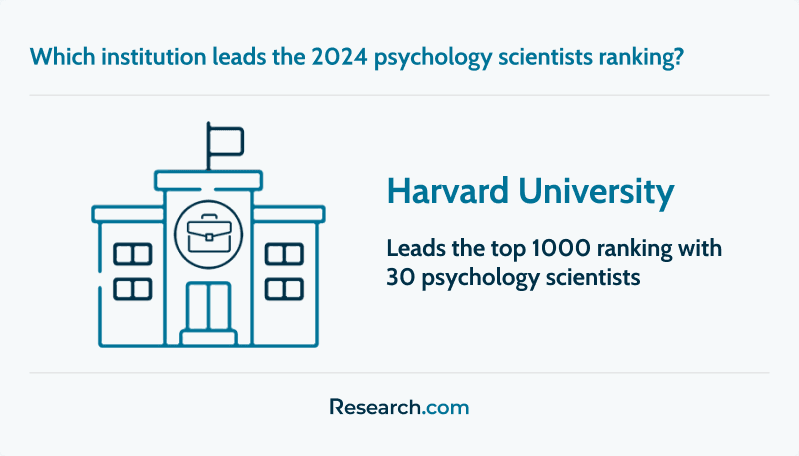
- Harvard University remains the institution with the highest number of ranked psychology scientists in the 2024 edition, with 30 affiliated scholars.
- The highest-ranked psychology scientist is Trevor W. Robbins of the University of Cambridge in the U.K., with a D-index of 260.
- American universities account for 70% of the 10 leading institutions, while the remaining three institutions are located in the U.K.
- The average D-index among the top 1% of scientists is 202.8, compared with 102.91 for all 1000 scientists included in the ranking.
The complete 2024 list is available here:
View the best psychology scientists ranking
How to use this ranking if you are a student, researcher, or institution
The ranking is most useful when it supports a specific decision. A prospective graduate student may use it to identify research-active institutions. A department chair may use it to benchmark faculty visibility. A funder may use it to spot established experts in a subfield. A researcher may use it to identify possible collaborators, keynote speakers, reviewers, or research groups with strong publication records.
| If you are... | Use the ranking to... | Also check before deciding |
| A prospective graduate student | Find universities with highly visible psychology researchers in your area of interest. | Advisor availability, funding, lab culture, program outcomes, and whether the faculty member is accepting students. |
| An early-career researcher | Identify senior scholars, labs, and institutions shaping your subfield. | Recent publications, collaboration history, research methods, and fit with your long-term agenda. |
| A university leader | Benchmark institutional visibility in psychology research. | Faculty retention, hiring priorities, grant infrastructure, ethics support, and interdisciplinary resources. |
| A funder or policy organization | Locate experts whose work may inform evidence-based programs or advisory panels. | Topic fit, conflicts of interest, practical implementation experience, and diversity of viewpoints. |
How financial support can strengthen psychology research
Psychology research often requires funding for participant recruitment, longitudinal data collection, clinical trials, statistical tools, research assistants, secure data storage, and interdisciplinary collaboration. Grants, scholarships, assistantships, and subsidized programs can help promising researchers move from a strong idea to a well-designed study.
Financial support also affects who can enter the field. Students comparing research-oriented programs should look beyond headline tuition and ask whether the school provides assistantships, supervised lab work, conference support, and access to funded projects. For learners comparing online options, resources such as online colleges that accept FAFSA can help them understand how federal aid may fit into broader education planning.
How accessible online master’s programs can support research preparation
Online master’s programs can make advanced psychology education more accessible for working adults, career changers, and students who cannot relocate. When designed well, these programs can provide training in research methods, statistics, assessment, program evaluation, and applied behavioral science while allowing students to keep professional or family commitments.
However, accessibility should not be confused with low academic expectations. Students who want a research-focused path should compare curriculum depth, faculty expertise, thesis or capstone requirements, data-analysis coursework, and opportunities to participate in research. Those exploring flexible graduate options can review online master’s degree options while still evaluating whether each program supports their actual research goals.
Emerging career paths connected to psychology research
Psychology research careers are no longer limited to tenure-track faculty roles. Many psychology-trained professionals now work in applied research, behavioral product design, user experience, mental health technology, organizational analytics, policy evaluation, neurotechnology, public health, education research, and data-informed intervention design.
These roles often require a combination of psychological theory, quantitative skills, ethical judgment, communication ability, and comfort with digital tools. Students at an earlier stage can compare major options carefully; broad resources on college majors may help with initial exploration, but students interested in research should prioritize programs that include statistics, research design, writing, and supervised project work.
| Career direction | Typical focus | Useful preparation |
| Academic psychology research | Publishing studies, teaching, mentoring students, and leading research programs. | Strong methods training, doctoral study, publications, conference activity, and grant experience. |
| Clinical and mental health research | Testing interventions, improving assessment, and evaluating treatment outcomes. | Ethics training, clinical research exposure, statistics, and knowledge of vulnerable population protections. |
| Behavioral data and technology | Studying digital behavior, product use, engagement, and decision-making. | Quantitative methods, data literacy, privacy awareness, and interdisciplinary collaboration. |
| Policy and program evaluation | Measuring whether education, health, workplace, or social programs are effective. | Applied research design, causal inference awareness, report writing, and stakeholder communication. |
Global collaboration: opportunities and barriers
International research collaboration can improve psychology by bringing together different populations, methods, cultural contexts, and disciplinary perspectives. It can also make findings more useful across settings instead of relying too heavily on narrow samples or single-country evidence.
Cross-border projects can be difficult, however. Researchers may need to navigate different ethics review systems, data-sharing rules, funding structures, language barriers, and privacy expectations. Digital platforms make collaboration easier, but they also require careful governance. Students and emerging researchers comparing affordable study options may find resources such as online colleges that accept financial aid useful when planning an education path that keeps costs manageable.
Ethical issues that matter in modern psychology research
Ethics are central to credible psychology research, especially when studies involve mental health, trauma, minors, clinical populations, biometric information, digital behavior, or sensitive personal data. Researchers must handle informed consent, confidentiality, participant risk, data security, transparency, and institutional review with care.
Technology adds another layer of responsibility. Online recruitment, app-based data collection, social media analysis, and AI-assisted tools can increase research scale, but they may also raise privacy and consent questions. Students seeking faster academic pathways, including quick degrees, should still make sure their programs provide serious training in research ethics, statistics, and responsible data use if they plan to work in psychology research.
Collaboration strategies that can improve psychology research quality
Strong psychology research increasingly depends on collaboration across fields. Neuroscience, data science, behavioral economics, education, public health, medicine, computer science, and sociology can all add tools that help researchers ask better questions and test findings more rigorously.
Effective collaboration requires more than putting different experts on the same project. Teams need clear research questions, agreed-upon authorship expectations, transparent data practices, shared terminology, and a plan for communicating findings to both academic and nonacademic audiences. Institutions that support flexible learning and research infrastructure, including those discussed in guides to accredited non-profit online colleges, can play a role in widening access to research training and cross-disciplinary networks.
Countries with the highest number of leading psychology scientists
The United States leads the 2024 ranking with 642 scientists, representing 64.2% of the full list and adding one scientist compared with last year. Even so, only 4 of the 10 scientists in the top 1% are affiliated with U.S. institutions this year.
The United Kingdom remains in second place from 2023, with 118 scientists included in the ranking.
The Netherlands holds third place in 2024, with 50 ranked scientists, compared with 51 scientists in the previous year.
Among the top 10 countries, 8 kept the same positions as before, while Italy and Belgium changed places. Italy moved down one position to rank 8 with 10 scientists, while Belgium rose to the 7th position, also with 10 scientists.
The rest of the top 10 includes Canada with 47 scientists, Australia with 42, Germany with 33, Switzerland with 8, and Sweden with 7.
The country assigned to a scientist reflects the affiliated research institution used for the ranking and should not be interpreted as the scientist’s nationality.
Institutions with the highest number of leading psychology scientists
Harvard University ranks first in the 2024 edition, with 30 affiliated scientists included in the psychology ranking. King's College London follows in second place with 28 scientists, and the University of California, Los Angeles ranks third with 23 scientists.
U.S. universities and institutions make up 70% of the top 10 leading institutions. The three institutions outside the U.S. are in the U.K.: King's College London, University of Cambridge, and University of Oxford.
Within the top 1% of leading scientists, four of the 10 institutions are based in the U.S. Four institutions, including the top 2 positions, are in the U.K., and two are in Australia.
Harvard University continues to lead the top 10 institutions with 30 scientists. King's College London, which had 27 scientists in 2022, holds the 2nd position with 28 scientists.
The University of California-Los Angeles moved from fourth to third with 23 scientists, while Stanford University moved to the 4th position with 22 scientists.
The University of Pittsburg returned to the top 10, ranking 10th in 2024 with 14 scientists.
Can accelerated psychology degree programs help future researchers?
Accelerated psychology programs can be useful for students who already know they want to move quickly toward graduate study, research assistantships, or applied behavioral science roles. A shorter timeline may help motivated learners reach advanced coursework sooner, but speed should not come at the expense of research preparation.
Before choosing an accelerated option, students should check whether the program includes statistics, research methods, writing-intensive coursework, faculty interaction, and opportunities to complete supervised research. Those comparing faster routes can start with Research.com’s guide to the fastest degree in psychology, then verify whether each option fits their long-term academic or professional plans.
Online universities and the changing research environment
Online universities can support psychology research by connecting students and faculty across locations. Virtual seminars, online research meetings, shared digital workspaces, and remote data collection can make collaboration possible even when researchers are not on the same campus.
The best online learning environments for research are not simply convenient; they also provide structure. Students should look for faculty access, library resources, statistical software, research ethics training, writing support, and clear policies for thesis or capstone projects. Flexibility is valuable, but research quality still depends on mentorship, methodological rigor, and responsible data practices.
D-index ranking: regional leaders, averages, and distribution
In Europe, Professor Trevor W. Robbins of the University of Cambridge in the U.K. ranks first globally. His D-index is 260.
In North America, Professor Terrie E. Moffitt of Duke University in the United States is the region’s top-ranked scientist, with a D-index of 202. She also ranks 3rd worldwide.
In Oceania, Professor Richard M. Ryan of Australian Catholic University in Australia leads the region. He ranks 5th globally and has a D-index of 200.
Professor Mario Mikulincer of Reichman University in Israel leads Asia and has a world ranking of 180.
No scientists affiliated with institutions in Africa or South America were included among the top 1000 scientists in 2024.
The top 1% of scientists has an average D-index of 202.8, while the average across all 1000 ranked scientists is 102.91.
The lowest index value among scholars who entered the ranking in 2022 was a D-index of 81.
For the top 1% of ranked scientists, the average number of published articles is 685.8. Across all 1000 scholars, the average is 387.76.
Common mistakes when interpreting scientist rankings
- Assuming a ranking measures everything. A research ranking can highlight scholarly influence, but it does not fully measure teaching, mentoring, student outcomes, clinical training, or community impact.
- Choosing a program only because one famous researcher is affiliated with it. Prospective students should confirm whether that scholar is active, available, publishing in the student’s area, and accepting advisees.
- Confusing institutional country with nationality. In this ranking, country placement is based on affiliated research institution, not the scientist’s citizenship or personal background.
- Ignoring subfield fit. Psychology includes many areas, so a highly ranked cognitive scientist may not be relevant to a student focused on counseling, developmental psychology, industrial-organizational psychology, or social psychology.
- Using citation impact as a guarantee of future results. Past publication influence is useful context, but it does not guarantee future discoveries, funding success, or student career outcomes.
- Relying on rankings instead of reading the work. Anyone considering collaboration, graduate study, or expert consultation should review recent publications, methods, datasets, and ethical standards.
Questions to ask before using the ranking for a major decision
- Which psychology subfield matters most for my goal?
- Are the scholars I am interested in publishing recently in that area?
- Does the institution provide the methods training, funding, facilities, and mentorship structure I need?
- For graduate study, is the faculty member accepting students or supervising projects?
- How does the program support research ethics, data security, and reproducibility?
- Am I comparing multiple evidence sources rather than relying only on one ranking?
- Does the program format, cost, and timeline fit my circumstances?
You can review the ranking methodology in more detail here.
Key insights
- The 2024 psychology scientists ranking reviewed more than 9,000 profiles and includes 1000 scholars selected through discipline-focused indicators and achievement-based criteria.
- The United States dominates the list with 642 scientists, or 64.2%, while the United Kingdom ranks second with 118 scientists.
- Harvard University leads all institutions with 30 affiliated psychology scientists in the 2024 ranking.
- Trevor W. Robbins of the University of Cambridge ranks first globally with a D-index of 260.
- The ranking is most useful for identifying influential researchers, research-intensive institutions, and global patterns in psychology scholarship.
- Readers should not use the ranking as a stand-alone measure of program quality, student fit, teaching strength, clinical training, or career outcomes.
- Students and early-career researchers should combine ranking data with deeper checks on faculty availability, research fit, funding, ethics training, and hands-on research opportunities.
About Research.com
This research was coordinated by Imed Bouchrika, Ph.D., a computer scientist with extensive experience collaborating on international research projects with academic partners. His role was to help ensure that the data remained unbiased, accurate, and up-to-date.
Research.com is a research portal for science and educational rankings. Its mission is to help professors, research fellows, and students advance their work and identify leading experts across scientific fields. Research.com also serves as an educational platform for students comparing colleges, academic options, and career paths.