World Online Ranking of Best Mechanical & Aerospace Engineering Scientists – 2024 Report

Co-Founder and Chief Data Scientist
Research impact in mechanical and aerospace engineering is difficult to judge from publication counts alone. The field spans aircraft propulsion, computational mechanics, robotics, advanced materials, energy systems, manufacturing, space systems, and fluid dynamics, so readers need a clearer way to identify scholars whose work has had sustained influence within the discipline.
On April 12, 2024, Research.com released the third edition of its annual ranking of leading mechanical and aerospace engineering scientists. This guide explains what the 2024 ranking shows, how to interpret the results, which countries and institutions are most represented, and what current research and education trends mean for students, researchers, and decision-makers following the field.
The ranking is useful for prospective graduate students comparing research environments, universities benchmarking their faculty strength, industry teams looking for academic collaborators, and researchers tracking influential work in mechanical and aerospace engineering.
Quick answer: who leads the 2024 mechanical and aerospace engineering scientist ranking?
The 2024 Research.com ranking reviewed more than 2,050 scientist profiles from multiple bibliometric data sources. Scholars were considered using several indicators, including the D-index, the share of their work in mechanical and aerospace engineering, and their awards and achievements.
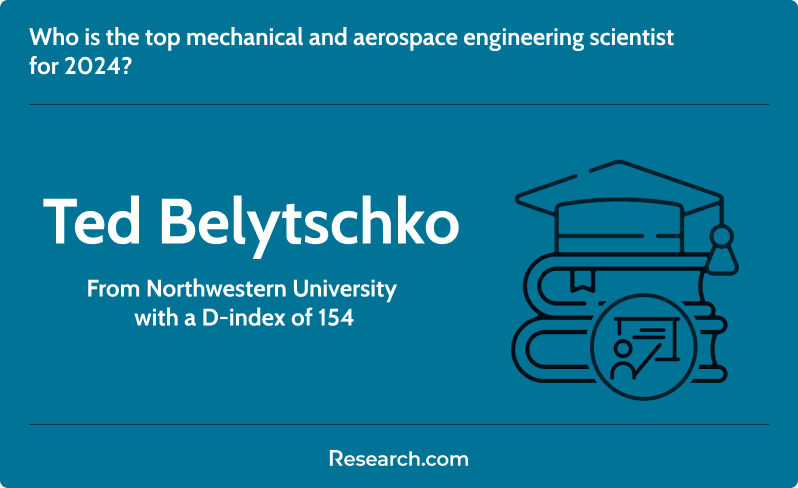
The top-ranked scientist in the 2024 list is Ted Belytschko from Northwestern University, with a D-index of 154. The United States has the largest presence in the ranking, with 436 scientists, representing 43.6% of all listed leading mechanical and aerospace engineering scientists. The University of Michigan-Ann Arbor hosts the highest number of ranked scientists in 2024, with 26 scholars affiliated with the institution.
| 2024 ranking snapshot | Result |
| Scientist profiles reviewed | More than 2,050 |
| Minimum D-index threshold for consideration | 30, when most publications were in mechanical and aerospace engineering |
| Top-ranked scientist | Ted Belytschko, Northwestern University |
| Top D-index in the ranking | 154 |
| Country with the most ranked scientists | United States, with 436 scientists |
| Institution with the most ranked scientists | University of Michigan-Ann Arbor, with 26 scientists |
| Average D-index for the top 1% | 137.7 |
| Average D-index for all ranked scientists | 63.67 |
How the 2024 ranking was evaluated
The ranking focuses on researchers whose publication record and disciplinary influence are concentrated in mechanical and aerospace engineering. For the 2024 edition, Research.com examined more than 2,050 scientist profiles using bibliometric data sources and discipline-specific metrics.
A scholar could be considered if their D-index, or Discipline H-index, reached 30 and most of their publications were associated with mechanical and aerospace engineering. Inclusion also accounted for the proportion of the scientist’s work within the discipline, along with recognized awards and achievements.
The D-index is intended to measure research influence within a specific field rather than across all areas of science. This distinction matters because mechanical and aerospace engineering researchers may publish in interdisciplinary venues that overlap with materials science, applied physics, computer science, civil engineering, robotics, energy, and computational modeling.
The latest discoveries in mechanical and aerospace engineering research
Mechanical and aerospace engineering research is being shaped by the pressure to reduce emissions, improve reliability, shorten design cycles, and make complex systems easier to monitor. Two areas stand out in the current research landscape: cleaner aviation technologies and digital engineering tools.
In aviation, researchers continue to explore propulsion systems that could reduce dependence on fossil fuels and lower aircraft emissions. One important area is electric propulsion for aircraft, which has the potential to reduce greenhouse gas emissions and noise when compared with traditional jet engine systems. The pace of adoption depends on technical constraints such as battery performance, aircraft size, safety standards, infrastructure, and certification requirements.
Digital twins are also becoming more important in engineering practice. A digital twin is a virtual representation of a physical asset, process, or system that can be used to simulate performance, monitor operating conditions, and support maintenance decisions. Recent work on the use of digital twins in industrial practices points to their growing role in design, manufacturing, operations, and predictive maintenance.
For aerospace and mechanical systems, digital twins can help engineers test scenarios before physical changes are made, detect early signs of equipment degradation, and improve product development. Companies such as Rolls-Royce have used digital twin approaches to monitor and predict jet engine performance, supporting more efficient maintenance procedures.
Key findings from the 2024 best mechanical and aerospace engineering scientists ranking
The 2024 ranking shows a strong concentration of leading mechanical and aerospace engineering researchers in the United States, while China, the United Kingdom, Australia, Canada, Iran, and Germany also have substantial representation.
- Scholars affiliated with institutions in the United States dominate the ranking with 436 scientists, equal to 43.6% of all leading mechanical and aerospace engineering scientists listed.
- Other highly represented countries include China with 89 scientists or 8.9%, the United Kingdom with 75 scientists or 7.5%, Australia with 43 scientists or 4.3%, Canada with 41 scientists or 4.1%, Iran with 28 scientists or 2.8%, and Germany with 30 scientists or 3.0%.
- 6 out of 10 scientists in the top 1% are affiliated with institutions in the United States. The remaining scholars in that group are affiliated with institutions in Canada, Iran, Romania, and Switzerland.
- Ted Belytschko from Northwestern University holds the top position in the global ranking with a D-index of 154.
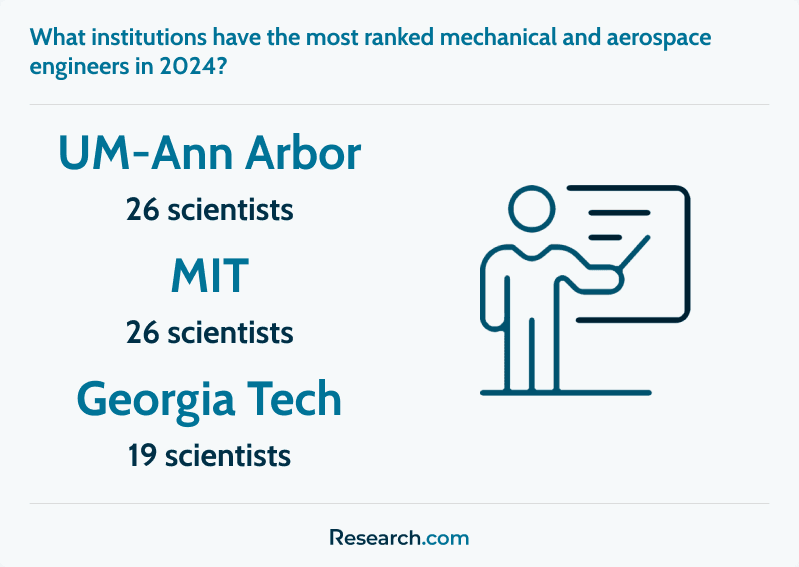
- University of Michigan-Ann Arbor has the highest number of leading mechanical and aerospace engineers in 2024, with 26 ranked scientists working there.
- Universities in the United States account for 70% of the top 10 leading institutions. The non-American institutions in the top 10 are the National University of Singapore in Singapore, Imperial College London, and the University of Cambridge in the United Kingdom.
- The top 1% of scientists have an average D-index of 137.7, compared with an average D-index of 63.67 across all scientists included in the ranking.
The complete 2024 list is available here:
Top Mechanical and Aerospace Engineering Scientists Ranking
Countries with the highest number of leading mechanical and aerospace engineering scientists
The United States remains the most represented country in the 2024 ranking, with 436 scientists affiliated with U.S. institutions. This equals 43.6% of the full list. The ranking also reports that 7 out of 10 scientists in the top 1% are from the U.S. The number of ranked U.S.-affiliated scientists declined from 442 in 2023 to 436 in 2024.
China holds second place with 89 scientists after adding 8 scholars in 2024. The United Kingdom remains third with 75 ranked scientists, up from 73 in the previous year.
Other countries with notable representation include Australia with 43 scientists, Canada with 41 scholars, Iran with 28 scientists, and Germany with 27 scholars. Singapore also increased its representation by 5 scholars, moving from 20 in 2023 to 25 in 2024.
South Korea was among the top 10 countries in 2023. In 2024, Italy entered the top 10 with 17 scientists, replacing South Korea.
The country assigned to a scientist is based on the affiliated research institution listed in MAG. It should not be interpreted as the scientist’s nationality.
| Country or region note | 2024 ranking detail |
| United States | 436 scientists, or 43.6% of the ranking |
| China | 89 scientists, after gaining 8 scholars in 2024 |
| United Kingdom | 75 scientists, up from 73 in the previous year |
| Australia | 43 scientists |
| Canada | 41 scholars |
| Iran | 28 scientists |
| Germany | 27 scholars |
| Singapore | 25 scientists, up from 20 in 2023 |
| Italy | 17 scientists and a place in the 2024 top 10 countries |
Institutions with the highest number of leading scientists
Institutional concentration is important because it can indicate where major research communities, laboratories, doctoral programs, and collaborative networks are strongest. In 2024, the University of Michigan-Ann Arbor leads the institutional list with 26 ranked scientists.
The Massachusetts Institute of Technology ranks second with 26 scientists, while the Georgia Institute of Technology is third with 19 scientists.
American universities make up 60% of the top 10 leading institutions. The non-American institutions in the top group include the National University of Singapore, Imperial College London, and the University of Cambridge.
Among the institutions represented in the top 1% of leading scientists, 6 out of 10 are based in the U.S. The remaining four are the University of Ontario Institute of Technology in Canada, ranked 5th; Babol Noshirvani University of Technology in Iran, ranked 6th; Babes-Bolyai University in Romania, ranked 7th; and ETH Zurich in Switzerland, ranked 10th.
Across the 20 leading institutions, 15 universities are based in the U.S. Other institutions in that group are located in the U.K., Singapore, Switzerland, and Iran. These include Imperial College London and the University of Cambridge in the U.K.; the National University of Singapore and Nanyang Technological University in Singapore; ETH Zurich in Switzerland; and Babol Noshirvani University of Technology in Iran.
| Institution finding | 2024 result |
| Institution with the most ranked scientists | University of Michigan-Ann Arbor, with 26 scientists |
| Second-ranked institution | Massachusetts Institute of Technology, with 26 scientists |
| Third-ranked institution | Georgia Institute of Technology, with 19 scientists |
| Share of American universities in the top 10 institutions | 60% |
| Non-American institutions in the top 10 | National University of Singapore, Imperial College London, and University of Cambridge |
| U.S.-based institutions in the top 1% group | 6 out of 10 |
How online universities and digital collaboration support engineering research
Mechanical and aerospace engineering research increasingly depends on collaboration across locations, disciplines, and computing environments. Online universities and digital learning platforms can support this work by giving students and researchers access to remote seminars, collaborative software, shared data spaces, virtual labs, and expert communities that are not limited by geography.
These tools are especially useful in research areas that combine field data, simulation, and interdisciplinary expertise. For example, researchers working on drone research on wildfire monitoring may need to combine aerospace systems, sensing technologies, environmental modeling, and data analysis.
Online collaboration can also help specialists in materials science, fluid dynamics, robotics, energy systems, and computational engineering work together on complex challenges in mechanical and aerospace engineering. This does not replace hands-on laboratory training, but it can expand access to expertise, accelerate information sharing, and support research projects that require multiple technical perspectives.
For students, the practical value of online education depends on program quality, accreditation, access to applied projects, faculty expertise, and whether the curriculum builds the technical skills required for the intended career path.
How to decide whether an online engineering-related program fits your goals
Online education can be useful for engineering students and working professionals, but the right choice depends on the credential, career target, technical depth, cost, and hands-on training requirements. Mechanical and aerospace engineering roles often require strong math, physics, design, simulation, and laboratory skills, so students should evaluate online options carefully rather than choosing only for speed or convenience.
| Option | When it may make sense | What to check before enrolling |
| Accelerated associate pathway | Useful for students seeking a faster technical foundation or an entry point into further engineering-related study. | Transfer policies, technical course coverage, lab expectations, and whether credits apply to a future bachelor’s degree. |
| Online bachelor’s degree | Best for students who need flexibility while building a broader academic foundation. | Accreditation, faculty qualifications, engineering design requirements, student support, and total program cost. |
| Advanced online degree | Appropriate for experienced students or professionals seeking research, specialization, or leadership preparation. | Research expectations, thesis or dissertation structure, faculty fit, time commitment, and employer recognition. |
| Vocational or certificate training | Helpful for targeted skills such as simulation tools, manufacturing technology, drafting, maintenance, or applied technical workflows. | Hands-on components, industry relevance, software access, credential value, and whether the training complements your degree plan. |
| Career-change degree pathway | Relevant for professionals moving from another field into engineering-related work. | Prerequisites, bridge courses, math readiness, internship options, and realistic timelines. |
Are accelerated online associate degrees a good first step into engineering?
Accelerated associate programs can help students build an earlier foundation in technical subjects, especially when they need flexibility or want to reduce time before transferring or entering a technician-oriented role. The main advantage is speed, but speed should not come at the expense of calculus, physics, drafting, computing, design, and lab preparation.
Students considering this route should review whether credits will transfer into a bachelor’s program and whether the curriculum aligns with their intended engineering field. A fast program may be useful, but only if it supports the next step. To compare options, students can explore accelerated associates degree online pathways.
Can accelerated advanced degrees support engineering career growth?
Advanced degrees can strengthen research, specialization, and leadership preparation, particularly for professionals working in simulation, design, energy systems, aerospace systems, manufacturing, or applied research. Accelerated formats may appeal to experienced learners who already have a strong technical background and a clear career goal.
However, students should be cautious with unusually compressed timelines. A rigorous research degree still requires meaningful engagement with advanced coursework, faculty supervision, and original work. Fast-track options, including a one year doctorate program, should be evaluated for academic expectations, research fit, and institutional credibility.
Is affordable online education a practical path into mechanical and aerospace engineering?
Cost matters because engineering education can require several years of study, software access, materials, fees, and sometimes travel or in-person lab experiences. A lower-cost program can improve affordability, but students should compare total cost rather than tuition alone.
A cheap online bachelor degree may be a practical choice if it offers credible academics, relevant technical coursework, strong student support, and a path toward the student’s intended career. Prospective students should also ask whether the program has any required in-person components and whether financial aid, transfer credit, or employer tuition assistance can reduce out-of-pocket costs.
How can supplemental online training strengthen engineering skills?
Many students and professionals use short online programs to fill skill gaps that a traditional curriculum may not cover in depth. Supplemental training can be especially useful in digital simulation, computer-aided design, sustainable design methods, manufacturing systems, robotics, data analysis, and emerging propulsion-related topics.
Targeted credentials such as online vocational certificate programs can help learners build applied competencies. These programs are usually most valuable when they complement, rather than replace, a broader technical education.
Can online programs lead to high-paying engineering careers?
Online programs can support career growth when they build relevant technical skills, include applied projects, and are respected by employers. Still, no degree format guarantees a specific salary. Earnings depend on the field, role, location, experience, employer, advanced skills, and market conditions.
Students evaluating programs tied to degrees that pay 100k a year should look beyond salary headlines. The better question is whether the program develops the competencies employers expect in roles involving design, analysis, testing, manufacturing, aerospace systems, energy, or advanced engineering software.
How can students check whether an online program is accredited and credible?
Accreditation is one of the first things students should verify. It helps indicate that a school or program has been reviewed against recognized academic standards. For engineering-related programs, students should also investigate whether the curriculum matches their career goal, whether faculty have relevant expertise, and whether the program provides adequate technical and academic support.
Students should also review financial aid eligibility and avoid assuming that all online programs provide the same funding options. Those comparing cost and aid availability can review online college courses with financial aid as part of a broader affordability search.
Can online engineering programs provide hands-on training?
Strong online programs often use simulations, remote labs, design projects, industry collaborations, and supervised applied assignments to help students practice engineering concepts. These tools can be valuable, especially for learners who cannot relocate or attend a full-time campus program.
Even so, students should ask direct questions about lab access, software requirements, capstone projects, team-based design work, internships, and employer partnerships. Career changers should be especially careful to confirm prerequisites and hands-on preparation before enrolling in master's degrees for a career changer or other graduate-level options.
Common mistakes when using rankings or choosing engineering programs
- Relying only on a ranking position. Rankings can identify influential scholars and strong institutions, but they do not automatically reveal the best fit for a student’s research interests, budget, location, or career goal.
- Ignoring faculty fit. Graduate students should look closely at individual faculty expertise, lab activity, funding opportunities, and publication areas rather than choosing a university based only on overall reputation.
- Confusing institutional affiliation with nationality. In this ranking, country placement is based on the affiliated research institution in MAG, not the scientist’s personal nationality.
- Choosing the fastest degree without checking quality. Accelerated programs can be helpful, but engineering preparation requires depth in math, science, technical design, and applied problem-solving.
- Looking only at tuition. Total cost can include fees, software, equipment, travel, textbooks, exams, and lost work time.
- Assuming every online program has adequate hands-on learning. Students should confirm lab access, design projects, simulations, internships, and software resources before enrolling.
- Overlooking accreditation and transfer rules. Accreditation, credit transfer, and employer recognition can affect whether a program supports future study or career advancement.
Questions to ask before choosing a mechanical or aerospace engineering research environment
- Which faculty members are active in the research area I want to study?
- Do the labs or research groups publish consistently in my area of interest?
- Are there opportunities for funded research, assistantships, internships, or industry collaboration?
- Does the program emphasize theory, applied engineering, experimentation, computation, or a combination of these?
- How much access will I have to equipment, software, data, and mentorship?
- What are the program’s expectations for thesis, dissertation, capstone, or design work?
- Will the degree or credential support my intended career path?
- What is the full cost after fees, materials, financial aid, and transfer credits are considered?
D-index ranking: leaders, averages, and distribution
The D-index results show the range of research influence represented in the ranking, from the top global scholars to the minimum index value required among included scientists.
For North America, Professor Ted Belytschko of Northwestern University in the United States ranks 1st in the overall list, with a D-index of 154.
In Asia, Professor Mohsen Sheikholeslami from Babol Noshirvani University of Technology in Iran leads the regional list with a D-index of 137 and a world ranking of 6.
For Europe, Professor Ioan Pop from Babes-Bolyai University in Romania ranks first regionally and 7th globally, with a D-index of 125.
In Oceania, Professor Yiu-Wing Mai from the University of Sydney in Australia leads the region with a world ranking of 12 and a D-index of 119.
Professor Josua P. Meyer from Stellenbosch University in South Africa is the highest-ranking scientist from Africa, with a world ranking of 365.
Professor Michael J. Brennan from Sao Paulo State University in Brazil is the top-ranked scientist from South America, with a world ranking of 355.
The average D-index among the top 1% of scientists is 137.7. Across all scientists included in the ranking, the average D-index is 63.67.
The lowest D-index value among scientists included in the 2024 ranking is 47.
The top 1% of ranked scientists have an average of 898 published articles, compared with an average of 369 published articles across all ranked scholars.
| Regional leader or metric | 2024 result |
| North America | Professor Ted Belytschko, D-index of 154, world rank 1 |
| Asia | Professor Mohsen Sheikholeslami, D-index of 137, world rank 6 |
| Europe | Professor Ioan Pop, D-index of 125, world rank 7 |
| Oceania | Professor Yiu-Wing Mai, D-index of 119, world rank 12 |
| Africa | Professor Josua P. Meyer, world rank 365 |
| South America | Professor Michael J. Brennan, world rank 355 |
| Average D-index, top 1% | 137.7 |
| Average D-index, all ranked scientists | 63.67 |
| Lowest D-index included in 2024 | 47 |
| Average published articles, top 1% | 898 |
| Average published articles, all ranked scientists | 369 |
You can learn more about the ranking methodology here.
How readers should use this ranking
This ranking is best used as a research-discovery tool, not as the only basis for choosing a university, collaborator, or graduate program. It helps identify highly cited and discipline-specific research leaders, but readers should combine it with other evidence.
- Students can use the list to identify potential advisors, research groups, and institutions with strong activity in mechanical and aerospace engineering.
- Researchers can use it to find influential scholars, track leading institutions, and discover possible collaborators.
- Universities can use the results to understand institutional research visibility and compare faculty representation across regions.
- Industry teams can use the ranking to locate academic experts in areas such as propulsion, computational modeling, materials, manufacturing, robotics, and energy systems.
Key insights
- The 2024 Research.com ranking reviewed more than 2,050 profiles and used the D-index, discipline-specific contribution, awards, and achievements to evaluate inclusion.
- Ted Belytschko of Northwestern University leads the 2024 ranking with a D-index of 154.
- The United States has the largest concentration of ranked scientists, with 436 scholars representing 43.6% of the list.
- China and the United Kingdom remain major contributors, with 89 and 75 ranked scientists respectively.
- University of Michigan-Ann Arbor has the highest institutional count in 2024, with 26 ranked scientists.
- Current research momentum is especially visible in electric aircraft propulsion, digital twins, remote monitoring, advanced simulation, and interdisciplinary engineering collaboration.
- Students should use rankings to identify research strength, but they should also evaluate faculty fit, accreditation, cost, hands-on training, and career outcomes before choosing a program.
- Online engineering-related education can be valuable when it is credible, applied, and aligned with the learner’s goals, but students should not assume that every online program offers the same academic depth or laboratory experience.
About Research.com
All research was coordinated by Imed Bouchrika, Ph.D., a computer scientist with an extensive record of collaboration on international academic research projects. His role was to help ensure that the data remained unbiased, accurate, and current.
Research.com is a research portal for science and educational rankings. Its mission is to help professors, research fellows, and students advance their research and identify leading experts across scientific disciplines. Research.com also supports learners by helping them compare colleges, academic opportunities, and career paths.