
Rising Stars of Science World Ranking 2024 (3rd edition)

Co-Founder and Chief Data Scientist
Research.com’s 2024 Rising Stars of Science ranking identifies early-career researchers whose published work has already gained substantial scholarly influence. Released on August 7, the list highlights scientists who published their first paper less than 13 years ago and whose research output, citations, H-index performance, awards, discipline-level contribution, and other achievements show strong momentum.
This guide explains what the 2024 ranking shows, which countries and institutions have the strongest representation, how the top researchers compare across H-index, citations, and publications, and how emerging scientists can use the findings to think more strategically about research visibility, career development, and skill-building.
Quick answer: Who leads the 2024 Rising Stars of Science ranking?
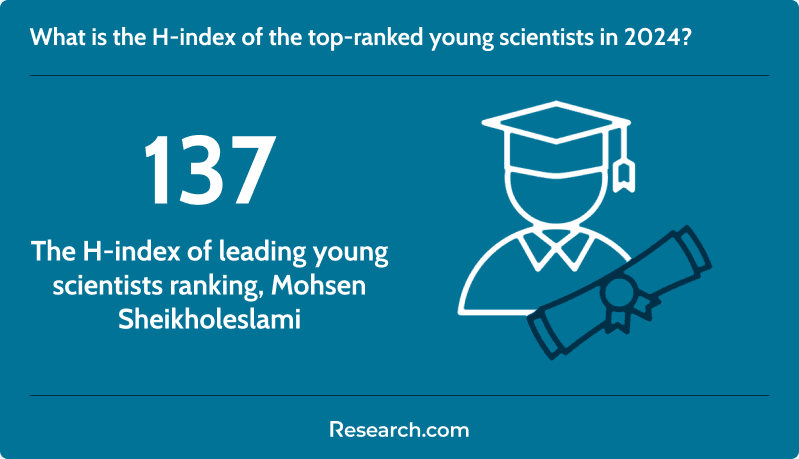
The top-ranked rising star of science in 2024 is Mohsen Sheikholeslami of Babol Noshirvani University of Technology in Iran, with an H-index of 137. China has the largest national presence in the top 1,000, with 358 rising scientists, followed by the United States with 153 and Iran with 48. The Chinese Academy of Sciences has the largest institutional representation, with 23 researchers in the top 1,000.
How the 2024 Rising Stars of Science ranking was built
For the 2024 edition, Research.com reviewed more than 166,880 scientist profiles and evaluated each researcher’s body of work using several indicators. These included H-index, citation totals, awards, the proportion of contributions within a discipline, and other relevant research accomplishments.
Eligibility was limited to scientists who published their first paper less than 13 years ago. The H-index threshold varied by field and was adjusted to reflect disciplinary norms, reaching 30 or 40 in many areas. A researcher’s listed country reflects the country of the affiliated institution, not the scientist’s nationality.
| Ranking element | How to interpret it |
| H-index | Shows a researcher’s combined productivity and citation impact, but it should be compared within the same field because citation patterns differ by discipline. |
| Citations | Reflect how often other researchers have referenced a scientist’s work, although large collaborative fields can produce higher citation counts. |
| Publications | Indicate research output volume, but publication count alone does not measure quality or influence. |
| Awards and achievements | Provide additional context on recognition beyond bibliometric indicators. |
| Affiliated country | Represents the location of the scientist’s institution, not citizenship or nationality. |
Key findings from the 2024 Rising Stars of Science ranking
- Mohsen Sheikholeslami from Babol Noshirvani University of Technology in Iran ranks first globally in 2024, with an H-index of 137.
- China has the strongest representation, with 358 rising stars of science. The United States follows with 153, and Iran ranks third with 48.
- Among the top 20 researchers, six are affiliated with institutions in China, five with institutions in the United States, two with Iran, and two with Italy. The remaining researchers are based in the Netherlands, Germany, Norway, and Australia.
- By region, the top 20 include 8 researchers from Asia, five from North America, five from Europe, and one from Oceania.
- The Chinese Academy of Sciences has the most researchers in the top 1,000, with 23. Tsinghua University follows with 13, and Hunan University has 12 scientists.
- The top 1% of rising stars have an average H-index of 98, compared with an average of 49 for the leading 1,000 scholars.
- The average citation count is 58,902 for the top 1% and 11,075 for the top 1,000 scholars.
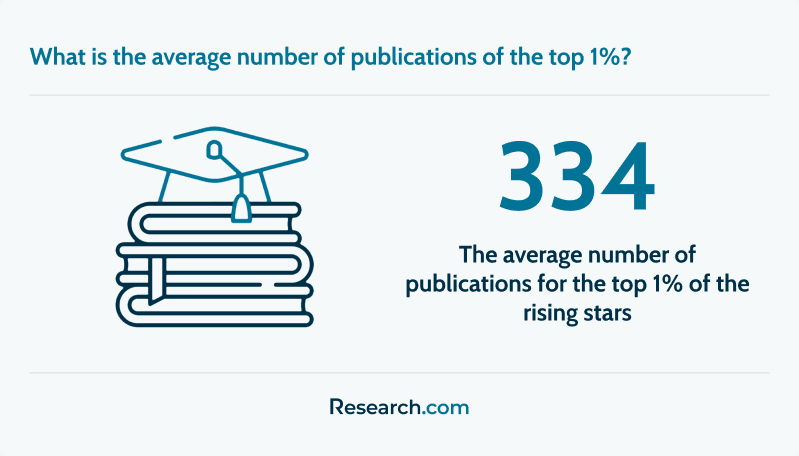
- The average publication count is 334 for the top 1% and 177 for the top 1,000 scholars.
- Professor Amir Kasaeian from Tehran, Iran, has the highest citation count, with 155,147 citations.
- Professor Simplice A. Asongu from the African Governance and Development Institute in Cameroon is listed as the rising star with the most publications and has 1,008 citations.
The complete 2024 global list is available here:
View the Rising Stars of Science ranking
Why this ranking matters for early-career researchers
Early-career scientists often face a difficult challenge: they must build a publication record, attract citations, secure collaborators, compete for funding, and establish credibility before they have the long track record of senior scholars. A ranking focused on researchers who began publishing less than 13 years ago helps identify scientists whose influence is developing quickly.
The 2024 list also shows that research momentum is not concentrated in one country, region, or field. Top-ranked researchers are affiliated with institutions across Asia, North America, Europe, Oceania, Africa, and South America, and their work spans disciplines such as medicine, mechanical engineering, biology, chemistry, and other scientific fields.
How emerging scientists can use this ranking
The Rising Stars of Science list is most useful when treated as a research intelligence tool rather than a simple leaderboard. Early-career researchers, graduate students, institutional leaders, and prospective collaborators can use it to identify active scholars, understand where high-impact research clusters are forming, and benchmark publication and citation patterns within a field.
| User | Best use of the ranking | What to avoid |
| Graduate students | Find potential supervisors, collaborators, and examples of strong early-career research trajectories. | Choosing a mentor based only on rank without reviewing research fit, supervision style, and lab culture. |
| Postdoctoral researchers | Identify fast-moving fields, active research groups, and institutions with strong publication momentum. | Assuming a high institutional count guarantees funding, mentoring, or career support. |
| Universities | Benchmark research visibility and evaluate where emerging scholars are gaining global attention. | Using bibliometric indicators as the only measure of faculty quality. |
| Industry and research partners | Locate scientists with strong evidence of scholarly influence for potential collaboration. | Ignoring applied experience, project fit, and intellectual property considerations. |
How do online certificate programs accelerate emerging scientific careers?
For researchers who need a targeted skill upgrade, an online certificate can be a practical option. Shorter programs may help scientists strengthen skills in data analysis, research communication, project coordination, programming, regulatory topics, or field-specific tools without stepping away from active research responsibilities.
Certificates are most useful when they solve a specific skills gap. For example, a scientist moving into computational analysis may benefit from structured training in statistics or data tools, while a researcher leading collaborative projects may need formal preparation in management or science communication. Researchers comparing options can start with Research.com’s guide to the best online certificate schools.
How can online master's programs provide a competitive edge for emerging scientists?
An online master’s program can help early-career scientists deepen their technical training, move into interdisciplinary work, or add a credential in a field adjacent to their original discipline. The main advantage is flexibility: researchers may be able to continue publishing, teaching, or working in a lab while completing advanced coursework.
This path makes the most sense when the program directly supports a research or career goal. A scientist should compare curriculum depth, faculty expertise, research opportunities, transfer policies, tuition, and whether the program is recognized by employers or academic institutions in the target field. Those seeking a streamlined option can review Research.com’s overview of the easiest masters degree online pathways, while remembering that “easier” should never mean lower quality or weaker relevance.
How can non-traditional academic pathways support emerging scientists?
Not every scientist follows a traditional full-time, campus-based route. Some researchers build expertise through hybrid degrees, online programs, short courses, professional certificates, military-friendly institutions, industry training, or employer-supported education. These pathways can be especially useful for scientists balancing research, teaching, family responsibilities, military service, or industry work.
The key is to verify quality before enrolling. Researchers should check accreditation, faculty qualifications, curriculum relevance, credit transfer rules, and whether the credential will be respected in their intended academic or industry setting. Students with military backgrounds or service-related education benefits can explore Research.com’s resource on veteran friendly colleges.
What strategic advantages do fully funded online PhD programs offer?
Doctoral study can be expensive and time-intensive, so funding matters. A fully funded doctoral pathway may reduce financial pressure and allow researchers to focus more fully on original scholarship, publications, and long-term academic development. Online or hybrid formats may also help some candidates continue professional or research work while completing doctoral requirements.
However, prospective students should be careful. Doctoral funding arrangements vary widely, and online PhD programs may not be appropriate for every scientific field, especially disciplines requiring intensive laboratory access, clinical placements, or in-person supervision. Before applying, candidates should confirm funding terms, residency requirements, dissertation support, research infrastructure, and faculty availability. Research.com’s guide to fully funded online PhD programs can help readers compare possible routes.
How can industry certifications complement a research career?
Industry certifications can strengthen a scientist’s applied profile when they validate skills that employers or research partners actively need. Examples may include analytical platforms, quality systems, data tools, project management, laboratory procedures, or specialized technical methods.
Certifications work best as complements to research expertise, not substitutes for it. A credential should help a scientist perform a specific task better, collaborate with industry more effectively, or qualify for a role that requires demonstrated technical proficiency. Researchers exploring applied credentials can review Research.com’s guide to certification programs for high paying careers.
Countries with the highest number of scientific rising stars
China again has the largest presence among the top 1,000 rising stars in the 2024 ranking. Its 358 listed scientists represent 35.8% of the top 1,000, slightly above its 2023 total of 353. Four of the top 10 researchers are affiliated with institutions in China, reinforcing the country’s strong research output among early-career scholars.
The United States ranks second with 153 scientists, or 15.3% of the top 1,000. One U.S.-affiliated scientist appears in the top 10, and five others are included in the top 20. The total is lower than the 171 recorded in 2023, but the country remains one of the major contributors to high-impact early-career research.
Iran ranks third with 48 scientists, compared with 51 in the prior year. The top-ranked scientist globally is affiliated with an Iranian institution, and additional Iranian researchers appear in the top 20. This indicates that Iran continues to produce highly visible early-career research talent.
The rest of the top 10 countries are Australia with 46, the United Kingdom with 43, India with 36, Germany with 26, Italy with 20, Canada with 19, and Singapore with 18.
| Rank by representation | Country | Number of rising stars in the top 1,000 |
| 1 | China | 358 |
| 2 | United States | 153 |
| 3 | Iran | 48 |
| 4 | Australia | 46 |
| 5 | United Kingdom | 43 |
| 6 | India | 36 |
| 7 | Germany | 26 |
| 8 | Italy | 20 |
| 9 | Canada | 19 |
| 10 | Singapore | 18 |
The country distribution also points to the growing visibility of Asian research institutions. A large share of the ranked young scientists are affiliated with Asian institutions, suggesting that the region is playing a major role in expanding the global research base.
Institutions with the highest number of scientific rising stars
The 2024 ranking shows particularly strong institutional representation from Asia. Among the top 10 institutions by number of rising stars, seven are based in Asia. Among the top 20, 15 are in Asia, while North America and Europe each have two institutions and Oceania has one.
The Chinese Academy of Sciences leads all institutions with 23 rising stars, one fewer than its 24 in the 2023 ranking. Tsinghua University follows with 12 scientists, Hunan University also has 12 scientists, and Huazhong University of Science and Technology has 11 scientists.
The University of Technology Sydney ranks fifth with 10 scientists. The remaining institutions in the top 10 are Google with 10, Zhejiang University with 9, ETH Zurich with 9, Fudan University with 8, and Islamic Azad University with 8.
| Institution | Number of rising stars |
| Chinese Academy of Sciences | 23 |
| Tsinghua University | 12 |
| Hunan University | 12 |
| Huazhong University of Science and Technology | 11 |
| University of Technology Sydney | 10 |
| 10 | |
| Zhejiang University | 9 |
| ETH Zurich | 9 |
| Fudan University | 8 |
| Islamic Azad University | 8 |
Across the top 20 institutions, 16 are located in Asia, while Europe and North America each account for two institutions.
What advanced academic programs offer for emerging scientists
Advanced academic programs can help emerging scientists build deeper methodological expertise, move into interdisciplinary research, and prepare for leadership roles in academia, government, healthcare, technology, or industry. The strongest programs connect coursework with actual research needs, such as advanced analytics, experimental design, scientific computing, translational research, or research management.
Speed should not be the only factor when choosing a program. A shorter option may be valuable if it is rigorous, accredited, affordable, and aligned with a researcher’s goals. Scientists who need a flexible graduate route can compare fastest online masters programs while also reviewing academic quality, faculty fit, and long-term career value.
What strategies can further accelerate career advancement for emerging scientists?
High-impact early-career researchers usually combine strong publication habits with strategic collaboration, clear research positioning, and continuous skill development. Funding constraints, limited mentorship, and growing interdisciplinary expectations can slow progress, so researchers benefit from a deliberate plan rather than relying only on publication volume.
Useful strategies include building a focused research niche, joining collaborative projects with complementary experts, presenting at field-specific conferences, improving grant-writing skills, learning advanced analytical methods, and seeking mentors outside one’s immediate institution. Researchers considering formal graduate study can compare master's degree options to determine whether a degree would add meaningful technical, methodological, or leadership value.
H-index ranking: leaders, averages, and distribution
World ranking leaders
The 2024 ranking includes both returning high performers and researchers who moved sharply upward compared with the 2023 list. Several scientists remained near the top, while others entered the top 10 after major gains in H-index performance and scholarly visibility.
Professor Mohsen Sheikholeslami of Babol Noshirvani University of Technology remains first in the 2024 global ranking. His H-index increased from 132 to 137, and his profile includes 50,205 citations and 557 publications. He also ranks first in Asia and first in Iran.
Professor Matthew D. Hellmann of Memorial Sloan Kettering Cancer Center ranks second in 2024. He has an H-index of 98, 67,096 citations, and 418 publications, and he ranks first in North America and the United States.
Professor Hao Bin Wu of Zhejiang University in China holds third place in the top 1000 list. His H-index is 97, with 40,027 citations and 251 publications. He ranks second in Asia and first in China.
Professor S. Caudill of the National Institute for Subatomic Physics ranks fourth, with an H-index of 96 and 51,758 citations. Professor Caudill has 295 publications and ranks first in Europe and the Netherlands.
Professor Florian Fischer of Charité - University Medicine Berlin ranks fifth. His H-index is 95, with 124,426 citations and 310 published articles. He ranks second in Europe and first in Germany.
| Global rank | Researcher | Affiliation | H-index | Citations | Publications |
| 1 | Mohsen Sheikholeslami | Babol Noshirvani University of Technology | 137 | 50,205 | 557 |
| 2 | Matthew D. Hellmann | Memorial Sloan Kettering Cancer Center | 98 | 67,096 | 418 |
| 3 | Hao Bin Wu | Zhejiang University | 97 | 40,027 | 251 |
| 4 | S. Caudill | National Institute for Subatomic Physics | 96 | 51,758 | 295 |
| 5 | Florian Fischer | Charité - University Medicine Berlin | 95 | 124,426 | 310 |
Continental leaders
Asia is led by Professor Mohsen Sheikholeslami of Babol Noshirvani University of Technology, whose H-index is 137. He also holds the top global position.
North America’s leading rising star is Professor Matthew D. Hellmann of Memorial Sloan Kettering Cancer Center, listed with an H-index of 91. He ranks second worldwide.
Europe’s top-ranked rising star is Professor S. Caudill of the National Institute for Subatomic Physics in the Netherlands, with an H-index of 96. He is fourth in the global ranking.
Oceania is headed by Professor Xiaoguang Duan of the University of Adelaide in Australia. His H-index is 90, and he ranks 12th worldwide.
Africa’s leading rising star is Professor Abdon Atangana of the University of the Free State in South Africa, with an H-index of 68. He is ranked 75th globally.
South America is led by Professor José C. S. dos Santos of Universidade Federal do Ceará in Brazil. His H-index is 52, and he ranks number 335 in the world.
| Region | Leading rising star | Affiliation | H-index | Global rank |
| Asia | Mohsen Sheikholeslami | Babol Noshirvani University of Technology | 137 | 1 |
| North America | Matthew D. Hellmann | Memorial Sloan Kettering Cancer Center | 91 | 2 |
| Europe | S. Caudill | National Institute for Subatomic Physics | 96 | 4 |
| Oceania | Xiaoguang Duan | University of Adelaide | 90 | 12 |
| Africa | Abdon Atangana | University of the Free State | 68 | 75 |
| South America | José C. S. dos Santos | Universidade Federal do Ceará | 52 | 335 |
Averages and distribution
In the 2023 world ranking, the top 1% of ranked young scientists recorded an average H-index of 98. Across the top 1000, the average H-index was 49. The distribution is concentrated below the highest bands: one scientist falls in the 130-139 range, 11 are in the 90-99 range, 17 are in the 80-89 range, and the remaining rising stars have H-index scores below 80.
For citations, the top 1% average is 58,902, compared with 11,075 for the top 1,000 scholars. The most-cited researcher in the 2024 world ranking is Professor Amir Kasaeian of Iran, with 155,147 citations. He is followed by Florian Fischer of Germany with 124,426 and Shafiu Mohammed of Nigeria with 120,284.
For publications, the top 1% average is 334, while the top 1,000 rising stars average 177. Professor Simplice A. Asongu of the African Governance and Development Institute in Cameroon has the highest publication count, with 1,008, followed by Pau Loke Show with 824 and Professor Yu-Ming Chu with 689.
Additional details about Research.com’s ranking process are available in the methodology overview here.
Current trends shaping early-career scientific impact
The 2024 ranking reflects several broader patterns in modern research. First, high-impact early-career work is increasingly international, with leading scientists distributed across multiple continents. Second, institutional research ecosystems matter: universities, academies, hospitals, and corporate research organizations can all support publication visibility when they provide strong infrastructure and collaboration networks.
Third, interdisciplinary skills are becoming more important. Many fast-moving research areas require scientists to combine domain expertise with data analysis, computational methods, project leadership, and the ability to communicate across fields. Finally, bibliometric indicators remain influential, but they do not capture every form of scientific value. Mentorship, reproducibility, open science practices, patents, policy influence, and applied implementation can also matter depending on the discipline.
Common mistakes when interpreting science rankings
| Mistake | Why it matters | Better approach |
| Comparing H-index across unrelated disciplines | Citation behavior differs widely by field, so a score that is exceptional in one area may be typical in another. | Compare researchers within the same discipline or closely related fields. |
| Treating citation count as the only measure of quality | Citations show influence but do not automatically prove rigor, originality, or practical importance. | Review the researcher’s major papers, methods, collaborations, and field-specific recognition. |
| Assuming country means nationality | The ranking uses institutional affiliation, not citizenship. | Interpret country data as institutional location data. |
| Choosing a graduate program based only on prestige | A famous institution may not be the best fit for a specific research topic or mentoring need. | Evaluate advisor fit, research facilities, funding, publication support, and career outcomes. |
| Adding credentials without a strategy | Certificates and degrees take time and money, and not every credential improves research productivity. | Choose training that closes a clear skills gap or supports a defined career move. |
Questions emerging scientists should ask before choosing a career-development path
- Will this degree, certificate, or certification strengthen a skill I need for my current research agenda?
- Does the program or credential have recognized accreditation, employer value, or academic credibility?
- Can I complete the training without reducing my research output, funding progress, or publication momentum?
- Does the curriculum include methods, tools, or collaborations that are directly relevant to my field?
- Will this path help me build a stronger research network?
- What opportunity cost will I face if I choose formal study instead of publishing, applying for grants, or joining a major collaboration?
- How will I measure whether the credential was worth it after completion?
Key insights
- Mohsen Sheikholeslami leads the 2024 Rising Stars of Science ranking with an H-index of 137.
- China has the largest national representation in the top 1,000, with 358 scientists, followed by the United States with 153 and Iran with 48.
- The Chinese Academy of Sciences is the leading institution by number of rising stars, with 23 researchers in the top 1,000.
- Asia has a particularly strong presence in the 2024 list, both at the country and institution levels.
- H-index, citations, and publications are useful indicators, but they should be interpreted by discipline and alongside qualitative evidence of research value.
- Emerging scientists can strengthen their careers through targeted skill-building, but credentials should be chosen for strategic fit rather than convenience alone.
- The most practical way to use the ranking is to identify research leaders, collaboration opportunities, institutional strengths, and field-specific benchmarks.
About Research.com
This research was coordinated by Imed Bouchrika, Ph.D., a computer scientist with extensive experience collaborating on international research projects with academic partners. His role was to oversee the process and help ensure that the data remained unbiased, accurate, and current.
Research.com is a research and education platform focused on science rankings, academic guidance, and career decision support. Its goal is to help professors, research fellows, students, and professionals identify leading experts, compare academic opportunities, and make better-informed education and career choices.





