
World Online Ranking of Best Social & Humanities Scientists – 2024 Report

Co-Founder and Chief Data Scientist
Research.com’s 3rd annual ranking of leading scholars in social sciences and humanities was released on May 17, 2024. The ranking is designed for readers who want to understand which researchers, countries, and institutions are producing highly influential work across fields such as psychology, economics, sociology, education, communication, political science, history, philosophy, and related humanities disciplines.
This guide explains what the 2024 ranking measures, how to interpret the results, what the main findings show, and how students, researchers, university leaders, policymakers, and funding organizations can use the data responsibly. It also highlights current research themes shaping the field, including artificial intelligence, machine learning, crisis communication, online collaboration, and interdisciplinary career preparation.
The ranking is based on an examination of more than 6,300 scientist profiles from Google Scholar and Microsoft Academic Graph. Researchers were evaluated through multiple indicators, including discipline-specific influence, publication concentration in the relevant field, awards, and professional achievements. To be considered, a scholar generally needed a D-index of 30 or higher when most of their publications were in humanities or social science.
Quick Answer: What Does the 2024 Social Sciences and Humanities Ranking Show?
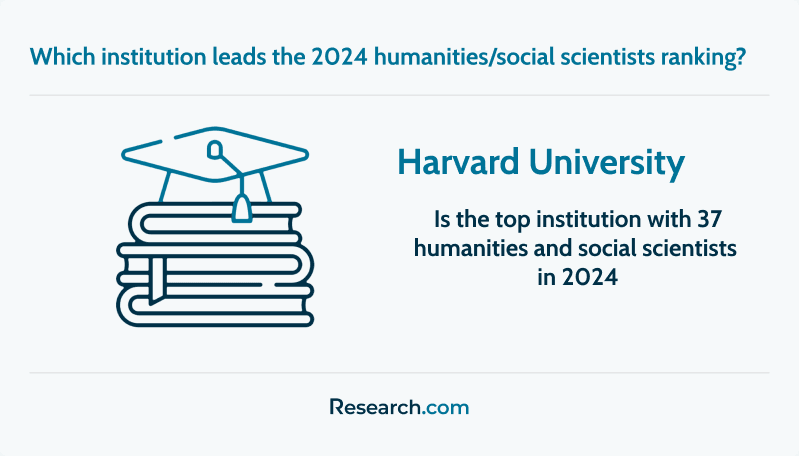
The 2024 Research.com ranking identifies 1000 highly influential social sciences and humanities scholars based on discipline-focused citation impact and related research indicators. The United States has the largest representation, with 506 scientists, or 50.6% of the ranking. Harvard University leads all institutions with 37 affiliated ranked scientists. The highest-ranked scholar is Herbert A. Simon from Carnegie Mellon University in the United States, with a D-index of 179.
| Ranking question | 2024 result |
| Country with the most ranked scholars | United States, with 506 scientists or 50.6% of the ranking |
| Institution with the most ranked scholars | Harvard University, with 37 scientists |
| Top-ranked scientist | Herbert A. Simon from Carnegie Mellon University, with a D-index of 179 |
| Average D-index for the top 1% | 145.7 |
| Average D-index for all 1000 scientists | 74.91 |
| Minimum D-index among ranked scholars in 2024 | 61 |
How to Use This Ranking Responsibly
A scientist ranking can be useful, but it should not be treated as the only measure of academic quality. Citation-based indicators help identify visible and widely cited research, yet they do not capture every form of scholarly value. Books, policy influence, public engagement, teaching, archival work, fieldwork, creative interpretation, and community-based research may matter greatly in social sciences and humanities even when they are not fully reflected in citation metrics.
Readers should use the ranking as a starting point for discovery. It can help identify leading scholars, strong research institutions, country-level patterns, and influential areas of inquiry. It should be combined with direct review of publications, research methods, field norms, institutional context, and the specific goals of the reader.
| If you are... | Use the ranking to... | Do not use it to... |
| A student | Find potential supervisors, research areas, graduate schools, and fields with strong scholarly communities | Choose a degree program based only on one scholar or one institutional count |
| A researcher | Identify possible collaborators, benchmark research visibility, and track field leaders | Assume citation impact is the same as research originality or social value |
| A university leader | Understand institutional research strengths and compare visibility across peer institutions | Replace department-level evaluation or peer review with a single ranking |
| A policymaker or funder | Locate established experts and areas with strong academic output | Fund only already-dominant institutions or overlook emerging research communities |
Latest Developments in Social Science and Humanities Research
Social sciences and humanities research is increasingly focused on how technology changes work, institutions, communication, risk, and human behavior. One active research direction examines the role of artificial intelligence in organizational management. Another explores how machine learning can strengthen traditional risk analysis, particularly in areas where technical systems intersect with human decision-making.
These developments matter because technological tools are not only engineering problems. They raise questions about trust, ethics, governance, labor, inequality, institutional accountability, and cultural meaning. Social scientists and humanities scholars help explain how technologies are adopted, resisted, regulated, and interpreted by communities and organizations.
Research on trade protectionism and social media during crisis communication also shows why these fields remain central to public decision-making. Trade policy affects supply chains, employment, international relations, and consumer behavior. Social media changes how people receive warnings, share information, organize support, and respond to uncertainty. Understanding these patterns requires evidence about institutions, communication systems, social behavior, and cultural context.
Career Pathways Connected to Social Sciences and Humanities Research
Social sciences and humanities training can lead to more than traditional faculty roles. Researchers increasingly combine theory, data analysis, writing, qualitative inquiry, policy knowledge, and public communication. These skills can support careers in universities, research institutes, government agencies, consulting, nonprofit organizations, public health, education, user research, communications, and cultural institutions.
The best path depends on the reader’s long-term goal. A student who wants to conduct clinical or developmental research may need a very different route from someone pursuing policy analysis, survey research, archival scholarship, applied ethics, or organizational consulting. For example, readers interested in child development, assessment, and mental health services can review the steps involved in becoming a child psychologist to understand how education, supervised training, and credential requirements shape that career path.
| Career direction | Typical focus | Useful preparation |
| Academic research | Publishing scholarship, teaching, mentoring students, and applying for research funding | Graduate study, methods training, strong writing, conference participation, and publication experience |
| Policy and public sector research | Evaluating programs, analyzing social problems, and advising decision makers | Statistics, qualitative methods, policy writing, economics, law, or public administration knowledge |
| Consulting and organizational research | Studying workplaces, customers, institutions, and organizational change | Research design, data interpretation, communication, project management, and stakeholder analysis |
| Clinical or developmental pathways | Studying behavior, development, assessment, intervention, and human well-being | Psychology coursework, supervised experience, graduate training, and awareness of licensure rules |
| Digital and communication research | Studying media, platforms, online behavior, crisis messaging, and public discourse | Communication theory, social media analysis, ethics, data literacy, and writing for public audiences |
How Rankings Can Inform Research Policy and Funding Decisions
Rankings can help policymakers and funding agencies see where research strength is concentrated, but they should be used with caution. A high concentration of ranked scholars may indicate strong institutional support, long-term funding, influential research networks, and mature doctoral pipelines. At the same time, lower representation does not necessarily mean weak research capacity; it may reflect language patterns, publication formats, indexing gaps, or the visibility of local and regional scholarship.
For funders, the most useful approach is to treat rankings as one layer of evidence. They can help identify established experts, possible review panel members, and fields with strong citation activity. They can also highlight the need to support interdisciplinary work, early-career researchers, underrepresented regions, and research that addresses public problems but may not generate immediate citation volume.
Education and workforce pathways are also relevant to research capacity. Some learners may build applied skills through academic, technical, or career-focused programs before entering research-adjacent roles. Readers comparing practical education options can explore Research.com’s guide to the best online trade schools, especially if they are considering how skills-based training differs from research-focused academic pathways.
Key Findings From the 3rd Edition of the Best Social Sciences and Humanities Scientists Ranking
- The United States accounts for the largest share of ranked scholars, with 506 scientists in 2024, equal to 50.6% of the full ranking.
- Other countries with strong representation include the United Kingdom with 184 scientists or 18.4%, Australia with 68 scientists or 6.8%, Canada with 56 scientists or 5.6%, the Netherlands with 35 scientists or 3.5%, and Germany with 26 scientists or 2.6%.
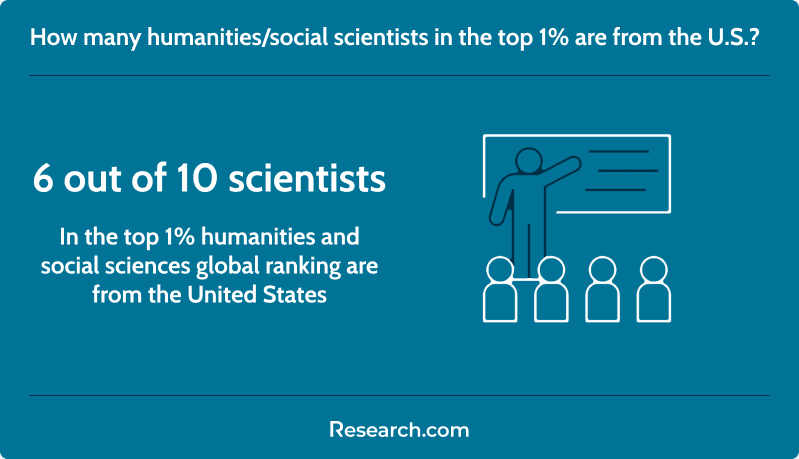
- Among scholars in the top 1%, 6 out of 10 are affiliated with institutions in the United States.
- Harvard University leads the 2024 institutional list, with 37 affiliated scientists included in the ranking.
- The highest-ranked social sciences and humanities scientist is Herbert A. Simon from Carnegie Mellon University in the United States, with a D-index of 179.
- American universities make up 70% of the 10 top leading institutions, with the remaining institutions based in the United Kingdom and Canada.
- The top 1% of scientists have an average D-index of 145.7, compared with an average of 74.91 across all 1000 ranked scientists.
The complete 2024 ranking is available here:
View the full humanities and social sciences scientist ranking
Countries With the Highest Number of Leading Social Sciences and Humanities Scientists
The 2024 ranking shows a strong concentration of leading social sciences and humanities researchers in the United States. U.S.-affiliated institutions account for 506 scientists, representing 50.6% of the entire ranking. The United States is also prominent at the very top of the list, with 6 out of 10 scientists in the top 1% affiliated with U.S. institutions.
The United Kingdom holds the second position with 184 ranked scientists. Australia ranks third with 68 scientists, which is four fewer than in the previous year.
Canada follows with 56 scientists, while the Netherlands has 35 and Germany has 26. Other countries represented among leading contributors include China with 13 scientists, South Africa with 12 scientists, France with 11 scientists, and Finland with 9 scholars.
Compared with 2023, the United States increased from 502 to 506 scientists. The United Kingdom remained at 184, and the Netherlands stayed at 35. Canada decreased by 2 scientists, while Germany decreased by 3 scientists.
Finland entered the 10th position among the top 10 countries in 2024 with nine scientists, taking the place previously held by New Zealand.
The country listed for each scientist reflects the affiliated research institution recorded in Microsoft Academic Graph, not necessarily the scientist’s nationality.
| Country | Number of ranked scientists in 2024 | Share or ranking note |
| United States | 506 | 50.6% of the full ranking |
| United Kingdom | 184 | 18.4% of the full ranking |
| Australia | 68 | 6.8% of the full ranking |
| Canada | 56 | 5.6% of the full ranking |
| Netherlands | 35 | 3.5% of the full ranking |
| Germany | 26 | 2.6% of the full ranking |
| China | 13 | Among the listed leading countries |
| South Africa | 12 | Among the listed leading countries |
| France | 11 | Among the listed leading countries |
| Finland | 9 | Reached the 10th position in 2024 |
Institutions With the Highest Number of Leading Scientists
Harvard University ranks first among institutions in the 2024 edition, with 37 affiliated scientists included. The University of Michigan-Ann Arbor follows with 21 ranked scientists, and University College London is third with 17 scholars.
Institutions in the United States account for 60% of the top 10 leading institutions in this section. The non-U.S. institutions represented include the University of Oxford and University College London in the United Kingdom, along with the University of Toronto in Canada.
Among institutions affiliated with scientists in the top 1%, four out of 10 are located outside the United States. These include two institutions in the United Kingdom, the University of Oxford and University College London, one in France, Collège de France, and one in Germany, Goethe University Frankfurt.
Harvard University increased from 34 ranked scientists in 2023 to 37 in 2024. The University of Michigan-Ann Arbor also increased, moving from 19 ranked scientists in 2023 to 21 in the current ranking. University College London rose from the 10th position in 2023 to the 3rd position in 2024, with 17 scientists.
| Institution | 2024 ranking detail | Change noted from 2023 |
| Harvard University | 37 affiliated ranked scientists | Increased from 34 in 2023 |
| University of Michigan-Ann Arbor | 21 affiliated ranked scientists | Increased from 19 in 2023 |
| University College London | 17 affiliated ranked scientists | Moved from 10th in 2023 to 3rd in 2024 |
Education Choices That Can Support Research Innovation
Students and working professionals who want to contribute to research should choose academic pathways based on the type of work they hope to do. Some research careers require a doctorate, especially tenure-track academic roles and independent scholarly leadership. Other roles may place more weight on applied research skills, policy analysis, data interpretation, writing, or domain expertise.
Accelerated and online degree options can help some learners build skills faster, but they are not the right choice for everyone. A compressed program may be useful for students who already have transfer credits, a clear career goal, and the time to handle an intensive workload. It may be a poor fit for students who need extensive mentoring, field placements, language training, laboratory access, archival work, or a slower academic pace.
Readers comparing speed, flexibility, and career outcomes can review Research.com’s guide to the quickest online degree options. The key is to compare program quality, faculty expertise, accreditation, research opportunities, and fit with long-term goals rather than choosing only by completion time.
Online Universities and Cross-Border Research Collaboration
Digital learning environments and remote research tools have made collaboration easier across institutions, countries, and disciplines. Scholars can exchange data, co-author manuscripts, host virtual seminars, share teaching materials, and participate in specialized networks without being limited by location. This is especially useful in social sciences and humanities, where projects may involve comparative case studies, multilingual sources, historical materials, public discourse, or field-specific theory.
Online collaboration also expands access to scholarly communities. Researchers can engage with established academic networks, join discipline-specific discussions, and participate in research development even when they are not located near a major research center.
At the institutional level, research universities use remote collaboration to support data sharing, virtual conferences, interdisciplinary workshops, and joint publications. Models such as the online collaboration initiatives developed by universities show how digital infrastructure can connect researchers working on complex social and cultural questions.
Choosing the Right Major for a Future Research Career
An undergraduate major can shape a student’s research direction, but it does not have to lock them into one career forever. Many social sciences and humanities researchers build their expertise through a combination of major coursework, statistics or methods classes, writing-intensive seminars, language study, internships, assistantships, and graduate education.
The best major is usually the one that gives the student both subject depth and transferable research skills. A future sociologist may need statistics and qualitative methods. A historian may need archival training and languages. A communication researcher may need media analysis and survey design. A psychologist may need research methods, laboratory experience, and later graduate training.
Students still exploring their options can compare flexibility, workload, and career alignment through Research.com’s guide to the easiest college degree options. Ease alone should not drive the decision. A major should support the student’s academic strengths, graduate school plans, and target career.
Are Online Master’s Degrees Respected in Research-Related Fields?
Online master’s degrees can be respected when they come from properly accredited institutions, include rigorous coursework, and match the expectations of the student’s target field. Employers and doctoral admissions committees often look beyond the delivery format and evaluate the institution, curriculum, faculty, research opportunities, student outcomes, and evidence of skill development.
For social sciences and humanities students, the important question is not simply whether a program is online. The better question is whether the program provides the training required for the next step. That may include methods courses, a thesis or capstone, faculty mentorship, writing support, access to data or archives, internship opportunities, and preparation for doctoral study or applied research work.
Readers weighing online graduate study can review Research.com’s discussion of whether online master’s degrees are respected. Before enrolling, students should confirm accreditation, transfer policies, faculty availability, research expectations, and whether the credential is accepted by employers, doctoral programs, or licensing bodies relevant to their goals.
How Affordable Education Can Expand Access to Research Careers
Cost is one of the biggest barriers for students who want to enter research-intensive fields. Tuition, living expenses, lost wages, books, technology, travel, and application fees can all affect whether a student can continue into graduate education or accept lower-paid research training opportunities.
Affordable online programs and certificate options may help learners build foundational skills before committing to a longer degree. They can be especially useful for students who need training in statistics, writing, data tools, education, public administration, psychology, communication, or another research-adjacent area. However, affordability should be evaluated alongside quality. A low-cost program is not a good value if it lacks accreditation, academic support, relevant coursework, or recognition by employers and graduate schools.
Students comparing cost-conscious options can examine FAFSA-approved online certificate programs and other aid-eligible pathways. The most practical approach is to compare total cost, financial aid eligibility, completion time, credit transfer rules, and how directly the program supports the student’s next academic or professional step.
Affordable Online Doctorate Programs and Advanced Research Training
Doctoral study is often the gateway to independent research leadership, but it can also require a major investment of time, money, and personal energy. Online doctorate programs may offer flexibility for experienced professionals who cannot relocate or stop working. They can be useful in fields where research, applied practice, leadership, or professional advancement can be supported through remote coursework and structured supervision.
Not every doctorate can be effectively completed online, and not every online doctorate is suitable for academic research careers. Students should look closely at dissertation expectations, faculty research activity, residency requirements, library access, methods training, funding options, cohort structure, and placement outcomes. If a field involves licensure, clinical work, supervised practice, or state-specific requirements, students should verify those rules before enrolling.
Readers seeking lower-cost doctoral options can compare programs through Research.com’s guide to the cheapest doctorate degree online. The right program should be affordable, accredited, academically credible, and aligned with the student’s research goals.
D-Index Ranking: Regional Leaders, Averages, and Distribution
The D-index is one of the core indicators used in the ranking. It reflects discipline-specific research influence rather than general citation activity across all areas. This makes it useful for comparing scholars within a broad field, although it should still be interpreted alongside publication type, research area, language, career stage, and field-specific citation patterns.
In North America, Professor Herbert A. Simon of Carnegie Mellon University in the United States ranks first in the top 1000 list with a D-index of 179. He is also the leading scientist in the region.
In Europe, Professor Martin McKee of the London School of Hygiene and Tropical Medicine leads the region with a D-index of 170 and ranks 2nd globally.
Professor Jordan J. Louviere of the University of South Australia is the highest-ranked scientist in Oceania. He ranks 32nd in the top 1000 list and has a D-index of 107.
Professor Carlos Augusto Monteiro of Universidade de São Paulo in Brazil is the top-ranked scientist from South America, with a world ranking of 63.
In South Africa, Professor Rachel Jewkes of the South African Medical Research Council leads the region and ranks 95th worldwide.
In Asia, Chin Chung Tsai of National Taiwan Normal University is the highest-ranked scientist in the region, with a world ranking of 49.
The top 1% of scientists in the ranking have an average D-index of 145.7, while the average for all 1000 ranked scientists is 74.91. The lowest D-index among scholars included in the 2024 ranking is 61.
Publication volume also differs sharply between the top 1% and the full list. The top 1% average 655.9 published articles, compared with an average of 327.12 articles across all 1000 ranked scholars.
| Region or group | Leading scholar or metric | Reported ranking detail |
| North America | Herbert A. Simon | D-index of 179; ranked first in the top 1000 list |
| Europe | Martin McKee | D-index of 170; ranked 2nd worldwide |
| Oceania | Jordan J. Louviere | Ranked 32nd in the top 1000 list; D-index of 107 |
| South America | Carlos Augusto Monteiro | World ranking of 63 |
| South Africa | Rachel Jewkes | World ranking of 95 |
| Asia | Chin Chung Tsai | World ranking of 49 |
| Top 1% average | D-index | 145.7 |
| All 1000 ranked scientists average | D-index | 74.91 |
You can review the ranking process in more detail on Research.com’s methodology page.
Common Mistakes When Interpreting Scientist Rankings
- Assuming a ranking measures every kind of scholarly value. Citation-based indicators are useful, but they do not fully capture mentoring, teaching, public scholarship, local impact, books, creative work, or policy influence.
- Comparing fields without context. Citation patterns differ across psychology, economics, sociology, education, philosophy, history, communication, and other fields. A strong profile in one discipline may look different from a strong profile in another.
- Treating institutional affiliation as nationality. In this ranking, country assignment is based on the affiliated research institution listed in Microsoft Academic Graph, not on personal citizenship or national origin.
- Choosing a university only because it appears in a ranking. Students should also consider faculty fit, funding, program structure, advising quality, research methods training, placement outcomes, and cost.
- Ignoring emerging scholars and smaller institutions. Rankings tend to highlight established influence. Important new work may be developing outside the most visible institutions.
- Using rankings as a substitute for peer review. Funding, hiring, promotion, and collaboration decisions should include expert evaluation of actual research quality and relevance.
Questions to Ask Before Using the Ranking for a Decision
| Decision | Questions to ask |
| Choosing a graduate program | Does the department have faculty in my research area? Are those faculty accepting students? What funding, mentoring, and methods training are available? |
| Identifying a research collaborator | Does the scholar’s recent work match my project? Are their methods, theory, and publication record relevant to the collaboration? |
| Evaluating an institution | Is research strength broad across the department, or concentrated among a small number of scholars? |
| Informing policy or funding | Does the ranking show established research capacity, overlooked needs, or opportunities for interdisciplinary investment? |
| Planning a career path | What degree level, research skills, field experience, and credentials are normally expected for the role I want? |
Key Insights
- Research.com’s 2024 social sciences and humanities ranking identifies highly influential scholars using discipline-focused indicators, including the D-index.
- The United States leads the ranking with 506 scientists, representing 50.6% of all ranked scholars, and 6 out of 10 scientists in the top 1% are affiliated with U.S. institutions.
- Harvard University has the highest institutional representation, with 37 affiliated scientists in the 2024 ranking.
- Herbert A. Simon of Carnegie Mellon University is the top-ranked scholar, with a D-index of 179.
- Rankings are most useful when treated as discovery tools, not as complete judgments of research quality, teaching strength, career fit, or institutional value.
- AI, machine learning, crisis communication, trade policy, and online collaboration are important areas where social sciences and humanities research helps explain the human consequences of technological and institutional change.
- Students should connect ranking insights with practical decisions about majors, graduate programs, funding, accreditation, mentorship, research training, and long-term career goals.
About Research.com
All research was coordinated by Imed Bouchrika, Ph.D., a computer scientist with extensive experience collaborating on international research projects with academic partners. His responsibility was to help ensure that the data remained unbiased, accurate, and current.
Research.com is a research and education portal focused on scientific rankings, college information, academic opportunities, and career guidance. Its goal is to help professors, research fellows, students, and education-focused readers identify leading experts, compare academic paths, and make better-informed decisions about research and learning.


