
Ranking of the Best Scientists in the World in 2023 (2nd Edition)

Co-Founder and Chief Data Scientist
Research.com's 2023 ranking of the world's best scientists, released on November 23, 2023, identifies highly influential researchers whose work has had a measurable impact across scientific disciplines. For students, early-career researchers, university leaders, policymakers, and research-focused organizations, the ranking is useful for understanding where leading scientific expertise is concentrated, which institutions are producing high-impact scholarship, and how citation-based indicators can help map global research influence.
This guide explains the main findings from the 2nd edition of the annual ranking, how to interpret the results, which countries and institutions are most represented, and what the data suggests about research ecosystems worldwide. It also highlights why rankings should be read carefully: citation metrics can show scholarly influence, but they do not capture every dimension of scientific contribution, public benefit, teaching, mentorship, or emerging research potential.
Quick answer: who is the best scientist in the world in the 2023 ranking?
According to Research.com's 2023 ranking, the best scientist in the world is Walter C. Willett of Harvard University, with an h-index of 385. The United States has the strongest representation overall, with 612 scientists in the ranking, equal to 61.2% of the entire list. Harvard University leads all institutions with 65 affiliated scientists included.
The full 2023 ranking is available here: World's Best Scientists Ranking.
Key findings from the 2023 world's best scientists ranking
- Walter C. Willett of Harvard University ranks first globally, with an h-index of 385.
- 9 out of 10 best scientists in the ranking are affiliated with institutions in the United States.
- The United States has 612 scientists in the 2023 ranking, representing 61.2% of the full list.
- The United Kingdom ranks next with 101 scientists, or 10.1%, followed by Germany with 48 scientists, or 4.8%.
- Harvard University has the highest institutional representation, with 65 scientists included.
- Eric S. Lander of the Office of Science and Technology Policy, United States, is the most cited scientist in the ranking, with 601,301 citations.
- The average h-index is 311 for the top 1% of scientists and 181 for the top 1000 scientists included in the ranking.
How to read the ranking without overinterpreting it
The ranking is designed to recognize scientists whose published work has achieved significant scholarly visibility. For the 2023 edition, more than 166,880 scientist profiles were examined, with multiple indicators and metrics reviewed when considering inclusion.
Readers should treat the ranking as one useful lens, not as a complete measure of scientific value. Citation-based indicators can help identify established influence, but they may favor older fields, larger research communities, highly collaborative specialties, and researchers with longer publication histories. They may also underrepresent early-career scientists, applied researchers, educators, and scholars whose impact appears through policy, clinical practice, technology transfer, or public engagement rather than citation volume.
| Ranking measure | What it helps show | What it does not fully show |
| H-index | Consistent scholarly influence across a body of published work | Quality of mentorship, teaching, public service, or early-career potential |
| Citation count | How often a scientist's work is referenced by other researchers | Whether citations are positive, critical, interdisciplinary, or field-dependent |
| Institutional affiliation | Where highly cited researchers are currently associated | A scientist's nationality, full career history, or all sources of research support |
| Country representation | Where leading research institutions in the list are located | The full strength of a country's entire scientific workforce |
Why the world's best scientists matter for global problem-solving
High-impact scientists often shape the direction of research in areas that affect public health, technology, climate, energy, and economic development. Their work can influence how governments fund research, how universities build research priorities, and how companies translate discoveries into useful tools, treatments, and systems.
In pharmaceutical research, the growth of covalent inhibitors has become a major area of therapeutic design. Since 2000, there have been more than 10,000 scientific articles discussing a subset of covalent inhibitors. These molecules can form long-lasting interactions with specific proteins, and recent technological advances have contributed to a new phase of therapeutic research. Continued work in this field may affect treatment strategies for conditions such as cancer, autoimmune disorders, obesity, and osteoarthritis.
Scientific breakthroughs also influence the global energy transition. One research team found that the world has enough geological reserves, including rare earth minerals and other critical raw materials, to move from fossil fuels toward renewable energy. Findings like this matter because energy policy, industrial planning, and climate strategies depend on whether the required materials and technologies can be scaled responsibly.
How self-paced online education supports research careers
Researchers increasingly need to learn new tools, methods, and technologies while continuing their laboratory, clinical, policy, or field work. Self-paced online education can help working scientists and graduate students build skills without pausing ongoing projects. This format is especially useful for learning statistics, programming, data visualization, research design, scientific writing, regulatory practices, or domain-specific software.
Self-paced learning is not a replacement for rigorous research training, mentorship, or laboratory experience. Its value is strongest when it fills a specific skills gap. Researchers comparing options should look for clear learning outcomes, credible instructors, assessment methods, and evidence that the course or program matches their research goals. Students exploring flexible formats can review Research.com's guide to self-paced online colleges and courses.
How funding and research infrastructure shape scientific innovation
Scientific output depends heavily on access to funding, equipment, facilities, data, trained staff, and collaborative networks. Countries and institutions that consistently invest in research infrastructure are better positioned to recruit leading researchers, support graduate students, maintain laboratories, and pursue complex interdisciplinary projects.
Funding decisions also influence educational access. Universities and research organizations increasingly evaluate whether digital learning can expand training capacity while controlling costs. For students and institutions comparing delivery models, Research.com's analysis of whether online college is cheaper than in-person study can help frame the cost side of that decision.
Countries with the highest number of leading scientists
The United States has the largest presence in the 2023 ranking, with 612 scientists, or 61.2% of the full list. This is slightly lower than the 617 scientists recorded in 2022, but the country still dominates the ranking. 9 out of 10 best scientists listed are affiliated with institutions in the United States.
The United Kingdom ranks second with 101 scientists, increasing from 95 the previous year. Germany ranks third with 48 scientists, which is nine more than last year.
Other highly represented countries include Australia, Italy, and China, each with 24 scientists; Canada with 20 scientists; France with 19 scientists; Japan with 18 scientists; and the Netherlands with 17 scientists.
Italy moved from 9th in 2022 to 5th in 2023, with 24 scientists included. The Netherlands entered the top 10 with 17 scientists, replacing Sweden.
The country assigned to each scientist reflects the location of the research institution associated with that scientist according to MAG. It does not necessarily indicate the scientist's nationality.
| Country | Scientists in the 2023 ranking | Context |
| United States | 612 | Largest share of the ranking at 61.2% |
| United Kingdom | 101 | Second overall, up from 95 last year |
| Germany | 48 | Third overall, with nine more scientists than last year |
| Australia | 24 | Among the next group of leading countries |
| Italy | 24 | Rose from 9th in 2022 to 5th in 2023 |
| China | 24 | Included among the countries with strong representation |
| Canada | 20 | Part of the top group by scientist count |
| France | 19 | Included among the leading countries |
| Japan | 18 | Included among the leading countries |
| Netherlands | 17 | Entered the top 10 in 2023 |
Research environments: why scientific integrity and staffing matter
Strong research systems are not built only on funding. They also depend on open inquiry, scientific integrity, adequate staffing, and the ability of scientists to communicate evidence without inappropriate interference. When these conditions weaken, the public benefit of research can be reduced.
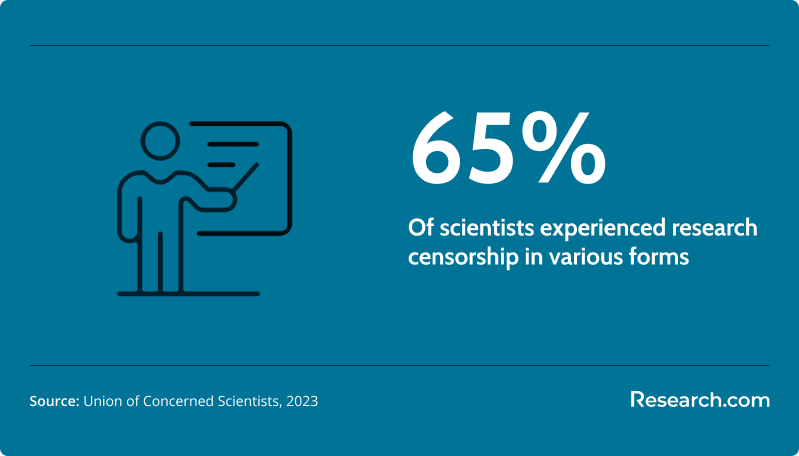
A report on barriers to science-based decision-making noted that many scientists did not report censorship, but some did encounter restrictions. Specifically, 26% said they had been asked to remove politically sensitive language from scientific outputs, 16% reported being directed or asked not to work on certain research topics that could be viewed as politically controversial, and 23% said they often self-censor. These findings are discussed in the report on barriers that can prevent science-based decision-making.
Staffing pressure is another challenge. Among scientists, 62% reported experiencing burnout in the last two years, and 70% of those who reported burnout attributed it to limited staff capacity. These conditions can affect productivity, morale, data quality, and the ability of agencies and institutions to carry out mission-driven research.
The countries with strong representation in the top 10 have research ecosystems that support highly visible scholarship. However, sustaining that success requires more than elite universities; it also requires transparent governance, adequate staffing, stable funding, and protections for scientific independence.
Institutions with the highest number of leading scientists
The top three institutions remain unchanged from the previous year. Harvard University leads the ranking with 65 affiliated scientists. The US National Institutes of Health ranks second with 22 scientists, while MIT ranks third with 21 scientists.
American universities and research institutions make up 80% of the top 10 institutions. The University of Cambridge and the University of Oxford represent the United Kingdom among the leading institutions.
Among the institutions connected with the best scientists list, 9 out of 10 are based in the United States. The only institution in the top 10 located outside the United States is Osaka University, which ranks 7th.
For the 2023 top 10, the California Institute of Technology and the University of California San Francisco both entered the top group, each with 13 scientists. The University of Oxford also moved up to the 7th position with 15 scientists, compared with its 10th-place position in 2022.
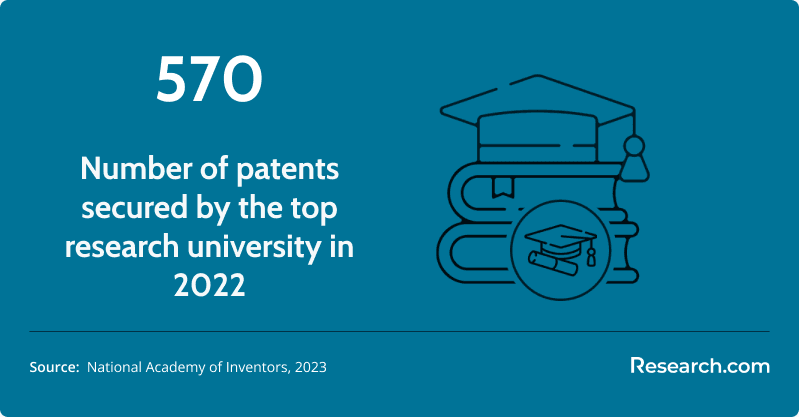
Research universities help develop scientific talent by supporting doctoral education, laboratories, interdisciplinary collaboration, and pathways into academic, government, nonprofit, and industry careers. University research also contributes to innovation. According to the National Academy of Inventors annual list of the top 100 universities granted utility patents, the University of California system received the highest number of patents in 2022, with 570.
| Institution | Scientists in the 2023 ranking | What the result indicates |
| Harvard University | 65 | Highest institutional representation in the ranking |
| US National Institutes of Health | 22 | Second-highest number of affiliated scientists |
| MIT | 21 | Third among institutions in the 2023 ranking |
| University of Oxford | 15 | Moved to the 7th position in the 2023 top 10 |
| California Institute of Technology | 13 | Entered the 2023 top 10 |
| University of California San Francisco | 13 | Entered the 2023 top 10 |
H-index leaders, averages, and distribution
The h-index is one of the main indicators used to understand the scholarly reach of a researcher's published work. A higher h-index generally reflects a larger number of publications that have each received substantial citations. However, h-index values vary widely by field, publication norms, career length, and collaboration patterns, so they should be interpreted in context.
In North America, Professor Walter C. Willett of Harvard University ranks first in the region and first globally, with an h-index of 385.
In Europe, Professor Michael Gratzel of the École Polytechnique Fédérale de Lausanne in Switzerland leads the region with an h-index of 279.
In Asia, Professor Shizuo Akira of Osaka University in Japan is the region's highest-ranked scientist, with an h-index of 297. He is ranked 7th worldwide.
In Oceania, Professor Nicholas G. Martin of the QIMR Berghofer Medical Research Institute in Australia ranks first in the region and no. 99 globally.
In Africa, Professor Dan J. Stein of the University of Cape Town in South Africa is the top-ranked scientist, with a world ranking of 561.
In South America, Professor Maria-Teresa Dova of the National University of La Plata in Argentina is the highest-ranked scientist, with a world ranking of 560.
The average h-index for the top 1% of scientists is 311, compared with an average of 181 for the top 1000 scientists included in the ranking.
The lowest h-index among scientists who entered the 2023 ranking is 155.
The top 1% of scientists in the ranking have an average of 1881 published articles, compared with an average of 1117 articles for the top 1000 scholars.
The top 1% of scientists have an average of 433,775 citations, while the top 1000 scholars have an average of 160,906 citations. The most cited scientist is Eric S. Lander of the Office of Science and Technology Policy, United States, with 601,301 citations.
| Region or group | Leading scientist or benchmark | Ranking detail |
| World and North America | Walter C. Willett | World ranking no. 1; h-index of 385 |
| Europe | Michael Gratzel | h-index of 279 |
| Asia | Shizuo Akira | h-index of 297; 7th in the world ranking |
| Oceania | Nicholas G. Martin | No. 99 in the world ranking |
| Africa | Dan J. Stein | World ranking of 561 |
| South America | Maria-Teresa Dova | World ranking of 560 |
| Top 1% average | H-index of 311 | Average of 1881 published articles and 433,775 citations |
| Top 1000 average | H-index of 181 | Average of 1117 published articles and 160,906 citations |
What alternative education pathways can contribute to scientific innovation
Not every research career begins with a traditional academic route, and not every scientific role requires the same type of training. Vocational, technical, and applied programs can prepare students for laboratory support, healthcare technology, environmental monitoring, data collection, equipment maintenance, and industry-based research operations. These roles are important because major scientific projects often depend on skilled technicians and applied specialists as well as principal investigators.
Alternative pathways are most useful when they provide hands-on experience, recognized credentials, and a clear connection to scientific or technical work. Students considering nontraditional options can compare programs through Research.com's guide to online vocational schools.
How college major choice affects a future science career
A student's major can influence access to research experiences, laboratory training, quantitative coursework, faculty mentorship, and graduate school preparation. Fields such as biology, chemistry, physics, mathematics, computer science, engineering, psychology, public health, and environmental science can all lead to research roles, but they prepare students for different kinds of questions and methods.
Students should not choose a major only because it sounds prestigious or easy. A better approach is to compare required courses, research opportunities, internship access, graduate school expectations, and the skills employers or laboratories want. Students still exploring options can use Research.com's discussion of the easiest college majors as one starting point, but the best choice should match long-term goals, strengths, and academic requirements.
How affordable online education can help emerging scientists
Cost can shape whether students and working professionals are able to continue their scientific training. Affordable online education may help learners build skills in data analysis, programming, project management, technical communication, or specialized scientific topics while reducing relocation and commuting barriers.
Affordability should not be judged by tuition alone. Students should also consider accreditation, eligibility for financial aid, transfer credit policies, technology fees, course availability, faculty access, and whether the program supports the next academic or career step. Learners comparing lower-cost options can start with Research.com's list of online colleges that accept FAFSA.
How short online degrees may support scientific career growth
Short online degrees and accelerated programs can help professionals add targeted skills faster than a traditional degree timeline may allow. For scientists and technical professionals, these programs may be useful for building competencies in analytics, health informatics, biotechnology operations, regulatory affairs, cybersecurity, or management.
The main trade-off is depth. A shorter program may be efficient for a specific skill goal, but it may not provide the broad theoretical foundation, research apprenticeship, or graduate-level preparation needed for some scientific roles. Learners should confirm whether the credential is recognized by employers, whether credits transfer, and whether the curriculum fits their intended career path. Research.com's guide to short online degrees can help students compare accelerated options.
How financial incentives influence scientific career decisions
Scientific careers are shaped by curiosity, public impact, mentorship, and intellectual challenge, but financial considerations still matter. Students may need to weigh years of education, graduate funding, research assistantships, grant competition, industry opportunities, and long-term earning potential before committing to a path.
Some research careers offer higher earning potential in industry than in academia, while academic careers may provide different benefits, including intellectual independence, teaching opportunities, and access to long-term research programs. Students comparing academic interests with earning prospects can review Research.com's guide to the highest paying college majors.
Questions students and emerging researchers should ask before choosing a science pathway
| Question | Why it matters |
| Does this pathway provide real research experience? | Graduate programs, labs, and research employers often value hands-on experience, not just coursework. |
| Is the program or institution properly accredited? | Accreditation can affect transfer credits, financial aid, graduate admissions, and employer recognition. |
| Will I learn quantitative and technical skills? | Modern research increasingly depends on data literacy, computational tools, and strong methods training. |
| Are faculty, labs, or industry partners active in my area of interest? | Relevant mentorship and project access can shape research opportunities and recommendations. |
| What are the total costs, not just tuition? | Fees, equipment, housing, lost income, and program length can change the real cost of a degree. |
| Does this credential support my next step? | A certificate, short degree, bachelor's program, or graduate program should match the role or training level you want. |
Common mistakes when using scientist rankings
- Assuming a ranking measures every kind of impact. Citation metrics are useful, but they do not fully capture mentorship, public service, clinical influence, teaching, or emerging breakthroughs.
- Comparing scientists across fields without context. Citation behavior differs by discipline, so h-index values should not be treated as identical across all research areas.
- Equating affiliation with nationality. The country listed reflects the affiliated institution according to MAG, not the scientist's citizenship or national origin.
- Choosing a university only because it appears in a ranking. Students should also evaluate program fit, advisor availability, funding, research facilities, location, cost, and career outcomes.
- Ignoring scientific integrity and working conditions. Strong research requires more than famous names; it depends on adequate staffing, open inquiry, and institutional safeguards.
- Assuming career outcomes are guaranteed. A prestigious institution or major can open doors, but research careers still depend on skills, mentorship, persistence, funding, and opportunity.
The best scientists help set the direction of future research
The 2023 annual ranking of the world's best scientists shows how strongly research excellence is connected to institutional capacity, national investment, scientific integrity, and long-term support for scholarly work. Countries and universities that provide stable research environments are better positioned to attract and retain highly influential scientists.
The broader policy environment also matters. In July 2023, the Scientific Integrity Act was reintroduced in the US House of Representatives. The continued discussion around scientific integrity reflects the importance of protecting research from inappropriate interference and maintaining public trust in evidence-based decision-making.
Research.com's purpose in publishing this ranking is to make influential scientific work more visible and to help researchers, students, institutions, and decision-makers identify leading experts across disciplines. Readers can learn more about how the ranking was developed by reviewing the Research.com methodology.
Key insights
- Walter C. Willett of Harvard University is ranked as the world's best scientist in the 2023 Research.com ranking, with an h-index of 385.
- The United States is the dominant country in the list, with 612 scientists, or 61.2% of the ranking.
- Harvard University leads all institutions with 65 affiliated scientists included in the 2023 ranking.
- Eric S. Lander is the most cited scientist in the ranking, with 601,301 citations.
- Rankings are useful for identifying scholarly influence, but readers should not treat them as complete measures of scientific value or career promise.
- Students planning research careers should look beyond rankings and compare accreditation, mentorship, research access, funding, technical skill development, and long-term fit.
- Scientific excellence depends on more than individual achievement; it requires funding, infrastructure, staffing, institutional integrity, and freedom to pursue evidence-based inquiry.
About Research.com
All research was coordinated by Imed Bouchrika, Ph.D., a computer scientist with an established history of collaboration on international academic research projects. His role was to help ensure that the data remained unbiased, accurate, and up to date.
Research.com is a research and educational rankings portal designed to help professors, research fellows, students, and professionals identify leading experts, compare academic opportunities, and make informed decisions about education and career pathways.


