
2027 Licensed Practical Nurse (LPN) vs. Certified Nursing Assistant (CNA): Explaining The Difference

Co-Founder and Chief Data Scientist
Choosing between becoming a licensed practical nurse (LPN) and a certified nursing assistant (CNA) is one of the most common early decisions for people entering nursing and direct patient care. Both roles can put you at the bedside quickly, but they differ sharply in training time, legal authority, clinical responsibility, cost, salary, and long-term mobility. The choice matters because nursing roles continue to be shaped by staffing shortages, an aging population, new care models, and expanding technology in hospitals, long-term care, and home health. The global private nursing services market is projected to reach $595.28 billion in 2025, making entry-level healthcare pathways especially important for students who want stable, practical career options.
This guide compares LPN vs. CNA careers for students, career changers, and healthcare workers deciding their next step. You will learn what each role does, how long training takes, what licensure or certification requires, where each role works, how pay compares, what advancement paths are available, and how to decide which option fits your goals.
Quick answer: LPN vs. CNA
An LPN is a licensed nurse with a broader clinical scope, more training, and higher earning potential. A CNA is a certified direct-care worker who helps patients with daily living needs and can enter the workforce faster and at a lower cost. If you want a quicker, less expensive way to start working in healthcare, CNA is usually the faster path. If you want more medical responsibility, stronger advancement options, and a higher salary range, LPN is usually the better long-term choice.
| Factor | LPN | CNA |
| Primary role | Provides basic nursing care under RNs and physicians | Assists patients with daily activities under licensed nursing supervision |
| Training length | Typically about one year; often 12 to 18 months | Usually 4 to 12 weeks |
| Credential | State licensure after passing the NCLEX-PN | State certification after a competency exam |
| Typical cost | $10,000 to $30,000 for tuition | $500 to $2,000, plus possible exam fees of $50 and $200 |
| Average annual salary | Approximately $54,700 | $37,140 |
| Best for | Students who want more clinical duties and a nursing ladder toward RN roles | Students who want fast entry into patient care before committing to more schooling |
Key Things You Should Know About the Difference Between Licensed Practical Nurse (LPN) vs. Certified Nursing Assistant (CNA)
- LPNs have a wider clinical role. They may give medications, update records, monitor patients, assist with treatments, and perform nursing duties allowed by state law.
- CNAs focus on essential bedside support. They help with bathing, dressing, meals, mobility, toileting, linen changes, and observation of patient needs.
- LPN training takes longer. LPNs complete a state-approved practical nursing program and pass the NCLEX-PN exam. CNA programs are shorter, ranging from four weeks to a few months, followed by a state competency exam.
- LPN is a license; CNA is a certification. This difference affects legal scope, accountability, supervision, and advancement options.
- Pay is different. LPN salaries typically range from $51,514 to $75,969, while CNA salaries range from $30,874 to $44,629.
- What does a licensed practical nurse do?
- What does a certified nursing assistant do?
- How do LPN and CNA education requirements compare for 2027?
- How do LPN licensure and CNA certification differ?
- Where do LPNs and CNAs work?
- What is the scope-of-practice difference between LPNs and CNAs?
- How much does it cost to become an LPN vs. CNA?
- How much do LPNs and CNAs earn?
- What advancement options are available for LPNs and CNAs?
- What challenges do LPNs and CNAs face?
- What trends are affecting LPN and CNA careers?
- What renewal and continuing education requirements apply?
- How can students reduce the cost of nursing education?
- Can online education help LPNs and CNAs move into advanced roles?
- How can specialization programs expand nursing opportunities?
- What skills do LPNs and CNAs need?
- Which path should you choose: LPN or CNA?
What is a licensed practical nurse?
A licensed practical nurse is a state-licensed healthcare professional who delivers basic nursing care under the supervision of registered nurses (RNs), physicians, and other authorized providers. In some states, the same role is called a licensed vocational nurse (LVN). LPNs are part of the nursing team, but they are not the same as RNs; their permitted duties depend on state nurse practice acts and employer policies.
Typical LPN duties include taking vital signs, giving certain medications, helping with wound care, documenting patient status, supporting care plans, and communicating changes in a patient’s condition to supervising clinicians. LPNs may also work with CNAs, medical assistants, and RNs, so understanding related roles such as medical assistant vs. CNA can help students see how different entry-level healthcare jobs fit together.
There were approximately 630,000 licensed practical nurses employed in the United States. The workforce comprises about 87.9% women and 12.1% men, with an average annual growth rate of -1.98% between 2014 and 2022. The demand for LPNs is projected to grow by 5% from 2022 to 2032, with about 54,400 job openings each year, primarily due to workforce turnover and the need to replace workers exiting the labor force.
What is a certified nursing assistant?
A certified nursing assistant is a state-certified healthcare worker who provides hands-on support with basic patient care. CNAs do not independently perform licensed nursing tasks. Instead, they work under the direction of LPNs, RNs, and other licensed clinicians.
CNAs help patients bathe, dress, eat, move safely, use the restroom, and maintain comfort and dignity. They also observe patients closely and report concerns such as appetite changes, pain, confusion, skin issues, or mobility problems. In 2022, approximately 1.36 million CNAs were employed in the United States, with 88.7% being women and 11.3% men.
Because CNA jobs are often entry-level, many job-search strategies used for other first healthcare roles also apply. Students who want help preparing applications may find useful parallels in guidance on getting a medical assistant job with no experience, especially around resumes, clinical exposure, and interview preparation.
The demand for CNAs is projected to grow by 4% from 2023 to 2033, aligning with the average growth rate for all occupations. This growth is driven by an aging population requiring increased care in long-term facilities and home healthcare settings. Each year, there are approximately 216,200 job openings for nursing assistants and orderlies, primarily due to workforce turnover and the need to replace workers exiting the labor force.

How do the education requirements for LPN vs. CNA compare for 2027?
LPN programs require more time, more clinical instruction, and a stronger science and nursing foundation than CNA programs. CNA training is shorter and focused on basic care skills, safety, infection control, communication, and supervised patient support. Your decision should depend on how quickly you need to start working, how much you can spend, and whether you want a direct path into licensed nursing.
| Education factor | LPN path | CNA path |
| Typical training provider | Community colleges, technical schools, and practical nursing programs | Community colleges, vocational schools, healthcare facilities, and approved training providers |
| Program length | About one year; commonly 12 to 18 months | Four weeks to a few months; often 4 to 12 weeks |
| Main academic focus | Nursing principles, pharmacology, anatomy, patient care, clinical practice | Daily living support, basic nursing tasks, patient safety, communication, infection control |
| Required exam | NCLEX-PN | State competency examination |
| Outcome | Eligibility for state licensure as an LPN or LVN | Eligibility for placement on the state nursing assistant registry |
LPN education requirements
To become an LPN, you must complete a state-approved practical nursing program and meet your state board’s requirements. Programs usually combine classroom learning, skills labs, and supervised clinical experience.
- Choose a state-approved practical nursing program. Confirm that the program is accepted by your state nursing board. If admissions flexibility is a priority, compare options such as the easiest LPN programs to get into, but do not rely on ease of admission alone.
- Complete classroom and clinical training. Expect instruction in nursing fundamentals, medication administration, patient care, and supervised clinical practice.
- Meet graduation requirements. You must complete all academic, lab, and clinical components before becoming eligible for licensure testing.
- Pass the NCLEX-PN. This national exam evaluates whether you are prepared for safe practical nursing practice.
- Apply for state licensure. Licensure is required before you can legally work as an LPN.
CNA education requirements
CNA training is designed for rapid entry into direct patient care. It emphasizes safe assistance, basic observation, communication, and patient dignity.
- Select a state-approved CNA program. Make sure the provider is recognized by the appropriate state health department or nursing assistant registry.
- Complete classroom and hands-on instruction. Training includes patient safety, infection control, vital signs, personal care, transfers, and basic documentation.
- Pass the state competency exam. Most exams include a written portion and a practical skills demonstration.
- Join the state registry. Once certified, you can work legally as a CNA in approved settings. For students researching the fastest paths to becoming a nurse, CNA training is often the quickest healthcare entry point, though it is not the same as becoming a licensed nurse.
What’s the difference in licensing and certification for LPN and CNA?
The biggest legal difference is that LPNs are licensed nurses, while CNAs are certified nursing assistants. LPNs must complete a state-approved practical nursing program, typically lasting about one year, and pass the NCLEX-PN exam to obtain licensure. CNAs must complete a state-approved training program, usually comprising a minimum of 75 hours of instruction, and pass a competency examination to earn certification.
This distinction affects what each worker can do. LPNs may perform nursing tasks allowed under state law and employer policy. CNAs provide supportive care and report observations to licensed staff. If you are comparing the nursing ladder beyond practical nursing, a detailed LPN vs. RN comparison can help clarify how practical nursing differs from registered nursing.
Optional certifications for CNAs
Initial CNA certification qualifies a worker for basic nursing assistant duties. Additional credentials can help CNAs move into specialized environments, but requirements vary by employer and state.
- Certified Hospice and Palliative Nursing Assistant (CHPNA): Focuses on comfort care, family support, symptom awareness, and end-of-life patient needs.
- Certified Wound Care Associate (CWCA): Builds knowledge in wound prevention, wound observation, and care support for patients with skin and tissue concerns.
- Certified Dialysis Technician (CDT): Prepares workers to assist with dialysis-related care for patients with kidney-related conditions.
Optional certifications for LPNs
LPNs do not usually need extra certifications beyond state licensure to begin work, but specialized credentials may strengthen job options in certain settings.
- IV Therapy Certification: Supports LPNs who need training in intravenous therapy, vein anatomy, infection control, and IV procedures.
- Long-Term Care Certification: Emphasizes care for older adults and people with chronic illnesses in nursing homes, assisted living, and similar settings.
- Pharmacology Certification: Expands medication knowledge, including safe administration, dosage calculations, and drug effects.
- Nephrology Certification: Focuses on kidney care, dialysis support, and patients with renal disorders.
- Wound Care Certification: Strengthens skills in wound assessment, treatment support, prevention, and monitoring.
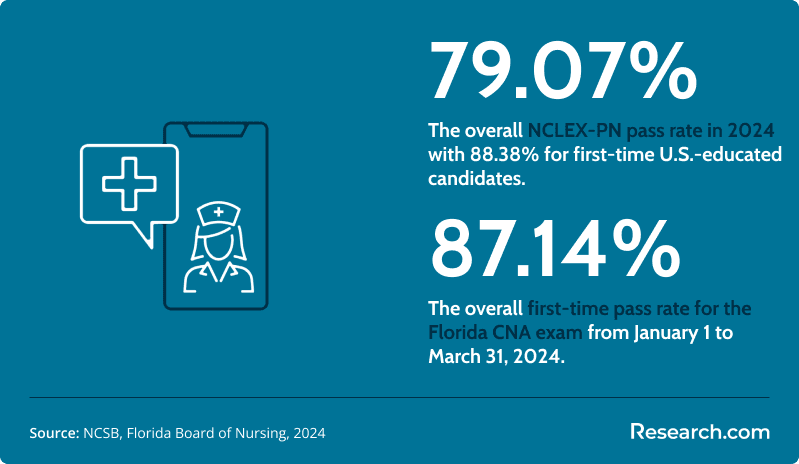
Certification and exam performance can also affect readiness. Recent data shows that the overall passing rate for CNAs is 79.07%, with first-time, U.S.-educated candidates achieving an 88.38% pass rate. In Florida, the CNA pass rate is 87.14%.
Where do LPNs vs. CNAs typically work?
LPNs and CNAs are employed in many of the same healthcare environments, but their responsibilities differ once they are on the unit. LPNs are more likely to handle nursing tasks and documentation, while CNAs are more likely to spend most of the shift assisting patients with direct daily care.
LPN employment is spread across several healthcare settings, with approximately 657,800 jobs in 2023. Some LPNs also travel to help facilities address staffing shortages in underserved regions.
| Industry | Employment |
| Nursing and residential care facilities | 35% |
| Hospitals; state, local, and private | 16% |
| Home healthcare services | 12% |
| Offices of physicians | 12% |
| Government | 6% |
| Source: Bureau of Labor Statistics, U.S. Department of Labor |
CNAs are commonly hired by skilled nursing facilities, hospitals, assisted living communities, hospice providers, home healthcare agencies, and government healthcare facilities. If you prefer long-term patient relationships, nursing homes and home health may be a strong fit. If you want exposure to acute care teams and varied cases, hospitals may be more appealing.
How do the scope and practice of LPNs vs. CNAs compare?
LPNs have a broader scope of practice than CNAs. They perform selected nursing tasks, contribute to patient monitoring, maintain records, administer certain medications, assist with tests and treatments, monitor vital signs, help with transfers, and provide patient comfort. Their specific permissions depend on state laws and employer policy.
CNAs provide foundational bedside care under supervision. Their work may include changing linens, restocking supplies, assisting with toileting, helping with meals, supporting dressing and bathing, observing intake and output, and helping patients move safely. CNAs are often the team members who spend the most time with patients, which makes their observations valuable.
For LPNs who want more flexibility after gaining experience, travel nursing can be one option. A guide on how to become a travel licensed practical nurse explains how mobility can change job settings and responsibilities.
| Task or responsibility | LPN | CNA |
| Assist with bathing, dressing, meals, and mobility | May assist as part of patient care | Core daily responsibility |
| Take vital signs | Yes | Yes, when trained and permitted |
| Administer medications | Often permitted within state rules and employer policy | No, generally not within CNA scope |
| Document clinical updates | Yes, more extensive documentation | Documents basic care and reports observations |
| Supervise others | May supervise CNAs in some settings | No licensed supervisory authority |
| Care planning | May contribute under RN or provider direction | Reports information that supports the care plan |
How do the costs of becoming an LPN and a CNA compare?
CNA training usually costs far less than LPN training, which is one reason many students use CNA certification as a low-risk entry into healthcare. LPN programs require a larger investment because they are longer, more clinically intensive, and lead to nursing licensure.
Licensed practical nurse programs cost between $10,000 to $30,000 for tuition. Students may also pay for books, uniforms, lab supplies, clinical materials, exam preparation, background checks, immunizations, and licensure-related expenses. LPN training typically takes 12 to 18 months, so students should also consider lost work time or reduced work hours while enrolled.
Certified nursing assistant programs typically cost $500 to $2,000, depending on provider and location. Students may also need to pay for textbooks, uniforms, health screenings, and certification testing. Exam fees are generally between $50 and $200. CNA programs usually last around 4 to 12 weeks, making the path faster and less expensive than practical nursing.
Cost factors to compare before enrolling
| Cost question | Why it matters |
| Is the program approved by the state? | Unapproved programs may not qualify you for licensure or certification. |
| Are books, uniforms, supplies, and exam fees included? | A low tuition price may not reflect the full cost of attendance. |
| Can you work while enrolled? | Shorter CNA programs may be easier to combine with work; LPN programs may require more scheduling flexibility. |
| Does the employer offer tuition help? | Some healthcare employers support workers who continue from CNA to LPN or RN roles. |
| Will credits transfer later? | Transfer policies can affect the cost and speed of future nursing education. |
How much do LPNs vs. CNAs earn?
LPNs generally earn more because they complete more training, carry licensed nursing responsibilities, and perform a broader range of clinical tasks. CNAs earn less on average, but the role requires less time and money to enter.
The average annual salary for a licensed practical nurse in the United States is approximately $54,700. Salaries typically range from $51,514 to $75,969, depending on experience, location, employer, and work setting. Entry-level LPNs earn around $52,525 annually, while those with over eight years of experience can expect approximately $57,334 per year.
A certified nursing assistant has an average annual salary of $37,140. CNA salaries range from $30,874 to $44,629, depending on experience, geography, facility type, and shift needs. Entry-level CNAs earn about $35,696 annually, with those possessing over eight years of experience earning up to $38,792 per year.
| Salary measure | LPN | CNA |
| Average annual salary | Approximately $54,700 | $37,140 |
| Typical salary range | $51,514 to $75,969 | $30,874 to $44,629 |
| Entry-level estimate | Around $52,525 annually | About $35,696 annually |
| Over eight years of experience | Approximately $57,334 per year | Up to $38,792 per year |
What are the career advancement opportunities for LPNs vs. CNAs?
Both roles can lead to advancement, but the ladders look different. CNAs often advance by earning another credential, such as LPN, RN, medical assistant, patient care technician, or phlebotomist. LPNs may advance by specializing, moving into leadership, working in home health or hospice, or continuing toward RN licensure.
Career advancement opportunities for LPNs
| Advancement path | What it involves | Median salary |
| Registered Nurse (RN) | Requires an ADN or BSN and passing the NCLEX-RN. Many working practical nurses compare LPN to RN online programs when looking for flexible bridge options. | $87,868 per year |
| Charge Nurse | Coordinates a unit or department during a shift, supports staff, manages patient flow, and helps maintain compliance. | $85,509 per year |
| Clinical Nurse Manager | Oversees nursing staff, staffing plans, budgets, policy implementation, and quality improvement within a department. | $89,949 per year |
| Home Health Nurse | Provides care in patients’ homes, including wound care, medication support, chronic condition monitoring, and family education. | $75,459 per year |
| Hospice Nurse | Supports terminally ill patients with comfort-focused care, pain and symptom support, and family communication. | $87,186 per year |
Career advancement opportunities for CNAs
| Advancement path | What it involves | Median salary |
| Licensed Practical Nurse (LPN) | Requires a state-approved practical nursing program and passing the NCLEX-PN; adds medication, nursing documentation, and care-support responsibilities. | $54,700 per year |
| Registered Nurse (RN) | Requires an ADN or BSN and passing the NCLEX-RN; expands responsibilities to assessment, care planning, coordination, and broader nursing judgment. | $87,868 per year |
| Medical Assistant | Requires additional training in clinical and administrative tasks. A certified medical assistant may take histories, draw blood, administer injections, schedule visits, and manage records. | $41,370 per year |
| Patient Care Technician (PCT) | May include EKG monitoring, phlebotomy, basic care, and other advanced support tasks under nursing supervision. | $38,480 per year |
| Phlebotomist | Specializes in drawing and handling blood specimens for testing, transfusions, research, or donation. | $39,658 per year |
What challenges do healthcare professionals face in LPN and CNA roles?
LPNs and CNAs both work in demanding care environments. The challenges are different, but both roles require stamina, emotional control, and strong communication.
| Challenge | How it affects LPNs | How it affects CNAs |
| Physical workload | May involve long shifts, patient transfers, and fast-paced clinical tasks | Often involves frequent lifting, repositioning, walking, and hands-on care |
| Emotional stress | Higher clinical accountability can increase pressure | Close contact with patients can be emotionally intense, especially in long-term care or hospice |
| Documentation burden | Requires accurate nursing notes, medication records, and communication with supervisors | Requires timely reporting of care tasks and patient changes |
| Staffing pressure | May need to prioritize multiple patients and supervise support staff | May manage heavy patient assignments and rapid task turnover |
| Career ceiling | Advancement may require RN education or specialization | Higher pay and scope usually require additional training or licensure |
Professionals who want to move beyond entry-level or practical nursing roles may eventually consider graduate-level pathways after completing the required nursing steps. For example, experienced nurses exploring advanced clinical education can research fast track nurse practitioner programs, but this is a later-stage option rather than an immediate path from CNA or LPN status alone.
What industry trends are shaping the future of LPN and CNA roles?
Several healthcare trends are changing what employers expect from LPNs and CNAs. Digital documentation, remote monitoring, telehealth support, team-based care, and growing demand from older adults are increasing the need for workers who can communicate clearly, adapt quickly, and document accurately.
For CNAs, this often means stronger expectations around observation, infection control, patient mobility, and reporting changes quickly. For LPNs, it may mean more involvement in medication workflows, electronic health records, care coordination, and chronic disease support. Workers who plan to advance should build comfort with technology early rather than treating it as optional.
Education pathways are also becoming more flexible for licensed nurses. LPNs who later become RNs may compare bridge and completion programs, including options such as 9 month RN BSN online programs, depending on their prior education, licensure, and program eligibility.
What are the continuing education and renewal requirements for LPNs and CNAs?
Renewal rules are set by states, so LPNs and CNAs should check the appropriate nursing board, health department, or registry before assuming requirements. Requirements may include continuing education, work-hour minimums, background checks, fees, skills updates, or proof of active practice.
LPN continuing education may include topics such as pharmacology, patient safety, infection control, legal responsibilities, and clinical updates. CNA renewal often emphasizes continued competency in basic care, patient safety, communication, and infection prevention.
Students planning a long-term nursing pathway should also understand that higher-level credentials require separate admissions and clinical requirements. For example, people with non-nursing bachelor’s degrees who want a graduate nursing route may research non nursing bachelor's to MSN online options, but eligibility varies and these programs are not substitutes for CNA or LPN certification requirements.
Are there financial aid and scholarship opportunities for nursing education?
Financial aid can make a major difference, especially for LPN students facing higher tuition. Students should compare federal aid eligibility, state workforce grants, community college aid, employer tuition reimbursement, local healthcare scholarships, and payment plans. CNA students should also ask whether a healthcare facility offers free or reduced-cost training in exchange for employment.
Practical ways to lower training costs
- Start with approved public options. Community colleges and public technical schools may offer lower tuition than private providers.
- Ask employers about reimbursement. Nursing homes, hospitals, and home health employers may help workers continue from CNA to LPN or RN roles.
- Compare total cost, not just tuition. Include uniforms, books, testing, transportation, health screenings, and lost work time.
- Confirm transfer policies. If you plan to advance, ask whether credits will count toward a later program.
- Avoid unapproved programs. A cheaper program can become expensive if it does not qualify you for the required exam or state credential.
For nurses who later pursue advanced specialization, cost control remains important. For example, advanced-practice candidates interested in women’s health may compare affordable online WHNP programs after meeting the necessary nursing education and licensure prerequisites.
Can online education bridge the gap to advanced nursing roles?
Online education can help working healthcare professionals continue their education, but it does not remove clinical or licensure requirements. CNA and LPN preparation includes hands-on skills, and LPN licensure requires an approved practical nursing program and the NCLEX-PN. Programs that advertise online flexibility should still be checked carefully for state approval, clinical placement expectations, and eligibility for required exams.
Online programs are often more relevant after a student has already become licensed or is completing a bridge pathway. For example, RNs who want a bachelor’s degree may compare the best online RN to BSN programs without clinicals, depending on their goals and prior credits.
How can online specialization programs expand your nursing opportunities?
Specialized online programs can support career growth after a healthcare worker has completed the required foundational nursing education. They may help nurses move toward leadership, population-specific care, or advanced practice, but they usually require prior credentials such as RN licensure and sometimes a BSN.
For example, nurses interested in behavioral health and advanced practice may eventually compare cheapest online psych NP programs. This type of path is not an entry-level CNA or LPN shortcut; it is a later educational step for nurses who meet advanced program requirements.
What skills are essential for LPNs vs. CNAs?
LPNs and CNAs both need compassion, patience, and reliability, but the technical skill mix is different. LPNs need stronger clinical and medication-related knowledge. CNAs need excellent bedside care, mobility support, and observation skills.
Technical and clinical skills for LPNs
- Patient assessment. LPNs gather health information, observe symptoms, record histories, and monitor vital signs within their scope.
- Medication administration. LPNs must understand safe medication delivery, dosage accuracy, side effects, and reporting requirements.
- Wound care support. LPNs assess wounds, apply dressings, monitor healing, and support infection prevention.
- IV therapy knowledge. Where permitted and properly trained, LPNs may support IV therapy and related monitoring.
- Patient and family education. LPNs help explain care instructions, medications, follow-up needs, and basic condition management.
Technical and clinical skills for CNAs
- Basic patient care. CNAs assist with bathing, dressing, feeding, toileting, grooming, and comfort.
- Vital sign monitoring. CNAs may measure temperature, pulse, respiration, and blood pressure and report meaningful changes.
- Infection control. Hand hygiene, personal protective equipment, cleaning practices, and isolation awareness are essential.
- Mobility assistance. CNAs help patients transfer, walk, reposition, and avoid falls or injury.
- Documentation and reporting. CNAs record care tasks and communicate concerns to LPNs, RNs, or supervisors.
Shared skills for both roles
- Clear communication. Both roles must communicate with patients, families, nurses, and other healthcare workers.
- Empathy. Patients often need emotional reassurance as much as physical assistance.
- Attention to detail. Small changes in behavior, appetite, skin condition, or mobility can signal larger problems.
- Physical stamina. Long shifts, lifting, standing, and repeated movement are common.
- Adaptability. Patient needs, staffing, and priorities can change quickly during a shift.
Which career is right for you: LPN vs. CNA?
The best choice depends on your timeline, budget, tolerance for responsibility, and long-term nursing goals. CNA is often the better first step if you need to work quickly or want to test whether patient care is right for you. LPN is stronger if you are ready for a longer program and want a licensed role with higher pay and a clearer path toward RN advancement.
Choose LPN if:
- You want more clinical responsibility. LPNs take on broader patient-care duties than CNAs, including selected nursing and medication-related tasks.
- You can commit to longer training. Practical nursing programs typically take 12 to 18 months and include more academic and clinical requirements.
- You want stronger earning potential. LPNs have an average annual salary of approximately $54,700, compared with $37,140 for CNAs.
- You may pursue RN licensure later. Many practical nurses use the role as a bridge to registered nursing, and some later compare LPN to RN online programs to continue while working.
Choose CNA if:
- You want the fastest entry into healthcare. CNA programs are short and affordable compared with practical nursing programs.
- You want direct bedside experience. CNAs spend much of their time helping patients with essential daily needs.
- You are not ready to commit to nursing school. CNA work can help you decide whether healthcare fits your personality and goals.
- You need a lower-cost starting point. CNA programs typically cost $500 to $2,000, while LPN programs cost between $10,000 to $30,000 for tuition.
Common mistakes to avoid when choosing between LPN and CNA
| Mistake | Better approach |
| Choosing only based on salary | Compare training time, cost, stress, scope of practice, and advancement goals. |
| Enrolling without checking state approval | Confirm the program qualifies you for the required exam and credential in your state. |
| Assuming all online options meet licensure rules | Ask about clinical requirements, state authorization, and exam eligibility. |
| Ignoring total cost | Include fees, supplies, transportation, background checks, and reduced work hours. |
| Expecting guaranteed salary outcomes | Use salary ranges as estimates; actual pay depends on location, employer, shift, experience, and setting. |
| Forgetting advancement requirements | Ask whether credits transfer and what additional education is required for LPN, RN, or advanced roles. |
Questions to ask before choosing a program
- Is the program approved by the state agency that controls LPN licensure or CNA certification?
- What are the total costs beyond tuition?
- What percentage of students complete the program and pass the required exam?
- Where are clinical or hands-on training sites located?
- Can I work while enrolled, and what schedule options are available?
- Does the school help with job placement, resume preparation, or employer connections?
- If I want to become an RN later, will any coursework or experience help me progress?
Here’s What Graduates Have to Say about Choosing LPN vs. CNA Careers
Becoming an LPN gave me more independence in patient care and helped me take on responsibilities that made the work feel meaningful. The training was demanding, but I now understand patients’ needs in a deeper clinical way.
– Jessica
I looked closely at CNA training, but I decided the LPN route matched my long-term goals better because it offered broader duties and stronger salary potential. The program required more effort, but the added responsibility has been worth it.
– Reana
Working as a CNA has allowed me to form close relationships with patients. I may not have the same scope as an LPN, but being present for people during basic daily care is the part of the job I value most.
– Mia
Key Insights
- LPN and CNA are not interchangeable roles. LPNs are licensed nurses with a broader clinical scope; CNAs are certified support workers who provide essential daily care under supervision.
- CNA is faster and cheaper. CNA programs typically cost $500 to $2,000 and often take 4 to 12 weeks, making them a practical entry point for students who want to start quickly.
- LPN usually offers stronger long-term value. LPN programs cost between $10,000 to $30,000 for tuition and take longer, but they lead to higher average pay and more clinical responsibility.
- State approval is nonnegotiable. Before enrolling, verify that the program qualifies you for the NCLEX-PN or the CNA competency exam in your state.
- Your career goal should drive the decision. Choose CNA if you want quick bedside experience or a low-cost start. Choose LPN if you are ready for licensed nursing duties and may later pursue RN advancement.
- Do not rely on salary alone. Consider workload, emotional stress, training demands, licensure rules, scheduling, advancement options, and whether the daily work fits your strengths.
References:
- NurseJournal. (n.d.). LPN vs. CNA salary differences. Retrieved February 26, 2025, from NurseJournal
- PracticalNursing.org. (n.d.). Cost of LPN programs and schools. Retrieved February 26, 2025, from PracticalNursing.org
- PracticalNursing.org. (n.d.). LPN vs. CNA: Key differences. Retrieved February 26, 2025, from PracticalNursing.org
- RegisteredNursing.org. (n.d.). Certified nursing assistant classes and cost. Retrieved February 26, 2025, from RegisteredNursing.org
- Salary.com. (n.d.). Licensed practical nurse salary. Retrieved February 26, 2025, from Salary.com
- Salary.com. (n.d.). Certified nursing assistant salary. Retrieved February 26, 2025, from Salary.com
- Market.us. (2022, November 23). Nursing workforce statistics. Retrieved February 26, 2025, from Market.us
- Salary.com. (n.d.). Registered Nurse (RN) salary. Retrieved February 26, 2025, from Salary.com
- Salary.com. (n.d.). Charge nurse salary. Retrieved February 26, 2025, from Salary.com
- Salary.com. (n.d.). Clinical nurse manager salary. Retrieved February 26, 2025, from Salary.com
- Salary.com. (n.d.). Home health registered nurse salary. Retrieved February 26, 2025, from Salary.com
- Salary.com. (n.d.). Hospice nurse salary. Retrieved February 26, 2025, from Salary.com
- Salary.com. (n.d.). Licensed practical nurse salary. Retrieved February 26, 2025, from Salary.com
- ZipRecruiter. (n.d.). Patient care technician salary. Retrieved February 26, 2025, from ZipRecruiter
- ZipRecruiter. (n.d.). Phlebotomist salary. Retrieved February 26, 2025, from ZipRecruiter
Other Things You Need to Know About LPN vs. CNA
LPN candidates must pass the NCLEX-PN after graduating from an approved practical nursing program. CNA candidates usually must pass a state competency exam with a written part and a skills demonstration after state-approved training. State nursing boards and nurse aide registries set the exact testing rules.
Becoming an LPN in 2027 typically requires completing a state-approved practical nursing program, which usually lasts about one year and includes coursework and clinical practice. Graduates must pass the NCLEX-PN exam to earn licensure, governed by state nursing boards.
Yes, CNAs can advance their careers by becoming LPNs. Many educational institutions offer bridge programs designed to help CNAs transition to LPN roles. These programs recognize the experience CNAs bring and often provide a streamlined path to becoming an LPN. After completing the necessary education, CNAs must pass the NCLEX-PN exam to obtain licensure as an LPN.


