
2027 How to Become a Nurse in Kentucky

Co-Founder and Chief Data Scientist
Becoming a nurse in Kentucky comes down to three decisions: which nursing role you want, which approved program will get you there, and how you will meet Kentucky Board of Nursing licensing rules. The process is manageable, but mistakes such as choosing a non-accredited program, overlooking background check requirements, or assuming an online program automatically qualifies you for Kentucky licensure can delay your start date.
This guide explains how to become a registered nurse, licensed practical nurse, advanced practice registered nurse, or nursing assistant in Kentucky. You will learn the education paths, license types, compact license rules, renewal expectations, career outlook, school selection factors, financial aid options, and practical steps that can help you enter the field with fewer surprises.
Quick Answer: How Do You Become a Nurse in Kentucky?
To become a nurse in Kentucky, you generally need to complete an approved nursing education program, pass the correct NCLEX exam, apply through the Kentucky Board of Nursing, complete fingerprinting and a background check, and maintain your license through annual renewal and continuing education. RNs usually complete an ADN or BSN and pass the NCLEX-RN, while LPNs complete a practical nursing program and pass the NCLEX-PN. APRNs need graduate-level nursing education and national certification in their specialty.
Key Things You Should Know About Becoming a Nurse in Kentucky
- Kentucky has reported a major nursing shortage, with projections showing a need for over 16,000 new nurses by 2024. For qualified applicants, that can translate into opportunities across hospitals, clinics, long-term care, home health, and rural healthcare settings.
- The average salary for nurses in Kentucky is around $63,000 per year, though actual pay depends on license type, experience, specialty, shift, employer, and location. Nurses in larger markets such as Louisville and Lexington may see higher compensation.
- The standard RN route is to finish an accredited Associate Degree in Nursing (ADN) or Bachelor of Science in Nursing (BSN), then pass the NCLEX-RN and meet Kentucky licensing requirements.
- Kentucky’s nursing labor market is shaped by an aging population, healthcare access needs, and ongoing staffing pressure in hospitals, outpatient care, and long-term care facilities.
- Nurses who want to move beyond entry-level roles can pursue specialties such as pediatrics, geriatrics, critical care, nurse practitioner practice, nurse-midwifery, education, leadership, or non-clinical healthcare work.
- What are the steps to becoming a nurse in Kentucky?
- What education do you need to become a nurse in Kentucky?
- Which nursing roles are legally recognized in Kentucky?
- What are Kentucky’s nursing license requirements?
- What nursing license types are available in Kentucky?
- Can a compact nurse work in Kentucky?
- Can you work as a nurse in Kentucky without a license?
- What is the current state of nursing in Kentucky?
- What are alternative career paths for nurses in Kentucky?
- Can fast-track RN to BSN programs help Kentucky nurses advance?
- What is the job outlook for nurses in Kentucky?
- How can Kentucky nursing students pay for school?
- What non-clinical healthcare roles can Kentucky nurses consider?
- How can new nurses manage stress and burnout in Kentucky?
- How can nurses keep up with Kentucky nursing regulations?
- How should you choose a nursing school in Kentucky?
- How can you become a nurse midwife in Kentucky?
- What advanced education options are available to Kentucky nurses?
- What options are available for aspiring LPNs in Kentucky?
- What are the nurse practitioner education requirements in Kentucky?
- What professional development resources are available for Kentucky nurses?
What are the steps to becoming a nurse in Kentucky?
The basic path to nursing licensure in Kentucky is straightforward, but the details differ by role. Before you enroll, confirm that your program is approved for the license you want and that it prepares graduates for Kentucky’s licensing process. The Kentucky Board of Nursing is the official source for licensure applications, renewal rules, disciplinary standards, and regulatory updates.
For most future registered nurses, the process begins with an accredited ADN or BSN program. After graduation, candidates take the NCLEX-RN, submit an application to the Kentucky Board of Nursing, complete fingerprinting and a background check, and satisfy any additional state requirements. Nurses already licensed in another state may be able to apply by endorsement, while eligible nurses from compact states may have multistate practice privileges.
| Step | What to Do | Why It Matters |
| 1. Choose your nursing role | Decide whether you want to become an LPN, RN, APRN, CNA, or pursue another healthcare role. | Each role has different education, testing, supervision, and scope-of-practice rules. |
| 2. Complete an approved program | Enroll in an accredited or state-approved program aligned with your target license. | Graduating from the wrong type of program can prevent or delay licensure. |
| 3. Pass the required exam | Take the NCLEX-RN for RN licensure or the NCLEX-PN for LPN licensure. | Passing the required exam demonstrates entry-level nursing competency. |
| 4. Apply for Kentucky licensure | Submit your application, education verification, fees, and required documents to the Kentucky Board of Nursing. | The license application is the formal step that authorizes practice once approved. |
| 5. Complete background checks | Follow Kentucky’s fingerprinting and criminal background check process. | Background screening is part of patient safety and professional accountability. |
| 6. Maintain your license | Renew annually by October 31, pay the $65 renewal fee, and complete 14 continuing education contact hours or seven hours plus additional proof of competency. | Licensure is ongoing; failing to renew can interrupt your ability to work legally. |
If you are licensed in another state and want Kentucky licensure by endorsement, Kentucky requires you to meet applicable education standards and pass a 35-question Jurisprudence Examination focused on Kentucky nursing law. The Board provides a free study guide, which can help you prepare without buying unnecessary materials.
Kentucky also participates in the Nurse Licensure Compact for qualifying RNs and LPNs. That can be valuable if you plan to work across state lines, accept telehealth roles, or live near a border state. Kentucky’s projected job growth rate of 8.8% for RNs makes planning your license and education route especially important if you want to enter the market efficiently. Nurses comparing different credential pathways may also want to review the distinction between FNP C and FNP BC certifications as they plan for future specialization.
What education do you need to become a nurse in Kentucky?
Kentucky nursing education requirements depend on the level of practice you want. A short practical nursing program may be enough for LPN licensure, while registered nurses generally complete an ADN or BSN. Advanced practice roles require graduate education, national certification, and additional regulatory steps.
| Education Path | Typical Time | Best For | Next Licensing Step |
| Practical nursing program | Usually about one year | Students who want a faster route into direct patient care as an LPN | Pass the NCLEX-PN and apply for LPN licensure |
| Associate Degree in Nursing (ADN) | Typically about two years | Students who want to become RNs quickly and may later complete a BSN | Pass the NCLEX-RN and apply for RN licensure |
| Bachelor of Science in Nursing (BSN) | Commonly a four-year degree | Students seeking broader preparation, leadership potential, and eligibility for employers that prefer BSN-prepared nurses | Pass the NCLEX-RN and apply for RN licensure |
| Master of Science in Nursing (MSN) | Usually an additional two years after the BSN | RNs pursuing nurse practitioner, clinical nurse specialist, education, leadership, or other advanced roles | Meet graduate, certification, and state practice requirements |
| DNS or DNP | Often three to four years | Nurses preparing for advanced clinical practice, systems leadership, scholarship, or high-level practice roles | Complete role-specific certification and Kentucky regulatory requirements |
An ADN can be a practical option if cost and speed are priorities. A BSN may be a stronger long-term choice for nurses who want more mobility, leadership opportunities, or graduate school preparation. Students who already hold a degree in another field may also find accelerated nursing options useful. If you are exploring shorter healthcare credentials before or alongside nursing, review quick certification programs in healthcare to compare related entry points.
Program format matters, but approval matters more. Online, hybrid, accelerated, and campus-based programs can all be legitimate if they meet the right standards. Before enrolling, verify accreditation, clinical placement support, state authorization, and whether graduates are eligible for Kentucky licensure. Students looking for a faster transition into RN practice can also compare fast-track online LPN to RN degrees.
Based on data from the American Association of Nurse Practitioners (AANP) in 2024, family practice remains the most common NP specialization at 70.3% of all NPs. Other common specializations include Adult-Gerontology Primary Care at 8.9%, Psychiatric/Mental Health at 6.5%, Adult-Gerontology Acute Care at 6.1%, and Adult at 5.7%. These patterns are useful if you are thinking beyond initial RN licensure and considering graduate nursing later.
The main takeaway: do not choose a nursing degree only by speed. Choose the credential that matches your target job, budget, learning style, licensure requirements, and long-term career goals.
Which nursing roles are legally recognized in Kentucky?
Kentucky regulates several nursing and nursing-adjacent roles. The right choice depends on how much responsibility you want, how long you are willing to study, and whether you plan to advance into independent or specialized practice.
- Registered Nurses (RNs): RNs provide assessments, coordinate care, administer medications, monitor patient status, educate patients and families, and collaborate with physicians and other healthcare professionals. Most RNs complete an ADN or BSN and pass the NCLEX-RN.
- Licensed Practical Nurses (LPNs): LPNs provide basic nursing care, collect patient information, assist with medications and treatments within their scope, and often work under RN or physician supervision. LPN candidates complete an approved practical nursing program and pass the NCLEX-PN. Students comparing costs may want to review the cheapest online LPN degrees.
- Advanced Practice Registered Nurses (APRNs): APRNs include nurse practitioners, clinical nurse specialists, nurse anesthetists, and nurse midwives. These nurses need graduate-level education, national certification, and authorization for advanced practice. In Kentucky, APRNs may diagnose, treat, prescribe within applicable rules, and manage patient care in specialty areas.
- Certified Nursing Assistants (CNAs): CNAs are not licensed nurses, but they are essential members of the care team. They help with activities of daily living, basic patient support, and monitoring under licensed supervision. Candidates complete state-approved training and a competency exam.
If you are deciding between a practical nursing path and an RN path, compare training length, cost, scope of practice, job duties, and advancement options. A helpful starting point is this guide to LPN certificates vs. nursing associate degrees online.
According to U.S. Bureau of Labor Statistics (BLS) 2024 data, the highest-paying industry for registered nurses in the United States is the government sector, with an annual salary of $99,840. Hospitals, including state, local, and private hospitals, follow at $88,430. Ambulatory healthcare services report $81,230, nursing and residential care facilities report $79,280, and educational services, including state, local, and private institutions, report $71,550. These national figures can help Kentucky students understand how setting and employer type may affect earnings.
What are Kentucky’s nursing license requirements?
Kentucky nursing licensure is designed to verify that applicants have the education, examination results, and professional background required for safe practice. The requirements vary by license type, but most applicants will need education verification, exam results, application documents, fees, and background screening.
For RN licensure, you typically complete an ADN or BSN and pass the NCLEX-RN. For LPN licensure, you complete an approved practical nursing program and pass the NCLEX-PN. APRNs must meet additional graduate education and certification expectations.
- Submit proof that you completed the required nursing education.
- File the appropriate application with the Kentucky Board of Nursing.
- Pay the applicable fee, around $150 for RNs and $100 for LPNs.
- Complete fingerprinting and a criminal background check.
- Meet any role-specific or endorsement-specific requirements, such as the Jurisprudence Examination when applicable.
The background check fee can vary but is typically around $50. Because fees and procedures can change, applicants should verify the current instructions before submitting materials. A common delay occurs when students apply before their school has sent official verification or when fingerprinting is incomplete.
| Requirement | RN | LPN | Why It Matters |
| Approved education | ADN or BSN | Practical nursing program | Confirms eligibility for the correct licensing exam |
| National exam | NCLEX-RN | NCLEX-PN | Required for entry-level licensure |
| Application | Kentucky Board of Nursing application | Kentucky Board of Nursing application | Starts the official review process |
| Fees | Around $150 | Around $100 | Must be paid for application processing |
| Background check | Required | Required | Supports patient safety and professional accountability |
What nursing license types are available in Kentucky?
Kentucky offers multiple nursing license categories, and each one leads to a different scope of practice. Choosing the right one should be based on the work you want to do, not just the shortest program available.
- Registered Nurse (RN): RNs usually complete an associate or bachelor’s degree in nursing from an accredited program and pass the NCLEX-RN. They assess patients, create and coordinate care plans, administer medications, monitor outcomes, and work in hospitals, clinics, schools, public health, home health, and other care settings.
- Licensed Practical Nurse (LPN): LPNs usually complete a practical nursing program in about a year, then pass the NCLEX-PN. Their work often includes basic nursing care, patient monitoring, medication support within scope, and assistance with daily care under RN or provider supervision.
- Advanced Practice Registered Nurse (APRN): APRNs include nurse practitioners, nurse anesthetists, clinical nurse specialists, and nurse midwives. APRNs need a master’s degree in nursing or higher, national certification, and Kentucky authorization for advanced practice. Kentucky is not currently part of the APRN compact.
Kentucky participates in the Nurse Licensure Compact for RNs and LPNs. If Kentucky is your primary state of residence and you qualify for a multistate license, you may be able to practice in other compact states without obtaining a separate single-state license for each one.
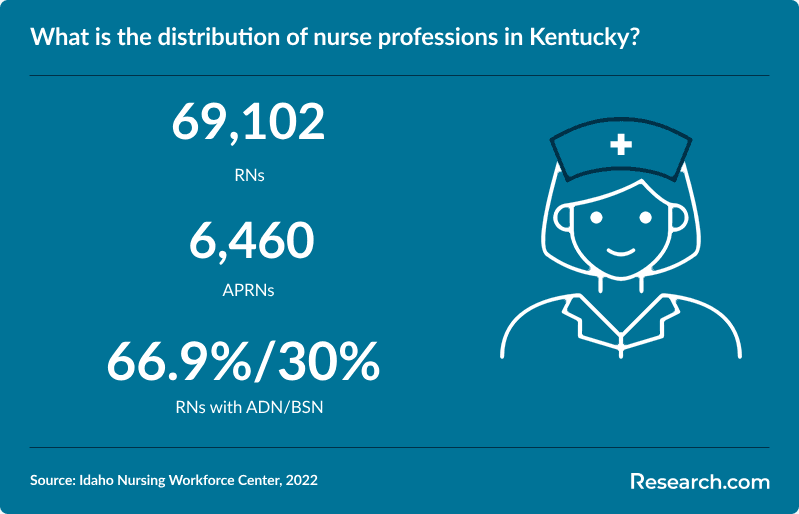
As of 2023, Kentucky’s nursing workforce included 69,102 registered nurses and 6,460 advanced practice registered nurses. Among APRNs, nurse practitioners made up 85.7%, nurse anesthetists 12.1%, clinical nurse specialists 1.2%, and nurse midwives 1.0%. Among Kentucky APRNs, 86.2% held a master’s degree and 11.1% held a doctorate of nursing. Among RNs, 66.9% held an associate’s degree and 30% held a bachelor’s degree.
Nursing is not the only healthcare pathway worth considering. If you want a non-clinical or administrative option alongside nursing, you may also benefit from understanding free online medical billing and coding.
Can a compact nurse work in Kentucky?
Yes. Kentucky is a member of the Nurse Licensure Compact (NLC), so eligible RNs and LPNs with a multistate license can practice in Kentucky without applying for a separate Kentucky single-state license. This is especially useful for nurses who relocate, travel, work near state borders, or provide care through qualifying telehealth arrangements.
- Multistate license: If your primary state of residence issued your compact license and you meet NLC requirements, you can practice in Kentucky and other compact states under that multistate privilege.
- Eligibility standards: Compact licensure generally requires graduation from an approved nursing program, passing the NCLEX, an active unencumbered license, and a qualifying criminal background history.
- Moving to Kentucky: If Kentucky becomes your primary state of residence, you need to apply for a multistate license within 60 days of the move.
- Background checks: Applicants for multistate licensure must complete federal and state fingerprint-based criminal background checks.
The compact can make employment more flexible, but it does not remove your responsibility to follow Kentucky nursing law while practicing in the state. If you are still planning your education and want a quicker RN route, compare accelerated RN degree options.
Can you work as a nurse in Kentucky without a license?
No. You cannot legally practice as a nurse in Kentucky without the appropriate active license or authorization. Nursing licensure is not a formality; it protects patients by confirming that the person providing care has met education, examination, background, and professional standards.
- RN and LPN practice requires licensure: You must complete the required education and pass the appropriate NCLEX exam before receiving authorization to practice.
- Titles matter: Representing yourself as a nurse without the proper license can create legal and professional consequences.
- Patient safety is the priority: Unlicensed practice can expose patients, employers, and the individual to serious risk.
- Workforce demand does not waive rules: Even during staffing shortages, employers must follow licensure laws.
The nursing workforce is also aging, with the median age of RNs at 52 and LPNs/LVNs at 53. That creates demand for new nurses, but it also reinforces the need for properly prepared and licensed professionals to replace retiring workers.
-
: "
One Kentucky nurse described receiving her license as the moment she felt accountable to patients, employers, and the profession. That perspective is useful for students: the license is not just a document. It is the public confirmation that you are qualified to accept nursing responsibility.
"
What is the current state of nursing in Kentucky?
Kentucky’s nursing environment is shaped by three forces: persistent staffing needs, a cost of living that can make nurse pay stretch farther than in higher-cost states, and growing demand for care across hospitals, long-term care, outpatient clinics, and home health services.
Employment Outlook for Nurses in Kentucky
Healthcare employers in Kentucky continue to need qualified nurses because of retirements, turnover, an aging population, chronic disease management, and the expansion of healthcare services. Nationally, the U.S. Bureau of Labor Statistics indicated that registered nurse employment was projected to grow by about 7% from 2019 to 2029, faster than the average for all occupations. Kentucky’s needs are particularly visible in hospitals, rural care settings, long-term care, and community-based services.
- Licensed workforce: Kentucky has a sizable workforce of RNs, LPNs, and APRNs, but distribution by region, specialty, and employer type can affect local hiring conditions.
- Nursing shortage pressure: Retirements, demanding schedules, burnout, and increasing patient care needs continue to create openings for new graduates and experienced nurses.
Cost of Living in Kentucky
Cost of living can affect the real value of a nursing salary. Kentucky is often attractive to nurses because housing and everyday expenses may be lower than in many higher-cost states, though costs vary by city and household.
- Housing considerations: Louisville, Lexington, smaller cities, and rural communities can offer different rent, commuting, and lifestyle trade-offs.
- Salary context: One commonly cited figure places the average salary for registered nurses in Kentucky around $60,000 per year. Other figures vary by data source, year, role, employer, and location.
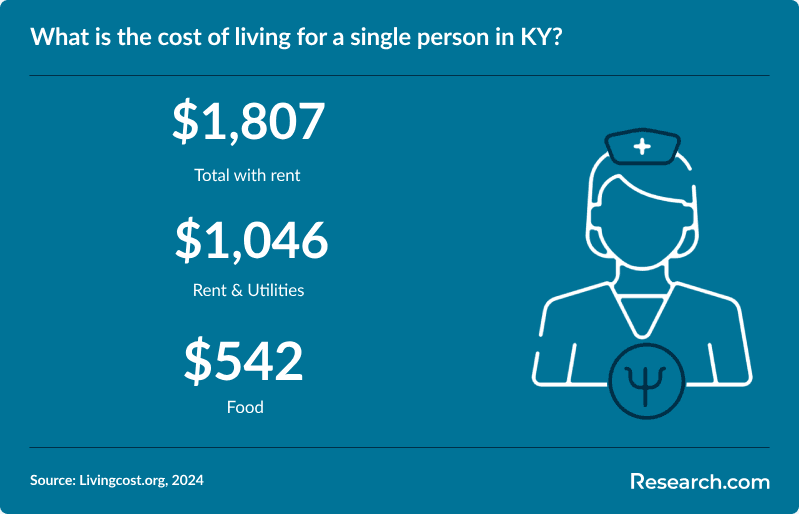
As shown in the graphic below, the cost of living in Kentucky is $1,807 for one person, which is 1.21 times less expensive than the national average. That total includes $761 without rent and $1,046 for rent and utilities. The average food cost is $542 per month. With an after-tax average salary of $4,110, residents in Kentucky can typically cover living expenses for approximately 2.3 months.
Top Industries Employing Nurses
- Hospitals and health systems: Large systems such as Norton Healthcare and Baptist Health employ nurses in acute care, emergency care, surgery, intensive care, specialty units, and outpatient departments.
- Long-term care: Nursing homes, rehabilitation centers, and assisted living settings need nurses who are comfortable with geriatric care, chronic conditions, medication management, and family communication.
- Home health services: More patients receive care at home, creating demand for nurses who can work independently, educate patients, document carefully, and coordinate with providers.
- Outpatient and community care: Clinics, public health agencies, behavioral health programs, schools, and specialty practices offer alternatives to hospital bedside work.
What are alternative career paths for nurses in Kentucky?
A nursing license can lead to more than bedside care. Kentucky nurses who want a different pace, schedule, or responsibility mix may move into education, case management, utilization review, infection prevention, informatics, quality improvement, leadership, public health, or research. Some nurses also transition into adjacent healthcare professions that use clinical knowledge in a different way.
| Alternative Path | Good Fit For | What to Consider |
| Clinical education | Nurses who enjoy teaching patients, students, or staff | May require experience, certification, or graduate education |
| Healthcare administration | Nurses interested in operations, staffing, compliance, or leadership | Business, management, and data skills become important |
| Quality and patient safety | Detail-oriented nurses who like systems improvement | Documentation, analytics, and policy knowledge are valuable |
| Public health | Nurses interested in prevention, outreach, and community programs | Roles may involve education, surveillance, and population health work |
| Pharmacy-related career transition | Nurses interested in medication science and a different licensed profession | Review the requirements for how to become a pharmacist in Kentucky before changing paths |
Can fast-track RN to BSN programs help Kentucky nurses advance?
Fast-track RN to BSN programs can be useful for licensed RNs who already have an ADN or diploma and want a bachelor’s degree without restarting their nursing education. These programs commonly focus on leadership, community health, evidence-based practice, population health, and professional nursing development.
This pathway makes the most sense if you are already an RN, want to qualify for BSN-preferred roles, plan to apply to graduate nursing school, or want stronger preparation for management and specialty positions. It may not be the best fit if you are not yet licensed as an RN or if your schedule cannot accommodate clinical, project, or practicum requirements. To compare accelerated options, review fast-track RN to BSN online programs.
What is the job outlook for nurses in Kentucky?
The job outlook for nursing in Kentucky is generally favorable, but it varies by license, specialty, region, and employer. According to the U.S. Bureau of Labor Statistics, employment for registered nurses in Kentucky is projected to grow by about 10% from 2020 to 2030. That growth is supported by healthcare demand, workforce retirements, and ongoing staffing needs.
Salary expectations should be interpreted carefully. The average salary for nurses in Kentucky is around $65,000 per year, while nurses in the Lexington-Fayette area may see averages reaching up to $70,000. Louisville can also offer competitive pay. LPNs generally earn less, with average salaries around $45,000, while nurse anesthetists and nurse practitioners can earn over $100,000 annually.
| Role or Setting | Pay or Outlook Detail Stated | Decision Takeaway |
| Registered nurses in Kentucky | Projected growth of about 10% from 2020 to 2030 | RN licensure can offer strong entry into the state healthcare workforce |
| Kentucky nurses overall | Average salary around $65,000 per year | Compare pay against cost of living, schedule, benefits, and overtime expectations |
| Lexington-Fayette nurses | Averages reaching up to $70,000 | Metro areas may provide higher pay but may also have different cost and competition factors |
| LPNs | Average salaries around $45,000 | LPN roles can offer faster entry but lower average pay than RN roles |
| Nurse anesthetists and nurse practitioners | Often earning over $100,000 annually | Advanced education can increase earning potential, but requires more time and investment |
Hospitals often offer strong pay and shift differentials, but outpatient care centers, nursing care facilities, schools, public health agencies, and home health organizations may offer schedules or work environments that better fit your life. The best role is not always the highest-paying one; it is the one that matches your skills, stamina, goals, and preferred patient population.
How can Kentucky nursing students pay for school?
Nursing school costs include more than tuition. Students should budget for fees, books, uniforms, supplies, background checks, health requirements, transportation to clinical sites, exam fees, and licensure costs. Financial assistance may include scholarships, grants, federal loans, work-study, employer tuition reimbursement, and healthcare organization support.
Before borrowing, ask each school for the full estimated cost of attendance and its refund, transfer credit, and progression policies. A lower tuition program may become expensive if it has weak completion support, limited clinical placements, or credits that do not transfer. Students seeking shorter and potentially more affordable routes into practical nursing can compare fast track LPN programs online.
| Funding Option | How It Helps | Question to Ask |
| Scholarships and grants | Reduce out-of-pocket cost and usually do not require repayment | Are awards renewable, and do they require enrollment or GPA minimums? |
| Federal student loans | Can cover tuition and qualified education expenses | What will monthly repayment look like after graduation? |
| Work-study or part-time employment | Provides income while enrolled | Can you realistically work while completing clinical requirements? |
| Employer tuition assistance | May help working CNAs, LPNs, or RNs advance | Is there a service commitment or repayment clause if you leave? |
| Loan forgiveness or repayment programs | May reduce debt for eligible nurses in qualifying roles | Which employers, locations, or specialties qualify? |
What non-clinical healthcare roles can Kentucky nurses consider?
Non-clinical roles can be a good fit for nurses who want to use healthcare knowledge without the physical demands or shift intensity of bedside care. These roles often value chart review, patient communication, terminology, compliance awareness, and an understanding of how care is delivered.
- Medical billing and coding: Uses clinical terminology and documentation knowledge to support reimbursement and records accuracy. Learn more about how to become a medical biller and coder in Kentucky.
- Case management: Helps coordinate services, discharge planning, insurance communication, and patient transitions.
- Utilization review: Reviews medical necessity, documentation, and payer requirements.
- Clinical research coordination: Supports studies, patient screening, informed consent processes, and protocol compliance.
- Healthcare quality and compliance: Focuses on safety, regulatory standards, audit readiness, and process improvement.
How does Kentucky support diversity and inclusion in nursing?
Diversity and inclusion in nursing matter because patients are more likely to trust and understand care when healthcare teams communicate respectfully, recognize cultural differences, and address barriers to access. Kentucky’s nursing employers, schools, and professional groups may support these goals through training, recruitment, mentorship, and community engagement.
- Cultural competency training: Helps nurses communicate more effectively with patients from different backgrounds and belief systems.
- Diversity recruitment efforts: Encourages broader representation in the nursing workforce.
- Support for minority nursing organizations: Provides advocacy, mentorship, and professional development for underrepresented nurses.
- Community partnerships: Connects nurses with local populations and helps improve outreach, prevention, and trust.
Students evaluating nursing schools should ask how programs prepare graduates to care for rural communities, urban populations, older adults, patients with limited access to care, and culturally diverse groups.
How can new nurses manage stress and burnout in Kentucky?
New nurses often face a steep transition from school to practice. High patient loads, rotating shifts, emotional cases, documentation demands, and fear of making mistakes can all contribute to stress. Burnout prevention should start early, not after exhaustion becomes severe.
- Choose your first job carefully: Ask about nurse-to-preceptor ratios, orientation length, mentorship, floating expectations, and how new graduates are supported.
- Use your preceptor and charge nurse: Safe practice depends on asking questions early, especially when patient conditions change.
- Track your stress signals: Sleep disruption, dread before shifts, irritability, and emotional numbness are signs to seek support.
- Build a peer network: New nurse residency programs, unit mentors, and professional groups can reduce isolation.
- Keep learning in manageable ways: Flexible programs such as the best online nursing programs in Kentucky can support continued education when timed realistically.
Do not assume that every difficult transition means nursing is the wrong career. Sometimes the issue is the unit, schedule, specialty, staffing model, or lack of support. If needed, speak with a supervisor, employee assistance program, mentor, or healthcare professional.
How can nurses keep up with Kentucky nursing regulations?
Kentucky nursing regulations can change, and nurses are responsible for knowing the rules that apply to their license and role. The safest strategy is to rely on official sources first, then use schools, employers, and professional associations for interpretation and training.
- Check Kentucky Board of Nursing updates regularly.
- Confirm renewal deadlines, continuing education rules, and jurisprudence requirements before they are due.
- Keep copies of continuing education documentation and competency records.
- Review employer policies, but remember that workplace policy does not replace state law.
- Use trusted summaries only after verifying current details through official sources.
For a focused overview, review the requirements for nursing licensure in Kentucky.
How should you choose a nursing school in Kentucky?
The right nursing school is not always the one with the most convenient schedule or lowest tuition. You need a program that prepares you for licensure, supports clinical learning, fits your budget, and gives you a realistic chance of completing the degree.
| Factor | Why It Matters | Question to Ask |
| Accreditation and approval | Licensure eligibility depends on appropriate program status | Is the program approved for Kentucky nursing licensure? |
| NCLEX preparation | Passing the NCLEX is required for RN or LPN licensure | How does the program support students who are at risk academically? |
| Clinical placements | Nursing skill development requires supervised practice | Who arranges clinical placements, and how far might I travel? |
| Cost | Total cost includes more than tuition | What are all fees, supplies, testing costs, and clinical expenses? |
| Schedule and format | Online coursework does not eliminate clinical obligations | Can I meet lab, simulation, and clinical requirements with my work schedule? |
| Student outcomes | Completion, licensure, and placement support affect ROI | What percentage of students complete the program and become licensed? |
Students comparing options can start with the best nursing schools in Kentucky, but rankings should be only one part of the decision. Always verify current program approval, cost, clinical expectations, and transfer credit rules directly with the school.
Common Mistakes to Avoid When Choosing a Kentucky Nursing Program
- Assuming online means fully remote: Nursing programs still require labs, simulations, clinicals, or in-person assessments.
- Looking only at tuition: Fees, supplies, background checks, travel, and exam costs can change the real price.
- Ignoring accreditation or approval: A program that does not meet licensure requirements can block your path to practice.
- Overlooking clinical placement responsibility: Some programs expect students to help secure sites, which can be difficult.
- Relying only on rankings: A highly ranked program may not fit your schedule, budget, learning needs, or location.
- Assuming salary outcomes are guaranteed: Pay depends on employer, role, shift, specialty, experience, and local demand.
How can you become a nurse midwife in Kentucky?
Nurse midwives are APRNs who specialize in reproductive health, pregnancy, childbirth, postpartum care, family planning, and newborn care. The path usually begins with RN licensure, followed by an accredited graduate nurse-midwifery program and national certification.
Because nurse-midwifery is an advanced practice role, candidates should confirm Kentucky authorization requirements, clinical hour expectations, certification rules, and prescriptive authority requirements before enrolling. For a detailed pathway, review how to become a nurse midwife in Kentucky.
What advanced education options are available to Kentucky nurses?
Advanced nursing education can help Kentucky nurses move into higher-responsibility clinical roles, teaching, leadership, policy, informatics, research, and specialized care. The right graduate degree depends on whether you want direct advanced practice, executive responsibility, academic work, or systems-level improvement.
- MSN programs: Often support nurse practitioner, nurse educator, clinical leadership, informatics, and administration goals.
- DNP programs: Focus on advanced clinical practice, leadership, evidence-based improvement, and healthcare systems.
- Post-master’s certificates: Can help nurses add a specialty without completing a second full graduate degree.
- Doctoral research pathways: May fit nurses interested in scholarship, teaching, or research-intensive roles.
One common route is becoming a nurse practitioner. NPs have a broader practice role than RNs and may diagnose, manage treatment, and prescribe medication within applicable Kentucky rules. To compare programs, review the best NP programs in Kentucky.
What options are available for aspiring LPNs in Kentucky?
LPN programs can be a practical choice for students who want to enter nursing faster than the traditional RN route. LPNs provide direct care in nursing homes, rehabilitation centers, outpatient clinics, home health, and some hospital settings. The typical path is to complete an approved practical nursing program, pass the NCLEX-PN, and apply for Kentucky LPN licensure.
This pathway may be a good fit if you want earlier workforce entry, plan to bridge to RN later, or prefer a role with structured supervision. It may not be ideal if your long-term goal requires RN licensure or graduate nursing education, unless you are willing to continue school. Flexible options are available through online LPN programs in Kentucky, but students should verify clinical requirements and Kentucky approval before enrolling.
What are the nurse practitioner education requirements in Kentucky?
Future nurse practitioners in Kentucky must first become licensed RNs, then complete an accredited graduate program such as an MSN or DNP with advanced clinical coursework and supervised practice. NP preparation typically includes diagnostics, pharmacology, pathophysiology, evidence-based management, population-specific care, and specialty clinical training.
After graduate education, candidates must pass a nationally recognized certification exam in their specialty area and meet Kentucky’s advanced practice requirements. For a role-specific explanation, review the nurse practitioner education requirements in Kentucky.
What professional development resources are available for Kentucky nurses?
Professional development helps nurses maintain licensure, improve patient care, qualify for advancement, and adapt to changing healthcare expectations. It can include continuing education, specialty certification, conferences, workshops, employer training, mentorship, residency programs, and advanced degrees.
- Continuing education: Supports annual renewal and keeps nurses current on clinical and legal topics.
- Specialty certification: Can demonstrate expertise in areas such as critical care, geriatrics, pediatrics, oncology, emergency nursing, or case management.
- Mentorship: Helps new and transitioning nurses develop judgment, confidence, and professional networks.
- Leadership training: Prepares nurses for charge nurse, manager, educator, and administrative roles.
- Career pathway planning: Nurses considering alternate credentials can review guides such as how to become an LVN in Kentucky for broader perspective on nursing-related roles.
How are AI, technology, and healthcare trends changing nursing in Kentucky?
Technology is changing how nurses document, communicate, monitor patients, and coordinate care. Electronic health records, remote patient monitoring, clinical decision support tools, telehealth, and AI-assisted administrative systems are increasingly part of healthcare workflows. These tools do not replace nursing judgment, but they do change the skills employers value.
- Documentation accuracy is more important: Digital records affect care continuity, billing, quality metrics, and legal accountability.
- Telehealth expands access: Nurses may support virtual visits, remote triage, patient education, and chronic disease monitoring.
- Data literacy is becoming useful: Nurses who understand dashboards, quality indicators, and patient outcomes data may be stronger candidates for leadership and quality roles.
- Human skills remain central: Communication, empathy, prioritization, patient advocacy, and ethical judgment are difficult to automate and remain core nursing strengths.
Students should look for programs that teach safe technology use, informatics basics, evidence-based practice, and patient-centered communication, not just task performance.
What do nurses say about becoming a nurse in Kentucky?
- What stood out to me was the support from other nurses. Kentucky healthcare teams can feel close-knit, and the lower cost of living made it easier for me to build a life outside work. Peggy
- Choosing nursing in Kentucky gave me room to grow. I started with broad clinical experience and later moved toward geriatrics, where I felt I could make the biggest difference. Harry
- The flexibility has been the biggest benefit. Nurses here can work in hospitals, clinics, travel roles, home health, or long-term care, so you can shape the career around the kind of work you want. Lance
Related Articles for Nearby States
- 2027 How to Become a Nurse in Indiana
- 2027 How to Become a Nurse in Ohio
- 2027 How to Become a Nurse in Tennessee
- 2027 How to Become a Nurse in West Virginia
- 2027 How to Become a Nurse in Virginia
- 2027 How to Become a Nurse in Illinois
- 2027 How to Become a Nurse in Missouri
- 2027 How to Become a Nurse in North Carolina
- 2027 How to Become a Nurse in Georgia
- 2027 How to Become a Nurse in Mississippi
References:
- Kentucky Board of Nursing. (2024). Kentucky Board of Nursing.
- Livingcost.org. (2024). Cost of living in Kentucky. Livingcost.org
- Nurse Journal. (2024). Nurse licensing requirements in Kentucky. Nurse Journal.
- Nursing License Map. (2024). Kentucky nursing license requirements. Nursing License Map.
- Patterson, J. (2021). Nursing workforce report: Kentucky. Journal of Nursing Regulation 12(4), 23-30.
- University of Kentucky. (2023). Kentucky nursing workforce report. University of Kentucky.
Key Insights
- To become a nurse in Kentucky, match your target role to the correct education path: practical nursing for LPNs, ADN or BSN for RNs, and graduate nursing education for APRNs.
- Licensure requires more than graduation. Plan for the NCLEX, Kentucky Board of Nursing application, fees, fingerprinting, background checks, and renewal requirements.
- Kentucky’s Nurse Licensure Compact participation can benefit eligible RNs and LPNs who want multistate flexibility, but compact nurses must still follow Kentucky practice rules while working in the state.
- Do not choose a nursing school based only on speed or tuition. Verify accreditation, Kentucky approval, clinical placements, NCLEX support, total cost, and student outcomes before enrolling.
- Nursing demand in Kentucky is strong, but salary varies by role, region, employer, specialty, and schedule. Compare pay with cost of living, burnout risk, benefits, and advancement potential.
- Advanced education can open doors to nurse practitioner, nurse-midwife, leadership, education, and specialized practice roles, but it should be weighed against time, cost, certification, and licensing requirements.
- The safest next step is to identify your desired license, shortlist approved programs, confirm total costs and clinical requirements, and review current Kentucky Board of Nursing rules before applying.
Other Things You Should Know About Becoming a Nurse in Kentucky
In 2027, the nursing licensure process in Kentucky involves completing an accredited nursing program, passing the NCLEX-RN exam, and submitting an application to the Kentucky Board of Nursing. The process typically takes several weeks to months, depending on application processing and exam scheduling.
To become a registered nurse in Kentucky in 2027, follow these steps: earn an accredited nursing degree (ADN or BSN), pass the NCLEX-RN exam, apply for a Kentucky RN license, and complete a criminal background check. Continuing education and renewal of the license are required every year.


