2027 Cheapest Way to Get a Teaching Credential in Delaware: Requirements & Certification

Co-Founder and Chief Data Scientist
Becoming a teacher in Delaware can be affordable, but the cheapest route depends on your starting point: whether you already have a bachelor’s degree, hold an out-of-state or international credential, need an online program, or are entering education for the first time. The main cost drivers are tuition, Praxis exams, application fees, background checks, field experience, and any coursework needed to meet Delaware Department of Education requirements.
This guide explains the lower-cost ways to earn a Delaware teaching credential, how alternative certification compares with traditional education degrees, what online programs can and cannot solve, and which expenses candidates often overlook. It is designed for career changers, recent graduates, substitute teachers, out-of-state educators, international teachers, and education majors who want a practical path to licensure without unnecessary debt.
Quick Answer: What Is the Cheapest Way to Get a Teaching Credential in Delaware?
The lowest-cost path is usually to start with an accredited bachelor’s degree you already have, enroll in a Delaware-approved teacher preparation or alternative certification pathway, pass the required Praxis exams, and complete any required field experience while minimizing tuition, commuting, and exam-preparation costs. Candidates who can teach while completing requirements may also reduce lost income compared with returning to school full time.
- You generally need a bachelor’s degree from an accredited institution before becoming licensed as a teacher in Delaware.
- A state-approved teacher preparation program is still required, but online and alternative routes may reduce costs for eligible candidates.
- Praxis exams are required for certification, and fees can add up if retakes or paid preparation courses are needed.
- Alternative pathways may allow some candidates to work while completing coursework, which can make the total cost more manageable.
- Financial support such as the Delaware Teacher Corps program may help candidates who maintain a GPA of 2.75 or higher.
- Budget for fingerprinting, background checks, and application fees in addition to tuition.
- Long-term substitute teaching may help some candidates gain classroom experience while earning income, depending on program and state requirements.
- Cost to become a teacher in Delaware
- Teaching license options for foreign educators
- Online teaching credential options in Delaware
- Using an out-of-state teaching credential in Delaware
- Teaching years and Delaware retirement rules
- What to do if a Delaware teaching credential expires
- Credit requirements for a Delaware teaching credential
- Teacher salaries in Delaware
- Teacher job outlook in Delaware
- Preschool education specialization in Delaware
- Complementary online credentials for teachers
- Teacher career path in Delaware
- Other education careers in Delaware
- Private versus public teaching credentials
- Affordable transition to middle school math teaching
- How subject specialization affects a teaching career
- Transitioning from teaching to educational consulting
- Professional networks and mentoring for Delaware teachers
- Affordable route to kindergarten teaching
- Affordable route to high school history teaching
- How to check quality and accreditation in online credential programs
- Delaware teacher credentialing options
How much does it cost to become a teacher in Delaware?
The cost of becoming a Delaware teacher depends most on how much education you still need. If you already have an accredited bachelor’s degree, your cheapest route is usually not another full bachelor’s program. Instead, compare approved alternative certification or post-baccalaureate teacher preparation options. If you do not yet have a bachelor’s degree, tuition becomes the largest expense.
For in-state students at public universities, tuition averages around $10,000 per year. Community colleges can be cheaper, often costing less than $5,000 annually, especially for students who complete transferable coursework before moving into a bachelor’s program.
| Cost category | Typical amount stated | How to keep the cost lower |
| Bachelor’s degree coursework | Public university tuition averages around $10,000 per year for in-state students; community colleges often cost less than $5,000 annually | Use transfer credits, compare public options first, and avoid repeating credits that do not apply to licensure |
| Praxis exams | $90 to $150 per test; some exam costs may range from $90 to $209 | Confirm the exact tests required before registering and use free or low-cost study materials before paying for prep courses |
| Initial application fee | $100 | Submit a complete application the first time to avoid delays or additional costs |
| Background checks and fingerprinting | Typically between $50 and $100 | Budget for these early because they are required for licensure |
| Professional development for license maintenance | 90 hours are required to maintain a teaching license | Use district-sponsored, community college, or affordable online professional development where accepted |
Cost should also be weighed against expected earnings and living expenses. Delaware has a higher-than-average cost of living, and as of 2024, the average salary for teachers in Delaware stands at approximately $65,567. That salary figure is useful for planning, but it should not be treated as a guaranteed outcome because district, role, experience, and education level can all affect pay.
For candidates who want to move into leadership later, additional preparation such as leadership development for managers may become relevant after gaining classroom experience. However, do not pay for extra credentials until you know whether they connect to your district’s salary scale or promotion requirements.
Cheapest-path checklist
- Confirm that your bachelor’s degree is from an accredited institution.
- Use Delaware-approved preparation pathways only.
- Ask whether prior coursework can satisfy program requirements.
- Compare online, public university, and alternative certification options by total cost, not tuition alone.
- Budget for Praxis exams, background checks, fingerprinting, and the $100 license application fee.
- Look for scholarships, district support, or programs such as Delaware Teacher Corps if eligible.
Can a foreigner get a Delaware teaching license?
Yes. Foreign-trained educators may be able to earn a Delaware teaching license, but they should expect a documentation-heavy process. The most affordable strategy is to avoid paying for unnecessary coursework before Delaware has reviewed your credentials and identified any gaps.
Foreign applicants generally need a valid teaching credential from their home country or another jurisdiction that Delaware can evaluate. Delaware uses a reciprocity-style review process, but international credentials must be documented carefully and evaluated against state standards.
- Credential evaluation: International academic records must be reviewed by an approved evaluation agency. Compare approved services and fees before ordering an evaluation.
- DEEDS application: Applicants submit materials through the Delaware Educator Data System. Accurate document submission is important because incomplete files can slow the process.
- Official documents: Transcripts, proof of student teaching, and teaching experience verification should be sent in the format Delaware requires, often directly from issuing institutions.
- Initial License and Emergency Certificate: If a Delaware district wants to hire a candidate who has not completed all requirements, the district may request a Secretary of Education Review. This can lead to an Initial License and Emergency Certificate while remaining requirements are completed.
- Additional coursework: If extra classes are required, compare local public institutions, community college options, and online coursework before enrolling. Candidates strengthening subject knowledge may also explore areas such as history degree options when relevant to their teaching goals.
Questions foreign educators should ask before paying for a program
- Will Delaware accept my credential evaluation agency?
- Do I need additional student teaching evidence or experience verification?
- Which Praxis exams apply to my intended subject and grade level?
- Can a Delaware employer support an emergency or provisional pathway?
- Will any required coursework be available online or at a lower-cost public institution?
Can I get my teaching credential online in Delaware?
Yes, online coursework may be part of a Delaware teaching credential pathway, but an online program must still meet Delaware’s requirements. The key issue is not whether a program is online; it is whether the program is approved, accredited, aligned with Delaware licensure rules, and able to place you in required field experiences.
| Online credential factor | Why it matters | What to verify before enrolling |
| State approval | A low-cost online program is not useful if Delaware will not recognize it | Confirm that the program meets Delaware Department of Education requirements |
| Accreditation | Accreditation affects transferability, financial aid eligibility, and employer confidence | Ask for the institution’s accreditation status and how it applies to teacher preparation |
| Praxis preparation | Praxis exams are required and may cost from $90 to $209 | Find out whether test preparation is included or whether you must pay separately |
| Student teaching or internship placement | Online programs still require supervised classroom experience | Ask who arranges placements and whether local Delaware schools are available |
| Total cost | Tuition is only one part of the price | Compare fees, books, technology charges, travel, exams, and background checks |
Online study can work well for career changers, working adults, and candidates balancing family obligations. However, it is risky to choose an online program based only on convenience. Before enrolling, compare it with Delaware-focused options and broader education pathways such as an online master's in teaching only if graduate study fits your career and salary goals.
Best candidates for an online Delaware teaching credential pathway
- Adults who already hold a bachelor’s degree and need certification coursework.
- Substitute teachers or paraprofessionals who need flexible scheduling.
- Career changers who cannot pause full-time employment.
- Students who can complete field placements locally while taking coursework online.
Who should be cautious about online-only options?
- Candidates who need intensive in-person coaching before student teaching.
- Students who are unsure whether the program is Delaware-approved.
- Applicants pursuing licensure areas with hard-to-place field experience requirements.
- Anyone choosing a program before confirming Praxis and certification alignment.
Can I teach in Delaware with an out of state credential?
Yes. Delaware allows educators with valid out-of-state teaching credentials to apply for comparable credentials through the Delaware Department of Education. This can be one of the cheapest routes because it may prevent you from repeating a full teacher preparation program. Still, reciprocity is not automatic, and some credentials are not accepted.
- Apply through DEEDS: The application is completed in the Delaware Educator Data System.
- Pay the application fee: The one-time, non-refundable fee is $100. If the out-of-state license covers multiple subject areas, separate applications may be required for each area, although the fee remains unchanged.
- Provide official transcripts: These should come from regionally accredited institutions.
- Submit your current credential: A copy of your existing license is needed. If the license has expired but remains valid, a verification letter from the issuing state’s Department of Education is required.
- Prepare for possible testing: Most applicants must meet Praxis II subject-specific testing requirements.
Delaware does not accept certain credential types, including intern certificates or private school licenses. This is important for applicants who have taught outside public licensure systems. If your credential does not transfer cleanly, you may need additional coursework, testing, or a Delaware-approved program.
Educators planning a new grade-level focus may compare pathways such as an online bachelor's in early childhood education if they need broader preparation. Before paying for another degree, ask Delaware or your intended employer whether a shorter certification route would satisfy the requirement.
Out-of-state credential decision table
| Your situation | Likely next step | Cost concern |
| You hold a current public school teaching license from another state | Apply through DEEDS and submit transcripts and license documentation | Praxis II testing and application fees may still apply |
| Your out-of-state license covers several subjects | Submit separate applications for each area if required | The fee remains unchanged, but documentation time increases |
| You taught under a private school license | Check whether Delaware recognizes your credential type | You may need a Delaware-approved certification route |
| You held an intern certificate | Expect that Delaware may not accept it as a comparable credential | Additional preparation may be required |
How many years do you have to teach in Delaware to retire?
Retirement rules matter when evaluating the return on the cost of becoming a teacher. In Delaware, teachers can retire with a reduced pension at age 55 after 15 years of service, or at any age with 25 years of service. Reductions apply if they do not reach 30 years.
For career changers, this timeline is especially important. A lower-cost credential may help you enter the profession sooner, but entering later in life may affect how many years you can accumulate toward retirement. The cheapest route is not always the best route if it delays licensure or limits employability.
- Alternative certification: Candidates with a bachelor’s degree in a non-education field may be able to begin teaching while completing coursework, reducing both tuition burden and lost income.
- Out-of-state reciprocity: Licensed educators moving to Delaware may avoid repeating a full preparation program if their credentials meet state standards.
- Online coursework: Flexible programs may allow candidates to continue working while completing certification requirements.
- Retirement planning: Service years can affect long-term benefits, so the timing of credential completion matters.
The number of individuals pursuing teacher preparation programs can also help illustrate the broader educator pipeline. The National Council on Teacher Quality table shows that enrollment in 2022 reached 591,353.
What happens if my Delaware teaching credential expires?
An expired Delaware teaching credential can interrupt your ability to teach, but the next step depends on how long the credential has been expired. Acting early is usually cheaper and easier than waiting until renewal is no longer available.
| Credential status | Delaware requirement stated | Why timing matters |
| Expired within the last five years | Renewal may be possible with 90 clock hours of relevant professional development | Renewal can be less disruptive than applying again from the beginning |
| Professional development requirement | At least 45 of the 90 hours should involve direct engagement with students or staff | Not all professional development may count, so document hours carefully |
| Away from the profession for less than four years | An approved mentoring program must be completed within the first year of re-employment | Missing the mentoring requirement can lead to license suspension |
| Credential expired for over three years | A year-long mentoring program is required, similar to the requirement for an Initial License | Plan for time and possible costs before returning to the classroom |
| Credential expired for more than five years | Renewal is not available; the educator must apply for an Initial License and meet current standards | This can be more expensive because requirements may have changed |
The practical lesson is simple: track your renewal date, save professional development documentation, and confirm that your professional development activities count before you pay for them. Letting a license lapse for too long can turn a manageable renewal into a full re-entry process.
How many units is a Delaware teaching credential?
Delaware does not treat a teaching credential as a simple number of “units” in the way some states or institutions might. The foundation is a bachelor’s degree, which typically includes 120 to 130 credit hours, or about 40 to 43 units depending on the institution’s structure.
An associate degree alone is not enough for Delaware teacher licensure. It can still be a smart cost-saving first step if credits transfer into an accredited bachelor’s program, but candidates should verify transferability before enrolling.
- A bachelor’s degree is required and usually includes 120 to 130 credit hours.
- That requirement is roughly equivalent to 40 to 43 units, depending on the institution.
- An associate degree may reduce cost but does not meet licensure requirements by itself.
- Accreditation matters because Delaware must be able to recognize the institution and coursework.
- Praxis exam costs should be included in the credential budget.
How to avoid paying for credits that do not help you get licensed
- Ask whether each course applies to your intended certification area.
- Confirm whether transfer credits will be accepted before starting at a community college.
- Keep syllabi and transcripts in case a program or state agency needs documentation.
- Do not assume that education-related courses automatically satisfy Delaware licensure rules.
How much do teachers in Delaware make?
Teacher pay in Delaware varies by district, grade level, experience, education, and contract terms. One salary estimate places the average teacher salary in the state at around $72,568 annually. Entry-level educators typically earn about $40,715, while the top 10% of earners can make as much as $84,481.
| Salary point | Amount stated | How to interpret it |
| Entry-level teacher pay | About $40,715 | Useful for budgeting during the first years of teaching |
| Average teacher salary estimate | Around $72,568 annually | May reflect a mix of experience levels, districts, and education levels |
| Top 10% of earners | As much as $84,481 | Usually not a realistic starting salary expectation |
| Another average salary reference | Approximately $65,567 as of 2024 | Shows why candidates should compare multiple salary sources and district schedules |
Advanced degrees, years of service, and district salary schedules can affect earnings. Some districts reward master’s or doctoral education with higher pay, but a graduate degree is not automatically the cheapest or best first move. Before paying for additional education, review district salary schedules and ask whether the credential will increase compensation.
Specializations may also matter. Areas such as special education or STEM can improve employability in some markets, but candidates should confirm actual local demand rather than assuming every specialization leads to higher pay.
What is the job outlook of teachers in Delaware?
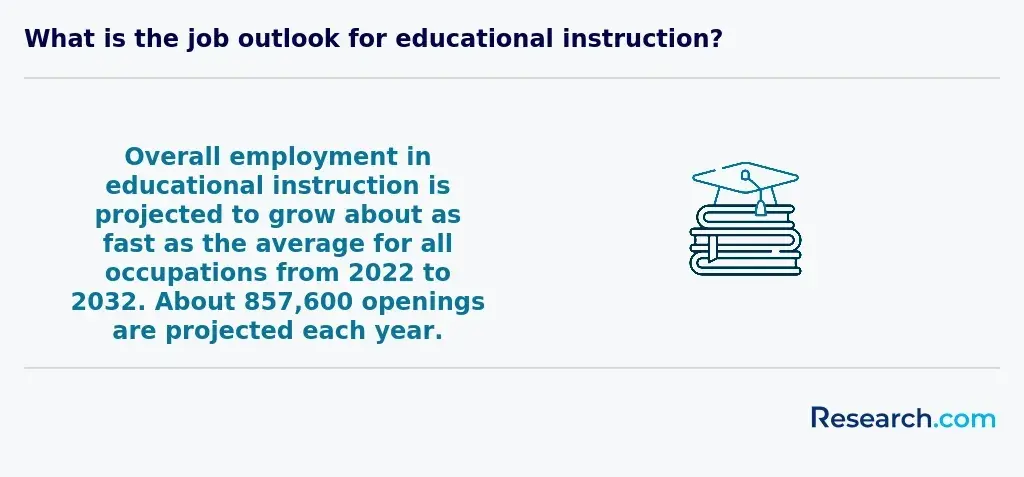
The Delaware teacher job market should be viewed realistically. As of 2020, Delaware employed around 230 postsecondary education teachers, and projections indicate that this number will remain stable through 2030. That represents a projected growth rate of 0% over the decade.
Even when total employment is stable, jobs still open. Delaware is expected to have approximately 20 openings each year for teachers during the 2020-2030 period, mostly because of retirements, turnover, or workers leaving the profession rather than new job creation.
Nationally, the outlook is somewhat stronger for postsecondary teachers. Employment is expected to rise from 74,300 in 2022 to 77,100 by 2032, a 4% growth rate. Delaware candidates should therefore prepare for a more competitive local market and avoid assuming that earning a credential alone guarantees employment.
How to improve your odds in a stable job market
- Build relationships with schools through substitute teaching, internships, or student teaching.
- Target shortage or high-need subject areas only after confirming local demand.
- Use mentoring and professional development to strengthen classroom readiness.
- Prepare a strong Praxis record and complete application documentation early.
- Be open to districts or grade levels beyond your first preference.
What are the pathways and advantages of specializing in preschool education in Delaware?
Preschool teaching can be a strong fit for candidates who want to work with young children and focus on early development, early literacy, social-emotional growth, and age-appropriate classroom routines. In Delaware, this path may involve targeted early childhood preparation rather than a broad K-12 focus.
From a cost perspective, preschool specialization can make sense when it aligns with your intended role and certification requirements. It is not automatically cheaper, so compare program requirements, field placement expectations, and whether your existing credits apply. For a focused guide, review how to become a preschool teacher in Delaware.
Can Complementary Online Credentials Enhance My Teaching Career in Delaware?
Additional online credentials can strengthen a teaching career when they solve a specific professional problem: qualifying for a specialized role, improving instructional practice, supporting curriculum work, or preparing for leadership. They can also become expensive distractions if they do not connect to licensure, salary advancement, or a clear career goal.
For example, a library science degree online may be useful for educators who want stronger skills in information literacy, research support, digital resources, or school library-related roles. Before enrolling, ask whether the credential is recognized by employers and whether it changes your career options enough to justify the cost.
What is the career path of a teacher in Delaware?
A typical Delaware teaching career begins with licensure, classroom teaching, and supervised experience. Over time, teachers may move into grade-level leadership, department chair roles, instructional coaching, curriculum development, school administration, or education consulting. The best credential route is the one that gets you licensed affordably while preserving room for future advancement.
| Career stage | Common focus | Cost-smart move |
| Pre-licensure | Complete degree, preparation program, Praxis exams, background checks, and application | Choose the shortest approved route that fits your background |
| Entry-level teacher | Build classroom management, lesson planning, assessment, and communication skills | Use district-provided mentoring and professional development where available |
| Experienced teacher | Specialize by subject, grade level, student population, or instructional approach | Pay only for credentials that meet state, district, or salary requirements |
| Teacher leader | Mentor peers, lead teams, support curriculum, or coach instruction | Document leadership experience before investing in advanced degrees |
| Administrator or consultant | Move into school leadership, policy, training, or advisory work | Compare required credentials with expected salary and career outcomes |
Affordable entry routes include alternative certification programs for eligible bachelor’s degree holders, community college coursework that transfers into a bachelor’s program, and online programs that meet Delaware requirements. The mistake to avoid is choosing the least expensive program without confirming that it leads to the specific credential you need.
What other careers in education are available in Delaware?
Teaching is not the only way to work in education. Delaware students and schools also rely on specialists, support professionals, administrators, counselors, instructional designers, and clinical providers. One example is speech-language pathology, which requires a different preparation and licensing process. Candidates interested in communication and swallowing disorders can review the path to an SLP license in Delaware.
Exploring related careers can be especially useful if you enjoy working with students but are unsure whether classroom teaching is the right long-term fit. Compare licensure requirements, graduate education needs, salary expectations, and daily responsibilities before committing to a pathway.
What are the differences between private and public teaching credentials in Delaware?
The biggest difference is that Delaware public school teachers generally need state licensure, while private schools may set their own hiring standards. Some private schools value subject expertise, prior teaching experience, religious or mission alignment, or professional background more heavily than state certification. However, requirements vary by school.
| Factor | Public school teaching | Private school teaching |
| Credential requirement | State-issued teaching license is generally required | Requirements depend on the individual school |
| Hiring criteria | Licensure area, Praxis, degree, approved preparation, background checks | Subject expertise, experience, degree background, and school-specific standards |
| Portability | State credential can support movement across public districts | Experience may not transfer into public licensure automatically |
| Cost consideration | Licensure costs are clearer but can require formal preparation | May be cheaper to enter, but future mobility can be limited without state certification |
Private school teaching can be a practical route for professionals who have strong subject knowledge but do not yet hold a public teaching license. Still, anyone considering this path should review private school teacher requirements in Delaware and ask each school what credentials it expects.
How Can I Transition to a Middle School Math Teaching Role Affordably?
A move into middle school math teaching is most affordable when you already have strong mathematics coursework or teaching experience that can be applied toward certification. Before enrolling in a new program, compare your transcripts against Delaware’s requirements for the subject and grade level.
Review the middle school math teacher requirements in Delaware before paying for coursework. Then ask whether you need a full program, a subject endorsement, Praxis preparation, supervised teaching experience, or targeted professional development. The cheapest path is usually the one that fills only the documented gaps.
Common mistakes that make Delaware teacher certification more expensive
- Choosing a program before checking Delaware approval: A cheap program becomes expensive if it does not qualify you for licensure.
- Looking only at tuition: Exams, books, technology fees, background checks, transportation, and lost wages also affect total cost.
- Assuming online means approved: Online programs still need proper accreditation, state alignment, and field placement support.
- Ignoring Praxis requirements until the end: Failing or retaking exams can delay hiring and increase costs.
- Overbuying credentials: Extra certificates, graduate credits, or degrees should connect to licensure, pay, or career advancement.
- Letting a credential expire: Renewal can become much harder if the license has been expired for more than five years.
- Relying only on rankings or advertisements: Always confirm state approval, accreditation, placement support, and total cost.
How Can Subject Specialization Influence My Teaching Career in Delaware?
Subject specialization can help a teacher stand out, especially in competitive hiring environments. It can also shape future advancement into department leadership, curriculum work, instructional coaching, or specialized classroom roles. The decision should be based on your strengths, Delaware certification requirements, and actual school hiring needs.
History is one example of a focused pathway. Candidates interested in social studies or secondary history instruction can review how to become a history teacher in Delaware to understand the training and credential steps before investing in additional coursework.
How Can I Transition to an Educational Consultant Role from Teaching Credentials?
Educational consulting is usually not an entry-level substitute for classroom teaching. It is more realistic for educators who have built expertise in curriculum, assessment, teacher training, school improvement, instructional technology, or a specialized content area.
If your long-term goal is consulting, use your Delaware teaching credential to build classroom credibility first. Document results, lead professional development, mentor peers, and learn how schools make curriculum and policy decisions. For a broader overview, see how to become an educational consultant.
How Can Professional Networks and Mentoring Enhance My Teaching Career in Delaware?
Professional networks and mentoring can reduce both career risk and credentialing mistakes. Mentors can help you choose approved programs, prepare for Praxis exams, find student teaching placements, understand district hiring cycles, and avoid paying for unnecessary credentials.
Networking is also useful for teachers considering specialized areas. For example, educators interested in arts instruction can compare their background with music teacher education requirements in Delaware and then speak with current music teachers about hiring realities, performance expectations, and certification steps.
How Can I Transition to Kindergarten Teaching with an Affordable Credential?
Kindergarten teaching requires preparation for early literacy, child development, classroom routines, family communication, and developmentally appropriate instruction. The affordable route depends on whether your current credential or coursework already overlaps with early childhood or elementary education requirements.
Before enrolling in a broad degree program, compare your existing credits with the requirements described in how to become a kindergarten teacher in Delaware. If only a few requirements are missing, targeted coursework or an approved certification pathway may be cheaper than starting over.
How Can I Transition to a High School History Teaching Role Affordably?
High school history teaching generally requires both teaching preparation and strong subject-area knowledge. Candidates with a history major or substantial history coursework may be able to reduce costs by using existing credits, but they still need to satisfy Delaware certification and testing requirements.
Start by confirming whether your transcripts support the content area, then identify any missing pedagogy, field experience, or exam requirements. For role-specific guidance, review how to become a high school history teacher in Delaware.
How Can I Ensure Quality and Accreditation When Selecting an Online Teacher Credential Program in Delaware?
Quality and accreditation should be checked before cost. A low-tuition program is not affordable if it delays licensure, lacks field placement support, or fails to meet Delaware standards.
Program questions to ask before enrolling
- Is the institution accredited?
- Is the teacher preparation pathway recognized for Delaware licensure?
- Which Delaware certification areas does the program support?
- Who arranges student teaching or internship placements?
- What Praxis exams will I need, and does the program prepare students for them?
- What is the total cost, including fees, books, technology, exams, and background checks?
- Can I use transfer credits or prior coursework?
- What happens if I move states before finishing?
For a Delaware-focused explanation of online preparation, consult how to become a teacher in Delaware.
What Are the Different Teacher Credentialing Options in Delaware?
Delaware candidates generally choose among traditional teacher preparation, alternative certification, out-of-state reciprocity, international credential review, and specialized credential pathways. The best option depends on your education level, current license status, target subject, career timeline, and budget.
| Credentialing option | Best for | Main advantage | Main caution |
| Traditional teacher preparation | Students who do not yet have a bachelor’s degree or want a full education major | Structured preparation with coursework and field experience | Can be more expensive and time-consuming |
| Alternative certification | Career changers with a bachelor’s degree | May allow teaching while completing requirements | Eligibility and requirements vary by area |
| Online credential pathway | Working adults and students needing schedule flexibility | Can reduce commuting and scheduling barriers | Must be Delaware-approved and include field experience |
| Out-of-state reciprocity | Licensed teachers moving to Delaware | May avoid repeating a full program | Some credential types are not accepted |
| International credential review | Foreign-trained educators | Can recognize prior teaching preparation | Documentation and evaluation requirements can be complex |
| Private school route | Professionals with subject expertise or school-specific qualifications | May not require the same state credential at every school | May not transfer easily into public school licensure |
For a detailed overview of credential types and requirements, review Delaware teacher certification requirements.
Practical Steps to Choose the Most Affordable Delaware Teaching Credential Path
- Identify your starting point: Do you already have a bachelor’s degree, a teaching license, international credentials, or only some college credits?
- Choose your target role: Grade level and subject determine which certification rules, Praxis exams, and field experiences apply.
- Confirm Delaware approval: Do not enroll until you know the program supports Delaware licensure.
- Compare total cost: Include tuition, fees, exams, background checks, books, technology, travel, and lost income.
- Ask about transfer credits: Prior coursework can reduce both time and cost if accepted.
- Plan for Praxis early: Register only for required exams and prepare before paying for retakes.
- Secure field experience: Ask whether the program places you or whether you must find a school site yourself.
- Check financial aid: Look into scholarships, employer support, district incentives, and Delaware Teacher Corps eligibility.
- Evaluate salary and retirement timing: Compare program length with expected entry date, pay, and service years.
- Keep documentation: Save transcripts, test scores, professional development records, and credential correspondence.
Key Insights
- The cheapest route to a Delaware teaching credential is usually not the same for every candidate; it depends on whether you already have a bachelor’s degree, teaching experience, or an existing credential.
- Alternative certification can be cost-effective for career changers because it may reduce time away from paid work.
- Online programs can lower commuting and scheduling costs, but only Delaware-approved, accredited pathways with valid field placements are worth considering.
- Budget beyond tuition. Praxis exams, the $100 application fee, fingerprinting, background checks, and professional development can all affect total cost.
- Out-of-state teachers may save money through reciprocity, but Delaware does not accept every credential type.
- A bachelor’s degree is the baseline requirement, typically involving 120 to 130 credit hours, or roughly 40 to 43 units depending on the institution.
- Teacher salary estimates in Delaware vary, with figures including approximately $65,567 as of 2024 and around $72,568 annually in another estimate; always review district salary schedules before calculating ROI.
- Letting a credential expire can become expensive. Renewal may be possible within the last five years, but after more than five years, educators must apply for an Initial License under current standards.
- Do not pay for extra degrees or certificates unless they clearly support licensure, salary advancement, specialization, or a defined career move.
Related Articles for Nearby States
- 2027 Cheapest Way to Get a Teaching Credential in Maryland: Requirements & Certification
- 2027 Cheapest Way to Get a Teaching Credential in New Jersey: Requirements & Certification
- 2027 Cheapest Way to Get a Teaching Credential in Pennsylvania: Requirements & Certification
- 2027 Cheapest Way to Get a Teaching Credential in Virginia: Requirements & Certification
- 2027 Cheapest Way to Get a Teaching Credential in West Virginia: Requirements & Certification
- 2027 Cheapest Way to Get a Teaching Credential in New York: Requirements & Certification
- 2027 Cheapest Way to Get a Teaching Credential in Connecticut: Requirements & Certification
- 2027 Cheapest Way to Get a Teaching Credential in Rhode Island: Requirements & Certification
- 2027 Cheapest Way to Get a Teaching Credential in North Carolina: Requirements & Certification
- 2027 Cheapest Way to Get a Teaching Credential in Ohio: Requirements & Certification
References:
- Education.delaware.gov (2022). Teacher K-12 Certification. https://education.delaware.gov/legacy/home/educators/licensure-and-certification/educators-certification/new-de-educators/teacher-k-12/
- National Center for Education Statistics. (2023). Characteristics of Traditional Public, Public Charter, and Private School Teachers. Retrieved from: https://nces.ed.gov/programs/coe/indicator/sld/public-private-school-teachers
- Onetonline.org (2024). Delaware Employment Trends 25-1081.00 - Education Teachers, Postsecondary. https://www.onetonline.org/link/localtrends/25-1081.00?st=DE
- Salary.com (2024). Public School Teacher Salary in Delaware. salary.com https://www.salary.com/research/salary/benchmark/public-school-teacher-salary/de
Other Things You Should Know About Getting a Teaching Credential in Delaware
In 2027, the cheapest option to gain a teaching credential in Delaware is through the Alternative Routes to Certification (ARTC) program. This program allows candidates to work while completing certification courses, thus minimizing costs. Additionally, it's often subsidized by school districts, reducing expenses further.
No, a master's degree is not required to obtain a teaching credential in Delaware. Aspiring teachers need a bachelor's degree and must complete a teacher preparation program. Obtaining a master's degree can enhance skills and opportunities, but it is not mandatory for initial certification.