2027 SLP Master's Programs With Cleft and Craniofacial Clinical Opportunities: What to Compare

Co-Founder and Chief Data Scientist

Reviewed by Rhea Paul, PhD
SLP Education & Research Expert
An SLP master's program can prepare you for general practice without giving you meaningful experience in cleft palate speech, resonance disorders, or craniofacial teams. That distinction matters if you hope to work in a hospital-based cleft clinic or specialize after graduation. This guide helps prospective students compare the quality - not merely the existence - of cleft and craniofacial opportunities, including clinical volume, interdisciplinary exposure, supervision, accreditation, and evidence of graduate preparation.
Key Things You Should Know
- There is no national count of CAA-accredited SLP master's programs with dedicated cleft and craniofacial rotations; applicants must verify each program's current clinic partners, placement availability, and whether participation is guaranteed or competitive.
- A meaningful specialty experience includes supervised assessment and treatment of resonance, articulation, velopharyngeal dysfunction, and postoperative cases - not simply a lecture or one-time observation at a cleft clinic.
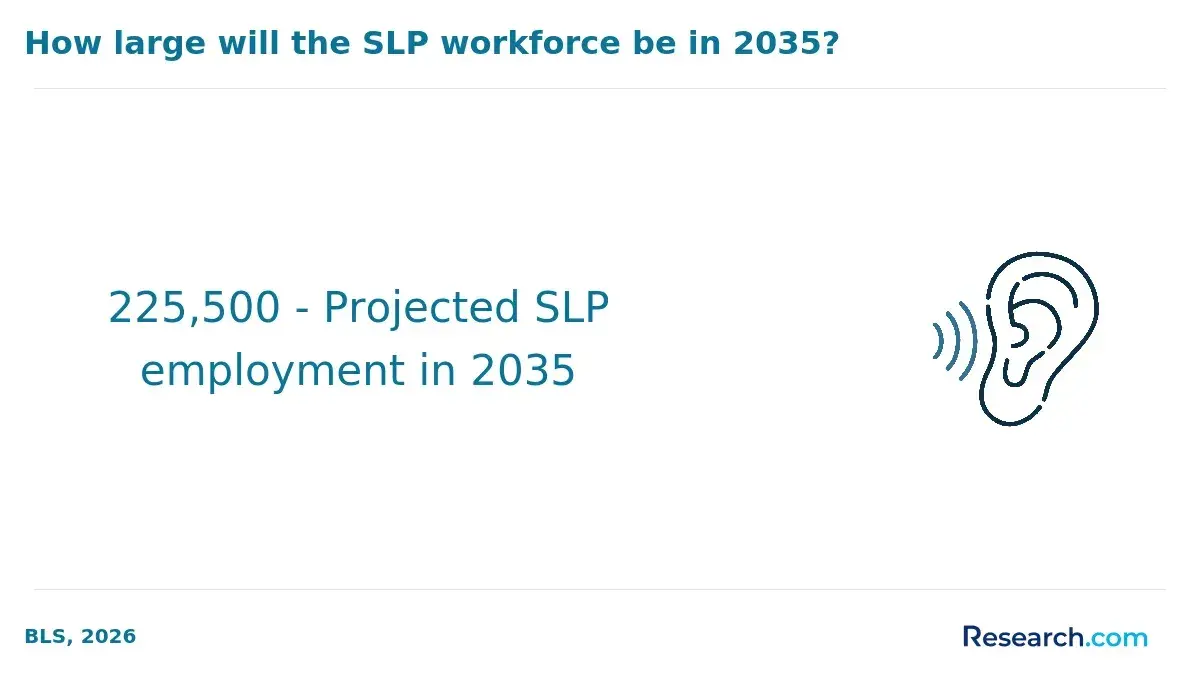
- SLP employment is projected to grow 17% from 2025 to 2035, with about 12,500 annual openings; specialty training can strengthen clinical fit, but it does not replace CAA-accredited graduate education, state licensure, or Clinical Fellowship requirements.
How many accredited SLP master's programs offer focused cleft and craniofacial clinical training today?
No authoritative national registry reports how many accredited speech-language pathology master's programs provide focused cleft and craniofacial clinical training. The American Speech-Language-Hearing Association's Council on Academic Accreditation (CAA) evaluates whether programs meet broad professional education standards; it does not label or count programs by cleft-palate specialty rotations.
That means an applicant should be cautious with broad claims that a school "offers cleft training." A program may have faculty expertise, a nearby craniofacial center, occasional guest lectures, research activity, or a recurring clinical placement. Those are materially different opportunities. Availability can also change when hospital contracts, supervisors, cohort size, or clinic capacity change.
The most defensible answer is that focused opportunities are a limited subset of accredited programs and are concentrated around academic medical centers, children's hospitals, university clinics, and established interdisciplinary craniofacial teams. A school's CAA accreditation confirms the degree's educational foundation, not a guaranteed specialty caseload.
The comparison below separates commonly confused types of exposure. Use it when reviewing program websites and speaking with a clinical education director.
| Type of opportunity | What it usually means | Value for a cleft-focused career goal |
| Course content | Instruction on cleft palate, resonance, and velopharyngeal dysfunction in a broader disorders course | Useful foundation, but not evidence of direct clinical skill |
| Observation | Watching a craniofacial clinic or team conference | Helpful for understanding team roles; limited hands-on preparation |
| Specialty practicum | Supervised evaluation and treatment of relevant patients | Most valuable pre-graduation experience when caseload and supervision are substantial |
| Research laboratory | Faculty-led work in speech, resonance, imaging, or outcomes | Strong fit for research interests; may not include direct patient care |
| Postgraduate fellowship or CF position | Employment after graduation in a cleft or pediatric medical setting | Often the route to deeper specialization when graduate placements are limited |
What defines a meaningful cleft and craniofacial clinical opportunity in an SLP master's curriculum?
A meaningful opportunity gives the student repeated, supervised responsibility for clinical decisions involving communication disorders associated with cleft lip and palate or other craniofacial conditions. It should move beyond recognizing hypernasality in class to gathering case history, conducting a perceptual speech assessment, counseling families, writing reports, planning intervention, and participating in referral decisions.
For applicants, the strongest programs make clear what students actually do, how often they do it, and who supervises them. A placement can be excellent even if it is not exclusive to cleft care, provided the student has a real caseload and sustained feedback.
Ask whether the experience includes the following elements, because together they distinguish a clinical rotation from a limited exposure activity.
- Assessment of articulation, resonance, nasal emission, intelligibility, language, feeding history, and related communication concerns.
- Experience distinguishing speech errors appropriate for therapy from patterns that may warrant surgical, dental, or instrumental reassessment.
- Supervision by an SLP with demonstrated experience in cleft palate speech and resonance disorders.
- Participation in case conferences, team clinics, follow-up visits, or coordinated documentation with other disciplines.
- Exposure to pediatric and, where available, adolescent or adult transition cases, since needs can change across development.
- Feedback on clinical reports, family counseling, treatment planning, and ethical limits of student practice.
A program need not promise exposure to every diagnosis or procedure. However, a vague statement that students "may have opportunities" should prompt follow-up questions about how many students recently completed the experience and what their responsibilities were.
Which SLP programs and clinical sites are recognized hubs for cleft and craniofacial care?
Recognized cleft and craniofacial care is generally delivered through interdisciplinary teams at children's hospitals, academic medical centers, university-affiliated health systems, and regional craniofacial centers. Programs located near these settings may have stronger potential for clinical affiliation, but geographic proximity alone does not establish a student placement agreement or reserved rotation slots.
Rather than choosing a school solely because it names a prominent hospital, compare the relationship between the graduate program and the site. A formal, recurring affiliation with designated student supervision is more valuable than an informal referral connection. Students comparing broader SLP master's programs should treat specialty placement access as a separate criterion from admissions accessibility.
This table identifies the kinds of organizations that commonly serve as clinical hubs and the evidence applicants should request.
| Potential hub | Why it can be valuable | What to verify with the university |
| Children's hospital craniofacial center | May offer coordinated pediatric cleft, speech, feeding, and surgical follow-up care | Whether graduate students have recurring placements and direct patient responsibilities |
| Academic medical center | May connect students with specialty faculty, instrumental services, and teaching conferences | Which disciplines participate and whether students attend team clinics |
| University speech and hearing clinic | Can provide close faculty supervision and longitudinal therapy | Whether the clinic regularly serves cleft or resonance cases rather than accepting them only occasionally |
| Community or regional cleft team | May broaden access in areas without a major academic hospital | Travel expectations, supervision arrangements, and frequency of specialty appointments |
Hospital team membership is also not synonymous with a graduate-school placement. Ask for the name of the clinical education office, the placement model, and a de-identified example of a recent student's role. If the program cannot describe recent student participation, regard the opportunity as possible rather than established.
How do SLP programs structure specialty practica with craniofacial teams and cleft clinics?
Programs commonly build specialty training through one of three models: an in-house university clinic, an external medical placement, or a general pediatric placement supplemented by team observations and focused supervision. The best fit depends on whether you prioritize continuity of therapy, medical-team exposure, or scheduling flexibility.
An in-house clinic may offer frequent supervision and a longitudinal client relationship, while a hospital rotation may expose students to surgical decision-making and interdisciplinary workflow. Neither is automatically better. A hospital clinic with only observation duties may offer less clinical growth than a university placement where a student manages appropriate cases under expert supervision.
The table below summarizes the trade-offs applicants should evaluate before assuming a placement model meets their goals.
| Practicum model | Typical strengths | Potential limitation | Best fit |
| University specialty clinic | Close faculty feedback, recurring therapy, structured documentation | May have a smaller or less medically complex caseload | Students seeking strong foundational clinical skill development |
| Children's hospital or medical center | Team conferences, postoperative follow-up, complex referrals | Placement slots may be limited and schedules may be less predictable | Students interested in medical and interdisciplinary practice |
| Community pediatric placement | Broader service-delivery experience and potentially more therapy hours | May not include a formal craniofacial team | Students building pediatric skills while pursuing specialty learning elsewhere |
| Hybrid model | Combines coursework, observation, and external practicum | Depth varies substantially by student assignment | Students who confirm the sequence and responsibilities in advance |
Schedule is a practical issue. Cleft-team clinics may occur only on certain weekdays and can conflict with courses, assistantships, or other rotations. Students considering accelerated speech language pathology programs should ask whether the compressed sequence leaves room for elective specialty practica; faster completion can reduce flexibility for a selective hospital placement.
What accreditation and ASHA CAA standards apply to cleft and craniofacial SLP training?
For U.S. professional practice, the central educational requirement is graduation from a CAA-accredited graduate program in speech-language pathology, subject to each state's licensing rules and other requirements. CAA accreditation addresses program quality, curriculum, faculty, assessment, clinical education, and student outcomes. It does not require every program to provide a dedicated cleft or craniofacial practicum.
CAA standards require students to obtain supervised clinical education that supports entry-level professional competence across the scope of practice. Programs determine how they organize placements and how they document student achievement. Consequently, an accredited program can be an appropriate route to licensure even when its specialty options are limited.
Applicants should separate three questions that are often blended together: whether the degree is accredited, whether clinical education supports certification and licensure requirements, and whether the program can provide the specialty experience the applicant wants. The first two establish professional eligibility; the third affects career preparation and should be verified directly.
Do not assume that online delivery changes the accreditation test. Some online masters SLP programs use distance coursework while requiring in-person clinical placements. Before applying, confirm authorization to enroll in your state, responsibility for finding placements, travel requirements, and the program's current licensure disclosures.
A red flag is any school that describes itself as "accredited" without clearly identifying the accreditor and the exact graduate program status. Confirm CAA status through ASHA's current program directory and review the university's disclosures before paying an enrollment deposit.
How should applicants compare caseload volume and case complexity in cleft-focused clinical placements?
Caseload volume matters, but raw numbers can mislead. A student who observes many one-time team evaluations may gain broad exposure but limited treatment responsibility. A student who treats a smaller number of clients over multiple visits may develop stronger skills in goal selection, data collection, parent coaching, and clinical adjustment.
Case complexity also should not be reduced to a prestige marker. Complex cases can be educational when supervision is close and the student has a defined role. They are less useful if students mainly watch specialists make decisions without receiving feedback or contributing to documentation and care planning.
Use these comparison questions in conversations with clinical coordinators. Request recent ranges or descriptions rather than accepting an unqualified assurance that cases are "available."
- How many students in the most recent cohorts completed a cleft, craniofacial, resonance, or closely related specialty placement?
- How many direct client contacts, evaluation sessions, therapy sessions, and team clinics did a typical participating student complete?
- Were students assigned ongoing clients, one-time evaluations, observations, or a combination of these activities?
- What diagnoses and age groups did students encounter, and how were cases matched to each student's readiness?
- Who supervised the work, how often was supervision provided, and what expertise did the supervisor have?
- Did students write reports, discuss referrals, and receive feedback on clinical reasoning and counseling?
Be especially careful when a school reports total clinical clock hours without identifying where those hours occurred. Total hours can show that a program meets graduation requirements, but they do not reveal whether you had sustained cleft-focused clinical learning.
In what ways do interdisciplinary experiences with surgery, dentistry, and genetics vary by program?
Cleft and craniofacial care is interdisciplinary because speech and resonance can be affected by anatomy, hearing, dental and orthodontic development, surgical history, feeding, language, and family priorities. The SLP's role commonly includes assessing speech and resonance, providing therapy when appropriate, counseling families, and communicating findings that inform team planning. SLPs do not independently make surgical, dental, or genetic diagnoses.
Programs vary widely in how students encounter other disciplines. One program may embed students in an interdisciplinary clinic; another may use guest lectures, case-based instruction, or referrals from external providers. Direct participation can be especially useful, but it is not essential for every graduate student if the curriculum teaches appropriate referral pathways and scope boundaries.
The following comparison clarifies what each experience can add to graduate preparation.
| Discipline or service | Relevant student learning | Meaningful participation example |
| Plastic or craniofacial surgery | How surgical history and structural concerns relate to speech assessment and referral | Attending case review and discussing perceptual speech findings with the team |
| Orthodontics and dentistry | How dentition, occlusion, and oral structure can influence speech production | Reviewing interdisciplinary recommendations and adapting therapy planning within SLP scope |
| Audiology and otology | How hearing status may affect speech and language development | Integrating hearing information into assessment and family counseling |
| Genetics | How syndromic and family-history information may affect referral and support needs | Learning referral roles, respectful communication, and documentation boundaries |
| Psychology or social work | How psychosocial needs, access barriers, and family stress can affect care | Participating in coordinated care discussions while respecting privacy and role boundaries |
Ask whether team participation is observational, educational, or clinical. A program should be able to explain what information students may access, how privacy is protected, and how supervision is handled in an interprofessional environment.
How do programs document graduate outcomes in cleft and craniofacial speech and resonance care?
Most graduate programs publish broad outcomes, such as program completion, Praxis performance, employment, or graduate achievement in certification-related requirements. Those measures are important, but they rarely isolate cleft and craniofacial competence because specialty employment is too narrow and graduates may pursue many different settings.
For a specialty-focused applicant, stronger evidence is usually qualitative and specific: recent examples of students completing a craniofacial practicum, faculty descriptions of assessment competencies, poster presentations, alumni roles in pediatric medical settings, or clinical partnerships that have remained active across cohorts. These examples should supplement - not replace - published program outcomes and CAA accreditation information.
When reviewing outcomes, distinguish between evidence that a school prepares entry-level SLPs and evidence that it consistently supports specialty readiness.
| Outcome evidence | What it can tell you | What it cannot prove |
| CAA accreditation status | The program meets applicable accreditation expectations | That every student receives a cleft placement |
| Program completion and Praxis outcomes | Broad academic and professional readiness indicators | Specialty clinical depth or job placement in craniofacial care |
| Recent placement examples | Whether specialty opportunities have operated in practice | That a future applicant will automatically receive the same rotation |
| Alumni profiles | Possible career paths and institutional connections | Typical salary, guaranteed employment, or causal program impact |
| Faculty scholarship and clinic publications | Relevant expertise and potential mentoring resources | Availability of direct student clinical supervision |
Career prospects should remain part of the larger decision. The U.S. Bureau of Labor Statistics reports a $97,870 median annual wage for speech-language pathologists in May 2025, but that figure covers the occupation as a whole, not cleft-clinic roles specifically. Compensation varies by setting, region, experience, and employer; readers exploring highest paying speech pathology jobs should not assume a specialty placement alone determines earnings.
What should prospective SLPs verify about licensure, supervision, and billing in cleft clinics?
A master's degree is one step in the professional pathway, not a substitute for state licensure. Requirements vary by state but commonly include an accredited graduate degree, supervised post-graduate experience, examination requirements, and an application to the state board. Many employers also expect or prefer ASHA certification, particularly in medical settings.
Students should understand that clinical supervision during graduate school differs from supervision during a Clinical Fellowship. Graduate clinicians provide services under faculty or site-supervisor oversight within the university's clinical education structure. After graduation, the Clinical Fellowship is a separate mentored professional period that supports certification requirements.
Billing is generally handled by the clinic, hospital, or employer rather than by a student. Still, learning the basics is useful because documentation must support medically necessary, ethical, and accurately coded services under applicable payer and facility rules. A strong placement teaches students to document assessment findings, treatment rationale, progress, and referrals clearly without asking them to practice outside their training or legal authority.
Before enrolling, verify these operational details with the program and, when appropriate, your state licensing board.
- Whether the program is CAA-accredited and whether it has a clear disclosure for students residing in your state.
- Whether out-of-state placements, background checks, immunizations, drug screening, transportation, or professional liability costs are the student's responsibility.
- Whether specialty supervisors hold the credentials and site approvals required by the university and placement setting.
- How the program records direct and indirect clinical activities and ensures that records support graduation and future credentialing needs.
- Whether students receive instruction on documentation, privacy, informed consent, referral, and scope-of-practice boundaries.
A common mistake is assuming a hospital affiliation solves every licensure issue. It does not. Licensure eligibility is state-specific, and each applicant remains responsible for confirming the rules where they intend to practice.
How can students independently confirm current cleft and craniofacial opportunities at target SLP programs?
Independent confirmation is essential because clinical affiliations and available caseloads can change faster than a university webpage. Start with the program's official clinical education materials and CAA status, then contact the clinical education director or specialty faculty member with focused questions. Admissions staff can explain general program structure, but clinical coordinators are often better positioned to explain rotation availability and student responsibilities.
Use a consistent process across every school so that you compare like with like rather than relying on marketing language.
- Confirm the graduate program's current CAA accreditation status and read its state-authorization and professional-licensure disclosures.
- Identify the named cleft, craniofacial, pediatric hospital, university clinic, or team affiliation on the school's official site.
- Ask whether the affiliation has placed graduate SLP students within the last two cohorts and whether the rotation is required, elective, selective, or observational.
- Request a description of student duties, supervision, approximate schedule, travel expectations, and the types of cases typically encountered.
- Ask how students are selected when specialty placements have fewer slots than interested students.
- Compare total attendance, travel, health-clearance, and placement costs alongside tuition before making a final enrollment decision.
Keep written notes from each conversation. The most transparent programs will distinguish what they can confirm from what depends on site capacity. Be wary of a school that guarantees a highly specific placement without explaining the process, or one that cannot identify a current clinical contact, recent student experience, or contingency plan.
For many applicants, the best decision is an accredited program with dependable broad pediatric training and credible access to specialty mentorship - not necessarily the program with the boldest cleft-clinic claim. You can deepen expertise through electives, continuing education, mentorship, a Clinical Fellowship, and later employment in a craniofacial setting.
Other Things You Should Know About Speech Language Pathology
No. You need to complete the educational, clinical, examination, and state-specific requirements that apply to your professional pathway. A cleft-focused practicum is a valuable specialization opportunity, but it is not required for entry-level SLP licensure or for every SLP position.
It can, but online coursework does not mean online clinical practice. Ask how in-person placements are secured, whether the program has existing specialty agreements, whether you may need to travel, and whether students in your state are eligible to enroll.
Helpful preparation usually includes phonetics, speech sound disorders, anatomy and physiology, child language, dysphagia or feeding foundations where offered, and coursework addressing resonance or craniofacial disorders. Programs sequence courses differently, so ask when specialty placements occur relative to those prerequisites.
Not always, but medical-setting experience can be helpful because cleft care often involves interdisciplinary communication and complex referral decisions. New graduates may build this expertise through a Clinical Fellowship, mentorship, continuing education, and supervised work in pediatric or craniofacial settings.
References
- HS MS in Speech-Language Pathology (SLP) https://medschool.vanderbilt.edu/hearing-speech/academics/msslp/
- Master of Arts Program in Speech-Language Pathology (SPLA) https://hesp.umd.edu/undergraduate/program-highlights-master-arts-program-speech-language-pathology-%28spla%29
- Speech-Language Pathology MA - Newark https://www.udel.edu/academics/colleges/chs/departments/cscd/graduate-programs/masters-program/
- Best Speech-Language Pathology Programs in America https://www.usnews.com/best-graduate-schools/top-health-schools/pathology-rankings
- Craniofacial Speech Pathology Fellowship https://www.nationwidechildrens.org/for-medical-professionals/education-and-training/fellowship-programs/craniofacial-speech-pathology-fellowship