2027 Online SLP Master's Programs for Maryland Residents: Eligibility, Tuition, and Clinical Placements

Co-Founder and Chief Data Scientist

Reviewed by Rhea Paul, PhD
SLP Education & Research Expert
Maryland residents can pursue an online master's in speech-language pathology, but the right choice depends on more than flexible classes. The program must be appropriately accredited, able to enroll Maryland students, support clinical education, and align with Maryland licensure rules. This guide explains how to evaluate online SLP options, compare tuition beyond the advertised rate, confirm placement support, and avoid enrolling in a program that creates avoidable licensing or travel barriers.
Key Things You Should Know
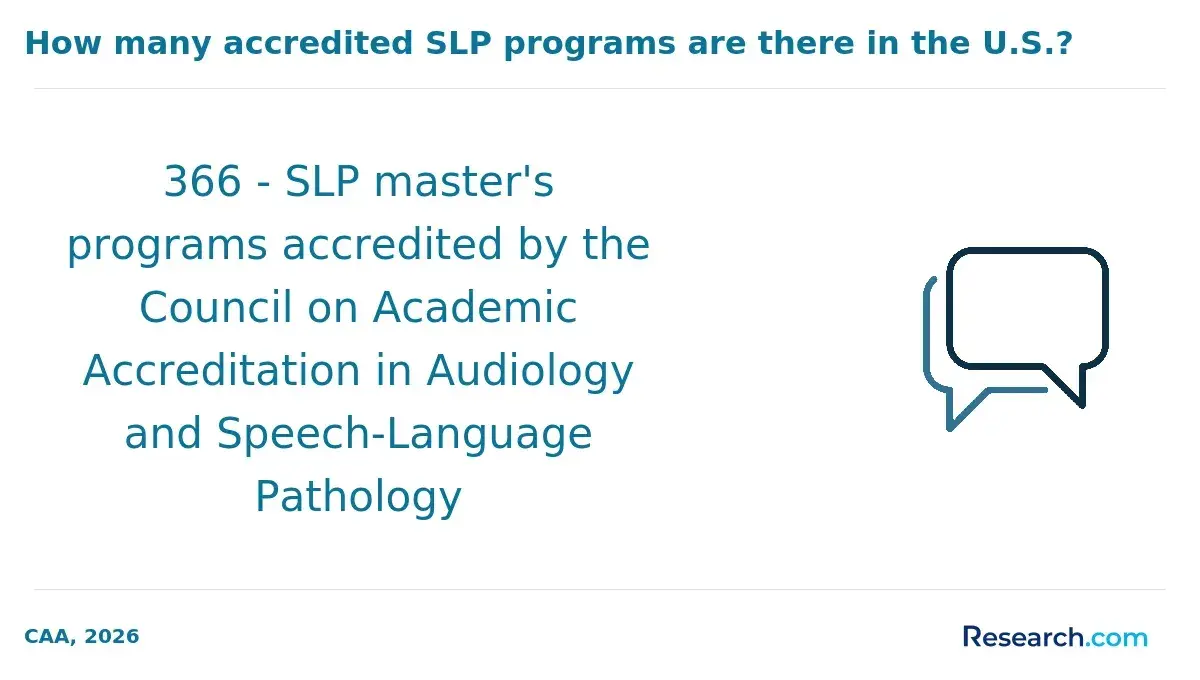
- For Maryland SLP licensure, prioritize a master's degree from a program accredited by the American Speech-Language-Hearing Association's Council on Academic Accreditation (CAA), plus the state's separate supervised-experience and examination requirements.
- Online SLP programs are not fully remote in the clinical sense: students generally complete in-person practicum and externship experiences, and some programs require campus immersions, live online sessions, or travel for skills assessment.
- The U.S. Bureau of Labor Statistics reports a $97,870 median annual wage for speech-language pathologists in May 2025 and projects 17% employment growth from 2025 to 2035, but program cost, debt, placement access, and licensure eligibility still determine whether an option is a sound individual investment.
Which online SLP master's programs enroll Maryland residents and meet licensure eligibility rules?
Maryland residents should begin with CAA-accredited graduate programs that explicitly accept applicants from Maryland or do not list Maryland as a restricted state. A school's ability to deliver online instruction in Maryland is separate from whether its curriculum supports Maryland professional licensure, so both disclosures matter.
The programs below are examples of institutions commonly associated with online or hybrid-entry master's pathways in speech-language pathology. Availability, cohort openings, residency requirements, and state authorization can change; confirm each item directly with the university and the Maryland licensing authority before paying an enrollment deposit.
| Program example | Delivery consideration | Maryland applicant verification point | Clinical education consideration |
| Emerson College, MS in Speech-Language Pathology | Online academic delivery with required clinical education and program-directed experiences | Confirm current Maryland enrollment and professional-licensure disclosure | Ask whether the program secures sites, how local site requests are handled, and whether travel may be required |
| Baylor University, online MS in Communication Sciences and Disorders | Online coursework with required clinical practicum experiences | Confirm Maryland authorization, cohort availability, and licensure alignment | Clarify the placement process, timeline, and student responsibilities for approved supervisors |
| New York University, online MS in Communicative Sciences and Disorders | Online academic format with in-person clinical training requirements | Review the school's current state authorization and Maryland disclosure | Determine whether clinical assignments can be completed in Maryland and whether relocation is possible |
| University of St. Augustine for Health Sciences, MS-SLP | Hybrid or distributed format may include scheduled practical experiences and travel | Confirm Maryland eligibility and exact on-campus expectations for the entering cohort | Verify placement geography, site approval rules, and any required travel for clinical training |
CAA accreditation is the central academic screening criterion, but it is not a substitute for reviewing a school's state-specific disclosure. Programs can change admissions availability by state because of authorization, clinical-contracting capacity, or institutional policy.
Compare each option against the same evidence: current accreditation status, Maryland enrollment permission, estimated total institutional charges, required travel, clinical-placement model, and pacing.
A broader list of online speech pathology programs can be useful for initial research, but admission accessibility should never outweigh accreditation and placement feasibility.
How do Maryland SLP licensure requirements shape acceptable online graduate program choices?
Maryland licensure requirements make program selection consequential. A prospective SLP generally needs a qualifying graduate degree, supervised professional experience, a passing national examination score, and a Maryland license before independently practicing under the state's rules.
Requirements and application procedures can change, so applicants should treat the Maryland Board of Examiners for Audiologists, Hearing Aid Dispensers, and Speech-Language Pathologists as the final authority.
In practical terms, a CAA-accredited master's program is usually the safest educational foundation because it is designed around recognized professional preparation standards. However, graduation alone does not automatically produce a Maryland license. The post-graduation clinical fellowship and state application remain separate steps.
Before applying, obtain written answers to the following licensure questions. These checks prevent the common mistake of assuming "online" means a program has already confirmed every state-specific requirement.
- Does the university currently enroll students who reside in Maryland?
- Does the program's licensure disclosure state that its curriculum meets, or is intended to meet, Maryland educational requirements for SLP licensure?
- Is the program currently CAA-accredited, rather than merely seeking accreditation or holding a different institutional accreditation?
- Can required clinical clock hours and supervised experiences be completed at approved Maryland sites?
- What additional steps will remain after graduation, including the clinical fellowship, Praxis examination, background checks, and Maryland licensure application?
Applicants with a degree outside communication sciences and disorders should also ask about prerequisite coursework. A leveling sequence can add time and cost before graduate clinical coursework begins, and it may not be fully online at every institution.
What tuition, mandatory fees, and cost-of-living factors affect Maryland online SLP students?
The advertised tuition rate is only one part of the cost. Online clinical degrees can reduce relocation expenses, but they may add technology fees, residency travel, clinical compliance expenses, and unpaid time away from work for daytime placements. Request a written, cohort-specific cost worksheet rather than relying on a per-credit figure alone.
This cost checklist separates expenses that are often billed by the university from expenses students may pay while meeting clinical requirements.
| Cost category | What to confirm | Why it matters for Maryland residents |
| Tuition | Per-credit rate, total required credits, annual increases, and whether the rate is fixed for the cohort | Some online programs charge one national rate; others distinguish resident and nonresident tuition |
| Mandatory institutional fees | Technology, clinical course, distance-learning, graduation, and student-service fees | Fees can materially change the total beyond advertised tuition |
| Travel and lodging | Required immersions, orientation, simulations, competency assessments, and clinical travel | A program based outside Maryland may require repeated trips or short-term lodging |
| Clinical compliance | Background checks, drug screening, immunizations, physicals, CPR training, liability coverage, and fingerprinting | Clinical sites may impose their own requirements before permitting placement |
| Books and equipment | Testing materials, software, headphones, webcam, and internet requirements | Remote coursework still requires reliable technology and privacy for telepractice-related learning |
| Income effects | Daytime practicum schedule, reduced work hours, child care, and commuting | These costs are especially important when placements are not close to home |
Federal financial aid eligibility depends on the institution, program enrollment status, and the student's circumstances. Complete the FAFSA, then compare scholarships, employer tuition assistance, federal loans, and institutional aid using the same total-cost estimate. Borrowing decisions should account for the full education timeline, including any prerequisite courses.
Career demand can support the long-term case for the degree, but it should not be used to justify unlimited borrowing.
The BLS projects about 12,500 SLP openings per year on average from 2025 to 2035; that is a favorable national indicator, not a guarantee of a particular Maryland job, salary, or repayment outcome. Readers comparing earnings across settings can review speech and language therapist salary information alongside local employer postings and their own debt estimate.
How do public versus private online SLP programs price tuition for Maryland residents and nonresidents?
Public and private institutions use different pricing models, but neither category is automatically cheaper. A Maryland resident may receive an in-state rate at a Maryland public university, while an out-of-state public online program may charge a higher nonresident rate or a separate online rate.
Private nonprofit universities often use one tuition rate regardless of residence, which can make the comparison more predictable but not necessarily less expensive.
Use this framework to interpret quotes without treating unlike prices as equivalent.
| Institutional model | Common tuition approach | Potential advantage | Important caution |
| Maryland public university | May distinguish in-state and out-of-state students | Resident tuition can be favorable when an eligible program has capacity and a suitable format | An online clinical format may still include campus, clinical, or program fees |
| Out-of-state public university | May charge nonresident, distance-learning, or market-based tuition | Can offer a specialized online structure or larger clinical network | Do not assume Maryland residency creates a discount |
| Private nonprofit university | Often charges one published rate for all students | Pricing may be simpler to forecast across the program | Higher tuition can offset predictable pricing; compare aid and all required fees |
| Private for-profit institution | May use a flat per-credit or program rate | May offer multiple start dates or structured online support | Verify CAA accreditation, state eligibility, aid terms, and clinical-placement commitments with particular care |
The most useful comparison is total required educational cost, not a school's label or a single semester's bill. Ask whether tuition is locked at entry, whether clinical semesters carry different charges, and whether the estimate assumes full-time enrollment. A lower rate can lose its advantage if extra terms, travel, or delayed placement add cost.
Applicants interested in a compressed timeline should evaluate it cautiously. SLP accelerated programs may reduce time to completion for some students, but an intense sequence can limit paid work and may leave less room to absorb a placement delay.
What types of clinical placements are available to Maryland residents in online SLP programs?
Clinical education is the part of an online SLP degree that cannot be completed solely through recorded lectures. Students typically progress from observation and skills practice to supervised practicum and advanced externship experiences with real clients. The mix of populations and settings matters because it shapes clinical competency and day-to-day scheduling.
Maryland students may seek experiences across the following settings, subject to program approval, affiliation agreements, supervisor qualifications, and site capacity.
- Public schools and early-intervention programs, where students may encounter pediatric language, speech-sound, fluency, and school-based service delivery needs.
- Hospitals, rehabilitation facilities, and outpatient clinics, which may offer adult neurogenic communication, swallowing, voice, and medically complex cases.
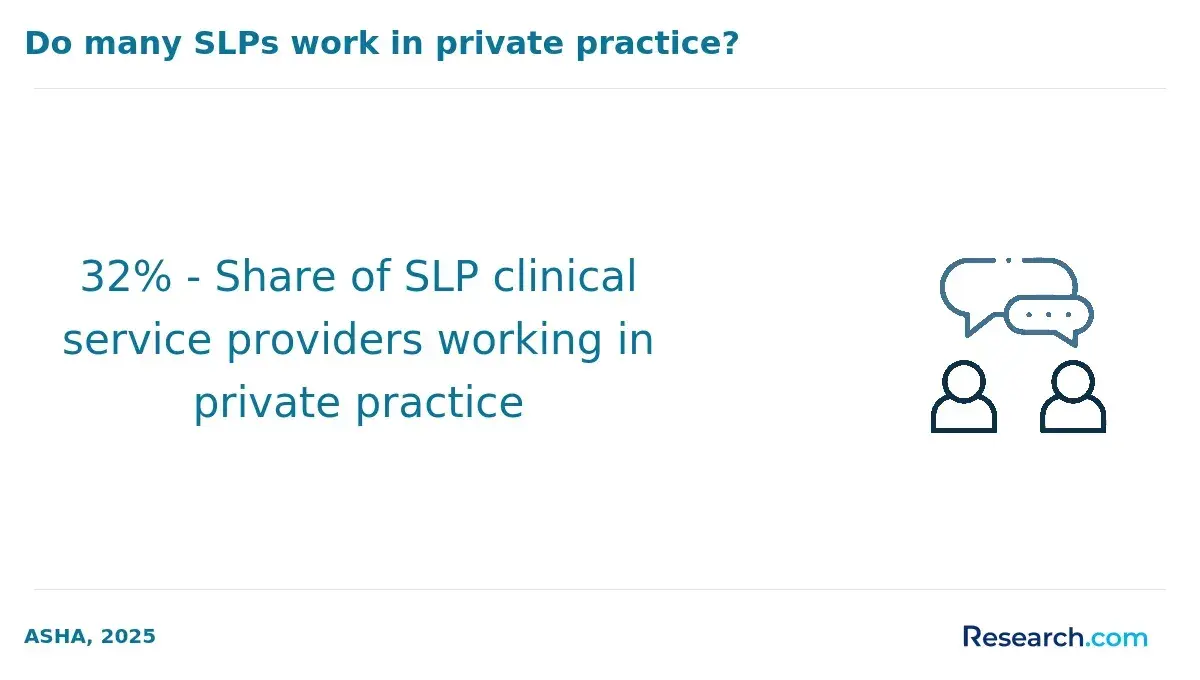
- Private practices and community clinics, where caseloads can vary widely by age group, diagnosis, and payer mix.
- Skilled nursing facilities and home-health-related services, where adult and geriatric communication or swallowing needs may be prominent.
- University clinics and telepractice-supported settings, when permitted by program and site policies and supervised appropriately.
No program can responsibly promise a particular population, school district, city, or specialty before site agreements and supervisor availability are confirmed. If your career goal is pediatric schools, medical SLP, bilingual service delivery, or dysphagia, ask how the program documents exposure to that area and whether students can express placement preferences.
A program that requires students to find their own sites is not necessarily unsuitable, but it carries more risk for applicants without professional contacts. That model can be difficult when sites already prioritize local universities with long-standing affiliation agreements.
How do online SLP programs arrange and supervise in-state clinical sites across Maryland settings?
Online SLP programs generally use one of three models: the university places the student, the student helps identify a site while the university approves it, or the program uses a shared-responsibility approach. The difference affects workload, placement certainty, travel distance, and the chance that graduation is delayed by an unfinished clinical requirement.
Ask admissions and clinical education staff to describe the model in writing. The following comparison identifies the practical trade-offs.
| Placement model | University role | Student role | Main risk to assess |
| Program-arranged | Locates and coordinates approved sites and supervisors, subject to availability | Meets onboarding and travel requirements | Placement location may be outside the student's preferred commute area |
| Student-sourced with approval | Reviews site, executes agreements, and verifies supervisor eligibility | Identifies prospective sites and supports the affiliation process | Sites may decline, contracts can take time, and placement may be delayed |
| Shared-responsibility | Uses existing partners while allowing local leads from students | Provides preferences or local contacts and completes required paperwork | Responsibilities may be unclear unless timelines and backup plans are documented |
Supervision should be provided by qualified practitioners under program and accreditation standards, with the university retaining responsibility for evaluating student performance. Do not assume a supervisor who is willing to help is automatically eligible; the program must approve the supervisor and site before hours count.
A strong question is not simply, "Do you offer Maryland placements?" Ask for the median distance students travel, the usual lead time for a placement decision, the number of placement attempts permitted, and the contingency plan if an affiliation agreement is not finalized. Schools may not publish all of these measures, but a clear answer is more useful than a general assurance.
Which accreditors and approvals should Maryland residents verify for online SLP program legitimacy?
Accreditation, institutional authorization, and professional licensure are related but distinct. A legitimate online program should clear all relevant checks rather than relying on broad claims such as "accredited university" or "licensure-focused curriculum."
Verify these items in order before applying. Each answers a different question about whether the degree can support your intended career path.
- Confirm CAA accreditation through ASHA's official accreditation directory or EdFind. Institutional accreditation alone does not establish professional SLP program accreditation.
- Read the university's current professional-licensure disclosure for Maryland. Look for clear language about whether the curriculum meets educational requirements, does not meet them, or has not been determined to meet them.
- Confirm that the institution is authorized to provide distance education to students located in Maryland, whether through interstate reciprocity or another authorization route.
- Review Maryland's current SLP licensing requirements and retain copies of the program's written disclosures for your records.
- Ask whether required clinical placements, clinical supervisors, and any telepractice activities are approved under the program's policies and applicable rules.
Be cautious with programs described as "pre-SLP," "communication disorders," "speech therapy," or "health sciences" if they do not clearly state that the graduate SLP program holds CAA accreditation. Those programs may be useful for other goals, but they may not provide the educational credential needed for SLP licensure.
For applicants who need a degree designed specifically for entry into the profession, a speech language pathologist online degree should be evaluated first for CAA status and licensure compatibility, then for price and convenience.
How do interstate distance-education compacts and Maryland authorization affect online SLP enrollment?
State authorization determines whether an institution may offer distance education to a student located in Maryland. Many colleges participate in the State Authorization Reciprocity Agreement (SARA), an interstate framework intended to simplify authorization for distance education. Participation can make enrollment administratively easier, but it does not itself determine whether an online SLP degree meets Maryland professional licensure requirements.
In other words, SARA addresses institutional distance-education authorization; it is not professional accreditation, a clinical-placement guarantee, or a Maryland SLP license. A university may be authorized to teach Maryland residents while still limiting clinical placements, requiring travel, or issuing a disclosure that its curriculum has not been determined to meet Maryland licensing requirements.
Before enrolling, request confirmation of your eligibility based on your physical location at the time of enrollment and during clinical placements. This is especially important if you expect to move, complete a placement in another state, or live near a state border. A change in residence can affect an institution's authorization obligations and its disclosures.
Also distinguish Maryland professional licensure from school employment credentials. SLPs working in public schools may encounter additional requirements from the employer or the Maryland State Department of Education. The degree program can be one part of the pathway, but it may not handle every school-system credentialing step for you.
How can Maryland residents compare online SLP outcomes such as Praxis pass rates and employment?
Outcome data can reveal whether a program has a consistent record of preparing students, but it is most useful when compared over the same reporting period and with the same definitions. Do not compare a school's first-time Praxis pass rate to another school's eventual pass rate, or compare a tiny graduating cohort with a much larger one without noting the difference.
Request the program's most recent CAA outcomes disclosure and ask how it defines completion, employment, and examination success. This table shows how to use common indicators responsibly.
| Outcome measure | What it can show | How to interpret it carefully |
| Program completion rate | Whether students generally finish within the program's expected timeframe | Ask whether leaves, placement delays, and prerequisite students are included |
| Praxis examination pass rate | Performance on a national requirement commonly relevant to licensure and certification | Check the reporting window, first-attempt versus eventual pass definition, and cohort size |
| Employment rate | Whether graduates report professional employment or further training after graduation | Confirm the time after graduation, response rate, and whether jobs are SLP positions |
| Clinical placement completion | Whether students complete required practicum experiences on schedule | Ask directly because this metric may not be publicly reported |
| Student debt and aid | The likely financial burden associated with attendance | Use the institution's financial-aid information and your own borrowing estimate, not a generic average |
National labor data provides useful context, not a school-specific outcome measure. The BLS projection of 17% SLP employment growth from 2025 to 2035 suggests continued demand nationally, yet local hiring can differ by employer type, specialization, reimbursement conditions, and school-system budgets.
When two programs have similarly credible outcomes, choose based on the constraints that will affect completion: affordability after aid, transparent placement support, required travel, and a schedule you can realistically sustain. A slightly shorter format is not better if it conflicts with your work or caregiving responsibilities.
What questions should Maryland SLP applicants ask programs about placements, tuition, and licensure support?
Ask questions by email or save written notes from admissions conversations. Written answers create a more reliable comparison record and are especially valuable if policies change between application and enrollment.
These questions target the information that is most likely to change the value and feasibility of an online SLP program for a Maryland resident.
- Are students who live in Maryland currently eligible to enroll in this specific SLP cohort?
- Is the program currently CAA-accredited, and where can I view its latest accreditation and student-outcomes disclosure?
- What does your Maryland professional-licensure disclosure say, and can you send it to me in writing?
- What is the estimated total tuition and mandatory-fee cost for my entering cohort, including clinical course fees and expected annual increases?
- Which costs are excluded from the estimate, including travel, lodging, background checks, immunizations, testing, software, and clinical supplies?
- Are classes asynchronous, live online, or mixed, and what daytime availability is required for class meetings and placements?
- How many campus visits, immersions, or skills assessments are required, where are they held, and who pays the travel costs?
- Does the program arrange Maryland clinical placements, require students to find them, or use a shared model?
- What happens if a Maryland placement is unavailable or an affiliation agreement is delayed?
- Can you provide recent outcome data for completion, Praxis performance, and employment using the same reporting period for all measures?
Red flags include vague answers about state eligibility, a refusal to explain placement responsibilities, tuition estimates that omit mandatory charges, and claims that graduation "guarantees" licensure or employment. A credible program should be able to identify the responsible office for clinical education, financial aid, and licensure disclosures.
After receiving answers, compare programs on one worksheet and rank your nonnegotiables first. For many Maryland applicants, those are CAA accreditation, written Maryland eligibility, a workable clinical-placement plan, and a total cost that fits their borrowing limit.
Other Things You Should Know About Speech Language Pathology
Possibly, but many students find full-time work difficult during clinical semesters. Practicum and externship schedules are often daytime and depend on site availability. Ask each program how many weekly clinical hours are typical and whether part-time enrollment is available.
Not always. Many programs accept applicants from other majors, but they may require prerequisite or leveling coursework in areas such as phonetics, language development, anatomy, audiology, and speech science. Confirm the exact prerequisites and whether they add semesters or cost.
Employers generally focus on whether you hold the required graduate credential, license, clinical competence, and relevant experience. A CAA-accredited program with strong clinical training is more important than whether academic lectures were delivered online, although employers may value specialty experiences relevant to the role.
Do not assume so. A program may try to place students locally, but availability depends on approved sites, supervisors, contracts, caseloads, and timing. Ask about expected travel radius, relocation expectations, and the school's backup plan before enrolling.
References
- Speech-Language Pathology Program Details https://mercy.edu/academics/programs/masters-speech-language-pathology-details
- Online Masters in Speech Pathology (SLP) https://online.marymount.edu/programs/online-slp-masters
- Speech-Language Pathology | PennWest Global Online https://online.pennwest.edu/programs/speech-language-pathology-grad/index.php
- Best Online Speech Pathology Programs https://www.forbes.com/advisor/education/healthcare/best-speech-pathology-programs-online/