2027 Best Online Speech Pathology Master's Programs for Residents of Buffalo, NY

Co-Founder and Chief Data Scientist

Reviewed by Rhea Paul, PhD
SLP Education & Research Expert
Buffalo residents choosing an online speech-language pathology master's program need more than a flexible class schedule: they need a CAA-accredited degree, supervised clinical education, and a realistic path to New York licensure.
This guide compares credible online and hybrid options by the factors that matter locally, New York eligibility, practicum support, travel, tuition transparency, and outcomes reporting. It also explains what to confirm in writing before paying an application fee, so you can choose a program that fits both your schedule and professional goal.
Key Things You Should Know
- For New York practice, prioritize a CAA-accredited master's program that the school confirms is available to New York residents and compatible with New York's education and clinical-training requirements.
- "Online" SLP master's programs still require in-person clinical practicum experiences; confirm who secures placements near Buffalo, whether placements may require travel, and whether campus immersions are mandatory.
- The U.S. Bureau of Labor Statistics reports a $97,870 median annual wage for speech-language pathologists in May 2025 and projects 17% employment growth from 2025 to 2035, but a degree alone does not create licensure or guarantee employment.
Which online speech pathology master's programs serve Buffalo students best?
The best option depends on whether you need maximum schedule flexibility, substantial placement support, fewer campus visits, or a particular cost structure. Buffalo students should not treat an online program as automatically local: the university may be elsewhere, clinical experiences remain face-to-face, and state authorization can change.
The programs below are useful starting points because they offer online or hybrid graduate SLP pathways and publish information about clinical education and professional preparation. Before applying, confirm current New York availability directly with each admissions office and review its CAA listing.
| Program | Delivery model | Potential advantage for Buffalo residents | Key trade-off to verify |
| Emerson College, M.S. in Communication Disorders | Online academic coursework with in-person clinical experiences | Designed for distance learners and includes clinical-placement support structures | Required immersions, live-session expectations, placement geography, and total charges |
| Baylor University, M.S. in Communication Sciences and Disorders | Online coursework with required clinical training and immersive components | Structured cohort model for students seeking an online professional program | New York authorization, travel requirements, scheduling, and local placement availability |
| New York University, M.S. in Communicative Sciences and Disorders | Online/hybrid professional preparation with clinical education | A New York-based institution may be especially relevant for applicants focused on state requirements | Specific online pathway availability, clinical-site expectations, and tuition by enrollment status |
| University of St. Augustine for Health Sciences, M.S.-SLP | Online coursework combined with required hands-on experiences | May suit applicants comfortable with a structured hybrid model | Residency travel, cohort calendar, clinical placement process, and state-specific disclosure |
Do not interpret this as a universal ranking. A program is a stronger fit when it gives you a written answer on New York eligibility, identifies its clinical-placement responsibilities, and provides a clear total-cost estimate - not simply because it markets itself as online.
Applicants who want a shorter calendar should distinguish an accelerated sequence from a lighter course load. A speech language pathology accelerated program can reduce elapsed time, but it may require intensive full-time study and leave less room for employment during clinical terms.
Which accredited programs can Buffalo residents enroll in online?
Accreditation and enrollment eligibility are separate checks. The Council on Academic Accreditation in Audiology and Speech-Language Pathology (CAA), an ASHA accrediting body, evaluates graduate professional programs; meanwhile, a school decides which states it can enroll and support students in. A CAA-accredited program can still have a state authorization restriction or a temporary enrollment limitation.
CAA-accredited online or hybrid options commonly considered by New York applicants include Emerson College, Baylor University, New York University, and the University of St. Augustine for Health Sciences. Their availability, delivery details, and authorization disclosures can change by term, so applicants should use the current university disclosure and ASHA EdFind record rather than relying on a third-party list.
The practical distinction below helps Buffalo applicants avoid a common misunderstanding.
| Question | What a "yes" should mean | Why it matters |
| Is the program CAA-accredited? | The degree program appears as accredited in the current CAA/ASHA record. | CAA accreditation is the most important educational quality signal for an entry-level SLP master's degree. |
| Can New York residents enroll? | The university confirms it may enroll students physically located in New York. | State authorization affects whether the school can deliver distance education to you. |
| Does the curriculum support New York licensure? | The school provides a current New York professional-licensure disclosure or individualized review. | Licensure is determined by New York, not by a program's marketing language. |
| Can clinical requirements be completed from Buffalo? | The school explains its placement model and whether it can approve suitable sites in your area. | Clinical access, not online lectures, is often the limiting factor for distance learners. |
CAA accreditation should be verified immediately before enrollment, not only at application time. If a program is in candidacy rather than accredited status, ask exactly how that status affects your graduating cohort and whether New York will accept the degree for the license you seek.
Which programs satisfy New York licensure and SLP certification requirements?
No university can independently grant a New York license. For an initial New York speech-language pathology license, applicants generally need an acceptable master's degree or equivalent preparation, required supervised experience, and an approved examination. New York State Education Department requirements control, and applicants with an out-of-state or online degree may need an individualized review.
CAA-accredited master's programs are generally the clearest educational route toward both state licensure and the Certificate of Clinical Competence in Speech-Language Pathology (CCC-SLP) from ASHA. Still, "generally" is not the same as automatic approval. Ask each school to identify how its curriculum, clock hours, supervision documentation, and clinical sequence align with New York requirements.
Use this checklist before selecting a program. It separates education requirements from the post-degree steps that an online master's degree does not eliminate.
- Confirm that the degree program holds current CAA accreditation and that the school may enroll a student located in New York.
- Request a written New York licensure disclosure and ask whether the school has identified any gaps or additional requirements for New York residents.
- Confirm that the program includes the supervised practicum documentation needed for state licensing and ASHA certification review.
- Plan for the national Praxis examination and the supervised post-graduate clinical fellowship required for professional progression.
- Submit licensing materials directly to the New York State Education Department and follow its current instructions rather than relying solely on university guidance.
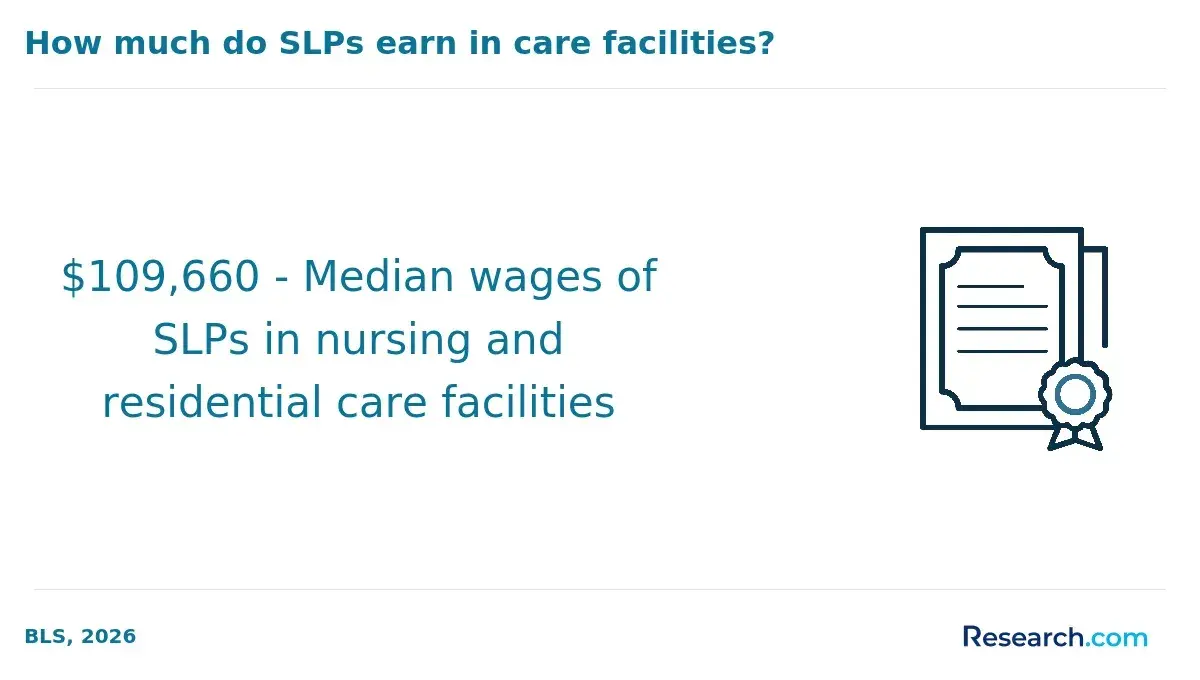
For career planning, the BLS projects about 12,500 speech-language pathologist openings each year on average from 2025 to 2035. That demand makes the credential valuable, but it also makes choosing a licensure-appropriate program essential: an inexpensive program that leaves a New York educational gap is not a lower-cost route.
Students evaluating specialty settings should also understand that earnings vary substantially by employer, experience, setting, and location. Review potential roles rather than assuming one pay outcome; this guide to becoming a highest paid speech pathologist can help frame the settings and advancement choices that may affect compensation.
What accreditation should Buffalo applicants verify before applying?
The first credential to verify is institutional program accreditation by the CAA, not merely regional institutional accreditation or an approval statement from a university. CAA accreditation evaluates whether an SLP graduate program meets professional education standards. It is particularly important for students who expect to pursue ASHA certification and state licensure after graduation.
Check the program in ASHA EdFind or the CAA directory, then compare that result with the university's current program page. The status should apply to the specific master's degree and delivery pathway you intend to enter, not merely to another campus, undergraduate major, or related communication-disorders program.
Applicants should obtain answers to the following items in writing because they can affect whether an online degree is usable in New York.
- The program's current CAA status, including any probationary or candidacy notation and the expected review timeline.
- Whether the university is authorized to enroll students residing in New York for the intended start term.
- Whether its New York professional-licensure disclosure states that the curriculum meets, is intended to meet, or has not been determined to meet state educational requirements.
- Whether the curriculum supplies the clinical education, supervised clock-hour records, and documentation needed for licensing and certification applications.
- Whether any prerequisite or leveling coursework must be completed before matriculation and whether it is included in the quoted price.
A frequent mistake is choosing a program described as "speech pathology" without confirming it is an entry-level professional SLP master's degree. A post-professional degree, a communication certificate, or an unaccredited program may be useful for another purpose but may not qualify a graduate for initial SLP licensure.
How do online and hybrid delivery options differ for Buffalo students?
In graduate SLP education, online usually describes the academic coursework - not the entire degree. Speech, language, swallowing, and diagnostic skills must be evaluated through supervised clinical experiences. As a result, virtually every legitimate distance pathway is hybrid in practice, even if lectures and discussions are online.
The delivery model should match your work, caregiving, transportation, and travel capacity. The comparison below shows why "online" is too broad a label for this decision.
| Format | Typical academic experience | Clinical component | Best fit |
| Primarily online cohort | Online modules, discussions, assessments, and sometimes scheduled live classes | In-person practicum at approved sites, often arranged with school involvement | Students who can follow a fixed sequence while living away from campus |
| Online with immersions | Most coursework is remote, plus short campus or regional intensive sessions | Local and/or assigned clinical placements with required supervision | Students who can travel periodically and value face-to-face skills instruction |
| Hybrid campus-based | Combination of online classes and regular on-campus meetings | University clinic and external placements | Students able to commute consistently or relocate closer to the institution |
| Traditional campus program | Most classes take place in person | University-managed clinic and external placements | Students who prefer local faculty access and can attend on a fixed campus schedule |
Ask whether classes meet live in Eastern Time, whether attendance is mandatory, and whether recording access is available. A program can be technically online yet unsuitable for a Buffalo applicant working daytime hours if it requires frequent synchronous daytime participation.
Applicants comparing formats can also review broader SLP online programs information, but admission accessibility should never replace accreditation, clinical quality, and New York licensure compatibility as the deciding criteria.
Which programs offer clinical practicum placements near Buffalo?
Schools may help identify, approve, coordinate, or fully assign clinical sites, but applicants should not assume a university can promise a placement in Buffalo. Site capacity changes with supervisor availability, affiliation agreements, patient populations, and competition from local programs. A program's clinical-placement model is therefore one of the most important differentiators for a Buffalo resident.
Online programs such as Emerson, Baylor, NYU, and the University of St. Augustine describe supervised clinical education as part of their professional curriculum. However, the degree of direct placement support varies by program and term. Ask whether the school finds the site, requires you to locate prospects, or uses a shared model in which you suggest sites and the university completes approvals.
Before committing, request a program-specific explanation covering the points below. These questions expose risks that a general statement about "nationwide placements" can hide.
- Does the program currently place or approve students in the Buffalo-Niagara region, and can it provide a general description of its process without promising a specific site?
- Who is responsible for contacting facilities, securing affiliation agreements, and finding an ASHA-qualified supervisor?
- What happens if a preferred placement falls through, a supervisor leaves, or a site cannot execute an affiliation agreement on time?
- Are students required to accept placements outside the Buffalo area, and who pays for travel, temporary housing, parking, and background checks?
- Which terms require full-time clinical availability, and can a student continue outside employment during those placements?
Look for programs that explain contingency planning rather than making vague placement assurances. A university that cannot guarantee a particular site may still be a strong choice if it has a transparent approval process, dedicated clinical staff, reasonable travel policies, and a record of placing distance learners successfully.
How do tuition and fees compare across online SLP programs?
Tuition comparisons are difficult because schools may quote per-credit tuition, a term price, or an annual estimate, while the required number of credits and clinical fees differ. For Buffalo applicants, the useful figure is the estimated total cost to complete the degree, including travel and clinical expenses - not the lowest advertised per-credit number.
The following cost categories should be collected from each institution's current tuition page and financial-aid office. Schools can revise rates by academic year, so treat any estimate as a planning figure rather than a guaranteed bill.
| Cost category | What to compare | Why it changes the decision |
| Program tuition | Total required credits multiplied by the applicable graduate tuition rate | Programs with similar term lengths can require different credit totals. |
| Mandatory university fees | Technology, student services, distance-learning, graduation, and clinical-course fees | Fees may not appear in headline tuition figures. |
| Clinical expenses | Immunizations, background checks, drug screening, liability coverage, equipment, and site requirements | These costs can recur across clinical terms. |
| Travel and lodging | Campus immersions, residencies, and distant placement travel | An online program may shift rather than eliminate location-related costs. |
| Prerequisite coursework | Leveling classes needed before admission or degree start | Applicants without a CSD background may face additional time and expense. |
Ask financial aid to provide a written cost-of-attendance estimate for your expected enrollment pattern, including summer terms if applicable. Also ask whether institutional aid applies to distance students and whether scholarships are restricted to full-time cohorts.
Federal student loans may help eligible graduate students, but borrowing should be tied to a realistic completion plan. The BLS median annual wage of $97,870 is a national occupational measure, not a starting-salary estimate for Buffalo graduates; use it as broad labor-market context, not as a personal repayment guarantee.
If affordability is your main filter, compare the total degree charge, clinical travel, and prerequisite costs alongside tuition. This overview of speech language pathologist masters online can help identify cost questions to bring to admissions offices.
What admissions requirements most affect Buffalo applicants?
The largest admissions hurdle for many applicants is academic preparation in communication sciences and disorders (CSD), not geographic location. Programs often expect foundational coursework in areas such as phonetics, language development, anatomy and physiology of speech and hearing, audiology, speech science, and statistics. Requirements differ, so a non-CSD bachelor's degree does not automatically prevent admission, but it may require leveling coursework.
Schools commonly evaluate applicants holistically using transcripts, prerequisite completion, letters of recommendation, a statement of purpose, résumé or experience, and interviews when required. Many programs have eliminated the GRE, but applicants should verify the policy for their entering cohort rather than assuming it is permanently waived.
Buffalo applicants should prepare these materials early because clinical and prerequisite planning can take longer than the application itself.
- Create a prerequisite audit using each target school's official course list and your transcripts, do not assume similarly titled courses will transfer.
- Request transcripts and recommendations well before the deadline, especially if you attended multiple institutions.
- Use your statement to explain relevant work with children or adults, bilingual or multicultural experience, disability-services exposure, research, or career-change preparation without overstating clinical competence.
- Ask whether observation hours are required before admission and how the school accepts documentation.
- Confirm the program's cohort start date, full-time or part-time options, background-check timing, and clinical availability expectations before accepting an offer.
A common mistake is applying only to the program with the lowest stated GPA threshold. A lower threshold does not establish likely admission, and it does not tell you whether the course sequence, clinical schedule, or New York disclosure fits your situation. Choose programs where you can satisfy prerequisites and complete required placements successfully.
Which programs publish strong outcomes for graduation and licensure?
CAA-accredited programs are expected to make student outcome information available, typically including program completion, Praxis examination pass rates, and employment outcomes for recent graduating cohorts. These reports are more useful than generalized promotional claims because they show whether a program publicly tracks the outcomes most connected to professional entry.
When evaluating Emerson, Baylor, NYU, the University of St. Augustine, or another program, look for the institution's current CAA-required outcome disclosure and note the reporting period, cohort size, and definitions used. A small cohort can make a percentage look unusually high or low, so compare several reporting years when available.
This table shows how to read outcome information without overstating what it proves.
| Published measure | What it can tell you | What it cannot tell you alone |
| Program completion rate | Whether enrolled students generally finish within the program's reporting window | Whether the schedule will work with your job, caregiving, or prerequisite needs |
| Praxis pass rate | How graduates performed on a required professional examination | Whether you personally will pass without adequate preparation |
| Employment rate | Whether reporting graduates obtained work in the profession or continued education | Starting pay, local job quality, or placement in a preferred Buffalo setting |
| Licensure disclosure | Whether the school has evaluated curriculum alignment for New York | Final approval of your individual license application by New York |
The strongest signal is not a single perfect-looking number. It is consistent, recent reporting combined with clear information on clinical support, academic progression, and state licensure. If a school cannot direct you to a current outcome disclosure, ask for it before you enroll.
What questions should Buffalo students ask before committing?
After receiving an offer, compare written answers rather than relying on phone-call impressions. The goal is to identify costs, travel, and placement obligations that could make an otherwise appealing online SLP program impractical.
Ask the admissions and clinical-education teams these questions before submitting a deposit.
- Can you confirm in writing that I may enroll while residing in New York and identify the current New York professional-licensure disclosure for this program?
- What is the program's current CAA accreditation status, and where can I review its most recent student outcome data?
- How many required campus visits, immersions, or residencies are there, where are they held, and what dates should I budget for?
- Are courses asynchronous, synchronous, or mixed, and what live attendance times should an Eastern Time student expect?
- Who secures clinical placements, what happens if a Buffalo-area site is unavailable, and may I be required to travel or relocate temporarily?
- What is my estimated total tuition and mandatory-fee cost from entry through graduation, excluding and including likely travel expenses?
- Which prerequisites have you accepted, which remain outstanding, and do they delay my cohort start?
- Can I attend part time, pause enrollment, or work during clinical terms without extending the program beyond its normal sequence?
Keep copies of replies, tuition estimates, curriculum plans, and licensure disclosures. Written documentation is especially valuable if a policy changes or you need to compare several offers after financial-aid packages arrive.
Other Things You Should Know About Speech Language Pathology
You may complete much of the academic coursework online, but an entry-level SLP degree cannot be entirely remote because supervised clinical education is required. Choose a CAA-accredited program, confirm New York enrollment and licensure compatibility, complete required clinical training, and meet New York's examination and supervised-experience requirements.
It depends on the university. Some schools assign or actively coordinate placements, while others expect students to identify potential sites for university approval. Ask for the exact process, the school's contingency plan, and whether you could be assigned outside the Buffalo area.
Many students work during coursework, but clinical practicum terms can require substantial daytime availability and may not be compatible with full-time employment. Review the term-by-term schedule before assuming an online format provides part-time flexibility.
Not always. Applicants from other majors may be admitted after completing prerequisite or leveling courses. This route can be viable for career changers, but it often adds cost and time, so obtain a transcript evaluation from each prospective program.
References
- MA in Speech-Language Pathology https://arts-sciences.buffalo.edu/cds/grad/masters.html
- Graduate Program - Speech-Language Pathology - Buffalo State https://speech.buffalostate.edu/graduate
- Speech-Language Pathology (MS) https://www.dyu.edu/academics/degrees-programs/speech-language-pathology-ms
- American Speech-Language-Hearing Association. (n.d.). Apply for certification in speech-language pathology. https://www.asha.org/certification/slpcertification/
- American Speech-Language-Hearing Association. (n.d.). Council on Academic Accreditation accredited program listing. https://apps.asha.org/eweb/ashadynamicpage.aspx?caacat=slp&site=ashacms&webcode=caalisting
- New York State Education Department, Office of the Professions. (n.d.). License requirements: Speech-language pathology. https://www.op.nysed.gov/professions/speech-language-pathology/license-requirements
- U.S. Department of Labor, Bureau of Labor Statistics. (2026). Speech-language pathologists. Occupational Outlook Handbook. https://www.bls.gov/ooh/healthcare/speech-language-pathologists.htm