2027 Online SLP Master's Programs for Ohio Residents: Eligibility, Tuition, and Clinical Placements

Co-Founder and Chief Data Scientist

Reviewed by Rhea Paul, PhD
SLP Education & Research Expert
Ohio residents considering an online speech-language pathology master's degree need more than a convenient class format: they need a program that can support Ohio licensure, arrange viable clinical education, and fit their finances. This guide explains how to evaluate online options, confirm state eligibility, compare true costs, and avoid enrolling in a program that creates problems when it is time for Praxis testing, a clinical fellowship, or an Ohio license application.
Key Things You Should Know
- Ohio applicants should prioritize a master's program accredited by the ASHA Council on Academic Accreditation, because accreditation is central to ASHA certification and is commonly expected for professional licensure pathways.
- Online SLP programs still require substantial hands-on training: ASHA certification standards include at least 400 supervised clinical hours, including 375 direct client-contact hours and 25 guided observation hours.
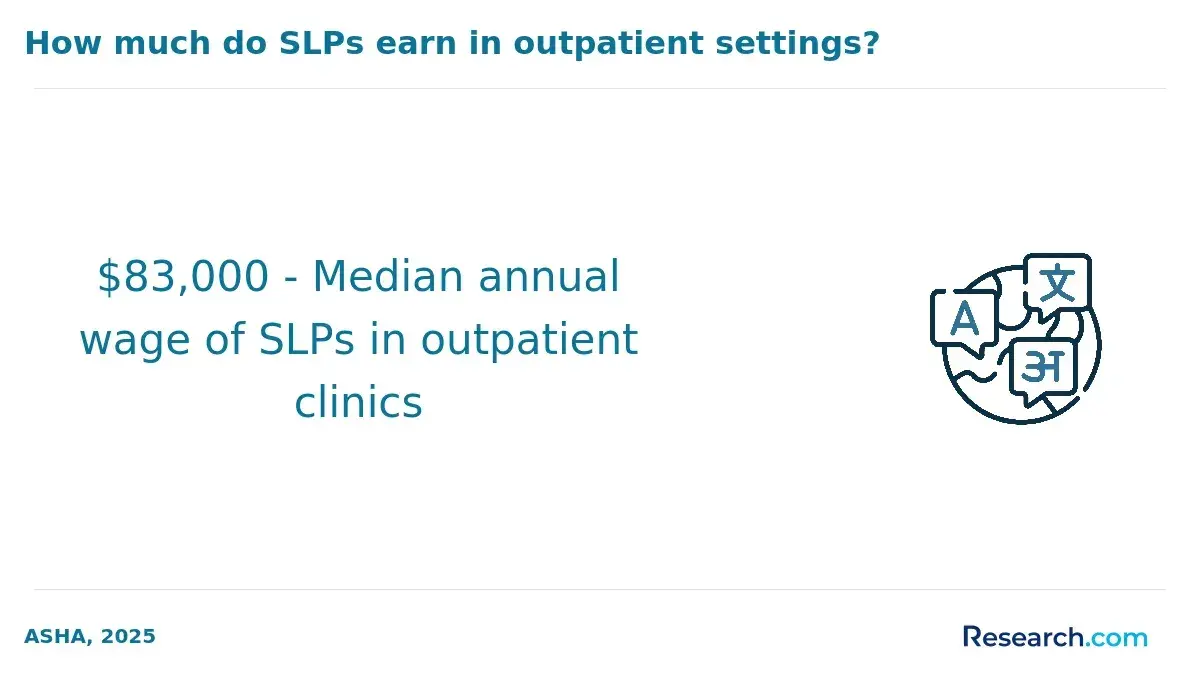
- Speech-language pathologists had a national median annual wage of $97,870 in May 2025, and the occupation is projected to grow 17% from 2025 to 2035; strong demand does not remove the need to verify Ohio licensure compatibility before enrolling.
Which online SLP master's programs accept Ohio residents and meet licensure requirements?
Several established online or hybrid master's programs in speech-language pathology may be options for Ohio residents, but "online" does not automatically mean a school is currently authorized to enroll Ohio students or able to support Ohio clinical placements. Enrollment eligibility, state disclosures, cohort availability, and placement capacity can change between admission cycles.
The programs below are examples worth investigating because they offer distance-based SLP graduate study. Before applying, obtain written confirmation that the program accepts Ohio residents for your intended start term and that it can support the clinical education needed for Ohio licensure.
| Program to investigate | Format considerations | Ohio-specific question to ask | Decision trade-off |
| Baylor University | Online coursework with required immersion and clinical education components | Is Ohio enrollment currently authorized, and can the program arrange or approve Ohio practicum sites? | National online structure may suit students seeking flexibility, but travel and placement requirements can add cost. |
| Emerson College | Online graduate SLP format with live learning, clinical placements, and required immersion experiences | Does the current Ohio professional licensure disclosure state that the curriculum meets or is intended to meet Ohio requirements? | Designed for distance learners, but scheduled sessions and immersions may not suit every work schedule. |
| New York University | Online-delivered SLP graduate study with fieldwork and in-person requirements | What are the required travel dates, and does the placement team have recent experience supporting Ohio sites? | May offer a broad clinical network, but private-university pricing can materially affect borrowing. |
| University of Cincinnati | Ohio-based graduate education option; delivery details and cohort offerings should be confirmed directly | Which courses, labs, and clinical experiences require in-person attendance, and where are placements typically completed? | An in-state institution can simplify local coordination, but it may not provide the same online flexibility as national programs. |
Use the table as a screening tool rather than a ranking. A program is a stronger fit when it confirms all three issues in writing: Ohio enrollment eligibility, CAA accreditation status, and a realistic clinical-placement process. Applicants comparing broader online speech and language pathology programs should also compare travel expectations and clinical support, not tuition alone.
How do Ohio licensing rules shape online speech-language pathology program eligibility and curriculum?
Ohio licensure rules shape nearly every important program choice. An online master's program must provide graduate-level academic preparation in speech-language pathology, supervised clinical education, and a pathway that supports the examination and post-graduate experience requirements applicable to Ohio licensure.
Ohio applicants should understand the difference between degree completion, national certification, and a state license. A master's degree is the academic credential. The Certificate of Clinical Competence in Speech-Language Pathology is ASHA's national professional credential. An Ohio license is the state authorization needed to practice where state law requires it. These milestones overlap, but they are not interchangeable.
Curriculum should include foundational and clinical content in areas such as speech sound disorders, language disorders, dysphagia, voice, fluency, audiology, research methods, ethics, and clinical decision-making. Programs may deliver lectures online, but client-facing assessment and treatment training cannot be completed solely through recorded coursework.
Students should ask admissions and licensure staff whether the program's curriculum is designed to meet Ohio requirements at the time of graduation. Do not rely on a general statement that a program "prepares students for licensure nationwide." A state-specific professional licensure disclosure is more useful because it identifies whether the institution has determined that its program meets, does not meet, or has not determined compliance with Ohio requirements.
What tuition, fees, and cost-of-living factors affect Ohio residents in online SLP programs?
The published tuition rate is only one part of the financial decision. Online SLP students may pay per-credit tuition, university fees, technology fees, health insurance charges, background-check costs, immunizations, clinical attire, testing fees, travel expenses, and costs associated with unpaid clinical rotations.
This cost comparison identifies the categories Ohio residents should request from each school before accepting an offer. Exact charges vary by institution, academic year, residency classification, credit load, and clinical location.
| Cost category | Why it matters for online SLP students | What to confirm before enrolling |
| Tuition | Programs may quote a per-credit rate, a term price, or a total estimate that excludes fees. | Total required credits, whether the quoted rate is locked, and whether Ohio residents receive a different rate. |
| Mandatory university fees | Distance-learning, student services, clinical, and graduation fees can increase the total beyond advertised tuition. | A written estimate of mandatory fees for every term. |
| Travel and immersion costs | Required campus visits can involve airfare, lodging, meals, ground transportation, and missed work. | Number, location, duration, and timing of all required immersions. |
| Clinical-placement expenses | Students may need to pay for background checks, drug screens, immunizations, transportation, and professional liability coverage. | Which expenses are paid by the program, site, or student. |
| Lost income | Full-time clinical rotations may limit paid work, even if lectures are online. | Expected weekly clinical hours and whether placements can be scheduled around employment. |
For many applicants, an apparently lower-priced program becomes less affordable if it requires multiple out-of-state immersions or leaves placement travel entirely to the student. Conversely, a higher tuition rate can be more manageable when a school offers predictable pacing, dependable placement support, and fewer travel obligations.
Ask each institution for a net-cost estimate rather than only a tuition quote. If speed is the priority, compare the added workload and borrowing implications of an accelerated speech-language pathology program with a standard full-time or part-time pathway.
How do online SLP programs arrange in-state and out-of-state clinical placements for Ohio students?
Clinical placement is the most important operational issue in an online SLP degree. Coursework may be delivered remotely, but clinical practicum requires supervised work with clients in approved settings such as schools, hospitals, rehabilitation facilities, outpatient clinics, early-intervention programs, or skilled nursing facilities.
CAA standards associated with ASHA certification preparation include at least 400 total supervised clinical experience hours. Of those hours, at least 375 must involve direct client or patient contact, while 25 may be guided clinical observation. Individual programs may require additional experiences or set their own sequencing rules.
Programs use different placement models. The difference affects convenience, risk, and the amount of work a student must do before beginning practicum.
- Program-arranged placements: The school's clinical team identifies and contracts with eligible sites, although the student may need to travel or accept a site outside a preferred city.
- Student-assisted placements: The student may suggest local sites or contacts, but the university must still approve the site, supervisor, affiliation agreement, and learning objectives.
- Student-secured placements: The student bears more responsibility for locating a site; this model can work for well-connected applicants but creates greater risk if local sites are full or cannot execute an affiliation agreement.
Ohio students should ask for realistic details, not broad assurances. Find out whether the school has placed students in Ohio recently, whether placements can be completed near your home, who handles affiliation agreements, how long approvals typically take, and what happens if a first-choice site declines. A school cannot ethically guarantee a particular school district, hospital, city, supervisor, or commute distance unless it has a confirmed placement.
A common mistake is assuming a workplace can automatically serve as a practicum site. Even when an employer is interested, the site must meet university requirements, the supervisor must have the appropriate credentials and experience, and the school must approve the arrangement before clinical hours begin.
Which accreditations and approvals should Ohio applicants verify for an online SLP program?
Accreditation and approval are separate checks. The most important programmatic credential for a master's degree leading to SLP practice is accreditation by the American Speech-Language-Hearing Association's Council on Academic Accreditation in Audiology and Speech-Language Pathology. Applicants should verify the program's current status directly through CAA or ASHA EdFind rather than relying on an old webpage or a school's marketing language.
CAA accreditation is especially important because it signals that the program has been evaluated against educational standards used in the pathway toward ASHA certification. However, accreditation alone does not confirm that a school is authorized to teach Ohio residents, that it has a placement available near you, or that all Ohio licensing requirements will be satisfied in your specific case.
Before paying a deposit, verify these separate items with the relevant institution and Ohio licensing authority:
- The program's current CAA accreditation status, including whether it is accredited or holds a different status such as candidacy.
- The university's state-specific professional licensure disclosure for Ohio.
- The school's institutional accreditation and distance-education authorization status.
- The graduate curriculum, clinical-hour structure, Praxis preparation, and clinical fellowship guidance.
- Whether the program can document supervised clinical experiences in the format needed for future credentialing applications.
Do not confuse institutional accreditation with CAA programmatic accreditation. A university can be institutionally accredited while a particular SLP program is not CAA-accredited. For an aspiring licensed SLP, that distinction can determine whether the degree supports the intended certification and licensure route.
How do Ohio's state authorization and SARA participation impact online SLP enrollment options?
State authorization determines whether an out-of-state institution may provide distance education to a resident of a particular state. Ohio participates in the State Authorization Reciprocity Agreement, commonly called SARA, which generally helps participating institutions offer distance education across member states.
SARA participation can reduce administrative barriers, but it is not a blanket professional-licensure approval. A program that can enroll an Ohio resident may still need to make separate determinations about whether its curriculum meets Ohio licensing requirements and whether it can arrange clinical education in Ohio.
Clinical placements deserve special attention because they may involve another layer of approval. A student who lives in Ohio but completes a placement in another state may encounter that state's site requirements, supervisor rules, fingerprinting procedures, school-district policies, or health-system onboarding requirements.
When comparing schools, ask whether any of the following restrictions apply to Ohio residents: enrollment limitations, restrictions on field placements, inability to make an Ohio licensure determination, or limits on students completing practicum outside their home state. Save the answer with your admissions materials; policies and disclosures can change after a website is updated.
What GPA, prerequisites, and background checks do Ohio-eligible online SLP programs typically require?
Admission standards vary, but online SLP master's programs usually expect a completed bachelor's degree, prerequisite coursework in communication sciences and disorders or equivalent subjects, a competitive undergraduate GPA, recommendation letters, a personal statement, and evidence that the applicant can complete clinical training. Some programs use CSDCAS, while others use their own graduate application system.
Applicants without a communication sciences and disorders major may need leveling coursework before entering the graduate sequence. This is not necessarily a disadvantage, but it can add time and cost. A student changing careers should ask whether prerequisites can be completed before admission, incorporated into the program, or transferred from another institution.
Common requirements that merit early attention include:
- Prerequisites in phonetics, anatomy and physiology of speech and hearing, language development, audiology, speech and hearing science, statistics, and related communication sciences coursework.
- ASHA-required foundational content in biological sciences, behavioral or social sciences, statistics, and physical sciences, which may need to be documented separately.
- Criminal background checks, fingerprinting, drug screening, immunization records, CPR certification, and health or safety training required by clinical sites.
- Technical requirements such as a reliable computer, webcam, secure internet access, and availability for live online sessions when required.
A strong GPA can help, but meeting a published minimum does not ensure admission. Schools may weigh prerequisite grades, communication-related experience, writing quality, recommendations, interview performance, and cohort capacity. Applicants exploring a speech language pathologist degree should treat "easier to get into" as a comparison of admissions policies, not as evidence that clinical or licensure standards will be easier.
How do online SLP degree plans align with Ohio's Praxis and supervised clinical hour standards?
Ohio-bound students should choose a degree plan that supports both academic graduation and the professional milestones that follow. Although requirements can change, the usual sequence is graduate degree completion, passing the Praxis examination required for the relevant credentialing pathway, completing a supervised clinical fellowship or other required post-graduate experience, and applying for Ohio licensure.
The Praxis requirement is particularly important because it is an external examination, not simply a final course grade. The Praxis Speech-Language Pathology examination passing score used for ASHA certification has been 162, but applicants should confirm the current required score and Ohio's current rules before scheduling the exam.
This timeline shows how major requirements fit together. It is a planning framework, not a substitute for the current rules of the Ohio licensing board, ASHA, or a student's graduate program.
| Milestone | How an online program should support it | What the Ohio student should verify |
| Graduate academic coursework | Delivers required knowledge and skills across communication disorders and clinical practice. | That the degree is a qualifying graduate SLP program and carries current CAA accreditation. |
| Clinical practicum | Provides supervision, tracking, and documentation of client-contact and observation hours. | That supervisors and experiences meet the school's, ASHA's, and applicable state expectations. |
| Praxis examination | May provide review resources, advising, or recommended testing timing. | Current Ohio and certification score requirements and when official scores must be sent. |
| Clinical fellowship or supervised post-graduate experience | May offer career advising but usually does not place every graduate into a fellowship job. | Ohio's current supervision, documentation, and application requirements before accepting a position. |
| Ohio licensure application | Provides official transcripts and clinical documentation as required. | Current forms, fees, background-check requirements, and any additional board documentation. |
Do not wait until graduation to investigate the fellowship stage. Ask whether the program tracks alumni outcomes, offers employer connections in Ohio, and explains how graduates document supervised experience. The national labor market is favorable: the Bureau of Labor Statistics projects 17% employment growth for speech-language pathologists from 2025 to 2035, with about 12,500 openings annually on average. That projection indicates demand, not a guarantee of a particular Ohio job, setting, schedule, or salary.
What funding options, employer tuition benefits, and loan considerations apply to Ohio SLP students online?
Funding an online SLP master's degree requires planning for both billed charges and the periods when clinical work may reduce earnings. Start with the Free Application for Federal Student Aid, then compare institutional scholarships, external awards, employer assistance, federal loans, and personal savings before relying on high-cost private borrowing.
Graduate students who qualify may generally access Direct Unsubsidized Loans, subject to the federal annual limit of $20,500 and aggregate borrowing limits. Graduate PLUS Loans may cover remaining education costs up to the school-certified cost of attendance after other aid, but they require a credit check and accrue interest. Borrow only after reviewing the program's total estimated cost and your expected repayment obligations.
Ohio applicants can reduce financial risk by taking these steps before committing:
- Request a term-by-term estimate that separates tuition, mandatory fees, travel, clinical expenses, and expected books or equipment.
- Ask your employer whether tuition assistance applies to graduate clinical degrees and whether continued employment, grade, or repayment conditions apply.
- Compare full-time, part-time, and accelerated pacing based on the effect on work income, not simply the number of months to graduation.
- Use the school's financial-aid office to confirm which scholarships remain available after the first year and whether aid changes during clinical rotations.
- Estimate repayment using the amount you expect to borrow, not the school's lowest advertised tuition figure.
Return on investment depends on debt, time away from paid work, licensure completion, geographic labor markets, and the job setting selected after graduation. The national median annual wage was $97,870 in May 2025, but earnings vary substantially by employer, experience, location, hours, and specialty. Review context around speech pathologist salary with a master's degree without treating compensation figures as a promise of individual earnings.
How can Ohio residents independently verify clinical site availability, licensure portability, and program outcomes?
The best way to evaluate an Ohio-eligible online SLP program is to collect written answers before enrolling. Websites are useful starting points, but admissions representatives, clinical-placement staff, financial-aid offices, and professional licensure contacts should confirm details that affect your eligibility and cost.
Use this verification sequence to reduce avoidable risk:
- Confirm the program's current CAA accreditation status through ASHA's official accreditation and program directory resources.
- Read the institution's Ohio professional licensure disclosure and ask for clarification if it says the school has not made a determination.
- Ask whether the school is accepting Ohio residents for your exact start term and intended concentration or delivery format.
- Request the complete clinical-placement policy, including student responsibilities, travel expectations, site-approval process, and contingency plan when a placement falls through.
- Ask for a complete cost-of-attendance estimate and identify whether quoted tuition includes required immersions, clinical fees, and technology charges.
- Review the program's most recent outcomes information, such as Praxis pass rates, program completion rates, employment outcomes, and graduation timelines, while noting the reporting period and cohort size.
- Verify current Ohio licensure requirements directly with the state board before making an enrollment decision.
Red flags include a school that will not provide an Ohio-specific licensure statement, cannot explain who is responsible for placements, advertises a low per-credit tuition rate without a total-cost estimate, or treats accreditation as the only question that matters. A transparent program should be able to explain its approval status, clinical model, student costs, travel requirements, and the limits of what it can guarantee.
Other Things You Should Know About Speech Language Pathology
Potentially, yes, if the degree is from an appropriately accredited program, includes required supervised clinical education, supports the relevant Praxis and post-graduate requirements, and meets Ohio's current licensing rules. "Fully online" usually refers to didactic coursework; clinical experiences and immersion activities still require in-person participation.
It depends on the program. Some schools arrange placements, some allow students to recommend sites, and others expect substantial student participation. Ask for the written placement policy and confirm what happens if a preferred Ohio site is unavailable.
Length varies by prerequisite background, credit load, clinical sequencing, and program design. Students entering without communication sciences prerequisites may need additional coursework before or alongside graduate study. Required clinical placements can also limit how quickly a student progresses.
Not automatically. Compare total cost, including fees, travel, lost work time, and clinical expenses. A lower tuition rate may be less valuable if the school offers limited placement support, requires expensive travel, or does not provide clear Ohio licensure guidance.
References
- Hybrid Online MS-SLP Program | Full & Part-Time | USAHS https://www.usa.edu/college-of-rehabilitative-sciences/master-science-speech-language-pathology-ms-slp/
- Online MA in Communication Sciences & Disorders https://onlinelearning.csuohio.edu/programs/online-masters-communication-sciences-disorders
- Best Online Speech Pathology Programs https://www.forbes.com/advisor/education/healthcare/best-speech-pathology-programs-online/
- 2026 Most Affordable Online Speech Pathology Master's... https://www.onlineu.com/most-affordable-colleges/speech-pathology-masters-degrees
- Best Online MSLP Programs with No GRE Required for 2026 https://www.speechpathologydegrees.com/online/mslp-no-gre-required