2027 Emerson vs University of St. Augustine SLP Master's: Online and Hybrid Study Compared

Co-Founder and Chief Data Scientist

Reviewed by Rhea Paul, PhD
SLP Education & Research Expert
Choosing between Emerson College and the University of St. Augustine for Health Sciences (USAHS) means weighing two different ways to complete a clinical master's degree in speech-language pathology. Emerson is known for an online-first cohort model with required in-person experiences, while USAHS uses a hybrid, campus-connected approach. This comparison explains the practical differences in coursework, travel, placements, accreditation, licensure preparation, admissions, and outcomes so prospective SLP students can identify which delivery model better fits their location, schedule, and professional goals.
Key Things You Should Know
- Emerson's MS in Speech-Language Pathology is designed as an online-first program with required in-person clinical experiences, whereas USAHS's MS-SLP is a hybrid program tied more directly to its physical campus locations and scheduled on-campus learning.
- CAA accreditation - not whether classes are labeled online or hybrid - is the essential threshold for a graduate seeking ASHA certification and state SLP licensure; applicants should confirm each program's current CAA status and state authorization before depositing.
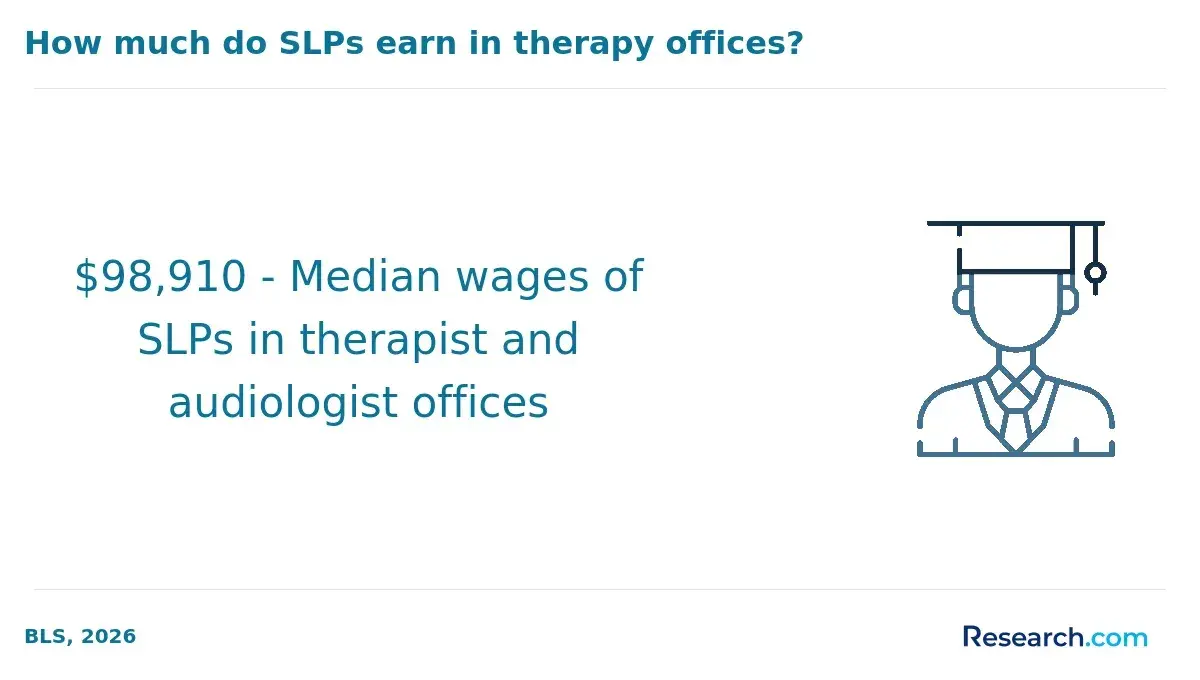
- SLP is a strong-demand clinical field: the U.S. Bureau of Labor Statistics reports a May 2025 median annual wage of $97,870 and projects 17% employment growth from 2025 to 2035, but graduation alone does not ensure a license, placement, job, or salary.
How do Emerson and University of St. Augustine structure their SLP master's delivery formats online and hybrid?
The central distinction is not simply "online versus in person." Both pathways require hands-on supervised clinical education. The meaningful difference is where academic instruction occurs, how often students must travel, and how closely the program experience is organized around a campus.
Emerson's program is commonly described as an online MS in Speech-Language Pathology. Didactic learning is delivered primarily online in a structured cohort, with live and collaborative components as assigned. Students should expect required in-person immersion or residency experiences and local clinical education; it is not a degree that can be completed entirely from home.
USAHS presents its MS-SLP as a hybrid pathway. Hybrid delivery generally combines online coursework with required learning at a designated USAHS campus or regional site. That model can appeal to students who want recurring face-to-face faculty and peer contact, but it can create a larger travel, relocation, and scheduling commitment than an online-first program.
The comparison below focuses on the operational questions that affect whether a format is workable, rather than treating either label as inherently better.
| Decision factor | Emerson College MS-SLP | USAHS MS-SLP |
| Primary academic delivery | Online-first cohort instruction | Hybrid instruction combining online and campus-based learning |
| In-person requirement | Required immersion/residency and clinical education experiences | Required campus-based learning plus clinical education experiences |
| Best fit | Students seeking an online-centered academic format who can meet travel requirements | Students who prefer a more campus-connected hybrid structure |
| Clinical training | Supervised practicum and full-time clinical experiences are required | Supervised practicum and full-time clinical experiences are required |
| Important limitation | Online coursework does not remove travel or placement obligations | Hybrid coursework does not necessarily mean a nearby campus or placement |
Choose Emerson if you need most classroom learning to happen remotely and can plan around fixed immersion and clinical dates. Choose USAHS if a hybrid structure and greater connection to a campus community are advantages rather than barriers. Students comparing broader online SLP programs masters options should compare required travel and clinical placement policies alongside tuition, not after admission.
How do Emerson's and University of St. Augustine's SLP curricula differ in clinical focus and sequence?
Both programs are intended to prepare students for entry-level SLP practice through graduate academic work and supervised clinical education. A typical CAA-aligned curriculum includes speech sound disorders, language disorders, swallowing, voice, fluency, neurogenic communication disorders, research or evidence-based practice, ethics, and clinical methods.
The more useful comparison is curricular sequence. Emerson's online-centered model typically integrates online academic courses with clinical preparation before students move through practicum and advanced clinical experiences. USAHS's hybrid design may make faculty-led skills practice and campus-based activities more visible in the early sequence. Exact course titles, credit totals, and rotation timing can change by catalog year and campus, so applicants should review the catalog governing their intended cohort.
Neither curriculum should be judged only by whether it lists a pediatric or medical course. Ask how students progress from observation and simulation into supervised work with children and adults, and whether specialty opportunities depend on local availability.
| Curricular question | Why it matters | What to confirm with either program |
| Prerequisite coverage | Missing communication-sciences prerequisites can delay entry or require leveling coursework | Required undergraduate courses, grade minimums, and whether courses may be completed before enrollment |
| Clinical sequencing | Placement timing affects employment and family planning | When clinic begins, when full-time externships occur, and whether dates are fixed |
| Adult and pediatric exposure | Broad exposure supports informed career planning and clinical competence | How experiences are arranged and whether a setting or population is guaranteed |
| Research and evidence-based practice | These skills support clinical decision-making and Praxis preparation | Capstone, research, assessment, and data-analysis expectations |
Applicants drawn to a shorter academic timeline should be cautious with marketing terms such as accelerated. A compressed sequence can reduce calendar time, but clinical hours, prerequisite gaps, travel, and a full-time externship can still make it difficult to work. Review accelerated speech pathology programs only after confirming that their pacing and clinical calendar are compatible with your obligations.
What are the key differences in clinical practicum, placements, and telepractice options between these SLP programs?
Clinical placement is usually the deciding issue for online and hybrid SLP applicants. A master's program must provide supervised clinical education, but the school, student, and site may each have responsibilities in securing and completing placements. Do not assume a program can place you near home, in your preferred specialty, or at your current employer.
Emerson's model is designed to support students completing clinical education in varied geographic areas, subject to program processes, site availability, contracts, supervisor qualifications, and state rules. USAHS students should similarly ask whether placements are coordinated near their enrolled campus, near their residence, or across a broader region. The answer can differ by cohort, state, and clinical need.
Telepractice can be a learning modality or clinical service setting, but it does not eliminate supervision standards, client privacy obligations, or state practice requirements. It is especially important to ask whether telepractice is optional, available only when a site offers it, and counted toward the school's clinical education requirements.
Before accepting an offer, obtain written answers to the following placement questions.
- Who is responsible for identifying, contacting, and contracting with clinical sites?
- What happens if a local site declines a placement or lacks an eligible supervisor?
- Are students required to travel, relocate temporarily, or accept evening, school-year, or full-time rotations?
- Which costs are separate from tuition, including background checks, immunizations, travel, lodging, liability coverage, and site onboarding?
- Can a student complete an externship with an employer or preferred site, and what approvals are required?
A program that provides substantial placement coordination may reduce administrative burden, but it cannot reasonably guarantee a specific city, school district, hospital, diagnosis group, or telepractice experience. Get placement commitments and contingency policies in writing rather than relying on informal assurances.
Which accreditors oversee Emerson and University of St. Augustine SLP programs, and is each ASHA CAA accredited?
For a future clinical SLP, programmatic accreditation is more consequential than institutional reputation alone. The Council on Academic Accreditation in Audiology and Speech-Language Pathology (CAA), part of the American Speech-Language-Hearing Association (ASHA), evaluates entry-level graduate programs against standards for curriculum, faculty, assessment, resources, and clinical education.
Emerson College's MS in Speech-Language Pathology and USAHS's MS-SLP should each be evaluated through the current CAA program directory for the exact program and location or delivery pathway under consideration. CAA status can be accredited, candidate, or subject to reporting changes; institutional accreditation is not a substitute for CAA status. A student should never infer that one accredited track automatically covers every campus, future cohort, or new delivery option.
CAA accreditation is generally the educational foundation used for ASHA Certificate of Clinical Competence eligibility and is commonly expected by state licensing boards and employers. It does not independently grant ASHA certification or a state license. Graduates still must meet applicable requirements for supervised clinical fellowship, examination, application, and state-specific documentation.
Use this verification sequence before enrolling.
- Find the exact degree and location in the current CAA directory and save the status page for your records.
- Read the school's current catalog and professional-licensure disclosure for your state of residence and intended practice state.
- Contact the relevant state SLP licensing board to confirm that the planned pathway meets its education requirements.
- Ask admissions to explain, in writing, how an accreditation change, new campus, or program closure would affect currently enrolled students.
This extra diligence is worthwhile because eligibility depends on the precise program, not a broad statement that a university offers health-sciences degrees.
How do Emerson and University of St. Augustine meet state licensure requirements for SLPs across different jurisdictions?
State licensure is jurisdiction-specific. Emerson and USAHS may publish professional-licensure disclosures explaining where a program is designed to meet educational requirements, where a determination has not been made, or where enrollment may be restricted. Those disclosures are useful, but they do not replace a licensing board's decision on an individual application.
For most U.S. jurisdictions, a practicing SLP needs a qualifying graduate degree, supervised post-graduate experience or clinical fellowship where required, a passing Praxis score, and a state license. Requirements vary in timing, terminology, fingerprinting, jurisprudence rules, telepractice rules, and whether ASHA certification is required or accepted as evidence of qualifications.
Your residence during study, clinical-site location, and intended practice location may all matter. This is particularly important for online students who move, complete a placement across state lines, or expect to provide telepractice services to clients located in another state.
| Situation | Potential issue | Best verification source |
| You live in a different state from the university | Distance-education authorization and clinical-placement approval may differ by state | University licensure disclosure and state authorization office |
| You plan to move after graduation | The destination board may have distinct documentation or fellowship rules | Destination state SLP licensing board |
| You want telepractice work | Client location, license type, and employer policy can affect authorization | State licensing board and prospective employer |
| You have prior discipline or a criminal-history concern | Licensing eligibility may be reviewed individually | State board before making an enrollment commitment |
Neither school can promise licensure in every state or future regulatory environment. The safest choice is the program that has a clear written determination for your situation and a clinical plan that does not require you to make unsupported assumptions about cross-state practice.
What are the admission standards, cohort models, and start dates for each SLP program's online or hybrid track?
Both programs use cohort-based professional education rather than open-ended self-paced enrollment. Students generally move through a planned sequence because later clinical and academic courses depend on earlier competencies. That structure can provide community and predictable milestones, but it limits the ability to pause, take one course at a time, or rearrange clinical terms.
Applicants should expect graduate-level evaluation of academic record, prerequisite preparation, written materials, recommendations, and other current application requirements. Policies such as minimum GPA, GRE submission, observation hours, interviews, application systems, deadlines, and prerequisite completion rules may change by cycle. A requirement shown for a prior class should not be treated as binding for a future start.
The practical admissions comparison is below. It identifies what applicants need to verify directly instead of implying that selective health-professions programs have interchangeable standards.
| Admissions issue | Emerson online-first pathway | USAHS hybrid pathway |
| Cohort structure | Planned cohort progression | Planned cohort progression, potentially linked to campus availability |
| Start dates | Confirm current admissions-cycle start terms | Confirm current campus-specific start terms |
| Prerequisites | Confirm CSD prerequisite list and completion deadline | Confirm CSD prerequisite list and completion deadline |
| Application requirements | Confirm current official admissions checklist | Confirm current official admissions checklist and campus requirements |
| Deferral and leave policies | Ask whether a cohort seat can be deferred and how clinical sequence changes | Ask whether a campus cohort seat can be deferred and how clinical sequence changes |
Do not choose based on a perceived "easy" admission route. Applicants using guides to easiest SLP grad schools to get into should still prioritize CAA status, prerequisite fit, financial feasibility, state eligibility, and clinical placement support. An accessible application process does not make a program a good fit if its required travel or schedule is unmanageable.
How do time-to-degree, course load expectations, and scheduling flexibility compare between Emerson and USAHS SLP pathways?
Both pathways are intensive professional master's programs, not casual part-time online degrees. The total time to graduation depends on the prescribed curriculum, prerequisite status, clinical calendar, satisfactory academic progress, and whether a student must repeat or defer a course or clinical experience.
Emerson's online-first design may offer geographic flexibility for academic coursework, but synchronous sessions, group work, immersion dates, and clinical rotations can substantially limit flexibility. USAHS's hybrid structure can provide more regular in-person learning, but scheduled campus participation can be harder for students who live far from the assigned location or have inflexible work hours.
Full-time clinical rotations are often the largest scheduling constraint in either option. Even if early coursework permits some employment, students should not budget on the assumption that they can maintain a full-time job throughout every phase of the degree.
Use a personal calendar, not a marketing timeline, to compare the programs. Map class meeting windows, travel days, campus requirements, practicum hours, likely externship terms, childcare coverage, and the time needed for licensure steps after graduation. If either school offers more than one pacing option, verify whether every option includes the same clinical sequence and whether it is available to your state.
For context on career return, the national occupation data are favorable but not personalized: BLS projects 17% growth in SLP employment from 2025 to 2035. That outlook supports careful planning for a licensed profession; it does not tell an individual student how quickly they will complete a program or find a position in a particular market.
What technology platforms, learning supports, and residency expectations distinguish Emerson's online SLP from USAHS's hybrid model?
An online-first SLP program requires dependable technology, disciplined time management, and active participation. A hybrid program adds those requirements to recurring in-person participation. In both cases, students should expect a learning-management system, video-conferencing tools, secure communication practices, digital clinical documentation training, and technical standards for audio and video quality.
Emerson applicants should pay close attention to its published device, connectivity, live-session, and immersion expectations. USAHS applicants should focus on campus schedule, travel distance, attendance rules, and whether the assigned campus - not merely the university - is workable. Required residencies or campus sessions should be treated as academic obligations, not optional networking events.
Support quality is best evaluated through concrete questions: availability of faculty office hours, disability accommodations, academic advising, clinical education staff, library access, technology support outside standard business hours, and remediation processes. Ask how the program responds when a student loses internet access during a live assessment activity or cannot attend a required session because of an emergency.
Modern clinical training also increasingly involves telepractice platforms, electronic health records, simulation, and privacy safeguards. These tools can build relevant experience, but they do not replace direct supervision, client contact, or the clinical judgment developed in supervised placements.
How do graduate outcomes, Praxis pass rates, and employment data compare for Emerson and USAHS SLP students?
Outcome reporting deserves careful reading because schools may report different graduating classes, denominators, time windows, and definitions of employment. The most comparable institution-level measures are those reported through CAA-required outcome disclosures: program completion rate, Praxis examination pass rate, and employment rate for recent cohorts.
Applicants should request or locate the current outcome disclosure for the exact Emerson and USAHS program pathway they are considering, then compare the same reporting years. Do not compare one program's first-time Praxis rate with another program's eventual pass rate, or one program's employment figure with another program's job-placement figure, as those are not equivalent measures.
The broader labor market helps explain why outcomes matter. The BLS lists a May 2025 median annual wage of $97,870 for speech-language pathologists, or $47.05 per hour. That national median is not an entry-level offer, a regional wage estimate, or a forecast for any graduate; school settings, medical settings, experience, payer mix, and location affect compensation. Readers can explore occupational variation through this speech-language pathologist salary resource.
Ask each program for the most recent disclosure and interpret it with four questions in mind.
- Which graduating cohorts are included, and how many students are in the denominator?
- Does the Praxis figure refer to first-time takers, eventual passers, or all graduates?
- How does the program define employment, and when are graduates surveyed?
- Are outcomes separated by campus, delivery pathway, or cohort when those experiences differ?
A strong outcome report is informative, but it is not a promise of admission, graduation, certification, licensure, or employment. It is one indicator to combine with fit, placement planning, cost, and state authorization.
What consumer-protection risks and verification steps should SLP applicants take when choosing between these programs?
The largest preventable risk is committing to a program based on a general online or hybrid label instead of the exact requirements that apply to you. Tuition alone can also be misleading when travel, temporary housing, clinical onboarding, technology, insurance, books, and delayed earnings during full-time rotations are not included in the plan.
Common red flags include vague answers about placements, pressure to enroll before reviewing state disclosures, claims that a program is "100% online" despite required clinical travel, and outcome statistics without a cohort year or denominator. Another mistake is assuming that institutional accreditation, approval to operate in a state, and CAA accreditation mean the same thing. They do not.
Take these steps before paying a nonrefundable deposit.
- Confirm current CAA status for the exact degree and campus or delivery pathway.
- Read the official catalog, tuition and fee schedule, refund policy, and professional-licensure disclosure that apply to your start term.
- Build an all-in budget that includes travel, housing, health requirements, background checks, equipment, and time away from work during clinical rotations.
- Obtain written clarification on placement coordination, required travel, live attendance, and what happens if a site cannot be secured.
- Contact the licensing board in the state where you expect to practice and retain its guidance with your application records.
- Compare current CAA outcome disclosures using identical reporting definitions and years.
Emerson is likely the better fit for applicants prioritizing an online-centered academic experience and able to manage mandated immersions and local clinical training. USAHS may fit applicants who want a structured hybrid experience and can meet the obligations of the relevant campus. For either choice, the best decision is the one supported by verified accreditation, licensure compatibility, a realistic placement plan, and an all-in financial plan.
Other Things You Should Know About Speech Language Pathology
Some students work during portions of graduate school, but full-time employment can become unrealistic during intensive coursework, required campus experiences, and full-time clinical rotations. Ask each program for a sample weekly schedule and clinical calendar before assuming work can continue.
The delivery format itself does not determine licensure. What matters is whether the exact program meets applicable educational, clinical, examination, fellowship, and state-board requirements. A CAA-accredited program is important, but you must still meet your state's individual requirements.
Not automatically. Compare total cost, including required travel, temporary housing, fees, clinical onboarding expenses, and income you may give up during rotations. A lower tuition figure can cost more overall if travel or delayed completion is substantial.
You should not assume so. Placement availability depends on site capacity, contracts, qualified supervisors, program requirements, and state rules. Ask each school whether it can support placements near your residence and what alternatives apply if a local site is unavailable.
References
- Emerson College Online Master's in Speech Pathology https://speech.emerson.edu/
- Hybrid Online MS-SLP Program | Full & Part-Time | USAHS https://www.usa.edu/college-of-rehabilitative-sciences/master-science-speech-language-pathology-ms-slp/
- Best Online Master's in Speech-Language Pathology for 2026 https://healthscience.pepperdine.edu/online-masters-in-speech-language-pathology/article/best-online-masters-in-speech-language-pathology-programs-guide.htm