2027 Best Online Speech Pathology Master's Programs for Residents of Chandler, AZ

Co-Founder and Chief Data Scientist

Reviewed by Rhea Paul, PhD
SLP Education & Research Expert
Choosing an online speech-language pathology master's program from Chandler is not simply a matter of finding a remote course format. Arizona licensure, CAA accreditation, local clinical placements, required campus travel, and state authorization can determine whether a degree supports your goal of becoming an SLP.
This guide helps prospective students compare Chandler-friendly options, identify questions schools must answer in writing, evaluate total cost, and avoid enrolling in a program that does not fit Arizona's professional requirements.
Key Things You Should Know
- For Arizona clinical licensure, the safest choice is a master's program accredited by ASHA's Council on Academic Accreditation (CAA) that confirms its curriculum and supervised clinical training support Arizona requirements.
- "Online" SLP programs are usually hybrid in practice: Chandler students should expect supervised local placements and may need to travel for skills intensives, orientations, simulations, or other campus-based requirements.
- The Bureau of Labor Statistics projects 17% employment growth for speech-language pathologists from 2025 to 2035, with about 12,500 openings annually; demand does not remove the need to verify licensure eligibility before paying a deposit.
Which online speech pathology master's programs accept students living in Chandler, AZ?
Chandler residents can consider online or distance-delivered master's programs offered by institutions that are authorized to educate Arizona residents and can arrange or approve clinical education in Arizona. "Best" does not mean the same program for every applicant: a program with lower travel demands may fit a working educator, while a more structured cohort may suit a student who wants predictable live instruction and stronger placement coordination.
The programs below are commonly considered by applicants seeking an online SLP pathway. Before treating any school as available, obtain a current written confirmation that it accepts Arizona residents for the specific cohort and that its professional-licensure disclosure addresses Arizona. State eligibility can change by term, program track, or clinical-site capacity.
| Program | Online format considerations | Clinical education considerations for Chandler residents | Best fit |
| Emerson College, Master of Science in Speech-Language Pathology | Online coursework with a cohort-based structure and required experiential components. | Clinical placements are a core requirement; ask whether the school secures, approves, or requires the student to help identify Arizona sites. | Applicants seeking a structured online curriculum and clear advising on field education. |
| New York University, MS in Communicative Sciences and Disorders | Distance-delivered graduate coursework with scheduled learning activities and in-person requirements that should be confirmed for the current cohort. | Ask about placement coordination, travel expectations, and whether Arizona sites have recently been used. | Students comfortable with a nationally delivered program and possible travel. |
| Baylor University, MS in Communication Sciences and Disorders | Online-delivered coursework with clinical and immersive components. | Confirm Arizona enrollment eligibility, required visits, local preceptor standards, and placement responsibility before applying. | Students who prefer a lockstep cohort and can plan ahead for intensive experiences. |
| University of Southern California, MS in Speech-Language Pathology | Online pathway with a sequenced curriculum and required clinical education. | Ask for the Arizona-specific licensure disclosure and a written explanation of clinical-placement procedures. | Applicants who value a large university's online infrastructure and can evaluate its higher total-cost implications. |
The comparison is a starting point rather than a guarantee of availability. Review additional online speech language pathology programs only after filtering for CAA status, Arizona authorization, travel requirements, and clinical-placement support.
How do Arizona licensure rules shape online speech pathology program choices for Chandler residents?
Arizona regulates speech-language pathology through the Arizona Department of Health Services. A master's degree is only one part of the route to independent practice. Applicants generally need qualifying graduate education, supervised professional experience, and applicable examination or credentialing documentation under current Arizona rules. Requirements can differ for state licensure, ASHA certification, school employment, and clinical-fellowship arrangements.
For Chandler residents, the practical implication is straightforward: an online program should be chosen for its ability to support the entire licensing sequence, not merely for its virtual classes. A school may be CAA-accredited yet still need to evaluate whether its curriculum, clinical clock-hour documentation, and state authorization disclosures align with a student's Arizona plans.
Ask every admissions or licensure-disclosure office for an Arizona-specific answer to the following questions before enrolling:
- Does the institution currently permit Arizona residents to enroll in this exact SLP master's cohort?
- Does the program state that its curriculum is designed to meet Arizona educational requirements for SLP licensure, or does it identify any gaps?
- How are supervised clinical hours documented, and are supervisors required to hold credentials acceptable for Arizona practice and ASHA standards?
- Can the program support an Arizona clinical fellowship plan after graduation, or must the graduate independently arrange that employment and supervision?
A common mistake is assuming that Arizona's participation in interstate distance-education arrangements resolves professional-program eligibility. Institutional authorization and professional licensure alignment are related but separate checks. Get both answers in writing, keep copies, and recheck them if your state of residence changes.
What accreditation and institutional approvals must an online speech pathology master's have for Chandler graduates?
CAA accreditation is the central academic quality check for a graduate SLP degree intended to support ASHA certification and the usual state-licensure pathway. CAA is ASHA's Council on Academic Accreditation in Audiology and Speech-Language Pathology. Its status categories matter: accreditation, candidacy, and approval processes are not interchangeable, and a program's status should be verified for the specific degree and location or modality.
Chandler applicants should evaluate three separate approvals. Each protects against a different risk.
| Approval or verification | What it addresses | Why it matters |
| CAA program accreditation | Academic and clinical education standards for the SLP degree. | It is the most important program-level credential for students pursuing ASHA certification and a conventional SLP licensure route. |
| Institutional accreditation | The university's overall academic oversight and eligibility for federal aid. | It helps establish that the institution, not only the individual program, meets recognized quality standards. |
| Arizona state authorization and licensure disclosure | Whether the school may enroll Arizona distance students and what it states about Arizona professional requirements. | It identifies enrollment restrictions and prevents reliance on generic national marketing claims. |
| Arizona licensing-board requirements | The state's rules for the individual applicant and future professional practice. | Only the board can ultimately determine whether an applicant meets current state standards. |
Do not confuse a university's regional or institutional accreditation with CAA accreditation of the SLP degree. Likewise, do not rely on a school's statement that a program "prepares students for licensure" without reading the Arizona-specific disclosure and confirming whether the statement applies to online students.
Which ASHA-recognized online speech pathology programs are regionally authorized to enroll Arizona students?
ASHA does not simply label online programs as "recognized." The relevant status is whether the degree program is accredited by CAA, which can be checked through ASHA's program directory and the university's own accreditation disclosure. An Arizona resident also needs confirmation that the institution is currently authorized to enroll them and that the program's clinical model can operate in Arizona.
Programs such as Emerson College, New York University, Baylor University, and the University of Southern California are examples of institutions with distance-delivered SLP pathways that prospective Arizona students may investigate. They should not be treated as automatically available to every Chandler applicant. Enrollment authorization, cohort availability, required travel, and placement capacity are operational matters that can change.
A meaningful shortlist should include only programs that provide all of the following in current writing:
- CAA accreditation status for the specific master's program and delivery pathway.
- A statement that Arizona residents may apply and enroll in the intended start term.
- An Arizona professional-licensure disclosure that addresses whether the curriculum meets, does not meet, or has not been determined to meet state educational requirements.
- A clear explanation of required campus visits, simulations, intensives, or other travel obligations.
- A clinical-placement policy explaining the respective responsibilities of the school and student.
If a university cannot provide these details before an application fee or enrollment deposit is due, treat that as a decision risk rather than a minor administrative delay. Another CAA-accredited program with a transparent Arizona process may be the better choice.
How do Chandler-friendly online speech pathology programs differ in clinical placement models and local practicum support?
Clinical education is the part of an online SLP master's degree that cannot be made fully virtual. Students must complete supervised practicum and externship experiences involving real clients or patients. For Chandler residents, placements may occur in school districts, outpatient clinics, hospitals, rehabilitation settings, early-intervention programs, or other approved sites in the Phoenix metropolitan area, but no program should promise a Chandler placement unless it specifically confirms one.
Programs generally use one of three models. The model affects workload, commute expectations, and how much placement risk the student carries.
| Placement model | How it works | Trade-off for Chandler students |
| University-arranged | The program identifies and contracts with sites, then assigns or matches students where capacity permits. | Usually reduces administrative burden, but geographic preference and exact schedule may be limited. |
| Student-assisted placement search | The student suggests potential sites while the university evaluates affiliation, supervision, and fit. | May offer local flexibility, but an affiliation delay can affect progression or graduation timing. |
| Student-secured placement | The student is primarily responsible for locating a qualified site and supervisor, subject to school approval. | Can work for well-connected local professionals but creates substantial risk for career-changers without provider networks. |
Before choosing a program, ask whether placements occur during standard weekday business hours, whether students may decline an unreasonable commute, how long affiliation agreements typically take, and what happens if a site withdraws. Educators should also ask whether school-based employment can count toward practicum; it usually cannot be assumed because client mix, supervision, and conflict-of-interest rules apply.
Strong placement support is especially valuable in a large metro area where sites may have their own onboarding, fingerprinting, immunization, background-check, and training requirements. Build time and money into your plan for commuting, unpaid clinical hours, healthcare compliance, and potential travel beyond Chandler.
What are the admission requirements and prerequisites for top online speech pathology programs serving Chandler?
Admissions requirements vary, but competitive SLP master's applicants usually need a bachelor's degree, foundational coursework in communication sciences and disorders or approved equivalents, academic references, a personal statement, and evidence that they can succeed in graduate-level science and clinical training. Many programs use CSDCAS or a university application system; some require the GRE, while others do not.
Career-changers should pay particular attention to prerequisites. A non-CSD bachelor's degree does not automatically prevent admission, but it can mean completing leveling courses before or alongside graduate study. Compare the sequence, cost, and effect on financial-aid eligibility rather than choosing solely on the advertised master's duration. Applicants seeking broader admissions context can review easiest SLP grad schools to get into, but a lower apparent barrier should never outweigh accreditation or Arizona clinical-placement fit.
A competitive application package usually requires the following items, although each university sets its own standards:
- An accredited bachelor's degree or equivalent undergraduate preparation.
- Required CSD prerequisites, often including anatomy and physiology of speech and hearing, phonetics, language development, audiology, speech science, and statistics.
- General education sciences that meet ASHA certification standards, where applicable.
- Official transcripts, recommendation letters, a statement of purpose, and any required observation or experience documentation.
- English-language proficiency evidence for applicants whose prior education does not meet the institution's stated language requirement.
Do not submit an application before mapping every prerequisite to the school's current list. A course title that sounds similar may not satisfy a requirement, and a missing prerequisite can delay enrollment even after admission.
How do tuition, fees, and total cost of attendance compare across Chandler-eligible online speech pathology programs?
Total cost is more useful than a headline tuition rate. Online SLP programs may bill by credit, term, or cohort, and some separate tuition from technology, clinical, immersion, graduation, health-insurance, and university fees. A lower per-credit figure can still produce a higher total if the program requires more credits, multiple campus trips, or extra prerequisite coursework.
Because published rates, residency rules, and required fees change, Chandler applicants should request a term-by-term written estimate from each program. The table identifies the cost categories that should be made comparable before deciding.
| Cost category | What to request | Why it changes the comparison |
| Program tuition | Total tuition for all required graduate credits, not only the first term or per-credit rate. | Programs can require different credit totals and may change rates annually. |
| Mandatory university and program fees | Technology, clinical, lab, assessment, student-service, and graduation fees. | These charges may not appear in an advertised tuition figure. |
| Travel and immersion expenses | Number, location, and duration of required visits plus estimated lodging and transportation. | Online delivery does not eliminate travel costs. |
| Clinical compliance expenses | Background checks, fingerprinting, drug screens, immunizations, liability insurance, and site onboarding. | These costs are often required before placements begin. |
| Lost-work and commute costs | Expected weekday practicum hours and likely travel range. | For working adults, reduced earnings can be as consequential as billed tuition. |
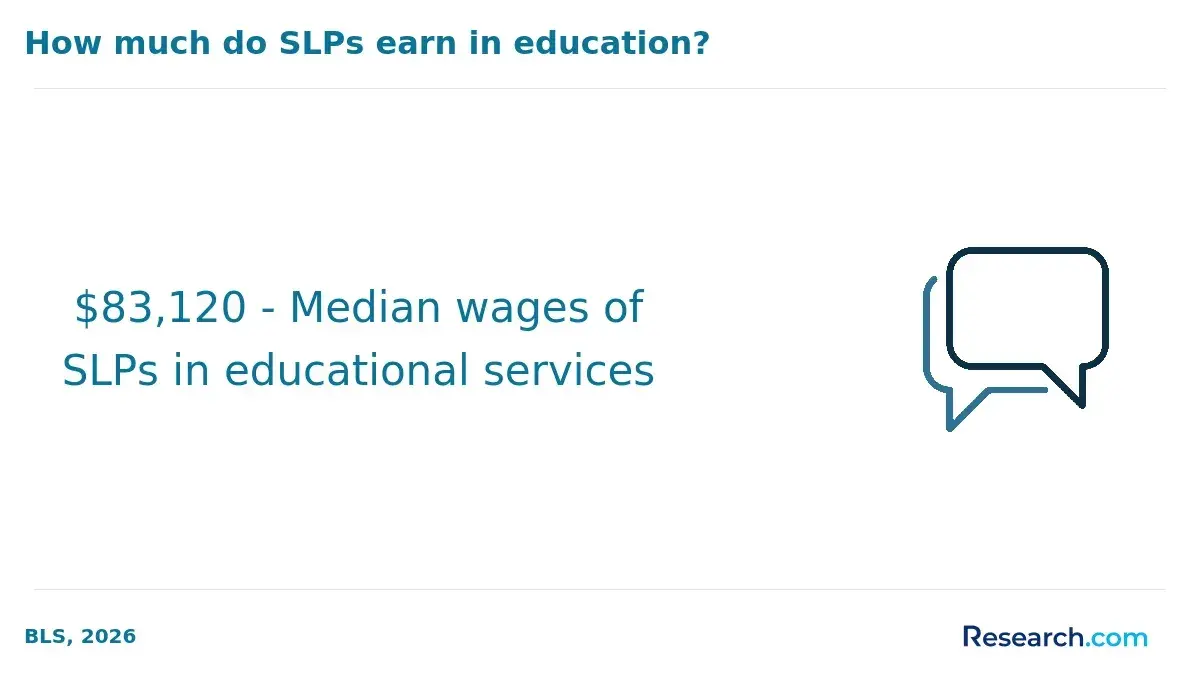
Use federal aid information from the school's financial-aid office and compare borrowing needs against realistic repayment capacity. The national median annual wage for speech-language pathologists was $97,870 in May 2025, according to the U.S. Bureau of Labor Statistics, but actual Arizona earnings vary by employer, setting, experience, and caseload. Use salary information as a planning input, not as a repayment guarantee; this overview of speech pathologist salary with a master's degree can help place different employment settings in context.
What graduation, Praxis pass, and employment outcomes do leading online speech pathology programs report?
Graduation, Praxis pass, employment, and completion outcomes can help distinguish programs with similar marketing language. However, outcomes should be read carefully: reporting periods differ, cohort sizes can be small, and employment measures may use different definitions. Request the most recent CAA-required outcome data directly from each program and ask whether the figures apply to the online pathway rather than a campus program overall.
These outcome measures are most useful when considered together rather than in isolation.
| Outcome measure | What it can show | How to use it |
| On-time program completion | Whether students commonly progress through the prescribed sequence. | Ask how leaves, placement delays, and prerequisite deficiencies affect completion time. |
| Praxis examination pass rate | Performance on a major examination used in the credentialing pathway. | Confirm the test window, number of test takers, and whether first-attempt results are reported. |
| Employment rate | Whether respondents obtained work after graduation under the program's reporting definition. | Ask whether jobs were SLP positions, clinical-fellowship roles, part-time work, or any employment. |
| ASHA certification rate | Progress toward a widely recognized professional credential. | Remember that certification may occur after the clinical fellowship and is not identical to graduation. |
The labor market supports careful investment: the Bureau of Labor Statistics projects 17% growth in SLP employment from 2025 to 2035 and about 12,500 annual openings over that period. That outlook suggests continuing need for qualified clinicians, but program outcomes still matter because each graduate must complete the credentialing steps and compete for placements and early-career positions.
How can Chandler applicants independently verify accreditation, state authorization, and licensure alignment before enrolling?
Independent verification should happen before you apply, again before you pay a deposit, and once more if a program changes its curriculum or your residency changes. Admissions representatives can be helpful, but a verbal assurance is not a substitute for a current written disclosure or a licensing-board determination.
Use this sequence to create a documented decision file for each program:
- Locate the exact degree in ASHA's CAA directory and confirm the current accreditation category, campus or delivery location, and review information.
- Read the university's distance-education authorization and professional-licensure disclosure for Arizona, not merely a general online-learning page.
- Ask the program director or clinical-education office whether Arizona residents in the next cohort may enroll and whether required clinical placements can be completed under the school's policy.
- Request the current curriculum plan, credit total, live-session schedule, required travel dates, and a complete estimate of tuition and mandatory fees.
- Review current Arizona SLP licensing requirements directly with the Arizona Department of Health Services and retain the written response from the school.
- Ask for the latest program outcome disclosures, including completion, Praxis, employment, and certification measures.
Save emails, PDF disclosures, tuition estimates, and placement policies in one folder. This record is valuable if a policy changes after admission or if you later need to explain how you selected a program aligned with Arizona practice goals.
What should practicing Arizona educators or career-changers consider when choosing an online speech pathology master's?
Working Arizona educators and career-changers should choose based on schedule reality, not only program length. SLP graduate education includes demanding academic content, clinical documentation, supervision, and weekday fieldwork. A program that looks flexible during didactic coursework may become much less flexible once practicum begins.
For current teachers, an SLP master's can be a logical transition if you want direct clinical assessment and intervention responsibilities, are prepared for a new professional license, and can accommodate supervised placements. It may be a poor fit if you need to keep a fixed full-time school schedule throughout the program or prefer classroom teaching over individual and small-group clinical work. Career-changers should assess prerequisite time, science readiness, clinical exposure, and their ability to absorb reduced work hours.
Compare your circumstances with these decision factors before committing:
- Choose a part-time or carefully sequenced program if you must continue earning, but verify that clinical rotations will not require weekday availability.
- Choose stronger university placement support if you do not already have relationships with qualified local sites and supervisors.
- Choose the lowest total-cost option that still provides CAA accreditation, Arizona enrollment eligibility, and workable clinical support; inexpensive tuition does not offset an unusable licensure pathway.
- Consider an accelerated route only if you already meet prerequisites and can handle the course and clinical pace; review 5-year accelerated speech pathology programs if an earlier undergraduate-to-graduate pathway better matches your timeline.
Technology is changing documentation, telepractice, and clinical workflow, but it does not replace the supervised human clinical judgment required for entry-level SLP preparation. The strongest program choice is one that gives you a viable Arizona credentialing path, realistic placement logistics, and a debt level you can manage.
Other Things You Should Know About Speech Language Pathology
Possibly, but "fully online" usually describes coursework rather than the entire degree. You still need supervised clinical education, and the program should be CAA-accredited, authorized to enroll Arizona residents, and aligned with Arizona's current licensure requirements.
Not always. Many programs admit students with other majors after they complete specified prerequisite or leveling courses. The added coursework can increase both cost and time to graduation, so obtain a written prerequisite evaluation before enrolling.
It depends on the program. Some arrange placements, some ask students to help identify sites, and others place most of the responsibility on students. Ask for the written policy and what happens if a site cannot be secured or withdraws.
The timeline depends on the program's clinical sequence, Arizona's current licensing rules, examination requirements, and the supervised post-graduate experience needed for your intended credential. Ask both the university and the Arizona licensing authority for the current steps that apply to your situation.
References
- Communication Disorders, MS - ASU degree https://degrees.asu.edu/masters-phd/major/ASU00/LACOMDISMS/communication-disorders-ms
- Master of Science in Speech-Language Pathology https://www.atsu.edu/arizona-school-of-health-sciences/academics/master-of-science-in-speech-language-pathology
- Best Speech-Language Pathology Programs in America https://www.usnews.com/best-graduate-schools/top-health-schools/pathology-rankings
- Premier Online Speech Pathology Master's Degrees https://resources.noodle.com/articles/best-online-masters-programs-for-speech-and-language-pathology/
- Masters SLP programs - preferably online: r/slpGradSchool https://www.reddit.com/r/slpGradSchool/comments/s5p0p0/masters_slp_programs_preferably_online/