2027 Best Online Speech Pathology Master's Programs for Residents of Tempe, AZ

Co-Founder and Chief Data Scientist

Reviewed by Rhea Paul, PhD
SLP Education & Research Expert
Tempe residents considering an online master's in speech-language pathology need more than a convenient course schedule: they need a program that can support Arizona licensure, arrange appropriate clinical education, and fit their academic background and budget.
This guide compares nationally delivered options and explains the questions that matter before applying. You will learn how to evaluate accreditation, Arizona eligibility, clinical placements, travel obligations, costs, outcomes, and admissions fit so you can choose a program based on verified requirements rather than marketing claims.
Key Things You Should Know
- A qualifying path to Arizona SLP licensure normally begins with a master's degree from a program accredited by ASHA's Council on Academic Accreditation (CAA); an online format does not remove clinical-hour, examination, or postgraduate supervision requirements.
- The U.S. Bureau of Labor Statistics projects 17% employment growth for speech-language pathologists from 2025 to 2035, with about 12,500 annual openings; demand is favorable, but admission to accredited graduate programs remains competitive.
- For Tempe applicants, the strongest option is not automatically the closest or least expensive school: confirm Arizona enrollment eligibility, placement responsibility, required campus immersions, total charges, and licensure disclosures in writing before paying a deposit.
Which online speech pathology master's programs fit Tempe residents?
For Tempe residents, a practical "best" program is one that is CAA-accredited, open to Arizona students, transparent about clinical placements, and realistic for your academic preparation and travel capacity. National online and distance-delivery programs can be viable because coursework is delivered remotely, but the professional degree still includes hands-on clinical experiences that cannot be completed entirely from home.
The comparison below identifies programs commonly considered by students seeking an online or distance-focused SLP master's degree. Program availability, state authorization, tuition, and immersion requirements can change by cohort, so use this as a short list for direct verification rather than a guarantee of Arizona eligibility.
| Program | Delivery model | Why it may fit a Tempe resident | Important trade-off to verify |
| Baylor University | Online coursework with required in-person immersion experiences and clinical education | Designed as an online-entry MS in Communication Sciences and Disorders pathway | Travel schedule, Arizona placement availability, current tuition, and cohort calendar |
| Emerson College | Online MS with live learning components, clinical placements, and immersion expectations | Structured online cohort model with placement support | Required synchronous attendance, travel, and total program charges |
| New York University | Online MS in Communicative Sciences and Disorders with clinical training | Nationally recognized distance-learning option for students able to manage a structured full-time curriculum | Arizona authorization, clinical-site assignment process, and high total cost |
| Western Kentucky University | Distance-learning MS model combining remote instruction and clinical training | May appeal to applicants seeking a public-university distance option | Campus visit expectations, cohort availability, and Arizona-specific disclosures |
These are not interchangeable choices. Baylor and Emerson may suit students who want a highly structured online cohort and can travel for required experiences. NYU may fit applicants prioritizing a national online model and extensive institutional support, provided the cost is manageable. Western Kentucky may be worth investigating for applicants who prefer a public-university option, but its distance format and state availability should be checked for the exact entering class.
Applicants who need broader comparisons can also review masters in speech pathology online options, then narrow the list using Arizona authorization and clinical-placement questions rather than rankings alone.
Are the programs properly accredited for Arizona licensure?
CAA accreditation is the first nonnegotiable check. The Council on Academic Accreditation in Audiology and Speech-Language Pathology, administered by the American Speech-Language-Hearing Association, evaluates whether a graduate program meets educational standards for entry into the profession. A school's general institutional accreditation is not a substitute for CAA accreditation of the specific SLP program.
Arizona licensure is a separate issue. A degree may be CAA-accredited yet still require the applicant to complete Arizona's examination, supervised professional experience, application, and documentation requirements. The Arizona licensing authority—not the university—ultimately determines eligibility for an individual license.
Before you apply, compare these distinct requirements. They address different risks that online students sometimes mistakenly treat as the same question.
| Requirement | Why it matters | What to confirm |
| CAA accreditation status | Supports professional preparation and is typically central to certification and licensure pathways | Check the program's current listing in ASHA EdFind or CAA records, including any accreditation conditions |
| Arizona state authorization | Determines whether the institution may offer the program to an Arizona resident | Ask whether Arizona residents may enroll in your intended cohort and modality |
| Arizona licensure disclosure | Shows whether the school has evaluated curriculum alignment with Arizona requirements | Request the disclosure in writing and compare it with current state board rules |
| Clinical education eligibility | Remote students must still complete supervised practicum and externship experiences | Ask whether the school can approve sites and supervisors in the Phoenix metropolitan area |
| Certification pathway | Many employers value ASHA's Certificate of Clinical Competence | Confirm how the program supports Praxis preparation and the clinical fellowship process |
A red flag is language that says a program is "designed to prepare" students for licensure without stating whether it meets Arizona educational requirements. That wording is not necessarily disqualifying, but it means you should ask for a direct, current answer. Save the school's response, because regulations and state authorization arrangements can change.
Which schools offer fully online or mostly online coursework?
"Online" in speech pathology usually describes academic coursework, not the entire degree. Expect a blend of asynchronous assignments, scheduled live classes, simulation activities, supervised clinical work, and one or more in-person immersions. A program may be mostly online while still requiring travel outside Arizona.
For a Tempe resident, time-zone expectations matter. Arizona does not observe daylight saving time, so a school using Eastern or Central Time may shift its meeting time relative to Tempe during part of the year. Ask for a sample weekly schedule for the upcoming cohort, not just a statement that courses are flexible.
These format questions reveal whether a program can work with employment, caregiving, or commuting obligations:
- Are classes asynchronous, live, or mixed, and which sessions have mandatory attendance?
- How many campus immersions are required, where are they held, and are travel and lodging included in the published cost?
- Can clinical placements occur in the Phoenix area, or could a student be asked to travel or relocate for an externship?
- Is the program full-time only, and what happens if a student needs to reduce course load because of a placement conflict?
- What technology, observation, recording, telepractice, and background-check requirements apply before clinical work begins?
A fully asynchronous program is not automatically better. Live instruction can provide routine contact with faculty and peers, while a more flexible format may help students with work obligations. The better choice is the one whose required meeting times and travel schedule you can consistently meet without compromising clinical training.
What admissions requirements matter for Tempe applicants?
Admission to a speech-language pathology master's program is usually based on academic preparation, prerequisite coursework, letters of recommendation, a personal statement, and evidence that the applicant understands the profession. Requirements vary considerably for applicants with a bachelor's degree in communication sciences and disorders (CSD) and career changers from unrelated majors.
Applicants with a CSD background may be ready for direct entry if they have completed foundational coursework in areas such as phonetics, language development, anatomy and physiology of speech and hearing, audiology, speech science, and statistics. Career changers often need prerequisite or leveling courses before beginning graduate clinical coursework. Those courses add cost and time, so they should be part of the program comparison from the beginning.
The following application materials deserve early attention because they are often the source of preventable delays:
| Application factor | What Tempe applicants should do | Common mistake |
| Prerequisite audit | Send transcripts to each program and request a written evaluation of missing CSD courses | Assuming a psychology, education, or health degree automatically covers communication disorder prerequisites |
| Observation experience | Track observation hours and supervision documentation using the program's required process | Waiting until close to the deadline to arrange observation opportunities |
| Academic record | Review cumulative and prerequisite GPA standards and explain meaningful academic context clearly if permitted | Applying based only on an overall GPA without checking prerequisite-grade rules |
| Recommendations | Choose people who can discuss academic readiness, communication skills, professionalism, and clinical potential | Requesting generic letters from people who do not know your work well |
| Application platform | Confirm whether the school uses CSDCAS, its own portal, or both, and allow time for verification | Submitting materials at the deadline without accounting for transcript-processing time |
Do not select a program simply because it appears among the easiest speech pathology programs to get into. Lower barriers at one stage do not eliminate the need for prerequisites, clinical readiness, or a licensure-compatible degree. A better strategy is to apply to programs where your preparation, schedule, and financial plan genuinely align with the published requirements.
How do practicum and clinical placements work remotely?
Clinical education is the feature that makes an online SLP master's fundamentally different from an online academic degree. Students must develop assessment, treatment, documentation, counseling, and professional skills under qualified supervision. Programs typically coordinate or approve placements, but the exact division of responsibility between school and student differs.
Ask each program whether it finds sites, whether students may suggest local sites, how long placement matching usually takes, and what happens if a site withdraws. A school may have relationships with providers in Arizona without guaranteeing a Tempe placement for every cohort.
A careful placement conversation should cover the full sequence, not only the final externship.
- Ask whether the program has placed students in the Phoenix metropolitan area recently, while recognizing that past placement does not guarantee a future assignment.
- Confirm the required number and timing of practicum, internship, or externship experiences and whether settings must include schools, medical facilities, or other populations.
- Find out who verifies supervisor credentials, liability coverage, immunizations, fingerprinting, background checks, drug screening, and site-specific onboarding.
- Budget for commuting, parking, professional attire, testing materials, possible reduced work hours, and any travel required by a placement.
- Get the school's contingency plan for delayed placement, supervisor changes, or a site that cannot provide required experiences.
Telepractice is increasingly relevant in SLP training and employment, but it does not mean a student can complete every clinical requirement from a home office. Programs and placement sites set rules for privacy, supervision, technology, and population experience. Treat telepractice as a possible component of training, not as a substitute for confirming the clinical plan.
Which programs are strongest for affordability and funding?
Affordability should be measured as the cost to finish, not the advertised per-credit tuition alone. Online SLP programs may charge tuition by credit, trimester, or term, and total expenses can also include university fees, clinical fees, technology charges, background checks, travel for immersions, textbooks, health insurance, and lost income during full-time placements.
Because schools update tuition and fee schedules frequently, request a written estimate for your entering cohort. Ask whether the quote includes every required credit, clinical fees, immersion expenses, and anticipated annual increases. Do not compare a public school's per-credit rate with a private school's total-program estimate as if they were equivalent figures.
Use the following cost categories to create a realistic personal budget before accepting admission:
- Direct educational charges: Tuition, mandatory university fees, program fees, clinical education fees, and technology fees.
- Required travel: Transportation, lodging, meals, and time away from work for campus immersions or an out-of-area placement.
- Clinical readiness costs: Immunizations, health screening, fingerprinting, background checks, liability coverage, clothing, and supplies.
- Living and opportunity costs: Reduced employment hours, childcare, commuting, and the possibility that a full-time externship limits paid work.
- Funding sources: Federal aid eligibility, scholarships, employer tuition support, graduate assistantships where available, and responsible borrowing.
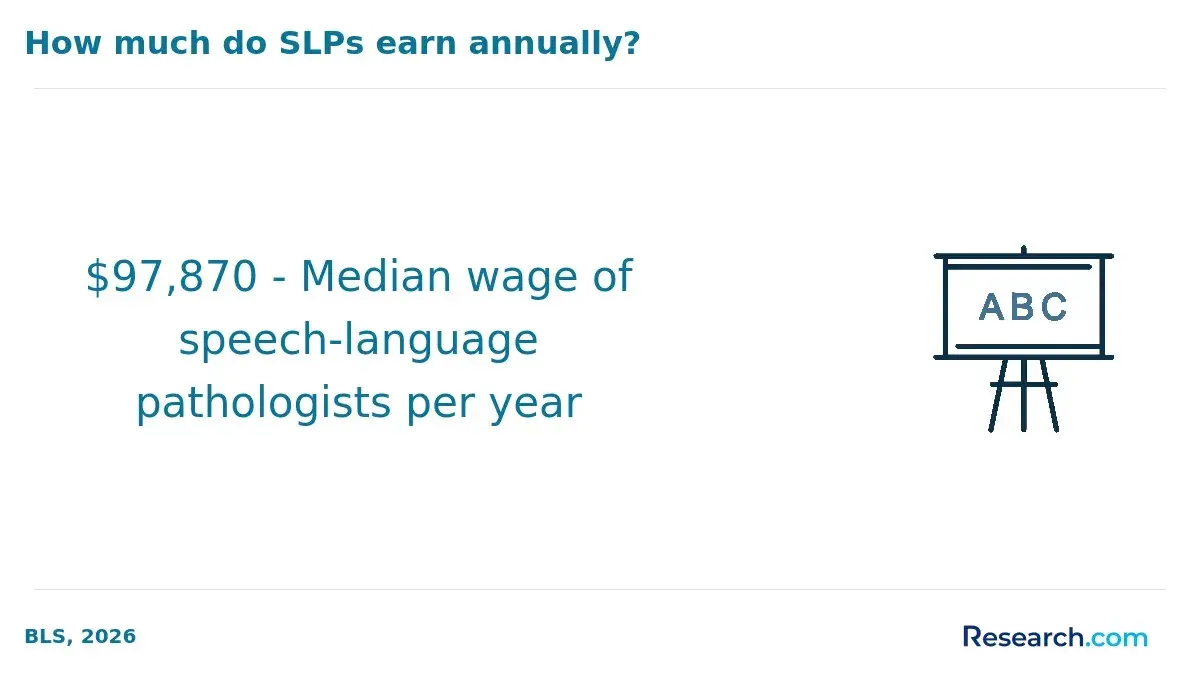
Federal aid may help eligible students, but borrowing should be based on a conservative repayment plan rather than projected earnings alone. The Bureau of Labor Statistics reports a May 2025 median annual wage of $97,870 for speech-language pathologists.
That national figure is useful career context, but individual pay varies by setting, experience, hours, and local employer. Students interested in setting-specific compensation can explore medical SLP salary information while remembering that a higher-paying setting may require particular clinical experience or geographic flexibility.
What speech pathology coursework and specializations do they provide?
SLP master's curricula prepare students to evaluate and treat communication, language, speech, voice, fluency, cognitive-communication, and swallowing disorders across the lifespan. Although course titles differ, CAA-accredited programs generally cover biological, acoustic, developmental, linguistic, behavioral, and social foundations alongside clinical methods and evidence-based practice.
Specialization is often developed through electives, clinical assignments, faculty expertise, and externship settings rather than through a separately titled concentration. Students should evaluate whether a program can provide relevant exposure without assuming that an advertised focus guarantees a particular placement.
The table below shows how common areas of interest translate into program-evaluation questions:
| Career interest | Useful coursework or clinical exposure | Question to ask the program |
| School-based practice | Child language, speech sound disorders, literacy, augmentative communication, education law, or collaboration | Can students complete supervised experience in school-based settings? |
| Medical SLP | Dysphagia, motor speech, neurogenic disorders, cognitive communication, adult assessment | Are adult medical placements available, and are they required or elective? |
| Pediatric early intervention | Language development, family-centered practice, autism, feeding, caregiver coaching | What infant, toddler, and family-centered experiences are available? |
| Voice and fluency | Voice disorders, stuttering and cluttering, counseling, instrumentation where available | Does the program offer relevant electives, clinics, or faculty mentorship? |
| Bilingual and multicultural practice | Cultural-linguistic diversity, bilingual assessment, interpreter collaboration, equity in diagnosis | How does the curriculum distinguish language difference from disorder? |
Tempe's multilingual and growing metropolitan environment can make cultural responsiveness especially valuable, but no program should imply that one course creates bilingual clinical competence. If serving bilingual clients is a priority, ask how the program evaluates language proficiency, supports ethical interpreter use, and creates relevant supervised experiences.
How do graduation rates and outcomes compare?
Graduation and employment outcomes are meaningful only when they are defined consistently. CAA programs publicly report outcome data that can include completion rates, Praxis examination pass rates, and employment rates for recent cohorts. These results are more useful than broad rankings because they relate directly to preparation for entry into the profession.
Read outcome reports carefully. A high employment rate may use a defined reporting window, exclude graduates seeking other work, or reflect a small cohort. Strong outcomes are encouraging, but they do not guarantee that a particular student will graduate on time, secure a preferred placement, pass an exam on the first attempt, or receive a certain salary.
When comparing program outcome disclosures, use the same questions for every school:
- What is the published completion rate for the most recent reporting period, and how many students were in the cohort?
- What is the Praxis pass rate, and does the school report first-attempt results or eventual pass rates?
- How does the program define employment, and what time frame is used after graduation?
- How many students leave or pause the program, and what academic, financial, or placement supports are available?
- What proportion of students complete on the advertised timeline versus taking longer because of clinical sequencing or personal circumstances?
The broader labor market supports the value of careful preparation. BLS projects 17% growth in SLP employment from 2025 to 2035, much faster than the average for all occupations. For applicants, that means the field has favorable projected demand, not that every program offers identical quality, affordability, or placement access.
Which programs best suit ASU students and local career changers?
Arizona State University students and Tempe-area career changers should start by separating academic eligibility from career interest. A student nearing completion of a CSD bachelor's degree may be ready to apply directly to graduate programs, while a student majoring in psychology, education, linguistics, biology, or another field may need a post-baccalaureate sequence first.
Direct-entry applicants may prefer a full-time online cohort if they can devote consistent daytime hours to clinical training. Career changers who need prerequisites, continued employment, or family flexibility may benefit from completing foundational courses before committing to a graduate cohort. The fastest option is not always the lowest-risk option if it leaves no room for prerequisite gaps or placement obligations.
For undergraduate students who are still choosing their route, 5-year accelerated speech pathology programs can be worth exploring. These pathways may reduce duplication between bachelor's and master's study, but students should still verify CAA status, progression standards, clinical sequencing, and whether the program is practical for an Arizona resident.
A local career changer should also consider whether they can complete observation experiences, prerequisites, and future clinical placements while maintaining work. Working as a speech-language pathology assistant, special education aide, behavior technician, healthcare coordinator, or teacher can offer relevant exposure, but these roles do not replace a qualifying graduate degree and supervised clinical education for SLP licensure.
How should Tempe residents verify a program before enrolling?
Before enrolling, verify the details that apply to your exact cohort, not a prior year's brochure or an advisor's general statement. This protects you from the most costly mistakes in online clinical graduate education: enrolling without Arizona eligibility, underestimating travel, and assuming a school will automatically secure every local placement.
Use this sequence when making a final decision:
- Confirm the program's current CAA accreditation status through ASHA's official resources and verify that the listed degree is the one you will earn.
- Ask the institution's state authorization or licensure disclosure office whether Arizona residents may enroll and whether the curriculum meets, is intended to meet, or has not been determined to meet Arizona educational requirements.
- Request a written clinical-placement explanation covering placement sourcing, student responsibilities, local-site history, travel risk, onboarding expenses, and contingency planning.
- Request an itemized estimate of tuition, mandatory fees, clinical costs, immersion travel, and the number of credits required after any prerequisite evaluation.
- Review the current student handbook or cohort calendar for live-class times, attendance rules, campus visits, progression standards, leave policies, and expected completion timeline.
- Compare CAA outcome data, financial aid offers, and your expected borrowing before accepting admission or paying a nonrefundable deposit.
Keep copies of written answers and compare them side by side. If a school cannot clearly answer whether it accepts Arizona residents, how placements work, or what required travel will cost, pause before enrolling. Transparency is a meaningful quality signal for a program that depends on coordinated clinical training.
Other Things You Should Know About Speech Language Pathology
Yes, if the degree and your subsequent training meet Arizona's current requirements. The coursework can be online, but you must complete supervised clinical education and satisfy applicable examination, supervised-experience, and licensing requirements. Confirm both CAA accreditation and Arizona licensure compatibility before enrolling.
Usually, yes. Travel may be required for campus immersions, skills assessments, or clinical placements. The amount varies by program and cohort. Ask for the exact number, location, and expected cost of required visits before applying.
Some students work during portions of a program, but full-time employment can be difficult during intensive clinical practicum or externship terms. Review live-class schedules, daytime placement expectations, and the program's full-time or part-time policies before relying on continued employment income.
Many cohorts are designed for roughly two years of full-time study, though the actual timeline depends on prerequisites, course sequencing, clinical placement timing, leaves of absence, and whether part-time enrollment is available. Career changers often need additional time for foundational CSD coursework before graduate study begins.
References
- Online MS in Speech-Language Pathology (SLP) | Pepperdine https://healthscience.pepperdine.edu/online-masters-in-speech-language-pathology/
- Communication Disorders, MS - ASU degree https://degrees.asu.edu/masters-phd/major/ASU00/LACOMDISMS/communication-disorders-ms
- Online Master's in Speech Pathology Programs: 2026 Guide https://speechpathologymastersprograms.com/
- 2026 Most Affordable Online Speech Pathology Master's... https://www.onlineu.com/most-affordable-colleges/speech-pathology-masters-degrees