2027 Best Online Speech Pathology Master's Programs for Residents of Alexandria, VA

Co-Founder and Chief Data Scientist

Reviewed by Rhea Paul, PhD
SLP Education & Research Expert
Alexandria residents can pursue an online speech-language pathology master's degree without relocating, but "online" does not mean fully remote or automatically Virginia-licensure eligible. The strongest options combine CAA accreditation, clear Virginia disclosures, structured clinical-placement support, and a schedule that works around required live classes and practicums.
This guide compares leading program models, explains Virginia's licensing path, and shows what to verify before paying an application fee.
Key Things You Should Know
- Choose only a program accredited by the ASHA Council on Academic Accreditation (CAA) or one with an accreditation status that Virginia will accept when you graduate; institutional accreditation alone is not enough for SLP licensure.
- Virginia licensure requires a qualifying graduate degree, supervised professional experience, and a passing Praxis examination; an online program must provide the academic and clinical foundation for those steps.
- The Bureau of Labor Statistics projects 17% growth in speech-language pathologist employment from 2025 to 2035, with about 12,500 annual openings nationally, making program quality and licensure compatibility more important than a school's online marketing claims.
How do online speech pathology master's programs serve Alexandria, VA residents seeking licensure?
Online speech-language pathology (SLP) master's programs typically deliver academic coursework through a mix of asynchronous modules, scheduled live classes, virtual simulation, and faculty-led discussion. They are not fully remote professional degrees: students must complete supervised clinical education with real clients and may need to attend campus immersions or skills intensives.
For an Alexandria resident, the practical appeal is access to programs outside Northern Virginia while remaining near local employers, schools, hospitals, rehabilitation facilities, and pediatric providers. The central question is not whether lectures are online; it is whether the school can enroll Virginia residents, support appropriate clinical training, and prepare graduates for Virginia licensure.
A typical pathway includes the following stages. Exact course sequencing, prerequisite expectations, and clinical-hour policies vary by institution.
- Complete required communication sciences and disorders prerequisites or a post-baccalaureate leveling sequence if your bachelor's degree is in another field.
- Complete graduate academic courses in areas such as language disorders, speech sound disorders, dysphagia, audiology, research methods, counseling, and professional ethics.
- Participate in supervised clinical practicum and advanced external placements that meet the program's and accreditation standards.
- Graduate from a qualifying program, pass the Praxis examination, complete Virginia's supervised professional experience requirements, and apply for state licensure.
Students with a non-CSD bachelor's degree should pay particular attention to prerequisite design. A school may admit career changers but require additional coursework before or during the master's curriculum, which can extend total time and cost. Applicants who want to shorten the academic runway can compare 5-year accelerated speech pathology programs when they are still completing an undergraduate degree; these combined pathways are generally different from an online graduate program designed for working adults.
Online delivery is a good fit for self-directed students who can reliably attend live sessions, travel for required experiences, and maintain availability during daytime clinical hours. It may be a weaker fit for applicants who need completely self-paced coursework or cannot adjust work schedules for practicum, because client care and supervisor schedules are rarely evenings-only.
Which accredited online speech-language pathology master's programs accept students from Alexandria, VA?
The programs below are examples of established online or distance-oriented SLP master's options that have publicly presented online delivery and CAA accreditation information. Availability for Virginia residents can change because of state authorization, clinical-capacity limits, and cohort policies. Applicants should obtain written confirmation from the admissions and licensure-disclosure teams before applying or depositing.
This comparison focuses on factors that matter more than brand recognition for an Alexandria applicant: CAA status, clinical model, travel, pacing, and the need to verify Virginia authorization.
| Program | Online delivery model | Clinical-placement approach | Travel and schedule considerations | Decision takeaway for Alexandria residents |
| New York University, MS in Communicative Sciences and Disorders | Online graduate coursework with structured cohort learning | Clinical education is required; placement details and site availability should be confirmed directly with the program | May include intensive in-person experiences; live-session expectations can affect work schedules | Consider if you want a national online program and can plan for required travel and daytime clinical commitments |
| Emerson College, MS in Speech-Language Pathology | Online coursework with a cohort-based format | Program-supported clinical experiences are part of degree completion; local placement availability is not guaranteed | Requires planned clinical availability and may involve residencies or immersion requirements | Consider if structured online learning and placement coordination matter more than fully asynchronous flexibility |
| Baylor University, MS in Communication Sciences and Disorders | Online graduate program with scheduled instruction and clinical education | Students complete supervised clinical experiences under program requirements | Ask about synchronous sessions, campus requirements, and Virginia-site approval before enrolling | Consider if you want a cohort-based program and can accommodate fixed clinical rotations |
These programs should not be treated as interchangeable. A school can be CAA-accredited yet have a different approach to placements, campus visits, prerequisite admission, and financial aid. The "best" option depends on whether the program can serve you in Virginia for your intended start term and whether its clinical calendar fits your work and caregiving responsibilities.
Applicants seeking faster entry should be cautious about advertising language. Some accelerated speech pathology programs online may shorten a course sequence, but they cannot eliminate the graduate-level academic and clinical requirements needed for professional preparation. A shorter advertised calendar is useful only if the program is accredited, state-authorized, and realistic for your availability.
Before narrowing your list, ask each school whether it currently accepts Virginia applicants, whether it has recently placed students in Northern Virginia or the Washington metropolitan area, and what happens if an approved placement cannot be secured near your home.
What accreditation and CAA-ASHA recognition must Alexandria applicants verify before enrolling online?
CAA accreditation is the most important program-quality check for a future SLP. The Council on Academic Accreditation in Audiology and Speech-Language Pathology is ASHA's specialized accreditor for graduate programs in speech-language pathology and audiology. CAA accreditation evaluates whether a program meets standards for curriculum, faculty, outcomes assessment, clinical education, and student support.
Do not confuse three separate concepts: institutional accreditation, CAA program accreditation, and ASHA certification. A university can be institutionally accredited while its SLP program is not CAA-accredited. CAA accredits the academic program; ASHA's Certificate of Clinical Competence (CCC-SLP) is a professional credential pursued after completing the relevant education, examination, and clinical fellowship requirements.
Use the following checks in this order before committing to a school. They protect against a degree that may be academically valid but unsuitable for the professional license you want.
- Locate the exact degree program in the current CAA directory and confirm its status, campus or delivery location, and any stated conditions or review dates.
- Read the school's professional-licensure disclosure for Virginia rather than relying on a general statement that graduates "may pursue licensure."
- Ask whether the school's curriculum and clinical education are designed to satisfy the educational requirements for Virginia SLP licensure.
- Confirm that your planned graduation date falls within the program's approved accreditation period or ask how the school will notify students if its status changes.
- Save written responses from admissions or compliance staff, especially if you are relocating, using veteran education benefits, or planning to seek licensure in more than one state.
Programs sometimes hold "candidate" status while working toward initial accreditation. Candidate status may be appropriate in limited situations, but it requires closer review because accreditation timelines and graduate eligibility rules matter. Ask the Virginia licensing board and the program how graduates of your specific cohort will be treated. Never assume candidate status has the same practical effect as full accreditation without confirming it.
CAA status alone also does not promise admission, a local placement, a passing Praxis score, or employment. It is a foundational eligibility and quality signal, not a guarantee of individual outcomes.
How does Virginia's speech-language pathology licensure process interact with online program selection?
Virginia licenses speech-language pathologists through the Virginia Board of Audiology and Speech-Language Pathology. Your online degree choice affects the first part of the process: whether your graduate education and clinical preparation meet the board's requirements. The degree does not replace later examination, application, background, documentation, or supervised-experience obligations.
In practical terms, select a program backward from your desired license. Verify that it provides a qualifying graduate education in speech-language pathology or communication sciences and disorders, prepares you for the national Praxis examination, and supports the clinical education records you will need later. Then confirm the current Virginia rules directly with the board before enrollment and again near graduation, because regulations can change.
The table separates the major professional milestones so applicants do not mistake graduation for full independent practice authority:
| Milestone | Why it matters | What to verify before choosing an online program |
| Graduate degree | Virginia requires qualifying graduate education for SLP licensure | CAA status, curriculum, Virginia licensure disclosure, and the degree title shown on the transcript |
| Graduate clinical education | Clinical experiences develop entry-level competencies and support later credentialing documentation | Who approves sites, who supervises, whether hours are tracked, and whether a placement may require travel |
| Praxis examination | A passing score is part of the professional credentialing pathway | How the program prepares students, publishes outcomes, and supports test planning |
| Supervised professional experience | Postgraduate supervised practice may be required before full independent licensure and professional certification | Whether the program provides career guidance; the graduate remains responsible for securing an eligible position and supervisor |
| Virginia application and renewal | Licensure is issued and maintained by the state, not the university | Current board forms, fees, background requirements, continuing-education rules, and any telepractice requirements |
Alexandria's proximity to Washington, DC, and Maryland creates an additional consideration. Clinical sites or first jobs may be across state lines, but each jurisdiction has its own license rules. A placement in another jurisdiction may be educationally useful, yet it does not automatically give you authority to practice there after graduation. If multistate mobility is important, compare each target state's requirements early rather than assuming Virginia licensure transfers automatically.
Also distinguish supervised student clinical work from paid employment. A school's clinical placement agreement, faculty requirements, and supervisor approval determine student practice; state licensure rules determine professional practice after graduation. Employers may also require ASHA certification or eligibility even when state law does not use identical wording.
Which online SLP master's programs offer the strongest clinical placement options near Alexandria?
No responsible program comparison can promise a placement in Alexandria unless the school explicitly commits to one. The strongest clinical-placement option is usually the program that has a documented process for approving sites, assigning qualified supervisors, monitoring competencies, and helping students respond when a preferred local site is unavailable.
For Northern Virginia residents, placement quality should be evaluated through process evidence, not a school's claim that it has a "national network." Alexandria-area possibilities may include public schools, early-intervention settings, outpatient pediatric clinics, hospitals, skilled nursing facilities, rehabilitation providers, and university-affiliated clinics. Whether any site is available depends on affiliation agreements, supervisor capacity, patient population, timing, and the school's approval standards.
Ask each program the questions below in writing. The answers reveal whether "placement support" means active coordination or simply a requirement that students locate sites independently.
- Does the program assign placements, approve student-suggested sites, or use a hybrid model?
- How many external placements are required, and what settings or client populations must they cover?
- Can students request Northern Virginia, Alexandria, Arlington, Fairfax, Washington, DC, or Maryland sites, and are those requests guaranteed?
- What happens if a placement is farther away than expected or requires temporary relocation?
- Who confirms that supervisors meet program, state, and accreditation qualifications?
- When are placements typically disclosed, and can a student decline one because of commute, childcare, or work conflicts?
A program with a well-supported placement process may be worth a higher tuition rate if it lowers the risk of delayed graduation. Conversely, a lower-cost program can be a strong choice when it clearly allows student-initiated placements and you already have realistic access to qualified local sites. Do not assume an employer's willingness to host you is enough; the university must approve the site and supervisor before hours begin.
Clinical rotations are usually the least flexible portion of an online SLP degree. Even programs with evening coursework may require weekday hours because schools, medical facilities, and clients operate primarily during the day. Applicants who must work full-time should ask for a sample clinical calendar before enrollment and budget for reduced work availability during intensive terms.
How do top online speech pathology programs compare on cost, time to degree, and flexibility?
Cost comparisons should begin with a complete attendance budget, not a headline per-credit tuition figure. Online SLP programs can include tuition, technology charges, clinical or simulation fees, background checks, immunizations, travel, lodging for intensives, textbooks, and lost wages during full-time practicum. The most affordable option is not necessarily the program with the lowest listed tuition if it requires multiple trips or delays clinical placement.
Applicants looking for a framework for tuition questions can review "How much does a masters in speech pathology cost?" Use published figures as a starting point, then request a program-specific estimate based on your prerequisite needs, residency classification, enrollment pace, and required travel.
The comparison below describes common trade-offs rather than presenting unlike tuition figures as if they were directly comparable. Schools should provide the current amount in writing for your entering cohort.
| Program model | Typical time-to-degree pattern | Flexibility strengths | Key trade-off | Best fit |
| Full-time cohort online master's | Often organized as a fixed multi-term sequence | Clear course progression and peer support | Limited ability to slow down; practicum can require daytime availability | Students able to prioritize school and follow a prescribed pace |
| Part-time or extended-distance format | Longer calendar time, where offered | May reduce course load during academic terms | Clinical terms may still be intensive, and total tuition can rise if rates increase | Working adults with predictable schedules and employer support |
| Career-changer program with leveling courses | Master's timeline plus prerequisite completion | Creates a route for non-CSD bachelor's graduates | More credits, more time, and potentially more financial-aid planning | Applicants changing fields who need foundational preparation |
| Lower-tuition program requiring greater travel | Depends on cohort design and placement timing | Can reduce direct instructional charges | Travel, lodging, and missed work can offset tuition savings | Students who can travel cheaply and have schedule flexibility |
A useful decision rule is to calculate both direct and opportunity costs. Direct costs are billed expenses and travel; opportunity costs include reduced work hours, delayed earnings, and childcare during clinical rotations. Compare the same scope for every school: total credits, mandatory fees, expected travel, program length, and whether clinical education can extend graduation if a site is delayed.
Federal financial aid may be available to eligible graduate students, but borrowing limits, interest costs, and institutional aid differ. Ask each financial-aid office whether its estimate includes all mandatory program charges. Avoid borrowing based on an assumed future salary.
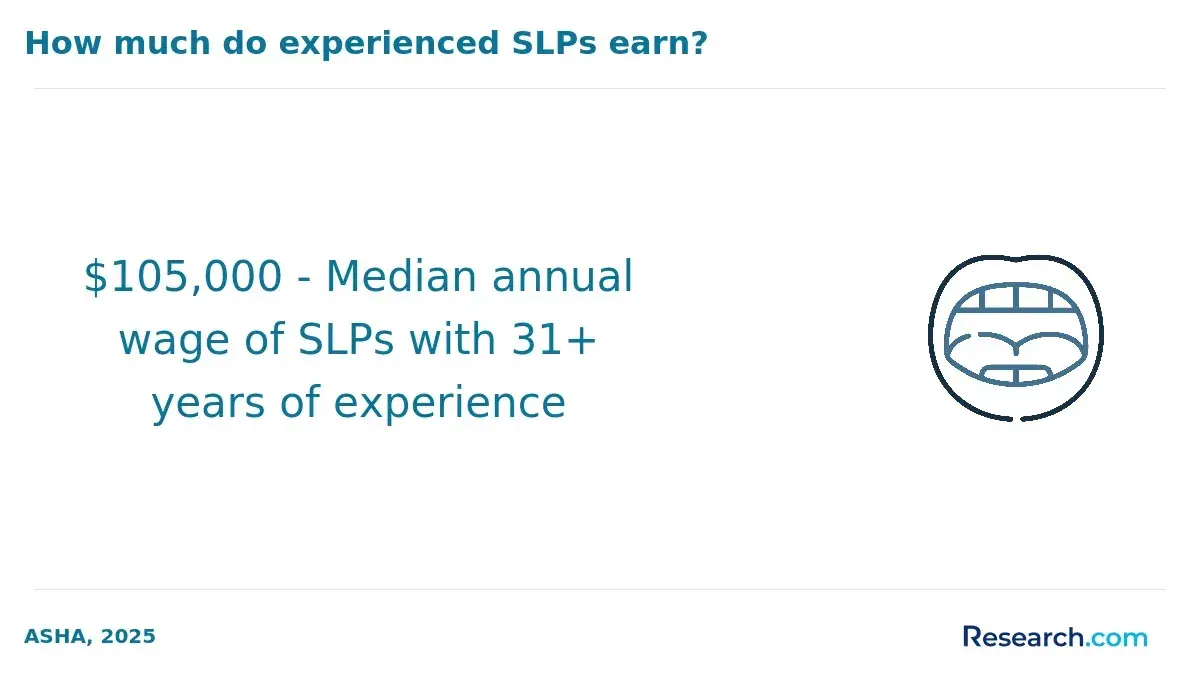
The BLS reports a $97,870 median annual wage for speech-language pathologists in May 2025, but earnings vary substantially by setting, experience, hours, employer, and local market.
What technology, supervision, and telepractice standards do quality online SLP programs follow today?
Quality online SLP programs use technology to deliver instruction and, where appropriate, support telepractice learning. They do not treat videoconferencing as a substitute for clinical competence. Students should expect secure learning platforms, live communication tools, digital case materials, virtual simulations, and documented competency assessment alongside direct supervised experience.
Telepractice is increasingly relevant because SLP services may be delivered through telecommunications when clinically appropriate and permitted by applicable laws, employer policies, payer rules, and professional standards. Students should learn how to assess whether telepractice fits a client, protect privacy, manage technology failures, involve caregivers, and document services. They should not assume all clinical hours can be completed remotely.
The following indicators help distinguish a professionally designed online program from one that simply uploads lectures:
- Clear technical requirements, accessibility support, and orientation before clinical coursework begins.
- Scheduled faculty access and timely feedback on clinical documentation, diagnostic reasoning, and treatment planning.
- Supervisor qualifications, orientation, observation expectations, and documented evaluation procedures.
- Secure handling of client information, including policies for recording, storing, and sharing protected health information.
- Simulation or telepractice activities tied to measurable clinical competencies rather than used as a replacement for required direct client care.
- Written contingency procedures for interrupted placements, technology outages, supervisor changes, and client cancellations.
Ask whether live classes are mandatory and what time zone they use. Alexandria follows Eastern Time, which can make synchronous attendance easier for East Coast schools but still challenging for programs that schedule daytime labs. Ask whether lectures are recorded, how often real-time attendance is required, and whether clinical seminars occur outside normal business hours.
Artificial intelligence tools are also becoming more visible in education and health documentation. A responsible program should teach students to use technology ethically, protect client confidentiality, verify outputs, and avoid entering protected information into unapproved systems. AI can support learning and administrative tasks, but it does not replace clinical judgment, supervision, or the licensed professional's responsibility for care.
How can Alexandria residents confirm NC-SARA participation and state authorization for online SLP study?
NC-SARA, the National Council for State Authorization Reciprocity Agreements, is a framework that can simplify distance-education authorization across participating states. It is useful, but it is not a substitute for professional-licensure confirmation. A school's participation may support its authority to deliver online instruction to Virginia residents, while separate program-specific disclosures still determine whether the curriculum is intended to meet Virginia licensing requirements.
Confirm both dimensions before applying: the institution's authority to enroll you in online education and the program's professional-licensure compatibility. A school may be able to teach Virginia residents but decline to state that a particular program meets Virginia's professional requirements, especially where clinical education rules are involved.
Use this practical verification sequence before paying a deposit:
- Check the university's state authorization or NC-SARA page to see whether Virginia residents are eligible for the online program.
- Read the SLP program's professional-licensure disclosure specifically for Virginia; do not rely on a general university disclaimer.
- Email the program and ask whether it accepts applicants residing in Virginia for your intended cohort and whether any restrictions apply to clinical placements.
- Ask whether a move to another state during enrollment changes your eligibility, tuition, placement options, or required notification process.
- Confirm Virginia educational and clinical requirements with the Virginia Board of Audiology and Speech-Language Pathology before enrolling.
- Keep dated copies of program disclosures and email responses in your admissions records.
State authorization can change quickly when a university updates its compliance arrangements or pauses admissions in a jurisdiction. Verify close to application submission, again before enrollment, and whenever you move. This is particularly important for military households and commuters in the DC metropolitan area who may relocate across state lines while enrolled.
If a school says it "has not determined" whether its curriculum meets Virginia requirements, treat that as an unresolved risk rather than a routine disclaimer. Ask for a written explanation of the missing determination and compare programs with clearer disclosures.
What outcomes data (Praxis pass rates, employment) distinguish leading online speech pathology programs?
Outcome data can reveal whether a program's support systems are working, but readers should interpret it carefully. The most useful indicators are reported consistently over multiple years, clearly define the cohort being measured, and distinguish graduates from all entrants. CAA-accredited programs are expected to make outcome information available, often including program completion, Praxis examination performance, and employment data.
For each school, request or locate its most recent published outcomes and ask how the figures were calculated. A very small graduating cohort can produce a dramatic percentage change from only one or two students, so multi-year trends are usually more informative than a single result.
| Outcome measure | What it can show | Question to ask | Limitation |
| Program completion | Whether students generally finish within the expected period | What percentage completed within the published timeframe, and why do students extend or withdraw? | May not show how many students reduced work hours or changed cohorts to finish |
| Praxis pass rate | How graduates performed on a required national examination | Which test window and score standard were used, and how many test takers are represented? | Pass rates do not measure all clinical skills or guarantee a future individual score |
| Employment rate | Whether graduates reporting employment found relevant work after graduation | What counts as employment, what time period is used, and how many graduates responded? | Definitions may vary and may not show salary, hours, setting, or geographic location |
| Clinical-placement completion | Whether students complete required rotations on schedule | How often are placements delayed, and what support is offered when a site falls through? | Schools may not publish this measure in a standardized way |
The national employment outlook provides context but should not replace program-level evidence. The BLS projects 17% employment growth for speech-language pathologists from 2025 to 2035 and about 12,500 openings per year on average. That suggests sustained demand, yet it does not guarantee a job in a preferred Alexandria-area setting or specialty.
Specialty interests can affect your program choice. For example, acute care, medical SLP, bilingual service delivery, and neonatal work may require targeted clinical exposure and postgraduate experience. A reader researching a NICU SLP salary should treat compensation information as career context rather than a reason to choose a program without pediatric medical placements or appropriate mentorship opportunities.
Strong programs are transparent about outcomes and honest about their limits. Be cautious when a school highlights employment success but does not explain its reporting rate, timeframe, or definition of employment.
How should Alexandria applicants protect themselves from unaccredited or misleading online SLP programs?
The biggest risk is enrolling in a program that sounds like a path to SLP practice but does not meet the educational standards needed for Virginia licensure or ASHA certification. Marketing phrases such as "speech therapy," "communication disorders," "clinical communication," or "professional preparation" are not proof of CAA accreditation, state eligibility, or clinical-hour quality.
Applicants should slow down when they encounter vague claims, unusually fast completion promises, or pressure to enroll before receiving answers in writing. An online degree can be legitimate and rigorous; the warning sign is missing evidence about licensure, accreditation, clinical supervision, cost, or student obligations.
Watch for these common red flags and use the corresponding safer alternative:
| Red flag | Why it matters | Safer action |
| The school cites only institutional accreditation | Institutional accreditation does not establish CAA status for an SLP degree | Confirm the exact program in the CAA directory and review its current status |
| "Fully online" is presented without clinical details | SLP education requires supervised clinical preparation that may involve travel or daytime work | Request the clinical-placement policy, number of rotations, and travel expectations |
| No Virginia licensure disclosure is available | You may not know whether the curriculum is intended to meet state requirements | Request a written Virginia-specific determination and verify with the state board |
| A tuition quote excludes fees or required travel | Direct costs can be materially higher than the advertised price | Request an itemized estimate for your cohort and calculate travel and lost-work costs |
| Guaranteed employment, salary, or placement claims | No school can guarantee individual licensing, hiring, pay, or a preferred site | Review transparent outcomes reports and ask how results were measured |
| Pressure to enroll immediately | High-pressure sales tactics can prevent appropriate due diligence | Compare at least two eligible programs, and keep all statements in writing |
Before submitting an application, create a simple evidence folder for each school: CAA status, Virginia disclosure, state-authorization confirmation, clinical-placement policy, total-cost estimate, required travel, admissions prerequisites, and outcome report. This makes it easier to compare programs on the same facts rather than on advertising language.
Finally, verify the school's refund, withdrawal, leave-of-absence, and placement-delay policies. These details matter if clinical availability changes after you have started. A school that explains these policies clearly is generally easier to evaluate than one that offers only broad assurances.
Other Things You Should Know About Speech Language Pathology
Yes, potentially. Many master's programs consider applicants from other majors, but you may need prerequisite or leveling coursework in communication sciences and disorders. Ask each program which courses are required, whether they must be completed before admission, and how they affect time to degree and financial aid.
Often, yes. Programs may combine recorded coursework with required live classes, virtual labs, clinical seminars, group work, and supervisor meetings. Clinical placements commonly require weekday availability. Request a sample weekly schedule for academic and clinical terms before enrolling.
Do not assume so. A program may try to support local placements, but site availability depends on approved supervisors, affiliation agreements, client needs, and timing. Ask whether local placement is guaranteed, whether travel is possible, and what support is provided if your preferred area is unavailable.
Virginia licensure and ASHA certification are separate credentials, although employers may prefer or require ASHA certification or eligibility. Many graduates pursue the CCC-SLP because it is widely recognized by employers and can support professional mobility. Confirm the current requirements of the Virginia board and your target employers.
References
- Communication Sciences and Disorders: M. Ed. - Master of... https://education.virginia.edu/academics/programs/communication-sciences-and-disorders-med-master-education
- Hybrid Online MS-SLP Program | Full & Part-Time | USAHS https://www.usa.edu/college-of-rehabilitative-sciences/master-science-speech-language-pathology-ms-slp/
- Communication Science & Disorders (Distance Learning) https://commdisorders.cci.fsu.edu/programs/grad-programs/communication-science-disorders-distance-learning/
- Best Online Speech & Language Pathology Master's... https://www.onlineu.com/most-popular/masters-speech-pathology
- Online Master's in Speech Pathology Programs: 2026 Guide https://speechpathologymastersprograms.com/