2027 Two-Year vs Three-Year Online SLP Master's Programs: Workload and Completion Trade-Offs

Co-Founder and Chief Data Scientist

Reviewed by Rhea Paul, PhD
SLP Education & Research Expert
Choosing between a two-year and three-year online speech-language pathology master's program is largely a choice about capacity: how much coursework, clinical training, income disruption, and scheduling uncertainty you can absorb at once. Both timelines can lead to the same professional destination when the program is appropriately accredited and meets state requirements.
This guide compares workload, completion pace, practicum demands, finances, and career readiness so you can choose a schedule that supports completion rather than simply choosing the fastest advertised option.
Key Things You Should Know
- A two-year online SLP master's usually compresses roughly the same graduate curriculum and clinical requirements into more consecutive terms, making it best for students who can prioritize school and adapt work schedules during placements.
- A three-year path typically spreads coursework and clinical sequencing over additional terms; it may reduce week-to-week academic pressure, but it can extend tuition exposure, delayed full-time SLP earnings, and reliance on financial aid.
- Program length does not change the core professional threshold: graduates generally need a CAA-accredited degree, supervised clinical education, the Praxis examination, a Clinical Fellowship, and state-specific licensure steps before independent practice.
How do two-year and three-year online SLP master's programs differ in structure and pacing?
Two-year and three-year online SLP programs usually lead to the same degree: a master's in speech-language pathology or communication sciences and disorders. The important distinction is not academic rigor, but how a school sequences didactic courses, simulations, campus experiences, practicum, and full-time externships. "Online" commonly describes coursework delivery; clinical education still occurs in person at approved sites.
Accelerated programs often run year-round and use tightly sequenced cohorts. Extended programs may use more conventional academic terms, lighter course loads, or a designated part-time phase before intensive clinical training. Neither model is automatically more flexible once off-campus placements begin.
This comparison highlights the planning differences that matter more than an advertised completion date:
| Decision factor | Typical two-year structure | Typical three-year structure |
| Course sequence | More courses per term, often including summer study | Fewer courses per term or more terms to complete the sequence |
| Cohort pacing | Highly prescribed; missed courses can delay progression | May offer more room to distribute coursework, subject to prerequisites |
| Clinical transition | Can arrive sooner and overlap with a demanding academic schedule | May allow more time before advanced placement blocks |
| Calendar length | Usually about 24 consecutive months | Usually about 30 to 36 months |
| Best fit | Students able to reduce employment and protect study time | Students needing a more sustainable runway before clinical intensity |
Do not assume that "part-time" means you can keep a full-time job throughout the degree. Ask each school for a term-by-term plan, including summer enrollment, synchronous meeting times, campus visits, and the semesters in which clinical hours are scheduled. Students comparing accelerated speech pathology programs online should treat the clinical calendar—not just the course calendar—as the real test of pace.
What weekly workload should students expect in accelerated versus extended online SLP tracks?
Online instruction does not mean low-commitment instruction. A useful planning baseline is approximately three hours of total academic work per credit each week, including class meetings, reading, assignments, exam preparation, group work, and clinical documentation. Actual time varies substantially by course design, prior preparation, and placement responsibilities.
In an accelerated term, a student carrying a heavier credit load may spend much of the week on academic work before accounting for commuting, caregiving, or employment. A longer program can reduce the concurrent course load, but it does not eliminate intensive periods; assessment courses, clinic documentation, and externships can be demanding in either format.
The workload pattern below is a planning framework, not a universal promise from every university:
| Activity | Two-year timeline | Three-year timeline |
| Academic coursework | Often concentrated across more courses or continuous terms | Usually distributed across more terms |
| Live online sessions | May be frequent and fixed by cohort schedule | May be fewer per term, but still scheduled at set times |
| Group projects and labs | Can overlap across several classes | Often fewer simultaneous course obligations |
| Clinical documentation | May coincide with accelerated coursework | May be staged more gradually, depending on curriculum |
| Paid work feasibility | Often declines sharply during full-time placements | May be more manageable early, but not necessarily in externship terms |
Before enrolling, map your nonnegotiable weekly commitments against the school's actual schedule. Include travel to clinic sites, preparation for therapy sessions, supervisor feedback, documentation, and the possibility that a placement operates during standard business hours. A program is only "flexible" if its required live and clinical commitments fit your life.
How do time-to-degree and graduation timelines compare between two-year and three-year SLP options?
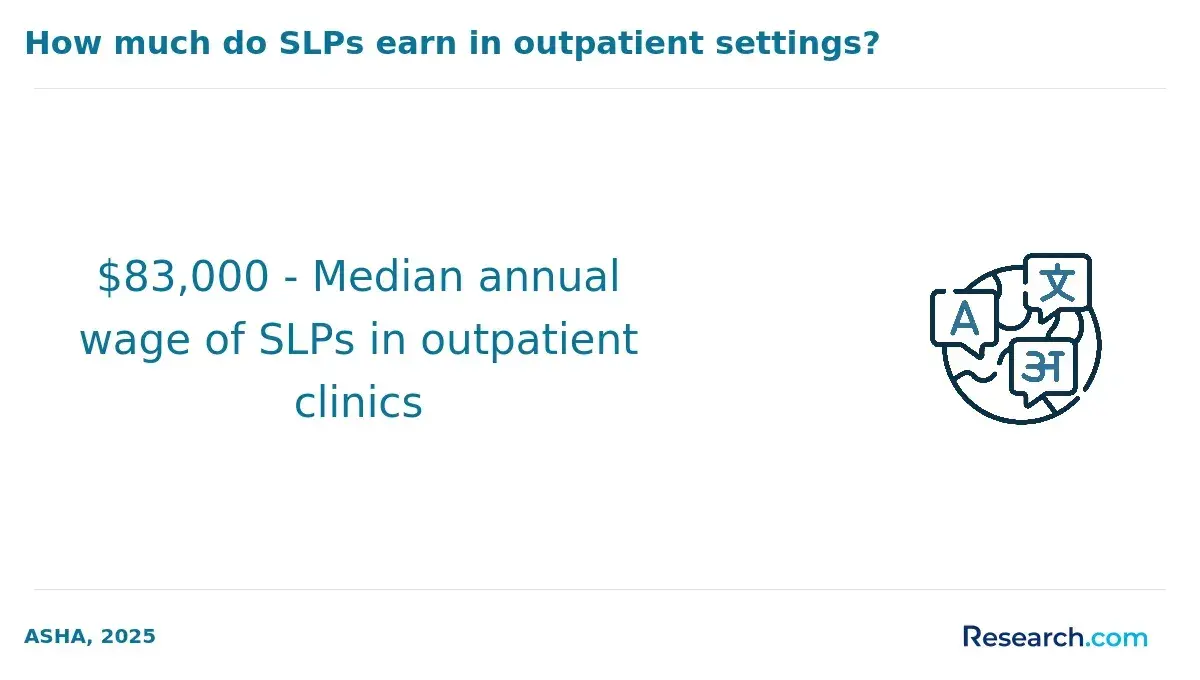
A two-year plan generally gets you to graduation about one year sooner than a three-year plan, assuming uninterrupted progression. That difference can matter because speech-language pathologists had a median annual wage of $97,870 in May 2025, according to the U.S. Bureau of Labor Statistics. However, graduation is not the same as independent licensure: most graduates still complete a postgraduate clinical fellowship and meet jurisdiction-specific licensing steps.
The faster path only delivers its time advantage if you can remain continuously enrolled. A delayed practicum, failed course, leave of absence, unavailable placement, or inability to attend a required residency can reduce or erase the calendar advantage.
Use this timeline to distinguish the degree-completion milestone from the broader path to practice:
| Milestone | Two-year program | Three-year program |
| Graduate coursework begins | Term 1 | Term 1 |
| Advanced clinical education | Often begins earlier in the overall calendar | May begin later, after a longer academic runway |
| Master's degree completion | Commonly around 24 months with continuous enrollment | Commonly around 30 to 36 months with continuous enrollment |
| Clinical fellowship and licensure process | Begins after graduation, subject to employment and state rules | Begins after graduation, subject to employment and state rules |
| Independent professional practice | Depends on certification, fellowship, and state approval | Depends on certification, fellowship, and state approval |
Compare the school's published "time to completion" with its progression rules. Ask whether the stated duration assumes summer enrollment, whether students can decelerate, what happens if a clinical placement is postponed, and whether all cohorts can access required experiences on schedule. The fastest advertised calendar is not necessarily the lowest-risk timeline.
How do clinical practicum and externship requirements align within shorter and longer online SLP programs?
Clinical education is the least flexible component of an online SLP degree. Students provide services in person under supervision, accumulate required experience, complete documentation, and follow the schedules and policies of schools, hospitals, clinics, or other assigned sites. A university may support placement development, but the exact model and the student's responsibilities vary by program.
For ASHA certification standards, graduate preparation includes a minimum of 400 supervised clinical practicum hours, including at least 375 hours of direct client or patient contact and 25 hours of guided clinical observation. Programs may require additional hours or experiences to meet their curricula, and states or sites may add requirements.
Shorter and longer plans normally target the same clinical outcomes, but they distribute the work differently, as seen in the table below:
| Clinical planning issue | Two-year program trade-off | Three-year program trade-off |
| Early planning | Placement details may need to be settled quickly | More calendar time to prepare, but no guarantee of preferred placement |
| Coursework overlap | Higher chance of concurrent course and clinic obligations | May separate some coursework and clinical work more clearly |
| Employment during placement | Full-time work may be difficult when externships intensify | Early employment may be more feasible; later clinical blocks can still limit work |
| Travel and relocation | Compressed schedule leaves less room to absorb changes | More time to plan, though travel requirements may remain |
| Placement delay impact | Can affect a tightly sequenced graduation plan | May be easier to absorb, depending on course availability and program policy |
Ask admissions staff for written answers about who secures placements, whether students may propose sites, geographic restrictions, expected travel, background checks, health clearances, liability costs, and whether a placement delay affects graduation. Do not enroll based on an assumption that a site near your home will be available or that evenings and weekends will satisfy clinical requirements.
What accreditation and ASHA CAA standards must both two-year and three-year SLP programs meet?
Length does not substitute for accreditation. The Council on Academic Accreditation in Audiology and Speech-Language Pathology (CAA), part of the American Speech-Language-Hearing Association, accredits qualifying graduate education programs. A two-year and a three-year program can both meet CAA standards; conversely, an online format or university brand alone does not establish eligibility for certification or licensure.
CAA standards evaluate educational quality and outcomes across areas such as curriculum, faculty, clinical education, student assessment, resources, and public information. Students should verify the program's current status directly in ASHA's accreditation directory and distinguish fully accredited status from candidacy, which can have important timing implications.
These checkpoints help prevent a costly mismatch between a degree plan and professional goals:
- Confirm the exact program, degree level, and campus or delivery pathway listed in the CAA directory rather than relying on a general university accreditation claim.
- Read the program's state authorization and professional licensure disclosures for the state where you expect to complete clinical education and seek a license.
- Request the curriculum plan showing how knowledge and skills standards, supervised clinical education, and assessment requirements are completed.
- Ask whether any prerequisite, leveling, residency, or clinical requirement is affected by your state of residence.
Applicants who are still narrowing their options can use guides to the easiest speech pathology programs to get into, but admissions accessibility should never override CAA status, clinical feasibility, and licensure compatibility.
How does program length affect eligibility and preparation for ASHA certification and state licensure?
Program duration by itself does not change the fundamental route to certification or licensure. Graduates generally need a qualifying graduate degree from a CAA-accredited program, passing Praxis performance, a completed clinical fellowship, and compliance with the requirements of the state in which they seek a license. Requirements, application processes, and supervision rules can differ by jurisdiction.
A two-year curriculum may move you more quickly to the fellowship stage, while a three-year curriculum can provide more time to develop study routines, clinical confidence, and professional relationships before graduation. Neither timeline waives the same post-degree requirements. A longer program should be viewed as a pacing choice, not an alternative credential.
The profession's demand context makes careful planning worthwhile. The BLS projects 17% employment growth for speech-language pathologists from 2025 to 2035 and about 12,500 openings per year on average over that decade. These national projections indicate demand, not a guarantee of a job, preferred setting, or state-specific salary.
Students interested in a speech pathologist online masters degree should compare each school's licensure disclosures before applying, especially if they may move after graduation. Keep copies of syllabi, clinical-hour records, supervisor documentation, and degree-verification materials; another state may request them when you apply for licensure by endorsement or initial licensure.
In what ways do student demographics and employment status differ between two-year and three-year SLP cohorts?
Schools do not use a single national profile for online SLP cohorts, so applicants should avoid assuming that age, prior career, caregiving status, or employment pattern determines success. Online programs often attract people who need geographic access or want to remain near family, but the cohort format may still require fixed live sessions and daytime placements.
In practice, two-year cohorts may appeal to students who want to enter the profession sooner and can temporarily limit paid work. Three-year tracks may better accommodate applicants balancing employment, family responsibilities, or prerequisite completion, particularly in the earlier academic phases. Once clinical education becomes intensive, both groups may face similar constraints.
The most useful self-assessment is operational rather than demographic. Consider whether you can reliably meet the following conditions before selecting a timeline:
- Availability for daytime clinical placements, travel, and unexpected schedule changes.
- Financial capacity to reduce work hours during practicum or externship terms.
- Quiet, dependable technology access for live online learning, telepractice activities, and group assignments.
- Support for caregiving, illness, transportation disruptions, and other events that can affect required attendance.
Ask programs for the actual meeting pattern for the most recent cohort and whether students commonly work during each phase. A candid answer is more useful than a generic statement that a program is designed for working adults.
How do stress, burnout risk, and work-life balance compare by program duration in online SLP study?
A two-year plan concentrates deadlines, examinations, clinical feedback, and life logistics into a shorter period. This can feel motivating for students with protected time and strong support, but the margin for illness, family emergencies, or work surges is smaller. A three-year plan may create more room for recovery and routine, yet the longer commitment can also produce fatigue, prolonged financial pressure, and delayed career transition.
Burnout risk is not determined by duration alone. It is more closely tied to the mismatch between required hours and available resources. Online students can also experience isolation when group projects, clinical supervision, and peer relationships are mediated by technology rather than daily campus contact.
Before committing, use these practical safeguards to test whether a timeline is sustainable:
- Build a term-by-term calendar that includes class meetings, estimated study time, placement hours, commuting, work shifts, caregiving, and exam weeks.
- Identify the terms when paid work must decrease and create a savings, aid, or household-income plan for those periods.
- Ask about leave-of-absence, deceleration, remediation, mental health, disability, tutoring, and clinical support policies before a crisis occurs.
- Choose the pace that leaves a realistic buffer for ordinary disruptions rather than assuming every term will proceed perfectly.
Common mistakes include choosing the shortest option to minimize discomfort, treating asynchronous coursework as self-paced, or assuming a longer program has no high-intensity periods. A better choice is the schedule you can complete consistently while meeting clinical and academic expectations.
What tuition, financial aid, and opportunity cost differences arise between shorter and longer SLP paths?
Tuition comparison requires more than multiplying a per-credit rate. Two programs with similar total credits can differ in mandatory fees, distance-learning charges, residency costs, travel, background checks, health requirements, testing, clinical attire, and the income a student gives up during placements. A shorter program can lower the time spent paying living expenses while enrolled, but a heavier schedule may make it harder to earn wages at the same time.
For eligible graduate students, Direct Unsubsidized Loans have an annual borrowing limit of $20,500; students who need more may consider Direct PLUS Loans, subject to federal rules and credit review. Aid eligibility, institutional scholarships, and tuition rates can change, so use each school's current financial-aid office and published cost-of-attendance information rather than relying on a general estimate.
The following framework separates the costs that can move in opposite directions:
| Financial factor | Potential effect of two-year route | Potential effect of three-year route |
| Total tuition | May be similar if required credits are identical; continuous enrollment can affect term fees | May be similar by credit, but additional terms can add fees or rate-change exposure |
| Living expenses while enrolled | Potentially fewer months in school | Potentially more months of housing, insurance, and household costs |
| Lost or reduced wages | May be concentrated during a shorter, more intensive period | May be spread over more time; clinical phases can still reduce work |
| Borrowing and interest | Earlier completion may shorten in-school time, but borrowing can be high if work stops abruptly | Longer enrollment can extend borrowing needs and interest accrual |
| Entry to post-degree employment | Potentially earlier, if progression remains on schedule | Later, though a steadier work arrangement may reduce financial strain during school |
Create two personal cash-flow plans, one for each pace. Include program-specific billed charges and non-billed costs, then model your income during every clinical term. For a broader career and earnings context, explore masters in speech pathology career options, while remembering that setting, location, experience, and licensure affect individual compensation.
Which students are best served by a two-year versus a three-year online SLP master's timeline?
A two-year online SLP master's program is often the better choice for a student who can treat graduate school as a primary commitment, has reliable financial and household support, and wants to reach the post-graduation Clinical Fellowship stage as soon as possible. It is not automatically the better value if its pace makes withdrawal, delayed progression, or excessive borrowing more likely.
A three-year program is often the better choice for a student who needs to preserve some employment in the academic phase, manage caregiving, complete remaining preparation, or build a more sustainable routine. It is not automatically easier: clinical placements can still require daytime availability and substantial unpaid time.
Choose based on the constraint that is least negotiable in your situation:
| If your priority is... | Usually favor... | Important caution |
| Finishing the degree sooner | Two-year timeline | Verify continuous summer, clinical, and residency availability |
| Maintaining more room for work early in the degree | Three-year timeline | Do not assume work remains feasible during externships |
| Minimizing time out of the workforce | Often two-year timeline | Compare lost wages, debt, and the risk of a delayed graduation |
| Managing unpredictable family or health demands | Often three-year timeline | Confirm deceleration and leave policies in writing |
| Seeking the lowest overall cost | Either, after full-cost comparison | Compare total billed and non-billed costs, not only duration |
| Meeting a state licensure goal | Either CAA-aligned option | Verify state disclosures and required clinical arrangements first |
Make your final decision only after reviewing the curriculum sequence, clinical placement model, current CAA status, state disclosures, full cost of attendance, and policies for interruption. The best program length is the one that preserves your ability to finish the accredited degree and meet professional requirements without an unsustainable personal or financial trade-off.
Other Things You Should Know About Speech Language Pathology
It may be possible during some coursework terms, particularly in a three-year plan, but it is often difficult during practicum and full-time externship periods. Ask for the required clinical schedule by term before relying on employment income.
No. Coursework may be online, but supervised clinical education is typically in person. Some programs also require campus immersions, skills assessments, or synchronous sessions. Confirm travel and attendance requirements before applying.
Not necessarily. A longer program generally spreads equivalent professional preparation across more time. Accreditation standards, clinical competencies, and graduation requirements - not calendar length alone - determine whether the preparation meets professional expectations.
Verify current CAA accreditation status, eligibility for your state, total cost of attendance, clinical placement responsibilities, required travel, live-session times, progression rules, and whether you can meet daytime placement demands. Obtain key answers in writing.
References
- Online Speech-Language Pathology Graduate Program https://csd.robbins.baylor.edu/graduate/online-csd-graduate-program
- Online Master of Speech-Language Pathology | WCU https://westcoastuniversity.edu/online-programs/master-of-speech-language-pathology
- 20 Online Speech Language Pathology Master's Programs https://www.campusexplorer.com/masters-degree/online-speech-language-pathology/
- Accelerated SLP Programs: Get Your Master's in 16-20 Months https://www.speechpathologygraduateprograms.org/blog/accelerated-slp-programs/
- Masters SLP programs - preferably online: r/slpGradSchool https://www.reddit.com/r/slpGradSchool/comments/s5p0p0/masters_slp_programs_preferably_online/