2027 Best Online Speech Pathology Master's Programs for Residents of Las Vegas, NV

Co-Founder and Chief Data Scientist

Reviewed by Rhea Paul, PhD
SLP Education & Research Expert
Las Vegas residents looking for an online speech-language pathology master's degree need more than a convenient class format: they need a CAA-accredited program that can support clinical training and fit Nevada licensure rules. This guide compares leading online and hybrid SLP options on the factors that matter most locally, including state eligibility, campus-travel expectations, placement support, tuition structure, pacing, and admissions barriers. It is designed to help prospective students narrow their list before they invest in prerequisites, application fees, or a multi-year degree.
Key Things You Should Know
- A Nevada-eligible, CAA-accredited master's degree is the essential starting point for Las Vegas residents pursuing SLP licensure; online coursework alone does not remove clinical-hour, examination, or supervised-experience requirements.
- Speech-language pathology has a strong national employment outlook: the U.S. Bureau of Labor Statistics projects 17% employment growth from 2025 to 2035, with about 12,500 openings annually on average.
- Programs differ materially in travel, live-class schedules, prerequisite expectations, placement responsibility, and total tuition, so the strongest choice depends on your academic background and ability to complete clinical experiences in or near Nevada.
Which online speech pathology master's programs serve Las Vegas residents?
Several established programs use online academic coursework while requiring students to complete supervised clinical education in person. For a Las Vegas applicant, the meaningful question is not whether a program is "100% online," but whether it accepts Nevada residents, can authorize enrollment in Nevada, provides an appropriate path to clinical placements, and meets professional education requirements.
The following programs are commonly considered by students seeking flexible graduate SLP training. Availability, state authorization, and clinical-placement capacity can change by cohort, so applicants should obtain written confirmation from each school before applying.
| Program | Delivery model | Key Las Vegas consideration | Best fit |
| New York University, MS in Communicative Sciences and Disorders | Online coursework with required in-person clinical training and intensives | Students should confirm Nevada enrollment eligibility, local placement processes, and required travel before applying | Applicants seeking an established online cohort model and structured clinical curriculum |
| Emerson College, MS in Speech-Language Pathology | Online coursework with in-person clinical placements and immersion experiences | Live participation and travel requirements may affect students working standard daytime schedules in Pacific Time | Career changers who want a program with clinical-placement support and multiple start options |
| Baylor University, MS in Communication Sciences and Disorders | Online coursework, virtual learning activities, and in-person clinical education | Confirm current Nevada authorization and whether placement travel may be necessary | Students seeking a faith-based private-university option with a cohort format |
| University of St. Augustine for Health Sciences, MS-SLP | Online didactic coursework with in-person clinical experiences and required residencies | Residency travel, placement availability, and Nevada licensure disclosures require close review | Students who value an interprofessional health-sciences environment |
A broad directory of online speech pathology master's programs can help you identify additional options, but use it as a starting point rather than proof of Nevada eligibility. The school's current state authorization and professional-licensure disclosure are the controlling documents.
Do not eliminate programs merely because their home campus is outside Nevada. A program can be a workable option for a Las Vegas resident if it is authorized to enroll Nevada students, holds appropriate accreditation, clearly addresses Nevada professional licensure, and has a realistic clinical-placement plan. Conversely, a nearby school is not automatically the better choice if its format requires daytime attendance or extensive out-of-state travel.
Which programs hold CAA accreditation for speech pathology training?
For prospective clinical speech-language pathologists, accreditation by the Council on Academic Accreditation in Audiology and Speech-Language Pathology (CAA) is the central academic quality check. CAA accreditation evaluates the graduate program, not simply the university's regional accreditation or the fact that classes are offered online.
NYU, Emerson College, Baylor University, and the University of St. Augustine for Health Sciences list CAA-accredited graduate SLP programs. However, applicants should verify the exact program's current status through the CAA directory and the institution's official accreditation page during the cycle in which they enroll. Accreditation status, accredited locations, and distance-education arrangements can be revised.
| Accreditation question | Why it matters for a Nevada applicant | What to verify |
| Is the specific master's program CAA-accredited? | CAA accreditation is commonly expected for ASHA certification and is highly relevant to state licensure eligibility | Program name, degree level, current accreditation status, and any cited conditions |
| Does accreditation cover the delivery pathway? | Some programs offer more than one campus, cohort, or modality | That the online or hybrid pathway is included in the accredited program structure |
| Is the school institutionally authorized to educate Nevada residents? | CAA accreditation does not itself grant permission to enroll residents of every state | Nevada state authorization and distance-education eligibility |
| Does the curriculum support Nevada licensure preparation? | Accreditation and state licensure are related but separate determinations | The school's Nevada professional-licensure disclosure and the Nevada board's current rules |
A frequent mistake is confusing ASHA certification, CAA accreditation, and a state license. They are distinct credentials and processes. A CAA-accredited degree can be an important foundation, but it does not by itself award the Certificate of Clinical Competence in Speech-Language Pathology (CCC-SLP) or a Nevada license.
Which online programs meet Nevada licensure expectations for speech-language pathologists?
Nevada licensure is governed by the Nevada Board of Examiners for Audiology and Speech Pathology. The board, rather than a university, decides whether an individual applicant meets the state's requirements. A Las Vegas student should therefore treat a university's disclosure as planning information, not as a guarantee that a future license will be issued.
Programs that state their curriculum is designed to meet Nevada educational requirements may be stronger initial candidates, but that statement should be checked against current board rules. Schools may categorize Nevada as "meets," "does not meet," "not determined," or "not accepting students"; each designation has a different consequence.
Before committing, request written answers to the following questions from the program's licensure or compliance office. These steps are especially important if you expect to work in Nevada immediately after graduation.
- Ask whether the program currently accepts Nevada residents and is authorized to deliver distance education in Nevada.
- Ask whether the school has determined that its curriculum meets educational requirements for Nevada SLP licensure and request the date of that determination.
- Ask whether the planned clinical sequence can provide the supervised experiences needed for graduation and later credentialing.
- Compare the school's response with current Nevada board requirements, including education, examination, supervised professional experience, and application documentation.
- Keep copies of disclosures, emails, course descriptions, clinic-hour records, and supervisor documentation for your future application.
Applicants should also plan beyond graduation. National ASHA certification generally involves a qualifying graduate degree, supervised clinical experience, a Praxis examination requirement, and a clinical fellowship. Nevada's requirements can overlap with those steps but may not be identical. Requirements can change, so verify them near the time you apply for licensure rather than relying on a disclosure issued years earlier.
What are the tuition, fees, and residency costs for Las Vegas students?
Online SLP programs often quote tuition per credit, per term, or as an estimated program total. Those figures are not interchangeable. Las Vegas students should compare the same cost category across schools and add expenses that are particularly significant in clinical degrees: campus immersions, transportation, background checks, immunizations, liability coverage, technology, textbooks, and potential travel to placements.
The figures below should be treated as planning examples based on published program pricing structures rather than final bills. Private programs may charge the same academic tuition regardless of residence, while public programs may apply different rates or fees. Ask each admissions or financial-aid office for a written estimate for your intended start term.
| Program | Published pricing approach | Cost issue to investigate | Las Vegas planning implication |
| NYU | Per-credit graduate tuition and university fees | Number of required credits, annual tuition changes, and immersion travel | Often a higher-cost private option; compare total required credits rather than one term's bill |
| Emerson College | Program tuition commonly presented as a per-credit or estimated-program amount | Mandatory fees, clinical costs, and required immersion expenses | Useful for students who value support services but need to budget for travel and a private-school price point |
| Baylor University | Program tuition and fees set by the university for the applicable cohort | Whether quoted figures include clinical and residency-related expenses | Compare its complete estimated cost with other private online pathways |
| University of St. Augustine for Health Sciences | Tuition set by program and term, with separate fees possible | Residency costs, clinical fees, and timing of tuition charges | Evaluate cash-flow needs as well as the total published tuition |
Build a personal cost worksheet before choosing a school. These cost categories are commonly omitted from headline tuition comparisons.
- Tuition for every required academic and clinical credit, including prerequisite or leveling coursework if needed
- Mandatory university, technology, application, graduation, health-record, and clinical-education fees
- Transportation, lodging, meals, and lost work time for on-campus immersions or residencies
- Travel costs if a clinical placement is outside Las Vegas or requires a lengthy commute
- Background checks, drug screening, immunizations, CPR certification, professional liability coverage, and clinical attire
- Interest and origination costs if federal or private loans will finance part of the degree
Students focused on minimizing borrowing should compare tuition with placement logistics and time away from paid work. A lower advertised tuition rate can be less economical if it requires repeated cross-country travel or delays graduation because clinical placements are difficult to secure. Review accelerated SLP programs carefully as well: a shorter academic calendar may reduce living-cost exposure, but it can also leave less room for employment and make intensive clinical terms harder to manage.
Which programs offer the required clinical practicum and externship placements?
Every credible entry-to-practice online SLP master's pathway includes in-person clinical education. Coursework may be delivered online, but direct client services, supervision, skills assessment, and clinical placements occur in real clinical settings. Programs sometimes use different terms - practicum, clinic, internship, externship, or clinical rotation - but all should explain how students progress from observation and simulation to supervised patient or client care.
Placement models vary substantially. The table highlights what a prospective Las Vegas student should clarify before treating a program as practical.
| Placement model | What the school may do | What the student may still need to do | Potential concern |
| School-coordinated placement | Identify, contract with, and assign sites where feasible | Meet onboarding requirements, travel, and accept available scheduling | A local placement is not guaranteed unless stated in writing |
| Collaborative placement search | Provide a clinical education team and approve sites | Suggest leads, communicate with facilities, and complete site paperwork | Students may overestimate how much local choice they will have |
| Student-initiated placement | Review and approve proposed sites and supervisors | Locate willing facilities and qualified supervisors | Can be difficult in competitive metropolitan clinical markets |
| Campus or regional intensive clinic | Provide some direct clinical training through university-arranged activities | Travel to required sessions and arrange lodging | Travel cost and scheduling may be significant |
Las Vegas has hospitals, rehabilitation settings, schools, early-intervention providers, and private practices, but neither the presence of local employers nor a school's national network guarantees a placement in the city. Clinical sites can limit learners, require daytime availability, impose health-clearance standards, or change their capacity. Ask whether prior Nevada placements have been used, but do not treat past use as a promise for your cohort.
Strong questions for a clinical education office include whether it guarantees placement, the typical distance students travel, whether a student may decline an assignment, who pays for site-related costs, whether school and medical placements are both required, and what happens if a site cancels. A school that gives precise written answers is generally easier to evaluate than one that relies on broad assurances.
How do admission requirements differ across online SLP master's programs?
Admissions requirements are especially important for career changers. Some online programs admit applicants with a bachelor's degree outside communication sciences and disorders (CSD), while others expect substantial undergraduate CSD preparation. "Prerequisite-friendly" does not mean prerequisites are waived; it usually means the school offers, recommends, or accepts leveling coursework before graduate clinical training begins.
Requirements differ by school and cycle, but applicants commonly need the following materials.
- A bachelor's degree from an institution recognized by the program, with official transcripts
- Specified CSD prerequisite courses or a documented plan to complete them before enrollment
- A minimum cumulative and, in some cases, prerequisite GPA
- Personal statement, résumé, recommendation letters, and experience information
- English-language proficiency documentation when applicable
- Background-check eligibility and the ability to meet clinical-site health and onboarding requirements
Some programs do not require the GRE, but that does not make admission automatic. Cohort-based clinical programs must assess academic readiness, communication skills, professionalism, and capacity for demanding clinical education. Applicants comparing easiest SLP grad schools to get into should still prioritize accreditation, Nevada eligibility, clinical support, and prerequisite fit over a perceived admissions advantage.
| Applicant profile | Likely admissions issue | Practical response |
| CSD bachelor's degree holder | Competitive GPA, clinical exposure, and fit with the cohort model | Confirm each school's current prerequisite and observation expectations |
| Career changer with unrelated bachelor's degree | Missing foundational science and CSD courses | Map prerequisites course by course before paying application fees |
| Applicant with a lower GPA | Minimum GPA threshold or limited evidence of recent academic readiness | Ask whether holistic review, recent coursework, or post-baccalaureate work is considered |
| Working adult | Ability to attend live sessions and daytime clinical placements | Discuss schedule constraints candidly before accepting admission |
A common mistake is applying first and checking prerequisites later. Instead, request an unofficial transcript review where available, identify the exact missing courses, and compare the time and cost of completing them with each program's next available start date.
Which programs allow part-time study, accelerated pacing, or synchronous classes?
Online SLP degrees are often structured around a fixed cohort and clinical sequence. That structure helps programs coordinate supervision and competency assessment, but it can limit the flexibility that applicants associate with online learning. Most students should expect at least some scheduled live sessions, group work, assessments, and clinical terms that occur during normal weekday hours.
Emerson, NYU, Baylor, and the University of St. Augustine each use organized cohort or term-based structures rather than purely self-paced instruction. Exact pacing, attendance requirements, and start dates vary. Applicants in Las Vegas should ask for meeting times in Pacific Time, not simply rely on a school's description of "evening" or "online" classes.
| Format feature | Why it matters in Las Vegas | Who it tends to suit |
| Asynchronous coursework | Reduces time-zone friction and can help with work or family responsibilities | Organized students who can meet deadlines without fixed daily class times |
| Synchronous online classes | May occur in Eastern or Central Time and can overlap with work hours | Students who benefit from real-time instruction and peer interaction |
| Full-time cohort pacing | Can create a clearer completion sequence but leaves limited employment flexibility | Students able to prioritize school and clinical training |
| Part-time academic pacing | May spread coursework but does not necessarily make clinical placements part-time | Students who need a slower pre-clinical schedule |
| Accelerated calendar | Can shorten time in school but increases weekly academic and clinical demands | Students with strong time availability and financial preparation |
Do not assume that "part time" means you can keep a full-time job throughout the degree. Clinical externships may involve daytime schedules aligned with schools, hospitals, or outpatient sites. Ask the program when full-time clinical availability becomes necessary and whether students can take a leave of absence without losing their cohort sequence.
What support do online students receive for placements, advising, and exam prep?
Student support can determine whether an online format is manageable, particularly when clinical sites, time zones, and licensure paperwork are involved. The most valuable services are concrete and documented: a clinical education team, a named academic adviser, technical support, disability accommodations, financial-aid counseling, and clear escalation procedures if a placement falls through.
When comparing schools, evaluate support as an operational service rather than a marketing promise. The table separates helpful evidence from vague language.
| Support area | Strong evidence | Question to ask |
| Clinical placement | Written explanation of who identifies sites, approves supervisors, and handles cancellations | What is the placement process for Nevada students, and what happens if no local site is available? |
| Academic advising | Assigned adviser, curriculum map, and published progression policies | How often can students meet with an adviser, and who approves schedule changes? |
| Licensure guidance | Current state-specific disclosures and records support | Who can help me document courses and clinical hours for a Nevada application? |
| Praxis preparation | Integrated review resources, practice materials, or coaching | Is exam preparation included, optional, or solely self-directed? |
| Career services | Career coaching, alumni access, and job-search resources appropriate to clinical professionals | Can distance students use the same career services as campus students? |
Praxis preparation matters, but it should not outweigh clinical quality or licensure compatibility. Similarly, job-search resources are useful but do not guarantee employment. The best support package for a Las Vegas learner is one that makes the school's responsibilities and the student's responsibilities easy to distinguish.
How should Las Vegas applicants verify accreditation and state authorization?
Verification should happen before submitting an enrollment deposit. Public webpages can be outdated, and a general statement that a program is online or accredited may not address whether it can enroll Nevada residents or prepare them for Nevada licensure.
Use this short verification sequence to create a defensible application record.
- Confirm the exact degree and delivery pathway in the CAA accreditation directory, including current status.
- Read the program's professional-licensure disclosure for Nevada and save a dated copy.
- Ask the university's state authorization or compliance office whether Nevada residents may enroll in your intended cohort.
- Ask the clinical education office how placements are arranged, whether travel may be required, and whether it can describe Nevada-specific experience without promising a local assignment.
- Review current Nevada Board of Examiners for Audiology and Speech Pathology requirements before enrolling and again before applying for a license.
- Get material answers in writing, especially answers about Nevada eligibility, required travel, prerequisite approval, and placement responsibility.
Red flags include a school that cannot identify its accreditation status, will not state whether Nevada residents are eligible, describes clinical placements only in general terms, or suggests that graduation automatically produces a license. Another warning sign is a tuition quote that excludes mandatory fees, travel, or prerequisite coursework without making those exclusions clear.
Which online speech pathology programs are strongest for Las Vegas residents?
There is no universally best online SLP master's program for every Las Vegas resident. The strongest option is the one that can document Nevada eligibility, CAA accreditation, a credible clinical-training pathway, manageable required travel, and a schedule and total cost that match your situation. Among widely known online options, NYU, Emerson, Baylor, and the University of St. Augustine merit consideration when their current Nevada disclosures align with your goals.
| Program type or option | Relative strength | Main trade-off | Best decision criterion |
| NYU online MS pathway | Established university-based online clinical education model | Private-university pricing and required in-person components may be substantial | Choose if its current Nevada eligibility, travel pattern, and total budget fit |
| Emerson online MS-SLP pathway | Designed for online delivery with structured student and clinical support | Live-session, immersion, and clinical scheduling demands can limit work flexibility | Choose if you want a cohort experience and can meet attendance requirements |
| Baylor online CSD master's pathway | Online cohort option with clinical education built into the degree path | Private cost and state-specific authorization must be confirmed | Choose if its admissions, curricular approach, and Nevada disclosure are a close fit |
| University of St. Augustine MS-SLP pathway | Health-sciences-oriented setting and hybrid clinical preparation | Residency and placement logistics can add cost and travel | Choose if the required residency model is workable for your household and job situation |
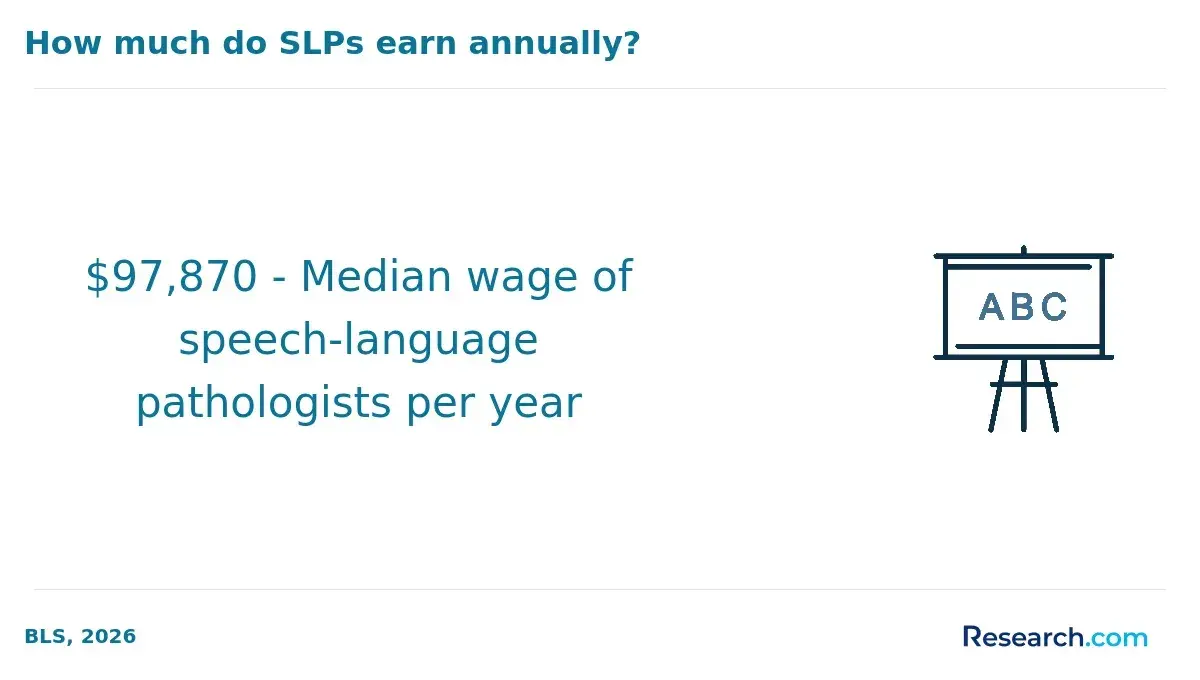
Career demand supports careful investment, not rushed enrollment. The U.S. Bureau of Labor Statistics reports a May 2025 median annual wage of $97,870 for speech-language pathologists and projects 17% growth from 2025 to 2035. Those national figures do not predict an individual Las Vegas salary, because compensation varies by employer, setting, experience, schedule, and local market. Use a detailed speech pathologist salary comparison to understand how medical, school, private-practice, and specialized roles may differ.
For most applicants, the practical shortlist should contain two to four programs. Eliminate any school that cannot confirm Nevada eligibility or explain its clinical model. Then compare remaining choices using a complete cost estimate, expected travel, prerequisite timeline, live-class schedule, and the level of placement support you need. That approach is more reliable than choosing solely by brand name, headline tuition, or advertised speed.
Other Things You Should Know About Speech Language Pathology
Yes, if the degree is from an appropriately accredited program, includes required supervised clinical education, and you complete Nevada's applicable licensure steps. Online academic delivery does not mean clinical training is virtual only; expect in-person practicum and externship requirements.
Not always. Many programs consider career changers, but they typically require foundational CSD and science prerequisites before or alongside graduate entry. Have each prospective program review your transcripts rather than assuming similarly named undergraduate courses will transfer.
It may be difficult, especially during advanced externships. Clinical sites often operate during weekdays, and students must follow the site's schedule. Ask each school when daytime availability becomes mandatory and whether clinical terms can be completed part time.
No. Schools may assist with placement development, but local placement availability can change. Graduation also does not guarantee employment. Select a program with transparent placement practices, then plan early for travel, professional networking, and Nevada licensure documentation.
References
- Online Speech Pathology Programs: 2026 Guide https://www.speechpathology.org/online/
- Online Master's in Speech-Language Pathology: 2026 Programs https://bestonlinecollege.org/programs/speech-pathology/masters
- Best Online Master's in Speech Pathology (SLP) Programs https://www.onlinemastersdegrees.org/best-programs/speech-language-pathology-slp/
- Best Online Speech-Language Pathology (SLP) Programs 2026 https://onlinespeechpathologyprograms.org/best-online-slp-programs/