2027 Best Online Speech Pathology Master's Programs for Residents of Killeen, TX

Co-Founder and Chief Data Scientist

Reviewed by Rhea Paul, PhD
SLP Education & Research Expert
Killeen residents seeking an online speech-language pathology master's degree need more than a convenient class schedule: they need a program that can support Texas licensure, supervised clinical education, and a realistic travel and tuition plan. This guide compares credible online and hybrid SLP master's options using the factors that matter most locally, including CAA accreditation, Texas enrollment eligibility, placement support, live-session expectations, cost transparency, and admission requirements. Use it to narrow your list before applying or committing to prerequisite coursework.
Key Things You Should Know
- A Texas SLP license generally requires a CAA-accredited master's degree, qualifying supervised clinical experience, a passing Praxis score, and completion of the required clinical fellowship; an "online" format does not remove these in-person requirements.
- Baylor, Emerson, the University of Cincinnati, and the University of St. Augustine for Health Sciences are notable online or hybrid-format options to investigate, but Killeen applicants must obtain written confirmation of current Texas authorization and clinical-placement policies before enrolling.
- The national median annual wage for speech-language pathologists was $97,870 in May 2025, and BLS projects 17% employment growth from 2025 to 2035; those figures support demand but do not guarantee a job, salary, or local placement.
Which online speech pathology master's programs best serve residents of Killeen, Texas today?
The strongest option depends on whether you value a Texas-based university, a highly structured placement process, fewer required trips, or a particular pacing model. For a Killeen applicant, "best" should mean that the program is CAA-accredited, currently accepts Texas residents, provides a workable clinical-education model, and gives clear Texas licensure disclosures - not simply that it is marketed as online.
The programs below are established online or hybrid MS-SLP/MS-CSD options worth comparing. Program availability, tuition, travel requirements, and state authorization can change, so treat the table as a screening tool and confirm each point with the university before applying.
| University and degree format | Why it may fit a Killeen resident | Important trade-off to verify | Best for |
| Baylor University, online MS in Communication Sciences and Disorders | Texas-based option with an online curriculum and clinical education component; Waco is substantially closer than many out-of-state campus requirements. | Confirm current required immersions, travel dates, Texas clinical-site process, and total charges. | Applicants who prefer a Texas university and can manage a cohort-based intensive program. |
| Emerson College, online MS in Speech-Language Pathology | National online delivery with a dedicated clinical-placement structure and a format designed for distance learners. | Confirm Texas authorization, required in-person immersions, live class schedule in Central Time, and clinical-site availability. | Applicants who want a fully developed distance-learning model and can budget for private-university pricing. |
| University of Cincinnati, online MS in Speech-Language Pathology | Public-university online option that may appeal to students seeking a structured graduate curriculum outside Texas. | Ask whether the current cohort accepts Texas residents, how placements are sourced, and whether any campus attendance is required. | Applicants comparing public-university delivery with part-time or cohort scheduling needs. |
| University of St. Augustine for Health Sciences, online MS-SLP | Health-professions-focused institution with an online pathway and clinical education infrastructure. | Verify CAA status for the exact program and location, Texas enrollment eligibility, travel, and all tuition and clinical fees. | Applicants who want an institution focused on health-professions education and can evaluate its format carefully. |
For many Central Texas students, Baylor deserves an early look because it is in Texas; however, proximity does not eliminate placement, travel, or cost questions. Emerson can be compelling for students who want an established distance model, while Cincinnati and St. Augustine can widen the comparison set. None is universally best, and an applicant should remove any program that cannot provide a clear written answer about Texas eligibility and clinical education.
If speed is your main priority rather than location flexibility, compare program calendars carefully. Some 5-year accelerated speech pathology programs are designed for students who begin planning during undergraduate study, but they are usually not a shortcut for applicants who already need graduate prerequisites or a post-baccalaureate leveling sequence.
Which accredited universities offer online speech-language pathology master's degrees to Texas residents?
CAA accreditation is the starting point, but it is not the same thing as a promise that a school can enroll every Texas resident in every term. Universities may alter state authorization, pause admissions in a state, or impose state-specific clinical-placement limits. Ask the admissions office for a current answer tied to your planned start term and keep that answer with your records.
This comparison separates institutional accreditation from the practical question of Texas enrollment. "Confirm directly" is not a warning sign by itself; it is the appropriate status when authorization and licensure disclosures are updated independently of the academic catalog.
| Program | Accreditation question to ask | Texas-resident question to ask | Clinical education question to ask |
| Baylor University | Confirm the exact MS-CSD program's current CAA accreditation status. | Ask whether the next online cohort is open to Texas residents, including military-connected students living near Fort Cavazos. | Ask whether the school arranges, approves, or requires students to locate sites for each practicum. |
| Emerson College | Confirm current CAA accreditation for the online MS-SLP pathway. | Request the current Texas professional-licensure disclosure and state authorization statement. | Ask how the placement team matches students, what happens if a nearby site declines, and whether travel may be required. |
| University of Cincinnati | Confirm that the distance-delivery master's pathway is covered by the university's current CAA accreditation. | Ask whether Texas is an authorized enrollment state for the specific cohort. | Clarify the student's responsibility for outreach, affiliation agreements, and site approval. |
| University of St. Augustine for Health Sciences | Confirm CAA status for the exact MS-SLP pathway, not merely institutional accreditation. | Obtain the school's Texas licensure disclosure in writing before paying a deposit. | Confirm how placements are developed and whether any clinical experiences require travel outside the Killeen area. |
A degree in speech-language pathology is a professional-entry credential. It prepares graduates to assess and treat communication, swallowing, voice, fluency, cognitive-communication, and related disorders under the rules of the state where they practice. Readers who are still evaluating the profession can review what does a speech pathologist do before investing in graduate preparation.
Do not rely on a general statement that a university is "online nationwide." Ask whether the program can enroll you while you live in Texas, whether it is designed to meet Texas academic requirements, and whether it has a workable plan for the clinical sites you will need.
How do Texas licensure rules and ASHA certification requirements shape online SLP program choices?
Texas licensure rules make accreditation and clinical education nonnegotiable. Texas licenses speech-language pathologists through the Texas Department of Licensing and Regulation. Applicants should expect to complete a qualifying master's degree, supervised practicum, the national Praxis examination, and the post-degree clinical fellowship requirements applicable to the license level they seek. Requirements can change, so applicants should verify the current rule directly with the licensing agency before enrollment and again before applying for licensure.
ASHA's Certificate of Clinical Competence in Speech-Language Pathology, commonly called the CCC-SLP, is a separate national professional credential that many employers value. Its core pathway generally includes a graduate degree from a CAA-accredited program, at least 400 supervised clinical-practicum hours with at least 25 observation hours and 375 direct clinical-contact hours, a passing Praxis score, and a Clinical Fellowship of at least 1,260 hours over at least 36 weeks. A compliant graduate program helps build the academic and practicum foundation, but it does not complete the fellowship for you.
Telepractice and digital documentation are increasingly common in clinical settings, but they do not make hands-on competence optional. A quality online program should explain how it supervises telepractice, protects patient privacy, trains students to use clinical technology, and ensures that virtual experiences meet its clinical-education standards.
What accreditation should Killeen-based students verify for online speech pathology master's programs?
Verify programmatic accreditation first. The key accreditor for U.S. graduate education in speech-language pathology is the Council on Academic Accreditation in Audiology and Speech-Language Pathology, or CAA, which operates under ASHA. Institutional accreditation alone is not enough for a degree intended to lead to SLP licensure.
Before accepting an offer, verify these items because each protects a different part of your path to practice:
- Confirm that the exact graduate program is CAA-accredited, and record the status and review date rather than relying on a schoolwide accreditation claim.
- Read the university's Texas professional-licensure disclosure and ask whether the curriculum is designed to meet educational requirements for Texas SLP licensure.
- Confirm that the university is authorized to provide distance education to students located in Texas during your enrollment period.
- Ask whether all required clinical experiences are included in the accredited program and how the school documents supervisory credentials and clinical hours.
- Review whether a program is accredited, in candidacy, or seeking accreditation; candidacy can carry materially different risk for an applicant depending on graduation timing and state rules.
A common mistake is enrolling in a communication-related master's degree that is not the professional SLP program needed for licensure. Another is assuming a school's CAA status automatically resolves state authorization. Verify both separately, and obtain answers by email when they affect your ability to practice in Texas.
How do tuition, fees, and total cost compare among top online SLP programs for Killeen residents?
Tuition comparisons are difficult because schools use different credit totals, fee structures, and billing models. A per-credit price cannot fairly be compared with a published program total unless both include the same required costs. Baylor's online MS-CSD has been publicly described as a 45-credit program, while other online pathways may require substantially more credits; credit count changes the meaning of any per-credit tuition figure.
The table identifies the cost categories that matter more than a headline tuition number. Request an itemized estimate for your starting term, not an estimate copied from a prior cohort's webpage.
| Cost category | Why it matters for Killeen students | What to request from the school |
| Tuition basis | Programs may charge by credit, term, or cohort; total credits vary substantially. | Total tuition for the full required curriculum, based on your planned pace. |
| Mandatory university fees | Technology, clinical, graduation, and student-service charges may not be included in advertised tuition. | A list of mandatory recurring and one-time fees. |
| Travel and immersion costs | Flights, lodging, meals, mileage, and time away from work can materially change the budget. | Required locations, number of visits, typical duration, and whether any travel is optional. |
| Clinical costs | Background checks, drug screening, immunizations, liability insurance, scrubs, and site onboarding are often student expenses. | An estimated clinical-readiness and placement budget. |
| Books, testing, and licensure | Praxis preparation, the examination, fingerprinting, and Texas licensing steps occur outside normal tuition. | Which items are included and which are paid separately. |
Financial fit should be judged against completion probability, not tuition alone. A lower advertised rate can become costly if the program requires repeated travel, delays a clinical placement, or forces you to reduce work hours unexpectedly. Conversely, a higher-cost program may be more workable if its placement support and schedule allow you to complete on time.
Ask financial-aid staff for the cost of attendance, federal loan options, scholarship deadlines, and the effect of part-time enrollment on aid. Do not assume that an out-of-state online program charges Texas residents in-state tuition, and do not assume employer tuition assistance covers clinical fees or travel.
Which online speech pathology programs allow Killeen students to complete clinical placements locally?
No responsible program can promise a placement in Killeen unless it has confirmed a site, an affiliation agreement, and a qualified supervisor for your specific term. "Local placement support" usually means the university will attempt to develop or approve sites within a reasonable radius; it does not mean every practicum will occur near home.
Programs commonly use one of three placement models. Understanding the model is more useful than relying on broad marketing language about local clinical experiences.
| Placement model | How it works | Risk for a Killeen student |
| University-arranged | The clinical education office identifies and contracts with sites, then assigns students when possible. | Availability may still require commuting, schedule flexibility, or travel beyond Bell County. |
| Student-assisted with university approval | The student suggests or contacts potential sites while the university manages approval and affiliation requirements. | Students with limited local professional networks may face more uncertainty and administrative work. |
| Hybrid model | The school secures some experiences and asks students to assist with others. | The degree of support may differ by term, specialty area, and the availability of supervisors. |
Ask admissions or clinical education staff these questions before depositing:
- How many required practicums and externships are completed in person, by telepractice, or through simulation?
- Who contacts Killeen-area sites and who executes affiliation agreements?
- What is the school's contingency plan if a planned site cancels or cannot provide enough hours?
- Can placements involve commuting to Temple, Waco, Austin, or other Central Texas communities?
- Can I keep my current job during external placements, and what are the usual daytime-hour expectations?
Clinical education is often the least flexible part of an online degree. Students who need to remain employed should plan for daytime availability well before their placement terms and should not assume that evening or weekend clinical hours will be sufficient.
How do admission standards and prerequisite coursework differ across leading online SLP programs?
Most professional SLP master's programs expect a completed bachelor's degree, academic prerequisites in communication sciences and disorders or related subjects, a competitive GPA, references, a statement of purpose, and observation or exposure to the field. Requirements differ enough that applicants should create a school-by-school checklist instead of assuming one completed application will satisfy every program.
Applicants without a CSD bachelor's degree may be eligible for a leveling sequence, post-baccalaureate coursework, or a longer program plan. That route can be a good fit for career changers, but it increases time and total cost. It is not the same as being admitted directly to the professional master's curriculum.
The admissions differences below commonly determine whether a program is realistic for a particular applicant.
| Requirement area | How programs may differ | Decision implication |
| Prerequisites | Some require a full CSD foundation before enrollment; others offer or accept leveling coursework. | Calculate extra courses and their cost before treating a listed degree length as your timeline. |
| GPA review | Programs may state a minimum GPA but admit competitively above that threshold. | A minimum is not an admission guarantee; ask whether prerequisite GPA receives separate review. |
| GRE policy | Many programs have moved away from requiring the GRE, while policies can change by cycle. | Confirm the policy for your application year instead of paying for an exam unnecessarily. |
| Observation and experience | Some programs expect documented observation or value relevant school, health-care, or support experience. | Complete only observation hours permitted by the program and document them accurately. |
| Interviews and writing | Programs may use interviews, recorded responses, essays, or holistic review. | Prepare examples that show communication skills, resilience, ethical judgment, and realistic understanding of clinical work. |
Applicants concerned about competitiveness should look for fit, not shortcuts. This guide to easiest SLP grad schools to get into can help frame realistic admission research, but every applicant should still prioritize CAA accreditation, Texas compatibility, and a clinical-placement plan over a perceived lower barrier to entry.
A frequent error is applying before confirming prerequisite equivalencies. Send unofficial transcripts to each program when permitted, ask for a written prerequisite review, and retain the response. It can prevent paying application fees for programs that require several unplanned courses.
What online learning formats and time-to-degree options work best for working adults in Killeen?
An online SLP master's degree usually means online academic coursework combined with in-person clinical education, not a fully remote route to licensure. Cohort programs often use a fixed sequence because clinical skills build across courses and because practicum placements must be coordinated. Most students should expect full-time intensity during at least some clinical terms.
Choose the format based on your work and caregiving constraints, not just your preference for remote lectures.
| Format feature | Potential advantage | Potential limitation |
| Asynchronous coursework | Lets students complete some lectures and discussions around work shifts. | Deadlines, group work, exams, and clinic obligations still follow a fixed schedule. |
| Live online classes | Provides real-time faculty interaction, skill practice, and cohort connection. | May conflict with work hours; confirm the meeting time in Central Time. |
| Full-time cohort | Provides a defined sequence and potentially faster completion than part-time study. | Often requires reduced employment during intensive academic and clinical periods. |
| Part-time or extended pacing | May reduce course load during early didactic terms. | May not extend to clinical placements and can raise total living and borrowing costs. |
| Required immersion | Supports hands-on skill development and faculty assessment. | Requires travel, lodging, leave from work, and backup plans for family responsibilities. |
For a working adult, the most important scheduling question is not "Are classes online?" It is "During which terms must I be available weekdays for clinic?" Request a term-by-term sample plan that identifies synchronous classes, expected practicum hours, immersion dates, and the point at which outside work becomes difficult to sustain.
Students who require maximum flexibility may be better served by completing prerequisites first, building savings, and applying when they can accommodate clinical training. A program that appears slower but has transparent placement timing can be safer than an accelerated pathway with ambiguous clinical expectations.
How do graduation outcomes, Praxis pass rates, and job placement look for these online SLP programs?
CAA-accredited programs publish outcome information that typically includes completion, Praxis examination, and employment data over multiple reporting periods. Those outcomes are valuable, but readers should compare definitions and cohort sizes before deciding that one percentage is meaningfully better than another. Small cohorts and different reporting windows can make year-to-year results volatile.
Ask each program for its most recent CAA outcome disclosure and use the same questions for every school:
- What is the on-time completion rate for the most recent reporting period, and how does the program define completion?
- What Praxis pass-rate measure is reported, what score is considered passing, and how many graduates were included?
- What percentage of graduates seeking employment obtained jobs, and how many were actively seeking work?
- How many students withdrew, took longer than expected, or experienced clinical-placement delays?
- What career support is available for Texas job searches, Clinical Fellowship applications, and licensure paperwork?
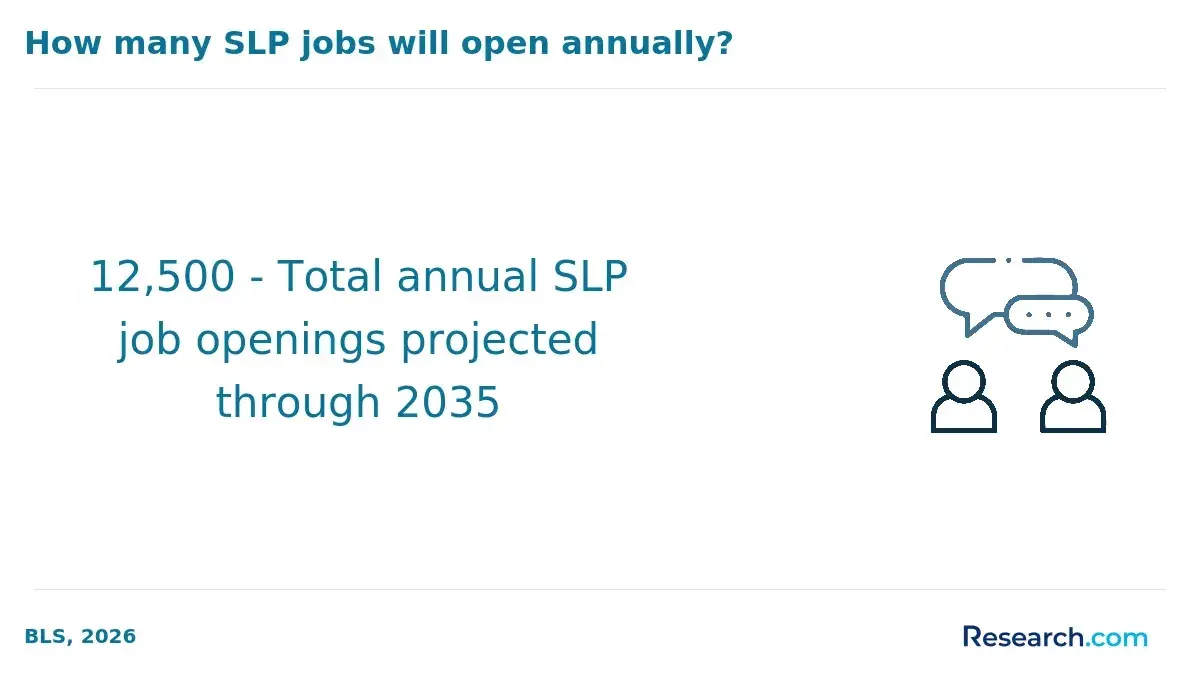
National labor data provide useful context but cannot predict an individual outcome. The U.S. Bureau of Labor Statistics reports a median annual wage of $97,870 for speech-language pathologists in May 2025 and projects 17% employment growth from 2025 to 2035, with about 12,500 openings annually on average. For a Killeen applicant, the practical takeaway is that the field has strong projected demand, while actual pay and hiring depend on setting, experience, employer, local market conditions, and Texas licensure status.
Do not choose a program solely on a published Praxis rate. A strong decision weighs outcomes alongside affordability, clinical support, licensure alignment, and whether the schedule gives you a realistic chance to finish without interruption.
What steps should Killeen students follow to vet program quality, consumer protections, and state authorization?
Use a documented verification process before you apply, and repeat key checks before you pay a nonrefundable deposit. This protects you from the most expensive errors: entering a nonqualifying program, discovering a state restriction late, or underestimating clinical and travel obligations.
Follow these steps in order to create an apples-to-apples comparison:
- Confirm the exact program's current CAA accreditation status and save a copy of the program's accreditation disclosure.
- Request written confirmation that the university may enroll students located in Texas for your intended start term.
- Request the Texas professional-licensure disclosure and ask whether the curriculum is intended to satisfy Texas educational requirements.
- Obtain a full curriculum plan showing prerequisite needs, credit requirements, expected completion date, live classes, practicum terms, and any residencies.
- Ask clinical education staff - not only admissions staff - how sites are arranged, whether local placement is guaranteed, and what travel could be required.
- Request an itemized total-cost estimate that includes tuition, mandatory fees, travel, clinical onboarding, books, insurance, and testing expenses.
- Review the withdrawal, leave-of-absence, refund, transfer-credit, and teach-out policies before signing an enrollment agreement.
- Compare the latest CAA outcome disclosure and ask how the program supports Texas licensure and Clinical Fellowship preparation.
Watch for red flags: vague answers about Texas authorization, promises of "local" placements without a process, confusing claims about accreditation, pressure to pay before receiving disclosures, or a tuition quote that excludes common required charges. A reputable program should be willing to explain its policies clearly and put material answers in writing.
Finally, keep a decision file containing emails, cost estimates, curriculum plans, and disclosures. If policies change, this record helps you ask precise follow-up questions and compare schools on evidence rather than impressions.
Other Things You Should Know About Speech Language Pathology
You can complete substantial coursework online, but licensure-track SLP education includes supervised clinical experiences that are completed in person and may include telepractice under supervision. Choose a CAA-accredited program that confirms Texas eligibility and explains its clinical-placement process.
Not necessarily. The university may be outside Texas, but it must be able to enroll Texas residents and support required clinical education. You may still need to travel for immersions, skills assessments, or placements, so confirm those requirements before enrolling.
Some students work during early online coursework, but full-time work can become difficult during practica and external clinical placements because those experiences commonly occur on weekday schedules. Review a term-by-term plan before assuming that employment can continue unchanged.
Ask programs for a transcript-based prerequisite review. You may need leveling or post-baccalaureate coursework before or alongside graduate study. Factor that added time and cost into your decision, and do not assume every online master's program offers a career-changer pathway.
References
- Emerson College Online Master's in Speech Pathology https://speech.emerson.edu/