2027 Best Online Speech Pathology Master's Programs for Residents of Cleveland, OH

Co-Founder and Chief Data Scientist

Reviewed by Rhea Paul, PhD
SLP Education & Research Expert
Cleveland residents considering an online speech-language pathology master's degree need more than a flexible class schedule: they need a CAA-accredited program that can support clinical training and lead toward Ohio licensure.
This guide compares realistic online, hybrid, and Ohio-based options; explains travel, placement, cost, and admissions trade-offs; and provides a practical checklist for choosing a program that fits a future career in Northeast Ohio.
Key Things You Should Know
- For Ohio licensure, prioritize a master's program accredited by ASHA's Council on Academic Accreditation (CAA), plus the supervised clinical education, Praxis examination, and post-graduate fellowship requirements Ohio expects.
- "Online" SLP programs are not fully remote clinical degrees: students should expect local or assigned practicum sites, live online sessions in some programs, and possible campus immersions or travel.
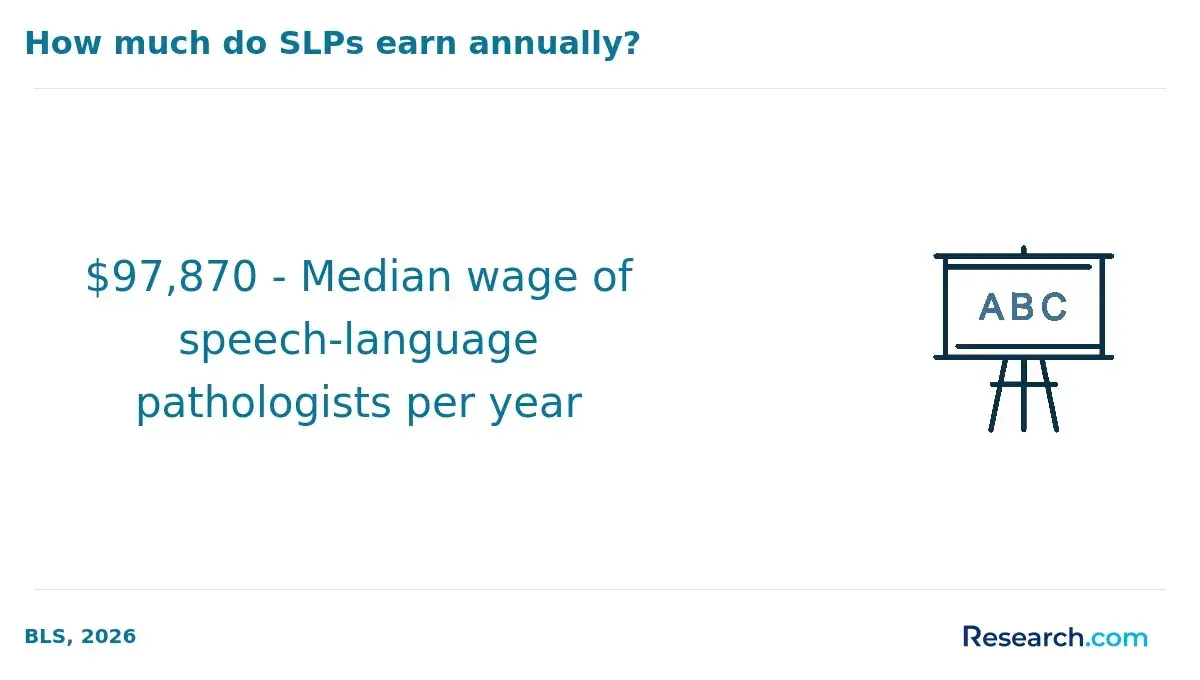
- Speech-language pathology remains a strong long-term field: the U.S. Bureau of Labor Statistics reports a $97,870 median annual wage in May 2025 and projects 17% employment growth from 2025 to 2035.
Which online speech pathology master's programs are realistically accessible to residents of Cleveland, OH today?
The most realistic options for Cleveland residents are CAA-accredited distance or hybrid programs that permit Ohio enrollment, disclose whether their curriculum is designed to meet Ohio professional licensure requirements, and have a workable plan for clinical placements. A school's national online availability does not automatically mean it can enroll Ohio residents in every term or arrange placements near Cleveland.
The following comparison identifies programs commonly considered by Ohio applicants. Enrollment eligibility, tuition, cohort start dates, and travel requirements can change, so applicants should obtain written confirmation from each admissions office before paying an enrollment deposit.
| Program | Delivery model | Why it may suit a Cleveland resident | Important trade-off to confirm |
| Emerson College | Online M.S. in Communication Disorders with clinical education and required experiential components | Designed for distance learners and commonly considered by applicants seeking an online CAA-accredited path | Clinical placement process, campus immersion expectations, Ohio authorization, and total tuition |
| New York University | Online M.S. in Communicative Sciences and Disorders with clinical placements | Structured online curriculum from a large university with established distance-learning operations | Live-session schedule, clinical-site assignment process, travel, and higher private-university cost exposure |
| Baylor University | Online M.S. in Speech-Language Pathology with required clinical experiences | Cohort-based online option for students who want a defined sequence and professional preparation | Required immersions, Ohio eligibility, placement responsibilities, and full-program charges |
| University of Cincinnati | Distance or hybrid learning options may be available within its M.S. SLP offerings | Ohio location can reduce uncertainty about state context and make regional travel more manageable | Whether the available track is open to a particular applicant, required campus attendance, and cohort format |
Use this list as a starting point rather than a universal ranking. Readers who want a broader national comparison can also review SLP master's programs online, then narrow the list using Ohio-specific licensure and placement questions.
A Cleveland applicant should generally choose an out-of-state online program only when it offers a clear advantage, such as a schedule that fits full-time employment, a better prerequisite pathway, or a clinical-placement model the applicant understands. A nearby campus or hybrid program may be a better choice when local faculty relationships, regional placements, and fewer travel complications matter more than asynchronous coursework.
How do Ohio licensure rules shape which online speech pathology programs Cleveland students should choose?
Ohio licensure should be the first filter, not the final administrative task. An online master's degree can be academically excellent yet still create problems if the institution cannot enroll Ohio residents, does not provide the required clinical education, or does not clearly state whether its curriculum is intended to meet Ohio's professional requirements.
Ohio's speech-language pathology licensing process is administered through the Ohio Board of Speech-Language Pathology and Audiology. Applicants should expect to document a qualifying graduate degree, supervised clinical preparation, a passing Praxis examination score acceptable to the Board, and post-graduate supervised experience before independent practice. Requirements, forms, and score standards can change, so students should review the Board's current rules during application season and again before graduation.
CAA accreditation matters because it is the recognized quality framework for entry-level professional SLP education. CAA standards address curriculum, faculty, student outcomes, clinical education, and program resources. Accreditation is not the same thing as a personal license, but it is a major safeguard for students pursuing Ohio licensure and ASHA certification.
For Cleveland residents planning to work in public schools, professional licensure is only part of the picture. School-based roles may also require an Ohio Department of Education and Workforce credential or license pathway. A program should be able to explain whether it supports school-credential applications, but the student remains responsible for meeting the current requirements of the hiring district and state education agency.
Before selecting a program, obtain answers to these questions in writing:
- Is the program currently CAA accredited, accredited on probation, or in candidacy status?
- May a new student residing in Ohio enroll in the specific online or hybrid track?
- Does the institution state that the curriculum is designed to meet Ohio SLP licensure educational requirements?
- Who secures practicum and externship sites, and what happens if a Cleveland-area placement cannot be finalized?
- What travel, live class attendance, background checks, health records, and technology requirements apply?
A common mistake is treating a school's general licensure disclosure as a guarantee. Ask about the precise degree track, your state of residence, and the term in which you would begin. Keep the response with your admission and financial-aid records.
Which online speech pathology programs serving Cleveland hold ASHA CAA accreditation and are license-eligible?
CAA accreditation is the strongest initial indicator that a master's program is structured for entry-level SLP practice. However, applicants should distinguish among full accreditation, accreditation with a monitoring condition, and candidacy. Candidacy can be meaningful for a new program, but it carries more uncertainty than an established accredited program and deserves especially careful review.
The programs below are widely known for CAA-accredited SLP education or are Ohio-based programs with CAA-recognized professional preparation. Because accreditation status is time-sensitive, use ASHA's CAA directory and each university's official accreditation statement to verify the status attached to the exact program before applying.
| Program or pathway | Accreditation and licensure value | Best fit | Key caution |
| Emerson College online M.S. pathway | CAA-accredited professional preparation should be verified against the current CAA listing | Applicants seeking a distance-first model | Confirm Ohio enrollment authorization and clinical placement terms |
| NYU online M.S. pathway | CAA-accredited professional preparation should be verified against the current CAA listing | Applicants comfortable with a highly structured online cohort | Confirm schedule, travel, and all clinical participation requirements |
| Baylor online M.S. pathway | CAA-accredited professional preparation should be verified against the current CAA listing | Students seeking an online program with sequenced clinical learning | Confirm state eligibility and required in-person experiences |
| University of Cincinnati M.S. SLP pathway | CAA status and applicable delivery track should be verified directly with the university and CAA | Applicants who prefer an Ohio-based institution | Do not assume that every M.S. track is fully online |
Do not choose solely on perceived admissions ease. A list of speech language pathology programs can help identify admissions patterns, but a Cleveland applicant should still prioritize accreditation, Ohio eligibility, clinical education, and financial fit over acceptance-rate marketing.
License eligibility also depends on individual completion of the required coursework and clinical milestones. Even in a CAA-accredited program, students must complete their own clinical hours, satisfy academic standards, pass required examinations, and complete the appropriate supervised fellowship before practicing independently.
What distance-learning and state authorization restrictions affect Cleveland enrollment in out-of-state speech pathology programs?
State authorization is separate from accreditation. A university may hold CAA accreditation but still limit enrollment from certain states because of regulatory, placement, or institutional authorization rules. Ohio residents should confirm that the institution can enroll them while they live in Ohio, not merely that the school advertises an online degree.
Distance-learning restrictions most often affect students in four ways: the school may pause new enrollment from Ohio, require an additional disclosure or acknowledgment, limit where clinical experiences occur, or require students to notify the program before relocating. These rules can matter if a student moves from Cleveland to another state during the program.
There are also practical restrictions that do not always appear prominently on a program homepage. Clinical sites may require immunizations, drug screening, fingerprinting, liability coverage, CPR certification, health insurance, transportation, and daytime availability. Cleveland has major healthcare and school systems, but no university can responsibly promise a specific site until an affiliation and supervisor are confirmed.
Applicants should be cautious about three red flags: a program that will not provide an Ohio licensure disclosure, an admissions representative who cannot explain the clinical-placement model, or an advertised "fully online" degree that does not clearly explain in-person clinical training. These issues do not automatically disqualify a school, but they require written clarification before enrollment.
How do online speech pathology programs compare on clinical placement support specifically in the Cleveland region?
Clinical placement support is often the deciding factor for Cleveland applicants. Academic lectures can be delivered online, but SLP competence requires supervised work with clients across age groups and communication or swallowing needs. A strong program has a formal placement team, clear student responsibilities, contingency planning, and transparency about travel expectations.
The comparison below focuses on how applicants should evaluate placement models rather than assuming that any program can place students at a particular Cleveland hospital, school district, rehabilitation facility, or private practice.
| Placement model | What the university typically does | What the student should expect to do | Who may benefit most |
| University-coordinated placement | Maintains affiliation agreements and seeks a suitable site and supervisor | Meet clearance requirements, accept reasonable travel, and communicate early about constraints | Students without professional SLP contacts in Northeast Ohio |
| Collaborative placement search | Provides approval standards and may assist with outreach | Identify leads, avoid independently promising a site, and submit sites for approval | Applicants with local professional networks and scheduling flexibility |
| Student-identified placement | Approves sites and verifies supervision after the student identifies options | Conduct substantial outreach and allow time for contracts and approvals | Experienced local professionals who understand clinical settings |
Ask each program how often students must travel outside their home area for practica, whether pediatric and adult experiences are assured, and how it handles a site cancellation. It is also useful to ask whether the program has existing affiliation agreements in Northeast Ohio; a school may decline to name individual sites, but it should be able to explain its process and typical geographic reach.
Online delivery is usually best for a Cleveland resident who can attend daytime clinical hours even if coursework is flexible. It is usually a poor fit for someone who needs all learning, including practica, to occur evenings or weekends. Clinical schedules are driven by client availability, supervisors, schools, and healthcare operations rather than by the convenience of online lectures.
Which Ohio-based universities offer hybrid or online speech pathology master's options attractive to Cleveland residents?
Ohio-based options can be attractive because they may reduce interstate authorization uncertainty and make campus travel more predictable. Still, Cleveland residents should not assume that an Ohio university's SLP master's program is online. Many respected Ohio programs remain campus-centered because of the intensity of clinical education.
University of Cincinnati is a logical institution to investigate for applicants seeking an Ohio-connected pathway with distance or hybrid possibilities. Its current availability, cohort structure, and on-campus requirements should be confirmed for the intended start term. Ohio State University, Case Western Reserve University, Kent State University, the University of Akron, Ohio University, and the University of Toledo are also institutions Cleveland applicants may encounter when researching Ohio SLP education, although many of their professional master's pathways are principally campus-based.
The key decision is not whether a university is physically close to Cleveland; it is whether the delivery model fits your working hours and clinical obligations. A campus-centered Ohio program may be preferable for students who value in-person faculty access and local cohort relationships. An out-of-state online program may be preferable for applicants who need remote academic coursework and can accommodate required clinical or immersion travel.
Before ruling out an Ohio school because it is not marketed as online, ask whether it offers part-time sequencing, selected remote courses, a distance-learning cohort, or clinical experiences closer to Northeast Ohio. Conversely, before choosing a national online program for convenience, compare its required trips and placement conditions with the commute and schedule demands of an Ohio-based option.
How do costs, funding, and assistantships differ across top online speech pathology programs open to Cleveland applicants?
Cost comparisons should use total program cost rather than a single per-credit tuition figure. Online SLP programs can differ materially in credit requirements, technology charges, clinical fees, travel, background checks, health requirements, books, and the cost of taking unpaid or reduced-work clinical semesters. A lower tuition rate does not automatically produce a lower total investment.
Schools should provide a current tuition-and-fee schedule for the relevant cohort. If a school cannot give a reliable estimate of required charges, treat that as an information gap rather than assuming the advertised tuition covers all professional preparation costs.
| Cost category | Why it matters for Cleveland applicants | How to compare it |
| Tuition and mandatory fees | Private online programs and public Ohio programs may use very different pricing structures | Request the estimated charge for all required credits, not just one term |
| Travel and immersion costs | Airfare, lodging, meals, and local transport can raise the cost of a distance program | Ask for the number, location, and typical timing of required visits |
| Clinical compliance costs | Health checks, testing, insurance, and background clearances can be required before placements | Request a clinical-readiness checklist and estimate |
| Lost earnings during practica | Daytime placements can reduce the ability to work full time | Map clinical semesters against your employment and household budget |
Federal student aid may be available to eligible graduate students through the FAFSA, but borrowing limits, interest, origination fees, and lifetime debt should be reviewed carefully. Graduate assistantships can reduce costs at some campus-based programs, yet they are less common or less workable in lockstep online cohorts. Ask whether assistants receive tuition remission, a stipend, health coverage, or only hourly wages.
Career demand can support the long-term case for the degree, but it should not be treated as a repayment guarantee. The BLS reports a national median annual wage of $97,870 for speech-language pathologists in May 2025; individual pay varies by setting, experience, schedule, employer, and geographic market. Specialized settings may pay differently, and readers comparing clinical career paths can explore the context around NICU SLP salary.
The best financial choice is often the program with the lowest realistic net cost after aid and travel, not the shortest advertised online path. Build a budget that includes the period when clinical demands may limit paid work.
What admissions timelines and prerequisite course expectations do leading online speech pathology programs require?
Admissions preparation for SLP master's programs usually begins well before the application deadline. Competitive applicants need to document academic readiness, communication-related prerequisite coursework, observation or exposure to the profession when required, and an ability to participate in demanding clinical education. Requirements differ by school and can change by cohort.
Common prerequisite expectations include anatomy and physiology of speech and hearing mechanisms, phonetics, language development, speech and hearing science, audiology, speech-language disorders, statistics, and social or behavioral science coursework. Applicants without a communication sciences and disorders bachelor's degree may need a post-baccalaureate leveling sequence before or alongside graduate admission.
A practical application sequence is:
- Choose programs only after verifying Ohio enrollment eligibility, CAA status, travel, and clinical-placement responsibilities.
- Request transcript evaluations early, especially if you have a non-CSD major or older prerequisite courses.
- Track each deadline, recommendation requirement, essay prompt, interview format, and application platform separately.
- Budget time for background checks, immunizations, observation documentation, and financial-aid forms after admission.
Some programs no longer require the GRE, while others may have different policies by cohort. Minimum GPA rules also vary, and meeting a minimum does not ensure admission. Ask for the school's current prerequisite list and whether it reviews applicants holistically, uses rolling admission, or fills a fixed cohort after a single deadline.
Applicants considering a faster route should distinguish accelerated academics from accelerated clinical eligibility. A speech language pathology accelerated program may reduce calendar time, but it still must include the supervised clinical education and sequenced competencies needed for professional preparation. A compressed plan may not be ideal for students who need to work full time or who are completing numerous leveling courses.
How can Cleveland applicants verify current accreditation, program status, and exam pass rates before enrolling?
Accreditation, authorization, outcomes, and licensure disclosures should be verified from official sources shortly before application and again before enrollment. Program webpages can be useful, but an applicant should not rely on an old social-media post, an aggregator listing, or a verbal statement from a recruiter when a licensure decision is involved.
Use this verification routine to reduce avoidable risk:
- Search ASHA's CAA program directory for the exact institution, degree, location, and current accreditation status.
- Read the university's Ohio professional-licensure disclosure for the exact online or hybrid track.
- Review the Ohio Board of Speech-Language Pathology and Audiology requirements for the license you expect to pursue.
- Ask the program for its most recent published student-outcome information, including Praxis performance, program completion, and employment data, along with the reporting period and cohort size.
- Save written answers about Ohio enrollment, placements, required travel, and any curriculum changes that could affect your start term.
Outcome rates require context. A very small graduating cohort can produce a high percentage that does not necessarily predict an individual applicant's experience. Likewise, employment outcomes may be reported at different intervals after graduation. Compare definitions, reporting years, and cohort sizes before treating one program's published outcome as better than another's.
The most important red flag is a mismatch between a school's marketing language and its formal disclosures. If an institution calls a program "licensure-ready" but will not identify the state-specific basis for that statement, pause the application until you receive a clear written explanation.
How do online speech pathology graduates from these programs fare in Ohio employment and CF opportunities near Cleveland?
Graduates who complete a qualifying program can pursue clinical fellowship and entry-level SLP opportunities in Cleveland-area schools, hospitals, rehabilitation settings, early-intervention programs, skilled nursing facilities, outpatient clinics, and private practices. Availability changes with local employer needs, and a degree alone does not guarantee a specific job, salary, or fellowship placement.
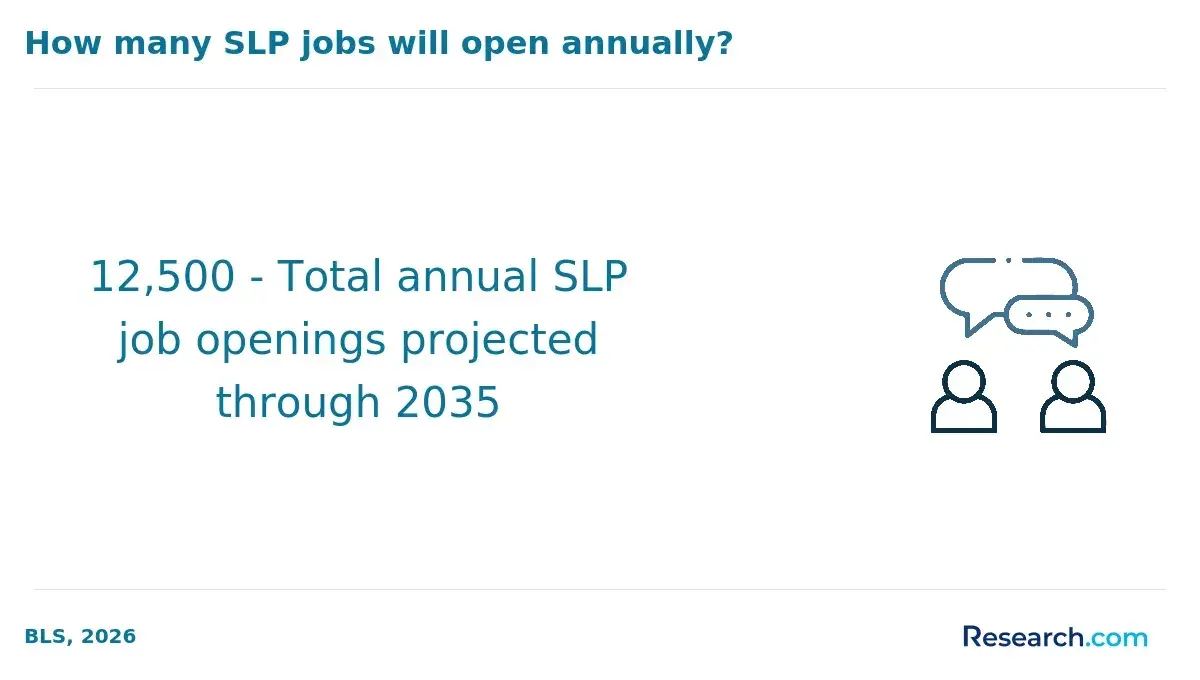
The national outlook supports careful investment in the field. The BLS projects 17% employment growth for speech-language pathologists from 2025 to 2035 and about 12,500 openings per year on average over the decade. For Cleveland applicants, that broad demand is most useful as a signal to plan strategically for licensure and fellowship - not as a substitute for local networking and a strong clinical record.
A clinical fellowship is a supervised transition from graduate education to independent practice. Students should begin discussing fellowship interests with faculty and supervisors before graduation, particularly if they prefer medical SLP, pediatric practice, schools, swallowing disorders, or adult neurogenic communication. Early conversations can help students select electives and clinical experiences that align with target employers.
Technology is also changing practice without replacing the credential. Telepractice, electronic health records, augmentative and alternative communication tools, remote hearing and language screening workflows, and AI-supported documentation tools may affect daily work. Employers still need clinicians who can make ethical clinical judgments, protect confidentiality, communicate with families, and deliver evidence-informed care.
To improve local employability, Cleveland students should maintain a professional portfolio with clinical competencies, supervisor feedback where appropriate, training records, and documentation of relevant populations served. They should also verify whether a prospective employer requires an Ohio SLP license, a clinical fellowship license or permit, ASHA certification progress, and an education credential for school-based work.
Other Things You Should Know About Speech Language Pathology
You may complete much of the academic coursework online, but professional SLP preparation cannot be entirely virtual because supervised clinical education is required. Choose a CAA-accredited program that can enroll Ohio residents, provides an acceptable clinical-training plan, and supports the educational requirements for Ohio licensure.
It depends on the school. Some programs coordinate placements, some use a shared model, and some expect students to identify possible sites. Ask whether the program has experience arranging Northeast Ohio placements, who signs affiliation agreements, and what happens if a proposed site is unavailable.
Not always. Many programs admit students from other majors, but they usually require prerequisite or leveling courses in core communication sciences and disorders subjects. The amount of additional coursework depends on your transcript and the school's policy.
Some students work during didactic coursework, but full-time employment becomes difficult when daytime clinical practica and externships begin. Before enrolling, review the clinical schedule, required live sessions, travel, and whether the cohort is full-time, part-time, or lockstep.
References
- Communication Sciences and Disorders https://health.csuohio.edu/communication-sciences-disorde/communication-sciences-and-disorders
- Speech Language Pathology | Programs https://case.edu/programs/speech-language-pathology-ma
- Cleveland State University https://www.facebook.com/clevelandstateuniversity/posts/our-ma-in-communication-sciences-and-disorders-program-is-now-online-designed-fo/1028418499329553/