2027 Best Online Speech Pathology Master's Programs for Residents of Palmdale, CA

Co-Founder and Chief Data Scientist

Reviewed by Rhea Paul, PhD
SLP Education & Research Expert
Choosing an online speech-language pathology master's program from Palmdale requires more than finding a distance-learning option. California licensure rules, required clinical practicum hours, possible campus visits, and a school's ability to arrange local placements can determine whether a program is practical.
This guide compares credible options and explains the questions Palmdale applicants should answer before applying, so they can choose a program that supports both graduation and California SLP licensure.
Key Things You Should Know
- California SLP licensure generally requires a qualifying master's degree from a program accredited by the Council on Academic Accreditation in Audiology and Speech-Language Pathology (CAA), supervised professional experience, and a passing Praxis examination score.
- Online delivery does not mean fully remote clinical training: students should expect in-person practicum experiences and may need to travel for required immersions, orientations, simulations, or assessments.
- The U.S. Bureau of Labor Statistics reports a $97,870 median annual wage for speech-language pathologists in May 2025 and projects 17% employment growth from 2025 to 2035, but a program's California licensure compatibility matters more than salary projections when selecting a degree.
Which accredited online speech pathology master's programs accept residents of Palmdale, California?
Palmdale residents should begin with CAA-accredited master's programs that explicitly permit enrollment from California and provide a clear path for California licensure review. "Online" can describe several formats: live virtual classes, asynchronous coursework, remote simulations, local clinical placements, and short on-campus experiences. A strong option is one that is transparent about all of those components before you deposit.
The programs below are commonly considered by California residents because they offer distance-based SLP graduate education. Availability, California authorization, admissions cycles, tuition, and residency requirements can change; applicants should obtain written confirmation directly from each institution before applying.
| Program | Accreditation consideration | Online-format consideration | Why it may fit a Palmdale resident | Important trade-off to confirm |
| Emerson College, Master of Science in Communication Disorders | CAA-accredited program | Distance-based coursework with required clinical education | Designed for students completing graduate SLP study through an online model | Clinical placement support, California eligibility, current tuition, and any required visits |
| New York University, MS in Communicative Sciences and Disorders | CAA-accredited program | Online coursework paired with in-person clinical experiences | Structured online pathway with a national clinical-education model | Live-session schedule, California placement logistics, and travel expectations |
| Baylor University, MS in Communication Sciences and Disorders | CAA-accredited program | Distance-learning graduate format with clinical requirements | May suit applicants seeking a cohort-based online structure | Required immersions, state authorization, prerequisites, and total charges |
| James Madison University, MS in Speech-Language Pathology | CAA-accredited program | Distance education with supervised clinical preparation | Potential option for applicants who can accommodate a planned distance cohort | California enrollment authorization, pacing, travel, and clinical-site arrangements |
There is no universally "best" program for every applicant. Emerson or NYU may appeal to applicants seeking established online delivery, while a cohort-based format at another institution may suit someone who values a fixed sequence and consistent peer group. The right choice depends on whether the school can support your California licensure plan, clinical education timeline, and work or family schedule.
Applicants who need a shorter academic timeline should distinguish an accelerated academic calendar from an easier program. Explore SLP accelerated programs only after confirming that the pacing still allows enough time for prerequisite coursework and in-person clinical requirements.
Before narrowing your list, ask each admissions office whether it currently accepts California residents, whether it has limitations for Antelope Valley-area students, and whether it has recently placed students in Los Angeles County or nearby communities. A school cannot promise a particular clinic in Palmdale, but it should be able to explain its placement process and contingency plan.
How does California's speech-language pathology licensure affect which online programs Palmdale residents should choose?
California licensure should be the first filter, not a final administrative task. The Speech-Language Pathology and Audiology and Hearing Aid Dispensers Board sets California requirements, and applicants must satisfy the rules in effect when they apply. An online degree can be appropriate, but only if its curriculum, clinical education, and documentation support the state's requirements.
For most applicants pursuing the standard California SLP license route, the major milestones include a qualifying graduate degree, supervised clinical preparation, a required supervised professional experience period, and a passing score on the national Praxis examination. California also evaluates applications individually, so a university statement that a program is designed to meet requirements is useful but does not replace the Board's authority.
Use the following comparison to evaluate whether a program supports the licensure sequence rather than simply awarding a master's degree.
| California licensure factor | What to verify with an online program | Why it matters for Palmdale applicants |
| CAA accreditation | Confirm the specific master's program is currently accredited by CAA, not merely that the university holds institutional accreditation | CAA accreditation is a central credential for clinical SLP education and national certification pathways |
| California licensure disclosure | Request the school's current disclosure for California professional licensure | State rules and institutional determinations can change after a student enrolls |
| Clinical practicum | Ask how supervised hours, patient populations, supervisor credentials, and documentation are managed | Clinical work must be completed in person, even when academic classes are online |
| Praxis preparation | Confirm that the curriculum covers the content expected for the SLP Praxis and that graduates are eligible to take it | Praxis performance is part of the post-degree licensure pathway |
| Required professional experience | Ask whether career services or clinical faculty help graduates understand the transition to post-graduate supervised experience | A California job setting and supervisor must meet applicable Board requirements |
A common mistake is assuming that ASHA certification, a state license, and graduation are interchangeable. They are related but separate milestones. California may have requirements that differ from ASHA's Certificate of Clinical Competence requirements, and employers may prefer or require credentials beyond the minimum state license depending on the role.
Applicants who anticipate moving after graduation should compare each destination state separately. A program that works for California may not automatically satisfy another state's rules, particularly if that state has its own course-content, practicum, or jurisprudence requirements.
What admission requirements do top online speech pathology master's programs typically set for Palmdale applicants?
Admissions requirements vary significantly based on whether you already have a bachelor's degree in communication sciences and disorders (CSD). Applicants with a CSD background often apply directly to the professional master's curriculum. Career changers may need prerequisite or leveling courses in areas such as phonetics, language development, speech and hearing science, anatomy and physiology, audiology, and statistics.
Most competitive online SLP programs evaluate academic readiness and evidence that an applicant understands the profession. The items below are typical, but each school's published instructions control.
- A bachelor's degree from an appropriately accredited institution, with required CSD prerequisites or an approved leveling plan.
- Official transcripts and a competitive GPA, with some programs reviewing the overall GPA and CSD-prerequisite GPA separately.
- A personal statement explaining professional goals, relevant experience, and readiness for intensive clinical training.
- Letters of recommendation, often from faculty members or supervisors who can assess academic ability, communication skills, and professional conduct.
- Resume or curriculum vitae documenting relevant employment, observation hours, volunteering, research, teaching, caregiving, or healthcare experience.
- Completion of any required observation hours, background checks, immunizations, drug screening, fingerprinting, or health documentation before clinical placement.
- English-language proficiency documentation when required for applicants whose prior education does not meet the institution's waiver criteria.
Do not treat a school without a published GRE requirement as automatically easy to enter. Cohort size, prerequisite grades, essay quality, recommendations, and available clinical capacity can still make admissions selective. Applicants who need a broader list can review easiest online SLP programs to get into, but should still prioritize accreditation and California eligibility over perceived admissions accessibility.
Palmdale applicants should begin preparation early because observation, prerequisite completion, transcript evaluation, and clinical compliance documents can take months. If you hold a non-CSD degree, ask whether prerequisites can be completed before admission, after conditional admission, or only through the university's own post-baccalaureate pathway. That answer can materially change your total time and cost.
Which online speech pathology master's programs offer the strongest preparation for California SLP licensure exams?
No school can guarantee a Praxis result or a California license. The strongest preparation comes from a CAA-accredited curriculum that systematically covers speech, language, swallowing, voice, fluency, audiology, research methods, ethics, assessment, intervention, and clinical decision-making. Look for a program that publishes outcomes when available and can explain how it monitors student readiness.
The Praxis is a national examination used in the SLP credentialing process. California applicants should confirm the passing-score standard currently recognized by the California Board when they are ready to apply, because examination and licensure policies can change. A school should also clearly explain whether students are expected to test before graduation, after graduation, or during a particular phase of clinical training.
When comparing programs, request the most recent outcomes report rather than relying on marketing claims. These indicators are useful because they describe different parts of the student journey.
| Outcome indicator | What it can tell you | Limitation to keep in mind |
| Praxis pass rate | Whether graduates who reported testing met the program's reported benchmark | Reporting period, test-taking cohort, and methodology may differ by school |
| Program completion rate | Whether students generally complete the curriculum within the stated timeframe | Does not reveal why individual students stopped out or changed plans |
| Employment rate | How many responding graduates reported work in the field or a related setting | Definitions, response rates, and geographic markets vary |
| Clinical placement completion | How successfully students progress through required practicum and externship experiences | Schools may not publish a comparable public measure |
Ask admissions representatives for the program's latest CAA-required student outcome information and for an explanation of tutoring, faculty advising, practice tests, remediation, and academic support. A transparent answer is more valuable than an unsupported claim that a program is "exam focused."
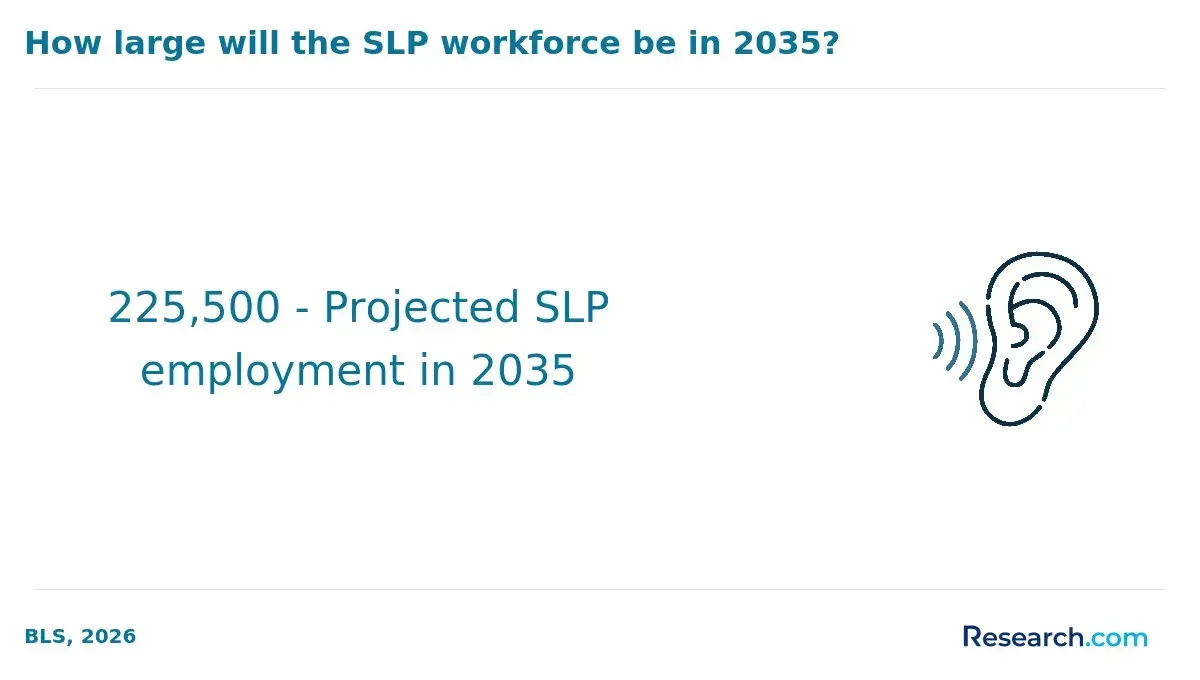
Career return should also be evaluated realistically. Nationally, the Bureau of Labor Statistics projects about 12,500 SLP openings per year on average from 2025 through 2035. This supports strong long-term demand, but employment opportunities, starting pay, and caseloads vary by employer and California region. For setting-specific context, review the factors that influence medical SLP salary potential rather than assuming one salary applies to every new graduate.
How do online speech pathology programs handle California-based clinical placements for students in Palmdale?
Clinical placement is usually the most consequential practical issue for Palmdale residents. Even in a distance program, direct client contact, supervision, and many assessments must occur in person. Programs commonly use a clinical placement team that identifies or approves sites and coordinates affiliation agreements, but the degree of student responsibility differs substantially.
Palmdale's location can offer access to school districts, outpatient clinics, hospitals, skilled nursing facilities, early-intervention providers, and telepractice settings across the Antelope Valley and greater Los Angeles area. However, local demand does not mean a placement is guaranteed. Existing affiliation agreements, supervisor availability, client populations, commute distance, and school-calendar timing can all affect assignment options.
Ask each program the following questions in writing before accepting an offer. The answers will show whether the program's clinical model is workable for your location and schedule.
- Does the program arrange placements, approve student-proposed sites, or require students to find sites independently?
- Has the program placed recent students in Los Angeles County, the Antelope Valley, or nearby California communities?
- Can the program guarantee that required clinical hours will be completed in California, or might travel or temporary relocation be necessary?
- Who secures the affiliation agreement, and what happens if a proposed site declines or delays approval?
- What types of clients and settings are required, and how are adult, pediatric, school-based, medical, and telepractice experiences balanced?
- What are the expected daytime hours, commute expectations, background-check requirements, and costs for clinical rotations?
- Can a student remain employed during placements, or do full-time daytime clinical commitments make that unrealistic?
Do not enroll based on an informal statement that "students typically find placements." Ask how the school handles a failed placement match and whether a delay could extend graduation. A lower tuition rate may not be a true savings if you must reduce work hours, drive long distances, pay for temporary housing, or wait an extra term for a clinical site.
Clinical technology is also expanding, especially through telepractice, digital documentation, and remote supervision tools. These tools can add useful experience, but they do not eliminate in-person training requirements or state and site policies. Confirm that any telepractice placement is supervised and counted in a way that supports your program and California licensure documentation.
What regional and professional accreditations must an online speech pathology master's program have to be credible?
For a future California SLP, professional program accreditation is the essential credential to verify. The Council on Academic Accreditation in Audiology and Speech-Language Pathology is the specialized accreditor for graduate programs in speech-language pathology and audiology. Check the status of the exact degree program, not simply the university or department.
Institutional accreditation also matters because it indicates that the college or university has been evaluated as an institution by a recognized accrediting body. It is relevant for federal financial aid, credit transfer, and general academic quality, but it does not substitute for CAA accreditation in an SLP licensure pathway.
| Credential to check | What it covers | What a Palmdale applicant should do |
| CAA accreditation | Professional standards for the graduate SLP program, including curriculum, faculty, clinical education, and student outcomes | Verify current status through ASHA's CAA or EdFind directory and save a copy of the result |
| Institutional accreditation | College-wide academic and administrative standards | Confirm the university's accreditor through the institution and appropriate federal accreditation resources |
| California professional licensure disclosure | The institution's determination about whether its curriculum meets California educational requirements | Request the current disclosure in writing and retain it with your admissions materials |
| Clinical affiliation agreements | Authorization for students to train at particular hospitals, schools, or clinics | Ask whether agreements are arranged before the placement begins and who manages the process |
Be cautious with phrases such as "accreditation pending," "aligned with ASHA standards," or "designed for communication disorders careers." Those phrases may describe a developing program or related curriculum, but they are not equivalent to graduating from a CAA-accredited SLP master's program. Candidacy status may be appropriate for some applicants, but it carries additional risk and should be reviewed carefully with the California Board and the institution.
A credible program should also provide accessible student-outcome data, faculty contact information, a clinical education policy, a published curriculum, and candid disclosures about where students can enroll. If the school cannot clearly identify its accreditation status or gives only verbal answers about licensure, treat that as a significant red flag.
How can Palmdale residents verify state authorization and distance-education approval for an online SLP program?
State authorization answers a separate question from accreditation: whether an out-of-state institution is permitted to provide distance education to a resident of California. A program may be academically strong and CAA-accredited yet have enrollment, practicum, or professional-licensure restrictions that affect California students.
California residents should use a documented verification process. This is particularly important before paying an application fee, completing expensive prerequisites, or leaving a job to attend clinical rotations.
- Check the institution's professional-licensure disclosure for the online SLP master's program and locate the entry for California.
- Email the admissions or compliance office asking whether new students physically located in California may enroll in the specific upcoming cohort.
- Ask whether the school can arrange, approve, and supervise clinical placements in California and whether any California locations have been used recently.
- Request a written list of all required campus visits, immersions, simulations, examinations, and travel-intensive experiences.
- Compare the school's disclosure with the California Board's current licensing requirements and ask the Board about any uncertainty that could affect your plan.
- Keep copies of responses, catalog pages, cost disclosures, and clinical-placement policies because institutional policies may change between application and graduation.
Do not confuse membership in an interstate distance-education reciprocity arrangement with an automatic assurance of California clinical eligibility. Authorization rules can depend on the student's location, the school's participation status, the type of experience being delivered, and whether the activity is considered distance education or supervised professional training.
Applicants comparing a broader group of programs can use an SLP grad school online guide as an initial cost and format reference, but should independently confirm California-specific authorization before treating any listing as an available option.
What tuition, fees, and financial aid options matter most for Palmdale students in online SLP programs?
The advertised tuition figure is rarely the full cost of an online clinical degree. Programs may charge by credit, term, or cohort, and some publish tuition without clinical, technology, graduation, residency, background-check, testing, or travel expenses. Compare official cost-of-attendance estimates whenever possible, and ask whether tuition can change while you are enrolled.
The table identifies the cost categories that matter most when comparing programs with different billing structures.
| Cost category | Why it matters | Question to ask |
| Tuition | Often the largest direct educational expense | Is the published amount per credit, per term, or the estimated total for the full degree? |
| Mandatory university fees | Technology, student-service, distance-learning, and graduation fees can add to the bill | Which fees are mandatory for online graduate students each term? |
| Clinical expenses | Background checks, fingerprinting, immunizations, liability coverage, supplies, and site requirements may be student-paid | What clinical costs are typical and which are included in tuition? |
| Travel and lodging | Required immersions or distant placements can change affordability substantially | How many trips are required, where do they occur, and are dates known before enrollment? |
| Income reduction | Daytime clinical rotations may limit work availability | During which terms do students commonly reduce work hours or stop working? |
| Loan costs | Borrowing affects the total amount repaid after graduation | What federal aid, graduate loan options, institutional grants, and payment plans are available? |
Federal financial aid generally begins with the Free Application for Federal Student Aid. Eligible graduate students may use federal Direct Unsubsidized Loans and, depending on financial circumstances and program cost, Graduate PLUS Loans. Scholarships, employer education benefits, service-based aid, and outside awards may reduce borrowing, but applicants should review eligibility rules and whether awards can be renewed.
Use a total-cost comparison rather than choosing solely by the lowest published per-credit rate. A higher-priced program may be more manageable if it has fewer travel requirements or a reliable California placement model; conversely, an inexpensive program can become costly if it prolongs completion or requires extensive travel. Avoid private loans until you have compared federal aid protections, interest terms, and repayment options.
How do graduation rates, Praxis pass rates, and job outcomes compare among leading online SLP programs?
Outcome data can help distinguish a polished online marketing page from a program with evidence of student progress. CAA-accredited programs are expected to make student outcome information available, typically including completion, Praxis examination, and employment information. However, direct comparisons require care because reporting windows, cohort sizes, and definitions can differ.
Rather than relying on a single ranking, request each program's most recent published outcomes and compare the same reporting period where possible. The following approach helps Palmdale applicants interpret results fairly.
- Compare completion outcomes with the program's stated length and pacing, especially if you plan to work while enrolled.
- Review Praxis outcomes alongside the number of graduates represented and ask whether the figure includes first-time test takers, all test takers, or self-reported results.
- Read employment outcomes closely to see whether they refer to SLP positions, related employment, further study, or all respondents who sought work.
- Ask how many students completed clinical placements on schedule and whether the program has a documented process for placement delays.
- Consider whether reported outcomes reflect students similar to you, including career changers, part-time students, and students completing placements outside the university's home state.
A high pass rate can be encouraging, but it does not establish that the program will fit your schedule, prerequisite preparation, or placement needs. Similarly, a reported employment rate does not guarantee a job, salary, or preferred setting in the Antelope Valley. Outcomes are best used as one part of a decision that also weighs accreditation, California eligibility, direct cost, and clinical support.
The broader employment outlook remains favorable: the BLS projects 17% growth in SLP employment from 2025 to 2035, faster than the average for all occupations. For applicants, that projection supports researching the field seriously, but it should not justify enrolling in a program without a verified route to licensure.
What unique scheduling, technology, and support challenges do Palmdale residents face in online speech pathology training?
An online SLP program may reduce commuting for lectures, but it is not a self-paced degree in the casual sense. Students often balance live class meetings, group projects, clinical documentation, simulation activities, faculty conferences, exams, and daytime placements. A Palmdale resident should evaluate the entire weekly structure, not just whether lectures are delivered online.
Pacific Time is an important practical consideration. Programs based in other regions may schedule live sessions according to Eastern or Central Time, which can create early-morning or evening obligations in California. Ask whether attendance is mandatory, whether sessions are recorded, and how often real-time clinical meetings occur.
Reliable technology is also part of professional readiness. Telepractice observation, video-based assignments, electronic health-record training, secure client communication, and online proctoring may require stable broadband, a current computer, webcam, headset, privacy-protected workspace, and backup connectivity. Students should not use unsecured public Wi-Fi for activities involving protected client information.
Before enrolling, create a realistic readiness plan that covers these factors.
- Map live class hours and likely clinical hours against work, caregiving, commute, and school-district calendar obligations.
- Budget for a private workspace, dependable high-speed internet, required software, and a backup plan for outages or equipment failure.
- Ask whether faculty office hours, tutoring, disability accommodations, mental-health support, career advising, and technical support are available to distance students.
- Determine whether clinical placements may require travel beyond Palmdale and whether you can meet a site's daytime attendance expectations.
- Discuss your work plan honestly with the program; many students can work during some academic terms, but clinical rotations can substantially reduce flexibility.
The most common avoidable mistake is choosing a program based on asynchronous coursework while overlooking synchronous and clinical commitments. Another is assuming family or employer support will remain available without discussing the periods when practicum intensity is highest. A good program will provide a clear academic calendar, clinical policies, escalation contacts, and expectations for professional communication.
Other Things You Should Know About Speech Language Pathology
Yes, but you will usually need foundational CSD coursework before or during admission to a master's program. The exact prerequisites vary by university. Ask whether the school offers leveling courses, accepts outside prerequisites, and how the added coursework affects your start date and cost.
Some students work during coursework-heavy terms, but full-time employment can be difficult during clinical practicum and externship periods. Required daytime client sessions, supervision, paperwork, and commute time may limit work availability. Review a term-by-term clinical schedule before relying on continued full-time income.
California licenses qualified applicants based on whether they meet the state's education, clinical, examination, and supervised-experience requirements; the delivery format alone is not the deciding factor. The key is graduating from an appropriate accredited program and completing every required licensure step.
No. An out-of-state online program may be a good fit if it accepts California residents, has a current California licensure disclosure, can support California clinical placements, and has manageable travel requirements. California-based options may simplify some logistics, but location alone does not confirm program quality or placement availability.
References
- Best Online Master's in Speech-Language Pathology for 2026 https://healthscience.pepperdine.edu/online-masters-in-speech-language-pathology/article/best-online-masters-in-speech-language-pathology-programs-guide.htm
- 2026 Most Affordable Online Speech Pathology Master's... https://www.onlineu.com/most-affordable-colleges/speech-pathology-masters-degrees
- Best Online Masters in SLP Programs | CAA-ASHA Included https://www.speechpathologydegrees.com/online/masters-slp
- Best Online Speech Pathology Programs https://www.forbes.com/advisor/education/healthcare/best-speech-pathology-programs-online/
- American Speech-Language-Hearing Association. (n.d.). About speech-language pathology careers. https://www.asha.org/students/about-speech-language-pathology-careers/
- U.S. Department of Labor, Employment and Training Administration. (n.d.). Speech-language pathologists. ONET OnLine*. https://www.onetonline.org/link/summary/29-1127.00