2027 UW-Eau Claire Online SLP Master's Review: Tuition, Admissions, and Clinical Training

Co-Founder and Chief Data Scientist

Reviewed by Rhea Paul, PhD
SLP Education & Research Expert
Choosing an online speech-language pathology master's program requires more than comparing tuition. You need to know whether the curriculum, clinical placements, residency expectations, accreditation, and state licensure pathway fit your circumstances. UW-Eau Claire's online MS in Communication Sciences and Disorders is designed for aspiring SLPs who need a structured distance-learning option with supervised clinical education.
This review explains the program's likely costs, admissions fit, training model, and questions to resolve before applying.
Key Things You Should Know
- UW-Eau Claire's online MS in Communication Sciences and Disorders is a CAA-accredited SLP master's pathway that combines online academic coursework with required supervised clinical education and possible campus-based requirements.
- The program is commonly structured as a 54-credit, part-time sequence completed in about 3 years; at a published rate of $800 per credit, tuition alone is approximately $43,200 before applicable fees, travel, books, and clinical expenses.
- Applicants should confirm current state eligibility, prerequisite coursework, clinical-placement expectations, campus visit dates, and Wisconsin or home-state licensure requirements before paying an application fee.
What makes UW-Eau Claire's online SLP master's program stand out?
UW-Eau Claire's online speech-language pathology master's option is distinctive because it aims to deliver a professional-entry SLP curriculum through distance learning while retaining the clinical supervision required for practice preparation. It is not a fully self-paced degree: students should expect sequenced courses, faculty-directed clinical requirements, and a cohort-style progression.
The program may appeal to students who need to remain in their community while completing graduate-level SLP education, but who can still accommodate required travel and a demanding clinical schedule. When comparing SLP master's programs online, the most important distinction is not whether lectures are online; it is how the school handles clinical training, local placements, supervision, and state authorization.
This comparison highlights the practical features that matter more than marketing labels.
| Decision factor | UW-Eau Claire online-program consideration | Why it matters |
| Academic delivery | Online coursework delivered in a planned cohort sequence | Students need dependable weekly study time and should verify live-session expectations. |
| Clinical education | Supervised practicum and externship experiences are required | Clinical hours cannot be completed entirely through online coursework. |
| Travel | Campus-based experiences may be required | Travel, lodging, and time away from work can materially affect the real cost. |
| Professional purpose | Designed as a master's-level preparation program for SLP practice | CAA accreditation and state licensure compatibility remain essential checks. |
Do not assume "online" means location-independent. A strong fit is someone who values the flexibility of remote academics but can plan around fixed clinical and residency obligations.
How much does the online SLP master's degree cost?
UW-Eau Claire has published online SLP tuition at $800 per credit. For a 54-credit program, that produces an estimated tuition figure of $43,200. This is a useful planning baseline, not a guaranteed all-in price, because rates, required fees, travel needs, insurance, background checks, and clinical expenses can change.
The tuition calculation and key additional cost categories are below. Applicants should request a written current-cost estimate for their entering cohort before making a deposit or borrowing.
- Published tuition rate: $800 per credit
- Program credits used for estimate: 54 credits
- Estimated tuition: $43,200
- Additional costs to confirm: university fees, books, clinical supplies, immunizations, background checks, transportation, lodging, and health insurance requirements
Tuition alone should not decide whether the program is affordable. A lower advertised tuition rate can be offset by substantial travel or clinical-placement costs, while a higher rate may be manageable for a student who can stay employed and avoid relocation. Ask financial aid staff which costs are included in the student budget used for federal aid and whether distance learners pay any separate online or program fees.
Before comparing schools, use the same basis for every estimate: total required credits multiplied by the applicable rate, plus mandatory fees and realistic travel costs. Avoid comparing UW-Eau Claire's estimated total tuition with another school's single-term tuition or per-credit price.
What are the admissions requirements for UW-Eau Claire's SLP master's?
Admission to a professional SLP master's program is typically selective because clinical cohorts must be sized around faculty supervision and placement capacity. UW-Eau Claire applicants should expect to submit undergraduate transcripts, a graduate application, recommendations, a personal statement or related written materials, and evidence that they meet required communication-sciences-and-disorders preparation.
A bachelor's degree in communication sciences and disorders is often the most direct preparation. Applicants from another academic major may need substantial prerequisite or leveling coursework before they can be competitive or eligible. The university has used a minimum 3.0 undergraduate GPA expectation for graduate admission, but applicants should verify the current program-specific GPA review standard, prerequisite list, application system, deadline, and GRE policy for their intended start term.
These are the areas to audit before starting an application.
- Match every completed course to the program's current prerequisite checklist rather than relying on a course title alone.
- Confirm whether your GPA meets the program's minimum and whether prerequisite grades receive separate review.
- Ask whether observation hours, interview steps, supplemental forms, or specific recommender types are currently required.
- Verify the application deadline well in advance because clinical master's programs commonly admit one planned cohort at a time.
Applicants who need a less competitive or more flexible entry route should compare admissions policies carefully; guides to SLP master's programs can help frame the questions, but no applicant should interpret "easier" as a substitute for meeting academic and clinical-readiness requirements.
A common mistake is applying before confirming missing prerequisites. That can delay enrollment by a year or more, especially when foundational courses are only offered during a particular term.
Is the program accredited for speech-language pathology licensure?
UW-Eau Claire's master's program in Communication Sciences and Disorders is accredited by the Council on Academic Accreditation in Audiology and Speech-Language Pathology (CAA), the accreditor recognized by the American Speech-Language-Hearing Association. CAA accreditation is a central credential for students pursuing clinical certification and state licensure as speech-language pathologists.
Accreditation is necessary, but it does not automatically settle every licensure question. State boards set their own requirements, and they may evaluate supervised clinical experience, examination results, post-graduate clinical fellowship requirements, background checks, and other items separately. Students planning to work outside Wisconsin should review the rules of the state where they expect to obtain their first license.
Before enrolling, verify three items directly with the university and the relevant licensing board.
- Confirm the program's current CAA accreditation status and accreditation period.
- Read UW-Eau Claire's current professional-licensure disclosure for your state of residence and intended practice state.
- Ask whether any state-specific coursework, clinical documentation, or placement restrictions could affect your path.
The red flag to avoid is assuming that a CAA-accredited online program automatically authorizes enrollment in every state or guarantees every state's licensure outcome. Accreditation supports the educational pathway; individual state licensing agencies make licensure decisions.
How is the online clinical practicum structure designed?
Clinical practicum is the part of SLP education in which students provide or participate in supervised services with real clients or patients. Online academic delivery does not remove this requirement. Students must complete guided observation and supervised clinical experiences that build competency across communication, swallowing, assessment, intervention, documentation, ethics, and professional collaboration.
ASHA certification standards have long required at least 400 total clock hours of supervised clinical experience, including at least 375 direct client or patient contact hours and 25 guided clinical observation hours. These are profession-wide benchmarks, not a promise that every UW-Eau Claire student will complete exactly the same experiences in the same order.
The clinical sequence generally progresses from preparation and foundational practice to more advanced placements. Students should ask how the program assigns experiences across pediatric and adult populations, school and medical settings, telepractice exposure, and specialty areas such as dysphagia or augmentative and alternative communication.
The most important practical question is capacity. A clinical site must have an appropriate supervisor, suitable caseload, and ability to meet program expectations. Students should be prepared for placements that may occur during standard business hours, even when academic courses are offered online.
What clinical placement support does UW-Eau Claire provide?
UW-Eau Claire's clinical education team coordinates and approves placements as part of the program's supervised training model. Students should not assume they can independently arrange any site they prefer, because affiliation agreements, supervisor qualifications, caseload fit, and university approval affect whether a placement can be used for credit.
Placement support is valuable, but it is not the same as a guarantee that a site will be close to home, fit a preferred specialty, or accommodate a work schedule. Local availability can change by term, and healthcare systems and school districts may limit student capacity.
Ask admissions or clinical education staff these questions before committing.
- Does the program initiate affiliation agreements in my region, and how long can that process take?
- What role will I have in identifying potential sites or providing local contacts?
- Can placements require travel outside my city or state?
- How are students supported if a planned site withdraws or cannot provide sufficient hours?
- Are evening, weekend, telepractice, pediatric, adult-medical, and school placements available, or should I expect daytime scheduling?
A common error is treating a school's statement that it "supports placement" as a promise of a specific commute, employer, population, or schedule. Obtain clear answers in writing when geography or employment obligations are nonnegotiable.
How long does the online SLP program take to finish?
UW-Eau Claire's online SLP master's curriculum is generally presented as a 3-year, part-time program. That pacing can make the academic workload more manageable than a traditional full-time, 2-year residential format, but it does not necessarily make the program easy to combine with full-time employment once clinical placements intensify.
Completion time depends on completing each sequenced course and clinical requirement successfully. Because professional courses and placements build on prior competencies, students may have limited ability to accelerate, skip ahead, or pause without affecting their cohort progression.
For perspective, compare the time trade-off before applying.
| Format | Typical planning implication | Best fit |
| UW-Eau Claire online, part-time sequence | About 3 years with coursework and clinical training planned across a longer timeline | Students seeking remote academic delivery and a paced cohort model |
| Traditional full-time residential program | Often organized around a shorter calendar but may require relocation or daytime attendance | Students able to study full time near campus |
| Accelerated professional program | May reduce calendar time but usually increases weekly intensity and limits work flexibility | Students with minimal outside obligations and strong prerequisite preparation |
Students considering faster options can compare accelerated speech pathology programs, but should scrutinize whether faster completion changes travel, course-load, or clinical-placement demands.
Before enrolling, map three years of work commitments, childcare, travel capacity, and likely daytime clinical availability. The schedule is a better fit when those obligations can flex during practicum terms.
What courses and specialties shape the curriculum?
The online curriculum is designed to cover the academic and clinical foundations needed for entry-level speech-language pathology practice. Students typically study communication development and disorders across the lifespan, assessment, intervention planning, research methods, professional issues, and supervised clinical practice.
Specific course titles and sequencing can change, but applicants should expect preparation in the following high-value clinical areas.
- Speech sound disorders, phonological development, and motor speech disorders.
- Language development and language disorders in children and adults.
- Fluency, voice, resonance, and cognitive-communication disorders.
- Swallowing disorders, feeding, and medically oriented clinical considerations.
- Audiology-related foundations, augmentative and alternative communication, and counseling.
- Evidence-based practice, research literacy, ethics, and interprofessional collaboration.
Curriculum breadth matters because SLPs work in settings with very different demands. A student interested in schools should still expect adult and medical content, while someone interested in hospitals should still need pediatric and education-related competence. Ask whether the program offers electives, specialty clinics, or placement opportunities aligned with your interests, but avoid choosing solely on a preferred niche: broad entry-level preparation is essential for licensure and early-career flexibility.
What outcomes and licensure results should applicants verify?
Applicants should ask UW-Eau Claire for its most recent, program-specific outcome data rather than relying on general employment statistics. Useful measures include CAA-required reporting on program completion, Praxis examination outcomes, employment, and graduate satisfaction, along with the reporting period and cohort size behind each measure.
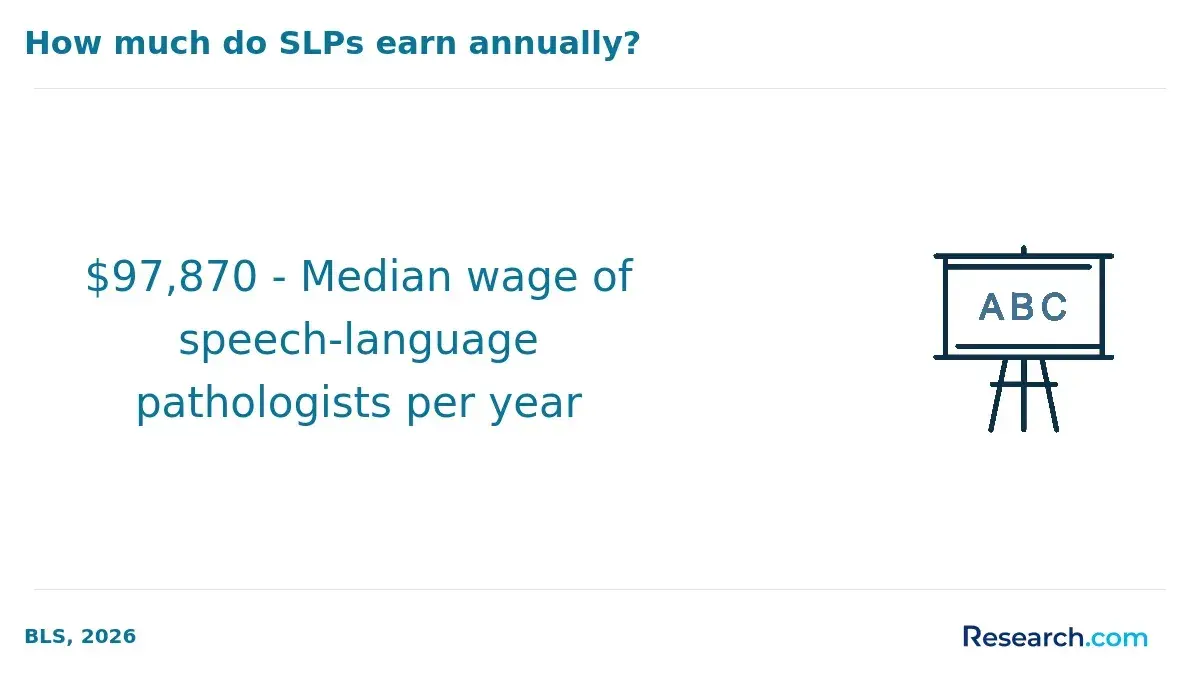
The broader labor market indicates strong demand, but it should be used as context rather than a personal earnings forecast. The U.S. Bureau of Labor Statistics reports a median annual wage of $97,870 for speech-language pathologists in May 2025 and projects 17% employment growth from 2025 to 2035. Those figures reflect a national occupation, not guaranteed pay for a new graduate; setting, region, experience, and employer all affect compensation.
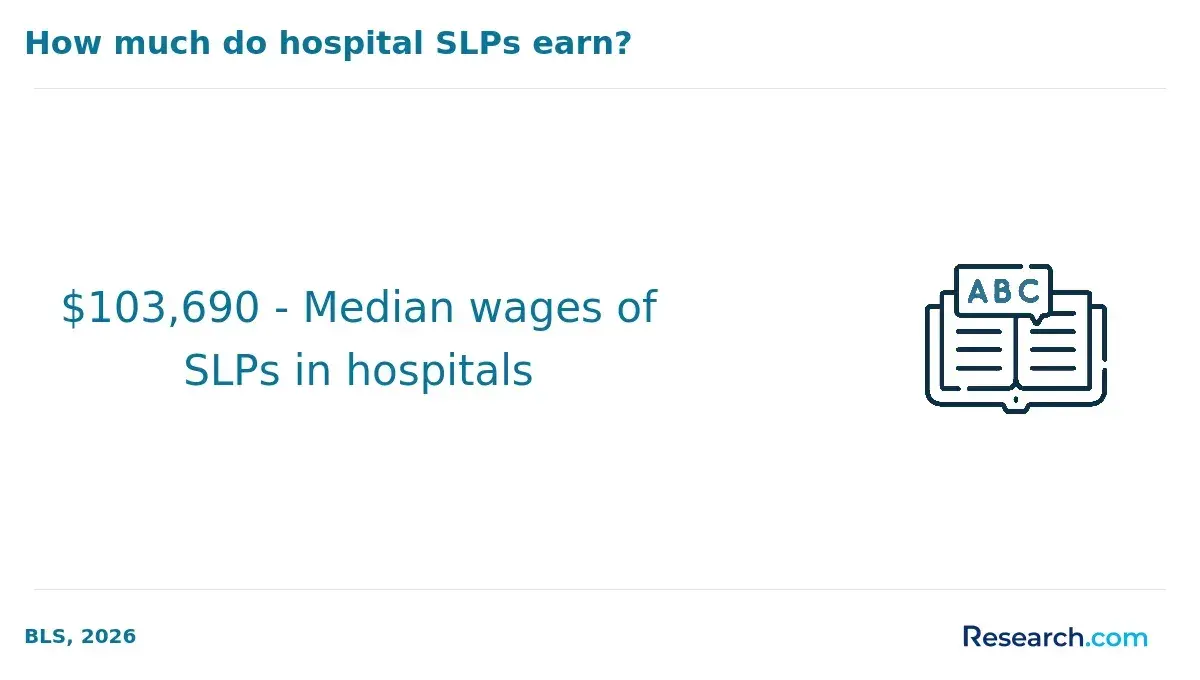
For students comparing practice settings, information on medical SLP salary can provide useful context, but hospital-oriented roles may have different clinical expectations than school-based positions.
Use the following verification checklist to assess return on investment.
- Request the latest CAA outcome disclosure and note the exact cohort years reported.
- Confirm whether graduates have met the educational requirements for ASHA certification and the states where they sought initial licensure.
- Ask how the program supports Praxis preparation, clinical fellowship planning, and employer networking.
- Compare your expected debt and living costs with likely early-career compensation in the state and setting where you intend to work.
Do not confuse an employment rate with job quality, location, salary, or licensure completion. Ask what counts as employment and whether the reported cohort includes graduates still completing a clinical fellowship.
Who is the UW-Eau Claire online SLP program best suited for?
UW-Eau Claire may be a strong match for a student with the required communication-sciences-and-disorders foundation who wants a CAA-accredited professional master's pathway without relocating for all academic coursework. It is particularly worth considering for organized learners who can follow a fixed sequence, participate in supervised clinical work during daytime hours, and budget for possible travel.
The program may be less suitable for applicants who need a fully asynchronous degree, cannot travel if campus experiences are required, require guaranteed placement at one local employer, or need to maintain an inflexible full-time work schedule through clinical terms. Students without the necessary prerequisites may also find that a post-baccalaureate or leveling plan is a more realistic first step.
Your best next step is to compare your nonnegotiables against the program in writing: total cost, state eligibility, prerequisites, application timeline, travel, live-class expectations, clinical placement process, and time away from work. If any answer is uncertain, resolve it with admissions and clinical education staff before enrolling.
Other Things You Should Know About Speech Language Pathology
Some students may work while completing online coursework, but clinical placements often occur during normal weekday service hours. Whether full-time work is realistic depends on the term, placement schedule, commute, and your employer's flexibility. Build a financial plan that allows reduced work availability during intensive clinical periods.
Not necessarily, but applicants without a communication sciences and disorders background commonly need prerequisite or leveling coursework. Confirm UW-Eau Claire's current prerequisite requirements before applying, because missing courses can delay eligibility.
A CAA-accredited degree is a major part of the pathway, but each state licensing board sets its own rules. Verify that UW-Eau Claire accepts students from your state and review the licensing requirements in the state where you intend to practice.
Graduates generally must complete remaining certification and licensure steps, which may include passing the Praxis examination, completing a supervised clinical fellowship, and applying to the appropriate state board. Requirements and timing vary by state and credentialing pathway.
References
- Speech-Language Pathology Online Graduate Program https://www.uwec.edu/speech-language-and-hearing-sciences-department/graduate-program/speech-language-pathology-online
- UW-Eau Claire maintains top 100 speech-language... https://www.wisconsin.edu/all-in-wisconsin/story/uw-eau-claire-maintains-top-100-speech-language-pathology-graduate-program/