2027 Best Online Speech Pathology Master's Programs for Residents of Bellevue, WA

Co-Founder and Chief Data Scientist

Reviewed by Rhea Paul, PhD
SLP Education & Research Expert
Bellevue residents considering an online master's in speech-language pathology need more than a convenient class schedule: they need a CAA-accredited degree, workable local clinical placements, and a clear path to Washington licensure. This guide compares the factors that matter most when evaluating online SLP programs, including state eligibility, travel, practicum support, tuition structure, and preparation for medical or school-based careers. It is designed to help prospective students narrow their choices before paying an application fee or committing to prerequisites.
Key Things You Should Know
- Washington licensure usually requires a qualifying graduate degree, supervised clinical education, a passing Praxis examination score, and completion of the clinical fellowship requirements set by the Washington State Department of Health.
- CAA accreditation is the central screening criterion: an online format can be appropriate, but the program must meet Council on Academic Accreditation standards and must be authorized to enroll Washington residents.
- The national median annual wage for speech-language pathologists was $97,870 in May 2025, while BLS projects 17% employment growth from 2025 to 2035; those figures support demand but do not replace program-specific cost and placement analysis.
Which online speech pathology master's programs accept Bellevue, WA residents and meet licensure requirements?
The strongest options for Bellevue applicants are not necessarily located in Washington. A viable online SLP master's program must be available to Washington residents, hold CAA accreditation or an appropriate status recognized by the accreditor, provide clinical education that can satisfy Washington requirements, and give a clear professional-licensure disclosure for Washington.
Programs commonly evaluated by Washington applicants include Emerson College's online Master of Science in Communication Disorders, New York University's online MS in Communicative Sciences and Disorders, Baylor University's online MS in Speech-Language Pathology, and the University of St. Augustine for Health Sciences' online MS-SLP option. Availability, state authorization, cohort openings, and licensure disclosures can change, so applicants should request written confirmation before applying.
The comparison below identifies the questions that matter more than a school's marketing language. It is especially useful for Bellevue residents because clinical work, live sessions, and travel obligations can affect whether an online program is realistically manageable.
| Program type or example | What Bellevue applicants should verify | Potential advantage | Possible trade-off |
| Emerson College online MS in Communication Disorders | Washington enrollment authorization, current CAA status, immersion schedule, and local placement process | Established online-focused delivery model with full-time and part-time pacing options | Clinical requirements and any in-person experiences may require travel and daytime availability |
| NYU online MS in Communicative Sciences and Disorders | Washington eligibility, clinical placement support, synchronous expectations, and required immersions | Online curriculum with university-coordinated clinical education structure | Private-university pricing and travel requirements may increase total cost |
| Baylor University online MS in Speech-Language Pathology | Washington disclosure, cohort calendar, on-campus or residency requirements, and clinical-site procedures | Designed for distance learners pursuing entry-level SLP preparation | Accelerated pacing can make outside employment difficult during clinical terms |
| University of St. Augustine online MS-SLP | Washington enrollment eligibility, accreditation status for the selected pathway, and required hands-on experiences | Health-professions-oriented model that may appeal to medically focused applicants | Program travel, placement, and tuition details must be compared carefully with public options |
Do not assume that a program's statement that it is "online" means it is available in every state. Ask admissions to confirm, in writing, that Washington residents may enroll in your intended start term and that the curriculum is designed to meet Washington educational requirements for SLP licensure.
Applicants who need a shorter academic timeline should still compare clinical sequencing carefully. Some accelerated speech pathology programs online reduce academic calendar time, but they cannot remove the supervised clinical education required for professional preparation.
How can Bellevue residents verify that an online speech pathology master's is properly accredited?
Start with the program - not merely the institution. A university may be regionally accredited while its speech-language pathology degree is not accredited by the American Speech-Language-Hearing Association's Council on Academic Accreditation in Audiology and Speech-Language Pathology, commonly called CAA.
For an entry-level clinical SLP degree, Bellevue applicants should look for a current CAA listing that identifies the exact degree and delivery location or format. CAA accreditation demonstrates that the program has been reviewed against standards covering curriculum, faculty, clinical education, student outcomes, and program resources. It does not by itself guarantee Washington licensure, which remains a state-board decision.
Use this verification sequence before submitting an application:
- Locate the exact master's program in ASHA's CAA or EdFind directory and confirm its current accreditation status.
- Read the university's Washington professional-licensure disclosure for the specific online program.
- Ask whether the program accepts Washington residents for your anticipated start date and obtain the answer in writing.
- Confirm that the curriculum includes the clinical practicum structure needed for state licensure and eventual ASHA certification.
- Save copies of the accreditation listing, licensure disclosure, curriculum plan, and admissions email in a personal compliance file.
Candidacy and accreditation are not interchangeable terms. A program in candidacy may be progressing through the accreditation process, but applicants should understand how that status affects their graduation timeline, certification plans, financial risk, and state-licensure eligibility. If the answer is unclear, pause before enrolling and contact the Washington licensing authority directly.
Which online speech pathology master's programs best balance cost, quality, and flexibility for Bellevue students?
There is no universally lowest-cost online SLP master's because published tuition may be shown per credit, per term, or as a program estimate, while clinical fees, travel, technology, and prerequisite coursework can materially change the final amount. Bellevue students should compare total expected educational cost rather than selecting a program solely on advertised tuition.
A useful first step is to compare speech pathology graduate programs online using the same cost categories. Public institutions may offer lower tuition for some students, but an out-of-state online rate, campus travel, or delayed graduation can narrow the apparent savings.
This framework shows how to weigh cost against program quality and flexibility.
| Decision factor | Lower-cost choice may look like | Higher-value choice may look like | What Bellevue students should ask |
| Tuition structure | Lower per-credit rate | Clear total program estimate with limited surprises | What are tuition, university fees, clinical fees, graduation fees, and annual increases? |
| Prerequisites | Few required courses before admission | Transparent leveling plan that prevents academic gaps | Which prerequisites must be completed, where may they be taken, and what will they cost? |
| Scheduling | Compressed full-time calendar | Part-time option with predictable clinical terms | When are live classes, exams, and full-time practica scheduled in Pacific Time? |
| Clinical placement | Student locates sites independently | Program-led placement support with clear escalation procedures | Who secures placements, and what happens if a Bellevue-area site cannot be confirmed? |
| Travel | No routine campus attendance | Required immersion schedule disclosed before enrollment | How many trips are required, where are they held, and what costs are excluded from tuition? |
The best balance often depends on employment needs. A working adult may reasonably pay more for a program with part-time pacing, predictable synchronous sessions, and strong placement coordination. A student able to study full time may prioritize a shorter sequence, provided that the faster schedule does not create unmanageable clinical or travel obligations.
Also compare aid eligibility and borrowing needs. Federal student loans may be available to eligible graduate students, but loans are not free funding; estimate borrowing across prerequisite courses, graduate tuition, travel, and living costs before accepting an offer.
What ASHA-related accreditation and program standards should Bellevue speech pathology applicants prioritize?
ASHA is the major U.S. professional association for speech-language pathologists, and its CAA accredits graduate education programs in speech-language pathology. CAA accreditation is particularly important because many employers, state licensing systems, and the pathway to ASHA's Certificate of Clinical Competence in Speech-Language Pathology rely on education from an appropriately accredited program.
Applicants should prioritize evidence that the program can deliver the full professional-preparation sequence, not just online lecture courses. That includes academic content across communication disorders, assessment, intervention, research literacy, professional ethics, and supervised clinical education with diverse clients and settings.
When comparing programs, review the following standards-related evidence:
- Current CAA accreditation status for the exact master's program and delivery pathway.
- A published curriculum that covers speech, language, swallowing, voice, fluency, cognitive-communication, and professional practice content.
- Documented clinical education policies, including supervision, client populations, evaluation procedures, and remediation support.
- Transparent student outcome information, such as program completion, Praxis examination, employment, and on-time completion disclosures when published.
- Clear policies for background checks, immunizations, health insurance, HIPAA training, drug screening, and other requirements imposed by clinical sites.
Applicants should not treat ASHA certification and Washington licensure as the same credential. They often overlap substantially, but licensure is issued by the state and certification is issued by ASHA. A program should be able to explain how its curriculum supports both pathways without making unsupported guarantees about an individual student's eligibility.
How do Washington and neighboring states handle licensure for graduates of online speech pathology programs?
Washington licenses speech-language pathologists through the Washington State Department of Health. An online graduate can pursue Washington licensure when the person meets the state's education, examination, supervised experience, and application requirements. The fact that coursework was delivered online is generally less important than whether the degree and clinical education meet the applicable standards.
Washington applicants should plan for a graduate degree in speech-language pathology from an appropriately accredited program or another pathway accepted by the state, supervised practicum, a passing Praxis examination score where required, and post-graduate clinical fellowship requirements. Requirements and application forms can change, so applicants should check the licensing authority before graduation rather than relying on an admissions representative alone.
Neighboring-state portability is possible but not automatic. This summary highlights why Bellevue students who may relocate should save detailed educational records.
| Jurisdiction | General licensure approach | Planning implication for Bellevue students |
| Washington | State professional license based on education, examination, supervised experience, and other board requirements | Choose a program with clear Washington disclosures and retain practicum and fellowship documentation |
| Oregon | Separate state licensing process with its own application review | Verify Oregon requirements before accepting an out-of-state job or clinical fellowship |
| Idaho | Separate state licensing process and documentation expectations | Confirm whether coursework, clinical hours, and examination records meet Idaho's current rules |
| Alaska | Separate state licensure review for practice in Alaska | Do not assume a Washington license automatically grants authority to practice in Alaska |
School-based practice can add another layer. A Washington school district may seek an Educational Staff Associate credential or other school-specific authorization through the Office of Superintendent of Public Instruction, while a medical employer commonly focuses on professional licensure, clinical fellowship status, and employer credentialing. Ask employers which credential is required for the role you want.
What clinical practicum and placement arrangements work for online students living in Bellevue, WA?
Clinical practicum is the part of an online SLP program that cannot be fully remote. Students work with clients under qualified supervision in settings such as schools, outpatient clinics, hospitals, rehabilitation facilities, early-intervention programs, or skilled nursing facilities. Placements may require weekday daytime attendance even when academic classes are asynchronous.
A well-designed distance program may identify, approve, and coordinate sites near a student's residence, but it cannot promise a specific Bellevue location unless it has an active arrangement and confirms availability. Site capacity changes with supervisor availability, district policies, client needs, and competition from local universities.
Before enrolling, ask the program these practical placement questions:
- Does the program secure clinical placements, assist with placements, or require students to locate sites independently?
- Has the program recently placed students in King County or elsewhere in western Washington without requiring out-of-state relocation?
- What is the process if the first proposed placement does not meet supervision or population requirements?
- How far may students be expected to travel, and can placements occur outside Bellevue or outside Washington?
- Are practica full time, and can employment hours be reduced or paused during clinical terms?
- Who pays for background checks, drug screening, immunizations, liability coverage, parking, commuting, and site-specific onboarding?
For Bellevue residents, a placement model with active faculty oversight may be worth a higher tuition price if it reduces the risk of delayed clinical progression. Conversely, students with established professional contacts in local health care or education settings may be comfortable with a program that expects greater student participation in identifying sites, provided the school retains final approval and supervision responsibility.
How can Bellevue residents compare in-state versus out-of-state online speech pathology master's options?
In-state and out-of-state are less meaningful labels for online SLP programs than they are for traditional campus degrees. Bellevue residents should compare the actual Washington tuition rate, required travel, clinical-placement support, time-zone fit, and state-licensure disclosure. An out-of-state institution can be a strong option if it is authorized to enroll Washington students and has a reliable pathway for local clinical education.
For students focused on speed, a speech pathology accelerated program may be appealing, but "accelerated" should be evaluated against clinical capacity rather than marketing timelines. A faster academic sequence may still include daytime placements, travel, and limited breaks that make full-time employment impractical.
This comparison separates the decision factors that most often determine whether an option is workable.
| Factor | In-state or regional option may be preferable when | Out-of-state online option may be preferable when |
| Tuition and aid | The institution offers a meaningful Washington-resident price advantage | The online rate is competitive after travel, fees, and prerequisite costs are included |
| Clinical network | The school has established relationships in western Washington | The program has demonstrated Washington placement processes and responsive clinical staff |
| Schedule | Campus or live sessions align easily with Pacific Time | Synchronous meetings are compatible with Pacific Time and recorded-content policies are clear |
| Travel | Required experiences can be reached without flights or overnight stays | Required immersions are limited, scheduled early, and affordable for the student |
| Career goals | The student expects to build a Washington-focused professional network | The curriculum, specialty opportunities, or placement model better matches the student's target setting |
Do not reject an out-of-state program only because its main campus is far away, and do not assume a Washington-based school is automatically the better option. The better program is the one that provides a documented Washington-compliant pathway, manageable clinical logistics, and total costs you can realistically finance.
Which online speech pathology programs offer the strongest support for Washington school-based and medical SLP careers?
The strongest program depends on the setting you intend to enter. School-based SLPs need preparation for educational evaluation, Individualized Education Programs, classroom consultation, and collaboration with educators and families. Medical SLPs commonly need deeper exposure to swallowing disorders, neurological communication disorders, adult rehabilitation, documentation, and interdisciplinary care.
Every entry-level CAA-accredited program should cover core professional competencies, but the clinical mix and elective availability can differ. Bellevue applicants should ask whether the program can support placements aligned with their target population and whether faculty can help them understand Washington school credentialing requirements.
Use the following career-fit comparison when discussing options with admissions and clinical-placement staff.
| Career direction | Program features to prioritize | Questions to ask |
| Washington public schools | Pediatric practicum, school-based assessment, language and literacy preparation, educational collaboration content | Can the program support school placements, and what additional Washington education credential may an employer require? |
| Private pediatric practice or early intervention | Child language, speech sound disorders, parent coaching, culturally responsive practice, early-intervention experience | Will clinical experiences include young children and family-centered intervention? |
| Hospitals and rehabilitation settings | Adult neurogenic disorders, dysphagia, cognitive-communication, medical documentation, interprofessional learning | Are medical placements available, and are there simulations or electives related to swallowing and rehabilitation? |
| Skilled nursing or home health | Adult and geriatric communication disorders, swallowing, functional goals, care-team collaboration | How does the program prepare students for medically complex adult populations? |
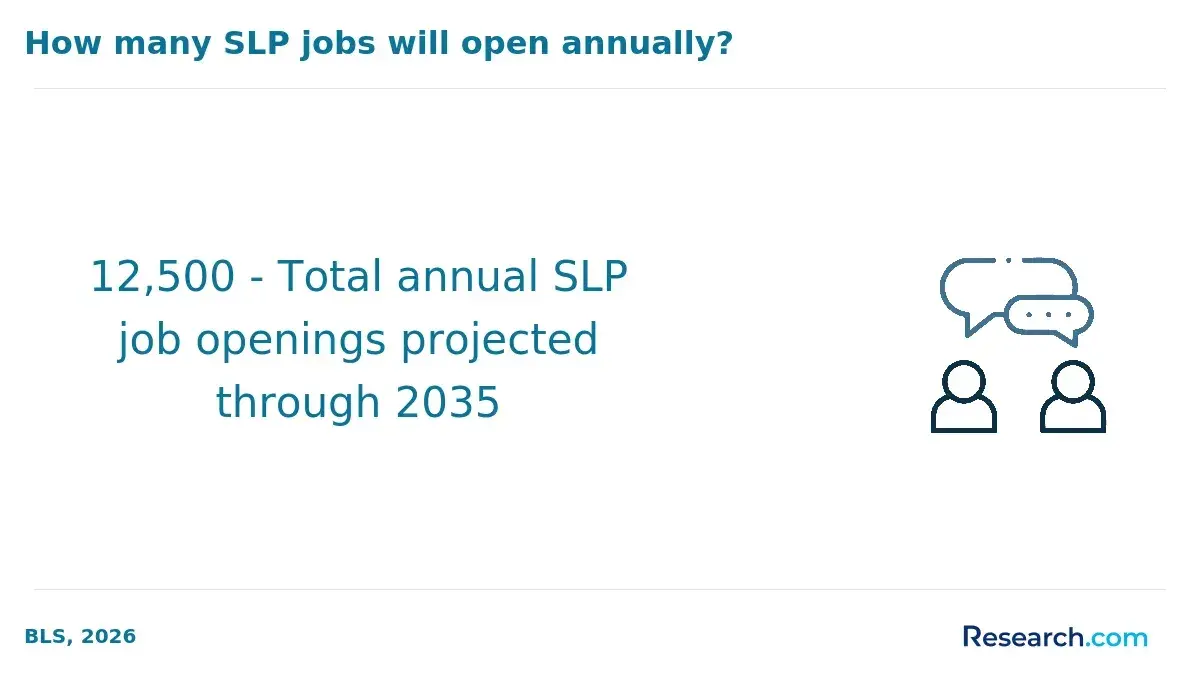
Career outlook is favorable but should not be treated as a personal employment guarantee. The Bureau of Labor Statistics projects 17% growth in SLP employment from 2025 to 2035 and about 12,500 openings annually, on average, over that period. Bellevue applicants can use this demand context alongside a realistic review of local placement access, licensing timelines, and desired work setting.
Before committing to a specialization, review current speech pathology salary information with care. Pay can vary substantially by employer type, clinical setting, experience, geographic market, productivity expectations, and whether a position is school-calendar based or year-round.
What red flags should Bellevue applicants watch for in online speech pathology program marketing and disclosures?
Online SLP programs can be legitimate and rigorous, but the high stakes of licensure make vague marketing especially risky. A polished website does not substitute for a current accreditation listing, a state-specific licensure disclosure, or a written explanation of how clinical placements work.
Watch for these warning signs before paying a deposit or accepting admission:
- The school describes institutional accreditation but does not clearly identify CAA status for the exact SLP master's program.
- The program says it is "designed for licensure" but does not publish a Washington-specific disclosure or will not confirm eligibility in writing.
- Tuition is advertised without mandatory fees, prerequisite costs, travel expenses, clinical costs, or likely annual increases.
- The school promises local placements but cannot explain who secures them, what happens when a site declines, or whether a student may need to travel.
- "Flexible" delivery is advertised without a calendar showing live-session times, required daytime practica, campus visits, and exam expectations.
- The program suggests rapid completion while minimizing the intensity of clinical education or the limited ability to work during practicum terms.
- Admissions staff make broad claims about licensure, certification, employment, or salary without directing you to the responsible state board or published outcome data.
The practical response is simple: compare written disclosures rather than verbal assurances. If a school cannot answer a core compliance question clearly, consider that uncertainty part of the program's cost and risk.
How should Bellevue, WA residents document and track program compliance for future speech-language pathology licensure?
Licensure applications may occur years after admission, and clinical sites or program personnel can change. Maintaining organized records helps Bellevue graduates demonstrate that their education and supervised experience meet Washington requirements and can also simplify applications in other states.
Create a secure digital folder and retain original documents where possible. The most useful records include admission materials, catalog pages, degree audits, practicum logs, supervisor information, Praxis results, clinical fellowship records, and correspondence about Washington eligibility.
Use this process throughout the degree rather than trying to recreate records after graduation:
- Save the program's Washington professional-licensure disclosure and the CAA accreditation information that applied during your enrollment period.
- Keep each course syllabus, degree plan, and official transcript request record.
- Track every clinical placement, client population, supervisor credential, dates, and verified clinical hours using the program's official system.
- Keep copies of background-check clearances, site onboarding confirmations, and any clinical remediation or accommodation documentation that affects progression.
- Record Praxis registration and score-report details, then retain official score documentation.
- During the clinical fellowship, maintain employer, supervisor, dates, evaluation, and hours records according to current Washington and ASHA requirements.
- Before applying for Washington licensure, compare your file with the current Department of Health instructions and resolve missing documents before submitting the application.
This recordkeeping does not replace official university or employer verification, but it makes discrepancies easier to identify early. It is especially valuable for graduates who plan to move, pursue school-based credentials, or seek licensure in more than one state.
Other Things You Should Know About Speech Language Pathology
Yes, provided the online degree is from an appropriately accredited program, you complete required supervised clinical education, meet Washington examination and clinical fellowship requirements, and receive state licensure. Online coursework does not eliminate in-person clinical training.
Not always. Applicants from other majors may be admitted after completing prerequisite or leveling courses in areas such as phonetics, language development, anatomy and physiology, audiology, and speech science. The required courses and timing vary by program.
Many students can work during some academic terms, particularly in part-time pathways. However, clinical practica often require weekday daytime availability and may become incompatible with full-time employment. Review the full clinical calendar before relying on employment income.
The timeline depends on the program sequence, examination timing, clinical fellowship completion, application processing, and whether your documents are complete. Plan for the post-graduation fellowship and licensing steps rather than assuming licensure occurs immediately when the degree is awarded.
References
- Best Online Speech Pathology Programs https://www.forbes.com/advisor/education/healthcare/best-speech-pathology-programs-online/
- Best Online Masters in SLP Programs | CAA-ASHA Included https://www.speechpathologydegrees.com/online/masters-slp
- Best Speech-Language Pathology Programs in America https://www.usnews.com/best-graduate-schools/top-health-schools/pathology-rankings
- Online Master's in Speech Pathology Programs: 2026 Guide https://speechpathologymastersprograms.com/
- Premier Online Speech Pathology Master's Degrees https://resources.noodle.com/articles/best-online-masters-programs-for-speech-and-language-pathology/