2027 Best Online Speech Pathology Master's Programs for Residents of Des Moines, IA

Co-Founder and Chief Data Scientist

Reviewed by Rhea Paul, PhD
SLP Education & Research Expert
Des Moines residents can pursue a speech-language pathology master's degree online, but "online" does not mean entirely remote or automatically eligible for Iowa licensure. The right program must combine CAA accreditation, Iowa enrollment authorization, a workable local clinical-placement plan, and transparent residency requirements.
This guide compares the factors that matter most before you apply, including licensure alignment, clinical training, cost, scheduling, and consumer-protection checks.
Key Things You Should Know
- A Des Moines applicant should prioritize a CAA-accredited master's program that confirms Iowa enrollment eligibility and provides a realistic plan for supervised clinical placements; a general online communication degree is not enough for SLP licensure.
- Iowa SLP licensure and ASHA's CCC-SLP pathway generally require a qualifying graduate degree, supervised clinical experience, a passing Praxis examination, and a clinical fellowship; verify requirements directly with the Iowa licensing authority before enrolling.
- Career demand supports careful program selection: the U.S. Bureau of Labor Statistics projects 17% employment growth for speech-language pathologists from 2025 to 2035, with a median annual pay of $97,870 in May 2025.
Which online speech pathology master's programs are accessible and licensed for Des Moines residents today?
The strongest online options for a Des Moines resident are not necessarily located in Iowa. A suitable program must be open to Iowa students, hold CAA accreditation, provide required clinical education, and disclose whether its curriculum is designed to meet Iowa professional-licensure requirements. Because state authorization and cohort availability can change, applicants should obtain written confirmation from each school before paying an application or enrollment deposit.
The programs below are examples of established distance-learning or hybrid pathways commonly considered by applicants seeking an online master's in speech-language pathology. "Accessible" means the program should be investigated for Iowa eligibility; it does not replace an individual written eligibility determination from the institution.
| Program | Format considerations | Clinical and travel considerations | Best fit |
| Baylor University, Master of Science in Communication Sciences and Disorders | Online cohort-based graduate format with scheduled coursework | Clinical education is required; applicants should confirm Iowa placement support, travel expectations, and current state eligibility | Students who want a structured online cohort and can accommodate supervised training requirements |
| Emerson College, Master of Science in Communication Disorders | Online graduate format with live-learning and cohort elements | Includes clinical education and required immersion experiences; travel and placement details should be verified before applying | Students who value a highly organized online experience and can plan for mandatory residencies |
| New York University, MS in Communicative Sciences and Disorders | Online coursework delivered in a structured program sequence | Clinical experiences and immersion requirements apply; local placement availability is not guaranteed | Applicants seeking a nationally known online option who can meet scheduling and travel obligations |
| University of Northern Colorado, distance-learning SLP pathway | Distance or hybrid delivery may include fixed pacing and synchronous elements | Fieldwork planning is central; confirm whether Iowa residents may enroll in the specific cohort and how placements are approved | Students who prefer a public-university option and can follow a prescribed clinical sequence |
| James Madison University, distance education SLP pathway | Distance-learning format with a sequenced graduate curriculum | Clinical practicum requirements remain in-person even when academic courses are online | Working applicants who can commit to a long, cohort-based plan and verify Iowa authorization |
Do not treat this as a universal ranking. The best choice depends on whether the school can legally enroll you in Iowa, approve your clinical sites, support your required schedule, and document that the program is appropriate for your intended Iowa license.
For applicants still comparing delivery models, a comprehensive overview of online masters in speech pathology can help distinguish tuition-focused options from programs selected mainly for format or pacing.
How does Iowa's speech-language pathology licensure shape online program choices from Des Moines?
Iowa licensure should drive the decision before convenience, brand recognition, or advertised program speed. To practice as a speech-language pathologist in healthcare, private practice, or many other clinical settings, graduates typically need a qualifying graduate degree, supervised experience, examination results, and completion of the state's licensing process. Requirements can change, and an institution's statement that a program is "ASHA-aligned" is not the same as confirmation that it meets Iowa requirements.
CAA accreditation is especially important because it is the central educational benchmark used by the profession. A CAA-accredited graduate program is designed to support the academic and clinical preparation needed for ASHA certification and state licensure, subject to each graduate completing all applicable requirements.
The following distinction helps Des Moines applicants avoid a costly mismatch between degree type and career goal:
| Goal after graduation | What usually matters most | What to verify before enrollment |
| Iowa clinical SLP license | Qualifying graduate education, supervised clinical requirements, examination, and state application rules | The program's Iowa licensure disclosure and the Iowa board's current requirements |
| ASHA CCC-SLP certification | CAA-accredited graduate education, required clinical hours, Praxis, and clinical fellowship requirements | Whether the program's curriculum and placement model support each certification component |
| School-based role in Iowa | Clinical licensure plus any school-employer or Iowa education credential requirements | Requirements of the Iowa Board of Educational Examiners and the prospective school district |
| Speech-related support role without SLP licensure | Employer-specific education and scope-of-practice rules | Whether the role legally requires a licensed SLP rather than an assistant or support professional |
A master's degree that is not CAA-accredited may be academically interesting but can create a major obstacle for a person seeking the standard clinical SLP pathway. If your goal is to become a licensed speech language pathologist, choose the credential pathway first and evaluate online delivery second.
Which accredited online speech pathology master's degrees lead to ASHA CCC-SLP eligibility?
Graduation from a CAA-accredited master's program is the usual educational foundation for pursuing the Certificate of Clinical Competence in Speech-Language Pathology, commonly called the CCC-SLP. Eligibility is not automatic at graduation: the candidate must also satisfy ASHA's current clinical-practicum, Praxis, and clinical fellowship requirements.
For prospective students, the key question is not whether a program uses the words "speech pathology" or "communication disorders." Ask whether the exact degree and delivery format are accredited by the Council on Academic Accreditation in Audiology and Speech-Language Pathology and whether the school will document completion of the competencies and clinical hours required for certification.
A CAA-accredited online or hybrid degree can be a strong fit when you need geographic flexibility but can still complete intensive supervised practicum work. It is usually a poor fit if you need fully asynchronous study with no daytime availability, cannot travel for required immersion sessions, or cannot adjust work commitments for clinic hours.
Applicants considering a faster sequence should be cautious. A speech pathology accelerated program may reduce calendar time only when prior prerequisites, clinical scheduling, and full-time workload capacity align; it does not eliminate required clinical education or licensure steps.
How do top online speech pathology programs serving Des Moines compare on accreditation and quality?
Quality in online SLP education is best evaluated through verifiable professional safeguards rather than broad rankings. For a Des Moines student, the most meaningful indicators are active CAA status, clear Iowa disclosures, transparent clinical-placement responsibilities, faculty and student support, and a schedule that permits successful practicum completion.
This comparison framework shows how to assess programs consistently. A "yes" should be supported by a current written policy or direct confirmation from the school, not a verbal assurance from a recruiter.
| Quality criterion | Why it matters | What a strong answer looks like |
| CAA accreditation status | Supports the standard educational route toward CCC-SLP and state licensure | The exact program appears in the current CAA directory with an active status |
| Iowa professional-licensure disclosure | Shows whether the institution has evaluated curriculum alignment for Iowa | A written statement specifically addressing Iowa, with an identified contact for questions |
| Clinical placement model | Practicum is required and often determines whether an online program is workable | The school explains who locates sites, who approves supervisors, and what happens if a placement falls through |
| Required travel | Residencies, skills intensives, and orientations can affect cost and work schedules | Dates, locations, frequency, and expected travel expenses are disclosed before enrollment |
| Live-session schedule | Synchronous courses can conflict with employment and Central Time schedules | Regular meeting windows are published or provided before a student commits |
| Student-support capacity | Online students need timely clinical, academic, and technical support | Named advising, clinical-placement, disability-support, and financial-aid contacts are available |
"Best" does not mean easiest or shortest. A program with more required planning can be the better choice if it has explicit Iowa eligibility, a credible placement process, and a format you can sustain without compromising clinical performance.
Admissions selectivity is also only one factor. A list of the easiest SLP grad schools to get into may be useful for building an application strategy, but applicants should never trade away accreditation or Iowa licensure compatibility for a lower admissions barrier.
What state authorization and SARA rules affect Iowa students enrolling in out-of-state online SLP programs?
State authorization determines whether an institution may provide distance education to a student located in Iowa. Iowa participates in the State Authorization Reciprocity Agreement, often called SARA, and many out-of-state institutions participate as well. However, SARA participation is not a blanket approval for every program, every clinical placement, or every professional license.
Clinical placements create an additional layer because they involve supervised in-person education at Iowa healthcare facilities, schools, clinics, or other sites. A school may be authorized to offer online coursework to an Iowa resident while still having restrictions, approvals, or practical limitations related to Iowa clinical training.
Before applying, request written answers to the following questions. These checks are especially valuable when a program's website uses broad language such as "available online nationwide:"
- Can a student physically located in Iowa enroll in this exact CAA-accredited SLP master's program for the intended start term?
- Does the institution's professional-licensure disclosure state that the curriculum meets, does not meet, or has not been determined to meet Iowa requirements?
- Can required practicum and externship experiences be completed in Iowa, and who is responsible for securing and approving sites?
- Are there any Iowa-specific restrictions involving distance education, clinical supervision, or school-based placements?
- What campus visits, skills intensives, orientations, or examinations require travel, and are dates known before enrollment?
SARA also does not resolve complaints about academic quality, licensure eligibility, financial aid, or clinical-placement outcomes. Keep copies of the school's disclosures, email confirmations, curriculum plan, tuition estimate, and clinical-placement policies in case information later changes.
How can Des Moines applicants verify institutional and CAA accreditation before choosing an online SLP program?
Accreditation verification should take only a few minutes, but it is one of the highest-value steps in the entire search. Institutional accreditation and programmatic CAA accreditation are different checks. Institutional accreditation evaluates the college or university broadly, while CAA evaluates the professional SLP program itself.
Use this sequence before submitting an application. Complete it again if you defer enrollment, since program status and state disclosures can change.
- Find the exact degree, campus or online pathway, and delivery format in the CAA program directory; do not assume the university's on-campus program accreditation covers a separate online pathway.
- Review the university's institutional accreditation information and confirm that the institution is recognized by an appropriate U.S. accrediting body.
- Read the program's professional-licensure disclosure for Iowa and save a dated copy of the page or written confirmation.
- Ask the program's clinical education office whether it can approve Iowa placements in the settings you may need, such as medical, pediatric, school, or adult rehabilitation sites.
- Compare the planned curriculum with current ASHA certification requirements and Iowa licensing requirements, then ask the school to identify any prerequisite or remediation gaps.
Be wary of vague statements such as "accreditation pending" or "designed for certification" when no precise accreditor, status, or effective date is provided. Candidacy and accreditation can have different implications, so applicants should ask what the status means for their cohort and future licensure path.
What clinical placement models work for Des Moines students completing online speech pathology practicums locally?
Online SLP programs deliver some academic content remotely, but clinical education is hands-on and supervised. Students generally need experiences across populations, settings, and disorders, with supervision that meets program and professional requirements. A successful placement plan therefore matters as much as the online classroom platform.
Des Moines offers potential placement environments, including school districts, hospitals, rehabilitation settings, outpatient clinics, early-intervention providers, skilled nursing facilities, and university-affiliated services. Availability depends on affiliation agreements, supervisor capacity, student timing, background checks, immunizations, and the program's approval process. No applicant should assume a local site will accept them.
The table compares common models and the trade-offs a working Iowa student should understand:
| Placement model | How it works | Main advantage | Main risk to manage |
| School-arranged placement | The university identifies or coordinates an approved site and supervisor | More centralized support and clearer compliance oversight | Placement location, schedule, and specialty mix may not match personal preferences |
| Student-assisted placement search | The student suggests local sites while the university handles approval and affiliation requirements | May make use of local professional contacts in greater Des Moines | A personal contact does not guarantee site approval, supervisor eligibility, or a signed agreement |
| Student-secured placement | The student bears substantial responsibility for finding a site that the university later approves | Potentially more geographic control for proactive students | High administrative burden and meaningful risk of delayed progression if a site fails to materialize |
| Regional or out-of-state placement | The student travels or temporarily relocates for a required rotation | Can expand specialty exposure when local capacity is limited | Housing, transportation, lost work time, and travel costs can materially increase total cost |
Ask for a written explanation of what happens if a placement is delayed. A strong answer specifies whether the university provides alternatives, how delays affect graduation, and whether the student remains responsible for tuition or fees while waiting for another site.
How do online SLP programs differ in preparing Iowa graduates for school and healthcare roles?
Both school and healthcare employers may hire licensed SLPs, but the daily work, documentation systems, caseload patterns, and employer requirements can differ significantly. A well-designed CAA-accredited program provides broad preparation, yet its clinical placement network and elective opportunities may influence how prepared you feel for a particular setting.
School-focused work often emphasizes educational access, language and literacy, individualized education programs, collaboration with educators and families, and school calendars. Healthcare roles may place greater emphasis on medical documentation, swallowing disorders, adult neurogenic communication disorders, acute or post-acute care, and interprofessional care teams. Neither setting is inherently better; fit depends on your clinical interests, schedule preferences, and tolerance for the specific administrative demands.
The following comparison can help applicants ask targeted questions about placements rather than relying on general curriculum descriptions:
| Preparation area | School-oriented emphasis | Healthcare-oriented emphasis | Question to ask the program |
| Clinical populations | Children and adolescents with speech, language, literacy, fluency, voice, and social communication needs | Adults and children with swallowing, cognitive-communication, voice, motor speech, and neurological conditions | How are placements distributed across age groups and clinical populations? |
| Documentation | Educational plans, progress reports, compliance documentation, and family communication | Medical records, treatment plans, billing-related documentation, and interdisciplinary notes | Will students receive supervised practice with documentation used in my preferred setting? |
| Schedule pattern | Often follows an academic-year calendar | May involve year-round services, varied shifts, and faster-paced care transitions | Can placements expose students to the schedule realities of both settings? |
| Additional credential considerations | May involve Iowa education credential or employer requirements in addition to clinical licensure | May involve employer preferences for specific medical training or clinical fellowship opportunities | What Iowa-specific requirements should I complete before applying to this type of employer? |
Choose a program that can provide broad foundational competence first. If you already know that you want pediatric schools, medical SLP, swallowing disorders, or bilingual service delivery, ask whether the program can realistically offer related coursework and placements rather than merely listing those topics in a catalog.
What consumer-protection risks should Des Moines residents avoid when comparing online speech pathology degrees?
The biggest risk is enrolling in a program that sounds career-relevant but does not support the credential you actually need. Because SLP is a regulated profession, marketing language about flexibility, affordability, or "online clinical training" should never replace verification of accreditation, licensure disclosures, and practicum logistics.
Watch for these red flags while comparing programs. Each one signals a question that should be resolved in writing before you apply or accept admission.
- A program advertises speech, communication, or language coursework but does not clearly identify active CAA accreditation for the exact master's pathway.
- The institution will not confirm whether Iowa residents may enroll or whether its curriculum is intended to meet Iowa professional-licensure requirements.
- The tuition page lists only a per-credit amount while omitting required fees, residency travel, clinical costs, technology charges, background checks, insurance, or graduation fees.
- The school says students "may assist" with placements but cannot explain whether it guarantees support, approves supervisors, or manages affiliation agreements.
- Recruiters make broad claims about licensure, certification, salary, job placement, or a fully remote experience without providing official written documentation.
- A program pressures applicants to enroll before they have received a complete financial-aid offer, a clinical-placement policy, or a written summary of required travel.
Also avoid assuming that a master's degree from any university is interchangeable with a clinical SLP master's degree. A general linguistics, education, psychology, or communication degree may be valuable, but it does not necessarily meet the education and supervised-practice requirements for SLP licensure.
How do cost, funding options, and regional workforce demand influence SLP program selection in Des Moines?
Cost should be evaluated as a total pathway expense, not just tuition. Online programs can reduce relocation costs, but required residencies, clinical travel, reduced work hours during practicum, technology, health clearances, and unpaid clinical experiences can substantially affect the real budget. Request a program-specific estimate for the full sequence rather than comparing a private university's per-credit tuition with a public university's annual resident tuition.
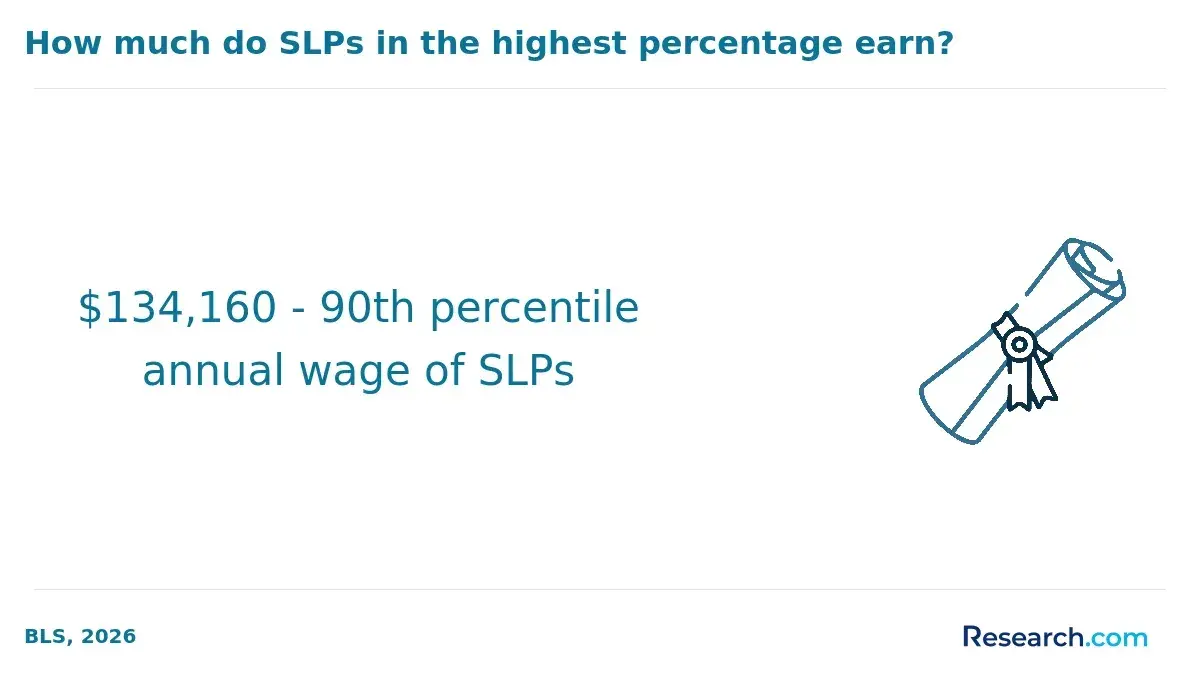
The labor market supports a careful long-term investment rather than a rushed enrollment decision. The U.S. Bureau of Labor Statistics reports a median annual wage of $97,870 for speech-language pathologists in May 2025 and projects 17% employment growth from 2025 to 2035. Those national figures do not predict an individual Iowa salary or guarantee a job, but they indicate that licensed SLP skills remain in demand across settings.
Use these cost categories when building an honest program budget. They clarify why the lowest advertised tuition is not always the lowest-cost option.
| Cost or funding factor | Why it affects the decision | What to compare |
| Tuition and mandatory fees | Forms the core direct cost but may be quoted inconsistently | Total required credits, rate basis, program fees, and anticipated rate changes |
| Residency and travel expenses | Online programs may require campus visits or skills intensives | Number of trips, estimated lodging, transportation, meals, and time away from work |
| Clinical-placement expenses | Fieldwork may require commuting, professional insurance, health checks, and unpaid time | Local versus distant placement likelihood and required compliance expenses |
| Federal financial aid | Eligible graduate students may use federal aid subject to program and individual eligibility | FAFSA process, direct loan limits, interest, origination fees, and borrowing plan |
| Scholarships and assistantships | Can reduce borrowing, but availability varies widely for distance students | Institutional awards, external scholarships, eligibility rules, and renewal conditions |
| Employer support | Some healthcare or education employers offer tuition assistance or repayment benefits | Service commitments, reimbursement timing, tax implications, and job-change restrictions |
For a Des Moines applicant, the best financial fit is usually the CAA-accredited program that minimizes preventable travel and delay risk while offering a sustainable borrowing plan. Compare net cost, not sticker price, and avoid counting on future salary growth to justify debt you could not comfortably repay under a conservative budget.
Other Things You Should Know About Speech Language Pathology
Possibly, but the academic coursework being online is not enough by itself. You need a qualifying program, appropriate clinical education, and completion of Iowa's current licensing requirements. Expect in-person supervised practicum work and potentially required travel for immersions or residencies.
Placement policies differ. Some programs coordinate placements, some ask students to help identify sites, and some place much of the responsibility on the student. Get the policy in writing and ask how the school handles placement shortages or delays.
Not always. Many programs accept applicants from other majors, but they may require prerequisite coursework in areas such as speech and hearing science, phonetics, language development, anatomy, and statistics. Completing prerequisites can add time and cost.
Completion time varies by program structure, prerequisite background, full-time or part-time enrollment, and clinical-placement timing. Cohort-based programs commonly follow a fixed sequence, and a delayed practicum can extend the calendar even when online coursework is finished on schedule.
References
- Master of Science in Speech-Language Pathology https://csd.uiowa.edu/graduate/ms-speech-language-pathology
- Best Speech-Language Pathology Programs in America https://www.usnews.com/best-graduate-schools/top-health-schools/pathology-rankings