2027 Is a Speech Pathology Online Degree Worth It?

Co-Founder and Chief Data Scientist

Reviewed by Rhea Paul, PhD
SLP Education & Research Expert
Choosing an online speech pathology degree is not just a question of convenience. It is a decision about licensure readiness, clinical training, cost, schedule pressure, and whether the program will help you qualify for the roles you want after graduation.
Online speech pathology programs can be a strong fit for students who need flexibility, cannot relocate, or want to keep working while completing advanced training. However, the “online” label can be misleading: most programs still require supervised clinical hours, scheduled live sessions, background checks, possible travel, and close coordination with approved placement sites.
This guide explains how to evaluate whether an online speech pathology degree is worth it, including who benefits most, what technology you need, how long programs take, how internships work, expected tuition, salary outcomes, hiring industries, and what graduates say about the experience.
Key Benefits of Online Speech Pathology Degree
- Online speech pathology programs often feature flexible scheduling, allowing working adults to balance coursework with professional and personal commitments effectively.
- These degrees align closely with growing clinical demand; the U.S. Bureau of Labor Statistics projects a 17% job growth through 2035 for speech-language pathologists.
- Accredited online programs incorporate practical fieldwork components, ensuring graduates meet certification requirements and gain essential hands-on experience.
Who Should Choose an Online Speech Pathology Degree Program?
An online speech pathology degree is best for students who need flexibility but can still commit to a structured, clinically intensive program. The strongest candidates are organized, comfortable with technology, and realistic about the time required for coursework, live participation, and supervised clinical experiences.
This format may be especially useful for the following learners:
- Working professionals: Online coursework can make it possible to continue earning income while completing classes. Asynchronous lectures, recorded materials, and flexible assignment windows are helpful, but students should still expect scheduled meetings, exams, and clinical obligations.
- Parents and caregivers: Students with family responsibilities often value the ability to study from home and build coursework around caregiving routines. The key challenge is arranging reliable coverage during live sessions, practicums, or daytime clinical placements.
- Students far from campus-based programs: Learners who live in rural areas or regions without nearby accredited options may use online study to access programs without relocating. They should confirm early whether the school can support clinical placement in their state or local area.
- Part-time students: Students who need a slower pace may benefit from part-time plans. This option can reduce weekly academic pressure, although it usually extends the time before graduation and employment eligibility.
- Career changers: Students entering speech pathology from another field may appreciate the structure of online learning, especially if they need to complete prerequisites or balance transition costs with current employment.
Online learning is not ideal for every student. Those who need frequent in-person support, prefer spontaneous campus interaction, or cannot protect time for clinical requirements may find a campus-based or hybrid program easier to manage. Data from institutions like Arizona State University demonstrates high enrollment and retention in online speech pathology, highlighting the demand and effectiveness of these programs for a wide range of students.
What Are the Pros and Cons of an Online Speech Pathology Degree?
An online speech pathology degree can be worth it when the program is properly accredited, supports clinical placement, fits your state requirements, and allows you to complete the degree without taking on unmanageable debt or schedule strain. The trade-off is that online study requires more self-management, stronger technology skills, and careful planning around in-person clinical work.
Pros of an Online Speech Pathology Degree
- Flexible scheduling: Online programs often let students complete lectures, readings, and discussion work remotely. This is valuable for learners who work, care for family members, or live far from a campus.
- Broader access to programs: Students are not limited to schools within commuting distance. This can expand access to accredited options and specialized formats that may not be available locally.
- Local clinical placement options: Many online programs help students pursue clinical hours at approved schools, clinics, hospitals, or private practices near their community. This can reduce relocation costs and help students build local professional contacts.
- Potential cost savings: Some online programs charge per-credit tuition that does not vary by residency. Students may also avoid moving, campus housing, and daily commuting expenses.
- Career continuity: Students may be able to remain employed while studying, which can reduce income loss and make tuition payments more manageable.
Cons of an Online Speech Pathology Degree
- Clinical requirements are still in person: Online coursework does not eliminate practicum or internship obligations. Clinical placements may require daytime availability, travel, immunizations, background checks, and liability insurance.
- Possible residencies or intensives: Some programs require short on-campus visits, simulation labs, or in-person skills checks. These can add travel, lodging, and missed-work costs.
- Technology dependence: Students need reliable internet, a suitable computer, a webcam, a microphone, and the ability to troubleshoot software problems quickly.
- Less informal networking: Online students may need to be more intentional about building relationships with faculty, supervisors, classmates, and future employers.
- Competitive admissions and heavy workload: Some programs report high academic expectations, with GPAs often above 3.8 among competitive applicants. Once enrolled, students must manage dense readings, clinical documentation, group work, and assessments.
Before enrolling, compare the program’s accreditation status, clinical placement process, total cost, Praxis preparation, state authorization, and graduation requirements. Students who are still weighing the broader return on investment of different fields can also review college degrees that are worth it.
How Do AI-Enhanced Virtual Classrooms Work in Online Speech Pathology Programs?
AI-enhanced virtual classrooms use digital tools to make online speech pathology training more interactive, practice-based, and responsive. These tools do not replace supervised clinical experience, but they can help students prepare for client interactions, analyze speech samples, and receive faster feedback before entering higher-stakes clinical settings.
- AI-driven simulations: Simulations can present realistic clinical scenarios involving speech, language, fluency, voice, or swallowing-related decision-making. Students can practice observation, assessment planning, and intervention reasoning in a controlled environment before working with real clients.
- Personalized learning support: AI tools may recommend practice activities, flag weak areas, or adapt review materials based on student performance. This can be useful in courses where students must master technical terminology, diagnostic frameworks, and treatment planning.
- AI-powered assessment: Speech recognition tools can transcribe and analyze spoken responses, helping students review accuracy, pacing, articulation, and documentation habits. Instant feedback can make practice more efficient, though faculty and clinical supervisors remain essential for professional judgment.
- Virtual collaboration: AI-supported platforms may help organize group case discussions, role-play activities, and peer feedback. This is particularly useful for students who need repeated practice explaining clinical decisions clearly.
- 24/7 academic support: AI virtual assistants can answer routine platform questions, point students to resources, or provide study prompts outside normal office hours. Students should still rely on faculty for program-specific, clinical, and ethical guidance.
The most effective online programs use AI as a supplement, not a shortcut. Students should ask how simulations are evaluated, whether AI tools are required or optional, and how faculty ensure that clinical reasoning is assessed by qualified instructors. Those comparing flexible online entry points can also review open enrollment college courses online.
Online speech pathology programs depend on video participation, recorded assignments, telepractice tools, learning management systems, and clinical documentation platforms. A weak technology setup can affect attendance, assignment quality, and performance during virtual simulations or live skills practice.
| Technology | Why it matters |
| Reliable computer | A current laptop or desktop with at least 8 GB of RAM and a multi-core processor supports course platforms, video meetings, simulations, and teletherapy-related tools. PennWest University's emphasis on teletherapy training, for example, requires a capable device that meets minimum specifications for online SLP coursework. |
| High-speed internet | A stable broadband connection with at least 10 Mbps download speed helps prevent dropped live classes, delayed uploads, and poor-quality video during assessments. |
| Webcam and microphone | Programs like Cal State East Bay and PennWest require frequent video participation for synchronous classes and virtual clinical practicums. Clear audio and video are essential when instructors are evaluating speech and language exercises. |
| Noise-cancelling headphones | Headphones help reduce background noise during live sessions, recorded assignments, and remote speech assessment practice. |
| Secure cloud storage | Tools such as Google Drive or Dropbox can help students store assignments, clinical documentation, and recorded materials securely while maintaining access across devices. |
| Productivity software | Microsoft Office, Google Workspace, or similar tools are commonly used for reports, presentations, spreadsheets, group projects, and case documentation. |
| Specialized platforms | Some programs use telepractice platforms or clinical simulation software to mirror professional therapy environments. PennWest's curriculum, for instance, includes simulated clinical experiences requiring installation of industry-standard applications. |
Students should test their setup before classes begin, especially their upload speed, camera angle, microphone quality, and ability to join live video sessions from a quiet location. Technology expectations also reflect professional practice: over 60% of speech-language pathologists use telepractice in some capacity, according to the American Speech-Language-Hearing Association.
Students comparing graduate-level options where technical skill can affect career flexibility may also review top paying masters degrees.
The time required to finish an online speech pathology program depends on enrollment pace, cohort structure, clinical placement timing, and whether the student enters with all prerequisites completed. Online coursework may be flexible, but clinical training often follows a stricter calendar.
- Full-time online track: Some programs can be completed in about 20 months. This option is best for students who can prioritize school and clinical hours over work or other major obligations.
- Part-time enrollment: Part-time plans usually take around 29 months or more. This route can be more manageable for working adults, but students should confirm when clinical placements occur and whether daytime availability will be required.
- Extended or cohort-based formats: Some schools structure programs over three years, including summer sessions. Cohort models can provide predictability, but they may offer less freedom to slow down or speed up.
- Flexible learning options: Many programs combine online coursework with in-person practica, local clinical placements, or short residencies. Students should plan for these obligations before assuming the degree can be completed entirely from home.
When comparing timelines, ask whether the advertised completion time includes prerequisites, clinical placement delays, capstone work, Praxis preparation, and any required in-person sessions. Students researching faster formats can also compare accelerated speech pathology programs online as part of their planning.
It is possible to work full-time while completing an online speech pathology degree, but it is usually difficult. The feasibility depends less on whether classes are online and more on when live sessions, exams, group work, and clinical placements take place.
- Course format: Asynchronous courses are easier to fit around a job. Synchronous classes, required meetings, and live skills demonstrations may conflict with standard work hours.
- Weekly workload: Even part-time pacing can require 15-20 hours per week for readings, assignments, exams, discussion posts, and preparation. Full-time study can require substantially more sustained attention.
- Clinical placement schedule: Practicum and internship hours often occur during normal business or school hours. This is the point where many working students need reduced hours, vacation time, flexible scheduling, or temporary job adjustments.
- Employer flexibility: A supportive employer can make a major difference. Students should discuss possible schedule changes early, especially before externships or intensive clinical periods.
- Personal bandwidth: Working full-time while completing graduate-level clinical training can affect sleep, family time, finances, and mental health. Students should build a realistic weekly calendar before enrolling.
A graduate who balanced full-time work while enrolled described it as “challenging but rewarding.” She emphasized the difficulty of managing heavy coursework alongside her job, especially when clinical hours required daytime availability. “I had to communicate constantly with my employer and rearrange shifts,” she said. Despite the fatigue, she found the flexibility of online courses essential and valued the discipline it built. “It felt overwhelming at times, but completing it while working full-time showed me what I was capable of.”
Her experience points to the practical answer: working full-time is achievable for some students, but only with strong planning, reliable support, and a willingness to adjust work commitments during clinical training.
Internships and clinical placements are central to speech pathology training. A credible online program should not simply tell students to “find a site.” It should explain how placements are approved, who secures affiliation agreements, what supervision is required, and how students document progress toward program and credentialing expectations.
- Local site placement: Many online programs allow students to complete clinical hours at approved clinics, schools, hospitals, rehabilitation centers, or private practices near where they live. This can reduce relocation needs and help students build connections in their intended job market.
- Placement coordinators: Dedicated coordinators may help identify sites, contact potential supervisors, manage paperwork, and confirm that affiliation agreements are in place before the placement begins.
- Faculty and clinical supervision: Faculty members and clinical instructors help ensure that the experience supports skill development and aligns with program expectations. Students should know who evaluates them and how often feedback is provided.
- Online application and tracking systems: Many programs use digital platforms to manage placement applications, log hours, upload evaluations, and monitor clinical progress.
- Virtual interviews and networking: Online tools can help students interview with sites, meet supervisors, and connect with potential employers before clinical rotations begin.
Before enrolling, students should ask direct questions: Does the program guarantee placement assistance? Are students responsible for finding their own sites? What happens if a local site falls through? Are placements available in the student’s state? The answers can affect graduation timing and overall program value.
The cost of an online speech pathology program varies widely by institution type, residency policy, program length, and required fees. Tuition is only one part of the total price; students should also budget for clinical expenses, technology, travel, and materials.
- Average tuition per credit: Costs vary significantly. Some public universities charge around $348 per credit, equating to roughly $7,190 annually. Private institutions may charge $1,495 to $1,800 per credit, pushing total program costs beyond $80,000.
- Public vs. private institutions: Public schools typically cost less than private institutions. Annual fees for public programs can be below $7,200, while private colleges often exceed $50,000 per year.
- In-state vs. out-of-state rates: Some public universities discount tuition for residents, while certain online programs use flat rates regardless of geography. A flat rate can simplify budgeting, but it is not always the lowest option for every student.
- Additional fees: Students should plan for expenses such as clinical software, background checks, and insurance, which can add from $1,700 up to $6,000 or more to total costs.
- Other costs: Textbooks, equipment, required software, travel for residencies, and transportation to clinical sites may not be included in advertised tuition.
When I spoke with a student pursuing an online speech pathology degree, he said the hardest part was planning beyond tuition. “Budgeting wasn't just about tuition; the unexpected fees for clinical prep and occasional travel caught me off guard,” he said. He still valued the online structure because it allowed him to balance work and study. “It was worth it to balance work and study, even if I had to stretch my finances carefully,” he reflected.
The practical takeaway is to calculate the full cost of attendance, not just the per-credit rate. Ask each program for a fee list, residency requirements, expected clinical costs, and financial aid options before committing.
Graduates of online speech pathology programs generally compete for the same roles as graduates of campus-based programs when they meet the same licensure, certification, and clinical training requirements. Employers usually focus on accreditation, supervised experience, licensure eligibility, clinical competence, and setting-specific skills rather than whether coursework was completed online.
- Average entry-level salary: Graduates with 1 to 3 years of experience typically earn median salaries around $74,000.
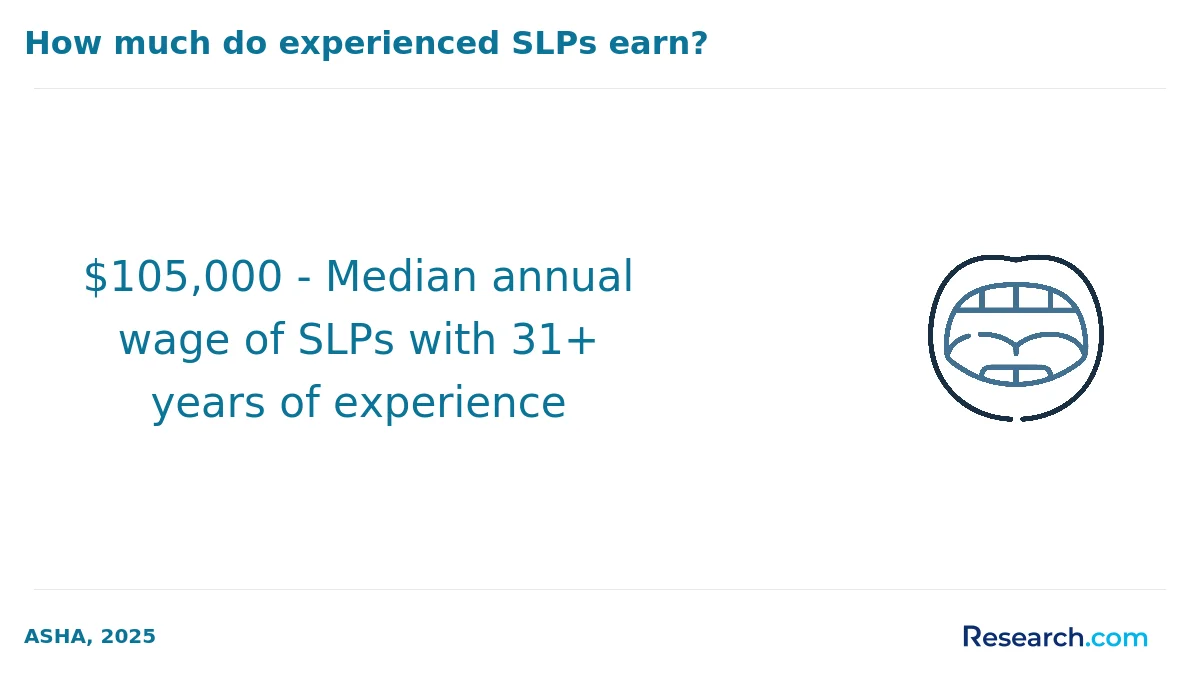
- Mid-career earnings: With approximately 7 to 12 years of experience, median salaries increase to about $85,000-$89,000. After nearly two decades in the field, earnings can exceed $98,000 annually.
- Salary by industry: Speech pathologists working in nursing and residential care facilities earn the highest average salaries, around $105,030, followed by those employed in hospitals at $100,130. Educational services offer comparatively lower salaries, averaging about $79,960.
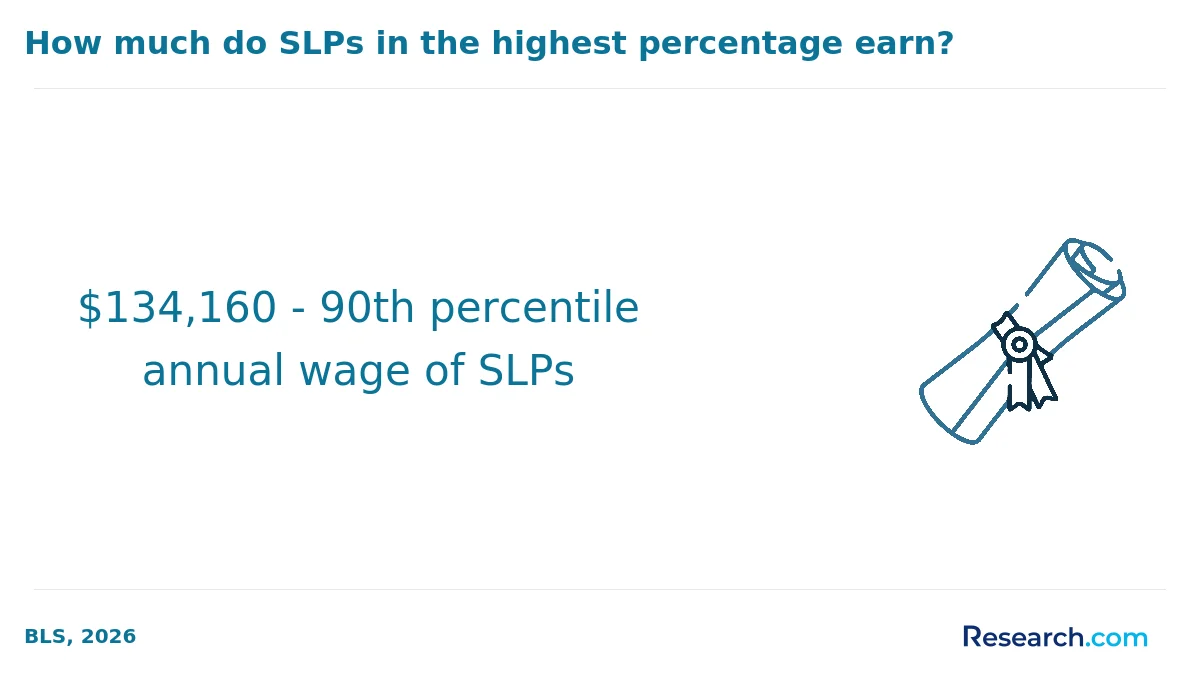
- Top earners and credentials: The top 25% of earners, often those with advanced certifications or high-demand specializations, make over $112,000 yearly.
- Salary by region: Location strongly affects pay. California ($114,050), New York ($111,640), and New Jersey ($109,310) offer the highest salaries. Metropolitan areas such as San Jose, CA, can reach as high as $135,190.
The average salary for online speech pathology degree graduates in 2025 aligns closely with those from traditional programs because licensure standards are consistent. To evaluate return on investment, compare expected debt with likely earnings in the state and setting where you plan to work. Prospective students should also review available online school financial aid options before finalizing a program choice.
Graduates from online speech pathology programs can work in many of the same settings as graduates from campus-based programs, provided they meet licensure, certification, and employer requirements. Hiring is strongest in sectors that need communication, swallowing, rehabilitation, pediatric, aging-related, and telepractice services.
- Healthcare: Hospitals, rehabilitation centers, community clinics, and long-term care settings hire speech-language pathologists to provide assessment and therapy services. The U.S. Bureau of Labor Statistics projects an 17% growth in jobs from 2025 to 2035, driven by an aging population and increased awareness of communication disorders.
- Education: Schools are a major employer of SLPs. Professionals in this setting assess and treat children with speech and language challenges, collaborate with teachers and families, and support individualized educational planning.
- Teletherapy and remote speech pathology roles: Telehealth companies and education technology firms hire clinicians for remote therapy services. These roles may be attractive to graduates who are comfortable with digital tools and want location flexibility.
- Technology and corporate settings: EMR companies, healthcare staffing agencies, and related organizations may hire speech pathology graduates for roles such as customer success managers, recruiters, training specialists, or sign language instructors.
The best industry depends on the graduate’s preferred population, schedule, salary goals, tolerance for documentation, and interest in direct clinical care versus adjacent roles. Students who prefer quieter, focused work environments may also find useful comparisons in this guide to the best job for introverts.
What Graduates of Online Speech Pathology Programs Say About Their Degree
- : "Pursuing an online speech pathology degree allowed me to learn at my own pace, which was perfect given my busy schedule. The program was comprehensive without being overwhelming, and the cost was much more manageable compared to traditional options. This flexibility made advancing my career in speech therapy both achievable and rewarding. — Westin"
- : "The decision to earn my speech pathology degree online was truly transformative. Beyond the cost savings, the ability to access diverse learning materials anytime made the educational experience rich and engaging. It significantly boosted my confidence and opened new doors in my professional journey. — Peter"
- : "From a professional standpoint, completing an online speech pathology degree was a smart investment. I appreciated how the curriculum balanced rigor with convenience, allowing me to apply concepts directly in my clinical work. Factoring in tuition and resources, the affordability made it a practical choice for career growth. — Andrew"
Other Things You Should Know About Speech Pathology Degrees
Accreditation is crucial for online speech pathology degrees to be recognized by employers and licensure boards. Most reputable programs hold accreditation from the Council on Academic Accreditation in Audiology and Speech-Language Pathology (CAA), ensuring the curriculum meets industry standards. Graduates from accredited online programs typically qualify for certification and licensing, making their degrees valuable in the job market.
An online speech pathology program must include at least 400 hours of supervised clinical practicum for ASHA certification, with 375 hours in direct client contact. Programs also require a clinical fellowship after graduation before a state license is issued in most U.S. states.
- U.S. Bureau of Labor Statistics - Speech-Language Pathologists https://www.bls.gov/ooh/healthcare/speech-language-pathologists.htm
- ASHA EdFind - Accredited Speech-Language Pathology Programs https://find.asha.org/ed/
- Audiology and Speech-Language Pathology Interstate Compact https://aslpcompact.com/compact-map/
- Maryville University - Master of Science in Speech-Language Pathology https://www.maryville.edu/masters/speech-language-pathology/
- University of Scranton - Master of Science (M.S.) in Speech-Language Pathology https://www.scranton.edu/academics/pcps/health-and-human-performance/programs/speech-language-pathology/index.shtml
- University of North Carolina at Greensboro - Speech-Language Pathology, M.A. (Online) https://csd.uncg.edu/graduate/masters-of-arts-online/
- New York University - Online MS, Communicative Sciences and Disorders (Speech@NYU) https://steinhardt.nyu.edu/degree/online-ms-communicative-sciences-and-disorders
- Nova Southeastern University - SLP Program - Master of Science in Speech-Language Pathology https://osteopathic.nova.edu/degrees/masters/speech-language-pathology/index.html