2027 Online vs On-Campus Speech Pathology Degree Programs: Pros & Cons

Co-Founder and Chief Data Scientist

Reviewed by Rhea Paul, PhD
SLP Education & Research Expert
Choosing between an online and an on-campus speech pathology program is not just a preference about where you study. It affects your schedule, clinical placements, costs, access to faculty, and how you build professional experience before licensure. Online enrollment across healthcare disciplines has increased by 30% in the past five years, which reflects a real shift toward flexible training models—but flexibility does not remove the need for supervised clinical practice, accreditation, or state licensure preparation.
This guide compares online and on-campus speech pathology programs across the factors that matter most: program structure, admissions, academic support, completion time, cost, financial aid, credibility, employer views, salary expectations, and fit. It is designed for prospective speech-language pathology students, career changers, working adults, and anyone weighing convenience against the benefits of in-person learning.
Key Benefits of Online vs On-Campus Speech Pathology Degrees
- Online speech pathology degree programs offer flexible scheduling, allowing students to balance work and study, with over 60% of programs providing asynchronous coursework to accommodate diverse lifestyles.
- Distance learning often reduces overall expenses by eliminating commuting and housing costs, making it an affordable option for many students pursuing speech pathology degrees.
- On-campus programs enable direct access to hands-on clinical experiences and immediate interaction with faculty, which 78% of employers value highly when hiring speech pathology graduates.
Are online vs. on-campus speech pathology programs structured the same way?
Online and on-campus speech pathology programs are usually built around the same academic and clinical outcomes, especially when they are designed to meet accreditation and licensure expectations. The main difference is not what students must learn, but how they complete coursework, interact with faculty, and arrange supervised clinical experience.
In both formats, students should expect graduate-level study in communication disorders, assessment, intervention, ethics, research, and clinical methods. They should also expect in-person clinical training. Speech pathology is a practice-based field, so even online programs cannot be entirely virtual.
Key structural differences
- Course delivery: Online programs often combine asynchronous modules, recorded lectures, digital assignments, and scheduled live sessions. This gives students more control over when they study. On-campus programs rely more heavily on classroom instruction, in-person labs, live discussions, and scheduled faculty interaction.
- Class schedules: Online programs are commonly designed for students who need flexibility, including working adults. Some offer part-time pacing and may take 3-4 years. On-campus programs usually follow a more fixed academic calendar and may allow full-time students to finish in about 2 years.
- Student interaction: On-campus students typically build relationships through face-to-face classes, lab work, cohort activities, and campus events. Online students interact through discussion boards, video meetings, virtual group projects, and faculty messaging. Online interaction can be effective, but it requires students to be proactive.
- Clinical experience: Both formats require at least 400 supervised clinical hours. Online students usually complete these hours through approved local placements or occasional campus-based intensives. On-campus students often complete clinical work through university clinics, affiliated schools, hospitals, or community sites.
- Capstone or culminating work: Online and on-campus programs may both require a capstone, research project, portfolio, comprehensive exam, or applied clinical project. Online students may present or submit this work virtually, while on-campus students may complete more in-person presentations or demonstrations.
The best structure depends on how much schedule control you need and how comfortable you are managing deadlines without daily in-person accountability. Students who thrive with independence may prefer online study. Students who want built-in structure, immediate access to labs, and regular face-to-face contact may be better served on campus.
Are admission requirements the same for online vs on-campus speech pathology degree programs?
Admission requirements are broadly similar because online and on-campus speech pathology programs are preparing students for the same profession. Applicants usually need a bachelor’s degree, prerequisite coursework, strong academic records, recommendation letters, and evidence that they can succeed in a clinically demanding graduate program.
The difference is often in emphasis. Online programs may look more closely at whether applicants can handle independent learning, technology-based coursework, and local clinical placement coordination. On-campus programs may focus more on cohort fit, in-person availability, and readiness for a fixed schedule.
Common admission requirements by format
- Academic qualifications: Both online and on-campus programs generally require a bachelor’s degree from an accredited institution. Many also require prerequisite coursework in areas such as anatomy, physiology, communication sciences, and statistics. Online programs may offer more flexible ways to complete missing prerequisites, which can help career changers.
- GPA requirements: A minimum undergraduate GPA of around 3.0 is common across both formats. Some online programs, such as Western Kentucky University, may use stricter academic thresholds, including a 3.5 in the last 60 credits, to assess readiness for remote graduate study.
- Standardized tests: GRE requirements are becoming less common, but policies vary by institution and format. Some programs require the GRE, some waive it, and others may accept alternatives such as the GMAT or MAT. Applicants should review each program’s current policy rather than assume that online programs are easier to enter.
- Application materials: Most programs ask for transcripts, a personal statement, and 2-3 letters of recommendation. Online programs may also request video statements or remote interviews to evaluate communication skills, professionalism, and technical readiness.
- Professional or clinical experience: Some online programs give added weight to relevant work or volunteer experience because remote learners need maturity and self-direction. On-campus programs may value experience as well, but it is not always emphasized in the same way.
- Technical readiness: Online applicants may need to show that they can use digital learning platforms, participate in video sessions, and manage remote communication. This is rarely a formal requirement for on-campus applicants.
- Clinical requirements: Accredited programs in both formats require in-person clinical experiences. Online students typically complete these at approved local sites, while on-campus students often use university-affiliated clinics or placement networks.
Students comparing faster graduate pathways sometimes review options such as a 1 year masters online, but speech pathology applicants should be cautious. Speed matters less than whether the program meets accreditation, clinical training, and licensure preparation requirements.
Do online speech pathology students receive the same academic support as on-campus students?
Online speech pathology students can receive academic support comparable to on-campus students, but the experience is different. The strongest online programs do not simply post lectures and leave students on their own. They provide advising, faculty access, tutoring, library resources, clinical placement guidance, and career services through remote platforms.
The key question is not whether support exists, but how accessible and responsive it is. Before enrolling, students should ask how often they can meet with faculty, who helps with clinical placements, what happens if a placement falls through, and whether tutoring or advising is available outside standard business hours.
Support services to compare
- Tutoring services: Both formats may offer tutoring through university learning centers. Online students usually access tutoring through video appointments, recorded resources, and digital writing or study support. On-campus students may attend in-person workshops, labs, or peer tutoring sessions.
- Career counseling: Online and on-campus students often receive help with resumes, interviews, licensure planning, and job search strategy. Online students typically use career portals, virtual appointments, and email-based advising. On-campus students may also attend in-person career fairs and networking events.
- Library access: Online students usually have access to digital journals, e-books, databases, citation tools, and research support. On-campus students have those digital resources plus physical collections, study rooms, and in-person librarian assistance.
- Faculty interaction: Online students connect through email, video calls, discussion boards, webinars, and virtual office hours. On-campus students benefit from classroom contact, in-person office hours, and informal conversations before or after class. Both can support mentorship, but students in online programs must often initiate communication more deliberately.
- Clinical placement support: This is one of the most important differences to investigate. Online programs may require students to identify local clinical sites, while others provide placement coordination. On-campus programs may have more established relationships with nearby clinics, schools, and healthcare organizations.
A strong support system is especially important in speech pathology because students must connect academic theory to clinical practice. If an online program cannot clearly explain how it supports clinical training, advising, and licensure preparation, applicants should proceed carefully.
Completion time depends on enrollment status, prerequisite needs, clinical placement timing, and whether the program runs on a fixed or flexible schedule. Online programs can be faster for some students and slower for others. On-campus programs often provide a more predictable timeline, but they may be harder to balance with work or family responsibilities.
Typical completion timelines
- Online speech pathology degree: Most full-time online master’s programs can be completed in about 20 months, while some take 2 to 3 years depending on summer terms, part-time options, and clinical placement schedules. Online programs often combine asynchronous coursework with evening synchronous sessions, which can help students who are employed or caring for family. Accelerated options may be available for students with relevant academic backgrounds.
- On-campus speech pathology degree: Traditional on-campus programs typically require 2 to 3 years of full-time study, including clinical rotations and internships. They usually follow a set semester calendar, which can make planning easier but less flexible. Some accelerated tracks shorten this to 15 months for students who already have a bachelor’s in speech-language pathology.
What can delay graduation?
- Missing prerequisite courses before admission or before beginning graduate clinical work.
- Limited availability of approved clinical placements near an online student’s location.
- Work schedules that conflict with required synchronous classes or clinical hours.
- Needing to repeat a course, practicum, or competency requirement.
- Choosing part-time enrollment to reduce workload or maintain employment.
A professional who completed an online speech pathology degree described finishing in under two years as demanding but manageable. He said the hardest part was balancing clinical hours with a full-time job and family responsibilities, while the most valuable feature was being able to access lectures and plan coursework around his weekly schedule.
“There were moments when balancing coursework and clinical placements felt overwhelming,” he said, “but knowing I could access lectures anytime and plan my weeks around work made a huge difference.” His experience shows the main trade-off of online study: the schedule may be more flexible, but the student must supply much of the structure.
For highly self-directed students, online programs can support efficient progress. For students who need consistent in-person accountability, a campus-based program may make it easier to stay on track.
Online speech pathology programs are often less expensive overall, but they are not automatically cheaper for every student. The real comparison should include tuition, fees, travel, housing, technology, clinical placement costs, lost income, and available financial aid.
Median annual tuition for online master’s programs in this field is around $14,950, with some well-ranked programs charging as little as $7,190 annually. That compares with a higher average of $17,500 for in-state campus tuition. These numbers make online programs appealing, but tuition is only part of the total cost.
Cost factors to compare
- Tuition and fees: Online programs may charge lower tuition, but students should check whether additional online learning, clinical placement, technology, or residency fees apply. On-campus tuition may be higher, but some students may qualify for institutional support or assistantships tied to campus participation.
- Living expenses: Online students may avoid relocation, campus housing, parking, and commuting costs. This can substantially reduce total spending, especially for students who can continue living at home or keep their current job.
- Technology costs: Online learners need reliable internet, a suitable computer, video capability, and a quiet space for coursework or telepractice-related activities. These costs are usually smaller than housing and commuting expenses, but they should still be planned for.
- Clinical placement expenses: Online students may need to travel to local sites, complete occasional campus intensives, or adjust work hours around practicum schedules. On-campus students may have easier access to university-affiliated sites, though travel may still be required.
- Financial aid impact: Both formats may offer federal aid, scholarships, and loans when the program is eligible. Many online programs have a net price after financial aid averaging near $9,600, showing how much aid can change the actual cost.
- Ability to keep working: Online coursework may allow students to maintain employment longer or reduce work hours more gradually. This can lower borrowing, although clinical requirements may still require daytime availability.
Students comparing affordable slp programs online should still verify accreditation, clinical placement support, and total program fees before choosing the lowest listed tuition.
For students thinking more broadly about degree cost and access, it may also help to compare how format affects other programs, including resources that explain what is the easiest bachelor's degree to get. For speech pathology, however, ease should not be the main goal; accredited clinical preparation should be.
Financial aid options are often similar for online and on-campus speech pathology students, provided the program and institution meet eligibility requirements. The most important step is confirming accreditation, institutional approval for federal aid, and any enrollment rules that affect funding.
Applicants should complete the FAFSA early, ask each school for a full aid estimate, and compare net cost rather than sticker tuition. They should also ask whether online students qualify for the same scholarships, assistantships, grants, and payment plans as campus students.
Main financial aid options
- Federal financial aid: Students enrolled in accredited speech pathology programs, whether online or on campus, are typically eligible for federal aid such as the Direct Unsubsidized Loan, up to $20,500 annually, and the Graduate PLUS Loan after completing the FAFSA. Online students should confirm that the specific program qualifies for federal aid.
- State aid: State grants and scholarships may be available to both groups, but some state programs limit eligibility to residents, in-state institutions, or on-campus enrollment. Some online students at certain public universities may qualify for in-state tuition rates regardless of residency, which can improve affordability.
- Scholarships and grants: Students in both formats may pursue scholarships from institutional funds, professional associations, and organizations such as the American Speech-Language-Hearing Foundation. Eligibility may vary by enrollment status, academic merit, financial need, or intended practice area.
- Employer tuition reimbursement: Working professionals may be able to use employer assistance for either format. Online programs can make this more practical because students may be able to keep working while completing coursework.
- Private student loans: Private loans are available to some students, but terms depend on credit, lender rules, and program eligibility. Accreditation and institutional recognition may affect whether lenders will fund a specific program.
Questions to ask before accepting aid
- Does the aid package apply to the full program or only the first year?
- Are online students eligible for the same scholarships as on-campus students?
- Will part-time enrollment reduce aid eligibility?
- Are clinical placement, travel, or residency costs included in the cost of attendance?
- How much debt is reasonable based on expected career outcomes?
Financial aid can make either format more affordable, but borrowing should be tied to a realistic career plan. Students comparing graduate options may also review what makes a master degree that pays well, while remembering that speech pathology compensation depends heavily on licensure, setting, experience, and location.
Online speech pathology programs can be as credible as on-campus programs when they meet the same accreditation, curriculum, faculty, and clinical training standards. The delivery format is less important than whether the program prepares students for required credentials and state licensure.
The Council on Academic Accreditation in Audiology and Speech-Language Pathology (CAA) is central to program quality. CAA-accredited programs must meet rigorous standards, including a strong curriculum, qualified faculty with advanced expertise in speech-language pathology, and at least 400 supervised clinical practice hours.
Graduates of qualifying programs may be prepared for credentials such as the Certificate of Clinical Competence in Speech-Language Pathology (CCC-SLP), which is an important professional credential. Students should verify how each program supports the path toward certification and licensure in the state where they intend to work.
What makes an online program credible?
- Recognized accreditation: Accreditation is the first factor to verify. It affects licensure preparation, employer confidence, financial aid eligibility, and transferability of academic work.
- Equivalent clinical expectations: Credible online programs require supervised in-person clinical experience rather than replacing clinical training with coursework alone.
- Qualified faculty: Students should review faculty credentials, clinical expertise, research areas, and availability for mentoring.
- Transparent outcomes: Strong programs provide information about licensure preparation, PRAXIS exam performance, completion rates, and job placement support when available.
- Reliable placement systems: Online students should understand who arranges clinical sites, how sites are approved, and what support exists if a placement changes.
Employer and licensing board acceptance has increasingly focused on accreditation and professional qualifications rather than whether the program was online or on campus. Survey data indicate that graduates of accredited online programs achieve licensure and career outcomes on par with traditional students, including similar employment rates and starting salaries.
Virtual learning tools, simulated clinical experiences, and university partnerships with healthcare providers have helped improve the quality and acceptance of online education. Still, students should not assume all online programs are equal. Credibility must be verified program by program.
Employers increasingly treat online and on-campus speech pathology degrees as comparable when the program is accredited and the graduate is properly licensed or on track for licensure. In hiring, the most important factors are usually clinical competence, communication skills, professional references, supervised experience, and the reputation and accreditation status of the program.
Surveys show that 61% of human resource leaders believe online education matches or exceeds the quality of traditional degree programs, and over 70% of organizations hired applicants holding online degrees within the last year. These findings reflect a broader shift: employers are more comfortable with online education when it is tied to rigorous standards and practical training.
What employers are likely to evaluate
- Accreditation: Employers want assurance that the program met recognized academic and clinical standards.
- Licensure readiness: Candidates must satisfy state requirements. A degree format cannot compensate for missing licensure elements.
- Clinical experience: Employers pay close attention to the quality, variety, and relevance of practicum and internship experiences.
- PRAXIS exam preparation: Universities with strong PRAXIS exam pass rates can strengthen graduate competitiveness.
- Professional skills: Employers value documentation accuracy, collaboration, ethical judgment, cultural responsiveness, and the ability to work with clients and families.
- Telepractice readiness: Online graduates may have added familiarity with remote platforms, which can be useful in teletherapy or hybrid service models.
The rise of remote and hybrid work has also reduced the stigma once attached to online degrees. High-quality online programs may provide the same faculty access, curriculum standards, and student services as campus programs, while still requiring in-person clinical practice. With the speech-language pathologist occupation projected to grow by 17% through 2035, graduates from both formats may find strong opportunities if they meet professional requirements.
A professional who completed her speech pathology degree online said employers focused less on the delivery format and more on her clinical placements, mentorship, and licensure status. “What mattered most was how I applied my skills in real-world settings,” she said. Her experience reflects a practical reality: in speech pathology, demonstrated competence carries more weight than whether lectures were completed online or in a classroom.
Online and on-campus speech pathology graduates can earn similar salaries when they graduate from accredited programs, meet licensure requirements, and compete for the same roles. Salary differences are usually driven more by employer type, geographic location, years of experience, certifications, and clinical specialization than by degree format.
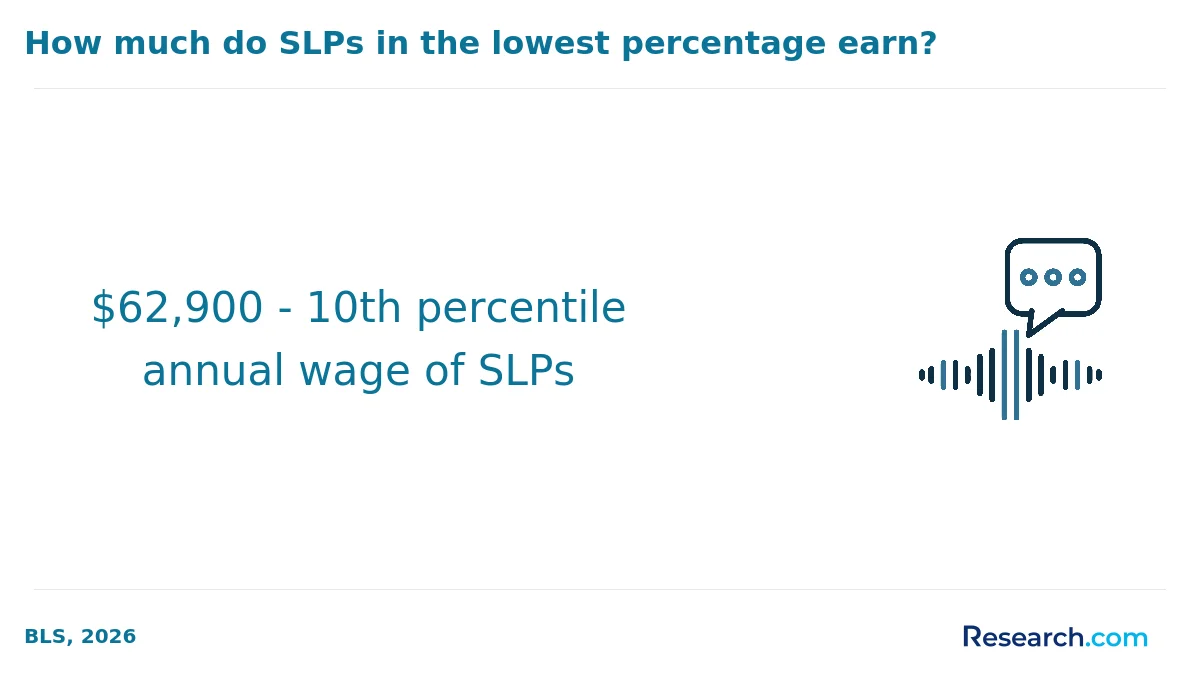
Entry-level salaries typically range from $56,000 to $74,000 regardless of degree format, with seasoned professionals often surpassing $100,000. Students should therefore focus on choosing a program that supports licensure, strong clinical training, and employability rather than assuming one format leads to higher pay.
Factors that affect salary more than format
- Accreditation and licensure: Employers primarily consider whether candidates completed a program accredited by the Council on Academic Accreditation in Audiology and Speech-Language Pathology (CAA) and meet state licensure or ASHA certification expectations. These factors matter more than whether coursework was online or in person.
- Employer perception: By 2025, employer bias against online degrees has largely diminished, especially when online programs include mandatory in-person clinical practicums. Hiring decisions increasingly focus on qualifications and performance.
- Experience and workplace setting: Salaries vary across schools, hospitals, private practices, clinics, and other service settings. Experience, caseload complexity, supervisory responsibilities, and specialty skills can all affect compensation.
- Geographic location: Regional demand and cost of living have a major impact. SLPs in states like California or New York may earn significantly higher salaries, and location usually outweighs degree format as a salary factor.
- Debt and total cost: Online programs may reduce borrowing through lower tuition, fewer relocation costs, or continued employment. This does not directly increase salary, but it can improve long-term financial return.
Students evaluating salary outcomes should also examine institutional quality. Reviewing best non profit accredited colleges can help applicants think critically about accreditation, reputation, and long-term value before committing to a program.
The right format depends on how you learn, how much flexibility you need, how close you are to clinical sites, and how you plan to manage the demands of graduate study. Online programs are not automatically easier, and on-campus programs are not automatically better. The best choice is the one that supports both completion and professional readiness.
Choose an online program if you need flexibility and can manage independence
- You need to balance school with work, caregiving, or location constraints.
- You are comfortable learning through recorded lectures, digital assignments, video meetings, and online discussion.
- You can stay organized without daily in-person reminders.
- You have access to reliable technology and a suitable study environment.
- You understand how clinical placements are arranged and are comfortable completing them locally or through required intensives.
Choose an on-campus program if you want structure and regular in-person access
- You learn best through face-to-face instruction, live discussion, and immediate feedback.
- You want easier access to campus clinics, labs, faculty offices, and peer study groups.
- You prefer a fixed full-time schedule and a traditional cohort experience.
- You want more informal networking opportunities with faculty, classmates, and local clinical partners.
- You can relocate or commute without creating excessive financial or personal strain.
Key questions before you enroll
- Is the program accredited and aligned with your state’s licensure requirements? This should be your first filter.
- Who arranges clinical placements? Ask whether the school secures sites or expects students to identify options.
- What is the real total cost? Include tuition, fees, travel, housing, technology, lost income, and clinical placement expenses.
- How accessible are faculty and advisors? Look for clear advising systems, not vague promises of support.
- Does the schedule match your life? A flexible program still requires time for synchronous sessions, assignments, and clinical hours.
- What outcomes does the program report? Ask about completion, licensure preparation, PRAXIS exam pass rates, and employment support.
If you are still exploring career pathways outside speech pathology, comparing trade school job options may help you evaluate time, cost, and career outcomes across different education routes. For speech pathology specifically, the decision should center on accredited preparation, supervised clinical training, and your ability to succeed in the chosen format.
Here's What Graduates of Online vs On-Campus Speech Pathology Programs Have to Say About Their Degree
- Tanner: "Completing my speech pathology degree online was a transformative experience because it let me balance school with family and work. The flexibility helped me stay focused, and the virtual clinical simulations were more useful than I expected for building practical judgment. Beginning my career with experience in remote learning also helped me adapt quickly to teletherapy tools and serve clients in underserved areas. This path gave me a deeper appreciation for access in healthcare education and service. I am proud to support children with special needs across different states."
- Aubrie: "Studying speech pathology on campus gave me direct access to hands-on clinical experiences, faculty mentorship, and a strong peer community. The live client sessions and group projects helped me build confidence and sharpen my problem-solving skills. I also formed professional relationships and friendships that continue to support my growth. When I entered the field, I felt prepared for diverse clinical settings because of the structure, feedback, and mentorship I received. The experience strengthened my commitment to making a measurable difference in patients’ lives."
- Hana: "The hybrid speech pathology program was the right fit for me because it combined online coursework with real-world clinical practice on campus. I developed self-discipline while still benefiting from face-to-face networking with instructors and classmates. The format also made me a more adaptable communicator, which helped when I began working in both telehealth and traditional therapy settings. Professionally, the hybrid degree gave me flexibility without sacrificing community or clinical preparation."
Other Things You Should Know About Online & On-Campus Speech Pathology Degree Programs
On-campus speech pathology programs in 2027 offer unique benefits such as direct access to faculty, in-person networking with peers, and hands-on experience in campus facilities. These programs foster a collaborative learning environment, which can be pivotal for students who thrive on face-to-face interactions and direct mentorship.
Yes. Many online speech pathology programs require at least one in-person clinical residency or on-campus intensive, often 1 to 3 short sessions for skills labs, simulation, and supervised practicum preparation. Programs aligned with ASHA standards must still include required supervised clinical clock hours before graduation.
- U.S. Bureau of Labor Statistics - Speech-Language Pathologists https://www.bls.gov/ooh/healthcare/speech-language-pathologists.htm
- ASHA EdFind - Accredited Speech-Language Pathology Programs https://find.asha.org/ed/
- Audiology and Speech-Language Pathology Interstate Compact https://aslpcompact.com/compact-map/
- Pepperdine University - Master of Science in Speech-Language Pathology https://healthscience.pepperdine.edu/online-masters-in-speech-language-pathology/
- California State University-East Bay - Online Master of Science in Speech-Language Pathology https://ce.csueastbay.edu/programs/speech-language-pathology/
- California State University-Northridge - Master of Science in Communicative Disorders (Online) https://tsengcollege.csun.edu/programs/CDS
- California State University-San Marcos - Online MS in Speech-Language Pathology https://www.csusm.edu/slp/programs/mastersonline/index.html
- Ithaca College - Online Master of Science in Speech-Language Pathology https://slponline.ithaca.edu/programs/masters-speech-language-pathology-online