2027 Public vs Private Online SLP Master's Programs: Compare Total Degree Costs

Co-Founder and Chief Data Scientist

Reviewed by Rhea Paul, PhD
SLP Education & Research Expert
An online speech-language pathology master's degree can be a major financial commitment, and the advertised per-credit rate rarely tells the whole story. Public programs may offer lower resident tuition, while private programs often charge one standardized rate and may provide different scholarship opportunities. This guide helps prospective SLP students compare total charges, clinical and travel costs, pacing, accreditation, and licensure considerations before choosing a program. It also explains how to verify each school's current estimate rather than relying on a headline tuition figure.
Key Things You Should Know
- Public online SLP programs can be less expensive when they offer in-state tuition, but many distance students pay an out-of-state or online-specific rate that narrows or removes that advantage.
- A valid cost comparison includes tuition, mandatory university and program fees, clinical-practicum expenses, travel, technology, books, and the cost of any prerequisite coursework - not tuition alone.
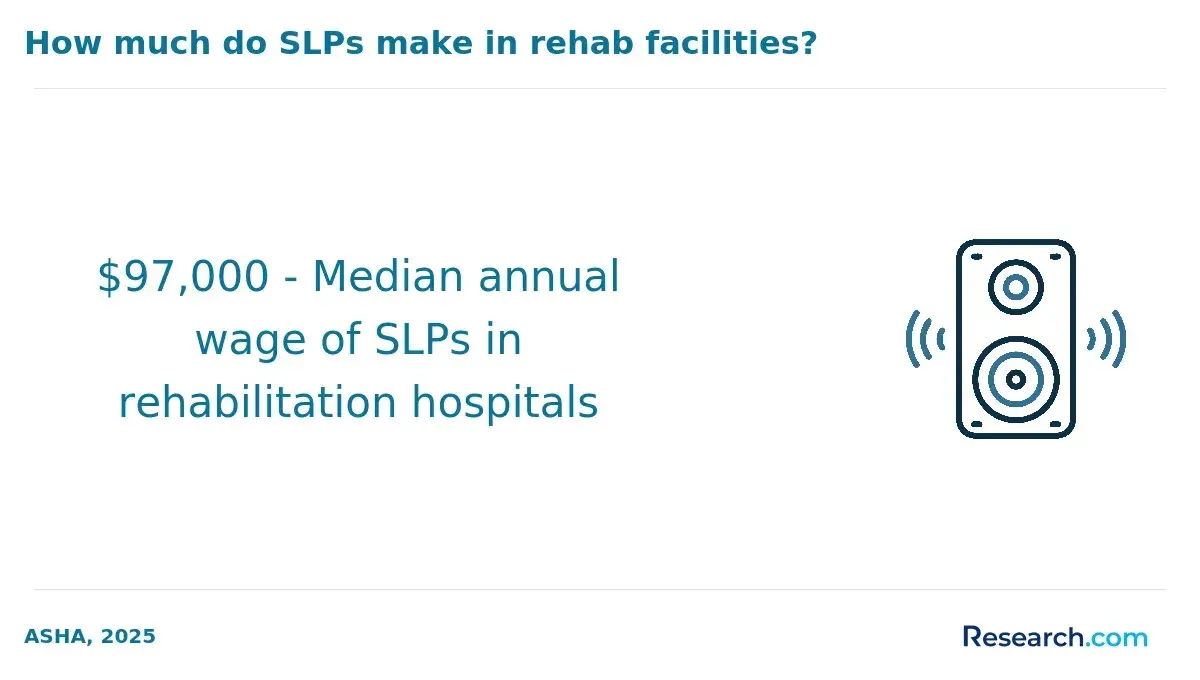
- Cost should be evaluated alongside CAA accreditation and state licensure eligibility: the U.S. Bureau of Labor Statistics reports a $97,870 median annual wage for speech-language pathologists in May 2025, but earning potential does not make an ineligible or unaccredited program a sound investment.
How do total degree costs compare between public and private online SLP master's programs?
Public institutions often have the lower potential price, especially for residents who qualify for in-state graduate tuition. Private nonprofit universities more commonly use one tuition rate regardless of residence, which can make their pricing simpler and occasionally competitive for nonresidents. Neither label reliably predicts the final bill.
The table identifies the financial patterns to test before deciding which institutional type is the better value for you.
| Comparison factor | Public online SLP program | Private online SLP program | What it means for a buyer |
| Tuition basis | May vary by residency, campus, or online classification | Often one published rate for all students | Nonresidents should not assume a public option is cheaper. |
| Potential tuition advantage | Often strongest for eligible in-state students | May be competitive where public nonresident rates are high | Compare required-credit totals using your actual rate. |
| Mandatory fee structure | May include separate university, distance, health, and clinical fees | May bundle some costs but still charge program or practicum fees | Request an itemized total, not a verbal estimate. |
| Financial aid | Federal aid plus institutional and state-based opportunities where eligible | Federal aid plus potentially larger institution-specific merit awards | Compare net price after grants and scholarships, not loans. |
| Scheduling model | May follow a traditional academic calendar | May use lockstep cohorts and condensed terms | A faster schedule can reduce living-cost exposure but increase yearly borrowing. |
For many working adults, the best value is a CAA-accredited program that is authorized for their state, fits their schedule, and has a verified all-in estimate they can fund with limited borrowing. For readers comparing a wider range of lower-cost options, this guide to how much does a masters in speech pathology cost can help frame the search.
What components make up the full cost of an online SLP master's degree?
Total degree cost means every required expense from enrollment through graduation. Tuition usually makes up the largest share, but SLP education has clinical, compliance, and travel requirements that can materially change the amount a student must finance.
Use the following cost categories to turn a school's quoted tuition into a comparable estimate.
| Cost component | Typical billing method | Why it matters |
| Tuition | Per credit, per term, or flat cohort price | Multiply the applicable rate by all required graduate credits. |
| Mandatory institutional fees | Per semester, term, or credit | Technology, student services, distance-learning, and health-related fees may not appear in tuition. |
| Program and clinical fees | Per course, placement, or practicum | These can include simulation, clinical education, assessment, or site-management charges. |
| Prerequisites or leveling courses | Separate undergraduate or graduate tuition | Applicants without communication-sciences prerequisites may need extra coursework before or during admission. |
| Travel and lodging | Paid directly by the student | Residencies, immersions, orientation, and clinical placements may require travel even in online programs. |
| Clinical compliance items | Paid directly or through the school | Background checks, drug screens, immunizations, CPR training, liability coverage, and fingerprinting may be required. |
| Learning materials and equipment | Per course or one-time purchase | Books, software, headsets, testing materials, and reliable internet are recurring or necessary expenses. |
Ask for the estimated cost of attendance and an itemized program budget for your entering cohort. Cost of attendance can include living expenses and is useful for financial-aid planning, but it is not the same as a bill from the university. Separate direct school charges from expenses you will pay to a vendor, airline, landlord, or clinical site.
How do in-state and out-of-state tuition rules affect online public SLP program pricing?
Online enrollment does not automatically qualify a student for in-state tuition. Each public university sets its own residency rules, and an online SLP program may use resident, nonresident, distance-education, cohort, or market-rate pricing. The answer can differ even among programs within the same state system.
Residency rules are especially important because moving to a state after admission may not change your rate. Some institutions classify residency at enrollment and apply requirements involving domicile, tax status, voter registration, or time living in the state. Other programs charge the same online rate to all students, eliminating the resident discount but making costs more predictable.
Before treating a public university as the lower-cost option, get written answers to these questions.
- What tuition rate applies to my state of residence for every required term?
- Is the online SLP cohort priced differently from campus-based graduate programs?
- Can my classification change after enrollment, and what documentation would be required?
- Do clinical rotations, summer terms, or out-of-state placements trigger different charges?
- Are there regional reciprocity agreements, waivers, or restrictions that apply to this program?
A public program is usually most attractive when you receive the resident rate, can complete required credits without excess terms, and can satisfy its travel and clinical commitments locally or at manageable cost. It may be a poor fit when its nonresident rate approaches private-program pricing but its schedule or travel burden is less workable.
Which online SLP master's programs have the lowest and highest estimated total student charges?
There is no permanent, defensible nationwide "lowest" or "highest" list because online SLP programs change rates, charge different fees by cohort and residency, and may not publish comparable all-in totals. A per-credit ranking is particularly misleading when programs require different credit totals, prerequisites, campus visits, or clinical travel.
The lowest estimated total student charges are often found at public institutions where the student receives a resident rate and has few additional travel requirements. The highest estimates frequently occur at private programs with high per-credit tuition, longer required curricula, substantial program fees, or required travel. These are patterns - not a substitute for a current school-specific quote.
The comparison below shows how to identify meaningful low- and high-cost candidates without treating unlike figures as equivalent.
| Candidate type | What to verify | Why the advertised price can mislead |
| Potential low-cost public resident option | Resident eligibility, total required credits, every mandatory fee, and required travel | A low resident rate may not apply to online students or may exclude fees. |
| Public nonresident option | Nonresident online rate, reciprocity status, and full-program estimate | Its total may exceed a private program with one national rate. |
| Private standardized-rate option | Required credits, cohort fees, scholarship terms, and campus attendance | A single rate is easier to compare but does not mean all clinical and travel expenses are included. |
| Accelerated cohort option | Terms per year, enrollment intensity, and ability to maintain progression | A shorter timeline may concentrate tuition and living expenses into fewer years. |
Build a short list of three to five CAA-accredited, state-eligible programs, then request each institution's written estimate for your entry term. If pace is a major part of the financial equation, compare it with the structure of accelerated speech pathology programs online; acceleration can change annual cash flow even when the required-credit total stays similar.
How do ASHA CAA accreditation and state licensure requirements shape valid online SLP options?
For most students seeking to practice as speech-language pathologists, cost comes after eligibility. Graduation from a program accredited by the American Speech-Language-Hearing Association's Council on Academic Accreditation in Audiology and Speech-Language Pathology (CAA) is a central educational requirement for ASHA certification and is widely expected for state licensure. CAA accreditation does not, by itself, confirm that a program can enroll students in every state or that every graduate will meet each state's current requirements.
Online programs still require supervised clinical education. The school may assist with placements, require students to identify potential sites, or use a combination of both. Placement availability, required travel, site approval, and the timing of full-time externships can affect both affordability and ability to continue working.
Before applying, verify the following items with the program and your intended licensing board.
- CAA accreditation status for the specific SLP master's program, including any candidacy or status-change information.
- Whether the institution is authorized to enroll residents of your state and has a state-specific professional-licensure disclosure.
- Whether required coursework and clinical experiences are designed to meet educational requirements in your intended state of practice.
- How placements are sourced, who approves them, whether travel is likely, and what expenses students must pay.
- Whether graduation meets the educational portion of licensure requirements while recognizing that examinations, supervised fellowship requirements, and board procedures may still apply.
A low-cost option that cannot enroll you, cannot support required clinical education, or does not align with your licensing destination is not a true bargain. This is also why selectivity should be considered only after validity and fit; readers can review admissions-focused options in easiest SLP grad schools to get into without assuming that easier admission resolves accreditation or licensure questions.
What hidden or non-tuition expenses should online SLP students budget for across program types?
"Online" describes how much academic instruction is delivered, not the total cost or the absence of in-person obligations. Clinical training, screenings, professional requirements, and technology needs can create expenses that are less visible on a tuition page.
Budget categories below are particularly relevant in SLP programs because they often arise before a placement can begin or when a student must attend an intensive experience.
- Travel, hotel, meals, and local transportation for required campus residencies, skills intensives, orientation, or clinical experiences.
- Background checks, fingerprinting, drug testing, immunizations, tuberculosis screening, and other site-specific clearance requirements.
- CPR certification, professional liability coverage, health insurance requirements, and clinical attire when required by a university or placement site.
- Textbooks, digital platforms, diagnostic materials, software subscriptions, a dependable computer, webcam, headset, and high-speed internet.
- Lost wages or added childcare during daytime clinical placements, which may be more consequential than a modest fee difference.
- Application, transcript, deposit, graduation, and credentialing expenses that occur outside regular tuition billing.
Public and private institutions can both impose these costs. The difference is usually transparency and local logistics, not institutional category. Ask whether each item is included in the program's official cost estimate, optional, paid to a third party, or likely to vary by placement location.
How do cohort length, credit load, and pacing change the real cost per year for SLP students?
Two programs with similar total tuition can create very different financial pressure. A lockstep cohort that runs year-round may finish sooner, but it can require more tuition payments in each calendar year and leave little room for full-time work. A part-time path can spread payments over more years, but additional terms may add recurring fees and delay full-time earnings.
When comparing pacing, distinguish total program cost from annual cash flow. The following framework helps reveal the trade-off.
| Pacing feature | Potential financial benefit | Potential financial trade-off |
| Year-round full-time cohort | May shorten time to graduation and professional entry | Higher annual tuition payments and reduced work flexibility |
| Traditional academic-year sequence | May align with standard aid disbursement and work routines | May take longer to complete if summers are not used |
| Part-time progression | Can make term bills more manageable and support continued employment | More terms can mean more fee exposure and a later career transition |
| Required full-time externship | Provides concentrated clinical training | May sharply reduce paid-work capacity regardless of online coursework |
Calculate two figures for each program: required direct charges for the full degree and the largest amount you may need to pay in a single academic year. Then add realistic living, childcare, and reduced-income assumptions for practicum-heavy terms. That approach prevents a shorter program from looking cheaper merely because it advertises a faster completion date.
In what ways do public and private online SLP programs differ in financial aid and scholarships?
Students at eligible public and private nonprofit institutions may generally pursue federal student aid by submitting the Free Application for Federal Student Aid. The key decision is net price: grants and scholarships reduce what you must pay, while federal and private loans generally must be repaid with interest.
Public universities may connect eligible residents to state-supported aid or institution-specific graduate awards. Private institutions may offer more visible merit scholarships, tuition discounts, or employer partnerships, but availability, renewal rules, and award amounts vary substantially. Do not assume a scholarship makes a higher-price program cheaper until you see the award in writing for the full enrollment period.
Compare aid offers using the same sequence.
- Start with required tuition and mandatory fees for the entire program, using your confirmed residency or online rate.
- Subtract only grants, scholarships, tuition waivers, and employer benefits that are documented and renewable under terms you can meet.
- Separate federal direct loans, Graduate PLUS loans, and private loans from gift aid because they remain debt.
- Review whether aid is available for summer enrollment, repeated courses, prerequisites, and an additional term if clinical progression is delayed.
- Compare the resulting borrowing need with your personal budget, not solely with a projected future salary.
The occupation has favorable demand conditions: the BLS projects 17% employment growth for speech-language pathologists from 2025 to 2035 and about 12,500 openings per year on average. Those figures describe the national occupation, not a guarantee of individual employment, location, specialty, or repayment capacity. Explore career settings and compensation variation through highest paying speech pathology jobs before using earnings assumptions in a borrowing plan.
How can prospective SLP students independently verify current tuition and total cost estimates?
Verify costs shortly before applying and again before accepting an offer. Tuition schedules, fees, cohort requirements, and state authorization can change, and admissions representatives may quote a figure that does not include every billable item.
Use this process to create an apples-to-apples comparison from primary institutional information.
- Confirm that the specific master's program is CAA-accredited and that the institution may enroll students in your state.
- Download the current graduate tuition schedule and identify the rate that applies to your residency, online cohort, and academic term.
- Confirm the total required graduate credits, including any separate prerequisite or leveling coursework you personally need.
- Find mandatory per-credit, per-term, clinical, technology, graduation, and distance-learning fees in the university catalog or fee schedule.
- Ask the program for a written, itemized estimate of direct charges from enrollment through graduation and ask what it excludes.
- Ask about required residencies, clinical-placement travel, equipment, compliance costs, and the expected timing of full-time clinical experiences.
- Compare financial-aid offers by grant aid first, then calculate the loans needed after all documented non-loan aid.
Keep the school's response, tuition page date, and assumptions in a spreadsheet. If a school cannot clearly explain the rate, credits, fees, and likely non-tuition obligations, treat the estimate as incomplete rather than assuming the lowest number is accurate.
What cost-based red flags or consumer-protection issues appear in some online SLP programs?
Most cost problems are not dramatic fraud; they are unclear assumptions that become expensive after enrollment. A prospective student should be cautious when a program's marketing emphasizes flexibility or a monthly payment while making it difficult to determine accreditation, total required credits, clinical expectations, or total borrowing.
These warning signs warrant written clarification before you pay a deposit or accept aid.
- An advertised "starting at" price without the number of required credits, applicable tuition rate, mandatory fees, or a full-program estimate.
- Unclear CAA accreditation status, vague language about "pathways" to licensure, or no state-specific enrollment and professional-licensure disclosure.
- Claims that online study eliminates in-person clinical requirements or that placements are guaranteed without explaining the student's role, location limits, and travel costs.
- Pressure to enroll before receiving a written aid offer, fee schedule, refund policy, or explanation of deposit terms.
- Payment plans presented as affordability solutions without a clear explanation that they do not reduce total charges or loan obligations.
- Promises or implications of guaranteed admission, clinical placement, licensure, employment, salary, or program completion.
- Large differences between catalog information, admissions statements, and financial-aid estimates that the school will not reconcile in writing.
A good consumer-protection habit is to ask every finalist for the same written information: applicable tuition rate, required credits, mandatory fees, aid terms, refund rules, accreditation status, state eligibility, placement model, and out-of-pocket clinical costs. If the answers cannot be compared, postpone the decision rather than using a marketing estimate as a binding commitment.
Other Things You Should Know About Speech Language Pathology
Not necessarily. Online programs can reduce relocation and commuting costs, but they may charge distance-learning fees and still require travel for clinical experiences or campus sessions. Compare each program's complete required charges and likely travel costs.
Some students work during academic coursework, but clinical practica and full-time externships can require daytime availability. Ask each program when placements occur, whether schedules are flexible, and how many weekly hours are expected before relying on employment income.
Many programs require foundational communication sciences and disorders coursework. Applicants from other majors may be eligible after completing prerequisites or a leveling sequence, which can add time and cost. Review the program's prerequisites before comparing master's tuition.
Choose the lowest-cost program only if it can enroll you in your state, supports the clinical training you need, fits your schedule, and aligns with your intended licensure path. A somewhat higher-priced program may be the better financial decision if it avoids extra prerequisite, travel, delay, or relocation costs.
References
- Speech-Language Pathology, M.A. | UNC Greensboro https://www.uncg.edu/academics-support/degrees-programs/online-degrees/speech-language-pathology-m-a/
- Online Graduate Program Tuition & Financial Aid - Baylor CSD https://csd.robbins.baylor.edu/graduate/masters-programs/online-masters-program/tuition-financial-aid
- 2026 Most Affordable Online Speech Pathology Master's... https://www.onlineu.com/most-affordable-colleges/speech-pathology-masters-degrees