2027 Online SLP Master's Programs for Michigan Residents: Eligibility, Tuition, and Clinical Placements

Co-Founder and Chief Data Scientist

Reviewed by Rhea Paul, PhD
SLP Education & Research Expert
Michigan residents considering an online speech-language pathology master's degree need more than a convenient class schedule: they need a CAA-accredited program that can legally enroll them, arrange supervised clinical education, and support Michigan licensure requirements. This guide explains how to evaluate online SLP options, compare tuition beyond the advertised rate, confirm placement expectations, and avoid enrolling in a program that creates licensure barriers. It is designed for career changers, recent graduates, and working adults planning to become licensed SLPs in Michigan.
Key Things You Should Know
- Michigan licensure typically requires a graduate degree from a CAA-accredited SLP program, supervised clinical experience, a passing Praxis score, and completion of the state's licensing process; an online format does not remove these requirements.
- Online SLP programs may accept Michigan residents but use very different clinical-placement models: some coordinate sites, some provide leads and approval support, and some expect students to secure placements with limited assistance.
- Compare total program cost rather than per-credit tuition alone, including prerequisite courses, clinical fees, technology charges, travel for immersions, background checks, immunizations, and potential unpaid practicum time.
Which online SLP master's programs accept Michigan residents and meet licensure-focused training needs?
Michigan residents should begin with programs that hold accreditation from the American Speech-Language-Hearing Association's Council on Academic Accreditation in Audiology and Speech-Language Pathology (CAA). CAA accreditation is the central educational credential to evaluate because it supports the pathway to ASHA certification and is generally expected for Michigan professional licensure.
Schools can change state eligibility, cohort availability, and authorization status. A program's statement that it is "online" is not proof that it currently accepts Michigan students or can place them in Michigan clinical sites. Ask for written confirmation before paying an application fee or enrollment deposit.
The comparison below identifies examples of established distance or online-focused graduate SLP options that prospective Michigan students may investigate. It is a starting point for direct verification, not a guarantee of current eligibility or placement availability.
| Program to investigate | Delivery consideration | Michigan-focused question to ask | Decision trade-off |
| Baylor University Master of Science in Communication Sciences and Disorders | Online coursework with required clinical education and program-directed experiences | Does the current cohort accept Michigan residents, and what travel or immersion requirements apply? | Structured online design may suit students seeking a defined cohort model, but travel and private-university pricing can affect total cost. |
| Emerson College Master of Science in Communication Disorders | Online graduate format with clinical training requirements | How are Michigan placements sourced, approved, and supervised for the applicant's anticipated start term? | May appeal to students seeking online delivery, but placement timing and total charges should be confirmed in writing. |
| New York University Master of Science in Communicative Sciences and Disorders | Online program pathway with fieldwork requirements | Are Michigan residents authorized to enroll, and are any in-person intensives required? | A national program can broaden options, but students should not assume local clinical availability. |
| University of Cincinnati Master of Science in Speech-Language Pathology | Distance-learning option with clinical education components | Does the program currently enroll Michigan residents and what is the expected placement radius? | A public-university option may be worth comparing, but nonresident tuition and out-of-state clinical arrangements can change affordability. |
Applicants who need a less selective route should distinguish between an accessible admissions process and a program that fits their licensure needs. A review of easiest SLP masters to get into can help identify admissions considerations, but accreditation, authorization, and clinical placement remain nonnegotiable screening criteria.
A Michigan-based campus or hybrid program can also be a practical alternative when predictable local placements matter more than fully online coursework. Students with limited ability to travel, work irregular schedules, or need school-based placements close to home should prioritize a program's documented clinical network over its marketing language about flexibility.
What eligibility and prerequisites do Michigan residents face for online SLP master's admission?
Admission requirements vary substantially by school, especially for applicants whose bachelor's degree is not in communication sciences and disorders (CSD). Most programs expect foundational preparation in speech, language, hearing, phonetics, anatomy and physiology, research methods, and statistics. They may also require observation hours, although the exact number and documentation process differ.
Applicants with a CSD bachelor's degree usually have the most direct path. Career changers can still qualify, but they commonly complete post-baccalaureate or leveling coursework before starting graduate clinical courses. That additional preparation can add cost and time, so it should be included in the financial plan rather than treated as an optional expense.
Before applying, compare the admission elements below against your transcript and professional timeline.
| Common requirement | Why programs use it | Michigan applicant action |
| Prerequisite CSD coursework | Confirms readiness for graduate-level clinical and scientific content | Request a transcript review and obtain a written list of missing courses before enrolling in a leveling sequence. |
| Statistics and science preparation | Supports evidence-based practice and prerequisite standards | Check whether the school accepts previous coursework and whether course age limits apply. |
| Observation or guided clinical exposure | Shows familiarity with the profession and ethical patient care | Use only observation hours that the target program says it will accept. |
| GPA, essays, recommendations, and interview materials | Helps programs assess academic readiness and professional fit | Ask whether the GPA calculation uses all coursework, the last 60 credits, or prerequisite courses only. |
| Background, health, and compliance documentation | Required by clinical sites before patient or student contact | Budget for fingerprints, immunizations, drug screening, CPR, and site-specific compliance requirements. |
Do not assume that a low-cost prerequisite provider will satisfy every graduate program. Confirm course equivalency, grade minimums, lab requirements, and timing with each admissions office. Applicants seeking a shorter combined undergraduate-to-graduate route may also compare 5 year accelerated speech pathology programs, although those pathways are generally most useful before a student completes a separate bachelor's degree.
A common mistake is applying broadly without first calculating how long prerequisites will take. The better approach is to create a transcript checklist for each school, identify overlapping missing courses, and choose coursework that is explicitly accepted by the programs on your final list.
How does Michigan's SLP licensure and ASHA certification affect online program selection?
Michigan residents should select an online program backward from the credential they need at graduation. For independent practice as a speech-language pathologist, Michigan applicants generally need an appropriate graduate degree, supervised professional preparation, examination results, and approval through the state licensing process. Requirements and application procedures can change, so applicants should verify them directly with Michigan's licensing authority before enrollment and again before graduation.
ASHA's Certificate of Clinical Competence in Speech-Language Pathology, commonly called the CCC-SLP, is separate from state licensure. It is widely valued by employers and may be required or preferred for some positions, but state licensure is the legal authorization to practice in Michigan. A school should be able to explain how its curriculum, clinical education, and documentation align with both pathways.
The following distinction helps prevent a costly misunderstanding.
| Credential or requirement | Primary purpose | Why it matters when selecting an online program |
| CAA accreditation | Evaluates whether a graduate program meets established educational standards | It is the strongest starting screen for students seeking Michigan licensure and ASHA certification eligibility. |
| Michigan SLP license | Authorizes professional practice in Michigan | Applicants must confirm that the program's education and clinical preparation can support the current state pathway. |
| Praxis examination | Measures professional knowledge for credentialing purposes | Ask programs how they prepare students and where they publish current outcome data. |
| ASHA CCC-SLP | National professional certification | Useful for employment mobility and professional recognition, but it does not replace Michigan licensure. |
| School-based credentialing | May apply to certain K-12 positions | Ask Michigan school employers and the relevant education authority whether additional school-specific requirements apply. |
Do not rely on a general statement that a curriculum is "designed for certification." Request the program's Michigan professional-licensure disclosure, ask whether any educational gaps are known, and save the response. This is especially important if you expect to work in Michigan public schools, medical settings, early intervention, or multiple states after graduation.
Which online SLP programs serving Michigan residents hold CAA and regional accreditation?
CAA accreditation and institutional accreditation answer different questions. CAA evaluates the professional SLP program; institutional accreditation evaluates the university as a whole. For a Michigan resident seeking licensure, both matter, but CAA status is the first program-level checkpoint.
Verify status in the current ASHA CAA directory or ASHA EdFind record, then compare it with the university's own accreditation statement. Do not confuse "seeking accreditation," "candidacy," or a general university accreditation claim with active CAA accreditation of the specific graduate SLP program.
Use this screening framework when reviewing a school's disclosures.
| What to verify | Acceptable evidence | Red flag |
| Programmatic accreditation | Current CAA listing for the exact master's SLP program and delivery pathway | The school only states that the university is accredited. |
| Institutional accreditation | Accreditor named by the university and consistent with recognized institutional oversight | Vague language without an accreditor or current status. |
| Accreditation status timing | Status applies during the student's anticipated enrollment and graduation period | A historical claim or a status that does not cover the relevant program. |
| Michigan licensure disclosure | Written statement addressing Michigan or an individualized review process | The program will not say whether Michigan students may enroll or pursue licensure. |
| Distance-delivery approval | Clear statement that the online pathway is included in the program's approved offering | Only the campus pathway appears in accreditation materials. |
Accreditation does not mean a program is automatically the right match. It does not guarantee local placements, admission, employer preference, a particular salary, or a specific time to graduation. It does, however, reduce a major credentialing risk and should be treated as a baseline requirement rather than a bonus feature.
How do tuition, mandatory fees, and residency status compare across Michigan-eligible online SLP programs?
Tuition comparisons are difficult because online SLP schools publish costs in different ways: per credit, per term, per year, or as a program estimate. Michigan residents should compare the same cost category across schools and ask whether the quote includes clinical education charges, university fees, required immersions, and nonresident tuition.
Public universities may charge a different rate for nonresidents, while private universities often use one published tuition rate regardless of residence. Neither model is automatically cheaper. A higher per-credit price may be offset by fewer credits, while a lower advertised rate can exclude clinical, technology, or travel expenses.
This cost worksheet shows the items that should be included before deciding which program is more affordable.
| Cost category | What to confirm | Why it changes the Michigan resident's comparison |
| Tuition basis | Per-credit, per-term, cohort, or annual rate; total required credits | Prevents comparing a one-term figure with a full-program figure. |
| Residency classification | Whether Michigan residents receive in-state, online, or nonresident pricing | Out-of-state public tuition can materially change the total. |
| Mandatory university fees | Technology, registration, student services, distance-learning, and graduation fees | Fees may be charged every term and are often excluded from headline tuition. |
| Clinical costs | Placement, supervision, liability insurance, background checks, health requirements, and site onboarding | These costs are particularly relevant in programs using distributed Michigan placements. |
| Travel and lodging | Campus intensives, skills labs, orientation, and any required out-of-area placement | Travel can erase an apparent tuition advantage. |
| Prerequisite coursework | Required leveling credits and whether financial aid applies | Career changers may have significant pre-enrollment expenses. |
Ask each admissions or financial-aid office for a written estimate based on your anticipated start term, program pace, and residency category. Then calculate a conservative total that includes travel and lost work time during full-time clinical rotations. Students comparing lower-cost entry routes can explore easiest online SLP programs to get into, but affordability should still be confirmed through the school's current tuition and fee schedule.
Federal financial aid eligibility depends on enrollment, program eligibility, and individual circumstances. Complete the FAFSA where appropriate, then compare aid offers by net cost and borrowing terms rather than choosing a school based only on the largest quoted award.
What clinical placement models do online SLP programs use for students living in Michigan?
Clinical education is the part of an online SLP degree that cannot be entirely virtual. Students need supervised experiences with clients or patients across appropriate populations and settings. Programs may deliver academic courses online while requiring in-person practicum and externship work in Michigan, another state, or at university-affiliated sites.
The placement model is often the deciding factor for Michigan applicants. "The program helps with placement" can mean very different things, so request a detailed explanation of responsibility, timeline, site approval, supervision, and travel expectations.
| Placement model | How it generally works | Best fit | Main risk to evaluate |
| Program-arranged placement | The university identifies and contracts with clinical sites where possible. | Students needing substantial administrative support or who lack professional contacts. | Placement location may be outside the student's preferred city or commuting radius. |
| Shared placement search | The school provides guidance and approvals while the student helps identify local possibilities. | Students with flexibility and local connections in schools or healthcare settings. | Students may underestimate the time needed to obtain site approval. |
| Student-initiated placement | The student finds a prospective site, subject to university review and affiliation agreements. | Students with strong local networks and comfort coordinating early. | A preferred site may decline, lack a qualified supervisor, or fail to finalize an agreement. |
| Centralized or campus-region placement | Some experiences occur near the university or at designated partner locations. | Students able to travel or temporarily relocate. | Travel, lodging, and work disruption may be substantial. |
Ask for examples of the types of settings used for prior distance students, without expecting the same site to be available to you. A school cannot ethically promise a particular hospital, district, or specialty clinic before an affiliation and supervisor are confirmed.
Michigan students who cannot relocate should state that limitation early. A program that cannot discuss its process for finding school, outpatient, hospital, rehabilitation, pediatric, or early-intervention experiences within a workable distance may not be a good operational fit, even if its online courses are appealing.
How do programs arrange in-state school, healthcare, and early intervention placements in Michigan?
Michigan clinical placements may occur in public schools, private practices, hospitals, rehabilitation facilities, skilled nursing settings, outpatient clinics, university clinics, and early-intervention environments. Availability depends on local contracts, supervisor capacity, site rules, client needs, and the student's readiness for the placement. No program should imply that every setting is available in every Michigan community.
Programs commonly begin by confirming whether a site has an affiliation agreement, whether a licensed and qualified supervisor is available, and whether the placement meets course objectives. Some sites require documentation months before a rotation begins, especially when students need fingerprinting, immunization records, liability coverage, or training modules.
Before accepting an offer, use the following questions to clarify the practical realities of in-state placement.
- Ask who is responsible for identifying the initial Michigan site and what happens if the first choice declines.
- Ask whether the university already has active Michigan affiliations, while recognizing that an active affiliation does not guarantee a student slot.
- Ask how far students may be expected to travel and whether temporary relocation has been required for recent cohorts.
- Ask whether school, medical, adult, pediatric, and early-intervention experiences are available through the program's normal sequence.
- Ask when full-time or near-full-time clinical rotations occur so you can plan employment, caregiving, and transportation.
- Ask whether the program pays any placement-related costs or whether students cover travel, parking, health clearances, and compliance charges.
Students interested in high-acuity medical work should also look beyond general placement language. For example, career expectations and compensation can differ for neonatal and hospital-focused paths; this overview of nicu SLP salary provides broader career context, but a graduate program cannot promise a NICU placement or a specialty job.
A frequent mistake is waiting until the clinical term to disclose that travel is impossible. Share geographic limitations, transportation constraints, and work obligations before enrolling, and retain any written explanation of the school's placement process.
What state authorization and distance education rules govern Michigan students in out-of-state SLP programs?
State authorization determines whether an out-of-state institution may provide distance education to a student located in Michigan. Professional programs such as SLP add another layer: a school may be authorized to deliver online instruction but still be unable to confirm that its curriculum meets Michigan licensure requirements or that it can arrange clinical education in the state.
Michigan applicants should check three separate issues: permission to enroll, professional-licensure alignment, and clinical-placement feasibility. These are related but not interchangeable. An admissions representative's verbal assurance is helpful, but the school's written state authorization and professional-licensure disclosures are more reliable for an enrollment decision.
| Question | What a clear answer should address | Why it matters |
| May a Michigan resident enroll? | Current authorization or institutional eligibility for students physically located in Michigan | Enrollment eligibility can change by state and academic term. |
| Does the program meet Michigan educational requirements? | A direct Michigan disclosure, individualized review process, or transparent statement of limitations | Prevents assuming national accreditation alone resolves every state rule. |
| Can clinical education occur in Michigan? | Placement process, affiliation requirements, and any known restrictions | Clinical availability is essential for completing the degree on schedule. |
| What happens if the student moves? | Whether the school must re-evaluate eligibility before the student relocates to another state | A move can affect authorization and placement planning. |
| Who handles complaints? | Institutional complaint process and applicable state-recipient information | Clear disclosures are a basic consumer-protection signal. |
Students should notify the university before moving during the program, including a move within a clinical term. A new location may require a new authorization review and could affect placement options. This issue is particularly important for military families, students living near state borders, and applicants planning to relocate after graduation.
How can Michigan residents verify program outcomes, Praxis pass rates, and employment data before enrolling?
Outcome data helps applicants evaluate whether a program has consistently supported students through graduation, certification examinations, and initial employment. The most useful sources are the program's required disclosures, CAA materials, published student-outcome reports, and direct answers from the department. Do not treat a single cohort's strong result as a prediction of your individual outcome.
Ask for the reporting period attached to every outcome figure. A school may present a multi-year aggregate, a first-attempt Praxis measure, a later-attempt measure, or employment data based on only respondents. Those definitions matter when comparing programs.
The table below identifies the evidence worth requesting and how to interpret it.
| Outcome measure | What to request | How to use it |
| Program completion | Completion results for recent cohorts, including the reporting period and denominator | Look for transparency about students who took longer, withdrew, or changed enrollment status. |
| Praxis performance | Whether the rate is first-attempt or eventual pass rate and the cohort size | Compare like with like; do not assume different reporting definitions are equivalent. |
| Employment outcomes | Timeframe after graduation, response rate, and job type where available | Use it to assess support and transparency, not as a salary or job guarantee. |
| ASHA certification outcomes | How the program tracks graduates' progress toward certification requirements | Confirm that the school distinguishes graduation from post-graduate credential completion. |
| Placement completion | Typical clinical progression and policies for placement delays | This is especially important for online students dependent on distributed sites. |
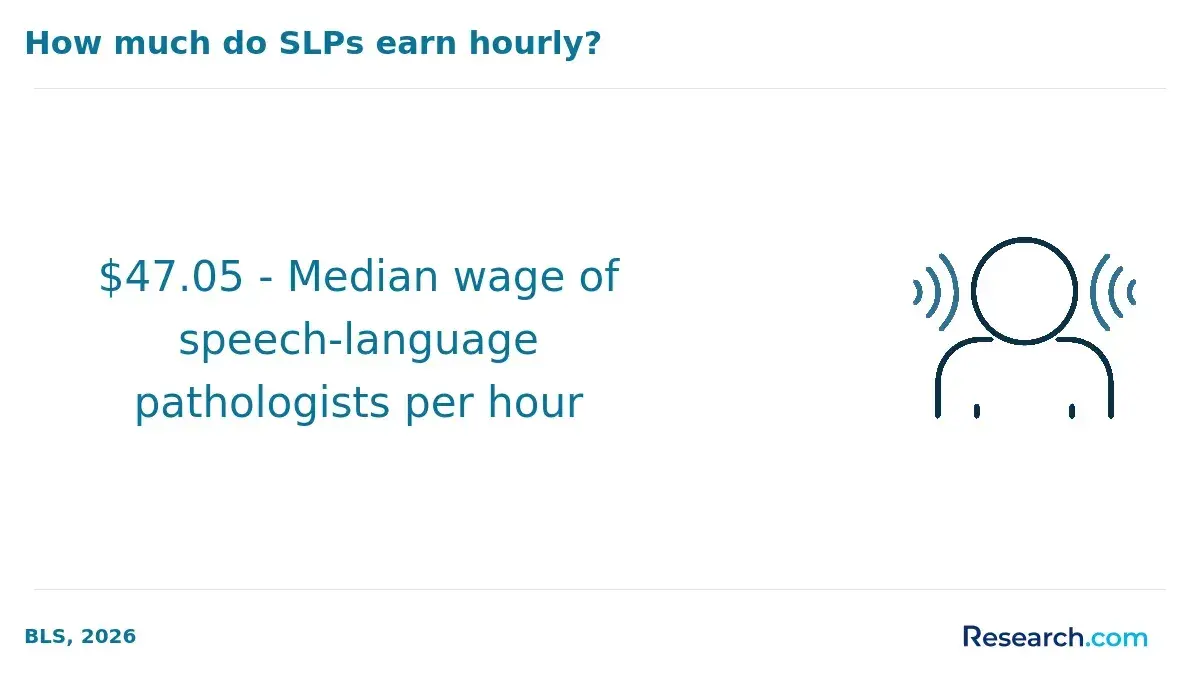
Labor-market data provides context but should not replace program-level evidence. The U.S. Bureau of Labor Statistics reports a median annual wage of $97,870 for speech-language pathologists in May 2025 and projects 17% employment growth from 2025 to 2035, with about 12,500 openings annually on average. These national figures indicate continuing demand, but Michigan pay, hiring, work setting, caseload, and specialty opportunities can differ.
When speaking with an admissions office, ask for the name of the person who can explain outcome definitions and clinical-placement delays. A program that provides specific, current, and documented answers is generally easier to evaluate than one that relies on broad promotional claims.
What consumer-protection steps should Michigan SLP applicants take when evaluating online programs?
The safest choice is usually the program that provides the clearest documentation, not the one with the most appealing headline. Before committing, verify every high-stakes claim independently through current university and CAA materials, then keep copies of emails, tuition estimates, disclosures, and clinical-placement policies.
Use these steps to reduce avoidable financial and credentialing risk.
- Confirm active CAA accreditation for the exact SLP master's program and delivery pathway you plan to enter.
- Obtain written confirmation that the institution currently accepts students located in Michigan.
- Request the program's Michigan professional-licensure disclosure and ask whether it identifies any unmet educational requirements.
- Ask for a full estimated cost of attendance that separates tuition, mandatory fees, prerequisites, clinical costs, travel, and supplies.
- Get a detailed explanation of who secures placements, what geographic area may be required, and what happens if placement is delayed.
- Verify all in-person requirements, including orientation, simulation labs, clinical intensives, examinations, and travel expectations.
- Review outcome data with dates, cohort sizes, and definitions rather than relying on undated marketing claims.
- Read withdrawal, leave-of-absence, transfer-credit, remediation, and dismissal policies before paying a deposit.
- Confirm whether your employment schedule can accommodate full-time clinical rotations, which may not be compatible with regular full-time work.
Red flags include a school that will not state whether Michigan residents are eligible, cannot explain its clinical-placement process, uses vague accreditation language, or quotes only tuition while refusing to discuss other mandatory costs. Another warning sign is pressure to enroll before the school completes a transcript review or state-authorization check.
An online SLP master's can be a strong investment for Michigan residents who need academic flexibility but can meet the in-person clinical demands. It is a weaker fit for applicants who require guaranteed local placements, cannot travel under any circumstances, or have not budgeted for prerequisites and unpaid clinical time. In those cases, a Michigan campus-based or hybrid option may offer more predictable logistics.
Other Things You Should Know About Speech Language Pathology
Potentially, yes. The coursework may be online, but clinical education is completed in person. Choose a CAA-accredited program, confirm that it accepts Michigan residents, obtain its Michigan licensure disclosure, and verify current state requirements before enrolling.
Often, yes. Travel needs vary by program and placement availability. Some students complete experiences near home, while others may need to commute farther, attend campus intensives, or temporarily relocate for a clinical rotation. Ask for the expected travel range in writing.
The graduate degree timeline depends on the program, but career changers often need prerequisite or leveling coursework first. That preparation can extend the overall path. A transcript review is the best way to identify the courses and time you may need before graduate enrollment.
Some students work during didactic coursework, particularly in part-time formats. However, clinical practicum and externship periods may require daytime availability and substantial weekly hours. Review the clinical sequence before assuming full-time employment will remain feasible.
References
- Online SLP Master's Program https://www.misericordia.edu/speech-language-pathology/online-slp-masters-program
- Master of Science in Speech-Language Pathology (M.S.) https://delval.edu/programs/graduate-programs/speech-language-pathology
- Online MA in Communication Sciences & Disorders https://onlinelearning.csuohio.edu/programs/online-masters-communication-sciences-disorders
- Master of Arts in Speech-Language Pathology https://calvin.edu/majors-programs/master-arts-speech-language-pathology