2027 Online SLP Master's Programs for Tennessee Residents: Eligibility, Tuition, and Clinical Placements

Co-Founder and Chief Data Scientist

Reviewed by Rhea Paul, PhD
SLP Education & Research Expert
Tennessee residents considering an online master's in speech-language pathology need more than a flexible class schedule: they need a CAA-accredited program that may enroll Tennessee students, supports local clinical training, and aligns with Tennessee licensure rules.
This guide explains how to evaluate eligibility, tuition, placements, travel requirements, financial aid, and post-graduation credentials so you can choose a program that fits both your budget and your path to practice.
Key Things You Should Know
- Tennessee SLP licensure generally requires a qualifying graduate degree, supervised clinical education, a passing Praxis examination score, and completion of a clinical fellowship; an online format does not waive any of these requirements.
- Prioritize programs accredited by the American Speech-Language-Hearing Association's Council on Academic Accreditation (CAA), because CAA accreditation is the clearest route toward ASHA certification and Tennessee licensure eligibility.
- ASHA certification standards include at least 400 supervised clinical practicum hours, while the post-graduation Clinical Fellowship typically includes 1,260 hours over at least 36 weeks; confirm that an online program can document both requirements.
What online SLP master's programs actively enroll Tennessee residents and how are they structured?
Online master's programs in speech-language pathology are graduate professional programs designed to prepare students for entry-level SLP practice. They are not usually fully self-paced degrees. Even when academic coursework is delivered online, students complete live clinical work with real clients, receive faculty supervision, and may need to attend campus immersions or residencies.
Availability for Tennessee residents can change because of state authorization, clinical-placement capacity, and institutional policy. Applicants should obtain written confirmation from each program that it currently accepts Tennessee residents before paying an application fee or making enrollment plans.
The programs below are examples of recognizable online or distance-delivered SLP pathways that prospective Tennessee students may investigate. Admission availability, required travel, curriculum, and licensure disclosures must be checked directly with each institution for the intended cohort.
| Program to investigate | Typical delivery approach | Clinical training model | Decision point for Tennessee applicants |
| Baylor University, Master of Science in Communication Sciences and Disorders | Online academic instruction with scheduled learning activities and clinical education | Program-supported placements and supervision arrangements | Ask whether Tennessee placements and required travel are available for your cohort |
| Emerson College, MS in Speech-Language Pathology | Online coursework with live and asynchronous elements | Clinical placements coordinated through the program's clinical education process | Confirm Tennessee authorization, placement timing, and immersion requirements |
| New York University, MS in Communicative Sciences and Disorders | Online graduate curriculum with clinical experiences | Clinical education is a required in-person component | Verify current Tennessee eligibility and any required on-campus experiences |
| Calvin University, MS in Speech-Language Pathology | Distance-oriented graduate coursework with required practical training | Supervised practicum and externship experiences | Ask specifically about Tennessee clinical-site availability and travel expectations |
Program structure matters as much as the word "online." A student working full time may prefer a part-time-friendly curriculum, but clinical semesters often require daytime availability because schools, hospitals, and outpatient facilities operate during standard business hours. Applicants who need maximum scheduling control should compare live-session times, cohort pacing, and placement-semester workload before enrolling.
If you are still comparing admissions accessibility and prerequisite expectations, this overview of speech language pathology programs can help frame the broader application landscape. It should not replace confirmation of Tennessee-specific eligibility from a program.
What licensing and educational requirements must Tennessee SLP candidates meet when studying online?
To practice as a speech-language pathologist in Tennessee, a graduate must satisfy the Tennessee Board of Communications Disorders and Sciences' requirements. The degree delivery method is secondary to whether the education, practicum, examination, and supervised professional experience meet state standards.
A typical Tennessee pathway includes a master's degree in speech-language pathology or communication sciences and disorders from an appropriately accredited program, documented supervised clinical experience, a qualifying Praxis score, and a required post-graduate supervised experience period. Candidates should confirm the current application forms, documentation rules, and examination-score policy with the Board before graduation because licensing requirements can change.
The credential sequence is important because each stage depends on the last:
- Complete a qualifying graduate program with the academic and clinical competencies required for entry-level SLP practice.
- Document supervised practicum hours completed during the graduate program.
- Pass the Praxis examination at the score Tennessee accepts when you apply.
- Complete the required supervised clinical fellowship or equivalent professional experience under an approved supervisor.
- Apply for Tennessee licensure and, if desired, apply separately for the ASHA Certificate of Clinical Competence in Speech-Language Pathology.
ASHA's current certification framework requires at least 400 clinical practicum hours, including a minimum number of direct client-contact hours, before graduation. It also requires a Clinical Fellowship that totals at least 1,260 hours over at least 36 weeks. Tennessee applicants should treat those figures as professional certification benchmarks, not as a substitute for checking the state board's current rules.
Students entering without undergraduate coursework in communication sciences and disorders may need leveling courses before or alongside graduate study. That can extend the timeline and add tuition. Applicants with a related bachelor's degree should request a transcript review rather than assume their anatomy, phonetics, language-development, audiology, and statistics courses will transfer.
How do Tennessee's state authorization and ASHA CAA accreditation affect online SLP program eligibility?
CAA accreditation and state authorization answer two different questions. CAA accreditation addresses the academic program's quality and its alignment with professional education standards. State authorization addresses whether an institution may deliver distance education to a student located in Tennessee. A program can be CAA-accredited yet temporarily unable to enroll students from a particular state, so both checks are necessary.
For an aspiring Tennessee clinician, CAA accreditation is usually the strongest starting point. Graduation from a CAA-accredited program is the conventional educational route toward ASHA certification and is commonly the most straightforward way to demonstrate that graduate education meets state licensing expectations.
This comparison shows why applicants should not treat any one approval as sufficient.
| Verification item | What it tells you | What it does not prove | Best action |
| CAA accreditation status | Whether the program meets CAA accreditation standards or holds a stated accreditation status | That the school may enroll Tennessee residents in your term | Check the program in ASHA EdFind and confirm the status directly with the university |
| Tennessee state authorization disclosure | Whether distance education is permitted for students located in Tennessee | That every required clinical site will be available near you | Request a written Tennessee eligibility confirmation |
| Professional licensure disclosure | Whether the institution states its curriculum meets, does not meet, or has not determined Tennessee educational requirements | That you will receive a Tennessee license | Compare the disclosure with current Board requirements |
| Clinical-placement policy | Who identifies, approves, contracts with, and supervises practicum sites | That a preferred site or schedule is guaranteed | Ask about placement lead time, travel radius, and student responsibilities |
A program's disclosure should use precise language. "Designed to meet," "meets educational requirements," and "has not determined" have materially different meanings. If a university cannot confirm Tennessee compatibility, do not assume that a CAA-accredited degree alone resolves the issue.
Students considering a shorter combined undergraduate-and-graduate route should also understand that accelerated study does not remove clinical or licensure standards. Review 5-year accelerated speech pathology programs only as a comparison point if you are still at the bachelor's-degree stage.
How much do Tennessee residents pay in tuition and fees at major online SLP programs?
Online SLP tuition is often charged at a uniform graduate rate rather than a Tennessee resident versus nonresident rate, particularly at private institutions. Public universities may use different rates or program-specific tuition. Because tuition schedules, credit requirements, and mandatory fees can change, applicants should use official cost-of-attendance estimates for their entry term rather than relying on an advertised per-credit rate alone.
The most meaningful comparison is total estimated program tuition plus required institutional fees, travel, clinical compliance expenses, and lost work time during intensive practicum semesters. A lower tuition rate can be offset by required campus travel or a longer enrollment period.
| Cost category | Why it matters | What to request from the program |
| Tuition per credit or term | Shows the published instructional charge but not necessarily the full degree cost | The rate applicable to your cohort and the required number of billed credits |
| Program length and credit total | Determines how many terms of tuition you are likely to pay | A curriculum plan showing required credits, clinical terms, and expected completion timeline |
| Mandatory university fees | May include technology, clinical education, student services, graduation, and distance-learning charges | An itemized estimate of recurring and one-time fees |
| Clinical compliance costs | Background checks, immunizations, drug screens, liability coverage, and health requirements can be required before placements | A current clinical onboarding checklist with estimated student-paid expenses |
| Travel and lodging | Immersions, simulations, campus intensives, or distant placements can materially increase cost | All required visits, dates, locations, and whether alternatives exist |
Do not compare an institution's annual tuition with another program's total degree tuition as though they are equivalent. Ask every school for a written estimate based on your anticipated start term, whether you need prerequisites, and whether you plan full-time or part-time enrollment.
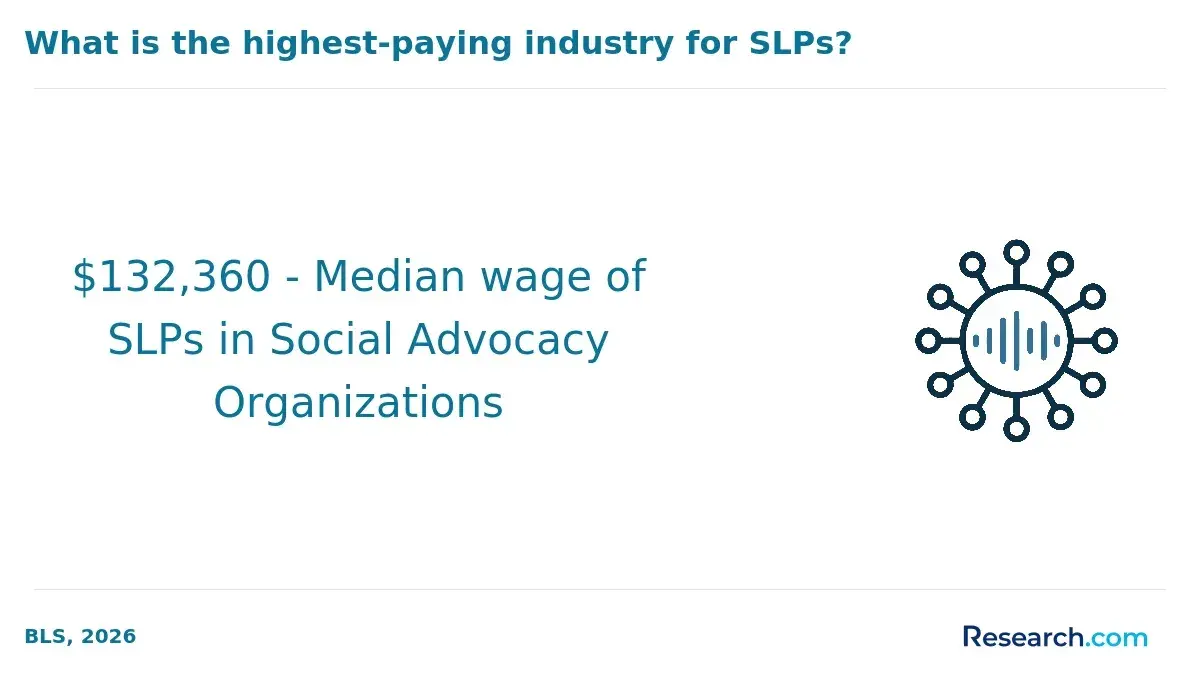
Cost should also be evaluated against the professional outcome, not treated as the only selection criterion. The U.S. Bureau of Labor Statistics reports a May 2025 median annual wage of $97,870 for speech-language pathologists and projects 17% employment growth from 2025 to 2035. Those national figures indicate strong demand, but they do not predict an individual graduate's pay, debt burden, job location, or time to licensure. For broader role and compensation context, see this guide to SLP salary.
What financial aid, scholarships, and employer tuition benefits are most relevant to Tennessee SLP students?
Most graduate SLP students use a combination of federal Direct Unsubsidized Loans, Graduate PLUS Loans, personal savings, scholarships, and employer support. Aid eligibility depends on enrollment status, cost of attendance, federal aid rules, satisfactory academic progress, and the institution's participation in federal financial-aid programs.
Tennessee residents should complete the FAFSA early and then compare each school's aid offer against the same estimated total cost. A larger loan package is not additional value if it simply covers a higher-priced program.
The following funding sources are especially relevant because clinical training can reduce a student's capacity to work.
- Federal Direct Unsubsidized Loans can help eligible graduate students cover education expenses, subject to annual and aggregate borrowing limits.
- Graduate PLUS Loans may fill remaining cost-of-attendance gaps for eligible borrowers but require a separate credit review and should be considered carefully because of total repayment obligations.
- University scholarships may be merit-based, need-based, profession-specific, or tied to cohort enrollment; ask whether awards renew throughout clinical semesters.
- Employer tuition assistance may be available to students working in school systems, health systems, rehabilitation organizations, early-intervention providers, or large employers with education benefits.
- Workforce and service-focused awards may support students willing to work in high-need settings or underserved communities, but obligations and eligibility conditions vary.
Before accepting loans, calculate the amount you would need to borrow for tuition, fees, travel, health insurance, and reduced earnings during full-time placements. A practical comparison includes the program's completion timeline, not just its sticker price. Students who can remain employed longer through a part-time format may reduce borrowing, although a longer program can also create additional living-cost exposure.
Where do Tennessee residents typically complete clinical placements when enrolled in out-of-state online SLP programs?
Tennessee students in out-of-state online SLP programs may complete clinical training in schools, hospitals, outpatient rehabilitation clinics, private practices, early-intervention settings, skilled nursing facilities, and university-affiliated clinics. The setting depends on the program's competency plan, a student's progress, supervisor availability, affiliation agreements, and the population experiences still needed.
Students should not assume that placement will occur in their hometown. A program may seek sites within a reasonable commuting region, but a site may be unavailable because it lacks a qualified supervisor, has no student capacity, cannot complete an affiliation agreement, or cannot provide the required client experiences.
The table highlights the main location realities Tennessee applicants should discuss before enrolling.
| Placement possibility | Potential benefit | Potential constraint |
| Placement near the student's home | May reduce relocation and commuting expenses | Depends on local supervisor availability and an approved affiliation agreement |
| Placement elsewhere in Tennessee | Can expand access to specialty settings or needed patient populations | May require substantial driving, temporary housing, or schedule changes |
| Placement near the university or another state | May give the program more direct control over site relationships | Can increase travel and lodging costs and disrupt local employment |
| School-based clinical experience | Provides experience with pediatric communication needs and educational collaboration | Usually follows school-day schedules and may be difficult to combine with full-time work |
| Medical or outpatient clinical experience | Can broaden adult, swallowing, voice, cognitive-communication, or rehabilitation exposure | Availability varies widely by region and supervisor specialty |
Ask whether the university finds placements, requires students to help identify sites, or uses a shared model. A student should never independently promise a facility that it will serve as a placement site; the program must approve the site and establish any required agreement before clinical hours begin.
For applicants comparing the broader online degree market, a guide to a speech pathologist online degree can provide additional cost context. Tennessee placement compatibility should still be verified separately for every program.
How do online SLP programs arrange, supervise, and verify Tennessee clinical practicum hours for licensure?
In a well-designed online SLP program, the school retains responsibility for clinical education standards even when the student trains at a Tennessee site. The university typically approves the facility and supervisor, tracks competencies and hours, evaluates student performance, and retains records needed for graduation and professional credentialing.
Clinical practicum is not simply observation. Students progressively provide assessment and intervention services under supervision, receive feedback, and document experiences by client population, disorder area, setting, and clock hours. Programs commonly require students to meet compliance requirements before they can start, including immunizations, background checks, drug screening, CPR training, and liability-related documentation.
Before accepting admission, obtain clear answers to these operational questions:
- Who has final responsibility for locating the practicum and externship site?
- Does the program have current affiliation agreements with Tennessee facilities, or must agreements be created for each site?
- What credentials and state license must a Tennessee clinical supervisor hold?
- How are direct and indirect hours recorded, approved, and retained?
- What happens if a planned site withdraws, a supervisor leaves, or a student needs additional competencies?
- Can placements require travel outside the student's county or outside Tennessee?
- How much advance notice does the program give before each clinical assignment?
Hours earned at an unapproved site, under an ineligible supervisor, or before formal authorization may not count toward graduation or certification. Keep personal copies of placement confirmations, hour logs, supervisor evaluations, and program completion documents, even though the university should maintain official records.
Which online SLP programs have track records of Tennessee graduates meeting ASHA CCC and state licensure?
Public, program-by-program data showing how many online-program graduates specifically obtained Tennessee licensure or the ASHA Certificate of Clinical Competence (CCC-SLP) are not consistently published. For that reason, applicants should be cautious about claims that a program has a definitive Tennessee "track record" unless the institution provides documented, current outcome information.
The strongest evidence is not a marketing statement; it is a combination of CAA accreditation, a clear Tennessee professional licensure disclosure, a functioning clinical-placement process, and direct confirmation that recent or current students have completed Tennessee-compatible training. A program may be academically strong while still being a poor fit if it cannot support clinical placement in the region where you live.
Use this evidence hierarchy when evaluating a school's outcome claims.
| Evidence to request | Why it is useful | How to interpret it |
| Current CAA status | Confirms the program's recognized accreditation standing | Necessary but not sufficient for Tennessee enrollment or placement access |
| Tennessee-specific licensure disclosure | Shows the institution's stated assessment of educational compatibility | Prefer a direct determination over a statement that the school has not determined eligibility |
| Graduate outcome report | May show Praxis pass rates, completion rates, employment data, or certification outcomes | Check the reporting period, denominator, and whether online students are separated from other cohorts |
| Written placement confirmation process | Demonstrates how the school operationalizes clinical training | Ask whether the process has recently worked for students in Tennessee |
| Admissions or clinical education response | Can clarify facts not visible on a public webpage | Save written responses; verbal assurances are weaker evidence |
ASHA CCC-SLP and Tennessee licensure are related but separate credentials. ASHA certification is a national professional credential, while Tennessee licensure is the legal authorization to practice in the state. Graduates generally need to complete the relevant post-graduate requirements and submit separate applications; neither outcome should be assumed solely from admission to an online program.
What risks do Tennessee residents face with unaccredited, non-ASHA-aligned, or restricted online SLP programs?
The biggest risk is paying for a degree that does not support the intended professional outcome. A master's degree with a similar title may be useful for research, education, communication, or allied work, but it may not meet the educational and clinical standards required for SLP licensure or ASHA certification.
Programs with unclear accreditation, incomplete clinical education, or restricted Tennessee enrollment can create expensive delays. A student may need additional coursework, repeat clinical experiences, transfer to another program, or be unable to begin a required placement on schedule.
Watch for the following red flags before enrolling:
- The program cannot clearly identify its CAA accreditation status or directs you only to broad institutional accreditation.
- The school has no Tennessee-specific professional licensure disclosure or states that it has not determined whether the curriculum meets Tennessee requirements.
- Admissions staff describe the program as fully online but cannot explain where, when, and under whose supervision clinical hours occur.
- The institution expects you to secure all placements independently without explaining site approval, contracts, supervisor qualifications, and contingency planning.
- Tuition is presented without the required number of credits, mandatory fees, clinical expenses, or travel expectations.
- The program promises that graduates will be licensed, certified, employed, or placed at a preferred site.
- The curriculum does not clearly address the graduate-level clinical and academic preparation expected for entry-level SLP practice.
Do not confuse regional or institutional accreditation with CAA programmatic accreditation. Institutional accreditation matters for federal aid and academic legitimacy, but it does not by itself establish that a speech-language pathology degree meets professional preparation expectations.
How can Tennessee applicants independently verify program accreditation, state approval, and clinical compatibility?
Independent verification protects you from relying on outdated webpages or generalized assurances. Complete these checks before submitting a deposit, declining another offer, or borrowing for tuition.
- Search ASHA EdFind for the exact campus and degree program, then review the stated CAA accreditation status and any relevant notes.
- Read the university's distance-education state authorization page and professional licensure disclosure for Tennessee, not just a national disclosure.
- Compare the program's stated outcomes and curriculum with the Tennessee Board of Communications Disorders and Sciences' current SLP licensure requirements.
- Email admissions and clinical education separately to request written confirmation that Tennessee residents may enroll in your intended cohort.
- Ask clinical education staff whether placements have recently been arranged in Tennessee, who secures sites, what travel may be required, and what happens if a site falls through.
- Request an itemized estimate covering all required credits, fees, prerequisite courses, clinical compliance costs, campus visits, and likely travel.
- Ask for the program's most recent outcome information, including completion, Praxis, employment, and certification measures where published.
- Keep copies of all written confirmations with your application records, especially statements about Tennessee eligibility and clinical placement responsibilities.
If a school's answer is incomplete, treat that uncertainty as meaningful information rather than a minor administrative issue. The best online SLP program for a Tennessee resident is one that provides a documented path from enrollment through supervised clinical education and post-graduation licensure steps, not simply one with convenient online classes.
Other Things You Should Know About Speech Language Pathology
Possibly during some academic terms, but many students must reduce work hours during clinical practicum and externship semesters. Placements often occur on weekdays and may require commuting or temporary travel. Ask for a term-by-term clinical schedule before assuming a program is compatible with full-time employment.
Not always. Some programs admit students from other majors, but they may require prerequisite or leveling courses in areas such as phonetics, language development, audiology, anatomy, and speech science. Those courses can increase both completion time and total cost.
For licensed clinical roles, employers generally focus on whether you hold the required Tennessee license, meet job-specific experience requirements, and can perform the role effectively. A CAA-accredited degree with strong clinical training is typically more important than whether academic coursework was online.
Timing depends on the program length, when you pass the Praxis examination, the availability of a qualifying fellowship position, and licensing processing. The ASHA Clinical Fellowship framework requires at least 36 weeks and 1,260 hours, so candidates should plan for a supervised post-graduate period after completing the master's degree.
References
- Online Speech-Language Pathology Graduate Program https://csd.robbins.baylor.edu/graduate/online-csd-graduate-program
- Master of Science in Speech Language Pathology https://www.south.edu/program/master-of-science-in-speech-language-pathology/
- Top 10 Budget-Friendly Online Master's in Speech Therapy https://specialistlanguagecourses.com/top-10-budget-friendly-online-masters-in-speech-therapy-for-2024/