2027 Online SLP Master's Programs for Pennsylvania Residents: Eligibility, Tuition, and Clinical Placements

Co-Founder and Chief Data Scientist

Reviewed by Rhea Paul, PhD
SLP Education & Research Expert
Pennsylvania residents can pursue an online master's in speech-language pathology, but the degree choice has consequences beyond convenience. A program must be appropriately accredited, authorized to enroll Pennsylvania students, and able to arrange qualifying clinical education before it can support Pennsylvania licensure.
This guide explains how to evaluate online and hybrid SLP programs, compare tuition and travel requirements, confirm clinical-placement policies, and avoid enrolling in a program that does not fit your professional goal.
Key Things You Should Know
- Pennsylvania SLP licensure generally requires a qualifying master's degree, passing the Praxis examination, and completion of a supervised clinical fellowship; a program's online format does not remove these requirements.
- CAA accreditation is the central academic quality check: students should verify the specific graduate SLP program's current status, not merely the university's regional or institutional accreditation.
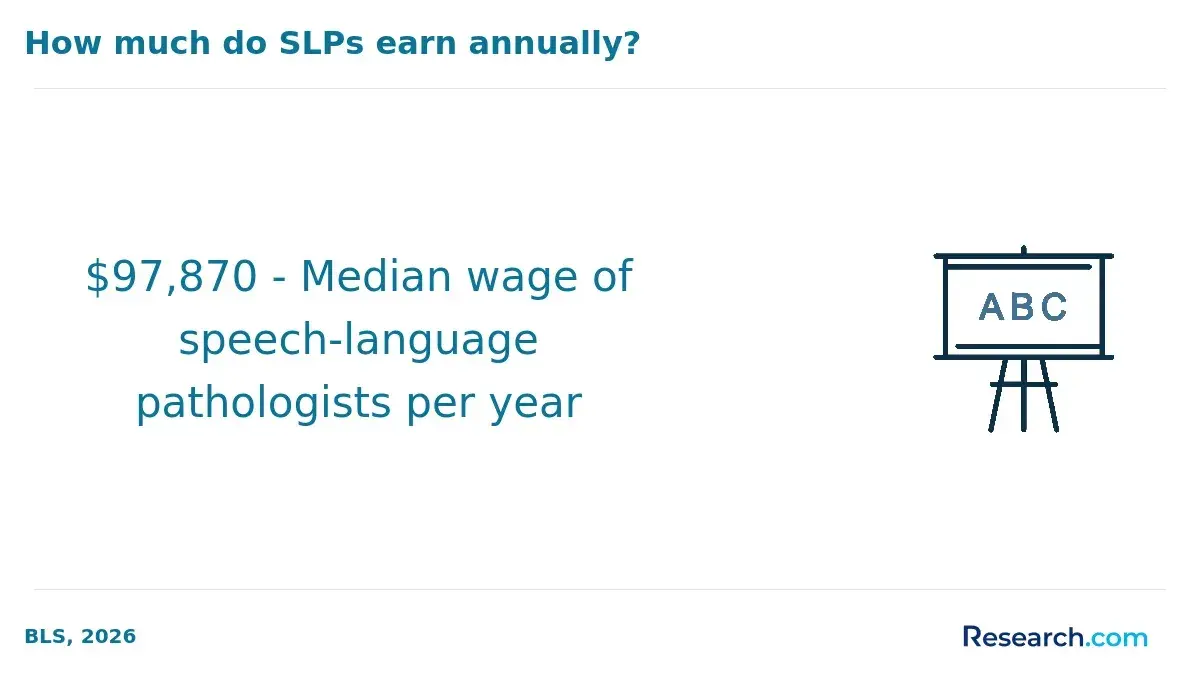
- The national median annual wage for speech-language pathologists was $97,870 in May 2025, and the occupation is projected to grow 17% from 2025 to 2035; demand does not eliminate the need to verify state authorization and placement access before enrolling.
Which online SLP master's programs currently enroll Pennsylvania residents and how are they classified?
Online SLP master's programs available to Pennsylvania residents generally fall into three categories: Pennsylvania-based hybrid programs, out-of-state distance programs with required immersions, and mostly online programs that arrange local clinical education. "Online" usually describes academic coursework, not the entire degree. Every entry-level SLP master's program includes supervised, in-person clinical work.
The programs below are examples of institutions with distance, hybrid, or online graduate SLP pathways that commonly publish information for out-of-state applicants or Pennsylvania learners. Availability, cohort openings, and state eligibility can change, so applicants should obtain written confirmation before paying an application fee or deposit.
| Program type | Examples a Pennsylvania resident may investigate | Typical delivery model | Key decision point |
| Pennsylvania-based hybrid | Temple University; Misericordia University; Commonwealth University programs where available | Online or blended academic work with local and/or campus-based clinical requirements | May reduce time-zone friction and simplify familiarity with Pennsylvania requirements, but travel and cohort scheduling still matter. |
| Out-of-state online CAA-accredited program | Emerson College; Baylor University; New York University; University of St. Augustine for Health Sciences | Online classes, live sessions in some programs, clinical placements near the student when approved, and possible immersions | Confirm Pennsylvania authorization, required travel, and whether the school can secure or approve placements in your area. |
| Hybrid or campus-supported program | Regional public and private universities with distance-friendly coursework | Combination of online instruction, campus labs, simulation, and in-person clinical rotations | Often a better fit for students who want frequent faculty contact or access to an affiliated clinic. |
Program labels can be misleading. A "distance education" pathway may require several on-campus experiences, while an "online" program may use scheduled live instruction that is difficult to combine with a full-time job. Compare published schedule details instead of relying on the headline format.
Applicants who are still building a shortlist can use this overview of SLP online programs as a starting point, then screen each option for CAA status, Pennsylvania eligibility, prerequisites, clinical capacity, and total cost.
A program is usually a stronger match for a Pennsylvania resident when it confirms all of the following in writing: it accepts applicants living in Pennsylvania, it is CAA accredited or holds an acceptable status for the applicant's intended licensure path, it can support Pennsylvania clinical placements, and its required travel is realistic for the student's work and family obligations.
What licensing and educational requirements must Pennsylvania SLPs meet and how do online programs align?
Pennsylvania licenses speech-language pathologists through the State Board of Examiners in Speech-Language and Hearing. An online or hybrid degree can support this path if it meets the same academic and clinical standards expected of a campus-based program. Licensure is not awarded by ASHA, the university, or an employer; it is granted by the state board after the applicant meets its requirements.
For a typical Pennsylvania clinical SLP license application, applicants should expect to document a qualifying graduate degree, passing examination results, and supervised postgraduate experience. The board's current rules and application forms control, so students should check them again shortly before graduation because policies can change.
| Requirement area | What it generally involves | How an online program should support it |
| Graduate education | A master's or doctoral degree in speech-language pathology or a closely related qualifying field | The curriculum should be designed to meet professional preparation standards and disclose its licensure alignment. |
| Program accreditation | Graduation from an appropriately accredited SLP graduate program is central to a straightforward licensure route | The university should identify its current CAA status and provide a direct licensure disclosure for Pennsylvania. |
| Clinical education | Supervised practicum experiences completed during the graduate program | The school should document clock hours, supervisor qualifications, evaluation methods, and placement approval procedures. |
| Examination | Passing the required Praxis examination in speech-language pathology | The curriculum should prepare students for the examination, but no school can guarantee a passing score. |
| Clinical fellowship | Supervised professional experience after graduation and before independent practice requirements are fully met | Career services and faculty may help students understand fellowship expectations, but the graduate usually secures the position. |
ASHA's certification standards are closely related to, but not identical to, Pennsylvania licensure. Many students pursue the Certificate of Clinical Competence in Speech-Language Pathology after completing their degree and clinical fellowship because employers often value it. However, students should treat Pennsylvania licensure, ASHA certification, school credentials, and employer hiring rules as separate checkpoints.
A separate issue applies to students who want to work in Pennsylvania public schools. School-based practice can involve Pennsylvania Department of Education certification or educational specialist credential requirements in addition to professional licensure. Ask both the graduate program and a prospective district whether the intended job requires a particular school credential.
Common mistake: assuming that a master's degree called "communication sciences and disorders" automatically qualifies a graduate for Pennsylvania clinical licensure. The safer approach is to verify the program's CAA status, its Pennsylvania professional-licensure disclosure, and the board's current requirements before enrollment.
How do online SLP programs handle clinical placements specifically for students living in Pennsylvania?
Clinical placement is the decisive practical issue for many Pennsylvania online SLP students. Coursework may be delivered remotely, but observation, practicum, and advanced externship experiences require direct work with clients under qualified supervision. Programs typically use a placement team, faculty clinical coordinators, affiliated sites, or a shared-responsibility model in which the student can suggest sites but the university must approve them.
Pennsylvania offers potential placement settings across school districts, early-intervention programs, hospitals, skilled-nursing facilities, outpatient clinics, rehabilitation providers, and university-affiliated clinics. Availability is uneven, especially in rural areas and in highly competitive metropolitan markets. A nearby employer is not automatically an approved site.
Before applying, ask each admissions or clinical-placement office the questions below. These questions reveal whether a program has a workable model rather than simply a general statement that it "supports" placements:
- Does the program place Pennsylvania students directly, or must the student find prospective sites?
- Has the program recently placed students in my region of Pennsylvania and in my preferred setting?
- Who executes affiliation agreements, verifies supervisor credentials, and handles clearances?
- Can I complete a placement with my employer, and what safeguards prevent conflicts of interest?
- What happens if a placement is delayed, cancelled, or unavailable within commuting distance?
- Are there additional travel, background check, drug screening, immunization, liability insurance, or site fees?
Students should not resign from a job or assume a local placement will be available until the program explains its process. Even schools that coordinate placements may not promise a particular city, specialty, schedule, age group, or commute radius. Flexibility is especially important for pediatric, medical, bilingual, and acute-care experiences, where supervision and site capacity can be limited.
Another red flag is a school that encourages applicants to arrange placements independently but cannot explain how affiliation agreements are completed or how long approvals typically take. The program, not the student alone, must retain academic control over clinical education.
Which online SLP programs are institutionally accredited and recognized by ASHA's CAA for Pennsylvania licensure?
Institutional accreditation and programmatic accreditation answer different questions. Institutional accreditation evaluates the university as a whole. The American Speech-Language-Hearing Association's Council on Academic Accreditation in Audiology and Speech-Language Pathology evaluates the graduate professional program. For prospective Pennsylvania SLPs, current CAA status is the more directly relevant credential.
The comparison below shows how to interpret the terminology a student may encounter. It is not a substitute for checking the current CAA directory and the program's own state-authorization disclosure, because accreditation statuses and delivery options can change.
| Term | What it means for an applicant | What to verify |
| Institutionally accredited university | The institution has recognized institutional accreditation. | This alone does not establish that its SLP master's program meets professional preparation expectations. |
| CAA-accredited SLP program | The specific graduate program has CAA accreditation. | Confirm the status is current, identify any public notices, and make sure the listed delivery pathway covers your intended option. |
| CAA candidate program | A newer program is progressing through the CAA accreditation process. | Ask how candidacy affects graduates' eligibility for Pennsylvania licensure and ASHA certification at the expected graduation date. |
| Program not listed by CAA | The program may be academic, preparatory, or in another discipline, but it is not a standard CAA-accredited entry-level SLP master's option. | Do not assume it leads to Pennsylvania SLP licensure without direct confirmation from the state board. |
Examples of universities that prospective Pennsylvania residents may evaluate for CAA-recognized graduate SLP study include Temple University, Misericordia University, Emerson College, Baylor University, New York University, and the University of St. Augustine for Health Sciences. Inclusion on a general list is not proof that every modality, campus, cohort, or state is currently open to every applicant.
For Pennsylvania licensure planning, use a three-part verification process: confirm the program in the CAA directory, read the school's Pennsylvania professional-licensure disclosure, and contact the Pennsylvania licensing board if the disclosure is incomplete or unclear. Save copies of responses, catalog pages, and clinical-hour documentation for your records.
Are there state authorization or distance education restrictions that affect Pennsylvania residents in online SLP programs?
Yes. A school may be CAA accredited and still be unable to enroll a Pennsylvania resident in a particular online pathway. State authorization governs whether an out-of-state institution may provide distance education to a student located in Pennsylvania. Professional licensure alignment addresses a separate question: whether the education is designed to meet Pennsylvania's requirements for a regulated profession.
Pennsylvania participates in the State Authorization Reciprocity Agreement, commonly called SARA. Participation can simplify distance-education authorization for participating institutions, but it does not automatically settle professional licensure eligibility, clinical-placement approval, or local site requirements. Students should not treat SARA participation as a substitute for a Pennsylvania-specific licensure disclosure.
Restrictions can arise when a university does not accept students from a state, when a program has not made a positive professional-licensure determination for that state, or when a clinical site cannot complete an affiliation agreement. Requirements can also change while a student is enrolled, particularly when a university revises a program or a state changes rules.
Ask for a direct answer to this question: "May a student residing in Pennsylvania enroll in this exact online or hybrid MS-SLP cohort, complete required clinical experiences in Pennsylvania, and use the degree toward Pennsylvania SLP licensure?" A useful response identifies the program, modality, current policy, and any conditions. A vague assurance that "our graduates work nationwide" is not enough.
Students who plan to relocate should repeat the check for the destination state before moving. The relevant state is generally where the student is physically located during distance education and where the student intends to complete clinical practice or seek a license.
What tuition, mandatory fees, and residency-based rate differences should Pennsylvania SLP students expect online?
Online SLP tuition is often charged by credit, term, or cohort rather than by a simple in-state versus out-of-state rate. Pennsylvania residents may receive resident pricing at a Pennsylvania public university, but many private and out-of-state online programs use one distance-learning rate for all students. The advertised tuition figure is only a starting point because clinical education can add substantial indirect costs.
Students comparing affordability should request a program-specific financial estimate that identifies the number of required credits, the applicable rate, required fees, and costs that are billed outside tuition. This is particularly important because SLP programs commonly include clinical and technology requirements that do not appear in a per-credit headline price.
| Cost category | What may be included | Why Pennsylvania students should check it |
| Tuition | Per-credit, per-term, or flat cohort charge | Determine whether the stated rate applies to online students and whether it can change during enrollment. |
| University fees | Technology, student services, matriculation, graduation, or distance-learning fees | Fees can be charged each term even when classes are delivered online. |
| Clinical costs | Background checks, clearances, immunizations, health insurance, liability coverage, drug screening, and site-required training | Requirements can differ across Pennsylvania school, hospital, and clinic placements. |
| Travel and lodging | Campus immersions, skills labs, orientations, and distant clinical placements | These costs are often excluded from published tuition. |
| Lost earnings | Reduced work hours during full-time practicum or externship periods | This can be more consequential than a modest difference in tuition rates. |
Use this calculation when comparing programs: total estimated tuition plus mandatory university fees plus required clinical and travel costs, then add a realistic allowance for reduced work availability. Do not compare one school's annual tuition with another school's full-program tuition; those are not equivalent figures.
Students focused on cost may find value in reviewing speech therapy masters online options but should still obtain a written estimate for their own residency, cohort, prerequisite status, and travel needs. The lowest published rate is not necessarily the least expensive degree if it requires repeated campus travel or delays graduation because of placement constraints.
Residency can matter most at public universities. Ask whether a Pennsylvania resident qualifies for an in-state graduate rate, whether online students are assessed a separate rate, and whether a move during the program affects billing. Private nonprofit universities usually do not use public-university residency pricing, although they may offer institutional scholarships.
How do online SLP programs structure practica and externships within Pennsylvania schools, hospitals, and clinics?
Online SLP programs typically sequence clinical education from observation and introductory practicum to more advanced, full-time or near-full-time externships. The exact terms vary, but the purpose is consistent: students must demonstrate clinical competence with real clients across appropriate settings, populations, and communication needs under qualified supervision.
ASHA certification standards have long used a clinical-hour framework that includes at least 400 total supervised clinical clock hours, including at least 25 observation hours and 375 direct client-contact hours, with at least 325 hours completed at the graduate level. A program may require more than this minimum or structure hours differently to meet its curriculum and accreditation obligations.
| Clinical stage | Common Pennsylvania setting options | Scheduling reality |
| Observation and early practicum | University clinic, telepractice observation, outpatient clinic, school, or supervised community setting | Often paired with coursework and may require daytime availability. |
| Intermediate practicum | School district, early-intervention provider, outpatient rehabilitation clinic, hospital department, or skilled-nursing facility | Students begin carrying greater responsibility while remaining closely supervised. |
| Advanced externship | Medical, school-based, pediatric, adult rehabilitation, or specialty placement | May resemble a full-time work schedule and can make outside employment difficult. |
School placements can provide experience with individualized education programs, classroom collaboration, language disorders, and speech-sound intervention. Medical placements may offer exposure to dysphagia, neurogenic communication disorders, voice, cognitive-communication care, and discharge planning. A balanced clinical portfolio can be valuable, but a specific specialty placement cannot be assumed.
Telepractice may appear in an online curriculum, yet it does not eliminate the need for approved supervision, client protections, and state-compliant service delivery. Students should ask whether telepractice hours are available, optional, or required, and how the program ensures that those hours are accepted for its clinical and licensure purposes. Meanwhile, hybrid SLP programs offer additional flexibility as these combine on-campus and online courses and activities.
A strong clinical plan accounts for Pennsylvania's practical requirements as well. School sites may require Pennsylvania background clearances and child-abuse clearances; health systems may require immunization records, training modules, and drug screening. Complete these early, but wait for the school's directions so that clearances are current when a site requests them.
What are the key differences between Pennsylvania-based and out-of-state online SLP programs for residents?
A Pennsylvania-based program can offer local regulatory familiarity and potentially resident tuition at a public institution. An out-of-state online program can widen choices in scheduling, cohort start dates, and curriculum design. Neither category is automatically better; the better option is the one that can document Pennsylvania eligibility, fits the student's financial and travel constraints, and provides an achievable clinical-placement pathway.
This comparison highlights the trade-offs that matter more than a school's physical location:
| Decision factor | Pennsylvania-based option | Out-of-state online option |
| State familiarity | May have established knowledge of Pennsylvania licensure and local clinical partners. | May have strong national systems, but applicants need explicit Pennsylvania-specific confirmation. |
| Tuition structure | Public institutions may offer resident graduate pricing. | Often uses a uniform online rate; private schools may not differentiate by residency. |
| Travel | Campus sessions may be easier to reach, depending on where the student lives. | Immersions can require flights, hotels, and time away from work. |
| Clinical placements | May have existing Pennsylvania affiliations, though no site is guaranteed. | May arrange local placements, rely on broader national networks, or expect student site leads. |
| Schedule | May align more naturally with Eastern Time and local academic calendars. | Can offer different pacing models, but live-session times and academic calendars may be less convenient. |
| Program choice | Smaller pool of local options. | Broader selection, with more need for due diligence. |
Choose a Pennsylvania-based option when resident pricing, lower immersion travel, local faculty connections, or established in-state clinical relationships materially reduce risk. Choose an out-of-state online program when it offers a better schedule, a verified Pennsylvania placement model, a curriculum that fits your goals, and a total cost that remains manageable after travel and fees.
Students considering shorter calendars should be cautious with labels such as "accelerated." Accelerated speech pathology programs online may reduce the calendar length, but they do not remove clinical-hour requirements, prerequisite coursework, or the intensity of full-time externships. A faster sequence can be a poor fit when a student must maintain substantial employment.
The BLS projects 17% employment growth for speech-language pathologists from 2025 to 2035, with about 12,500 openings projected annually on average. That outlook supports careful investment in a qualifying degree, but it should not be used to justify accepting unclear placement policies or unaffordable borrowing.
How can Pennsylvania residents verify an online SLP program's accreditation, authorization, and clinical eligibility before enrolling?
Verification should happen before an application deposit, not after admission. The goal is to create a written record that the exact degree, delivery format, and student location align with Pennsylvania licensure and clinical requirements. A general university webpage is not enough when it does not address the graduate SLP program directly.
Use this sequence to complete a practical pre-enrollment review. It separates issues that are often mistakenly bundled together: program accreditation, state authorization, professional licensure, and clinical placement.
- Find the specific master's-level SLP program in ASHA's CAA directory and record its current accreditation or candidacy status.
- Read the university's Pennsylvania professional-licensure disclosure for the exact online or hybrid pathway, not a different campus or undergraduate major.
- Ask admissions to confirm in writing that applicants residing in Pennsylvania may enroll in the intended start term.
- Ask the clinical education office how placements are sourced, approved, supervised, and handled if no site is available near your home.
- Request the total required credits, tuition rate, mandatory fees, immersion dates, and estimated non-tuition expenses in writing.
- Compare the program's curriculum and clinical-hour documentation with the Pennsylvania board's current license application requirements.
- If you plan to work in schools, verify Pennsylvania Department of Education credential expectations with the program and prospective employers.
Keep copies of email responses, catalog pages, tuition disclosures, and clinical-placement policies. If a representative gives a verbal answer that affects your enrollment decision, send a follow-up email summarizing the conversation and request confirmation.
Warning signs include an unclear response about CAA status, a refusal to discuss Pennsylvania eligibility, no explanation of who approves clinical supervisors, or an estimate that omits required travel. These do not necessarily mean a program is unsuitable, but they do mean the applicant should pause until the school provides documentation.
What funding options, tuition waivers, and employer or school-district support exist for Pennsylvania SLP students online?
Most eligible graduate SLP students combine federal student aid, institutional aid, personal savings, employer support, and loans. Online enrollment does not automatically make a student ineligible for aid, but the program must meet federal eligibility standards, and the student must satisfy enrollment and academic-progress rules.
Federal Direct Unsubsidized Loans and Graduate PLUS Loans are common financing tools for eligible graduate students who file the Free Application for Federal Student Aid. These funds can help cover education costs, but students should review borrowing totals against their expected budget and avoid treating projected earnings as a guarantee of repayment capacity.
Employer assistance can be especially useful for paraprofessionals, speech-language pathology assistants, school employees, healthcare workers, and rehabilitation staff moving toward the SLP credential. Before enrolling, ask human resources whether support requires continued employment, a service commitment, a minimum grade, or repayment if you leave early.
The following funding sources are worth investigating because their terms vary substantially by school and employer:
- University scholarships, departmental awards, and need-based grants available to graduate CSD students.
- Graduate assistantships, research assistantships, teaching roles, or clinic support positions, where offered and compatible with the program's schedule.
- School-district tuition reimbursement, grow-your-own workforce initiatives, and service-commitment support for employees preparing for shortage-area roles.
- Hospital, rehabilitation, and healthcare-system education benefits for employees who remain in good standing.
- Professional association scholarships and community-based awards for students who meet specified eligibility criteria.
- Federal loan programs for eligible graduate students after filing the FAFSA.
When comparing aid offers, distinguish grants and scholarships from loans, and distinguish one-time awards from renewable awards. A large first-term scholarship may not offset a higher tuition rate over the full program. Ask whether funding continues during clinical externship terms, when students may have the least time to work.
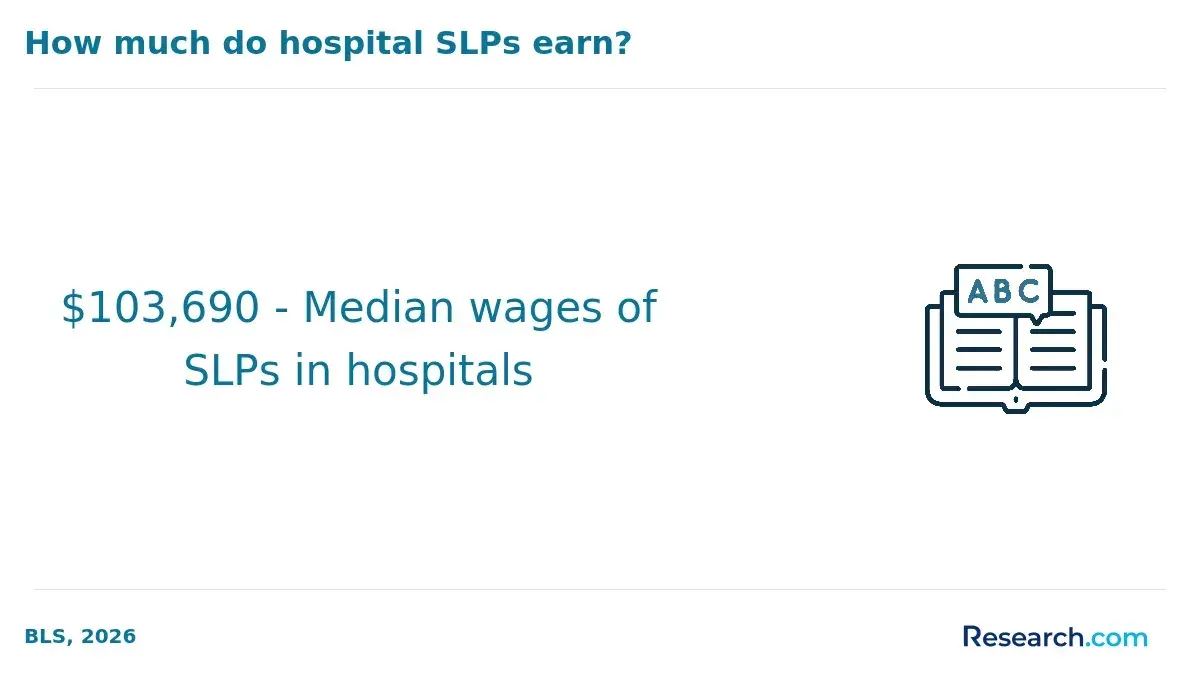
Career prospects can inform, but should not dominate, a borrowing decision. The national median annual wage for speech-language pathologists was $97,870 in May 2025; actual pay varies by setting, experience, local market, productivity expectations, and benefits. Review speech therapy salary information alongside realistic debt, completion time, and placement assumptions.
Other Things You Should Know About Speech Language Pathology
Some students work during didactic coursework, particularly in part-time pathways, but clinical practicum and externship terms often require daytime availability and can resemble a full-time schedule. Ask for a term-by-term calendar before assuming you can maintain full-time employment throughout the degree.
Not always. Applicants from other majors may be admitted after completing prerequisite or leveling coursework. This can add time and cost, so ask whether prerequisites must be completed before admission, can be taken alongside graduate courses, and qualify for financial aid.
Usually not without formal approval. A current workplace may be considered if it provides appropriate clients, qualified supervision, educational independence, and an affiliation agreement. Programs commonly require varied experiences and may limit placements where an employment relationship creates conflicts.
Employers generally focus on whether you meet licensing and credentialing requirements, completed appropriate clinical training, and fit the role. A CAA-accredited program with strong clinical preparation can be a valid route, but students should be prepared to explain their experiences and obtain Pennsylvania licensure before positions requiring independent practice.
References
- Master's in Speech-Language Pathology (MS) https://www.commonwealthu.edu/academics/programs/speech-language-pathology-ms
- Speech-Language Pathology | PennWest Global Online https://online.pennwest.edu/programs/speech-language-pathology-grad/index.php
- Online SLP Master's Program https://www.misericordia.edu/speech-language-pathology/online-slp-masters-program
- 2026 Most Affordable Online Speech Pathology Master's... https://www.onlineu.com/most-affordable-colleges/speech-pathology-masters-degrees
- 2024-2025 Master's Level SLP Stipend for School-Based... https://sites.google.com/pattan.net/pa-apr/2024-2025-masters-level-slp-stipend-for-school-based-placements