2027 Best Online Speech Pathology Master's Programs for Residents of Huntington Beach, CA

Co-Founder and Chief Data Scientist

Reviewed by Rhea Paul, PhD
SLP Education & Research Expert
Choosing an online speech-language pathology master's program from Huntington Beach involves more than finding a flexible class schedule. California licensure, local clinical placements, required campus visits, and state authorization can determine whether a program is practical for your career goal. This guide compares the factors that matter most, explains how to verify California eligibility, and helps prospective SLPs identify an accredited program that fits their budget, timeline, and ability to complete supervised clinical training.
Key Things You Should Know
- For California licensure, prioritize a master's degree from an ASHA Council on Academic Accreditation (CAA)-accredited program, sufficient supervised clinical experience, and confirmation that the school accepts California residents and supports California placements.
- Online SLP degrees are not fully remote: students generally complete in-person practicum and externship experiences and may need to attend required residencies, immersions, or live classes scheduled in another time zone.
- The U.S. Bureau of Labor Statistics reports a $97,870 median annual wage for speech-language pathologists in May 2025 and projects 17% employment growth from 2025 to 2035, but program cost, licensure readiness, and local placement feasibility should drive the enrollment decision.
Which online speech pathology master's programs accept Huntington Beach residents without relocation?
Huntington Beach residents should treat enrollment eligibility as a school-by-school question. A program may be delivered online but still limit enrollment by state authorization rules, require brief campus attendance, or be unable to confirm California clinical placements before admission. The strongest options are typically CAA-accredited programs that explicitly serve distance learners, disclose California professional-licensure information, and have a clear process for arranging clinical education.
The programs below are useful starting points because they are established distance-learning options frequently considered by applicants seeking a CAA-accredited clinical master's degree. Availability, tuition, travel obligations, and California authorization can change, so obtain written confirmation for your intended start term before paying an enrollment deposit.
| Program to investigate | Why it may fit a Huntington Beach applicant | Important trade-off to verify |
| Emerson College, MS in Speech-Language Pathology | Distance-oriented format with clinical education designed for online cohorts. | Required immersion experiences, California enrollment authorization, local placement process, and total charges. |
| New York University, MS in Communicative Sciences and Disorders | Online pathway from a university with an established CAA-accredited SLP curriculum. | Live-session expectations, in-person requirements, California placement support, and cohort pacing. |
| Baylor University, MS in Communication Sciences and Disorders | Online-oriented clinical master's option that may appeal to applicants seeking a structured cohort model. | California eligibility, clinical-site availability, residency requirements, and current tuition. |
| University of St. Augustine for Health Sciences, MS-SLP | Hybrid-style option worth reviewing for applicants willing to complete required in-person components. | Campus/residency location, California disclosures, placement responsibility, and schedule intensity. |
"Without relocation" does not mean "without travel." A California resident may remain based in Huntington Beach for most coursework while traveling for intensives or completing a placement outside the city if a suitable local site is unavailable. Do not interpret online delivery as a promise that every clinic hour can be completed near home.
For a broader starting list, review SLP masters online options, then narrow the list using California eligibility and clinical-placement questions rather than brand recognition alone.
How do California licensure rules shape online SLP program choices from Huntington Beach?
California licensure is the central filter for choosing an online clinical SLP degree. The California Speech-Language Pathology and Audiology and Hearing Aid Dispensers Board sets state licensure requirements, while ASHA certification has separate national standards. Many employers prefer or expect the Certificate of Clinical Competence in Speech-Language Pathology (CCC-SLP), but California state licensure is the authority that permits practice in the state.
A typical path requires an appropriate graduate degree, qualifying supervised clinical experience, a required clinical fellowship after graduation, and successful completion of the national Praxis examination. The exact requirements, documentation rules, and timelines should be confirmed directly with the California board because regulations can change and individual academic histories differ.
For an online applicant, the key issue is whether the program's curriculum and clinical sequence enable completion of California requirements. CAA accreditation is highly important because it signals that the program meets established educational standards, but it does not eliminate the applicant's responsibility to verify state-specific licensure eligibility.
Before applying, ask each school to answer the following California-specific questions in writing.
- Does the institution currently accept applicants residing in California for this program and start term?
- Does the school state that its curriculum is designed to meet California educational requirements for SLP licensure, or does it identify any gap?
- Who approves practicum and externship sites, supervisors, and hour documentation in California?
- Can the program confirm whether its required placements allow students to meet ASHA and California clinical-experience expectations?
- Are there required visits, synchronous classes, or examinations that conflict with Pacific Time work and caregiving schedules?
Applicants who hold a bachelor's degree outside communication sciences and disorders should also ask about prerequisite coursework. A leveling sequence can add time and cost before the clinical master's degree begins. A speech pathologist degree guide can help applicants understand how prerequisite and admissions expectations vary, but accessibility should never outweigh accreditation and California licensure compatibility.
Which accredited online speech pathology master's programs best support California clinical placements?
No program can responsibly guarantee a specific Huntington Beach practicum or externship site before evaluating your clinical needs, site capacity, supervisor qualifications, and affiliation agreements. The best-fit program is therefore not simply the one with the largest online marketing presence; it is the one that can clearly explain how it develops, approves, and monitors California placements.
CAA accreditation should be your first screen. Next, distinguish between programs that centrally coordinate clinical education and those that expect students to locate potential sites themselves. Most programs use a shared model: the school maintains responsibility for approval and contracts, while students may suggest sites in their communities.
| Clinical-placement model | What it can mean for a Huntington Beach student | Best question to ask |
| School-arranged placement | The program leads the search and contracting process, though location may be outside the city. | How often have California distance learners received placements within reasonable commuting distance? |
| Student-suggested, school-approved placement | You may contact local districts, medical settings, and private practices, but the university must approve the site and supervisor. | When should I submit site leads, and what happens if an affiliation agreement is delayed? |
| Mixed placement model | The school supplies some experiences and expects student participation in finding others. | Which placements are school-arranged, and which are my responsibility? |
| Travel-dependent placement model | A required specialty experience may be assigned where capacity exists rather than near your residence. | What travel, housing, and transportation expenses should I budget beyond tuition? |
A strong clinical-support signal is specificity: a program should be able to describe its affiliation process, supervisor qualification review, tracking of clinical hours, contingency approach if a placement falls through, and typical timing for communicating assignments. Vague assurances that "placements are available nationwide" are not enough for a California applicant making a major financial commitment.
Programs with robust placement support may be worth a higher tuition cost when they reduce the risk of delayed graduation. Conversely, a lower-cost program can be a better choice if it has a transparent California placement history and you have realistic local site leads.
What accreditation and state authorization should Huntington Beach SLP students verify before enrolling online?
Verify three separate issues: programmatic accreditation, institutional authorization to educate California residents, and professional-licensure disclosures. These are related but not interchangeable. A university can be institutionally accredited yet offer a clinical program that lacks CAA accreditation; a CAA-accredited program may still have state-authorization or enrollment restrictions for a particular location or term.
The following comparison clarifies why each check protects a different part of your decision.
| Verification item | Why it matters | What to retain for your records |
| CAA accreditation status | CAA accreditation is the primary professional accreditation benchmark for entry-level graduate SLP education. | Current accreditation listing and the program name/campus or delivery pathway covered. |
| California distance-education authorization | It confirms whether the institution may enroll a student residing in California. | Written admissions or compliance confirmation for your intended term. |
| California professional-licensure disclosure | It addresses whether the curriculum is designed to meet, does meet, or has not been determined to meet California educational requirements. | The current disclosure language and any stated limitations. |
| Clinical education policy | It shows how the program approves supervisors, contracts with sites, and records hours. | The clinical handbook or a written response from clinical education staff. |
Check the CAA directory rather than relying on a school's older promotional language. Pay close attention to whether a program is accredited, on probation, or in candidacy status, and whether that status applies to the exact program and location you plan to attend. Candidacy and accreditation have different implications, particularly if your graduation date could occur during a status change.
State authorization also deserves attention because it can change due to regulatory or institutional decisions. Ask whether California residents may enroll now, not merely whether previous California students have attended. If a representative gives an informal answer, request a follow-up email from the appropriate admissions, compliance, or licensure-disclosure office.
How do ASHA CAA-accredited online SLP programs differ in coursework, practica, and learning format?
CAA-accredited programs share core professional expectations, but the student experience can differ substantially. All clinical SLP master's programs combine graduate academic work with supervised clinical education; the major differences are sequence, pace, real-time attendance, patient-contact scheduling, and travel. An applicant who works full time may find that an "online" program is still incompatible with daytime practicum demands.
Coursework commonly addresses language disorders, speech sound disorders, fluency, voice, swallowing, neurogenic communication disorders, research methods, assessment, and professional practice. Programs may deliver lectures asynchronously, live online, or through a mixed model. Clinical experiences, by contrast, require direct participation at designated times and cannot be completed entirely through self-paced study.
Use this format comparison to match the program design to your practical constraints.
| Format feature | Potential advantage | Potential limitation |
| Asynchronous coursework | More flexibility for reading, recorded lectures, and assignments. | Does not make clinical shifts or group work self-paced. |
| Live online classes | Regular interaction, case discussion, and predictable cohort contact. | Attendance may be required at fixed times; confirm Pacific Time scheduling. |
| Full-time cohort sequence | Clear progression and potentially faster completion. | Can be difficult to combine with full-time employment or extensive caregiving. |
| Part-time sequence | May spread academic workload over a longer period. | Not all programs offer it, and clinical semesters may still require daytime availability. |
| On-campus immersion or residency | Can support hands-on skill development and faculty connection. | Adds travel, lodging, time off, and planning costs. |
If speed is your main priority, compare published course sequences carefully rather than assuming every online program is accelerated. Some accelerated SLP programs online may shorten the academic timeline, but clinical-hour requirements, placement availability, and readiness for intensive coursework still determine whether the pace is realistic.
Choose a full-time cohort when you can protect regular study and daytime clinical hours. Consider a part-time or hybrid alternative when income continuity is essential, but calculate the added living expenses and delayed earnings that may result from a longer enrollment period.
Which online speech pathology programs have strong outcomes for California-based graduates and job placement?
Comparable California-specific employment outcomes are not consistently published for every online SLP program, so applicants should avoid treating general marketing claims as proof of local job placement. Instead, examine outcomes that a school reports using clear definitions: Praxis pass rates, program completion rates, employment rates, reporting period, number of graduates, and whether outcomes apply to the online pathway rather than a broader department.
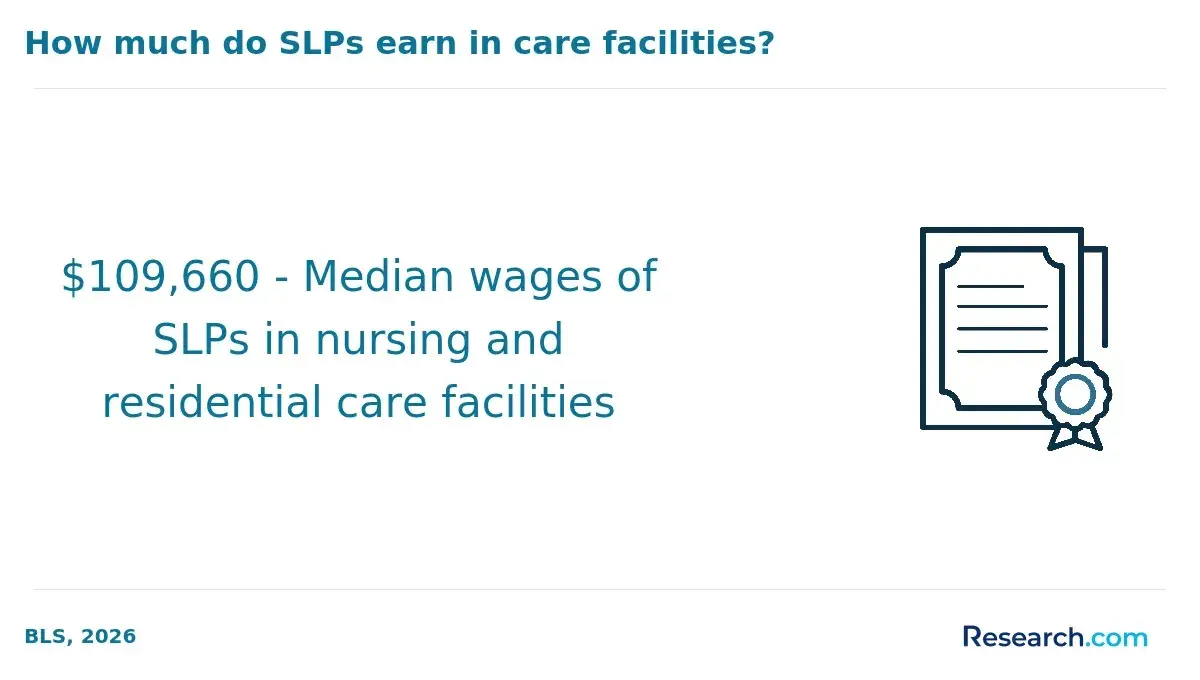
National labor-market conditions support careful investment in the credential. The U.S. Bureau of Labor Statistics reports that speech-language pathologists had a median annual wage of $97,870 in May 2025 and projects 17% employment growth from 2025 to 2035. Those figures describe the occupation nationally, not guaranteed California earnings or an individual program's outcomes. They are most useful for judging the long-term demand context after you have confirmed that a program can lead to California licensure.
A program's outcomes are more persuasive when the school can provide the same definitions and reporting window for each measure. Compare the following evidence rather than relying on one headline number.
- CAA-required or institutionally published completion, Praxis, and employment outcome data, including the number of graduates represented.
- Career-services support for clinical fellowship searches, résumé preparation, interviewing, and California employer connections.
- Clinical experiences across settings such as schools, outpatient clinics, hospitals, rehabilitation, and early-intervention services.
- Clear disclosure of whether placement and employment figures include online students, on-campus students, or both.
Ask schools for the most recent outcomes report and read the footnotes. A high employment percentage has limited value if the denominator is small, the time frame is unclear, or graduates were excluded from reporting. For compensation context, compare role, setting, experience level, and location using information about how much does a speech therapist make rather than assuming a national median will apply to every first job.
How can Huntington Beach residents secure local practicum and externship sites for online SLP training?
Start early, but do not independently promise a clinic or school that you will train there. Universities must approve each site and supervisor, and many sites require an affiliation agreement before a student can begin. Orange County offers diverse potential settings, but availability depends on the term, patient population, supervisor capacity, district procedures, and university contract timelines.
First, obtain the program's clinical handbook and determine when it permits student site suggestions. Then create a realistic commuting map that includes Huntington Beach, nearby Orange County communities, and, if needed, parts of Los Angeles County. Include school districts, pediatric clinics, medical centers, rehabilitation settings, skilled nursing facilities, private practices, and early-intervention providers that match your stage of training.
The following sequence helps you contribute constructively without bypassing program rules.
- Confirm the program's placement model, lead times, supervisor qualifications, and policy on student-proposed sites.
- Prepare a professional site-lead list with facility contact information, setting, population served, and commute feasibility.
- Ask clinical education staff before contacting a site to avoid duplicate outreach or conflicts with existing contracts.
- When authorized, explain that the university will handle formal approval, supervisor verification, and affiliation documentation.
- Keep backup geographic options and a financial plan for a longer commute or temporary travel if a local match is unavailable.
Be especially cautious about assuming a workplace can automatically become your placement. Employer policies, conflict-of-interest rules, supervisor credentials, caseload requirements, and university standards may prevent it. A program that clearly communicates these constraints is usually safer than one that makes broad, unqualified placement promises.
What total costs, fees, and financial aid options matter most for Huntington Beach online SLP students?
Compare total educational cost, not advertised per-credit tuition alone. An online clinical degree can include technology charges, clinical fees, background checks, immunizations, liability insurance, testing, travel, lodging for immersions, books, and transportation to practicum sites. A lower tuition rate may not be the lower-cost option if it requires repeated out-of-state travel or extends enrollment.
Because institutions revise tuition and fee schedules, request a term-by-term estimate for your cohort. Ask whether the quote includes every required credit, institutional fees, clinical education charges, graduation fees, and projected residency costs. Do not compare one school's per-credit price with another school's total program estimate as though they are equivalent.
| Cost category | Why it affects online SLP students | How to evaluate it |
| Tuition and required credits | Usually the largest direct expense. | Multiply the current rate by required credits only when the school confirms the rate structure. |
| Mandatory university and clinical fees | May be charged by term, course, placement, or residency. | Request a written list of recurring and one-time charges. |
| Travel and lodging | Residencies and distant placements can materially change affordability. | Estimate transportation, hotel, meals, parking, and missed work separately from tuition. |
| Lost income or reduced work hours | Daytime practica can reduce work availability. | Build a monthly cash-flow plan for clinical semesters. |
| Licensure and examination expenses | Costs continue after graduation during licensure and clinical fellowship preparation. | Budget separately for required examinations, applications, fingerprinting, and professional expenses. |
Federal financial aid may be available to eligible graduate students through the FAFSA, and some schools offer institutional scholarships or payment plans. California residents should also investigate employer tuition benefits, professional association scholarships, and service-based opportunities where applicable. Borrow only after reviewing the program's full cost of attendance and your likely need to reduce employment during clinical training.
Cost-conscious applicants should compare the expected time to completion alongside price. Paying less per term but taking substantially longer can raise living and borrowing costs. Paying more for a program with dependable placement support can be rational if it reduces the chance of a delayed clinical sequence, but that value should be supported by clear policies rather than assumptions.
How do waitlists, admissions selectivity, and start dates vary across top online SLP programs?
Online SLP cohorts are often selective because faculty supervision and clinical placements limit capacity. Schools may use fall-only starts, multiple annual starts, rolling review, fixed priority deadlines, or waitlists. A program's application timing can matter as much as its stated minimum GPA, especially for applicants who need prerequisites, observation hours, or a placement-compatible work plan.
Do not assume a published minimum GPA is the GPA of a typical admitted student. Admissions committees commonly review prerequisite performance, overall academic record, personal statement, recommendations, relevant experience, communication skills, and evidence that the applicant understands the demands of clinical education. Some programs use CSDCAS, while others use institutional applications or a combination.
Before submitting applications, compare the operational admissions details below for each program and intended term.
| Admissions factor | Why it changes your strategy | What to confirm |
| Start dates | Fall-only cohorts can create a long delay after a missed deadline. | Available terms, application deadlines, and whether prerequisites must be complete before enrollment. |
| Waitlist policy | A waitlist can affect housing, employment, and financial-aid planning. | Whether the school uses one, deposit rules, and the latest likely notification date. |
| Prerequisite rules | Missing foundational CSD courses can add semesters. | Required courses, grade minimums, expiration policies, and accepted equivalents. |
| Interview process | Interviews may be required and scheduled during work hours. | Format, preparation expectations, and whether attendance is mandatory. |
| Clinical availability requirements | Programs may expect daytime availability later in the curriculum. | When clinical work begins and whether outside employment is discouraged or restricted. |
Apply to a balanced set of programs only after confirming California eligibility at each one. An applicant with a strong academic profile may still choose multiple options because cohort capacity and placement logistics can be limiting. Avoid nonrefundable deposits until you understand the withdrawal policy, tuition liability, and any conditions attached to your admission.
What consumer-protection steps should Huntington Beach applicants take when comparing online SLP programs?
Online professional programs require more document-based verification than many academic degrees because clinical training, licensure, and state authorization overlap. The safest approach is to keep a written comparison file for every program, based on official policies rather than verbal assurances or third-party rankings.
Before enrolling, complete the following due-diligence steps.
- Verify the program's current CAA status through the accreditor and confirm that the status applies to the specific delivery pathway you will attend.
- Request written confirmation that California residents are eligible to enroll in your chosen term and ask for the current California licensure disclosure.
- Obtain the complete clinical education handbook and identify who arranges sites, who pays travel costs, and what happens if placement is delayed.
- Request a full program-cost estimate that separates tuition, mandatory fees, residency travel, clinical expenses, and estimated living costs.
- Review refund, withdrawal, leave-of-absence, transfer-credit, and teach-out policies before submitting a deposit.
- Ask for outcome data with definitions, reporting periods, and student counts, rather than relying on broad employment claims.
Common red flags include pressure to enroll before receiving state-authorization answers, unclear accreditation language, promises of guaranteed local placement, and tuition quotes that omit mandatory fees or travel. Another mistake is assuming an online degree will fit around a full-time job indefinitely; clinical semesters may require substantial daytime availability.
The best choice is usually the program that provides the clearest written answers, has a credible California licensure pathway, and matches your financial and scheduling reality. If a school cannot document a critical point, treat that uncertainty as a real cost and compare another accredited option.
Other Things You Should Know About Speech Language Pathology
Yes, an online or hybrid degree can be a viable route if the program is appropriately CAA-accredited, accepts California residents, supports the required clinical education, and meets California's applicable licensure requirements. Delivery format alone does not determine eligibility; accreditation, curriculum, supervised experience, and state rules do.
Not always during early academic coursework, but many students need to reduce work hours when practicum and externship begin. Clinical experiences generally occur on a site's schedule, which may include weekday daytime hours. Ask for the semester-by-semester clinical schedule before deciding whether full-time employment is realistic.
Length varies by program pace, prerequisite status, clinical sequence, and whether part-time enrollment is available. Applicants with a communication sciences and disorders background may finish sooner than students who need leveling coursework. Confirm the published curriculum sequence and ask how placement delays affect completion time.
No. ASHA's CCC-SLP is a national professional credential, while a California license is issued by the state and governs legal practice in California. Many clinicians pursue both because employers may value ASHA certification, but you should verify the current requirements for each separately.
References
- Online MS in Speech-Language Pathology (SLP) | Pepperdine https://healthscience.pepperdine.edu/online-masters-in-speech-language-pathology/
- Best Speech-Language Pathology Programs in America https://www.usnews.com/best-graduate-schools/top-health-schools/pathology-rankings
- Online Master's in Speech Pathology Programs: 2026 Guide https://speechpathologymastersprograms.com/
- 2026 Most Affordable Online Speech Pathology Master's... https://www.onlineu.com/most-affordable-colleges/speech-pathology-masters-degrees
- Best Online Speech Pathology Programs https://www.forbes.com/advisor/education/healthcare/best-speech-pathology-programs-online/