2027 Best Online Speech Pathology Master's Programs for Residents of Springfield, MO

Co-Founder and Chief Data Scientist

Reviewed by Rhea Paul, PhD
SLP Education & Research Expert
Choosing an online speech-language pathology master's program from Springfield requires more than finding a school with virtual classes. Missouri licensure, CAA accreditation, clinical placement support, travel expectations, and total cost can determine whether a program fits your career plan.
This guide compares the decision factors that matter most for prospective Springfield-area students, including programs commonly designed for distance learners. It also explains what to verify directly with every university before applying, so you can choose a degree that supports certification, supervised clinical training, and employment goals.
Key Things You Should Know
- A Missouri resident should generally choose a master's program accredited by the American Speech-Language-Hearing Association's Council on Academic Accreditation (CAA) and confirm in writing that the institution accepts Missouri students and supports Missouri licensure pathways.
- Online SLP master's degrees are not fully remote in the clinical sense: students still complete supervised practicum and externship experiences, and some programs require campus immersions or live online classes.
- Speech-language pathology remains a high-demand field: the U.S. Bureau of Labor Statistics projects 17% employment growth from 2025 to 2035, with about 12,500 openings annually, but a degree alone does not confer Missouri licensure or ASHA certification.
Which online speech pathology master's programs best serve Springfield, MO residents right now?
The best online option depends on whether it can enroll Missouri residents, maintain CAA accreditation, arrange or approve clinical education near Springfield, and fit your ability to travel. No program is automatically best for every applicant. A school's brand matters less than its state authorization, clinical-placement process, required visits, prerequisite policy, and published financial terms.
The programs below are examples of established distance-oriented master's pathways that prospective Missouri students commonly investigate. Enrollment eligibility, tuition, cohort availability, and licensure disclosures can change; confirm every item with the university before submitting an application.
| Program | Online-format consideration | Springfield-area decision point | Potential fit |
| Emerson College, MS in Speech-Language Pathology | Online coursework with clinical education and program-directed experiential requirements | Verify Missouri enrollment authorization, clinical-site process, live-session schedule, and any immersion requirements | Applicants seeking a well-established online cohort model and structured distance support |
| New York University, MS in Communicative Sciences and Disorders | Online pathway with clinical and residency-style requirements | Travel and time-zone demands may be material for a Missouri resident | Students comfortable with a private-university cost structure and required in-person components |
| Baylor University, MS in Communication Sciences and Disorders | Online academic delivery paired with supervised clinical training | Ask whether a Springfield-area placement can be arranged or whether relocation/travel may be needed | Students wanting a cohort-based online clinical degree with clear placement planning |
| University of St. Augustine for Health Sciences, MS-SLP | Hybrid-oriented professional preparation with online learning and required hands-on elements | Confirm Missouri eligibility, clinical coordination, and travel before comparing advertised tuition | Applicants who can accommodate a blended rather than exclusively home-based model |
Use this table as a screening tool, not as a guarantee of availability. The most practical next step is to request a written answer from each program on Missouri eligibility, clinical placement responsibility, total required travel, and whether its curriculum is designed to meet Missouri's academic requirements.
Students who want a wider starting list can review online SLP masters programs, then narrow the list using Missouri-specific questions rather than general rankings alone.
How do Springfield, MO licensure rules shape which online speech pathology degrees qualify?
Missouri licensure is the central filter for Springfield residents. To practice as a speech-language pathologist, graduates generally need an appropriate graduate degree, supervised professional experience, a passing Praxis examination score, and approval through the applicable Missouri licensing process. School-based work may also involve Missouri Department of Elementary and Secondary Education credential requirements that are distinct from health-professions licensure.
A CAA-accredited master's program is typically the safest academic foundation because CAA accreditation is the standard recognized for the ASHA Certificate of Clinical Competence (CCC-SLP). However, accreditation does not remove the need to meet Missouri's individual application, examination, clinical fellowship, and documentation requirements.
Before enrolling, get written answers to the following licensing questions. They reduce the risk of discovering a state-specific restriction after paying a deposit.
- Does the university currently accept students who reside in Missouri?
- Does the program state that its curriculum is designed to meet educational requirements for Missouri SLP licensure?
- Will the program document clinical clock hours and competencies in a format usable for Missouri licensure and ASHA certification applications?
- Does the university identify any Missouri-specific limitation, additional coursework, or required disclosure?
- If you want to work in schools, what additional Missouri educator credential steps apply after graduation?
Licensure rules can change, and universities may update their state-authorization policies between admission cycles. Treat the Missouri licensing board and the university's current professional-licensure disclosure as controlling sources, especially if you intend to relocate after graduation.
Which accredited online speech pathology programs accept students from Missouri and neighboring states?
"Accredited" and "available to Missouri residents" are separate questions. CAA accreditation evaluates the academic program; state authorization determines whether the institution may enroll a student living in a particular state. A program may be CAA-accredited but temporarily unable to accept applicants from a state because of authorization, placement, or institutional policy.
For applicants in Missouri, Arkansas, Kansas, Oklahoma, and Illinois, verify eligibility individually rather than assuming regional proximity resolves the issue. The table shows the evidence to seek from each school.
| Verification area | What to look for | Why it matters to a Missouri applicant |
| CAA status | Current accreditation status in ASHA's CAA directory | Supports eligibility for the conventional national certification pathway |
| State authorization | Written confirmation that the university may enroll Missouri residents in the specific SLP program | Prevents enrolling in a program that later restricts participation |
| Professional licensure disclosure | A Missouri-specific statement rather than a broad "may meet requirements" claim | Shows whether the curriculum is intended to satisfy Missouri educational standards |
| Clinical placement policy | Who finds sites, who approves supervisors, and whether the school can place students locally | Clinical training may be the largest practical barrier to a distance degree |
| Travel requirements | Number, location, timing, and estimated cost of immersions or residencies | Travel can materially affect both work schedules and total cost |
CAA accreditation should be confirmed through ASHA's current records, not a school's outdated marketing page. For a broader comparison of distance programs, review asha accredited online SLP programs and then independently verify each program's Missouri disclosure.
What institutional and programmatic accreditations should Springfield speech pathology students verify first?
Verify programmatic accreditation before comparing convenience features. For entry-level clinical practice in speech-language pathology, the key programmatic standard is accreditation by ASHA's Council on Academic Accreditation in Audiology and Speech-Language Pathology. Institutional accreditation is also important because it supports federal financial-aid eligibility and confirms oversight of the university as a whole.
These checks address different risks and should be completed in this order.
- Confirm that the specific master's program, not merely the university, has current CAA accreditation or clearly disclosed candidacy status.
- Check the institution's recognized institutional accreditation and ensure the exact campus or online division is covered.
- Read the program's Missouri professional-licensure disclosure and ask admissions to clarify ambiguous language in writing.
- Confirm that the clinical education model provides the supervised experiences needed for graduation, future certification, and state application.
- For a school-employment goal, verify Missouri school credential requirements separately from clinical licensure.
Candidacy and accreditation are not interchangeable terms. A program in candidacy may be progressing through review, but applicants should understand its precise status, the school's teach-out or contingency policies, and how that status affects their intended certification timeline before enrolling.
How do online speech pathology programs handle clinical placements in and around Springfield, MO?
Online SLP programs deliver much of the academic curriculum virtually, but clinical education remains supervised, hands-on work with patients or clients. Students usually complete a combination of early practicum and later full-time or near-full-time external placements. The exact sequence, hour requirements, settings, and supervisor qualifications are program-specific.
Some universities maintain affiliation agreements and actively place students; others expect students to suggest sites while retaining final approval authority. Neither model guarantees a placement at CoxHealth, Mercy, Springfield Public Schools, or any other specific organization. Healthcare systems and school districts control their own affiliation capacity, onboarding requirements, background checks, and supervisor availability.
Ask clinical education staff these questions before accepting admission. Direct answers are more useful than a general statement that the program "supports placements nationwide."
- Will the university secure my placement, or am I responsible for identifying potential Springfield-area sites?
- Does the program already have active agreements with facilities or school districts in southwest Missouri?
- What happens if a local site is unavailable when I reach the clinical phase?
- Can I complete placements while employed, or must I be available during standard weekday clinical hours?
- Who pays for background checks, drug screening, health records, liability coverage, travel, and any temporary housing?
A strong plan includes backup capacity beyond Springfield. Students who cannot relocate or commute should prioritize schools that will clearly explain their placement history, escalation process, and expectations if local capacity is constrained.
Which online speech pathology programs align best with CoxHealth, Mercy, and Springfield school district needs?
CoxHealth, Mercy, and area school districts represent different practice environments, not guaranteed clinical partners. Hospital and outpatient roles may emphasize adult neurogenic disorders, swallowing, acute care, rehabilitation, and medical documentation. School-based positions commonly center on language, speech sound disorders, educational access, individualized education programs, and collaboration with educators and families.
For a hospital-oriented goal, favor programs that clearly include adult medical coursework, dysphagia education where appropriate, clinical simulation or skills training, and access to medical placements. For a school-focused goal, look for robust pediatric and school-based preparation, assessment coursework, and clarity on Missouri educator credential requirements.
| Career target | Program features to prioritize | Question to ask the program |
| Hospital or outpatient rehabilitation | Adult communication disorders, dysphagia preparation, medical documentation, acute or rehab placement access | Can the program support a medical placement within reasonable distance of Springfield? |
| Public school setting | Pediatric language, speech sound disorders, educational assessment, school practicum, credential guidance | How does the program prepare graduates for Missouri school credential requirements? |
| Private practice or pediatric clinic | Pediatric practicum, family-centered care, assessment and intervention breadth, business exposure if offered | Can I seek supervised experiences in outpatient pediatric settings? |
| Mixed career goals | Broad lifespan curriculum and placements across at least two settings | How are clinical rotations sequenced to ensure exposure beyond one setting? |
Technology is increasingly embedded in assessment, telepractice, electronic health records, and therapy planning, but it does not replace supervised clinical judgment. Choose a curriculum that teaches evidence-based use of technology while preserving substantial direct client-care preparation.
How do tuition, fees, and total cost of attendance compare for Springfield-focused online programs?
Do not compare a private program's total published tuition with a public program's per-credit price, or assume online delivery eliminates major expenses. The meaningful number is the estimated total cost to complete the degree: required tuition and institutional fees plus travel, clinical compliance, technology, books, and income lost or reduced during full-time placements.
Schools may charge by credit, term, or cohort. The comparison framework below prevents an apparently lower price from becoming the more expensive option after clinical and travel costs are included.
| Cost category | What to obtain from each program | Springfield-specific consideration |
| Tuition | Required credits multiplied by the current rate, with any fixed cohort price identified | Ask whether the same rate applies to Missouri distance learners for the full program |
| Mandatory university fees | Technology, student services, clinical, graduation, and distance-learning charges | Confirm whether fees are charged each term or only once |
| Clinical compliance costs | Background check, immunizations, drug screening, insurance, testing, and required equipment | Health-system requirements may differ by site |
| Travel and lodging | Required immersion dates and locations, plus likely placement travel | Include flights, hotel stays, parking, mileage, and time away from work |
| Opportunity cost | Expected work-hour reduction during practicum and externship terms | Full-time weekday placements can be difficult to combine with a full-time job |
Request a written, program-specific estimate before making a deposit and compare it with your federal aid eligibility, employer tuition assistance, scholarships, and realistic borrowing limit. Cost-conscious applicants may also want to compare accelerated speech pathology programs online, but a shorter calendar format is only economical if you can handle the pace and required clinical availability.
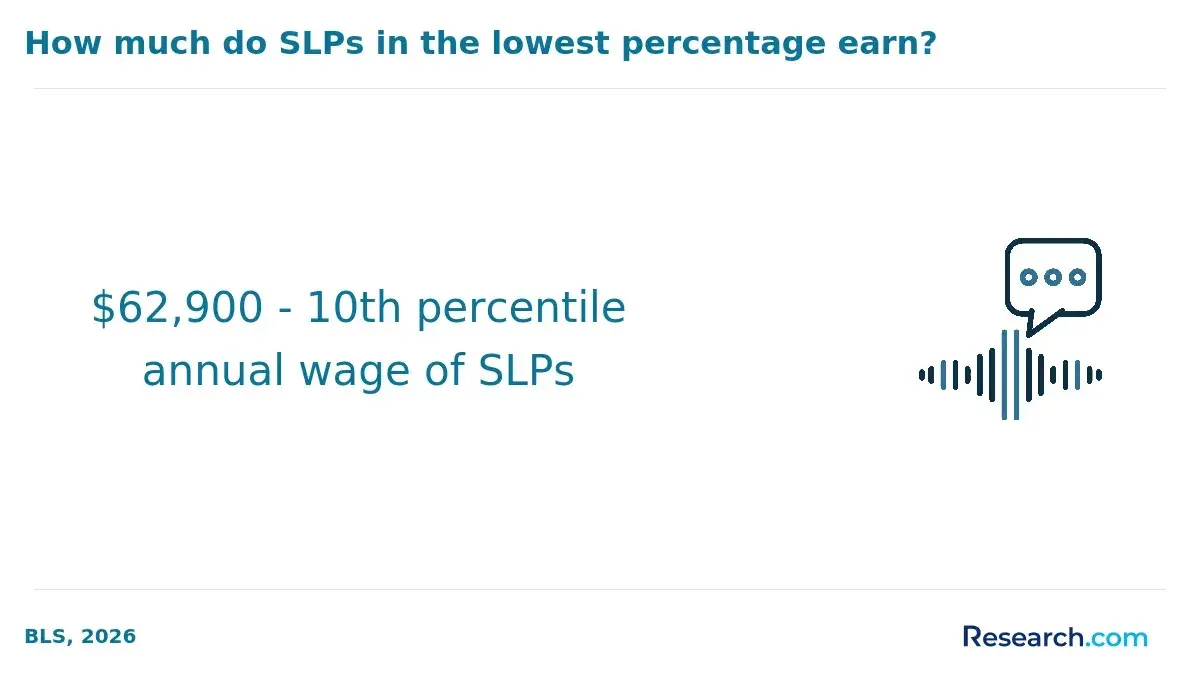
The national median annual wage for speech-language pathologists was $97,870 in May 2025, according to the U.S. Bureau of Labor Statistics. This is a national occupation-wide benchmark, not a starting-salary promise for Springfield graduates, so use it to frame long-term potential rather than justify unmanageable debt.
What admission prerequisites do top online speech pathology master's programs typically require of Missouri applicants?
Most entry-level SLP master's programs require a bachelor's degree and substantial undergraduate preparation in communication sciences and disorders. Applicants with a CSD major are often best positioned, while career changers may need post-baccalaureate leveling coursework before or alongside graduate study. Requirements vary materially by institution.
Common application components are shown below. A requirement is not universal simply because it is common, so rely on the current program admissions page and graduate catalog.
| Requirement | Typical purpose | What Missouri applicants should confirm |
| Undergraduate prerequisites | Establishes foundations in speech, language, hearing, phonetics, anatomy, and related science | Whether missing courses can be completed before enrollment or through a formal leveling plan |
| ASHA foundational coursework | Documents preparation in biological science, physical science, statistics, and social/behavioral science | How the school evaluates courses from your prior institution |
| Minimum GPA | Sets an academic eligibility threshold | Whether the program uses cumulative, prerequisite, or last-60-credit GPA and whether conditional review exists |
| Recommendations and statement | Assesses readiness, communication, and understanding of the profession | Whether clinical observation or relevant experience is expected or simply recommended |
| Interview or live assessment | Evaluates professional communication and program fit | Whether attendance is required during Central Time business hours |
Career changers should not choose a program solely because it appears to have fewer prerequisites. A transparent leveling pathway can be a better choice than an accelerated application process that leaves academic gaps unresolved. Strong applications explain your exposure to the profession, ability to manage clinical training, and realistic plan for work and travel.
How do graduation, Praxis pass, and job placement outcomes vary across leading online programs?
Outcome data can help distinguish programs, but comparison requires care. CAA programs publish student outcome information using defined reporting periods, often including on-time program completion, Praxis examination pass rates, and employment rates. Different cohorts, reporting windows, sample sizes, and definitions can make a simple side-by-side percentage comparison misleading.
Use outcomes as a quality check rather than a prediction of your individual result. A small cohort may show volatile percentages, while a larger program may report results across a broader group of learners and clinical settings.
When reviewing each program's disclosures, compare the same reporting year and ask admissions to explain any missing data or unusual change. Focus on these indicators.
- Whether the program publishes CAA-required outcome data in a current, accessible format.
- Whether completion and Praxis results are reported for the same cohort and time period as competing programs.
- How the institution defines employment and how soon after graduation it measures the outcome.
- Whether the school provides support for Praxis preparation, clinical fellowship planning, and Missouri licensure documentation.
The broader labor market is favorable but not a substitute for program due diligence. The Bureau of Labor Statistics projects 17% growth in SLP employment from 2025 to 2035, suggesting continued demand; local hiring conditions, setting preferences, and school or medical credential requirements still shape an individual graduate's options. Readers comparing geographic earnings can explore where do SLPs make the most money, while remembering that pay varies by employer, setting, experience, and local cost of living.
How can Springfield students protect themselves from unaccredited or low-quality online speech programs?
The most serious mistake is enrolling in a program that uses broad language such as "speech therapy," "communication disorders," or "clinical preparation" without confirming that it is the graduate professional degree needed for your intended Missouri license. A short certificate, assistant-level training, or unaccredited master's curriculum may have value for a different goal but may not qualify a graduate for SLP licensure or ASHA certification.
Watch for red flags that indicate a program needs more scrutiny. None proves poor quality alone, but each warrants a direct written response.
- The school cannot identify the specific program's current CAA accreditation or candidacy status.
- Admissions staff will not provide a Missouri-specific professional-licensure disclosure.
- The program promises guaranteed local placements, employment, salary, or licensure.
- Tuition is prominently advertised, but required fees, travel, clinical compliance, and placement costs are unclear.
- The school gives vague answers about who secures clinical sites, who approves supervisors, or what happens if a placement falls through.
- Outcome data are absent, outdated, or presented without the reporting period and cohort definition.
Protect yourself by saving program disclosures, cost estimates, and placement communications before paying a nonrefundable deposit. Speak with clinical education staff - not only enrollment representatives - and verify accreditation and Missouri requirements independently. If a program's answers remain unclear, pause the application rather than assuming the issue will be resolved after enrollment.
Other Things You Should Know About Speech Language Pathology
You may be able to work during academic terms, particularly in part-time formats, but clinical practicum and externship schedules often require weekday availability. Ask each program when full-time clinical participation begins and whether placements can be completed evenings or weekends; do not assume they can.
Not always. Many programs consider applicants from other majors, but they usually require prerequisite or leveling coursework in core communication sciences and disorders subjects. The amount of additional study can substantially affect your time and cost to degree completion.
Employers generally focus on whether you hold the required graduate degree, licensure, certification, clinical competence, and relevant experience. The more important distinction is whether the program is properly accredited and provides high-quality supervised clinical education, not whether lectures were online.
Make a short list of CAA-accredited programs that confirm Missouri eligibility, then request written answers about licensure alignment, clinical placement responsibility, travel, prerequisites, total estimated cost, and clinical schedule. Compare those answers before paying application or enrollment deposits.
References
- Speech-Language Pathology Graduate Program https://www.missouristate.edu/SHCP/CSD/SpeechLanguage/default.htm
- Online Master's in Speech Pathology Programs: 2026 Guide https://speechpathologymastersprograms.com/
- Premier Online Speech Pathology Master's Degrees https://resources.noodle.com/articles/best-online-masters-programs-for-speech-and-language-pathology/
- Best Online Speech Pathology Programs https://www.forbes.com/advisor/education/healthcare/best-speech-pathology-programs-online/
- 2026 Most Affordable Online Speech Pathology Master's... https://www.onlineu.com/most-affordable-colleges/speech-pathology-masters-degrees