2027 Best Online Speech Pathology Master's Programs for Residents of Tacoma, WA

Co-Founder and Chief Data Scientist

Reviewed by Rhea Paul, PhD
SLP Education & Research Expert
Tacoma residents considering an online speech-language pathology master's degree need more than a flexible class schedule: they need a program that can support Washington licensure and supervised clinical training. This guide compares credible online options, explains Washington's rules, and shows how to confirm state authorization, accreditation, practica arrangements, costs, and travel obligations before applying. It is designed for future SLPs who want to make a careful, licensure-focused decision rather than choose a program based on online marketing alone.
Key Things You Should Know
- Washington SLP licensure generally requires a qualifying graduate degree, supervised clinical education, a passing national examination, and completion of the state's application requirements; an online degree is suitable only if its clinical and academic components meet those standards.
- The strongest online choices for Tacoma residents are typically CAA-accredited programs that explicitly authorize Washington enrollment, coordinate clinical placements, disclose required campus immersions, and provide written Washington licensure information.
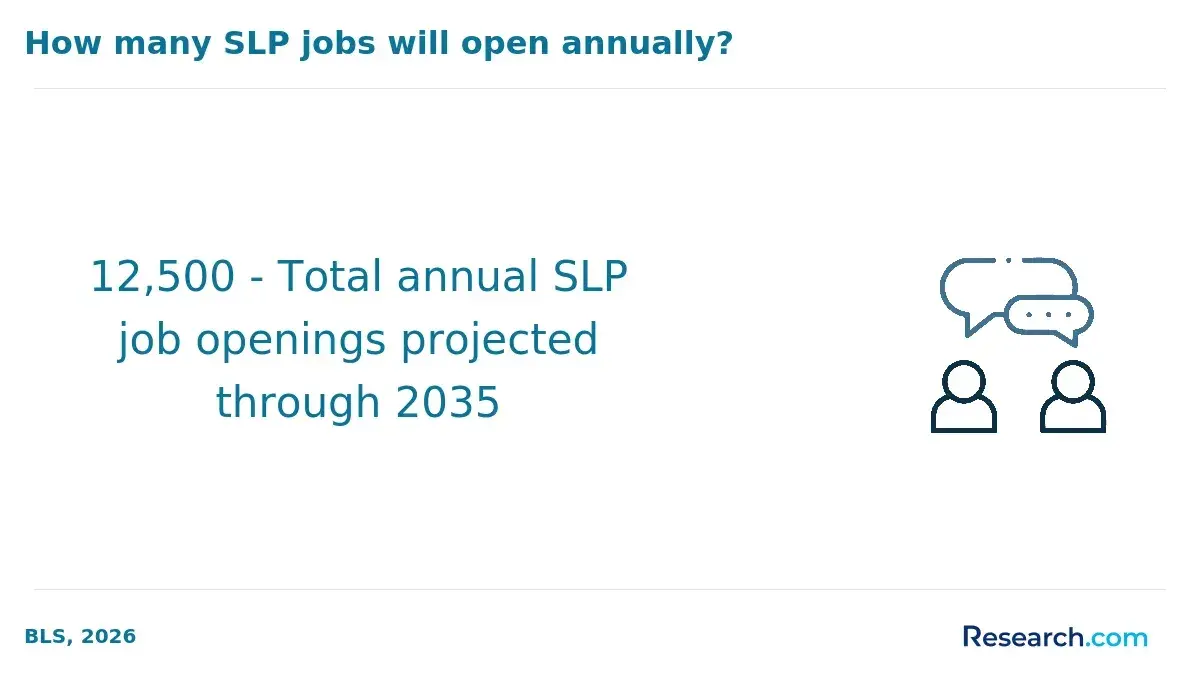
- Speech-language pathology is a high-demand profession: the U.S. Bureau of Labor Statistics projects 17% employment growth from 2025 to 2035, with about 12,500 annual openings nationally, but a degree does not guarantee placement, licensure, or employment.
Which online speech pathology master's programs accept Tacoma residents and operate with legitimate accreditation?
For Tacoma applicants, "best" should mean licensure-ready and operationally realistic, not merely highly ranked. A viable online SLP master's program should hold accreditation from the American Speech-Language-Hearing Association's Council on Academic Accreditation in Audiology and Speech-Language Pathology (CAA), be authorized to enroll Washington residents, include the required supervised clinical education, and clearly explain any travel or live-class expectations.
The programs below are established online or distance-delivery MS-SLP options frequently considered by out-of-state applicants. Enrollment permissions, clinical-site availability, tuition, and disclosure language can change, so applicants should obtain written confirmation from each school before paying an application fee.
| Program | CAA status to verify | Online format considerations | Tacoma decision point |
| Baylor University, MS in Communication Sciences and Disorders | CAA-accredited program | Online coursework with clinical education and required in-person learning components | Ask whether Washington enrollment and Pierce County clinical placements can be supported for your cohort. |
| New York University, MS in Communicative Sciences and Disorders | CAA-accredited program | Online graduate pathway with live learning and in-person clinical requirements | Confirm Washington eligibility, Pacific Time scheduling, travel dates, and placement process. |
| Emerson College, MS in Speech-Language Pathology | CAA-accredited program | Online coursework combined with clinical placements and immersion requirements | Determine whether placements are arranged by the school, whether sites are guaranteed, and what travel is required. |
| University of St. Augustine for Health Sciences, MS-SLP | CAA status and current disclosure should be checked directly | Distance-learning model with supervised clinical education requirements | Request a written Washington professional-licensure determination before enrolling. |
These are comparison starting points rather than a promise that every program can enroll every Washington applicant. Review several online SLP programs, then narrow the list based on accreditation, state authorization, placement support, schedule, and total out-of-pocket cost.
A program is usually a stronger fit when it provides a named clinical-placement team, publishes campus-visit expectations, and will answer Washington licensure questions in writing. It may be a weaker fit when it calls itself "fully online" but cannot explain where clinical hours will occur or whether it is authorized to enroll Washington residents.
How does Washington's SLP licensure law shape online master's program choices for Tacoma residents?
Washington licensure is administered through the Washington State Department of Health. The state evaluates the applicant's education, supervised professional experience, examination record, and other application materials; it does not license a person simply because the degree was delivered online. Therefore, Tacoma applicants should choose an online program only after confirming that its curriculum and clinical training can support the state's licensing pathway.
A CAA-accredited master's degree is the most practical educational foundation because CAA standards are widely recognized by licensing boards and employers. However, accreditation is not a substitute for checking Washington-specific requirements, since state rules, documentation practices, and post-graduation supervised experience requirements may differ from national certification standards.
Before committing, ask the admissions or licensure-disclosure office for a direct answer to these questions:
- Is the institution authorized to enroll students who reside in Washington at the time of admission?
- Does the school state that its program is designed to meet, or has been determined to meet, Washington SLP educational requirements?
- Will the program document clinical hours, supervisors, course content, and degree completion in a form usable for a Washington licensure application?
- What post-graduation supervised experience and examination steps will remain after graduation?
Do not rely on a verbal assurance that "graduates work everywhere." Request the current written disclosure, save it with your enrollment records, and independently review Washington Department of Health instructions near the time you apply. Rules and interpretation can change between admission and graduation.
What accreditation and ASHA CAA recognition must Tacoma applicants verify for online speech pathology degrees?
CAA accreditation is the central program-level credential to verify. The Council on Academic Accreditation in Audiology and Speech-Language Pathology accredits graduate programs that meet standards for curriculum, faculty, assessment, resources, and clinical education. A school's general institutional accreditation alone does not establish that its speech-language pathology degree meets professional preparation standards.
Applicants should distinguish among the following statuses because they carry different levels of certainty:
| Status or term | What it means | How a Tacoma applicant should use it |
| CAA-accredited | The program has been accredited by ASHA's specialized accreditor. | This is generally the clearest choice for a future Washington licensure pathway, subject to state review. |
| CAA candidate or developing program | The program may be pursuing accreditation but does not necessarily have the same status as an accredited program. | Ask exactly how accreditation timing affects your cohort and obtain the answer in writing. |
| Institutionally accredited university | The institution meets broad higher-education accreditation standards. | Necessary for legitimacy, but not enough by itself for SLP licensure preparation. |
| ASHA certification eligibility statement | The school describes how graduates may pursue the Certificate of Clinical Competence. | Useful context, but still verify Washington licensure and clinical placement details separately. |
Also verify that the accreditation applies to the exact degree format and location you plan to attend. Some universities offer both campus and distance pathways, and applicants should not assume every pathway has identical approval, clinical-site access, or enrollment permissions.
A careful applicant will confirm four records: the program's CAA listing, the university's institutional accreditation, the school's Washington professional-licensure disclosure, and the Washington Department of Health licensing requirements. This four-part check reduces the risk of discovering a mismatch after investing in prerequisites or tuition.
Which regionally accredited universities offer online SLP master's programs open to Washington residents?
"Regionally accredited" remains a common phrase, although U.S. institutional accreditation is now generally described without the former regional categories. For a Tacoma resident, the practical question is whether a properly institutionally accredited university has a CAA-accredited SLP program and is currently authorized to enroll Washington students in the particular online pathway.
Baylor University, Emerson College, New York University, and the University of St. Augustine for Health Sciences are examples of universities with distance-oriented SLP options that prospective Washington students may investigate. None should be treated as automatically available without direct confirmation. State authorization can be affected by a student's residence, program modality, clinical placement location, and professional-licensure disclosure policy.
Applicants comparing SLP master's programs should avoid using admissions accessibility as the only criterion. A program with a manageable application process may still be unsuitable if it cannot place students in Washington, requires frequent out-of-state travel, or has prerequisites that substantially extend the timeline.
The comparison below shows how to interpret institutional claims without assuming that one school fits every Tacoma applicant.
| Comparison factor | Better-fit signal | Why it matters in Tacoma |
| Washington enrollment authorization | Written confirmation that Washington residents may enroll | Online delivery does not automatically permit enrollment across state lines. |
| Professional licensure disclosure | Clear Washington-specific determination or explanation of limitations | It helps identify whether the degree is intended to support the state pathway. |
| Clinical education process | Named placement staff and a defined affiliation process | Local sites can be competitive, especially when multiple universities seek placements. |
| Required travel | Published immersion dates, locations, and duration | Travel costs and time away from work can materially change the real cost of an online degree. |
| Class schedule | Published synchronous meeting times and attendance rules | Evening classes on Eastern Time may be difficult for working students in Pacific Time. |
If a university will not provide a direct answer on Washington eligibility, treat that uncertainty as a decision factor rather than an inconvenience. Choose a school that can explain its compliance and student-support process clearly.
How do Tacoma-focused online SLP programs differ in prerequisites, clinical hours, and graduation requirements?
Online SLP master's programs generally serve students with varied undergraduate backgrounds, but they are not interchangeable. Applicants with a bachelor's degree in communication sciences and disorders often enter directly, while career changers may need prerequisite or leveling coursework in areas such as phonetics, language development, anatomy and physiology of speech and hearing, audiology, and speech science.
Clinical education is the major non-online component. Programs commonly build toward at least 400 total clinical clock hours, including observation and direct client-contact experience, consistent with widely used professional preparation standards. The exact sequence, documentation method, and number of placement terms differ by school.
| Requirement area | What varies by program | What Tacoma applicants should confirm |
| Prerequisites | Required courses, grades, recency rules, and whether leveling courses are built into the degree | Ask for a transcript evaluation before assuming you can start with the next cohort. |
| Clinical hours | Timing, setting mix, supervision model, and responsibility for finding sites | Confirm whether the school secures sites, assists with affiliations, or expects you to identify possible sites. |
| Graduation credits | Total academic credits and transfer-credit limits | Compare the complete curriculum, not just the advertised number of terms. |
| Campus immersion | Number, location, and length of in-person requirements | Budget airfare, lodging, meals, local transportation, and time off work. |
| Completion pace | Full-time lockstep cohorts versus part-time or extended pathways | Choose based on your work, caregiving, and placement availability rather than speed alone. |
An accelerated schedule can reduce the time before graduation, but it can also make employment difficult during clinical terms. A speech pathology accelerated program may fit applicants who have completed prerequisites, can attend required live sessions, and can accommodate full-time clinical work; it may not fit someone needing consistent full-time income.
Ask each school whether any prerequisite courses can be completed at a community college, whether grades below a stated threshold must be repeated, and whether science prerequisites have expiration rules. These details often determine the actual starting date more than the published program length does.
Where can Tacoma students complete required clinical practica and externships for online speech pathology degrees?
Clinical practica and externships take place in real service settings, not solely through online simulations. Possible sites in the Tacoma area and broader Puget Sound region can include hospitals, outpatient rehabilitation clinics, early-intervention providers, skilled nursing facilities, private practices, and public schools. Availability depends on formal affiliation agreements, supervisor capacity, client population needs, and the university's placement policies.
Applicants should not assume that a school's national placement network guarantees a site in Tacoma. Local facilities may already work with Washington universities, may limit outside affiliations, or may be unable to supervise a student in a particular term.
Before enrolling, get specific answers about the placement model:
- Whether the university assigns placements, asks students to suggest sites, or uses a shared process.
- Whether the university already has active affiliations in Pierce County or elsewhere in the Puget Sound area.
- What happens if a local placement cannot be secured by the required term.
- Whether the student may need to commute to another Washington community or travel out of state.
- Who pays for background checks, drug screening, immunizations, liability coverage, transportation, and site-specific onboarding.
For students who need predictable employment or caregiving schedules, the clinical-placement policy may be more important than a program's asynchronous coursework. Placements often follow the operating hours of schools, clinics, or medical facilities, so daytime availability can be essential even when academic classes occur online.
How do Washington's telepractice and school-based SLP rules affect graduates of online programs?
Telepractice expands how SLP services may be delivered, but it does not remove licensing obligations. An SLP providing services to a client located in Washington generally needs to comply with Washington professional requirements, regardless of where the clinician, university, or telehealth platform is located. Graduates planning virtual work should learn the current Washington rules on licensure, supervision, documentation, privacy, competence, and client safety.
School employment is a separate planning issue. Many school-based positions require credentials administered through the Washington Office of Superintendent of Public Instruction in addition to, or in coordination with, Department of Health licensure. Requirements can depend on the role, employer, endorsement, and school system.
Online master's students who expect to work in Washington schools should confirm the following before selecting a program:
- Whether the curriculum supports the educational credential pathway relevant to Washington public-school employment.
- Whether school-based practica can be completed under supervisors who satisfy both university and site requirements.
- Whether the program provides documentation needed for state education credential applications.
- Whether telepractice training is included and how the program evaluates clinical competence in virtual service delivery.
Telepractice competence is increasingly useful because providers may serve clients through hybrid care models, but it should complement - not replace - broad experience with assessment, intervention, ethics, supervision, and in-person clinical decision-making. Employers determine their own technology, productivity, and onboarding expectations.
What consumer-protection red flags should Tacoma residents avoid when researching online speech pathology programs?
The most serious risk is enrolling in a program that cannot support the Washington pathway you intend to pursue. Promotional language such as "online," "flexible," or "ASHA-aligned" is not enough. Tacoma applicants should look for formal, current disclosures and concrete answers about clinical education.
The following red flags deserve extra scrutiny because they can create expensive delays:
- A program does not appear in the CAA directory and cannot explain its current specialized accreditation status.
- The admissions team will not provide a written Washington state-authorization or professional-licensure disclosure.
- The school describes clinical placements vaguely or implies that students are solely responsible for obtaining required sites.
- Tuition is advertised per credit without a clear estimate of total credits, mandatory fees, travel, clinical costs, and possible prerequisite expenses.
- "Fully online" marketing omits required immersions, daytime clinical schedules, examinations, or out-of-state travel.
- The program claims that graduation automatically qualifies a student for a license or guarantees a job, salary, placement, or certification.
Another common mistake is treating a lower tuition rate as the lowest total cost. A program with a modest per-credit price may be less affordable after multiple campus visits, delayed placement, added leveling courses, lost work hours, or relocation for an externship. Compare the full educational and practical cost of completing the degree.
Be cautious with pressure tactics, including nonrefundable deposits requested before the school answers licensure questions. A reputable program should give prospective students enough information to evaluate accreditation, state eligibility, clinical expectations, academic policies, and financial obligations.
How can Tacoma applicants independently verify accreditation, state authorization, and licensure outcomes data?
Independent verification protects applicants from relying on outdated webpages or generalized admissions statements. Check each issue through the organization that controls it: the specialized accreditor for program status, the university for enrollment authorization and disclosures, and Washington authorities for licensing requirements.
Use this sequence before applying or accepting admission:
- Locate the exact degree program in ASHA's CAA program directory and record its current accreditation status and review information.
- Review the university's professional-licensure disclosure for Washington and ask the school to confirm in writing whether your residence and intended clinical location are eligible.
- Read the Washington Department of Health SLP licensure instructions and identify the education, examination, supervised-experience, and documentation requirements that will apply when you graduate.
- Request the program's most recent outcomes information, including completion, Praxis examination, employment, and program-completion reporting where available.
- Ask for a written breakdown of tuition, institutional fees, clinical fees, travel expectations, health requirements, technology costs, and estimated prerequisite costs.
- Save emails, disclosures, catalogs, and placement-policy documents in case the program's public webpage changes.
Outcomes data should be interpreted carefully. A high completion or examination pass rate can be encouraging, but it does not show whether a program can accommodate your work schedule, prerequisite background, finances, or Tacoma-area placement needs. Use outcomes as one quality indicator alongside licensure compatibility and practical fit.
If a school's catalog, admissions representative, and licensure disclosure provide inconsistent answers, pause the application process. Ask the program director or compliance office to reconcile the discrepancy in writing.
What funding, employer support, and local resources are available to Tacoma SLP master's students online?
Funding an online SLP master's degree usually requires combining institutional aid, federal student aid for eligible students, scholarships, savings, and employment planning. Clinical semesters can limit work availability, so the best financial plan accounts for living costs and lost income as well as billed tuition.
Start with the university's financial-aid office and compare offers using the same cost categories. Useful sources of support may include federal Direct Unsubsidized Loans and Graduate PLUS Loans for eligible students, university scholarships, external communication-sciences scholarships, veterans' education benefits where applicable, and employer tuition assistance. School districts, health systems, and rehabilitation employers may offer assistance or hiring incentives, but terms vary and should be reviewed carefully.
When estimating return on investment, separate national labor-market information from a personal earnings forecast. The U.S. Bureau of Labor Statistics reports a May 2025 median annual wage of $97,870 for speech-language pathologists nationally. Local pay can differ by setting, experience, work schedule, union agreement, and employer. Readers comparing career settings can explore how much do SLPs make, but no salary figure should be treated as guaranteed income after graduation.
Use a conservative funding plan built around the following categories:
- Published tuition and required institutional fees for the complete degree.
- Prerequisite or leveling coursework not included in the graduate curriculum.
- Travel, lodging, meals, and transportation for required immersions or distant placements.
- Clinical onboarding costs, including background checks, immunizations, insurance, equipment, and testing.
- Reduced work hours during daytime practica or full-time externships.
- Emergency savings for a placement change, delayed cohort progression, or unexpected travel.
Tacoma applicants may also benefit from speaking with local SLP employers, school districts, and healthcare organizations before enrolling. These conversations cannot substitute for a university placement agreement, but they can clarify typical work settings, hiring expectations, commute patterns, and whether an employer offers future tuition or professional-development support.
Other Things You Should Know About Speech Language Pathology
Yes, potentially. The delivery format is less important than whether the degree is from an appropriately accredited program, includes required supervised clinical education, supports Washington requirements, and is accepted by the relevant licensing authority. Verify all of those points before enrolling.
Not always. Many programs admit students from other academic backgrounds, but they usually require prerequisite coursework before or during graduate study. A transcript review is the best way to determine your individual timeline.
Some programs coordinate placements, while others use a shared process or require students to help identify potential sites. No applicant should assume a Tacoma-area site is guaranteed unless the program confirms its placement plan in writing.
Many full-time cohort programs are designed to take about two years, but the actual timeline can be longer if you need prerequisites, choose part-time enrollment, face a placement delay, or must repeat a course or clinical requirement.
References
- UW Speech-Language Pathology Master's Degree - Seattle https://www.speech-pathology-masters.uw.edu/
- Best Online Master's in Speech-Language Pathology for 2026 https://healthscience.pepperdine.edu/online-masters-in-speech-language-pathology/article/best-online-masters-in-speech-language-pathology-programs-guide.htm
- Best Online Masters in SLP Programs | CAA-ASHA Included https://www.speechpathologydegrees.com/online/masters-slp
- Best Speech-Language Pathology Programs in America https://www.usnews.com/best-graduate-schools/top-health-schools/pathology-rankings
- Fully online speech language pathology masters programs? https://www.facebook.com/groups/123939594310021/posts/26153063910970900/
- Masters SLP programs - preferably online: r/slpGradSchool https://www.reddit.com/r/slpGradSchool/comments/s5p0p0/masters_slp_programs_preferably_online/