2027 Best Online Speech Pathology Master's Programs for Residents of Salinas, CA

Co-Founder and Chief Data Scientist

Reviewed by Rhea Paul, PhD
SLP Education & Research Expert
Salinas residents seeking an online master's in speech-language pathology need more than a program with virtual classes: they need CAA accreditation, California enrollment eligibility, realistic clinical-placement support, and a path that fits California licensure rules. This guide compares leading online and hybrid-accessible options, explains what "online" actually means in SLP education, and shows how to evaluate costs, travel, admissions, and clinical training before applying. The career case is substantial: U.S. speech-language pathologist employment is projected to grow 17% from 2025 to 2035.
Key Things You Should Know
- For California licensure and ASHA certification, prioritize a master's program accredited by the Council on Academic Accreditation in Audiology and Speech-Language Pathology (CAA); a fully online-looking program is not automatically licensure-ready.
- Clinical training is the deciding local issue: students generally complete at least 400 supervised clinical hours for ASHA certification, and a school may help coordinate placements but cannot promise one in Salinas or Monterey County before enrollment.
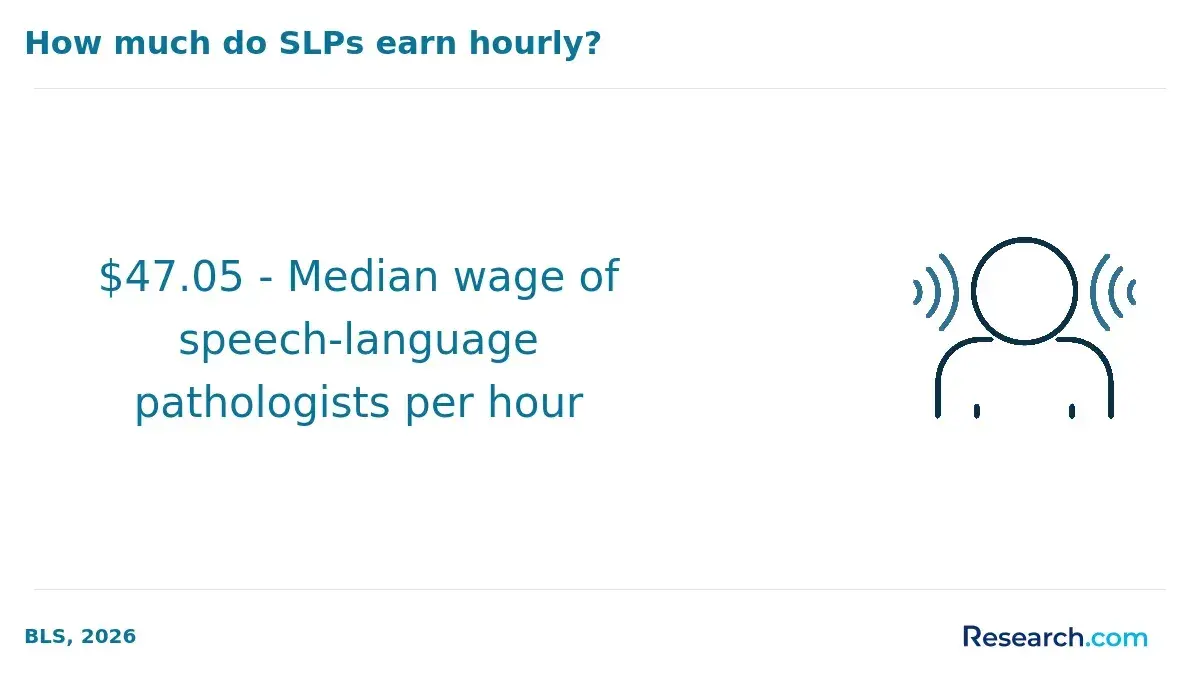
- The strongest fit depends on travel tolerance, schedule, prerequisite background, and total cost - not reputation alone. Nationally, speech-language pathologists had a median annual wage of $97,870 in May 2025, but local pay and hiring vary by setting and experience.
Which online speech pathology master's programs accept Salinas, CA residents without relocation?
Salinas residents should focus on programs that are CAA-accredited, deliver academic coursework online, and affirm that California residents may enroll. "Without relocation" does not necessarily mean "without travel": most entry-level online SLP programs require campus immersions, intensive weekends, or other in-person activities, plus local clinical practica.
The programs below are useful starting points because they have established distance-learning or online pathways. Enrollment eligibility, California professional-licensure disclosures, cohort availability, and travel requirements can change, so obtain written confirmation from each school before paying an application fee or deposit.
| Program option | Delivery model | California resident considerations | Best-fit trade-off |
| Emerson College MS in Speech-Language Pathology | Online coursework with required clinical education and in-person immersion experiences | Verify current California authorization, clinical-placement process, and required travel dates | Useful for applicants seeking a well-established online cohort model; travel and program intensity require planning |
| New York University Speech@NYU MS in Communicative Sciences and Disorders | Online live and asynchronous learning with clinical experiences and immersion components | Confirm California eligibility, Pacific Time live-session expectations, and placement support | Can suit students who value a structured national online format but can accommodate a private-university cost model |
| Baylor University Online MS in Communication Sciences and Disorders | Online academic instruction with clinical training and required on-campus experiences | Ask specifically whether the current cohort accepts California students and how California placements are approved | Worth considering for a cohort-based program; required travel and pacing may not suit every working adult |
| University of St. Augustine for Health Sciences MS-SLP | Hybrid/online-oriented model with in-person clinical education and required residencies | Confirm California state authorization, licensure disclosures, and the current residency calendar | May appeal to students who want health-sciences infrastructure; compare total tuition and travel carefully |
| California CSU/UC pathways | Often campus-based or hybrid rather than fully online | May reduce interstate authorization uncertainty and support California-specific networking, but commuting or relocation may be necessary | Best for applicants able to attend required campus instruction and seeking public-university tuition structures |
There is no single best program for every Monterey County applicant. A parent, career changer, or full-time employee may value predictable online scheduling, while an applicant who can commute to a California campus may prefer a local public program's regional clinical relationships and potentially lower resident tuition.
Before narrowing the list, ask admissions whether the school is currently accepting California residents, whether it has placed students in Monterey County or nearby counties, and whether any placement, practicum, or residency travel could require time away from work.
How do top online speech pathology master's programs differ in format and clinical training?
Online SLP master's programs are not correspondence degrees. They combine online graduate courses with live interaction, skills practice, supervised clinical work, and faculty evaluation. The real comparison is the amount of schedule control a program gives you versus the in-person commitments it requires.
These format features affect whether a program is realistic for a Salinas-based student with employment, caregiving, or transportation constraints.
| Format feature | What it means | Decision impact for Salinas residents |
| Asynchronous coursework | Recorded lectures and assignments completed by stated deadlines | Provides flexibility, but does not eliminate daytime clinical obligations |
| Synchronous classes | Live online sessions at scheduled times | Ask for the exact days and Pacific Time schedule; East Coast programs may hold evening or late-afternoon sessions |
| Campus immersion or residency | Short required in-person skill-building or assessment experiences | Add airfare, lodging, meals, child care, and work-leave costs to the tuition comparison |
| Practicum | Faculty-supervised clinical experiences during the academic program | Usually requires availability during standard school, clinic, or medical work hours |
| Externship | Later clinical placement with more sustained client-care responsibilities | May be near Salinas, elsewhere in Monterey County, or in a neighboring area depending on site availability |
| Cohort pacing | A fixed sequence taken with the same group of students | Creates structure but may limit the ability to pause, reduce course load, or accelerate |
Applicants with a non-CSD bachelor's degree should also distinguish between a post-baccalaureate leveling sequence and the graduate degree itself.
A program that advertises a direct-entry or extended path may be a practical option, but it can take longer and cost more than a traditional master's designed for applicants who already completed communication sciences and disorders prerequisites.
If finishing quickly matters, compare a speech pathology accelerated program with a conventional cohort program. Accelerated pacing can reduce time to graduation, but it often increases weekly workload and leaves less flexibility when a clinical site changes or family obligations arise.
Which online speech pathology master's options best support California licensure and ASHA certification?
The best option for California practice is usually a CAA-accredited entry-level master's degree that clearly supports California licensure requirements and ASHA's Certificate of Clinical Competence in Speech-Language Pathology (CCC-SLP) pathway. Accreditation is the foundation, but it is not the only requirement after graduation.
For ASHA certification, candidates generally need a qualifying graduate degree, the required supervised clinical experience, a passing Praxis examination score, and a Clinical Fellowship.
California licensure has its own rules and should be verified directly with the California Speech-Language Pathology and Audiology and Hearing Aid Dispensers Board before enrollment and again before applying.
The comparison below separates what a graduate program can provide from steps the student or graduate must complete independently.
| Requirement area | What an appropriate master's program should provide | What the Salinas-based student must still verify or complete |
| Degree accreditation | CAA accreditation during the period of enrollment and graduation | Confirm the status directly in ASHA's CAA directory; do not rely only on marketing language |
| Academic preparation | Graduate curriculum in speech-language pathology and communication sciences | Meet any prerequisite, grade, and graduation requirements |
| Clinical education | Supervised practicum designed to meet program and certification standards | Confirm whether local placement availability could affect progression or travel needs |
| Praxis examination | Academic preparation aligned with professional competency expectations | Register for, take, and pass the required national examination under current rules |
| Postgraduate fellowship | Career support may be available | Secure and complete a qualifying Clinical Fellowship and California-required supervised professional experience |
| California license | State-specific disclosures or advising when available | Apply to the California board and satisfy its current education, examination, and supervised-experience requirements |
For a California applicant, a school's licensure disclosure is more useful than a generic statement that graduates "may pursue licensure." Look for language addressing California specifically and ask whether the institution has identified any curricular gaps, placement limitations, or state-specific conditions.
A CAA-accredited degree is normally the lower-risk choice for someone pursuing the CCC-SLP and California license.
Programs with CAA candidacy status can be appropriate in some circumstances, but applicants should understand the effective dates, the program's teach-out or accreditation-contingency policies, and how status at graduation affects their intended credential path.
What accreditation should Salinas residents verify for online speech-language pathology master's programs?
Verify institutional accreditation and programmatic accreditation, but give special weight to CAA accreditation for an entry-level SLP master's degree. The Council on Academic Accreditation in Audiology and Speech-Language Pathology is ASHA's specialized accreditor for graduate education in the field.
Use this verification sequence before applying. It prevents the common mistake of assuming that an institution's general accreditation is enough for clinical SLP licensure.
- Find the exact degree and delivery location in ASHA's CAA program directory, not just the university name.
- Check whether the status is accredited, candidacy, or another category, and confirm the dates applicable to your anticipated graduation.
- Read the school's California professional-licensure disclosure and state-authorization information.
- Ask admissions to confirm in writing that California residents may enroll in your intended start term.
- Contact the California licensing board if your degree path, prerequisite record, or clinical-training situation is unusual.
Do not confuse ASHA certification, CAA accreditation, and state licensure. CAA evaluates the education program; ASHA awards the CCC-SLP to eligible individuals; California issues the legal authorization to practice in the state. Many employers prefer or require the CCC-SLP, while California practice requires the appropriate state credential.
Applicants comparing broad lists of online speech pathology programs should treat admissions accessibility as secondary to accreditation and state eligibility. A program that is easier to enter but does not clearly support California licensure can be a costly detour.
How do CSU and UC system speech pathology master's programs compare to private online options?
California public-university programs and private online programs solve different problems. CSU and UC programs may offer California-centered faculty, regional employer relationships, and resident tuition structures, but many are campus-based and selective. Private online programs can expand geographic access, yet they may include higher tuition, mandatory travel, and clinical-placement constraints.
This comparison helps applicants decide whether location flexibility or a California public-campus experience better matches their circumstances.
| Factor | CSU or UC option | Private online option |
| Class delivery | Often primarily campus-based, with some hybrid elements depending on the program | Academic coursework may be substantially online, but clinical training remains in person |
| Geographic relevance | Potentially stronger California-focused networks and familiarity with local systems | May offer national clinical networks, but local site availability varies |
| Tuition structure | Resident tuition can be advantageous, though campus fees and living costs still matter | Usually a private tuition model; compare full program tuition, fees, and travel rather than per-credit price alone |
| Travel and relocation | May require regular commuting or relocation near the campus | May avoid weekly campus travel but often requires immersions and flexible clinical-site travel |
| Schedule flexibility | Typically follows a campus cohort schedule | May offer online convenience, but practicum and live sessions can still limit work hours |
| Admissions strategy | Can be highly competitive with limited seats | Broader geographic applicant pool; requirements and cohort capacity differ by institution |
A Salinas resident who can attend a nearby California program without major relocation should compare it seriously against online choices. The savings from avoiding airfare, hotels, and repeated campus residencies can matter as much as the published tuition rate.
Conversely, a private online program may be the better fit for someone who cannot commute regularly but can travel a few times each year and arrange daytime practicum availability. Institution type alone does not determine educational quality or return on investment; accreditation, completion plan, support, and total out-of-pocket cost matter more.
What are the typical admission requirements for online speech pathology master's programs serving Californians?
Most online SLP master's programs expect a bachelor's degree, competitive academic preparation, prerequisite coursework, letters of recommendation, a personal statement, and an interview or recorded-response component in some cases. Requirements differ enough that applicants should create a school-by-school checklist rather than assuming one application satisfies every program.
Applicants without a communication sciences and disorders degree may still qualify, but they often need foundational coursework in areas such as phonetics, language development, anatomy and physiology of speech and hearing, audiology, speech science, and statistics. Schools may also require science prerequisites and observation hours.
These are common application components and the questions that matter most when comparing programs.
| Application component | Why schools review it | What to confirm |
| Undergraduate GPA | Indicates academic readiness for a rigorous clinical graduate curriculum | Minimum GPA, whether CSD-prerequisite GPA is separate, and whether recent coursework can strengthen the file |
| Prerequisite courses | Establishes foundational knowledge before graduate clinical work | Which courses must be complete before applying versus before matriculation |
| Observation hours | Introduces applicants to clinical SLP practice | Whether guided observation hours are required, accepted virtually, or verified in a specific format |
| Letters and statement | Provide evidence of professional readiness, communication skills, and motivation | Required number, recommender type, essay prompts, and word limits |
| Interview or assessment | May assess communication, professionalism, and program fit | Format, technology requirements, and Pacific Time scheduling |
| Background checks and health records | Often required before clinical placements | Vaccination, drug-screening, fingerprinting, and onboarding costs that may apply later |
Career changers should apply strategically rather than rushing into the first available cohort. First determine whether a program offers a formal leveling route, accepts post-baccalaureate coursework from another institution, or requires all prerequisites to be completed before admission.
Strong applicants connect their experience to the realities of clinical practice: documentation, cultural humility, client and family communication, collaborative care, and comfort with supervision. They do not present online delivery as a reason to avoid in-person clinical work; graduate SLP education requires it.
How do online speech pathology programs arrange clinical placements near Salinas and Monterey County?
Clinical placement is the highest-stakes question for an online SLP student in Salinas. Programs may maintain affiliation agreements, use clinical-placement teams, ask students to suggest sites, or use a combination of all three. None of these models means a placement at a specific Salinas facility is guaranteed.
Potential placements may include schools, early-intervention programs, outpatient clinics, hospitals, skilled nursing facilities, rehabilitation settings, and private practices. Availability depends on contracts, supervisor qualifications, client populations, capacity, schedule fit, and competition from local universities.
Ask each school the following questions before enrollment because the answers reveal whether the clinical model is practical for your location and life circumstances.
- Does the program arrange placements, approve student-proposed sites, or require the student to find sites independently?
- Has the program recently placed students in Monterey County, Santa Cruz County, Santa Clara County, or nearby Central Coast communities?
- What happens if a local site cannot be secured by the required term?
- Can a placement require travel outside Monterey County, and who pays for mileage, lodging, or temporary housing?
- How many hours per week should students expect during practicum and externship terms?
- Are evening, weekend, bilingual, medical, school-based, pediatric, and adult placements realistically available?
- Who is responsible for verifying supervisors, affiliation agreements, background checks, and site onboarding requirements?
Salinas has a substantial bilingual Spanish-English community, which can be professionally valuable for aspiring clinicians. However, bilingual ability does not replace formal clinical competence, and students should not assume it will secure a preferred placement.
Ask how the program teaches culturally and linguistically responsive assessment and whether it can support appropriate bilingual clinical supervision.
A red flag is vague language such as "students find their own placements" without a written approval process, timeline, or contingency plan. Another is assuming that an employer or local clinic can host a student before the university has approved the site and supervisor.
What tuition, fees, and financial aid options matter most for Salinas-based online SLP students?
The advertised tuition rate is only one part of the financial decision. For an online clinical degree, compare the complete cost of attendance: tuition, institutional fees, books and testing, clinical compliance, travel, lodging, technology, lost work hours, and any additional prerequisite coursework.
The following cost categories are especially important because online programs can shift, rather than eliminate, location-related expenses.
| Cost category | Why it matters | How to compare it fairly |
| Tuition | May be charged per credit, per term, or as a program rate | Multiply the current rate by required credits and ask whether future cohort increases apply |
| Mandatory university fees | Can include technology, clinical, graduation, or student-service charges | Request a term-by-term estimate rather than relying on tuition alone |
| Campus travel | Immersions can require flights, hotels, meals, and ground transportation | Use the actual number and location of required visits in your estimate |
| Clinical compliance | Background checks, immunizations, drug screening, liability coverage, and health requirements may be required | Ask which charges are paid directly by the student and how often they recur |
| Reduced employment | Clinical schedules may make full-time work difficult or impossible | Build a monthly cash-flow plan for practicum-heavy terms, not only annual tuition |
| Prerequisites | Career changers may need several undergraduate-level courses before admission | Separate these costs from graduate tuition so programs are compared on equivalent preparation |
Federal Direct Unsubsidized Loans and Graduate PLUS Loans may be available to eligible graduate students who file the Free Application for Federal Student Aid.
Scholarships, employer education benefits, departmental awards, and loan-repayment programs can also help, but availability and eligibility vary. Treat private loans as a last-resort funding source after reviewing federal terms and realistic borrowing needs.
For an affordability-focused starting point, review SLP masters online options alongside public California programs. A lower per-credit figure is not automatically lower cost if it excludes travel, required fees, or an extended prerequisite sequence.
Before accepting admission, request the program's official financial-aid estimate and make a personal budget that includes an emergency reserve. Do not assume you can maintain current work hours once client-facing clinical education begins.
How do online SLP master's program outcomes compare, including Praxis pass rates and job placement?
Outcome data can help distinguish programs, but it needs context. The most useful indicators are cohort completion, Praxis performance, employment outcomes, time to degree, and the share of graduates who obtain their intended credentials. Compare the same reporting period and definition across schools whenever possible.
Programs accredited by CAA publish or make available outcome information under accreditation-related reporting expectations, although reporting formats and cohorts can differ. A high pass rate can be encouraging, but it does not measure clinical-placement convenience, debt burden, cultural fit, or your chance of admission.
Use the following interpretation framework when reviewing a school's reported outcomes.
| Outcome measure | What it can tell you | Question to ask |
| Praxis pass rate | Whether tested graduates met the program's reported examination benchmark | What cohort and time period are included, and how many graduates took the examination? |
| Program completion rate | Whether enrolled students generally finish within the expected timeframe | Does the rate include leaves, withdrawals, and students delayed by clinical-placement issues? |
| Employment rate | Whether respondents or graduates obtained relevant work after graduation | What counts as employment, when was it measured, and what was the response rate? |
| Time to degree | Whether students progress through the prescribed sequence on schedule | What causes delays, and how does the program handle a missed practicum or failed placement? |
| Credential readiness | Whether the curriculum and clinical education support next steps toward certification and licensure | What California-specific support is available for graduates pursuing a Clinical Fellowship and state license? |
Career demand supports careful investment, not automatic enrollment. The U.S. Bureau of Labor Statistics projects about 12,500 speech-language pathologist openings each year on average from 2025 to 2035. That national projection reflects replacement needs and employment growth, but it does not guarantee a particular Salinas vacancy, work setting, wage, or timeline to hire.
When evaluating return on investment, compare debt to the likely settings you may enter after fellowship, not only to national wage data.
The BLS reported a $97,870 median annual wage for speech-language pathologists in May 2025; individual compensation varies by geography, employer, hours, specialty, experience, and benefits. For a broader role and compensation overview, see speech and language therapist salary information.
What should Salinas residents know about state authorization and consumer protections for online SLP degrees?
State authorization determines whether an institution may deliver distance education to a student located in California. Professional-licensure disclosures address a separate question: whether the program's curriculum is designed to meet California's educational requirements for a license. You need clear answers to both.
Do not rely on a recruiter's general verbal assurance. Before enrolling, save copies of the school's California authorization and licensure disclosures, catalog requirements, clinical-placement policies, refund schedule, and any written confirmation of your eligibility.
These steps reduce the risk of enrolling in a program that cannot serve your state or cannot support your intended professional path.
- Confirm that the university currently accepts students located in California for the specific online SLP program and start term.
- Read the California professional-licensure disclosure for the exact degree, including any statements that the program does not determine individual eligibility.
- Verify CAA status independently and record the program name, location, delivery pathway, and status date.
- Request written details on required residencies, practicum hours, placement support, and the policy if a placement is delayed.
- Review withdrawal, leave-of-absence, tuition-refund, transfer-credit, and teach-out policies before making a nonrefundable commitment.
- Contact the California licensing board directly if you have unusual prior education, international coursework, a prior discipline issue, or questions about supervised professional experience.
Consumer protection also means understanding what a school cannot promise. No ethical program can guarantee a nearby clinical placement, admission to a fellowship job, a passing exam score, California licensure, or a particular salary. A credible program explains the process, documents its policies, and gives you realistic timelines and costs.
Keep in mind that licensure regulations can change while you are enrolled. Recheck California requirements near graduation rather than assuming rules in an admissions brochure will remain unchanged for your license application.
Other Things You Should Know About Speech Language Pathology
Yes, if the degree is from an appropriate CAA-accredited program and you complete California's current licensing requirements, including required supervised experience and examination requirements. Online coursework does not remove the need for in-person supervised clinical training.
Policies vary. Some programs coordinate placements, some approve student-proposed sites, and many use a combination. Ask for a written explanation of who is responsible for placement, what happens if no local site is available, and whether travel may be required.
Some students work during early academic terms, but full-time employment can become difficult during practicum and externship periods because clinical sites often operate during weekday business or school hours. Build your work plan around the clinical calendar, not only online class flexibility.
Timing depends on prerequisite preparation, the graduate program's sequence, clinical-placement progression, examination timing, and postgraduation supervised experience. Applicants without communication sciences and disorders prerequisites may need additional coursework before or within their graduate pathway.
References
- Online MS, Communicative Sciences and Disorders https://steinhardt.nyu.edu/degree/online-ms-communicative-sciences-and-disorders
- Online MS in Speech-Language Pathology (SLP) | Pepperdine https://healthscience.pepperdine.edu/online-masters-in-speech-language-pathology/
- 2026 Most Affordable Online Speech Pathology Master's... https://www.onlineu.com/most-affordable-colleges/speech-pathology-masters-degrees
- Best Speech-Language Pathology Programs in America https://www.usnews.com/best-graduate-schools/top-health-schools/pathology-rankings
- Online Master's in Speech Pathology Programs: 2026 Guide https://speechpathologymastersprograms.com/