2027 Best Online Speech Pathology Master's Programs for Residents of Madison, WI

Co-Founder and Chief Data Scientist

Reviewed by Rhea Paul, PhD
SLP Education & Research Expert
Madison residents choosing an online speech-language pathology master's program need more than a convenient class schedule: they need a CAA-accredited degree, a workable clinical-placement plan, and a path that supports Wisconsin licensure. This guide compares leading online and hybrid options using those practical criteria. You will learn what to verify before applying, where travel may be required, how costs differ, and which program structures may fit full-time students, working adults, and career changers.
Key Things You Should Know
- A Wisconsin-bound SLP applicant should prioritize a CAA-accredited master's program that confirms it accepts Wisconsin residents and provides a clear Wisconsin professional-licensure disclosure.
- Online SLP master's degrees are not fully remote clinical degrees: students must complete at least 400 supervised clinical hours under national certification standards, and placements may require daytime availability and possible travel.
- The U.S. Bureau of Labor Statistics reports a $97,870 median annual wage for speech-language pathologists in May 2025, with employment projected to grow 17% from 2025 to 2035; strong demand does not remove the need to meet Wisconsin's education, examination, and supervised-experience requirements.
Which online speech pathology master's programs serve Madison, Wisconsin students best?
The best option depends less on a university's distance from Madison than on its confirmed Wisconsin eligibility, CAA accreditation, clinical-placement support, travel requirements, schedule, and total cost. A high-quality online program combines didactic coursework delivered online with supervised in-person clinical education; it is not a degree that can be completed entirely from home.
The programs below are widely recognized online or hybrid pathways to a master's degree in speech-language pathology. Before treating any program as available, ask the admissions office to confirm current authorization to enroll Wisconsin residents, the program's CAA status, and its Wisconsin licensure disclosure in writing.
| Program | Delivery model | Decision-relevant strengths | Important trade-off for Madison applicants |
| New York University | Online coursework with required clinical education and in-person components | Established online MS pathway and structured clinical education model | Private-university cost and travel expectations may be substantial |
| Baylor University | Online graduate coursework with clinical placements and required immersion experiences | Cohort-based online format designed for students entering professional practice | Students should plan for fixed sequencing, clinical-hour demands, and travel |
| Emerson College | Online coursework with in-person clinical training and immersion requirements | Online-focused program structure and clinical-placement coordination | Private tuition, live-course expectations, and placement scheduling can limit flexibility |
These are comparison starting points rather than universal rankings. A lower-cost public option, if it accepts Wisconsin residents and fits your prerequisites, may be a stronger choice than a more prominent private online program. Conversely, a program with better placement infrastructure may justify a higher price when relocating or finding a local site independently would be difficult.
Applicants who want a broader starting list can review SLP online programs, but admissions accessibility should never outweigh accreditation and Wisconsin licensure compatibility.
Which programs are CAA accredited and Wisconsin licensure aligned?
CAA accreditation means the Council on Academic Accreditation in Audiology and Speech-Language Pathology has reviewed a program against professional education standards. For an aspiring Wisconsin speech-language pathologist, this is the central credential check: an unaccredited degree can create serious barriers to certification, licensure, employment, and clinical fellowship opportunities.
CAA accreditation and state authorization answer different questions. Accreditation evaluates the academic program. State authorization concerns whether an institution may enroll a resident of a particular state in distance education. A third question - whether the curriculum meets Wisconsin's educational requirements for professional licensure - must be answered through the university's licensure disclosure and current Wisconsin Department of Safety and Professional Services requirements.
| Verification item | What it tells a Madison applicant | What to request |
| CAA status | Whether the degree meets a key professional education benchmark | The program's current accreditation status and review date |
| Wisconsin enrollment eligibility | Whether the institution can enroll a Wisconsin resident in the distance program | Written confirmation from admissions or distance-education compliance staff |
| Wisconsin licensure disclosure | Whether the school states its curriculum meets, is intended to meet, or has not been determined to meet Wisconsin requirements | The current disclosure applicable to the specific online track |
| Clinical-placement policy | Who coordinates placements and whether Madison-area placement is assured | A written explanation of student and program responsibilities |
Do not assume that CAA accreditation automatically means a school accepts Wisconsin students or guarantees Wisconsin licensure. State requirements, institutional authorization, and program disclosures can change. The safest approach is to retain the written responses you receive before paying an enrollment deposit.
Which universities offer the strongest online options for Madison residents?
For Madison residents, strong options are programs that make the logistics of professional preparation transparent. NYU, Baylor, and Emerson merit close review because they offer distance-based graduate SLP pathways with clinical education rather than simply online prerequisite coursework. None should be chosen solely because classes are online.
NYU may suit applicants seeking an established online graduate model and who can budget for a private-university program. Baylor may fit students comfortable with a cohort structure and planned immersion travel. Emerson may appeal to students who value an online-first learning environment but can meet live-session, clinical, and travel obligations. Each applicant should compare current details directly because program calendars and clinical policies can change by cohort.
A Wisconsin public university can be especially attractive when resident tuition, commuting access, or existing regional clinical relationships lower the total cost. However, some public programs are campus-based or hybrid rather than primarily online. Applicants should compare these choices against speech language pathologist masters online options only after confirming that the financial figures use the same basis: tuition alone versus tuition, fees, travel, housing, and clinical expenses.
How do admissions requirements differ across these online SLP programs?
Admissions requirements differ most sharply for applicants with and without a communication sciences and disorders background. Students who already completed the required undergraduate CSD foundation typically apply directly to the professional master's curriculum. Career changers may need leveling courses before enrollment or as part of an extended sequence.
The comparison below highlights the admissions areas that most often affect an applicant's timeline. Specific GPA thresholds, prerequisite lists, references, essays, interviews, and GRE policies should be verified for the intended entry term because they are program-specific and can change.
| Admissions factor | Typical purpose | Why it matters for Madison applicants |
| Undergraduate prerequisites | Shows readiness in speech, language, hearing, anatomy, phonetics, and related CSD subjects | Missing courses can add cost and delay the start of graduate clinical training |
| Overall and prerequisite GPA | Measures academic preparation for a demanding clinical curriculum | A stronger recent academic record may matter especially for career changers |
| Observation experience | Introduces applicants to clinical practice and professional expectations | Confirm whether observation must be supervised and documented in a particular way |
| Application platform and deadlines | Organizes transcripts, recommendations, essays, and program-specific materials | Early preparation is important because transcript reviews and prerequisite audits take time |
| Interview or writing requirement | Assesses communication, motivation, and fit for clinical training | Applicants should explain realistic plans for daytime practicum availability |
A common mistake is choosing a program based on a published minimum GPA while overlooking prerequisites. A candidate can meet the GPA threshold yet still need several foundational courses. Ask each school for an individualized transcript evaluation before assuming that a stated completion timeline applies to you.
If speed is important, compare the actual prerequisite plan with the professional sequence. An accelerated SLP master's program can make sense for applicants who already hold the required CSD coursework, but an accelerated calendar does not reduce required clinical competencies or make placements easier to schedule.
What clinical practicum options work for students studying from Madison?
Clinical education is the part of an online SLP degree that requires the most planning. Under standards commonly used for ASHA certification, students complete at least 400 supervised clinical hours, including at least 375 direct client-contact hours. Programs typically begin with foundational clinical work and progress toward more advanced placements across different ages, conditions, and settings.
Madison offers potential clinical environments such as schools, hospitals, outpatient clinics, rehabilitation settings, early-intervention services, and skilled nursing facilities. Availability is not guaranteed, however. A university may help identify and approve sites, but an individual student should not assume the school already has a contract with a Madison employer.
Before enrolling, obtain specific answers to these questions about clinical education:
- Does the program secure placements, approve sites proposed by students, or use a shared-responsibility model?
- Can placements occur in the Madison area, and what happens if no local site is available?
- How many clinical rotations are required, and can they be completed while maintaining outside employment?
- Who pays for background checks, drug screening, immunizations, liability coverage, site onboarding, travel, and temporary housing if needed?
- What are the program's rules if a site requires a schedule that conflicts with work or caregiving responsibilities?
The most important red flag is a vague placement promise. A school may properly state that it cannot guarantee a particular city, specialty, client population, or commute distance. That is different from a school being unable to explain its placement process, timeline, escalation support, and student responsibilities.
How do tuition, fees, and hidden costs compare for Madison applicants?
Tuition alone is not a reliable comparison for online SLP master's programs. One program may quote a per-credit price, another may publish a full-time term rate, and another may package some fees into tuition. A fair comparison uses the full required curriculum and adds costs that are unavoidable for your situation.
The table separates costs that are commonly published from costs that applicants frequently overlook. Request a written estimate from each institution for the cohort and term in which you expect to enroll; universities can change rates, fees, and travel requirements.
| Cost category | How to compare it | Why it matters |
| Tuition | Multiply the applicable per-credit rate by required credits, or use the institution's published program total | Per-credit figures are not comparable without the required credit count |
| University and technology fees | Check whether charged by term, credit, or program | Online students may still pay broad institutional fees |
| Clinical compliance costs | Include background checks, health records, testing, liability coverage, and site-specific onboarding | These costs often occur before placements begin |
| Travel and lodging | Estimate required immersions, campus visits, and distant clinical assignments | Travel can materially change the value of a lower-tuition option |
| Lost work time | Assess daytime practicum blocks and reduced work availability | This can be the largest unbudgeted cost for working adults |
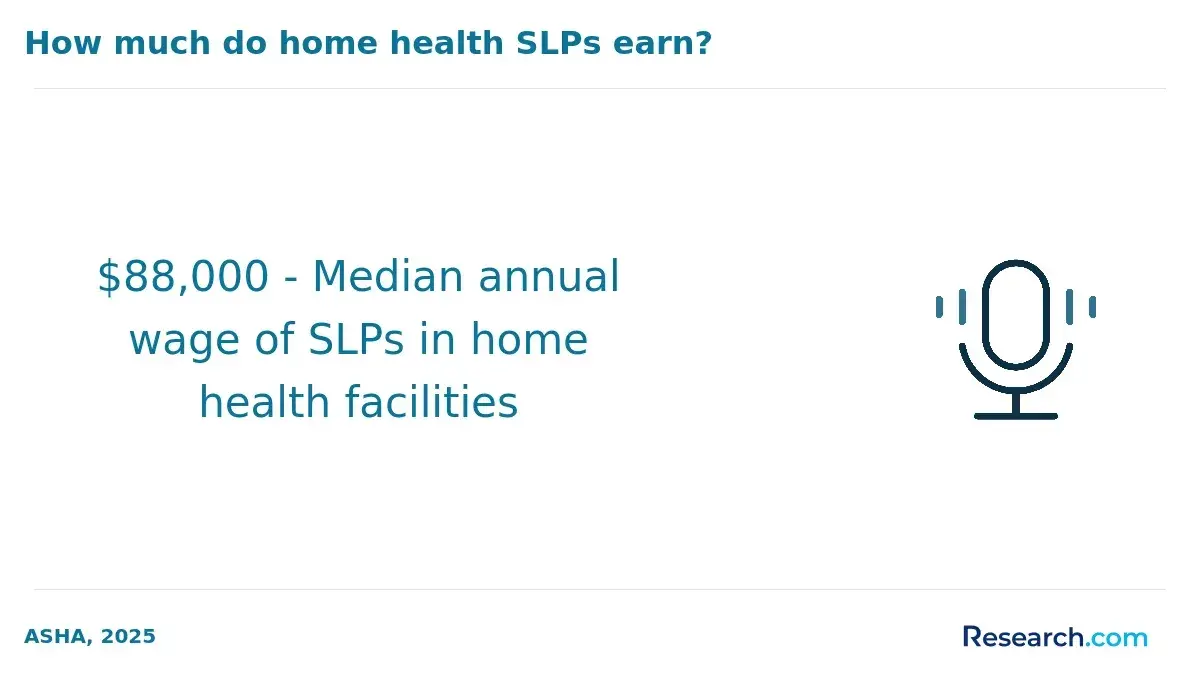
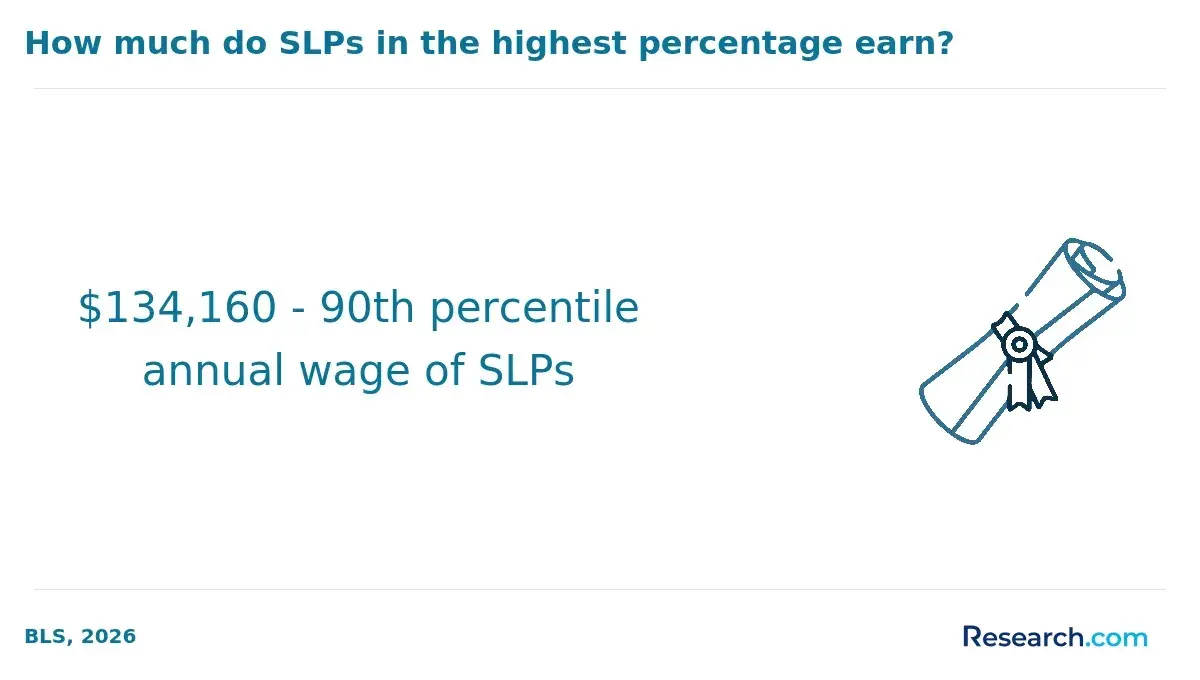
Federal student aid may be available to eligible graduate students, but borrowing should be considered alongside the full cost of attendance and expected income interruption. The BLS reports a national median annual wage of $97,870 for speech-language pathologists in May 2025. That is useful labor-market context, not an earnings guarantee for a new Wisconsin graduate, because pay varies by setting, experience, employer, and local market conditions.
For a career-income perspective, readers can explore how much does a speech therapist make. Use salary information to model a conservative repayment plan rather than to justify borrowing based on a best-case outcome.
Which programs offer the most flexible pacing, term lengths, and start dates?
"Online" does not necessarily mean self-paced. Most CAA-accredited master's programs use a cohort sequence because clinical courses build on one another and supervisors must evaluate competencies in a planned order. That structure can support timely progression, but it limits the ability to pause, take only one course, or shift clinical terms around a job schedule.
For working adults, the most valuable flexibility is often predictable scheduling rather than asynchronous lectures alone. A program may offer online coursework while still requiring live discussion sessions, group work, daytime clinical shifts, set immersion dates, and full-time externships near the end of the degree.
| Format feature | Best fit | Question to ask |
| Full-time cohort | Students able to prioritize sequential study and clinical work | Can I reduce course load without leaving the cohort or extending costs significantly? |
| Part-time pathway | Students with continuing work or caregiving responsibilities | Are practicum and externship terms still full-time or daytime? |
| Live online classes | Students who benefit from regular faculty interaction | What days, times, and time-zone expectations apply? |
| Asynchronous modules | Students needing flexibility around lectures and readings | Which courses, if any, are fully asynchronous? |
| Multiple annual starts | Applicants needing timing options | Does every start date offer the same pacing, tuition, and Wisconsin availability? |
Do not select a program by term length alone. A shorter term can mean a heavier weekly workload, while a longer program can be more manageable if it permits a lower course load. Ask to see a sample course-and-clinical sequence before deciding whether the advertised format is compatible with your work and family obligations.
How well do these programs prepare graduates for Wisconsin SLP licensure?
A CAA-accredited master's degree is a major component of professional preparation, but graduation is not the same as receiving a Wisconsin license. Wisconsin applicants should verify the current requirements with the Wisconsin licensing authority, including degree standards, examination requirements, supervised postgraduate experience where applicable, application documentation, and any background-review process.
Programs such as NYU, Baylor, and Emerson can support a Wisconsin licensure path only if their current disclosures indicate that the program meets or is designed to meet Wisconsin educational requirements and the student completes all remaining state requirements. A school's disclosure may use careful language because licensure rules can change and because the state - not the university - makes the licensing determination.
Graduates often also pursue the ASHA Certificate of Clinical Competence after completing the required clinical fellowship and other certification requirements. This credential is distinct from a state license, although employers and insurers may value or require it. Keep the two processes separate when evaluating program claims.
The employment outlook makes careful preparation worthwhile. BLS projects 17% employment growth for speech-language pathologists from 2025 to 2035 and about 12,500 openings each year on average over that period. Those national projections indicate broad demand, but they do not predict openings in one Madison employer, specialty, or school district.
What online format features matter most for working adults in Madison?
Working adults should evaluate the clinical calendar before evaluating video platforms or recorded lectures. A program can be technologically flexible yet professionally rigid when it reaches practicum and externship terms. The key question is whether you can be present during the hours when clients, schools, supervisors, and healthcare facilities operate.
The following features deserve priority because they affect whether a student can remain employed and progress through clinical requirements without major disruption:
- Published live-session times, including whether attendance is required and whether recordings are available for limited circumstances.
- A complete sequence showing when observation, simulation, practicum, and full-time clinical placements begin.
- Clear policies for leaves, reduced course loads, remediation, and re-entry after an interruption.
- Accessible faculty, clinical coordinators, disability services, tutoring, and technical support for distance students.
- Upfront disclosure of required immersions, travel dates, equipment needs, and clinical compliance deadlines.
Current SLP education also increasingly uses telepractice tools, digital documentation, simulation, and remote collaboration. These technologies can improve learning and expand service delivery, but they do not replace supervised in-person clinical competency development. Applicants should ask how the program teaches telepractice ethics, privacy, documentation, and client safety.
A common mistake is assuming a flexible academic schedule will offset a full-time job during clinical rotations. It may not. Build a personal schedule and budget around the most demanding anticipated placement term, not around the first online lecture course.
How can Madison students verify a program's accreditation and student outcomes?
Verification should happen before application fees, deposits, or loan commitments. Start with the program's official website and graduate catalog, then independently confirm the current CAA listing through ASHA's accreditation resources. Match the exact degree and delivery track to the listing; a university may have multiple CSD programs with different formats or statuses.
Use this practical sequence to compare final choices:
- Confirm that the exact online or hybrid master's track is currently CAA accredited and ask whether its status is expected to change before your graduation date.
- Ask the university to confirm that Wisconsin residents may enroll and request its current Wisconsin professional-licensure disclosure.
- Request a complete curriculum plan showing credits, terms, live sessions, immersion dates, and clinical-placement sequence.
- Ask for the school's current clinical-placement process, including what support is available if a Madison-area placement cannot be arranged.
- Compare total estimated cost, including tuition, fees, travel, clinical compliance expenses, and likely reduction in work hours.
- Review published student-outcome information, such as completion, Praxis, employment, and program-completion data, while noting the reporting period and cohort size.
Outcome data should be interpreted carefully. A high pass rate can be encouraging, but it does not reveal every student's debt, schedule constraints, specialty interest, or local job search experience. Use outcomes as one quality signal alongside accreditation, licensure alignment, transparent costs, and clinical support.
Finally, save every important answer. Written confirmation of Wisconsin eligibility, licensure disclosure, tuition basis, and travel expectations is far more useful than an informal verbal assurance when you are comparing programs over several months.
Other Things You Should Know About Speech Language Pathology
Yes, if the degree is from a properly accredited program, you complete required supervised clinical education, and you meet Wisconsin's current examination and licensure requirements. The coursework may be online, but clinical training is completed in approved real-world settings.
Not always. Many programs consider applicants from other majors, but they commonly require foundational CSD coursework before or during graduate study. A transcript evaluation is the best way to identify missing prerequisites and estimate your actual timeline.
Some students work during early coursework, but clinical placements often require daytime availability and may become difficult to combine with full-time employment. Review the clinical sequence and discuss expected hours with each program before relying on continued full-time income.
The timeline varies based on the program's length, required post-graduate supervised experience, examination timing, application processing, and any additional state requirements. Ask the Wisconsin licensing authority and your program for the current steps that apply to your situation.
References
- Masters Program - Communication Sciences and Disorders https://csd.wisc.edu/masters/
- Best Online Speech Pathology Programs https://www.forbes.com/advisor/education/healthcare/best-speech-pathology-programs-online/
- Wisconsin Speech Pathology Degrees, Online MSLP Included https://www.speechpathologydegrees.com/st/wisconsin
- Best Speech-Language Pathology Programs in America https://www.usnews.com/best-graduate-schools/top-health-schools/pathology-rankings