2027 Best Online Speech Pathology Master's Programs for Residents of Baltimore, MD

Co-Founder and Chief Data Scientist

Reviewed by Rhea Paul, PhD
SLP Education & Research Expert
Baltimore residents can pursue an online master's in speech-language pathology (SLP) without choosing a Maryland-based university, but the degree must support Maryland licensure and include intensive in-person clinical education.
This guide compares credible distance-learning pathways by the factors that matter locally: CAA accreditation, Maryland enrollment eligibility, placement support, travel, scheduling, cost transparency, and certification preparation. Use it to create a short list, ask better questions, and avoid enrolling in a program that cannot support your intended license.
Key Things You Should Know
- A Maryland SLP license generally requires a qualifying graduate degree, supervised clinical experience, a passing Praxis score, and completion of the state's post-graduate clinical fellowship requirements; an "online" degree does not remove the hands-on requirements.
- For national certification, ASHA's current standards require at least 400 supervised clinical practicum hours, including 375 direct client-contact hours, plus a 36-week, 1,260-hour clinical fellowship after graduation.
- The strongest choices for Baltimore residents are CAA-accredited programs that explicitly authorize Maryland enrollment, explain how placements are secured, disclose required immersions, and provide written Maryland licensure guidance before a deposit is paid.
Which online speech pathology master's programs accept Baltimore residents and meet Maryland licensure rules?
The best practical options are not necessarily the closest universities. A Baltimore applicant should prioritize a program's current CAA status, Maryland state-authorization position, professional-licensure disclosure, and clinical-placement process. Admission eligibility can change by term, so obtain confirmation in writing from each program before applying.
The programs below are established distance or hybrid SLP master's options that should be evaluated by Maryland residents. CAA accreditation and state participation can change, so confirm the current listing in ASHA EdFind and verify Maryland eligibility directly with admissions.
| Program | Delivery model | What Baltimore applicants should confirm | Best fit |
| Emerson College | Online coursework with clinical education and required immersion experiences | Current Maryland authorization, immersion dates and travel costs, and whether the placement team can support the student's preferred Baltimore-area setting | Students seeking a structured online cohort with substantial placement support |
| Baylor University | Online coursework, clinical placements, and required on-campus immersion components | Maryland enrollment availability, number and timing of immersions, placement responsibility, and total fee estimate | Students comfortable with a fast-paced cohort and travel requirements |
| New York University | Online graduate coursework paired with in-person clinical training | Maryland authorization for the intended cohort, live-class schedule, local placement process, and residency expectations | Applicants who want an online program with a large university clinical network model |
| Calvin University | Online/hybrid SLP education with required in-person experiences and clinical practicum | Maryland eligibility, required travel, cohort calendar, and local preceptor/site availability | Students wanting a cohort-based program and clear in-person touchpoints |
| University of St. Augustine for Health Sciences | Hybrid/online coursework with on-site clinical education and scheduled residencies | Current CAA status, Maryland licensure disclosure, residence requirements, and the extent of school-arranged placements | Applicants who can travel and want a health-professions-focused environment |
Do not treat this as a guarantee that every program currently accepts Maryland residents. State authorization is a separate issue from accreditation, and schools may pause enrollment in a state while updating approvals or placement capacity.
Maryland's licensing board, not the university, makes the final licensing determination. A school's statement that its curriculum is "designed to meet" Maryland requirements is useful, but it should be paired with a current written disclosure and your own review of Board of Examiners requirements.
If affordability is your primary filter, compare published tuition, mandatory fees, travel, health-clearance costs, and lost work time rather than relying on a single advertised number. This overview of online SLP master programs can help frame a broader cost comparison, but licensure compatibility should remain the first screen.
How can Baltimore students confirm CAA-accredited online speech pathology programs for licensure preparation?
CAA accreditation is the central academic quality check for a future clinical SLP. The Council on Academic Accreditation in Audiology and Speech-Language Pathology accredits graduate programs, and graduation from a CAA-accredited program is the standard route to ASHA certification and licensure in most states, including Maryland.
Use this verification sequence before submitting an application. It protects you from confusing institutional accreditation, which applies to the university broadly, with specialized CAA accreditation, which applies to the professional program.
- Search ASHA EdFind or the CAA program directory for the exact degree and delivery location, then note whether its status is accredited, candidate, or another category.
- Read the university's current professional-licensure disclosure for Maryland and save a copy dated near your application.
- Ask admissions whether the school is authorized to enroll a Maryland resident in your intended start term, not merely whether it has enrolled Maryland students in the past.
- Ask the clinical education office how it finds, approves, and monitors Baltimore-area sites and what happens if a site withdraws.
- Send the Maryland Board of Examiners your specific questions if your prior degree, supervised hours, or intended practice setting creates an unusual situation.
Candidate status can be appropriate for some applicants, but it carries more uncertainty than full accreditation. Ask exactly how a status change would affect your cohort, whether graduates are considered to have completed a qualifying accredited program, and what teach-out protections apply if the program does not progress as expected.
A common mistake is relying on an institution's regional or national accreditation badge alone. That approval can support federal financial aid and transferability, but it does not by itself establish eligibility for SLP certification or Maryland clinical licensure.
Which online speech pathology master's programs best serve Baltimore residents clinically and logistically?
No online program is universally best. For Baltimore residents, the most useful comparison is whether the program can make the clinical portion workable while preserving enough schedule flexibility for employment, commuting, and family responsibilities. A program that is academically excellent but requires frequent weekday travel may be a poor fit for a full-time worker.
This comparison highlights the decision factors that are usually more consequential than brand name. Confirm all current details with the institution because calendars, state eligibility, and tuition change.
| Decision factor | Why it matters in Baltimore | What a strong answer sounds like |
| Clinical-placement model | Sites may be competitive across schools, hospitals, private practices, and university programs | The program explains whether it places students, permits student leads, approves sites, and has a contingency process |
| Required travel | Online programs may require campus immersions, simulations, assessments, or orientations | The school gives the number, city, approximate duration, and expected timing of all required visits |
| Live-session schedule | Eastern Time helps Baltimore residents, but required daytime sessions can conflict with work | The program identifies synchronous days, attendance rules, recording policy, and clinical-semester demands |
| Program pacing | Part-time pacing may help working students, while accelerated cohorts may shorten time away from the workforce | The school provides a term-by-term plan, including the point at which outside employment becomes unrealistic |
| Prerequisite pathway | Career changers may need communication-sciences coursework before graduate study | The program evaluates transcripts and gives a written list of missing prerequisites or leveling work |
| Maryland disclosure | Licensure rules determine whether the degree serves the intended career goal | The school identifies Maryland clearly and directs applicants to the relevant board requirements |
Emerson, Baylor, NYU, Calvin, and the University of St. Augustine can each be reasonable starting points when they are open to Maryland residents, but their practical fit differs. Students who need heavy placement coordination should favor a program with a documented placement team and realistic lead times. Students with an established relationship to a Baltimore clinic or school should still ask whether that site can be formally approved; a personal contact is not a guaranteed practicum.
Applicants needing a shorter combined undergraduate-and-graduate route should distinguish that option from a standard master's degree for career changers. Some best 5 year speech pathology programs are designed for students beginning before the graduate level and may not solve the prerequisite needs of a bachelor's degree holder from another field.
Choose an online format when you can manage self-directed academic work and can accommodate in-person clinics. Consider a Maryland campus-based or hybrid program instead if you need immediate access to university-operated clinics, prefer daily face-to-face instruction, or cannot travel for mandatory residencies.
How do Maryland and interstate telepractice laws affect clinical placements in online SLP programs?
Telepractice is the delivery of SLP services through telecommunications technology. It can expand a practicum's reach, but it does not eliminate licensure, supervision, privacy, competency, or site-approval rules. For a Baltimore student, the controlling issue is commonly where the client receives services, not where the university's online course is taught.
Maryland-authorized SLPs may provide telepractice when they comply with applicable Maryland professional standards and the requirements of the setting. Students provide services only under approved supervision as part of a university practicum; they do not independently practice simply because a session occurs by video.
Before accepting a telepractice placement, ask the program and site to document the following operational points:
- Which state license or student authorization is required based on the client's physical location during each session.
- Whether the supervising SLP holds the credentials and any state authorization needed for that client population and location.
- How direct and indirect supervision will be documented for ASHA, program, and site records.
- Which HIPAA-aligned platform, consent process, technology checks, and emergency procedures the site requires.
- Whether the hours will count toward the program's practicum requirements and how client-contact time is tracked.
The Audiology and Speech-Language Pathology Interstate Compact may eventually make multistate practice simpler for eligible licensed clinicians where compact privileges are available. It is not a substitute for checking current Maryland rules, and students should not assume it authorizes student clinical training or cross-border telepractice.
A frequent error is assuming that a virtual placement can be completed from any location. A placement can involve multiple jurisdictions: the student's location, supervisor's location, university's location, and client's location. Obtain written clearance before services begin.
What should Baltimore residents know about ASHA certification requirements when choosing an online program?
ASHA's Certificate of Clinical Competence in Speech-Language Pathology, commonly called the CCC-SLP, is a nationally recognized professional credential. It is separate from Maryland licensure, although the requirements substantially overlap and many employers value or expect it.
Under ASHA's current certification standards, applicants generally need a master's or doctoral degree from a CAA-accredited program, required knowledge and skills, at least 400 supervised clinical practicum hours, a passing score on the Praxis examination in speech-language pathology, and a clinical fellowship. At least 375 of the 400 practicum hours must be direct client/patient contact; guided observation may account for the remaining 25 hours.
The post-graduate clinical fellowship is not an informal internship. ASHA describes it as at least 36 weeks and 1,260 hours of full-time-equivalent professional experience under a qualified mentor. Maryland applicants should separately verify the state's clinical-fellowship licensing process and timing, because a state temporary license or other authorization may be needed before beginning paid post-graduate work.
When comparing schools, ask for a clear explanation of how the program tracks competencies and clinical hours, prepares students for Praxis, supports fellowship planning, and handles remediation if a student needs more time to meet a clinical skill standard. A school should never imply that graduation alone automatically confers the CCC-SLP or a Maryland license.
Career demand supports careful planning rather than rushed enrollment. The U.S. Bureau of Labor Statistics projects 17% employment growth for speech-language pathologists from 2025 to 2035, with about 12,500 openings per year on average. That outlook suggests sustained need, but it does not guarantee a particular Baltimore job, specialty, salary, or fellowship placement.
How do major online SLP programs compare on cost, supervision models, and local practicum access in Baltimore?
Published tuition often cannot be compared cleanly because schools may quote per-credit tuition, per-term tuition, or total estimated charges, and some exclude travel, technology, clinical, health, or graduation fees. For that reason, Baltimore applicants should request a written program-specific estimate rather than rank programs solely by an advertised figure.
This framework shows how to compare the major cost and placement variables fairly. "Local access" means the capacity to pursue approved placements near Baltimore, not a promise that a particular site will accept a student.
| Program type or example | Cost information to request | Typical supervision structure to confirm | Baltimore practicum question |
| Private online cohort program, such as Emerson or Baylor | Total tuition by cohort, mandatory fees, immersion travel, and any tuition changes after enrollment | University clinical faculty coordinate site approval; licensed site supervisors oversee direct clinical work | Does the program arrange sites in Maryland, accept student leads, or require relocation if placement options are limited? |
| Online program with scheduled residencies, such as NYU, Calvin, or University of St. Augustine | Per-credit or cohort tuition, residency charges, lodging, transportation, and clinical compliance costs | Program faculty assess competency; preceptors provide documented field supervision under program rules | How many placements may be completed in the Baltimore region, and when must site requests be submitted? |
| Maryland-based campus or hybrid alternative | Resident tuition, campus fees, commuting, and the cost of any reduced work hours during clinic | Faculty clinic and affiliated-site supervision, often with an established local network | Does local proximity meaningfully improve access to the types of clients and settings you want? |
Supervision quality matters more than whether a placement is called "local." Ask how supervisors are selected, how often faculty observe or review performance, how concerns are escalated, and whether the program has a documented backup plan. A school that cannot explain those processes is a meaningful red flag.
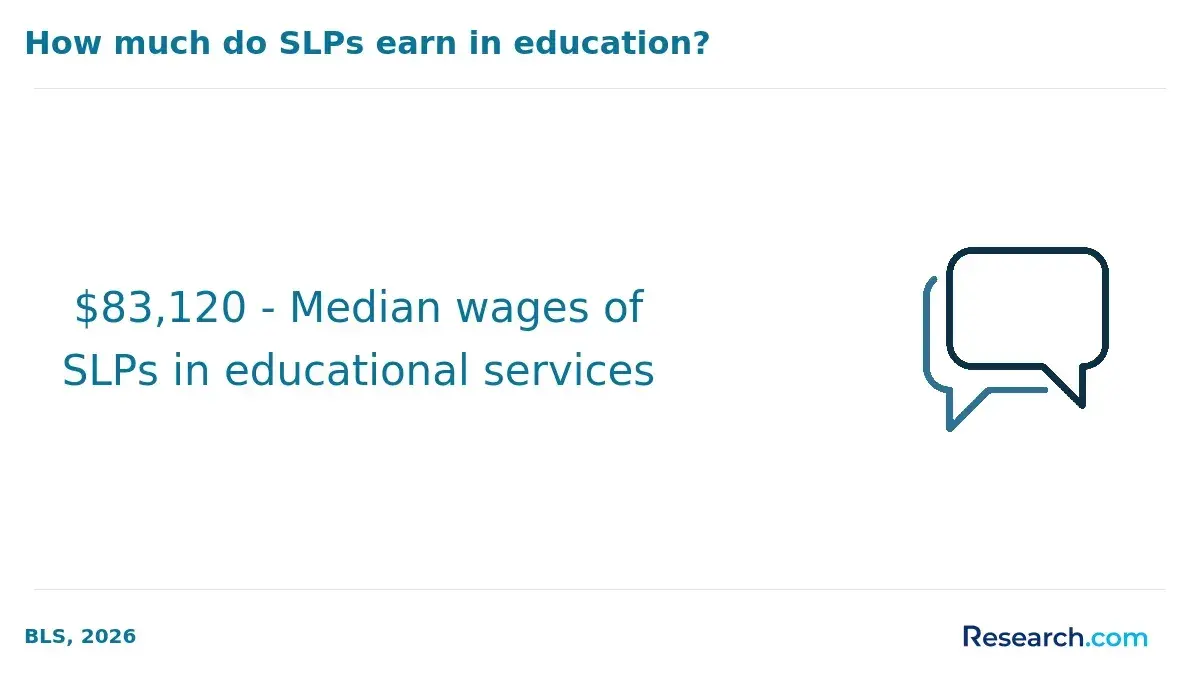
Compare total educational debt against realistic career plans, not a promise of immediate earnings. The national median annual wage for speech-language pathologists was $97,870, or $47.05 per hour, in May 2025 according to the Bureau of Labor Statistics; actual pay varies by setting, experience, schedule, and local employer. For broader career context, review current speech therapist salary information while recognizing that higher-paying roles may require experience, specialized skills, or different work conditions.
Ask financial-aid staff whether your enrollment pattern affects federal aid eligibility, whether scholarships are renewable, and whether a clinical semester with fewer work hours changes your borrowing plan. Do not compare a public university's in-state per-credit rate to a private institution's all-inclusive cohort estimate as if they represent the same total cost.
Which Baltimore-area health and school sites commonly host online SLP students for clinical rotations?
Baltimore has a broad mix of pediatric, adult medical, rehabilitation, early-intervention, school, and private-practice environments. However, clinical sites choose whether to accept students, and affiliation agreements, supervisor capacity, vaccination requirements, and the university's approval process determine availability. No applicant should presume access to a named organization.
Common categories of potential Baltimore-area learning environments include the following:
- Public school systems and nonpublic special-education programs serving children with speech, language, fluency, voice, and augmentative communication needs.
- Hospital and outpatient medical settings that may expose students to adult neurogenic communication disorders, dysphagia, voice, and acute-care workflows.
- Inpatient and outpatient rehabilitation facilities supporting stroke, traumatic brain injury, progressive neurological conditions, and swallowing rehabilitation.
- Early-intervention and pediatric therapy providers that work with infants, toddlers, preschool-aged children, and families.
- University-affiliated clinics, private practices, and community agencies that may offer specialized populations or telepractice experience.
A balanced clinical plan usually includes varied age groups and disorder areas, but the exact mix is driven by competency requirements and site availability. A student interested in medical SLP should ask whether the program has a realistic path to adult medical exposure rather than assuming a school-based placement will meet that goal.
Begin the placement conversation early. Ask the program whether you may contact sites directly, whether contact must come from the clinical education office, how long affiliation agreements take, and whether it has existing agreements in the Baltimore metropolitan area. Contacting a site against a program's policy can jeopardize a relationship the school needs for all students.
How can Baltimore residents verify institutional accreditation, state authorization, and complaint processes for online SLP schools?
Three separate checks protect a Maryland applicant: institutional accreditation, programmatic CAA accreditation, and authorization to deliver distance education to Maryland residents. Each answers a different question. A valid university may lack CAA accreditation for a particular program, and a CAA-accredited program may still have enrollment restrictions in a state.
Use these sources and records before enrolling:
- Review the university's institutional-accreditation statement and identify the recognized accreditor named by the school.
- Verify the exact SLP graduate program's CAA status through ASHA's official directory rather than relying on marketing language.
- Read the school's distance-education and professional-licensure disclosures for Maryland, including whether it can enroll Maryland students.
- Check the Maryland higher-education consumer-protection or complaint information identified in the school's state-authorization disclosure.
- Save emails, catalogs, tuition estimates, and licensure statements that applied when you enrolled, especially if a recruiter makes a material promise.
The State Authorization Reciprocity Agreement, often called SARA, can help institutions offer distance education across participating states, but SARA participation does not determine professional-licensure eligibility. Clinical placements and programs leading to a professional license can involve additional state-specific requirements.
Read the school's complaint process before you need it. It should identify internal escalation steps and the external agency available to Maryland residents. For licensure questions, the appropriate route is the Maryland Board of Examiners; for academic or consumer complaints, follow the school's published process and the state pathway identified in its disclosures.
Red flags include vague phrases such as "meets national standards" without a Maryland disclosure, an inability to identify the program's CAA status, pressure to enroll before receiving cost details, or a promise that the school will "guarantee" a local placement. Legitimate programs explain limits and document responsibilities.
What are the main timeline, workload, and technology demands of online speech pathology master's study?
An online SLP master's is not a fully asynchronous, location-free degree. Students can often complete academic coursework remotely, but they must complete supervised clinical education in person or through approved telepractice, attend any required immersions, and meet the same clinical competency standards as campus students.
Full-time programs commonly use a cohort sequence over multiple terms, while part-time options may extend the academic timeline. The clinical phase can be the least flexible period because site hours often follow school or health-care schedules. Applicants should expect that paid employment may need to be reduced during intensive practicum terms.
Before enrolling, match the program calendar to your real availability:
- Request a term-by-term course and practicum sequence, including daytime clinical expectations and any summer requirements.
- Confirm the time zone, frequency, and attendance policy for live online classes, meetings, simulations, and examinations.
- Budget for a reliable computer, webcam, headset, stable internet, secure workspace, and any clinical software or proctoring requirements.
- Plan for background checks, immunizations, CPR training, drug screening, fingerprinting, liability coverage, and site-specific compliance tasks where required.
- Ask whether students can pause, decelerate, or repeat a clinical course and what that decision means for tuition and graduation timing.
Technology is increasingly part of clinical practice, including telepractice platforms, electronic documentation, and digital speech or language tools. Programs should teach students to use these tools ethically and within scope, not treat technology as a replacement for clinical judgment, supervision, or client relationships.
Applicants who need a less demanding academic sequence may wish to compare admission pathways and prerequisite expectations across SLP programs online. "Easier to get into" should never outweigh CAA accreditation, Maryland eligibility, or the ability to complete required clinical experiences.
How do outcomes for Baltimore graduates of online SLP programs compare with campus-based pathways?
When both routes lead to graduation from a CAA-accredited program and the graduate completes Maryland's licensing requirements, the online versus campus label is generally less important to employers than licensure eligibility, clinical competence, relevant experience, and professional fit. The degree delivery method does not waive certification or state requirements.
Online pathways can be advantageous for Baltimore residents who need to remain in the area while completing coursework and who can manage remote learning independently. A local campus pathway can be advantageous for students who value direct daily faculty contact, access to an established university clinic, and a more geographically concentrated placement network.
| Outcome factor | Online/hybrid pathway | Campus-based pathway |
| Academic access | May allow students to remain in Baltimore and choose from institutions beyond Maryland | Usually requires regular local attendance but can provide immediate in-person academic support |
| Clinical experience | Depends heavily on the program's ability to secure and approve local sites | May draw from established local affiliates, although placements are never automatic |
| Professional network | Can build Baltimore contacts through practicum, fellowship, and local professional involvement | May offer a denser faculty-and-alumni network near the campus |
| Employer readiness | Depends on supervised hours, competencies, references, and setting-specific experience | Depends on the same factors; campus attendance alone does not ensure a job outcome |
For either route, outcomes improve when students intentionally select placements aligned with their goals, maintain strong supervisor relationships, prepare early for the Praxis, and apply strategically for clinical fellowships. A school's completion, Praxis, employment, and on-time completion outcomes can be informative, but compare cohorts carefully because reporting windows and definitions vary.
The smartest choice is the program that you can complete successfully without compromising licensing eligibility or creating unmanageable financial and scheduling pressure. For many Baltimore residents, that means accepting some travel in exchange for an online academic format while protecting time for the in-person clinical work that actually develops professional readiness.
Other Things You Should Know About Speech Language Pathology
Yes, potentially. The university may be located outside Maryland if the program is appropriately accredited, you are eligible to enroll from Maryland, and you meet Maryland's current education, examination, supervised-experience, and application requirements. Confirm details with the Maryland Board of Examiners before enrolling.
Some students work during early coursework, but full-time employment can become difficult during practicum semesters because clinical sites often operate during weekday business or school hours. Ask for the exact practicum schedule before assuming you can maintain your current job.
Not always. Many programs consider applicants from other majors, but they may require prerequisite communication-sciences coursework before or alongside graduate study. Obtain a transcript evaluation from each program because prerequisite rules differ.
Not necessarily. Online tuition may be similar to or higher than campus tuition, and required travel, immersion, technology, and clinical-compliance expenses can add materially to the total. Compare written total-cost estimates, not only per-credit tuition.
References
- Speech-Language Pathology, M.S. https://www.mcdaniel.edu/academics/graduate-professional-studies/speech-language-pathology-ms
- Master of Arts Program in Speech-Language Pathology (SPLA) https://hesp.umd.edu/undergraduate/program-highlights-master-arts-program-speech-language-pathology-%28spla%29
- Best Speech-Language Pathology Programs in America https://www.usnews.com/best-graduate-schools/top-health-schools/pathology-rankings